


Santa Cruz Beach Boardwalk

Encyclopedia
The Santa Cruz Beach Boardwalk is an oceanfront amusement park
in Santa Cruz, California
. Founded in 1907, it is California
's oldest surviving amusement park and one of the few seaside parks on the West Coast of the United States
.
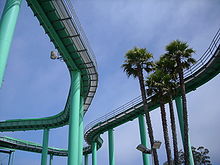 The Boardwalk extends along the coast of the Monterey Bay
, from just east of the Santa Cruz Municipal Wharf to the mouth of the San Lorenzo River
. At the western edge of the park lies a large building originally known as the Neptune Casino
(which does not offer gambling), which contains a video arcade
, an indoor miniature golf
course, a laser tag
arena and the Cocoanut Grove banquet room and conference center. A Laffing Sal
automated character, from San Francisco's Playland, is viewable near the miniature golf
course.
East of the Casino, the boardwalk portion of the park stretches along a wide, sandy beach
visitors can access easily from the park. The eastern end of the boardwalk is dominated by the Giant Dipper
roller coaster
, one of the best-known wooden coasters in the world and one of the most visible landmarks in Santa Cruz. The Dipper and the Looff Carousel
, which still contains its original 342-pipe organ
built in 1894, are both on the US National Register of Historic Places
. They were, together, declared to be a National Historic Landmark
in 1987
and the park is California Historical Landmark number 983.
Old-fashioned carnival games and snack booths can be found throughout the 24 acres (9.7 ha) park.
It is located at 400 Beach Street in Santa Cruz, 36°57′51"N 122°01′04"W south of the Ocean Street exit of California State Route 1
, which is the southern terminus of California State Route 17.
The beach was a destination for railroads and trolleys since 1875; a short passenger service to Henry Cowell Redwoods State Park
was restored in 1985.
The Santa Cruz, Big Trees and Pacific Railway
stops in the middle of Beach Street at the park.
, the park is headed by Charles Canfield, the son of Laurence Canfield, the president of the park from the 1950s through the early 1980s. It has won the Best Seaside Amusement Park Award from Amusement Today
in 2007, 2008, and 2009.
Although there is no admission and the beach is public, parking is charged a fee when the rides are open. Season or day passes can be purchased or tickets for one dollar; rides take 3 to 5 tickets each.
in Long Beach, California
, Neptune Beach
in Alameda
and Playland
at San Francisco
's Ocean Beach. Those all have long since closed, but the Santa Cruz Beach Boardwalk survives as a reminder of a bygone era in amusement. Pacific Park
at the Santa Monica Pier
closed in 1930, but reopened in the 1980s, and Belmont Park
in San Diego, California
was founded in 1925, shut down in 1976, and reopened in 1990.
The Boardwalk was founded by Santa Cruz businessman Fred Swanton
(1862–1940), who aimed to create a resort on the West Coast similar to Coney Island
or Atlantic City, New Jersey
, since he had come from Brooklyn, New York.
Swanton began his project in 1904 with a building he called the Neptune Casino. The Neptune Casino survived the April 1906 San Francisco earthquake
, but burned down on June 22, 1906 from a kitchen fire. Rebuilding began a few months later; a new Casino opened in 1907.
Swanton developed the Casa Del Rey Hotel across the street from the Casino in 1911, which was connected via a bridge. By 1912, a business downturn caused by the Panic of 1910–1911 wiped out the original stockholders. For the third time Swanton convinced investors to raise funds for the enterprise. By 1915 the Santa Cruz Seaside Company took over with Swanton again becoming an investor.
The park has been owned and operated by the Santa Cruz Seaside Company since 1915.
In 1908, the first "thrill ride" opened, a miniature railway designed by LaMarcus Adna Thompson
.
In 1911, woodcarver and amusement park pioneer Charles Looff created the Looff Carousel. His son, Arthur, suggested that the park owners replace the aging L.A. Thompson Scenic Railway with a modern wooden coaster, the Giant Dipper, which was designed by the younger Looff and opened in 1924.
Business slowed during the Great Depression
and World War II
, but the Cocoanut Grove ballroom was at its peak.
In the 1950s and 1960s, many older seaside amusement parks closed, including the Pike and Playland-at-the-Beach. The Boardwalk survived by introducing many new attractions and undergoing an extensive renovation in the early 1980s.
The October 17, 1989 Loma Prieta earthquake damaged the exterior wall of the Plunge. This accelerated plans to transform the facility into a major attraction, Neptune's Kingdom, an adventure center.
On June 25, 2006 the WipeOut ride opened, intending to simulate surfing
.
In March 2007, the Boardwalk installed a Wurlitzer
Style 165 band organ to use along with the A. Ruth & Sohn organ at the Looff Carousel. It was bought for $250,000 and restored by the Stinson Band Organ Company of Ohio. The new Wurlitzer organ features a façade to hide its inner workings painted with scenes of historic California, including illustrations of the original San Francisco Cliff House
.
At the time of the Wurlitzer's installation the Ruth & Sohn organ was sent to Stinson for restoration. A new façade was fabricated that features historical illustrations of the Beach Boardwalk as well as figures playing drums. The Ruth & Sohn organ returned to the Boardwalk in October 2008. The Boardwalk owns a Wurlitzer Style 146 band organ and plans to have it restored.
in the 1930s, serving alcoholic drinks was also outlawed and the Casino changed its name to Cocoanut Grove. The name includes an old spelling of Coconut
, Cocos nucifera, which was used in the popular Marx Brothers
movie The Cocoanuts
of 1929. The name was also used by a number of popular nightclubs of the era, including one in The Ambassador Hotel in Los Angeles, California
.
In the 1930s and 1940s, the Grove was a popular spot for major big band
acts, including Stan Kenton
, Benny Goodman
, Lionel Hampton
and Tommy Dorsey
.
Today, the Grove rarely hosts musical acts. It is a venue for weddings, banquets, school formal occasions and reunions, and corporate events. The Grand Ballroom and Sun Room complexes include over 20000 ft2 of space and commercial kitches.
Amusement park
thumb|Cinderella Castle in [[Magic Kingdom]], [[Disney World]]Amusement and theme parks are terms for a group of entertainment attractions and rides and other events in a location for the enjoyment of large numbers of people...
in Santa Cruz, California
Santa Cruz, California
Santa Cruz is the county seat and largest city of Santa Cruz County, California in the US. As of the 2010 U.S. Census, Santa Cruz had a total population of 59,946...
. Founded in 1907, it is California
California
California is a state located on the West Coast of the United States. It is by far the most populous U.S. state, and the third-largest by land area...
's oldest surviving amusement park and one of the few seaside parks on the West Coast of the United States
West Coast of the United States
West Coast or Pacific Coast are terms for the westernmost coastal states of the United States. The term most often refers to the states of California, Oregon, and Washington. Although not part of the contiguous United States, Alaska and Hawaii do border the Pacific Ocean but can't be included in...
.
Overview
Monterey Bay
Monterey Bay is a bay of the Pacific Ocean, along the central coast of California. The bay is south of San Francisco and San Jose, between the cities of Santa Cruz and Monterey....
, from just east of the Santa Cruz Municipal Wharf to the mouth of the San Lorenzo River
San Lorenzo River
The San Lorenzo River drains a large watershed in Santa Cruz County, California. The headwaters originate in the Santa Cruz Mountains at an elevation of , and the river flows through the San Lorenzo Valley before emptying into the Pacific Ocean at Monterey Bay...
. At the western edge of the park lies a large building originally known as the Neptune Casino
Casino
In modern English, a casino is a facility which houses and accommodates certain types of gambling activities. Casinos are most commonly built near or combined with hotels, restaurants, retail shopping, cruise ships or other tourist attractions...
(which does not offer gambling), which contains a video arcade
Video arcade
An amusement arcade or video arcade is a venue where people play arcade games such as video games, pinball machines, electro-mechanical games, redemption games, merchandisers , or coin-operated billiards or air hockey tables...
, an indoor miniature golf
Miniature golf
Miniature golf, or minigolf, is a miniature version of the sport of golf. While the international sports organization World Minigolf Sport Federation prefers to use the name "minigolf", the general public in different countries has also many other names for the game: miniature golf, mini-golf,...
course, a laser tag
Laser tag
Laser tag is a team or individual sport or recreational activity where players attempt to score points by tagging targets, typically with a hand-held infrared-emitting targeting device. Infrared-sensitive targets are commonly worn by each player and are sometimes integrated within the arena in...
arena and the Cocoanut Grove banquet room and conference center. A Laffing Sal
Laffing Sal
Laffing Sal is one of several automated characters that were built primarily for funhouses throughout the United States. Sometimes called "Laughing Sal",she produces a raucous laugh that sometimes frightens small children and annoys adults.-History:...
automated character, from San Francisco's Playland, is viewable near the miniature golf
Miniature golf
Miniature golf, or minigolf, is a miniature version of the sport of golf. While the international sports organization World Minigolf Sport Federation prefers to use the name "minigolf", the general public in different countries has also many other names for the game: miniature golf, mini-golf,...
course.
East of the Casino, the boardwalk portion of the park stretches along a wide, sandy beach
Beach
A beach is a geological landform along the shoreline of an ocean, sea, lake or river. It usually consists of loose particles which are often composed of rock, such as sand, gravel, shingle, pebbles or cobblestones...
visitors can access easily from the park. The eastern end of the boardwalk is dominated by the Giant Dipper
Giant Dipper
The Giant Dipper is a historic wooden roller coaster located at the Santa Cruz Beach Boardwalk, an amusement park in Santa Cruz, California. It opened on May 17, 1924. It is the fifth-oldest roller coaster in the United States; over 55 million riders have ridden it since its opening...
roller coaster
Roller coaster
The roller coaster is a popular amusement ride developed for amusement parks and modern theme parks. LaMarcus Adna Thompson patented the first coasters on January 20, 1885...
, one of the best-known wooden coasters in the world and one of the most visible landmarks in Santa Cruz. The Dipper and the Looff Carousel
Santa Cruz Looff Carousel and Roller Coaster
Santa Cruz Looff Carousel and Roller Coaster On The Beach Boardwalk is a National Historic Landmark composed of two parts, a Looff carousel and the Giant Dipper wooden roller coaster, on the boardwalk at Santa Cruz, California.-Looff Carousel:...
, which still contains its original 342-pipe organ
Organ (music)
The organ , is a keyboard instrument of one or more divisions, each played with its own keyboard operated either with the hands or with the feet. The organ is a relatively old musical instrument in the Western musical tradition, dating from the time of Ctesibius of Alexandria who is credited with...
built in 1894, are both on the US National Register of Historic Places
National Register of Historic Places
The National Register of Historic Places is the United States government's official list of districts, sites, buildings, structures, and objects deemed worthy of preservation...
. They were, together, declared to be a National Historic Landmark
National Historic Landmark
A National Historic Landmark is a building, site, structure, object, or district, that is officially recognized by the United States government for its historical significance...
in 1987
and the park is California Historical Landmark number 983.
Old-fashioned carnival games and snack booths can be found throughout the 24 acres (9.7 ha) park.
It is located at 400 Beach Street in Santa Cruz, 36°57′51"N 122°01′04"W south of the Ocean Street exit of California State Route 1
California State Route 1
State Route 1 , more often called Highway 1, is a state highway that runs along much of the Pacific coast of the U.S. state of California. It is famous for running along some of the most beautiful coastlines in the world, leading to its designation as an All-American Road.Highway 1 does not run...
, which is the southern terminus of California State Route 17.
The beach was a destination for railroads and trolleys since 1875; a short passenger service to Henry Cowell Redwoods State Park
Henry Cowell Redwoods State Park
Henry Cowell Redwoods State Park is a California State Park located in Santa Cruz County, primarily in the area in-between the cities of Santa Cruz, Felton, and Scotts Valley, and the University of California at Santa Cruz, and it includes an extension in the Fall Creek area.-Geography:The main...
was restored in 1985.
The Santa Cruz, Big Trees and Pacific Railway
Santa Cruz, Big Trees and Pacific Railway
The Santa Cruz, Big Trees and Pacific Railway is a freight and heritage railroad in Northern California.It uses diesel locomotives to haul excursion trains over an route between Olympia, California and an interchange with the Union Pacific Railroad at the Santa Cruz Wye, though the line is now...
stops in the middle of Beach Street at the park.
, the park is headed by Charles Canfield, the son of Laurence Canfield, the president of the park from the 1950s through the early 1980s. It has won the Best Seaside Amusement Park Award from Amusement Today
Amusement Today
Amusement Today is a monthly periodical featuring articles, news, pictures, and reviews about all things relating to the amusement park industry, including parks, rides, and ride manufacturers. The magazine, which is based in Arlington, Texas, USA, was founded in 1997 by Gary Slade and Virgil...
in 2007, 2008, and 2009.
Although there is no admission and the beach is public, parking is charged a fee when the rides are open. Season or day passes can be purchased or tickets for one dollar; rides take 3 to 5 tickets each.
History
The West Coast once hosted many more beach parks, including the PikeThe Pike
The Pike became a world famous Long Beach, California amusement zone in 1902 along the shoreline south of Ocean Boulevard with several independent arcades, food stands, gift shops, a variety of rides and a grand bath house...
in Long Beach, California
Long Beach, California
Long Beach is a city situated in Los Angeles County in Southern California, on the Pacific coast of the United States. The city is the 36th-largest city in the nation and the seventh-largest in California. As of 2010, its population was 462,257...
, Neptune Beach
Neptune Beach, California
Neptune Beach was an amusement park on the shore of San Francisco Bay in the city of Alameda, California. The park was served by the Southern Pacific Transportation Company and ferries from San Francisco. It operated from 1917 until it closed in 1939....
in Alameda
Alameda, California
Alameda is a city in Alameda County, California, United States. It is located on Alameda Island and Bay Farm Island, and is adjacent to Oakland in the San Francisco Bay. The Bay Farm Island portion of the city is adjacent to the Oakland International Airport. At the 2010 census, the city had a...
and Playland
Playland (San Francisco)
Playland was a seaside amusement park located next to Ocean Beach at the western edge of San Francisco, California along the Great Highway where Cabrillo and Balboa streets are now...
at San Francisco
San Francisco, California
San Francisco , officially the City and County of San Francisco, is the financial, cultural, and transportation center of the San Francisco Bay Area, a region of 7.15 million people which includes San Jose and Oakland...
's Ocean Beach. Those all have long since closed, but the Santa Cruz Beach Boardwalk survives as a reminder of a bygone era in amusement. Pacific Park
Pacific Park
Pacific Park is an oceanfront amusement park located in Santa Monica, California.The park looks directly out on the Pacific Ocean, in the direction of Catalina Island. There are a total of twelve rides in Pacific Park, including a Ferris wheel that provides a view of the Pacific Ocean and a roller...
at the Santa Monica Pier
Santa Monica Pier
The Santa Monica Pier is a large double-jointed pier located at the foot of Colorado Avenue in Santa Monica, California and is a prominent, 100-year-old landmark.-Pacific Park:...
closed in 1930, but reopened in the 1980s, and Belmont Park
Belmont Park (San Diego)
Belmont Park is a historic oceanfront amusement park located in the Mission Bay area of San Diego, California. The park was developed by sugar magnate John D. Spreckels and opened on July 4, 1925 as the Mission Beach Amusement Center. In addition to providing recreation and amusement it also was...
in San Diego, California
San Diego, California
San Diego is the eighth-largest city in the United States and second-largest city in California. The city is located on the coast of the Pacific Ocean in Southern California, immediately adjacent to the Mexican border. The birthplace of California, San Diego is known for its mild year-round...
was founded in 1925, shut down in 1976, and reopened in 1990.
The Boardwalk was founded by Santa Cruz businessman Fred Swanton
Fred Swanton
Fred Wilder Swanton was a businessman who served as mayor of Santa Cruz, California from 1927 until 1933. He promoted the expansion of Santa Cruz County from a small lumber town along the Pacific Coast to a booming beach resort city...
(1862–1940), who aimed to create a resort on the West Coast similar to Coney Island
Coney Island
Coney Island is a peninsula and beach on the Atlantic Ocean in southern Brooklyn, New York, United States. The site was formerly an outer barrier island, but became partially connected to the mainland by landfill....
or Atlantic City, New Jersey
Atlantic City, New Jersey
Atlantic City is a city in Atlantic County, New Jersey, United States, and a nationally renowned resort city for gambling, shopping and fine dining. The city also served as the inspiration for the American version of the board game Monopoly. Atlantic City is located on Absecon Island on the coast...
, since he had come from Brooklyn, New York.
Swanton began his project in 1904 with a building he called the Neptune Casino. The Neptune Casino survived the April 1906 San Francisco earthquake
1906 San Francisco earthquake
The San Francisco earthquake of 1906 was a major earthquake that struck San Francisco, California, and the coast of Northern California at 5:12 a.m. on Wednesday, April 18, 1906. The most widely accepted estimate for the magnitude of the earthquake is a moment magnitude of 7.9; however, other...
, but burned down on June 22, 1906 from a kitchen fire. Rebuilding began a few months later; a new Casino opened in 1907.
Swanton developed the Casa Del Rey Hotel across the street from the Casino in 1911, which was connected via a bridge. By 1912, a business downturn caused by the Panic of 1910–1911 wiped out the original stockholders. For the third time Swanton convinced investors to raise funds for the enterprise. By 1915 the Santa Cruz Seaside Company took over with Swanton again becoming an investor.
The park has been owned and operated by the Santa Cruz Seaside Company since 1915.
In 1908, the first "thrill ride" opened, a miniature railway designed by LaMarcus Adna Thompson
LaMarcus Adna Thompson
LaMarcus Adna Thompson was a US inventor and businessman most famous for developing many highly enjoyable gravity rides.-Early years:...
.
In 1911, woodcarver and amusement park pioneer Charles Looff created the Looff Carousel. His son, Arthur, suggested that the park owners replace the aging L.A. Thompson Scenic Railway with a modern wooden coaster, the Giant Dipper, which was designed by the younger Looff and opened in 1924.
Business slowed during the Great Depression
Great Depression
The Great Depression was a severe worldwide economic depression in the decade preceding World War II. The timing of the Great Depression varied across nations, but in most countries it started in about 1929 and lasted until the late 1930s or early 1940s...
and World War II
World War II
World War II, or the Second World War , was a global conflict lasting from 1939 to 1945, involving most of the world's nations—including all of the great powers—eventually forming two opposing military alliances: the Allies and the Axis...
, but the Cocoanut Grove ballroom was at its peak.
In the 1950s and 1960s, many older seaside amusement parks closed, including the Pike and Playland-at-the-Beach. The Boardwalk survived by introducing many new attractions and undergoing an extensive renovation in the early 1980s.
The October 17, 1989 Loma Prieta earthquake damaged the exterior wall of the Plunge. This accelerated plans to transform the facility into a major attraction, Neptune's Kingdom, an adventure center.
On June 25, 2006 the WipeOut ride opened, intending to simulate surfing
Surfing
Surfing' is a surface water sport in which the surfer rides a surfboard on the crest and face of a wave which is carrying the surfer towards the shore...
.
In March 2007, the Boardwalk installed a Wurlitzer
Wurlitzer
The Rudolph Wurlitzer Company, usually referred to simply as Wurlitzer, was an American company that produced stringed instruments, woodwinds, brass instruments, theatre organs, band organs, orchestrions, electronic organs, electric pianos and jukeboxes....
Style 165 band organ to use along with the A. Ruth & Sohn organ at the Looff Carousel. It was bought for $250,000 and restored by the Stinson Band Organ Company of Ohio. The new Wurlitzer organ features a façade to hide its inner workings painted with scenes of historic California, including illustrations of the original San Francisco Cliff House
Cliff House, San Francisco
The Cliff House is a restaurant perched on the headlands on the cliffs just north of Ocean Beach on the western side of San Francisco, California...
.
At the time of the Wurlitzer's installation the Ruth & Sohn organ was sent to Stinson for restoration. A new façade was fabricated that features historical illustrations of the Beach Boardwalk as well as figures playing drums. The Ruth & Sohn organ returned to the Boardwalk in October 2008. The Boardwalk owns a Wurlitzer Style 146 band organ and plans to have it restored.
Rides
- Giant DipperGiant DipperThe Giant Dipper is a historic wooden roller coaster located at the Santa Cruz Beach Boardwalk, an amusement park in Santa Cruz, California. It opened on May 17, 1924. It is the fifth-oldest roller coaster in the United States; over 55 million riders have ridden it since its opening...
- HurricaneHurricane (ride)The Hurricane is an amusement ride first manufactured by Frank Hrubrtz & Co. The Hurricane was first created in 1972, and is directly based on the older Saturn 6 ride, which first operated in 1948. Frank Hrubrtz & Co was the sole distributor of the ride until 1992, when construction was taken over...
- Sea Serpent
- Double ShotDouble Shot (ride)Double Shot is a type of amusement ride manufactured by S&S Power.The ride is a drop tower type attraction that uses compressed air to rapidly propel riders up the tower then gently lower them with a series of air-cushioned bounces back to the loading platform.The ride is very similar to the Space...
- Cave Train
- Logger's Revenge
- Haunted Castle
- TornadoTornado (ride)The tornado is an amusement ride manufactured by Wisdom Industries Ltd. Most tornados travel with a traveling midway company to many fairs with many other rides.- Ride experience :The center base spins at 10 RPM while each car can be spun by the riders...
- Tsunami
- Cliff HangerCliffhanger (ride)The Cliff Hanger is a ride that is very popular, and is seen at most amusement parks and wealthy traveling shows. The ride is for the intent of simulating hang gliding.-Design Of Ride:This device consist of a metal ram with a hinged end...
- Fireball
- Crazy Surf
- Cyclone
- Bulgy
- Convoy
- FreefallFreefall (ride)The Freefall is an amusement ride developed by Giovanola and marketed throughout the world by Swiss company, Intamin AG. Two generations of this ride were developed. First generation Freefall rides can be identified by the angled supports at the base of the lift tower. Second generation Freefall...
- Jet Copters
- Merry Go-Round
- Red Baron
- Rugged Buggies
- Sea Dragons
- WipeOut
- Speed Bumps
- Space Race
- Rock & Roll
- Starfish
- Speedway
- Speed Boats
- Sky Glider
- Riptide
- Sea Swings
- Pirate Ship
- Ghost BlastersGhost BlastersGhost Blasters is an interactive dark ride franchise, designed and created by Sally Corporation. The franchise includes many locations at various amusement parks throughout the United States and Canada. Riders on "Ghost Blasters" are equipped with laser guns, as the attraction travels though a...
- Ferris WheelFerris WheelThe original Ferris Wheel, sometimes also referred to as the Chicago Wheel, was the centerpiece of the 1893 World's Columbian Exposition in Chicago, Illinois....
- Rock-O-PlaneRock-O-PlaneThe Rock-O-Plane is an amusement park ride designed by Lee Eyerly in 1948 and manufactured by the Eyerly Aircraft Company of Salem, Oregon.It is sometimes nicknamed "the cages". Its shape is similar to that of a Ferris wheel, but with seats that are enclosed and rock and roll as the ride turns. If...
Cocoanut Grove
The Cocoanut Grove conference center includes banquet rooms and a performing arts venue at the Santa Cruz Beach Boardwalk. Food, drink, and theater were profitable aspects of the resort since the original Casino of Swanton in 1904. Although gambling was never legal, it was generally known that guests could take boats from the "pleasure pier" to a ship in the harbor to play games of chance in the early days. During ProhibitionProhibition in the United States
Prohibition in the United States was a national ban on the sale, manufacture, and transportation of alcohol, in place from 1920 to 1933. The ban was mandated by the Eighteenth Amendment to the Constitution, and the Volstead Act set down the rules for enforcing the ban, as well as defining which...
in the 1930s, serving alcoholic drinks was also outlawed and the Casino changed its name to Cocoanut Grove. The name includes an old spelling of Coconut
Coconut
The coconut palm, Cocos nucifera, is a member of the family Arecaceae . It is the only accepted species in the genus Cocos. The term coconut can refer to the entire coconut palm, the seed, or the fruit, which is not a botanical nut. The spelling cocoanut is an old-fashioned form of the word...
, Cocos nucifera, which was used in the popular Marx Brothers
Marx Brothers
The Marx Brothers were an American family comedy act, originally from New York City, that enjoyed success in Vaudeville, Broadway, and motion pictures from the early 1900s to around 1950...
movie The Cocoanuts
The Cocoanuts
The Cocoanuts is the first feature-length Marx Brothers film, produced by Paramount Pictures. The musical comedy stars the four Marx Brothers, Oscar Shaw, Mary Eaton, and Margaret Dumont. Produced by Walter Wanger and the first sound movie to credit more than one director , and was adapted to the...
of 1929. The name was also used by a number of popular nightclubs of the era, including one in The Ambassador Hotel in Los Angeles, California
Los Angeles, California
Los Angeles , with a population at the 2010 United States Census of 3,792,621, is the most populous city in California, USA and the second most populous in the United States, after New York City. It has an area of , and is located in Southern California...
.
In the 1930s and 1940s, the Grove was a popular spot for major big band
Big band
A big band is a type of musical ensemble associated with jazz and the Swing Era typically consisting of rhythm, brass, and woodwind instruments totaling approximately twelve to twenty-five musicians...
acts, including Stan Kenton
Stan Kenton
Stanley Newcomb "Stan" Kenton was a pianist, composer, and arranger who led a highly innovative, influential, and often controversial American jazz orchestra. In later years he was widely active as an educator....
, Benny Goodman
Benny Goodman
Benjamin David “Benny” Goodman was an American jazz and swing musician, clarinetist and bandleader; widely known as the "King of Swing".In the mid-1930s, Benny Goodman led one of the most popular musical groups in America...
, Lionel Hampton
Lionel Hampton
Lionel Leo Hampton was an American jazz vibraphonist, pianist, percussionist, bandleader and actor. Like Red Norvo, he was one of the first jazz vibraphone players. Hampton ranks among the great names in jazz history, having worked with a who's who of jazz musicians, from Benny Goodman and Buddy...
and Tommy Dorsey
Tommy Dorsey
Thomas Francis "Tommy" Dorsey, Jr. was an American jazz trombonist, trumpeter, composer, and bandleader of the Big Band era. He was known as "The Sentimental Gentleman of Swing", due to his smooth-toned trombone playing. He was the younger brother of bandleader Jimmy Dorsey...
.
Today, the Grove rarely hosts musical acts. It is a venue for weddings, banquets, school formal occasions and reunions, and corporate events. The Grand Ballroom and Sun Room complexes include over 20000 ft2 of space and commercial kitches.