

.gif)
Sanjan (Khorasan)

Encyclopedia
Sanjan is an ancient city on the southern edge of the Kara-kum Desert
, in the vicinity of the historically eminent oasis-city of Merv
. Topographically, Sanjan is located in the Greater Khorasan
region of Central Asia
. Politically, Sanjan is in the present-day Mary Province
of Turkmenistan
.
Together with Merv
, Sanjan was an important stopping place and center of trade on the southern route of the Silk road
. Sanjan gained further importance following the Seleucid
establishment of Merv as the principal city of the Margiana province, a status it also held during the subsequent Parthia
n (250 BCE–226 CE
) and Sassanid
(226
-651 CE
) eras.
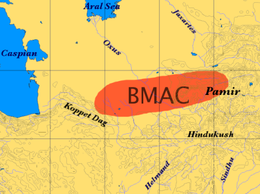 As a site in the Bactria-Margiana Archaeological Complex
, Sanjan is subject to the hypothesis that the Indo-Iranians
, a major branch that split off from the Proto-Indo-Europeans
, originated there. (see also: BMAC:Indo-Iranian hypothesis)
According to the Qissa-i Sanjan
, an epic poem from around 1600, the Zoroastrians
who fled to the Indian subcontinent
in the 8th or 9th century, to escape religious persecution from Islmaic invaders, established the settlement of Sanjan (Gujarat)
. These Zoroastrians, who were at first called Sanjanas or Khorasanis (today, the descendants of these and later Zoroastrian emigrants are collectively known as the Parsis), are thought to have named the Indian west-coast settlement after the city of their origin.
Sanjan must not be confused with the phonetically similar Iranian province Zanjan
, or its capital, the city of Zanjan
.
Karakum Desert
The Karakum Desert, also spelled Kara-Kum and Gara Gum is a desert in Central Asia. It occupies about 70 percent, or 350,000 km², of the area of Turkmenistan....
, in the vicinity of the historically eminent oasis-city of Merv
Merv
Merv , formerly Achaemenid Satrapy of Margiana, and later Alexandria and Antiochia in Margiana , was a major oasis-city in Central Asia, on the historical Silk Road, located near today's Mary in Turkmenistan. Several cities have existed on this site, which is significant for the interchange of...
. Topographically, Sanjan is located in the Greater Khorasan
Greater Khorasan
Greater Khorasan or Ancient Khorasan is a historical region of Greater Iran mentioned in sources from Sassanid and Islamic eras which "frequently" had a denotation wider than current three provinces of Khorasan in Iran...
region of Central Asia
Central Asia
Central Asia is a core region of the Asian continent from the Caspian Sea in the west, China in the east, Afghanistan in the south, and Russia in the north...
. Politically, Sanjan is in the present-day Mary Province
Mary Province
Mary Province is one of the welayatlar of Turkmenistan. It is in the south-east of the country, bordering Afghanistan. Its capital is the city of Mary. Its area is and population 1,480,400...
of Turkmenistan
Turkmenistan
Turkmenistan , formerly also known as Turkmenia is one of the Turkic states in Central Asia. Until 1991, it was a constituent republic of the Soviet Union, the Turkmen Soviet Socialist Republic . Turkmenistan is one of the six independent Turkic states...
.
Together with Merv
Merv
Merv , formerly Achaemenid Satrapy of Margiana, and later Alexandria and Antiochia in Margiana , was a major oasis-city in Central Asia, on the historical Silk Road, located near today's Mary in Turkmenistan. Several cities have existed on this site, which is significant for the interchange of...
, Sanjan was an important stopping place and center of trade on the southern route of the Silk road
Silk Road
The Silk Road or Silk Route refers to a historical network of interlinking trade routes across the Afro-Eurasian landmass that connected East, South, and Western Asia with the Mediterranean and European world, as well as parts of North and East Africa...
. Sanjan gained further importance following the Seleucid
Seleucid Empire
The Seleucid Empire was a Greek-Macedonian state that was created out of the eastern conquests of Alexander the Great. At the height of its power, it included central Anatolia, the Levant, Mesopotamia, Persia, today's Turkmenistan, Pamir and parts of Pakistan.The Seleucid Empire was a major centre...
establishment of Merv as the principal city of the Margiana province, a status it also held during the subsequent Parthia
Parthia
Parthia is a region of north-eastern Iran, best known for having been the political and cultural base of the Arsacid dynasty, rulers of the Parthian Empire....
n (250 BCE–226 CE
226
Year 226 was a common year starting on Sunday of the Julian calendar. At the time, it was known as the Year of the Consulship of Severus and Marcellus...
) and Sassanid
Sassanid Empire
The Sassanid Empire , known to its inhabitants as Ērānshahr and Ērān in Middle Persian and resulting in the New Persian terms Iranshahr and Iran , was the last pre-Islamic Persian Empire, ruled by the Sasanian Dynasty from 224 to 651...
(226
226
Year 226 was a common year starting on Sunday of the Julian calendar. At the time, it was known as the Year of the Consulship of Severus and Marcellus...
-651 CE
651
Year 651 was a common year starting on Saturday of the Julian calendar. The denomination 651 for this year has been used since the early medieval period, when the Anno Domini calendar era became the prevalent method in Europe for naming years.- Europe :* Clovis II, king of Neustria and Burgundy,...
) eras.
Bactria-Margiana Archaeological Complex
The Bactria–Margiana Archaeological Complex is the modern archaeological designation for a Bronze Age culture of Central Asia, dated to ca. 2300–1700 BC, located in present day Turkmenistan, northern Afghanistan and northeastern Iran, southern Uzbekistan and western Tajikistan, centered on...
, Sanjan is subject to the hypothesis that the Indo-Iranians
Indo-Iranians
Indo-Iranian peoples are a linguistic group consisting of the Indo-Aryan, Iranian, Dardic and Nuristani peoples; that is, speakers of Indo-Iranian languages, a major branch of the Indo-European language family....
, a major branch that split off from the Proto-Indo-Europeans
Proto-Indo-Europeans
The Proto-Indo-Europeans were the speakers of the Proto-Indo-European language , a reconstructed prehistoric language of Eurasia.Knowledge of them comes chiefly from the linguistic reconstruction, along with material evidence from archaeology and archaeogenetics...
, originated there. (see also: BMAC:Indo-Iranian hypothesis)
According to the Qissa-i Sanjan
Qissa-i Sanjan
The Story of Sanjan is an account of the early years of Zoroastrian settlers on the Indian subcontinent...
, an epic poem from around 1600, the Zoroastrians
Zoroastrianism
Zoroastrianism is a religion and philosophy based on the teachings of prophet Zoroaster and was formerly among the world's largest religions. It was probably founded some time before the 6th century BCE in Greater Iran.In Zoroastrianism, the Creator Ahura Mazda is all good, and no evil...
who fled to the Indian subcontinent
Indian subcontinent
The Indian subcontinent, also Indian Subcontinent, Indo-Pak Subcontinent or South Asian Subcontinent is a region of the Asian continent on the Indian tectonic plate from the Hindu Kush or Hindu Koh, Himalayas and including the Kuen Lun and Karakoram ranges, forming a land mass which extends...
in the 8th or 9th century, to escape religious persecution from Islmaic invaders, established the settlement of Sanjan (Gujarat)
Sanjan (Gujarat)
Sanjan is the second railway station in Gujarat on the Western railways just inside the Gujarat-Maharashtra border...
. These Zoroastrians, who were at first called Sanjanas or Khorasanis (today, the descendants of these and later Zoroastrian emigrants are collectively known as the Parsis), are thought to have named the Indian west-coast settlement after the city of their origin.
Sanjan must not be confused with the phonetically similar Iranian province Zanjan
Zanjan Province
Zanjan Province is one of the 31 provinces of Iran. Located in the North West of Iran, its capital is Zanjan city. Zanjan province with an area of 36,400 km² has a mostly rural, population of 964,601 . The province lies 330 km northwest of Tehran, connected to it via a freeway.Zanjan...
, or its capital, the city of Zanjan
Zanjan (city)
Zanjan is the capital of Zanjan Province in northwestern Iran. It is an Azeri inhabited city. It lies 298 km north-west of Tehran on the main highway to Tabriz and Turkey and approximately 125 km from the Caspian Sea...
.