

San Luis Province

Encyclopedia
San Luis is a province
of Argentina
located near the geographical center of the country (on the 32° South parallel). Neighboring provinces are, from the north clockwise
, La Rioja
, Córdoba, La Pampa, Mendoza
and San Juan
.
es, Ranqueles, Puelche
s, and Pehuenche
s.
The city of San Luis
was founded in 1594 by Luis Jufré de Loaysa y Meneses, to be later abandoned after repeated attacks of the natives, and then again by Martín García Óñez de Loyola
in 1596 under the name San Luis de Loyola Nueva Medina de Río Seco.
In 1712 the city was severely damaged in an attack of the aboriginal malones
and had to be rebuilt, along with a series of fortresses in that area.
Shortly after the creation of the Viceroyalty of the Río de la Plata
in 1776, the province was taken under the intendency of Córdoba and, in 1813, to the intendency of Cuyo. On March 1820 the province declared its autonomy, and its constitution in 1855.
The railway system
reached San Luis in the year 1875, which led to the founding of small towns on its path, such as Villa Mercedes
and Santa Rosa.
During the 1930s' crisis there was a massive exodus of almost half of the population of the province. It was reversed and stabilised after a tax reduction given to the province to encourage industrial development, a policy which has contributed to San Luis's expansion to this day.
Politics in San Luis have long been influenced by the descendants of the noted mid-19th century advocate for San Luis's integration into the rest of Argentina, Juan Saá. Since the return of Argentina to democratic rule in 1983, in particular, the Rodríguez Saá family (of Peronist affiliation) has occupied the governor's seat. This situation is, as in many smaller provinces in Argentina (and, indeed, elsewhere), partly explained by the customary use of a combination of nepotism
, propaganda
and generous social welfare legislation. This includes substantial allegations of illegal pressure, including the violent 1991 harassment of a local journalist and his neighbors. Since 1983, however, Governor (now Senator) Adolfo Rodríguez Saá
has also overseen record investment by light manufacturers (mostly food-processors and bottling plants) and advances like the construction of Argentina's most extensive expressway network.
During the last week of 2001, Adolfo Rodríguez Saá
was interim
president of Argentina
for 7 days, unsuccessfully presiding over the social instability inherited from the December 2001
. His brief turn at the presidency is memorable for his having declared a cease in payments on US$93 billion of Argentina's public foreign debt, making it (then) the largest sovereign financial default in world history.
On the central and souther part of the province predominate flatlands, and the Pampa de las Salinas great salt lake at the centre depression
.
Even though the weather of the province is temperate
-arid, there are numerous areas with milder microclimate
s, such as Villa de Merlo
, where the land is fertile and the air less dry as the eastern slope retains the humidity of the Atlantic Ocean
.
Generally speaking, the southeast of the province around Villa Mercedes is the most suited for agriculture, with a temperate Pampas climate that brings hot summers (highs of 30°C or 86F, lows of 16°C or 61F) with frequent thunderstorms, and extremely dry winters with a large thermal amplitude (highs are 17°C, or 63F, and average lows are 1°C, or 34F). Temperatures have reached values below -14°C (7F) and snow falls sporadically, but in small quantities. Precipitation is about 700 mm (27 in) in the wettest spots and drought is possible. The southern end of the province is markedly dryer, and rainfall is unpredictable, falling often in the form of severe thunderstorms with hail. Rainfall ranges from 350 mm to 550 mm (14 in to 21 in). The northwest has significantly hotter summer days because of intense solar radiation, with average highs of 33°C (91F) or more. A special micro-climate exists around the sierras, with mild summer days with very comfortable nights (28°C during the day, 14°C at night, or 82F and 57F), and very sunny winters with highs around 15°C (59F) and lows around 3°C (37F). At higher elevations, snow falls frequently but usually in small quantities due to the winter drought. In the rest of the province, snow falls only on occasion.
 The main rivers of the provinces are the Conlara and Quinto, and the border rivers of Desaguadero River
and Salado River
.
It was the only province in Argentina which does not change the hour during summer, remaining at UTC-3
while the rest of the country changes to UTC-2
. However, in 2008 most Andean and Western Argentinean provinces have joined San Luis and remained at UTC-3.
Before the tax incentives for the industry applied in the province after 1982, its economy was more agricultural, this based mainly on maize
and cattle
, which is still very important specially related to dairies
, meat plants, and tanneries
.
Manufacturing, however, now contributes nearly half of San Luis' output, a higher proportion than in any other Argentine province. Of the industries installed in San Luis after the tax reform, mainly in the city of San Luis and in Villa Mercedes, it is worth mentioning the production of home appliances, textiles, ceramics, plastics, and paper/cardboard articles.
Mining is concentrated on construction materials such as limestone
and marble
, but also extracted are tungsten
, uranium
and salt
.
. Other destinations include the capital city, the Sierra de las Quijadas National Park
, Valle del Conlara, Lake Potrero de los Funes
, Papagayos
, Carpintería, La Carolina, El Volcán, La Toma, El Trapiche, and the artificial lake of the La Florida dam
.
took place in the Hotel Potrero de los Funes from 27 September to 16 October 2005. It was won by Veselin Topalov
.
(departamentos).
Provinces of Argentina
Argentina is subdivided into twenty-three provinces and one autonomous city...
of Argentina
Argentina
Argentina , officially the Argentine Republic , is the second largest country in South America by land area, after Brazil. It is constituted as a federation of 23 provinces and an autonomous city, Buenos Aires...
located near the geographical center of the country (on the 32° South parallel). Neighboring provinces are, from the north clockwise
Clockwise
Circular motion can occur in two possible directions. A clockwise motion is one that proceeds in the same direction as a clock's hands: from the top to the right, then down and then to the left, and back to the top...
, La Rioja
La Rioja Province (Argentina)
La Rioja is a one of the provinces of Argentina and is located in the west of the country. Neighboring provinces are from the north clockwise Catamarca, Córdoba, San Luis and San Juan.-History:...
, Córdoba, La Pampa, Mendoza
Mendoza Province
The Province of Mendoza is a province of Argentina, located in the western central part of the country in the Cuyo region. It borders to the north with San Juan, the south with La Pampa and Neuquén, the east with San Luis, and to the west with the republic of Chile; the international limit is...
and San Juan
San Juan Province (Argentina)
San Juan is a province of Argentina, located in the western part of the country. Neighbouring provinces are, moving clockwise from the north, La Rioja, San Luis and Mendoza. It borders with Chile at the west....
.
History
The present area of the San Luis Province was inhabited by different aboriginal tribes: Michilingües, CalchaquíCalchaquí
The Calchaquí were a tribe of South American Indians of the Diaguita group, now extinct, who formerly occupied northern Argentina. Stone and other remains prove them to have reached a high degree of civilization...
es, Ranqueles, Puelche
Puelche
Puelche is the name that the Mapuche used to give the ethnic groups who inhabited the lands to the east of the Andes Mountains including the northern Tehuelches and Hets, these last ones were also known as the Pampas or Querandíes...
s, and Pehuenche
Pehuenche
Pehuenches are an indigenous people that are part of the Mapuche peoples and live in the Andes in south central Chile and Argentina. Their name derives from their habit of harvesting of piñones, the seeds of the Araucaria araucana or pehuén...
s.
The city of San Luis
San Luis, Argentina
-External links:* * *...
was founded in 1594 by Luis Jufré de Loaysa y Meneses, to be later abandoned after repeated attacks of the natives, and then again by Martín García Óñez de Loyola
Martín García Óñez de Loyola
Don Martín García Óñez de Loyola was a Spanish Basque soldier and Royal Governor of Chile.-Early life:...
in 1596 under the name San Luis de Loyola Nueva Medina de Río Seco.
In 1712 the city was severely damaged in an attack of the aboriginal malones
Malón
Malón or maloca was a military raiding tactic of the Mapuche peoples from the 17th to the 19th centuries.The "maloca" among the Mapuche is described as a means of obtaining justice, by Juan Ignacio Molina:...
and had to be rebuilt, along with a series of fortresses in that area.
Shortly after the creation of the Viceroyalty of the Río de la Plata
Viceroyalty of the Río de la Plata
The Viceroyalty of the Río de la Plata, , was the last and most short-lived Viceroyalty of the Spanish Empire in America.The Viceroyalty was established in 1776 out of several former Viceroyalty of Perú dependencies that mainly extended over the Río de la Plata basin, roughly the present day...
in 1776, the province was taken under the intendency of Córdoba and, in 1813, to the intendency of Cuyo. On March 1820 the province declared its autonomy, and its constitution in 1855.
The railway system
Rail transport in Argentina
The Argentine railway network comprised of track at the end of the Second World War and was, in its time, one of the most extensive and prosperous in South America. However, with the increase in highway construction, there followed a sharp decline in railway profitability, leading to the break-up...
reached San Luis in the year 1875, which led to the founding of small towns on its path, such as Villa Mercedes
Villa Mercedes, San Luis
Villa Mercedes is a city in the province of San Luis, Argentina. It lies on the center-east of the province, on the left-hand banks of the Quinto River, 32 km from the border with Córdoba, on National Route 148, and near the intersection of National Routes 8 and 7. National Route 7 links the city...
and Santa Rosa.
During the 1930s' crisis there was a massive exodus of almost half of the population of the province. It was reversed and stabilised after a tax reduction given to the province to encourage industrial development, a policy which has contributed to San Luis's expansion to this day.
Politics in San Luis have long been influenced by the descendants of the noted mid-19th century advocate for San Luis's integration into the rest of Argentina, Juan Saá. Since the return of Argentina to democratic rule in 1983, in particular, the Rodríguez Saá family (of Peronist affiliation) has occupied the governor's seat. This situation is, as in many smaller provinces in Argentina (and, indeed, elsewhere), partly explained by the customary use of a combination of nepotism
Nepotism
Nepotism is favoritism granted to relatives regardless of merit. The word nepotism is from the Latin word nepos, nepotis , from which modern Romanian nepot and Italian nipote, "nephew" or "grandchild" are also descended....
, propaganda
Propaganda
Propaganda is a form of communication that is aimed at influencing the attitude of a community toward some cause or position so as to benefit oneself or one's group....
and generous social welfare legislation. This includes substantial allegations of illegal pressure, including the violent 1991 harassment of a local journalist and his neighbors. Since 1983, however, Governor (now Senator) Adolfo Rodríguez Saá
Adolfo Rodríguez Saá
Adolfo Rodríguez Saá Páez Montero is an Argentine Peronist politician. He was the governor of the province of San Luis during several terms, and briefly served as President of Argentina.-Biography:...
has also overseen record investment by light manufacturers (mostly food-processors and bottling plants) and advances like the construction of Argentina's most extensive expressway network.
During the last week of 2001, Adolfo Rodríguez Saá
Adolfo Rodríguez Saá
Adolfo Rodríguez Saá Páez Montero is an Argentine Peronist politician. He was the governor of the province of San Luis during several terms, and briefly served as President of Argentina.-Biography:...
was interim
Ad interim
The Latin phrase ad interim literally means "in the time between" denotes the meaning of "in the meantime", "for an intervening time" or "temporarily" in the English language...
president of Argentina
President of Argentina
The President of the Argentine Nation , usually known as the President of Argentina, is the head of state of Argentina. Under the national Constitution, the President is also the chief executive of the federal government and Commander-in-Chief of the armed forces.Through Argentine history, the...
for 7 days, unsuccessfully presiding over the social instability inherited from the December 2001
December 2001 riots (Argentina)
The December 2001 uprising was a period of civil unrest and rioting in Argentina, which took place during December 2001, with the most violent incidents taking place on December 19 and December 20 in the capital, Buenos Aires, Rosario and other large cities around the country.- Background :The...
. His brief turn at the presidency is memorable for his having declared a cease in payments on US$93 billion of Argentina's public foreign debt, making it (then) the largest sovereign financial default in world history.
Geography and climate
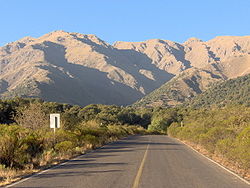
The province has low sierras on the north neighboring the Pampas, and another such system on the west with the Guayaguas, Cantanal, Quijadas and Alto Pencoso Sierras, typical of the Cuyo region.On the central and souther part of the province predominate flatlands, and the Pampa de las Salinas great salt lake at the centre depression
Depression (geology)
A depression in geology is a landform sunken or depressed below the surrounding area. Depressions may be formed by various mechanisms.Structural or tectonic related:...
.
Even though the weather of the province is temperate
Temperate
In geography, temperate or tepid latitudes of the globe lie between the tropics and the polar circles. The changes in these regions between summer and winter are generally relatively moderate, rather than extreme hot or cold...
-arid, there are numerous areas with milder microclimate
Microclimate
A microclimate is a local atmospheric zone where the climate differs from the surrounding area. The term may refer to areas as small as a few square feet or as large as many square miles...
s, such as Villa de Merlo
Villa de Merlo
Villa de Merlo lies 796 meters above sea level at 32° 36' 00" South, 66° 07' 60" West, in the Department of Junín, Province of San Luis, Argentina, a small city administered by an intendant, presently Sergio Luis Guardia, FJpSL. The demotic for Merlo is "merlino".Merlo is the principal tourist’s...
, where the land is fertile and the air less dry as the eastern slope retains the humidity of the Atlantic Ocean
Atlantic Ocean
The Atlantic Ocean is the second-largest of the world's oceanic divisions. With a total area of about , it covers approximately 20% of the Earth's surface and about 26% of its water surface area...
.
Generally speaking, the southeast of the province around Villa Mercedes is the most suited for agriculture, with a temperate Pampas climate that brings hot summers (highs of 30°C or 86F, lows of 16°C or 61F) with frequent thunderstorms, and extremely dry winters with a large thermal amplitude (highs are 17°C, or 63F, and average lows are 1°C, or 34F). Temperatures have reached values below -14°C (7F) and snow falls sporadically, but in small quantities. Precipitation is about 700 mm (27 in) in the wettest spots and drought is possible. The southern end of the province is markedly dryer, and rainfall is unpredictable, falling often in the form of severe thunderstorms with hail. Rainfall ranges from 350 mm to 550 mm (14 in to 21 in). The northwest has significantly hotter summer days because of intense solar radiation, with average highs of 33°C (91F) or more. A special micro-climate exists around the sierras, with mild summer days with very comfortable nights (28°C during the day, 14°C at night, or 82F and 57F), and very sunny winters with highs around 15°C (59F) and lows around 3°C (37F). At higher elevations, snow falls frequently but usually in small quantities due to the winter drought. In the rest of the province, snow falls only on occasion.
Desaguadero River
The Desaguadero River is the general name of a river in western Argentina that receives a number of different names on its path of 1,515 kilometres, with its most important section named Desaguadero proper.-Spring:...
and Salado River
Salado River (Buenos Aires)
The Salado River is a river in northern Buenos Aires Province, Argentina. It originates at El Chañar Lake on the border with Santa Fe Province, above mean sea level, and flows generally southeast for before debouching into Samborombón Bay, part of the Río de la Plata estuary on the Atlantic Ocean...
.
It was the only province in Argentina which does not change the hour during summer, remaining at UTC-3
UTC-3
UTC−03:00 is an identifier for a time offset from UTC of −03:00.-As standard time :*Suriname*Falkland Islands*French Guiana*Brazil - East Northern and Northeastern States...
while the rest of the country changes to UTC-2
UTC-2
UTC−02:00 is an identifier for a time offset from UTC of −02. This time is used in:-As standard time :*Brazil - Ocean Islands - Fernando de Noronha, Trindade, Martim Vaz, etc.*South Georgia and the South Sandwich Islands...
. However, in 2008 most Andean and Western Argentinean provinces have joined San Luis and remained at UTC-3.
Economy
San Luis' economy has, over the past generation, been among the most improved in Argentina. Its 2006 output, estimated at US$3.4 billion, yielded a per capita income of US$9,200 (somewhat above the national average).Before the tax incentives for the industry applied in the province after 1982, its economy was more agricultural, this based mainly on maize
Maize
Maize known in many English-speaking countries as corn or mielie/mealie, is a grain domesticated by indigenous peoples in Mesoamerica in prehistoric times. The leafy stalk produces ears which contain seeds called kernels. Though technically a grain, maize kernels are used in cooking as a vegetable...
and cattle
Cattle
Cattle are the most common type of large domesticated ungulates. They are a prominent modern member of the subfamily Bovinae, are the most widespread species of the genus Bos, and are most commonly classified collectively as Bos primigenius...
, which is still very important specially related to dairies
Dairy
A dairy is a business enterprise established for the harvesting of animal milk—mostly from cows or goats, but also from buffalo, sheep, horses or camels —for human consumption. A dairy is typically located on a dedicated dairy farm or section of a multi-purpose farm that is concerned...
, meat plants, and tanneries
Tanning
Tanning is the making of leather from the skins of animals which does not easily decompose. Traditionally, tanning used tannin, an acidic chemical compound from which the tanning process draws its name . Coloring may occur during tanning...
.
Manufacturing, however, now contributes nearly half of San Luis' output, a higher proportion than in any other Argentine province. Of the industries installed in San Luis after the tax reform, mainly in the city of San Luis and in Villa Mercedes, it is worth mentioning the production of home appliances, textiles, ceramics, plastics, and paper/cardboard articles.
Mining is concentrated on construction materials such as limestone
Limestone
Limestone is a sedimentary rock composed largely of the minerals calcite and aragonite, which are different crystal forms of calcium carbonate . Many limestones are composed from skeletal fragments of marine organisms such as coral or foraminifera....
and marble
Marble
Marble is a metamorphic rock composed of recrystallized carbonate minerals, most commonly calcite or dolomite.Geologists use the term "marble" to refer to metamorphosed limestone; however stonemasons use the term more broadly to encompass unmetamorphosed limestone.Marble is commonly used for...
, but also extracted are tungsten
Tungsten
Tungsten , also known as wolfram , is a chemical element with the chemical symbol W and atomic number 74.A hard, rare metal under standard conditions when uncombined, tungsten is found naturally on Earth only in chemical compounds. It was identified as a new element in 1781, and first isolated as...
, uranium
Uranium
Uranium is a silvery-white metallic chemical element in the actinide series of the periodic table, with atomic number 92. It is assigned the chemical symbol U. A uranium atom has 92 protons and 92 electrons, of which 6 are valence electrons...
and salt
Salt
In chemistry, salts are ionic compounds that result from the neutralization reaction of an acid and a base. They are composed of cations and anions so that the product is electrically neutral...
.
Tourism
Even though San Luis is not common destination for international tourism, it receives a lot of Argentinians searching for the oxygen-rich mild-weather sierras that produce the well known microclimate around Villa de MerloVilla de Merlo
Villa de Merlo lies 796 meters above sea level at 32° 36' 00" South, 66° 07' 60" West, in the Department of Junín, Province of San Luis, Argentina, a small city administered by an intendant, presently Sergio Luis Guardia, FJpSL. The demotic for Merlo is "merlino".Merlo is the principal tourist’s...
. Other destinations include the capital city, the Sierra de las Quijadas National Park
Sierra de las Quijadas National Park
Sierra de las Quijadas National Park is a national park in Argentina, in San Luis Province. It was established in 1991....
, Valle del Conlara, Lake Potrero de los Funes
Lake Potrero de los Funes
Lake Potrero de los Funes is a reservoir 18 km northeast of San Luis, Argentina.-Overview:The site, originally located in a corral belonging to the prominent Funes family of San Luis, was first dammed in 1860...
, Papagayos
Papagayos
Papagayos is a village in Chacabuco Department, San Luis Province, Argentina. Among the small towns that are at the feet of the Comechingones Mountains, Papagayos stands out by its particular landscape of Caranday Palms....
, Carpintería, La Carolina, El Volcán, La Toma, El Trapiche, and the artificial lake of the La Florida dam
Dam
A dam is a barrier that impounds water or underground streams. Dams generally serve the primary purpose of retaining water, while other structures such as floodgates or levees are used to manage or prevent water flow into specific land regions. Hydropower and pumped-storage hydroelectricity are...
.
World Chess Championship
The FIDE World Chess Championship 2005FIDE World Chess Championship 2005
The FIDE World Chess Championship 2005 took place in Potrero de los Funes, San Luis Province in Argentina from September 27 to October 16, 2005. It was won by Veselin Topalov.-Background:...
took place in the Hotel Potrero de los Funes from 27 September to 16 October 2005. It was won by Veselin Topalov
Veselin Topalov
Veselin Aleksandrov Topalov is a Bulgarian chess grandmaster. He currently has the sixth highest rating in the world, and was the challenger facing world champion Viswanathan Anand in the World Chess Championship 2010, losing the match 6½–5½....
.
Political division
The province is divided into nine departmentsDepartments of Argentina
Departments form the second level of administrative division in the provinces of Argentina. There are no departments in the city of Buenos Aires, which has so far been divided into neighbourhoods as its administrative divisions, but is to be divided now into communes by a recently passed local act...
(departamentos).
| Department | Capital |
|---|---|
| Ayacucho | San Francisco de Monte de Oro |
| Belgrano | Villa General Roca |
| Juan Martin De Pueyrredon | San Luis San Luis, Argentina -External links:* * *... |
| Chacabuco | Concarán |
| Coronel Pringles | La Toma |
| General Pedernera | Villa Mercedes Villa Mercedes, San Luis Villa Mercedes is a city in the province of San Luis, Argentina. It lies on the center-east of the province, on the left-hand banks of the Quinto River, 32 km from the border with Córdoba, on National Route 148, and near the intersection of National Routes 8 and 7. National Route 7 links the city... |
| Gobernador Dupuy | Buena Esperanza |
| Junín | Santa Rosa |
| Libertador General San Martín | Libertador General San Martín |
External links
- Provincia de San Luis - Official website (in Spanish)
- Argentour: San Luis Province