


San Francisco Vigilance Movement

Encyclopedia
Vigilante
A vigilante is a private individual who legally or illegally punishes an alleged lawbreaker, or participates in a group which metes out extralegal punishment to an alleged lawbreaker....
tradition of the American Old West
American Old West
The American Old West, or the Wild West, comprises the history, geography, people, lore, and cultural expression of life in the Western United States, most often referring to the latter half of the 19th century, between the American Civil War and the end of the century...
.
These militias hanged eight people and forced several elected officials to resign. Each Committee of Vigilance formally relinquished power after three months.
1851
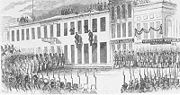
The 1851 Committee of Vigilance was inaugurated on June 9 with the promulgation of a written doctrine declaring its aims and on June 10, followed up with the hanging of John Jenkins, from SydneySydney
Sydney is the most populous city in Australia and the state capital of New South Wales. Sydney is located on Australia's south-east coast of the Tasman Sea. As of June 2010, the greater metropolitan area had an approximate population of 4.6 million people...
, convicted in a trial organized by the committee of stealing a safe from an office (grand larceny was punishable by death under California law at the time). The June 13 San Francisco Alta printed this statement:
It boasted a membership of 700 and operated parallel to, and in defiance of, the duly constituted city government. Committee members used its headquarters for the interrogation and incarceration of suspects, who were denied the benefits of due process. The Committee engaged in policing, investigating disreputable boarding houses and vessels, deporting immigrants, and parading its militia. In total, four people were hanged by the Committee; one was whipped (a common punishment at that time); fourteen were deported to Australia; fourteen were informally ordered to leave California; fifteen were handed over to public authorities; and forty-one were discharged. The 1851 Committee of Vigilance was dissolved during the September elections, but its executive members continued to meet into 1853. Among those killed were John Jenkens, an Australian from Sydney, accused of burglary, who was hanged on June 10, 1851; James Stuart, also from Sydney, accused of murder, hanged on July 11, 1851; and Samuel Whittaker and Robert McKenzie, associates of Stuart accused of "various heinous crimes", hanged on August 24, 1851. The lynching of Whittaker and McKenzie occurred three days after a standoff between the Committee and the nascent police force trying to protect the prisoners; the Committee nabbed Whittaker and McKenzie after storming the jail during Sunday church services.
The Committee offered a $5,000 reward for the capture of anyone found guilty of arson, and committee members patrolled the streets at night to watch for fires. After these actions were taken, fires in San Francisco diminished noticeably.
1856
People's Party
The People's Party, Peoples Party, or Popular Party, is any of several political parties claiming to speak for the people.People's Parties in various countries run the gamut from left to right...
, which ruled until 1867 and was eventually absorbed into the Republican Party. The vigilantes had thus succeeded in their objective of usurping power from the Democratic Party machine
Political machine
A political machine is a political organization in which an authoritative boss or small group commands the support of a corps of supporters and businesses , who receive rewards for their efforts...
that hitherto dominated civic politics in the city. Notable people included William Tell Coleman
William Tell Coleman
William Tell Coleman was an American pioneer. He was born in Cynthiana, Harrison County, Kentucky, and was educated at St. Louis University.-Committees of Vigilance:...
, Martin J. Burke, San Francisco mayor Henry F. Teschemacher
Henry F. Teschemacher
Henry Frederick Teschemacher served as the tenth mayor of San Francisco from October 3, 1859 to June 30, 1863....
, and San Francisco's first chief of police James F. Curtis
James F. Curtis
James Freeman Curtis II , 49er, Vigilante leader in San Francisco, its first Chief of Police, officer in the California militia and Volunteers in the American Civil War.- 49er :...
.
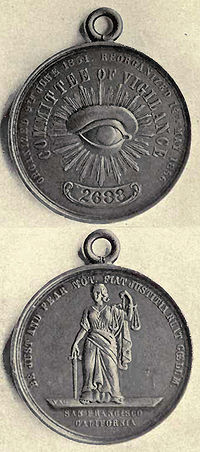
Vigilante headquarters in 1856 consisted of assembly halls, meeting rooms, a military kitchen and armoury, an infirmary, and prison cells, all of which were fortified with gunny sacks and cannons. Four people were officially executed again in 1856, but the death toll also includes James “Yankee” Sullivan
Yankee Sullivan
Yankee Sullivan also known as Frank Murray and James Sullivan was a bare knuckle fighter and boxer. He was a Champion of Prizefighting from 1851 to October 12, 1853...
, an Irish
Irish people
The Irish people are an ethnic group who originate in Ireland, an island in northwestern Europe. Ireland has been populated for around 9,000 years , with the Irish people's earliest ancestors recorded having legends of being descended from groups such as the Nemedians, Fomorians, Fir Bolg, Tuatha...
immigrant and professional boxer who killed himself after being terrorized and detained in a Vigilante cell. The 1856 Committee also engaged in policing, investigations, and secret trials, but it far exceeded its predecessor in audacity and rebelliousness. Most notably, it seized a federal shipment of armaments intended for the state militia and tried the chief justice of the California Supreme Court
Supreme Court of California
The Supreme Court of California is the highest state court in California. It is headquartered in San Francisco and regularly holds sessions in Los Angeles and Sacramento. Its decisions are binding on all other California state courts.-Composition:...
. The Committee’s authority, however, was bolstered by almost all militia units in the city, including the California Guards.
Controversy

Controversy
Controversy is a state of prolonged public dispute or debate, usually concerning a matter of opinion. The word was coined from the Latin controversia, as a composite of controversus – "turned in an opposite direction," from contra – "against" – and vertere – to turn, or versus , hence, "to turn...
exists about the vigilance movements. The 1856 hangings of Charles Cora and James Casey, for example, are open to interpretation. Both were hanged as murderers by the Committee of Vigilance: Cora shot dead a U.S. Marshal who had drunkenly insulted his mistress, and Casey killed a rival newspaper editor for publishing an editorial that exposed Casey's criminal record in New York
New York
New York is a state in the Northeastern region of the United States. It is the nation's third most populous state. New York is bordered by New Jersey and Pennsylvania to the south, and by Connecticut, Massachusetts and Vermont to the east...
. Cora's first trial had ended in a hung jury
Hung jury
A hung jury or deadlocked jury is a jury that cannot, by the required voting threshold, agree upon a verdict after an extended period of deliberation and is unable to change its votes due to severe differences of opinion.- England and Wales :...
, and there were rumors that the jury had been bribed. Casey's friends sneaked him into the jail precisely because they were afraid that he would be hanged. This hanging
Hanging
Hanging is the lethal suspension of a person by a ligature. The Oxford English Dictionary states that hanging in this sense is "specifically to put to death by suspension by the neck", though it formerly also referred to crucifixion and death by impalement in which the body would remain...
could be seen either as a response by frustrated citizens to ineffectual law enforcement, or as their unwillingness to accept the possibility that due process would result in acquittals. Most popular histories have accepted the former view, that the illegality and brutality of the vigilantes was justified by the need to establish law and order in the city.
One prominent critic of the San Francisco vigilantes was General W. T. Sherman
William Tecumseh Sherman
William Tecumseh Sherman was an American soldier, businessman, educator and author. He served as a General in the Union Army during the American Civil War , for which he received recognition for his outstanding command of military strategy as well as criticism for the harshness of the "scorched...
, who resigned from his position as major-general of the Second Division of Militia in San Francisco. In his memoirs, Sherman wrote:
As[the vigilantes] controlled the press, they wrote their own history, and the world generally gives them the credit of having purged San Francisco of rowdies and roughs; but their success has given great stimulus to a dangerous principle, that would at any time justify the mob in seizing all the power of government; and who is to say that the Vigilance Committee may not be composed of the worst, instead of the best, elements of a community? Indeed, in San Francisco, as soon as it was demonstrated that the real power had passed from the City Hall to the committee room, the same set of bailiffs, constables, and rowdies that had infested the City Hall were found in the employment of the "Vigilantes."
Influence in British Columbia Affairs
A former member of the San Francisco Committee of Vigilance, physician Max Fifer, having moved to YaleYale, British Columbia
Yale is an unincorporated town in the Canadian province of British Columbia. It was founded in 1848 by the Hudson's Bay Company as Fort Yale by Ovid Allard, the appointed manager of the new post, who named it after his superior, James Murray Yale, then Chief Factor of the Columbia District...
, British Columbia
Colony of British Columbia
The Colony of British Columbia was a crown colony in British North America from 1858 until 1866. At its creation, it physically constituted approximately half the present day Canadian province of British Columbia, since it did not include the Colony of Vancouver Island, the vast and still largely...
at the time of the Fraser Canyon Gold Rush
Fraser Canyon Gold Rush
The Fraser Canyon Gold Rush, began in 1858 after gold was discovered on the Thompson River in British Columbia at its confluence with the Nicoamen River. This was a few miles upstream from the Thompson's confluence with the Fraser River at present-day Lytton...
participated in the organization of a Vigilance Committee on the Fraser River
Fraser River
The Fraser River is the longest river within British Columbia, Canada, rising at Fraser Pass near Mount Robson in the Rocky Mountains and flowing for , into the Strait of Georgia at the city of Vancouver. It is the tenth longest river in Canada...
in 1858 to address issues of lawlessness and a vacuum of effective governmental authority created by the sudden influx of goldseekers to the new British colony. The Vigilance Committee, which in San Francisco had persecuted disgraced Philadelphia lawyer Ned McGowan
Ned McGowan (lawyer)
right|300px|thumb|Ned McGowan Edward McGowan was an American lawyer, Pennsylvania assemblyman, Judge of the California Court of Quarter Sessions, poet, Fraser Canyon gold seeker, adventurer, assistant sergeant-at-arms in the United States Congress, newspaper publisher and bon vivant instigator of...
, played a role in the bloodless McGowan's War
McGowan's War
McGowan's War was a bloodless war that took place in Yale, British Columbia in the fall of 1858. The conflict posed a threat to the newly-minted British authority on the British Columbia mainland, which had only just been declared a colony the previous summer, at the onset of the Fraser Canyon Gold...
on the lower Fraser in 1858-1859. At the end of the so-called 'War', McGowan was convicted by judge Matthew Baillie Begbie
Matthew Baillie Begbie
Sir Matthew Baillie Begbie was born on the island of Mauritius, thereafter raised and educated in the United Kingdom...
of an assault against Fifer in British Columbia but McGowan's statement in defence, which described some of the activities of the San Francisco vigilantes and his own personal experience of their vigilantism, impressed and disturbed Begbie who, like colonial governor Douglas
James Douglas (Governor)
Sir James Douglas KCB was a company fur-trader and a British colonial governor on Vancouver Island in northwestern North America, particularly in what is now British Columbia. Douglas worked for the North West Company, and later for the Hudson's Bay Company becoming a high-ranking company officer...
was determined to prevent conditions in the goldfields of British Columbia from deteriorating into mob rule.
See also
- McGowan's WarMcGowan's WarMcGowan's War was a bloodless war that took place in Yale, British Columbia in the fall of 1858. The conflict posed a threat to the newly-minted British authority on the British Columbia mainland, which had only just been declared a colony the previous summer, at the onset of the Fraser Canyon Gold...
- William Tell ColemanWilliam Tell ColemanWilliam Tell Coleman was an American pioneer. He was born in Cynthiana, Harrison County, Kentucky, and was educated at St. Louis University.-Committees of Vigilance:...
- Samuel BrannanSamuel BrannanSamuel Brannan was an American settler, businessman, and journalist, who founded the "California Star" newspaper in San Francisco, California...
External links
- Hubert Howe Bancroft, Popular Tribunals Volume I and Volume II. San Francisco: The History Company, 1887.
- Kevin Mullen, "Malachi Fallon: First Chief of Police" from the Encyclopaedia of San Francisco.
- Primary sources from the Virtual Museum of the City of San Francisco.
- Mary Floyd Williams, History of the San Francisco Committee of Vigilance: A Study of Social Control on the California Frontier in the Days of the Gold Rush, Berkeley, CA: University of California Press, 1921.
- Website critical of the Vigilantes
- Guide to the San Francisco Committee of Vigilance of 1851 Papers at The Bancroft Library
- Guide to the San Francisco Committee of Vigilance of 1856 Papers at The Bancroft Library
- Discussion of 1856 vigilante activities in Memoirs of William T. Sherman
- Edward McGowan, Narrative of Edward McGowan, including a full account of the author's adventures and perils while persecuted by the San Francisco vigilance committee of 1856, together with a report of his trial, which resulted in his acquittal. McGowan's account of his persecution by the Committee of Vigilance, self-published, 1857, reprinted 1917.