
All Topics  
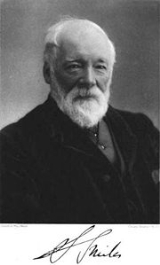
Samuel Smiles

 
Samuel Smiles

   Email Print
   Bookmark   Link


Samuel Smiles


Samuel Smiles (23 December, 1812 – 16 April, 1904), was a Scottish
Scotland

conventional_long_name = ScotlandAlba|common_name= Scotland|image_flag = Flag of Scotland.svg|flag_width = 130px...
 author and reformer.

in Haddington
Haddington, East Lothian

Haddington is a town and former Royal Burgh in East Lothian, Scotland. It is the main administrative, cultural and geographical centre for East Lothian, which was known officially as Haddingtonshire before 1921....
, the son of Samuel Smiles of Haddington and Janet Wilson of Dalkeith, Smiles was one of eleven surviving children. The family were strict Cameronians. He left school at the age of 14 and was apprenticed to a doctor, an arrangement that eventually enabled Smiles to study medicine at the University of Edinburgh
University of Edinburgh

The University of Edinburgh founded in 1582, is an internationally renowned centre for teaching and research in Edinburgh, Scotland, United Kingdom....
.


Discussion
Ask a question about 'Samuel Smiles'
Start a new discussion about 'Samuel Smiles'
Answer questions from other users
Full Discussion Forum


Encyclopedia


Samuel Smiles (23 December, 1812 – 16 April, 1904), was a Scottish
Scotland

conventional_long_name = ScotlandAlba|common_name= Scotland|image_flag = Flag of Scotland.svg|flag_width = 130px...
 author and reformer.

Early life

Born in Haddington
Haddington, East Lothian

Haddington is a town and former Royal Burgh in East Lothian, Scotland. It is the main administrative, cultural and geographical centre for East Lothian, which was known officially as Haddingtonshire before 1921....
, the son of Samuel Smiles of Haddington and Janet Wilson of Dalkeith, Smiles was one of eleven surviving children. The family were strict Cameronians. He left school at the age of 14 and was apprenticed to a doctor, an arrangement that eventually enabled Smiles to study medicine at the University of Edinburgh
University of Edinburgh

The University of Edinburgh founded in 1582, is an internationally renowned centre for teaching and research in Edinburgh, Scotland, United Kingdom....
. His father died in the cholera epidemic of 1832, but Smiles was enabled to continue with his studies, supported by his mother who kept running the family shop selling hardware, books, etc, firm in the belief that "The Lord will provide". Her example, working ceaselessly to support herself and his nine younger siblings, was a strong influence on his future life, though he developed a more benign and tolerant outlook somewhat at odds with his Cameronian forebears . While studying and after graduating, he campaigned for parliamentary reform
Reform Act

In the United Kingdom, Reform Act is a generic term used for legislation concerning electoral matters. It is most commonly used for laws passed to enfranchise new groups of voters and to redistribute seats in the British House of Commons....
, contributing articles to the Edinburgh Weekly Chronicle and the Leeds Times.

Samuel married Sarah Ann Holmes Dixon in Leeds in December 7, 1843. They had three daughters, Janet, Edith and Lillian, and two sons, William and Samuel. In his late teens, Samuel junior contracted a lung disease, and his father was advised to send him on a long sea voyage. The letters young Samuel wrote home, and the log he kept of his journey to Australia and America between February 1869 and March 1871, were later edited by his father and published in London in 1877, under the title 'A Boy's Voyage Round the World'.

Samuel senior's grandchildren include Sir Walter Smiles
Walter Dorling Smiles

Lt Col Sir Walter Dorling Smiles CIE Distinguished Service Order Deputy Lieutenant was a British politician.Sir Walter was the son of William Holmes Smiles, director of Belfast Ropeworks, and grandson of Samuel Smiles....
, an Ulster Unionist Party
Ulster Unionist Party

The Ulster Unionist Party is the more moderate of the two main Unionist political parties in Northern Ireland. Prior to the split in Unionism in the late 1960s, when the former Protestant Unionist Party began to attract more hard line support away from the UUP, it governed Northern Ireland between 1921 and 1972 as the sole Unionist party....
 MP. Through this family, Samuel Smiles is also the great-great-grandfather of popular explorer Bear Grylls
Bear Grylls

Bear Grylls , real name Edward Michael Bear Grylls, is a British adventurer, television presenter and writer currently best known for his television series Born Survivor ....
.

Career

In 1838, he was invited to become the editor for the Leeds Times, a position which he accepted and filled until 1845. In May 1840, Smiles became Secretary to the Leeds Parliamentary Reform Association, an organisation that held to the six objectives of Chartism
Chartism

Chartism was a movement for political and society reform movement in the United Kingdom during the mid-19th century between 1838 and 1848. It takes its name from the People's Charter of 1838, which stipulated the six main aims of the movement as:...
: universal suffrage
Universal suffrage

Universal suffrage consists of the extension of the Suffrage to adult citizens as a whole, though it may also mean extending said right to minors and noncitizens....
 for all men over the age of 21; equal-sized electoral districts; voting by secret ballot
Secret ballot

The secret ballot is a voting method in which a voter's choices are confidential. The key aim is to ensure the voter records a sincere choice by forestalling attempts to influence the voter by intimidation or bribery....
; an end to the need of MPs to qualify for Parliament
Parliament of the United Kingdom

The Parliament of the United Kingdom of Great Britain and Northern Ireland is the supreme legislature in the United Kingdom and British overseas territories....
, other than by winning an election; pay for MPs; and annual Parliaments.

In 1845, Samuel Smiles left the Leeds Times and became secretary to the Leeds and Thirsk Railway and then, nine years later, the South Eastern Railway
South Eastern Railway (UK)

South Eastern Railway was a railway company in the United Kingdom, which linked London with Kent.The company was formed from the London and Greenwich Railway and the Canterbury and Whitstable Railway ....
. In 1866, he left this position to be president of the National Provident Institution, but left in 1871, after suffering a debilitating stroke
Stroke

A stroke is the rapidly developing loss of brain function due to a disturbance in the blood supply to the brain. According to the National Stroke Association, a "stroke" occurs when a blood clot blocks and artery or a blood vessel breaks, interrupting blood flow to an area of the brain....
. He recovered from the stroke, eventually learning to read and write again, and he even wrote books after his recovery. He died in Kensington
Kensington

Kensington is a district of West London, England within the Royal Borough of Kensington and Chelsea, located west of Charing Cross. An affluent and densely-populated area, its commercial heart is Kensington High Street and it contains the well-known museum district of South Kensington....
 and was buried in Brompton Cemetery
Brompton Cemetery

Brompton Cemetery is located near Earl's Court in West Brompton, a part of the Royal Borough of Kensington and Chelsea in west London, England....
.

As editor of the Leeds Times, he advocated radical causes ranging from women's suffrage to free trade
Free trade

Free trade is a type of trade policy that allows traders to act and transact without coercive interference from government. Thus, the policy permits trading partners mutual gains from trade, with goods and services produced according to the law of comparative advantage....
 to parliamentary reform. But by the late 1840s, Smiles became concerned about the advocation of physical force by Chartists Feargus O'Connor
Feargus O'Connor

Feargus Edward O'Connor was an Ireland Chartism leader and advocate of the Land Plan....
 and George Julian Harney
George Julian Harney

George Julian Harney was a 19th century England political activist, journalist, and Chartist leader. He was also associated with Marxism, socialism, and universal suffrage....
, though he seems to have agreed with them that the movement's current tactics were not effective, saying that "mere political reform will not cure the manifold evils which now afflict society." In the 1850s he seems to have completely given up on parliamentary reform and other structural changes as a means of social advance. For the rest of his career, he advocated individual self improvement.

Writings


Smiles is best known today as the writer of books extolling virtues of self help, and biographies lauding the achievements of "heroic" engineer
Engineer

An engineer is a person professionally engaged in a field of engineering. Engineers are concerned with developing economical and safe solutions to practical problems, by applying mathematics and scientific knowledge while considering technical constraints....
s.

Smiles' self-help books have been cited as influential on the New Thought Movement in late 19th century America
United States

The United States of America is a Federal government constitutional republic comprising U.S. state and a federal district. The country is situated mostly in central North America, where its Contiguous United States and Washington, D.C., the Capital districts and territories, lie between the Pacific Ocean and Atlantic Oceans, Borders of the U...
 and England
England

native_name =|conventional_long_name = England|common_name = England|image_flag = Flag of England.svg|image_coat = England COA.svg|symbol_type = Royal Coat of Arms...
, and, in particular, on the career of the New Thought author Orison Swett Marden
Orison Swett Marden

Orison Swett Marden was an United States writer associated with the New Thought Movement. He also held a degree in medicine, and was a successful hotel owner....
, who said that his early ambition had been to become "the Samuel Smiles of America"

Most of Smiles' biographies were contained in the four volume work, 'Lives of the Engineers', but he also wrote many other biographies. He selected the topics of his biographies as a means of emphasising his thesis of self help. These works have come to exemplify Victorian values for the modern reader. He received some criticism in his own time from socialists
Socialism

Socialism refers to a broad set of economic theories of social organization advocating public or state ownership and administration of the means of production and distribution of goods, and a society characterized by equality for all individuals, with a fair or Egalitarianism method of compensation....
 because of his emphasis on individual achievement.

He was a prolific author of books and articles. The following is an incomplete list of his most important work. See Jarvis, below, for a full listing of his writings.

Self help topics

  • Self-Help
    Self-Help (book)

    Self-Help; with Illustrations of Character and Conduct was a book published in 1859 by Samuel Smiles. The second edition of 1866 added Perseverance to the subtitle....
    , London, 1859
  • Character, London, 1871
  • Thrift, London, 1875
  • Duty, London, 1880
  • Life and Labour, London 1887


Biographical works

  • The Life of George Stephenson
    George Stephenson

    George Stephenson was an England civil engineer and mechanical engineering who built the first public railway line in the world to use steam engine locomotives and is known as the "Father of Railways"....
    , London, 1857
  • The Story of The Life of George Stephenson, London, 1859 (abridgement of the above)
  • Brief biographies, Boston, 1860 (articles reprinted from periodicals such as the Quarterly Review)
  • Lives of the Engineers, 3 vol, London 1862
    • Vol 1, Early engineers - James Brindley
      James Brindley

      James Brindley was an English engineer. He was born in Tunstead, Derbyshire, Derbyshire, and lived much of his life in Leek, Staffordshire, becoming one of the most notable engineers of the 18th century....
      , Sir Cornelius Vermuyden, Sir Hugh Myddleton
      Hugh Myddleton

      Sir Hugh Myddelton , 1st Baronet was a Wales goldsmith, clothmaker, banker, entrepreneur, mine-owner and self-taught engineer.The sixth son of Richard Myddelton, governor of Denbigh Castle and MP for Denbigh in north Wales, he travelled to seek his fortune in London and after being apprenticed to a goldsmith became so successful in that...
      , Capt John Perry
      John Perry (engineer)

      John Perry was a pioneering engineer and mathematician from Ireland.He was born on February 14 1850 at Garvagh, County Londonderry, the second son of Samuel Perry and a Scottish-born wife....
    • Vol 2, Harbours, Lighthouses and Bridges - John Smeaton
      John Smeaton

      John Smeaton, Fellow of the Royal Society, was a civil engineer – often regarded as the "father of civil engineering" – responsible for the design of bridges, canals, harbours and lighthouses....
       and John Rennie, (1761-1821)
    • Vol 3, History of Roads - John Metcalfe
      John Metcalfe

      John Metcalfe is a British-based composer and viola, and a former member of the band the Durutti Column....
       and Thomas Telford
      Thomas Telford

      Thomas Telford was born in Langholm, Scotland, UK. He was a stonemason, architect and civil engineer and a noted road, bridge and canal builder....
  • Industrial Biography, London, 1863
Includes lives of Andrew Yarranton
Andrew Yarranton

Andrew Yarranton was an important English people engineer in the 17th century who was responsible for making several rivers into navigable waterways....
, Dud Dudley, Henry Maudslay
Henry Maudslay

Henry Maudslay was a United Kingdom machine tool innovator, tool and die maker, and inventor. He is considered a founding father of machine tool technology....
, Joseph Clement
Joseph Clement

Joseph Clement was a United Kingdom engineer and industrialist, chiefly remembered as the maker of Charles Babbage's first Difference engine, between 1824 and 1833....
, etc..
  • Boulton and Watt
    Boulton and Watt

    The firm of Boulton & Watt was initially a partnership between Matthew Boulton and James Watt ....
    , London, 1865
  • The Huguenots: Their Settlements, Churches and Industries in England and Ireland, London, 1867
  • Lives of the Engineers, new ed. in 5 vols, London, 1874
(includes the lives of Stephenson and Boulton and Watt)
  • Life of a Scotch Naturalist: Thomas Edward
    Thomas Edward

    Thomas Edward may refer to:* Thomas Edward , Scottish naturalist* T. E. Lawrence , Thomas Edward Lawrence, British soldier, liaison officer during the Arab Revolt...
    , London, 1875
  • George Moore, Merchant and Philanthropist, London & New York, 1878
  • Robert Dick
    Robert Dick

    Robert Dick , Scotland geologist and botanist was born at Tullibody, in Clackmannanshire.His father was an officer of excise. At the age of thirteen, after receiving a good elementary education at the parish school, Dick was apprenticed to a baker, and served for three years....
    , Baker of Thurso, Geologist and Botanist
    , London, 1878
  • Men of Invention and Industry, London, 1884
Phineas Pett
Phineas Pett

Phineas Pett was a shipwright and a member of the The Pett Dynasty....
, Francis Pettit Smith
Francis Pettit Smith

Sir Francis Pettit Smith was a British inventor and, along with Fr?d?ric Sauvage and John Ericsson, one of at least three people disputably viewed as inventor of the screw propeller....
, John Harrison
John Harrison

John Harrison was a self-educated England clockmaker. He invented the marine chronometer, a long-sought and critically-needed key piece in solving the problem of accurately establishing the East-West position, or longitude, of a ship at sea, thus revolutionising and extending the possibility of safe long distance sea travel in the Age of Sai...
, John Lombe
John Lombe

John Lombe was a silk spinning in 18th century Derby, England.He was born in Norwich in approximately 1693 the son of a worsted weaver.He was a younger half-brother of Thomas Lombe, who after his death would go on to amass a fortune as a silk merchant in Norwich and London....
, William Murdock
William Murdock

William Murdock was a Scotland-born United States statesman in colonial Maryland. During the tensions leading up to the American Revolution he was an important spokesman for the rights of the colonists....
, Frederick Koenig
Friedrich Koenig

Friedrich Gottlob Koenig was a Germany inventor best-known for his high-speed printing press, which he built together with watchmaker Andreas Friedrich Bauer....
,The Walter family of The Times, William Clowes (Printer), Charles Bianconi
Charles Bianconi

Charles Bianconi , was born Carlo Bianconi in Costa Masnaga on September 24 1786. He moved from an area poised to fall to Italian Republic and travelled to Ireland in 1802, via England, just four years after the Irish Rebellion of 1798....
, and chapters on Industry in Ireland, Shipbuilding in Belfast, Astronomers and students in humble life
  • James Nasmyth
    James Nasmyth

    James Hall Nasmyth was a Scotland engineer and inventor famous for his development of the steam hammer....
    , engineer, an autobiography
    , ed. Samuel Smiles, London, 1885
  • A Publisher and his Friends. Memoir and Correspondence of the Late John Murray
    John Murray (publisher)

    John Murray was a United Kingdom publishing house, renowned for the roster of authors it has published in its history, including Jane Austen, Sir Arthur Conan Doyle, George Gordon Byron, 6th Baron Byron, Charles Lyell, Johann Wolfgang von Goethe and Charles Darwin....
    , London, 1891
  • Jasmin
    Jasmin

    Jasmin may refer to:*Jasmin Dervi?evic, Bosnian rapper*Jasmin is often used as a given name.*Jasmin * Jasmin is an Assembly language#Assembler developed for the Java Virtual Machine specification...
    . Barber, Poet, Philanthropist
    , London, 1891
  • Josiah Wedgwood
    Josiah Wedgwood

    Josiah Wedgwood was an England potter, credited with the industrial process of the manufacture of pottery. He was a member of the Darwin-Wedgwood family, most famously including his grandson, Charles Darwin....
    , his Personal History
    , London, 1894
  • The Autobiography of Samuel Smiles, LLD, ed. T. Mackay
    Thomas Mackay

    Thomas Mackay was a United Kingdom wine merchant and classical liberal.Mackay, the son of a colonel, was born in Edinburgh and educated at Glenalmond and New College, Oxford....
    , London, 1905 -


The growth of industrial archaeology and history in Britain from the 1960s caused a number of these titles to be reprinted, and a number are available on the Web from such sources as Project Gutenberg
Project Gutenberg

Project Gutenberg, abbreviated as PG, is a volunteer effort to digitize, archive and distribute cultural works, as founder Michael Hart said "To encourage the creation and distribution of eBooks."....
, noted below.

The reliability of Smiles' work

Jarvis maintains that Smiles should never be taken as the 'last word' on the lives of Victorian
Victorian era

The Victorian Era of the United Kingdom of Great Britain and Ireland was the period of Victoria of the United Kingdom reign from June 1837 to January 1901....
 engineers. Aside from the accuracy of his statements (it is known, for example, that he was prone to making selective quotations from documents to show his subjects in the best light), there is the balance of his coverage. He tended to concentrate on civil engineering
Civil engineering

Civil engineering is a Professional Engineer discipline that deals with the design, construction and maintenance of the physical and naturally built environment, including works such as bridges, roads, canals, dams and buildings....
, to the detriment of mechanical engineering
Mechanical engineering

Mechanical Engineering is an engineering discipline that involves the application of physics#branches of physics for analysis, design, manufacturing, and maintenance of machine....
 and invention
Invention

An invention is the creation of a new configuration, composition of matter, device, or process. Some inventions are based on pre-existing models or ideas....
. Present-day researchers who rely upon an uncritical reading of Smiles may therefore be left with a lop-sided view of industrialisation
Industrialisation

Industrialization is the process of social and economic change whereby a human group is transformed from a pre-industrial society into an industry one....
 during the Industrial Revolution
Industrial Revolution

The Industrial Revolution was a period in the late 18th and early 19th centuries when major changes in agriculture, manufacturing, production, and transportation had a profound effect on the socioeconomics and cultural conditions in United Kingdom....
 and the Victorian era in Britain.

Further reading

  • Briggs, Asa (1968). "Samuel Smiles and the Gospel of Work" in Victorian People, Pelican, Harmondsworth.

External links