

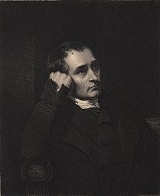
Samuel Crompton

Encyclopedia
Samuel Crompton was an English inventor and pioneer of the spinning industry.
, Bolton
, Lancashire
to George and Betty Crompton (née Elizabeth Holt of Turton). Samuel had two younger sisters. While he was a boy he lost his father, and had to contribute to the family resources by spinning yarn
. The defects of the spinning jenny
imbued him with the idea of devising something better, and for five or six years the effort absorbed all his spare time and money, including what he earned by playing the violin
at the Bolton theatre.
On 16 February 1780 at Bolton Parish Church, Crompton married Mary Pimlott (or Pimbley). They had eight children including George Crompton (born 8 January 1781), who followed in the family business.
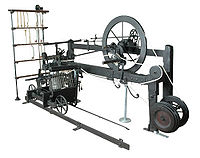 About 1779 Samuel Crompton succeeded in producing a machine which spun yarn suitable for use in the manufacture of muslin
, and which was known as the muslin wheel or the Hall i' th' Wood
wheel, from the name of the house in which he and his family resided. The muslin wheel later became known as the spinning mule
. About the same time, a good demand arose for the yarn which Crompton made at Hall i' th' Wood
. However, in the absence of means to take out a patent
, the prying, to which his methods were subjected, drove Crompton to the choice of either destroying his machine or making it public. He adopted the latter alternative on the promise by a number of manufacturers to pay him for the use of the mule, but all he received was about £60. He then resumed spinning on his own account, but with indifferent success.
In 1800 a sum of £500 was raised for his benefit by subscription, and when in 1809 Edmund Cartwright
, the inventor of the power loom
, obtained £10,000 from parliament, Crompton determined also to apply for a grant. In 1811 he toured the manufacturing districts of Lancashire
and Scotland to collect evidence showing how extensively his mule was used, and in 1812 parliament awarded him £5,000. With the aid of this money Crompton embarked in business, first as a bleacher and then as a cotton merchant and spinner, but again without success. In 1824 some friends, without his knowledge, bought him an annuity of £63.
Crompton died at his house in King Street, Bolton on 26 June 1827, and was buried at the local parish church.

Early life
Samuel Crompton was born at 10 Firwood Fold10 Firwood Fold
10 Firwood Fold is a 16th century house in Bolton, Greater Manchester . It is a Grade I listed building and the birthplace of Samuel Crompton....
, Bolton
Bolton
Bolton is a town in Greater Manchester, in the North West of England. Close to the West Pennine Moors, it is north west of the city of Manchester. Bolton is surrounded by several smaller towns and villages which together form the Metropolitan Borough of Bolton, of which Bolton is the...
, Lancashire
Lancashire
Lancashire is a non-metropolitan county of historic origin in the North West of England. It takes its name from the city of Lancaster, and is sometimes known as the County of Lancaster. Although Lancaster is still considered to be the county town, Lancashire County Council is based in Preston...
to George and Betty Crompton (née Elizabeth Holt of Turton). Samuel had two younger sisters. While he was a boy he lost his father, and had to contribute to the family resources by spinning yarn
Yarn
Yarn is a long continuous length of interlocked fibres, suitable for use in the production of textiles, sewing, crocheting, knitting, weaving, embroidery and ropemaking. Thread is a type of yarn intended for sewing by hand or machine. Modern manufactured sewing threads may be finished with wax or...
. The defects of the spinning jenny
Spinning jenny
The spinning jenny is a multi-spool spinning frame. It was invented c. 1764 by James Hargreaves in Stanhill, Oswaldtwistle, Lancashire in England. The device reduced the amount of work needed to produce yarn, with a worker able to work eight or more spools at once. This grew to 120 as technology...
imbued him with the idea of devising something better, and for five or six years the effort absorbed all his spare time and money, including what he earned by playing the violin
Violin
The violin is a string instrument, usually with four strings tuned in perfect fifths. It is the smallest, highest-pitched member of the violin family of string instruments, which includes the viola and cello....
at the Bolton theatre.
On 16 February 1780 at Bolton Parish Church, Crompton married Mary Pimlott (or Pimbley). They had eight children including George Crompton (born 8 January 1781), who followed in the family business.
Spinning mule
Muslin
Muslin |sewing patterns]], such as for clothing, curtains, or upholstery. Because air moves easily through muslin, muslin clothing is suitable for hot, dry climates.- Etymology and history :...
, and which was known as the muslin wheel or the Hall i' th' Wood
Hall i' th' Wood
Hall i' th' Wood is an early 16th century manor house in Bolton, Greater Manchester . It is a Grade I listed building and is currently used as a museum by Bolton Metropolitan Borough Council. The original building is timber framed and has a stone flagged roof; there were later additions to the...
wheel, from the name of the house in which he and his family resided. The muslin wheel later became known as the spinning mule
Spinning mule
The spinning mule was a machine used to spin cotton and other fibres in the mills of Lancashire and elsewhere from the late eighteenth to the early twentieth century. Mules were worked in pairs by a minder, with the help of two boys: the little piecer and the big or side piecer...
. About the same time, a good demand arose for the yarn which Crompton made at Hall i' th' Wood
Hall i' th' Wood
Hall i' th' Wood is an early 16th century manor house in Bolton, Greater Manchester . It is a Grade I listed building and is currently used as a museum by Bolton Metropolitan Borough Council. The original building is timber framed and has a stone flagged roof; there were later additions to the...
. However, in the absence of means to take out a patent
Patent
A patent is a form of intellectual property. It consists of a set of exclusive rights granted by a sovereign state to an inventor or their assignee for a limited period of time in exchange for the public disclosure of an invention....
, the prying, to which his methods were subjected, drove Crompton to the choice of either destroying his machine or making it public. He adopted the latter alternative on the promise by a number of manufacturers to pay him for the use of the mule, but all he received was about £60. He then resumed spinning on his own account, but with indifferent success.
In 1800 a sum of £500 was raised for his benefit by subscription, and when in 1809 Edmund Cartwright
Edmund Cartwright
Edward Cartwright was an English clergyman and inventor of the power loom.- Life and work :...
, the inventor of the power loom
Power loom
A power loom is a mechanized loom powered by a line shaft. The first power loom was designed in 1784 by Edmund Cartwright and first built in 1785. It was refined over the next 47 years until a design by Kenworthy and Bullough, made the operation completely automatic. This was known as the...
, obtained £10,000 from parliament, Crompton determined also to apply for a grant. In 1811 he toured the manufacturing districts of Lancashire
Lancashire
Lancashire is a non-metropolitan county of historic origin in the North West of England. It takes its name from the city of Lancaster, and is sometimes known as the County of Lancaster. Although Lancaster is still considered to be the county town, Lancashire County Council is based in Preston...
and Scotland to collect evidence showing how extensively his mule was used, and in 1812 parliament awarded him £5,000. With the aid of this money Crompton embarked in business, first as a bleacher and then as a cotton merchant and spinner, but again without success. In 1824 some friends, without his knowledge, bought him an annuity of £63.
Crompton died at his house in King Street, Bolton on 26 June 1827, and was buried at the local parish church.
External links