
Home      Discussion      Topics      Dictionary      Almanac
Signup       Login
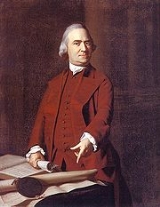
Samuel Adams

Samuel Adams

Overview
Samuel Adams was an American
United States
The United States of America is a federal constitutional republic comprising fifty states and a federal district...

 statesman, political philosopher
Political philosophy
Political philosophy is the study of such topics as liberty, justice, property, rights, law, and the enforcement of a legal code by authority: what they are, why they are needed, what, if anything, makes a government legitimate, what rights and freedoms it should protect and why, what form it...

, and one of the Founding Fathers of the United States
Founding Fathers of the United States
The Founding Fathers of the United States of America were political leaders and statesmen who participated in the American Revolution by signing the United States Declaration of Independence, taking part in the American Revolutionary War, establishing the United States Constitution, or by some...

. As a politician in colonial Massachusetts
Province of Massachusetts Bay
The Province of Massachusetts Bay was a crown colony in North America. It was chartered on October 7, 1691 by William and Mary, the joint monarchs of the kingdoms of England and Scotland...

, Adams was a leader of the movement that became the American Revolution
American Revolution
The American Revolution was the political upheaval during the last half of the 18th century in which thirteen colonies in North America joined together to break free from the British Empire, combining to become the United States of America...

, and was one of the architects of the principles of American republicanism
Republicanism in the United States
Republicanism is the political value system that has been a major part of American civic thought since the American Revolution. It stresses liberty and inalienable rights as central values, makes the people as a whole sovereign, supports activist government to promote the common good, rejects...

 that shaped the political culture of the United States. He was a second cousin to President John Adams
John Adams
John Adams was an American lawyer, statesman, diplomat and political theorist. A leading champion of independence in 1776, he was the second President of the United States...

.
Discussion
Ask a question about 'Samuel Adams'
Start a new discussion about 'Samuel Adams'
Answer questions from other users
Full Discussion Forum
 
Unanswered Questions
Recent Discussions
Quotations

All men have a right to remain in a state of nature as long as they please; and in case of intolerable oppression, civil or religious, to leave the society they belong to, and enter into another.

The Rights of the Colonists (1772)

In regard to religion, mutual toleration in the different professions thereof is what all good and candid minds in all ages have ever practised, and, both by precept and example, inculcated on mankind.

The Rights of the Colonists (1772)

The natural liberty of man is to be free from any superior power on Earth, and not to be under the will or legislative authority of man, but only to have the law of nature for his rule.

The Rights of the Colonists (1772)
Encyclopedia
Samuel Adams was an American
United States
The United States of America is a federal constitutional republic comprising fifty states and a federal district...

 statesman, political philosopher
Political philosophy
Political philosophy is the study of such topics as liberty, justice, property, rights, law, and the enforcement of a legal code by authority: what they are, why they are needed, what, if anything, makes a government legitimate, what rights and freedoms it should protect and why, what form it...

, and one of the Founding Fathers of the United States
Founding Fathers of the United States
The Founding Fathers of the United States of America were political leaders and statesmen who participated in the American Revolution by signing the United States Declaration of Independence, taking part in the American Revolutionary War, establishing the United States Constitution, or by some...

. As a politician in colonial Massachusetts
Province of Massachusetts Bay
The Province of Massachusetts Bay was a crown colony in North America. It was chartered on October 7, 1691 by William and Mary, the joint monarchs of the kingdoms of England and Scotland...

, Adams was a leader of the movement that became the American Revolution
American Revolution
The American Revolution was the political upheaval during the last half of the 18th century in which thirteen colonies in North America joined together to break free from the British Empire, combining to become the United States of America...

, and was one of the architects of the principles of American republicanism
Republicanism in the United States
Republicanism is the political value system that has been a major part of American civic thought since the American Revolution. It stresses liberty and inalienable rights as central values, makes the people as a whole sovereign, supports activist government to promote the common good, rejects...

 that shaped the political culture of the United States. He was a second cousin to President John Adams
John Adams
John Adams was an American lawyer, statesman, diplomat and political theorist. A leading champion of independence in 1776, he was the second President of the United States...

.

Born in Boston
Boston
Boston is the capital of and largest city in Massachusetts, and is one of the oldest cities in the United States. The largest city in New England, Boston is regarded as the unofficial "Capital of New England" for its economic and cultural impact on the entire New England region. The city proper had...

, Adams was brought up in a religious and politically active family. A graduate of Harvard College
Harvard College
Harvard College, in Cambridge, Massachusetts, is one of two schools within Harvard University granting undergraduate degrees...

, he was an unsuccessful businessman and tax collector before concentrating on politics. As an influential official of the Massachusetts House of Representatives
Massachusetts House of Representatives
The Massachusetts House of Representatives is the lower house of the Massachusetts General Court, the state legislature of the Commonwealth of Massachusetts. It is composed of 160 members elected from single-member electoral districts across the Commonwealth. Representatives serve two-year terms...

 and the Boston Town Meeting in the 1760s, Adams was a part of a movement opposed to the British Parliament
Parliament of Great Britain
The Parliament of Great Britain was formed in 1707 following the ratification of the Acts of Union by both the Parliament of England and Parliament of Scotland...

's efforts to tax the British America
British America
For American people of British descent, see British American.British America is the anachronistic term used to refer to the territories under the control of the Crown or Parliament in present day North America , Central America, the Caribbean, and Guyana...

n colonies without their consent. His 1768 circular letter
Massachusetts circular letter
The Massachusetts Circular Letter was a statement written by Samuel Adams and passed by the Massachusetts House of Representatives in February 1768 in response to the Townshend Acts...

 calling for colonial cooperation prompted the occupation of Boston by British soldiers, eventually resulting in the Boston Massacre
Boston Massacre
The Boston Massacre, called the Boston Riot by the British, was an incident on March 5, 1770, in which British Army soldiers killed five civilian men. British troops had been stationed in Boston, capital of the Province of Massachusetts Bay, since 1768 in order to protect and support...

 of 1770. To help coordinate resistance to what he saw as the British government's attempts to violate the British Constitution at the expense of the colonies, in 1772 Adams and his colleagues devised a committee of correspondence
Committee of correspondence
The Committees of Correspondence were shadow governments organized by the Patriot leaders of the Thirteen Colonies on the eve of American Revolution. They coordinated responses to Britain and shared their plans; by 1773 they had emerged as shadow governments, superseding the colonial legislature...

 system, which linked like-minded Patriots
Patriot (American Revolution)
Patriots is a name often used to describe the colonists of the British Thirteen United Colonies who rebelled against British control during the American Revolution. It was their leading figures who, in July 1776, declared the United States of America an independent nation...

 throughout the Thirteen Colonies
Thirteen Colonies
The Thirteen Colonies were English and later British colonies established on the Atlantic coast of North America between 1607 and 1733. They declared their independence in the American Revolution and formed the United States of America...

. Continued resistance to British policy resulted in the 1773 Boston Tea Party
Boston Tea Party
The Boston Tea Party was a direct action by colonists in Boston, a town in the British colony of Massachusetts, against the British government and the monopolistic East India Company that controlled all the tea imported into the colonies...

 and the coming of the American Revolution.

After Parliament passed the Coercive Acts in 1774, Adams attended the Continental Congress
Continental Congress
The Continental Congress was a convention of delegates called together from the Thirteen Colonies that became the governing body of the United States during the American Revolution....

 in Philadelphia, which was convened to coordinate a colonial response. He helped guide Congress towards issuing the Declaration of Independence
United States Declaration of Independence
The Declaration of Independence was a statement adopted by the Continental Congress on July 4, 1776, which announced that the thirteen American colonies then at war with Great Britain regarded themselves as independent states, and no longer a part of the British Empire. John Adams put forth a...

 in 1776, and helped draft the Articles of Confederation
Articles of Confederation
The Articles of Confederation, formally the Articles of Confederation and Perpetual Union, was an agreement among the 13 founding states that legally established the United States of America as a confederation of sovereign states and served as its first constitution...

 and the Massachusetts Constitution
Massachusetts Constitution
The Constitution of the Commonwealth of Massachusetts is the fundamental governing document of the Commonwealth of Massachusetts, one of the 50 individual state governments that make up the United States of America. It was drafted by John Adams, Samuel Adams, and James Bowdoin during the...

. Adams returned to Massachusetts after the American Revolution, where he served in the state senate
Massachusetts Senate
The Massachusetts Senate is the upper house of the Massachusetts General Court, the bicameral state legislature of the Commonwealth of Massachusetts. The Senate comprises 40 elected members from 40 single-member senatorial districts in the state...

 and was eventually elected governor.

Samuel Adams is a controversial figure in American history. Accounts written in the 19th century praised him as someone who had been steering his fellow colonists towards independence long before the outbreak of the Revolutionary War
American Revolutionary War
The American Revolutionary War , the American War of Independence, or simply the Revolutionary War, began as a war between the Kingdom of Great Britain and thirteen British colonies in North America, and ended in a global war between several European great powers.The war was the result of the...

. This view gave way to negative assessments of Adams in the first half of the 20th century, in which he was portrayed as a master of propaganda
Propaganda
Propaganda is a form of communication that is aimed at influencing the attitude of a community toward some cause or position so as to benefit oneself or one's group....

 who provoked mob violence to achieve his goals. Both of these interpretations have been challenged by some modern scholars, who argue that these traditional depictions of Adams are myths contradicted by the historical record.

Early life


Samuel Adams was born in Boston
Boston
Boston is the capital of and largest city in Massachusetts, and is one of the oldest cities in the United States. The largest city in New England, Boston is regarded as the unofficial "Capital of New England" for its economic and cultural impact on the entire New England region. The city proper had...

 in the British colony of Massachusetts
Province of Massachusetts Bay
The Province of Massachusetts Bay was a crown colony in North America. It was chartered on October 7, 1691 by William and Mary, the joint monarchs of the kingdoms of England and Scotland...

 on September 16, 1722, an Old Style date
Old Style and New Style dates
Old Style and New Style are used in English language historical studies either to indicate that the start of the Julian year has been adjusted to start on 1 January even though documents written at the time use a different start of year ; or to indicate that a date conforms to the Julian...

 that is sometimes converted to the New Style date of September 27. Adams was one of twelve children born to Samuel Adams, Sr., and Mary (Fifield) Adams; in an age of high infant mortality, only three of these children would live past their third birthday. Adams's parents were devout Puritan
Puritan
The Puritans were a significant grouping of English Protestants in the 16th and 17th centuries. Puritanism in this sense was founded by some Marian exiles from the clergy shortly after the accession of Elizabeth I of England in 1558, as an activist movement within the Church of England...

s, and members of the Old South Congregational Church. The family lived on Purchase Street in Boston. Adams was proud of his Puritan heritage, and emphasized Puritan values, especially virtue
Virtue
Virtue is moral excellence. A virtue is a positive trait or quality subjectively deemed to be morally excellent and thus is valued as a foundation of principle and good moral being....

, in his political career.

Samuel Adams, Sr. (1689–1748) was a prosperous merchant and church deacon
Deacon
Deacon is a ministry in the Christian Church that is generally associated with service of some kind, but which varies among theological and denominational traditions...

. Deacon Adams became a leading figure in Boston politics through an organization that became known as the Boston Caucus, which promoted candidates who supported popular causes. The Boston Caucus helped shape the agenda of the Boston Town Meeting. A New England town meeting
Town meeting
A town meeting is a form of direct democratic rule, used primarily in portions of the United States since the 17th century, in which most or all the members of a community come together to legislate policy and budgets for local government....

 is a form of local government
Local government
Local government refers collectively to administrative authorities over areas that are smaller than a state.The term is used to contrast with offices at nation-state level, which are referred to as the central government, national government, or federal government...

 with elected officials, and not just a gathering of citizens; it was, according to historian William Fowler, "the most democratic institution in the British empire". Deacon Adams rose through the political ranks, becoming a justice of the peace, a selectman, and a member of the Massachusetts House of Representatives
Massachusetts House of Representatives
The Massachusetts House of Representatives is the lower house of the Massachusetts General Court, the state legislature of the Commonwealth of Massachusetts. It is composed of 160 members elected from single-member electoral districts across the Commonwealth. Representatives serve two-year terms...

. He worked closely with Elisha Cooke, Jr.
Elisha Cooke, Jr.
Elisha Cooke, Jr. was a physician and politician from the Province of Massachusetts Bay. He was the son of Elisha Cooke, Sr...

 (1678–1737), the leader of the "popular party", a faction that resisted any encroachment by royal officials on the colonial rights embodied in the Massachusetts Charter of 1691. In the coming years, members of the "popular party" would become known as Whigs or Patriots
Patriot (American Revolution)
Patriots is a name often used to describe the colonists of the British Thirteen United Colonies who rebelled against British control during the American Revolution. It was their leading figures who, in July 1776, declared the United States of America an independent nation...

.

The younger Samuel Adams attended Boston Latin School
Boston Latin School
The Boston Latin School is a public exam school founded on April 23, 1635, in Boston, Massachusetts. It is both the first public school and oldest existing school in the United States....

 and then entered Harvard College
Harvard College
Harvard College, in Cambridge, Massachusetts, is one of two schools within Harvard University granting undergraduate degrees...

 in 1736. His parents hoped that his schooling would prepare him for the ministry, but Adams gradually shifted his interest to politics. After graduating in 1740, Adams continued his studies, earning a master's degree
Master of Arts (postgraduate)
A Master of Arts from the Latin Magister Artium, is a type of Master's degree awarded by universities in many countries. The M.A. is usually contrasted with the M.S. or M.Sc. degrees...

 in 1743. His thesis, in which he argued that it was "lawful to resist the Supreme Magistrate, if the Commonwealth cannot otherwise be preserved", indicated that his political views, like his father's, were oriented towards colonial rights.

Adams's life was greatly affected by his father's involvement in a banking controversy. In 1739, with Massachusetts facing a serious currency shortage, Deacon Adams and the Boston Caucus created a "land bank
Land Bank
A land bank is a bank that issues long-term loans on real estate in return for mortgages. This term could also apply to:*The Land Bank of Taiwan, a wholly state-owned bank of the Republic of China...

", which issued paper money to borrowers who mortgaged their land as security. The land bank was generally supported by the citizenry and the popular party, which dominated the House of Representatives, the lower branch of the General Court
Massachusetts General Court
The Massachusetts General Court is the state legislature of the Commonwealth of Massachusetts. The name "General Court" is a hold-over from the Colonial Era, when this body also sat in judgment of judicial appeals cases...

. Opposition to the land bank came from the more aristocratic "court party", who were supporters of the royal governor and controlled the Governor's Council
Massachusetts Governor's Council
The Massachusetts Governor's Council is a governmental body that provides advice and consent in certain matters such as judicial nominations, pardons, and commutations to the Governor of Massachusetts...

, the upper chamber of the General Court. The court party used its influence to have the British Parliament
Parliament of Great Britain
The Parliament of Great Britain was formed in 1707 following the ratification of the Acts of Union by both the Parliament of England and Parliament of Scotland...

 dissolve the land bank in 1741. Directors of the land bank, including Deacon Adams, became personally liable for the currency still in circulation, payable in silver and gold. Lawsuits over the bank persisted for years, even after Deacon Adams's death, and the younger Samuel Adams would often have to defend the family estate from seizure by the government. For Adams, these lawsuits "served as a constant personal reminder that Britain's power over the colonies could be exercised in arbitrary and destructive ways".

Early career


After leaving Harvard in 1743, Adams was unsure about his future. He considered becoming a lawyer, but instead decided to go into business. He worked at Thomas Cushing's counting house
Counting house
A counting house, or compting house, literally is the building, room, office or suite in which a business firm carries on operations, particularly accounting. By a synecdoche, it has come to mean the accounting operations of a firm, however housed...

, but the job only lasted a few months because Cushing felt that Adams was too preoccupied with politics to become a good merchant. Adams's father then loaned him £
Massachusetts pound
The pound was the currency of the Commonwealth of Massachusetts and its colonial predecessors until 1793. Like the British pound sterling of that era, the Massachusetts pound was subdivided into 20 shillings, each of 12 pence, but the Massachusetts and British pounds were not equivalent in value...

1,000 to go into business for himself, a substantial amount for that time. Adams's lack of business instincts were confirmed: he loaned half of this money to a friend, which was never repaid, and frittered away the other half. Adams would always remain, in the words of historian Pauline Maier
Pauline Maier
Pauline Maier is a popular scholar of the American Revolution, the preceding era and post-revolutionary United States. She is the William R. Kenan Jr. Professor of American History at the Massachusetts Institute of Technology ....

, "a man utterly uninterested in either making or possessing money".

After Adams had lost his money, his father made him a partner in the family's malthouse
Malthouse
A malt house, or maltings, is a building where cereal grain is converted into malt by soaking it in water, allowing it to sprout and then drying it to stop further growth. The malt is used in brewing beer, whisky and in certain foods. The traditional malt house was largely phased out during the...

, which was next to the family home on Purchase Street. Several generations of Adamses were maltsters, who produced the malt
Malt
Malt is germinated cereal grains that have been dried in a process known as "malting". The grains are made to germinate by soaking in water, and are then halted from germinating further by drying with hot air...

 necessary for brewing
Brewing
Brewing is the production of beer through steeping a starch source in water and then fermenting with yeast. Brewing has taken place since around the 6th millennium BCE, and archeological evidence suggests that this technique was used in ancient Egypt...

 beer. Years later, a poet would poke fun at Adams by calling him "Sam the maltster". Adams has often been described as a brewer, but the extant evidence suggests that Adams worked as a maltster and not a brewer.

In January 1748, Adams and some friends, inflamed by British impressment
Impressment
Impressment, colloquially, "the Press", was the act of taking men into a navy by force and without notice. It was used by the Royal Navy, beginning in 1664 and during the 18th and early 19th centuries, in wartime, as a means of crewing warships, although legal sanction for the practice goes back to...

, launched the Independent Advertiser, a weekly newspaper that printed many political essays written by Adams. Drawing heavily upon English political theorist John Locke
John Locke
John Locke FRS , widely known as the Father of Liberalism, was an English philosopher and physician regarded as one of the most influential of Enlightenment thinkers. Considered one of the first of the British empiricists, following the tradition of Francis Bacon, he is equally important to social...

's Second Treatise of Government
Two Treatises of Government
The Two Treatises of Government is a work of political philosophy published anonymously in 1689 by John Locke...

, Adams's essays emphasized many of the themes that would characterize his subsequent career. He argued that the people must resist any encroachment on their constitutional rights. He cited the decline of the Roman Empire
Decline of the Roman Empire
The decline of the Roman Empire refers to the gradual societal collapse of the Western Roman Empire. Many theories of causality prevail, but most concern the disintegration of political, economic, military, and other social institutions, in tandem with foreign invasions and usurpers from within the...

 as an example of what could happen to New England
New England
New England is a region in the northeastern corner of the United States consisting of the six states of Maine, New Hampshire, Vermont, Massachusetts, Rhode Island, and Connecticut...

 if it were to abandon its Puritan values.

When Deacon Adams died in 1748, Adams was given the responsibility of managing the family's affairs. In October 1749, he married Elizabeth Checkley, his pastor's daughter. Elizabeth gave birth to six children over the next seven years, but only two—Samuel (born 1751) and Hannah (born 1756)—would live to adulthood. In July 1757, Elizabeth died soon after giving birth to a stillborn son. Adams would remarry in 1764, to Elizabeth Wells, but would have no other children.

Like his father, Adams embarked on a political career with the support of the Boston Caucus. He was elected to his first political office in 1747, serving as one of the clerks of the Boston market. In 1756 the Boston Town Meeting elected him to the post of tax collector, which provided a small income. Adams often failed to collect taxes from his fellow citizens, which increased his popularity among those who did not pay, but left him liable for the shortage. By 1765, Adams's account was more than £8,000 in arrears. Because the town meeting was on the verge of bankruptcy, Adams was compelled to file suit against delinquent taxpayers, but many taxes went uncollected. In 1768, Adams's political opponents would use the situation to their advantage, obtaining a court judgment of £1,463 against him. Adams's friends paid off some of the deficit, and the town meeting wrote off the remainder. By then, Adams had emerged as a leader of the popular party, and the embarrassing situation did not lessen his influence.

Struggle with Great Britain


Samuel Adams emerged as an important public figure in Boston soon after the British Empire
British Empire
The British Empire comprised the dominions, colonies, protectorates, mandates and other territories ruled or administered by the United Kingdom. It originated with the overseas colonies and trading posts established by England in the late 16th and early 17th centuries. At its height, it was the...

's victory in the Seven Years' War
Seven Years' War
The Seven Years' War was a global military war between 1756 and 1763, involving most of the great powers of the time and affecting Europe, North America, Central America, the West African coast, India, and the Philippines...

 (1756–1763). Finding itself deep in debt and looking for new sources of revenue, the British Parliament
Parliament of Great Britain
The Parliament of Great Britain was formed in 1707 following the ratification of the Acts of Union by both the Parliament of England and Parliament of Scotland...

 sought, for the first time, to directly tax the colonies of British America
British America
For American people of British descent, see British American.British America is the anachronistic term used to refer to the territories under the control of the Crown or Parliament in present day North America , Central America, the Caribbean, and Guyana...

. This tax dispute was part of a larger divergence between British and American interpretations of the British Constitution and the extent of Parliament's authority in the colonies.

Sugar Act


The first step in the new program was the Sugar Act
Sugar Act
The Sugar Act, also known as the American Revenue Act or the American Duties Act, was a revenue-raising act passed by the Parliament of Great Britain on April 5, 1764. The preamble to the act stated: "it is expedient that new provisions and regulations should be established for improving the...

 of 1764. Adams saw the act as an infringement of longstanding colonial rights. Because colonists were not represented in Parliament, he argued, they could not be taxed by that body; only the colonial assemblies, where the colonists were represented, could levy taxes upon the colonies. Adams expressed these views in May 1764, when the Boston Town Meeting elected its representatives to the Massachusetts House. As was customary, the town meeting provided the representatives with a set of written instructions, which Adams was selected to write. Adams highlighted what he perceived to be the dangers of taxation without representation:

For if our Trade may be taxed, why not our Lands? Why not the Produce of our Lands & everything we possess or make use of? This we apprehend annihilates our Charter Right to govern & tax ourselves. It strikes at our British privileges, which as we have never forfeited them, we hold in common with our Fellow Subjects who are Natives of Britain. If Taxes are laid upon us in any shape without our having a legal Representation where they are laid, are we not reduced from the Character of free Subjects to the miserable State of tributary Slaves?


"When the Boston Town Meeting approved the Adams instructions on May 24, 1764," wrote historian John K. Alexander, "it became the first political body in America to go on record stating Parliament could not constitutionally tax the colonists. The directives also contained the first official recommendation that the colonies present a unified defense of their rights." Adams's instructions were published in newspapers and pamphlets. Adams soon became closely associated with James Otis, Jr.
James Otis, Jr.
James Otis, Jr. was a lawyer in colonial Massachusetts, a member of the Massachusetts provincial assembly, and an early advocate of the political views that led to the American Revolution. The phrase "Taxation without Representation is Tyranny" is usually attributed to him...

, a member of the Massachusetts House famous for his defense of colonial rights. Although Otis boldly challenged the constitutionality of certain acts of Parliament, he would not go as far as Adams, who was moving towards the conclusion that Parliament did not have sovereignty over the colonies.

Stamp Act


In 1765, Parliament passed the Stamp Act
Stamp Act 1765
The Stamp Act 1765 was a direct tax imposed by the British Parliament specifically on the colonies of British America. The act required that many printed materials in the colonies be produced on stamped paper produced in London, carrying an embossed revenue stamp...

, which required colonists to pay a new tax on most printed materials. News of the passage of the Stamp Act produced an uproar in the colonies. The colonial response echoed Adams's 1764 instructions. In June 1765, Otis called for a Stamp Act Congress
Stamp Act Congress
The Stamp Act Congress was a meeting on October 19, 1765 in New York City of representatives from some of the British colonies of North America. They discussed and acted upon the Stamp Act recently passed by the governing Parliament of Great Britain overseas, which did not include any...

 to coordinate colonial resistance. The Virginia House of Burgesses
House of Burgesses
The House of Burgesses was the first assembly of elected representatives of English colonists in North America. The House was established by the Virginia Company, who created the body as part of an effort to encourage English craftsmen to settle in North America...

 passed a widely reprinted set of resolves
Virginia Resolves
The Virginia Resolves were a series of resolutions passed by the Virginia General Assembly in response to the Stamp Act of 1765. The Stamp Act had been passed by the British Parliament to help pay off some of its debt from its various wars, including the French and Indian War fought in part to...

 against the Stamp Act that resembled Adams's arguments against the Sugar Act. Not only did Adams argue that the Stamp Act was unconstitutional; he also believed that it would hurt the economy of the British Empire. He supported calls for a boycott of British goods to put pressure on Parliament to repeal the tax.

In Boston, a group called the Loyal Nine, a precursor to the Sons of Liberty
Sons of Liberty
The Sons of Liberty were a political group made up of American patriots that originated in the pre-independence North American British colonies. The group was formed to protect the rights of the colonists from the usurpations by the British government after 1766...

, organized protests of the Stamp Act. Adams was friendly with the Loyal Nine, but was not a member. On August 14, stamp distributor Andrew Oliver
Andrew Oliver
Andrew Oliver was a merchant and public official in the Province of Massachusetts Bay. Born in Boston, he was the son of Daniel Oliver, a merchant, and Elizabeth Belcher Oliver, daughter of Governor Jonathan Belcher. Andrew had two brothers: Daniel Oliver and Peter Oliver...

 was hanged in effigy from Boston's Liberty Tree
Liberty Tree
The Liberty Tree was a famous elm tree that stood in Boston near Boston Common, in the days before the American Revolution. Ten years before the American Revolution, colonists in Boston staged the first act of defiance against the British government at the tree...

; that night, his home was ransacked and his office demolished. On August 26, lieutenant governor Thomas Hutchinson's home was destroyed by an angry crowd.

Officials such as Governor Francis Bernard, believing that common people acted only under the direction of agitators, blamed the violence on Adams. This interpretation was revived by scholars in the early 20th century, who viewed Adams as a master of propaganda
Propaganda
Propaganda is a form of communication that is aimed at influencing the attitude of a community toward some cause or position so as to benefit oneself or one's group....

 who manipulated mobs into doing his bidding. For example, in what became the standard biography of Adams, historian John C. Miller wrote in 1936 that Adams "controlled" Boston with his "trained mob". Some modern scholars have argued that this interpretation is a myth, and that there's no evidence that Adams had anything to do with the Stamp Act riots. After the fact, Adams did approve of the August 14 action because he saw no other legal options to resist what he viewed as an unconstitutional act by Parliament, but he condemned attacks on officials' homes as "mobbish". According to the modern scholarly interpretation of Adams, he supported legal methods of resisting parliamentary taxation—petitions, boycotts, and nonviolent demonstrations—but he opposed mob violence, which he saw as illegal, dangerous, and counterproductive.

In September 1765, Adams was once again appointed by the Boston Town Meeting to write the instructions for Boston's delegation to the Massachusetts House of Representatives. As it turned out, he wrote his own instructions: on September 27, the town meeting selected him to replace the recently deceased Oxenbridge Thacher as one of Boston's four representatives in the assembly. With James Otis attending the Stamp Act Congress in New York City, Adams was the primary author of a series of House resolutions against the Stamp Act, which were more radical than those passed
Declaration of Rights and Grievances
The Declaration of Rights and Grievances was a document created during the Committees of Correspondence declaring that taxes imposed on British colonists without their formal consent were unconstitutional...

 by the Stamp Act Congress. Adams was one of the first colonial leaders to argue that mankind possessed certain natural rights
Natural rights
Natural and legal rights are two types of rights theoretically distinct according to philosophers and political scientists. Natural rights are rights not contingent upon the laws, customs, or beliefs of any particular culture or government, and therefore universal and inalienable...

 that governments could not violate.

Although the Stamp Act was scheduled to go into effect on November 1, 1765, it was not enforced because protestors throughout the colonies had compelled stamp distributors to resign. Eventually, British merchants were able to convince Parliament to repeal the tax. By May 16, 1766, news of the repeal had reached Boston. There was celebration throughout the city, and Adams made a public statement of thanks to British merchants for helping their cause.

The Massachusetts popular party gained ground in the May 1766 elections. Adams was reelected to the House and selected as its clerk. In the coming years, Adams would use his position as clerk, in which he was responsible for official House papers, to promote his political message with great effect. Joining Adams in the House was John Hancock
John Hancock
John Hancock was a merchant, statesman, and prominent Patriot of the American Revolution. He served as president of the Second Continental Congress and was the first and third Governor of the Commonwealth of Massachusetts...

, a new representative from Boston. Hancock was a wealthy merchant—perhaps the richest man in Massachusetts—but a relative newcomer to politics. Initially a protégé of Adams, Hancock used his wealth to promote the Whig cause.

Townshend Acts


After the repeal of the Stamp Act, Parliament took a different approach to raising revenue, passing the Townshend Acts
Townshend Acts
The Townshend Acts were a series of laws passed beginning in 1767 by the Parliament of Great Britain relating to the British colonies in North America. The acts are named after Charles Townshend, the Chancellor of the Exchequer, who proposed the program...

 in 1767, which established new taxes on various goods imported into the colonies. These duties were relatively low, because the British ministry wanted to establish the precedent that Parliament had the right to tax the colonies before imposing higher taxes. Revenues from these taxes were to be used to pay for governors and judges who would be independent of colonial control. To enforce compliance with the new laws, the Townshend Acts created a customs
Customs
Customs is an authority or agency in a country responsible for collecting and safeguarding customs duties and for controlling the flow of goods including animals, transports, personal effects and hazardous items in and out of a country...

 agency known as the American Board of Custom Commissioners, which was headquartered in Boston.

Resistance to the Townshend Acts grew slowly. When news of the acts reached Boston in October 1767, the General Court was not in session. Adams therefore used the Boston Town Meeting to organize an economic boycott, and called for other towns to do the same. By February 1768, towns in Massachusetts, Rhode Island, and Connecticut had joined the boycott. Opposition to the Townshend Acts was also encouraged by Letters from a Farmer in Pennsylvania
Letters from a Farmer in Pennsylvania
Letters from a Farmer in Pennsylvania is a series of essays written by the Pennsylvania lawyer and legislator John Dickinson and published under the name "A Farmer" from 1767 to 1768. The twelve letters were widely read and reprinted throughout the thirteen colonies, and were important in uniting...

, a series of popular essays by John Dickinson
John Dickinson (delegate)
John Dickinson was an American lawyer and politician from Philadelphia, Pennsylvania and Wilmington, Delaware. He was a militia officer during the American Revolution, a Continental Congressman from Pennsylvania and Delaware, a delegate to the U.S. Constitutional Convention of 1787, President of...

, which started appearing in December 1767. Dickinson's argument that the new taxes were unconstitutional had been made before by Adams, but never to such a wide audience.

In January 1768, the Massachusetts House sent a petition to King George asking for his help. Adams and Otis requested that the House send the petition to the other colonies, along with what became known as the Massachusetts Circular Letter
Massachusetts circular letter
The Massachusetts Circular Letter was a statement written by Samuel Adams and passed by the Massachusetts House of Representatives in February 1768 in response to the Townshend Acts...

, which became "a significant milestone on the road to revolution". The letter, written by Adams, called on the colonies to join with Massachusetts in resisting the Townshend Acts. The House initially voted against sending the letter and petition to the other colonies, but after some politicking by Adams and Otis, it was approved on February 11.

Hoping to prevent a repeat of the Stamp Act Congress, Lord Hillsborough
Wills Hill, 1st Marquess of Downshire
Wills Hill, 1st Marquess of Downshire PC , known as the Viscount Hillsborough from 1742 to 1751 and as the Earl of Hillsborough from 1751 to 1789, was a British politician of the Georgian era...

, the British colonial secretary
Secretary of State for the Colonies
The Secretary of State for the Colonies or Colonial Secretary was the British Cabinet minister in charge of managing the United Kingdom's various colonial dependencies....

, instructed the colonial governors in America to dissolve the assemblies if they responded to the Massachusetts Circular Letter. He also directed Massachusetts Governor Francis Bernard to have the Massachusetts House rescind the letter. On June 30, the House refused to rescind the letter by a vote of 92 to 17, with Adams citing their right to petition
Right to petition
The right to petition government for redress of grievances is the right to make a complaint to, or seek the assistance of, one's government, without fear of punishment or reprisals.-United States:...

 as justification. Far from complying with the governor's order, Adams instead presented a new petition to the king asking that Governor Bernard be removed from office. Bernard responded by dissolving the legislature.

When the commissioners of the Customs Board found that they were unable to enforce trade regulations in Boston, they requested military assistance. Help came in the form of the HMS Romney
HMS Romney (1762)
HMS Romney was a 50-gun fourth rate of the Royal Navy. She served during the American War of Independence, and the French Revolutionary and Napoleonic Wars in a career that spanned forty years....

, a fifty-gun warship, which arrived in Boston Harbor
Boston Harbor
Boston Harbor is a natural harbor and estuary of Massachusetts Bay, and is located adjacent to the city of Boston, Massachusetts. It is home to the Port of Boston, a major shipping facility in the northeast.-History:...

 in May 1768. Tensions escalated after the captain of the Romney began to impress
Impressment
Impressment, colloquially, "the Press", was the act of taking men into a navy by force and without notice. It was used by the Royal Navy, beginning in 1664 and during the 18th and early 19th centuries, in wartime, as a means of crewing warships, although legal sanction for the practice goes back to...

 local sailors. The situation exploded on June 10, when customs officials seized the Liberty
HMS Liberty (1768)
HMS Liberty was a British ship that was burned in 1769 by American colonists in Newport, Rhode Island as one of the first acts of open defiance against the British crown.-History:The ship was originally owned by John Hancock...

, a sloop owned by John Hancock—a leading critic of the Customs Board—for alleged customs violations. When sailors and marines from the Romney came ashore to tow away the Liberty, a riot broke out. Things calmed down in the following days, but fearful customs officials packed up their families and fled to the Romney and eventually to Castle William
Fort Independence (Massachusetts)
Fort Independence is a granite star fort that provided harbor defenses for Boston, Massachusetts. Located on Castle Island, Fort Independence is the oldest continuously fortified site of English origin in the United States. The first primitive fortification was placed on the site in 1634 and...

, an island fort in the harbor, for protection.

In response to the Liberty incident and the struggle over the Circular Letter, Governor Bernard wrote to London, informing his superiors that troops were needed in Boston to restore order. Lord Hillsborough ordered four regiments of the British Army
British Army
The British Army is the land warfare branch of Her Majesty's Armed Forces in the United Kingdom. It came into being with the unification of the Kingdom of England and Scotland into the Kingdom of Great Britain in 1707. The new British Army incorporated Regiments that had already existed in England...

 to Boston.

Boston under occupation


Learning that British troops were on the way, the Boston Town Meeting met on September 12, 1768, and requested that Governor Bernard convene the General Court. Bernard refused, and so the town meeting called on the other Massachusetts towns to send representatives to meet at Faneuil Hall
Faneuil Hall
Faneuil Hall , located near the waterfront and today's Government Center, in Boston, Massachusetts, has been a marketplace and a meeting hall since 1742. It was the site of several speeches by Samuel Adams, James Otis, and others encouraging independence from Great Britain, and is now part of...

 beginning on September 22. About 100 towns sent delegates to the convention, which was effectively an unofficial session of the Massachusetts House. Using language more moderate than what Adams desired, the convention issued a letter that insisted that Boston was not a lawless town, and that the impending military occupation violated Bostonians' natural, constitutional, and charter rights. By the time the convention adjourned, British troop transports had arrived in Boston Harbor. Two regiments disembarked in October 1768, followed by two more in November.

According to some accounts, the occupation of Boston was a turning point for Adams, after which he gave up hope of reconciliation and secretly began to work towards American independence. However, in 1928 historian Carl Becker
Carl L. Becker
Carl Lotus Becker was an American historian.-Life:He was born in Waterloo, Iowa. He studied at the University of Wisconsin–Madison. Frederick Jackson Turner was his doctoral advisor there. Becker got his Ph.D. in 1907. He was John Wendell Anderson Professor of History in the Department of History...

 wrote that "there is no clear evidence in his contemporary writings that such was the case." Nevertheless, the notion that Adams desired independence before most of his contemporaries, and steadily worked towards this goal for years, became part of the standard view of Adams. Historian Pauline Maier challenged that idea in 1980, arguing instead that Adams, like most of his peers, did not embrace independence until after the American Revolutionary War
American Revolutionary War
The American Revolutionary War , the American War of Independence, or simply the Revolutionary War, began as a war between the Kingdom of Great Britain and thirteen British colonies in North America, and ended in a global war between several European great powers.The war was the result of the...

 had begun in 1775. According to Maier, Adams was at this time a reformer rather than a revolutionary; he sought to have the British ministry change its policies, and warned Britain that independence would be the inevitable result of a failure to do so.

Adams wrote numerous letters and essays in opposition to the occupation, which he considered a violation of the 1689 Bill of Rights
Bill of Rights 1689
The Bill of Rights or the Bill of Rights 1688 is an Act of the Parliament of England.The Bill of Rights was passed by Parliament on 16 December 1689. It was a re-statement in statutory form of the Declaration of Right presented by the Convention Parliament to William and Mary in March 1689 ,...

. The occupation was publicized throughout the colonies in the Journal of Occurrences
Journal of Occurrences
The "Journal of Occurrences", also known as "Journal of the Times" and "Journal of Transactions in Boston", was a series of newspaper articles published from 1768 to 1769 in the New York Journal, chronicling the occupation of Boston, Massachusetts, by the British Army...

, an unsigned series of newspaper articles that may have been written by Adams in collaboration with others. In an innovative approach for an era without professional newspaper reporters, the Journal presented what it claimed to be a factual daily account of events in Boston during the military occupation. Drawing upon the traditional Anglo-American distrust of standing armies garrisoned among civilians, the Journal depicted a Boston besieged by unruly British soldiers, who assaulted men and raped women with regularity and impunity. The Journal ceased publication on August 1, 1769, which was a day of celebration in Boston: Governor Bernard had left Massachusetts, never to return.

Adams continued to work on getting the troops withdrawn, and keeping the boycott going until the Townshend duties were repealed. Two regiments were removed from Boston in 1769, but the other two remained. Tensions between soldiers and civilians eventually resulted in the killing of five civilians in the so-called Boston Massacre
Boston Massacre
The Boston Massacre, called the Boston Riot by the British, was an incident on March 5, 1770, in which British Army soldiers killed five civilian men. British troops had been stationed in Boston, capital of the Province of Massachusetts Bay, since 1768 in order to protect and support...

 of March 1770. According to the "propagandist interpretation" of Adams popularized by historian John Miller, Adams deliberately provoked the incident to promote his secret agenda of American independence. According to Pauline Maier, however, "There is no evidence that he prompted the Boston Massacre riot".

After the Boston Massacre, Adams and other town leaders met with Bernard's successor, Governor Thomas Hutchinson, and Colonel William Dalrymple, the army commander, to demand the withdrawal of the troops. The situation remained explosive, and so Dalrymple agreed to remove both regiments to Castle William. Adams wanted the soldiers to have a fair trial, because this would show that Boston was not controlled by a lawless mob, but was instead the victim of an unjust occupation. He convinced his cousins John Adams
John Adams
John Adams was an American lawyer, statesman, diplomat and political theorist. A leading champion of independence in 1776, he was the second President of the United States...

 and Josiah Quincy
Josiah Quincy II
Josiah Quincy, Jr., was an American lawyer and patriot. He was a principal spokesman for the Sons of Liberty in Boston prior to the Revolution and was John Adams' co-counsel during the trials of Captain Thomas Preston and the soldiers involved in the Boston Massacre.-Family:Quincy was father of...

 to defend the soldiers, knowing that those Whigs would not slander Boston to gain an acquittal. However, Adams wrote essays condemning the outcome of the trials; he thought the soldiers should have been convicted of murder.

"Quiet period"


After the Boston Massacre, politics in Massachusetts entered what is sometimes known as the "quiet period". In April 1770, Parliament repealed the Townshend duties, except for the tax on tea. Adams urged colonists to keep up the boycott of British goods, arguing that paying even one small tax allowed Parliament to establish the precedent of taxing the colonies, but the boycott faltered. As economic conditions improved, support for Adams's causes waned. In 1770 first New York City then Philadelphia abandoned the non-importation boycott of British goods. Faced with the risk of being economically ruined, Boston merchants agreed to generally end the non-importation and effectively defeated Samuel Adams’ cause in Massachusetts. John Adams withdrew from politics, while John Hancock and James Otis appeared to become more moderate. Adams was reelected to the Massachusetts House in April 1772, but he received far fewer votes than ever before.
A struggle over the power of the purse
Power of the purse
The power of the purse is the ability of one group to manipulate and control the actions of another group by withholding funding, or putting stipulations on the use of funds. The power of the purse can be used to save their money and positively or negatively The power of the purse is the ability...

 brought Adams back into the political limelight. Traditionally, the Massachusetts House of Representatives paid the salaries of the governor, lieutenant governor, and superior court judges. From the Whig perspective, this arrangement, by keeping royally appointed officials accountable to democratically elected representatives, was an important check on executive power
Separation of powers
The separation of powers, often imprecisely used interchangeably with the trias politica principle, is a model for the governance of a state. The model was first developed in ancient Greece and came into widespread use by the Roman Republic as part of the unmodified Constitution of the Roman Republic...

. In 1772, Massachusetts learned that the those officials would henceforth be paid by the British government rather than by the province. To protest this development, in November 1772 Adams and his colleagues devised a system of committees of correspondence
Committee of correspondence
The Committees of Correspondence were shadow governments organized by the Patriot leaders of the Thirteen Colonies on the eve of American Revolution. They coordinated responses to Britain and shared their plans; by 1773 they had emerged as shadow governments, superseding the colonial legislature...

; the towns of Massachusetts would consult with each other concerning political matters via messages sent through a network of committees that recorded British activities and protested imperial policies. Committees of correspondence soon formed in other colonies as well.

Governor Hutchinson, concerned that the committees of correspondence were growing into an independence movement, convened the General Court in January 1773. Addressing the legislature, Hutchinson argued that to deny the supremacy of Parliament, which some committees had done, came dangerously close to rebellion. "I know of no line that can be drawn," he said, "between the supreme authority of Parliament and the total independence of the colonies." Adams and the House responded that the Massachusetts Charter did not establish Parliament's supremacy over the province, and so Parliament could not claim that authority now. Hutchinson soon realized that he had made a major blunder by initiating a public debate about independence and the extent of Parliament's authority in the colonies. The Boston Committee of Correspondence published its statement of colonial rights, along with Hutchinson's exchange with the Massachusetts House, in the widely distributed "Boston Pamphlet
Boston Pamphlet
The Boston Pamphlet was a 1772 pamphlet published in Boston in the early stages of the American Revolution. Written by members of the Boston Committee of Correspondence, the pamphlet outlined the rights of British American colonists and indicated how recent British policies were in violation of...

".

The quiet period in Massachusetts was over. Adams was easily reelected to the Massachusetts House in May 1773, and was also elected as moderator of the Boston Town Meeting. In June 1773, Adams introduced in the Massachusetts House a set of private letters
Hutchinson Letters Affair
The Hutchinson Letters Affair was an incident that increased tensions between the American colonies and the British government prior to the American Revolution...

 written by Hutchinson several years earlier. In one letter, Hutchinson appeared to recommend to London that there should be "an abridgement of what are called English liberties" in Massachusetts. Although Hutchinson denied that this is what he meant, his career in Massachusetts was effectively over. The House sent a petition to the king asking for his recall.

Tea Party


Adams took a leading role in the events that led up to the famous Boston Tea Party
Boston Tea Party
The Boston Tea Party was a direct action by colonists in Boston, a town in the British colony of Massachusetts, against the British government and the monopolistic East India Company that controlled all the tea imported into the colonies...

 of December 16, 1773, although the precise nature of his involvement has been disputed.

In May 1773, the British Parliament passed the Tea Act
Tea Act
The Tea Act was an Act of the Parliament of Great Britain. Its principal overt objective was to reduce the massive surplus of tea held by the financially troubled British East India Company in its London warehouses. A related objective was to undercut the price of tea smuggled into Britain's...

, a tax law to help the struggling East India Company
East India Company
The East India Company was an early English joint-stock company that was formed initially for pursuing trade with the East Indies, but that ended up trading mainly with the Indian subcontinent and China...

, one of Great Britain's most important commercial institutions. Because of the heavy taxes imposed on tea imported into Great Britain, Britons could buy smuggled Dutch tea more cheaply than the East India Company's tea, and so the company amassed a huge surplus of tea that it could not sell. The British government's solution to the problem was to sell the surplus in the colonies. The Tea Act permitted the East India Company, for the first time, to export tea directly to the colonies, bypassing most of the merchants who had previously acted as middlemen. This measure was a threat to the American colonial economy because it granted the Tea Company a significant cost advantage over local tea merchants and even local tea smugglers, driving them out of business. The act also reduced the taxes on tea paid by the company in Britain, but kept the controversial Townshend duty on tea imported in the colonies. A few merchants in New York, Philadelphia, Boston, and Charlestown
Charleston, South Carolina
Charleston is the second largest city in the U.S. state of South Carolina. It was made the county seat of Charleston County in 1901 when Charleston County was founded. The city's original name was Charles Towne in 1670, and it moved to its present location from a location on the west bank of the...

 were selected to receive the company's tea for resale. In late 1773, seven ships carrying East India Company tea were sent to the colonies, including four bound for Boston.

News of the Tea Act set off a firestorm of protest in the colonies. This was not a dispute about high taxes: the price of legally imported tea was actually reduced by the Tea Act. Protesters were instead concerned with a variety of other issues. The familiar "no taxation without representation
No taxation without representation
"No taxation without representation" is a slogan originating during the 1750s and 1760s that summarized a primary grievance of the British colonists in the Thirteen Colonies, which was one of the major causes of the American Revolution...

" argument, along with the question of the extent of Parliament's authority in the colonies, remained prominent. Some colonists worried that by buying the cheaper tea, they would be conceding that Parliament had the right to tax them. The "power of the purse" conflict was still at issue: The tea tax revenues were to be used to pay the salaries of certain royal officials, making them independent of the people. Colonial smugglers played a significant role in the protests, since the Tea Act made legally imported tea cheaper, which threatened to put smugglers of Dutch tea out of business. Legitimate tea importers who had not been named as consignees by the East India Company were also threatened with financial ruin by the Tea Act, and other merchants worried about the precedent of a government-created monopoly.

Adams and the correspondence committees promoted opposition to the Tea Act. In every colony except Massachusetts, protestors were able to force the tea consignees to resign or to return the tea to England. In Boston, however, Governor Hutchinson was determined to hold his ground. He convinced the tea consignees, two of whom were his sons, not to back down. The Boston Caucus and then the Town Meeting attempted to compel the consignees to resign, but they refused. With the tea ships about to arrive, Adams and the Boston Committee of Correspondence contacted nearby committees to rally support.

When the tea ship Dartmouth arrived in the Boston Harbor in late November, Adams wrote a circular letter calling for a mass meeting to be held at Faneuil Hall on November 29. Thousands of people arrived, so many that the meeting was moved to the larger Old South Meeting House
Old South Meeting House
The Old South Meeting House , in the Downtown Crossing area of Boston, Massachusetts, gained fame as the organizing point for the Boston Tea Party on December 16, 1773. 5,000 colonists gathered at the Meeting House, the largest building in Boston at the time.-Church :The church, with its 56 m ...

. British law required the Dartmouth to unload and pay the duties within twenty days or customs officials could confiscate the cargo. The mass meeting passed a resolution, introduced by Adams, urging the captain of the Dartmouth to send the ship back without paying the import duty. Meanwhile, the meeting assigned twenty-five men to watch the ship and prevent the tea from being unloaded.

Governor Hutchinson refused to grant permission for the Dartmouth to leave without paying the duty. Two more tea ships, the Eleanor and the Beaver, arrived in Boston Harbor. The fourth ship, the William was stranded near Cape Cod and never arrived to Boston. On December 16—the last day of the Dartmouth's deadline—about 7,000 people had gathered around the Old South Meeting House. After receiving a report that Governor Hutchinson had again refused to let the ships leave, Adams announced that "This meeting can do nothing further to save the country." According to a popular story, Adams's statement was a prearranged signal for the "tea party" to begin. However, this claim did not appear in print until nearly a century after the event, in a biography of Adams written by his great-grandson, who apparently misinterpreted the evidence. According to eyewitness accounts, people did not leave the meeting until ten or fifteen minutes after Adams's alleged "signal", and Adams in fact tried to stop people from leaving because the meeting was not yet over.

While Adams tried to reassert control of the meeting, people poured out of the Old South Meeting House and headed to Boston Harbor. That evening, a group of 30 to 130 men, some of them thinly disguised as Mohawk Indians
Mohawk nation
Mohawk are the most easterly tribe of the Iroquois confederation. They call themselves Kanien'gehaga, people of the place of the flint...

, boarded the three vessels and, over the course of three hours, dumped all 342 chests of tea into the water. Adams never revealed if he went to the wharf to witness the destruction of the tea. Whether or not he helped plan the event is unknown, but Adams immediately worked to publicize and defend it. He argued that the Tea Party was not the act of a lawless mob, but was instead a principled protest and the only remaining option the people had to defend their constitutional rights.

Revolution


Great Britain responded to the Boston Tea Party in 1774 with the Coercive Acts. The first of these acts, the Boston Port Act
Boston Port Act
The Boston Port Act is an Act of the Parliament of Great Britain which became law on March 30, 1774, and is one of the measures that were designed to secure Great Britain's jurisdictions over her American dominions.A response to the Boston Tea Party, it outlawed the use...

, closed Boston's commerce until the East India Company had been repaid for the destroyed tea. The Massachusetts Government Act
Massachusetts Government Act
The Massachusetts Government Act was passed by the Parliament of Great Britain and became a law on May 20, 1774. The act is one of the Intolerable Acts , designed to suppress dissent and restore order in the Province of Massachusetts Bay...

 rewrote the Massachusetts Charter, making many officials royally appointed rather than elected, and severely restricting the activities of town meetings. The Administration of Justice Act
Administration of Justice Act 1774
The Administration of Justice Act, or Act for the Impartial Administration of Justice, also popularly called the Murdering Act or Murder Act, an Act passed by the Parliament of Great Britain and becoming law on May 20, 1774, is one of the measures The Administration of Justice Act, or Act for the...

 allowed colonists charged with crimes to be transported to another colony or to Great Britain for trial. A new royal governor was appointed to enforce the acts: General Thomas Gage
Thomas Gage
Thomas Gage was a British general, best known for his many years of service in North America, including his role as military commander in the early days of the American War of Independence....

, who was also commander of British military forces in North America.

Adams worked to coordinate resistance to the Coercive Acts. In May 1774, with Adams serving as moderator, the Boston Town Meeting organized an economic boycott of British goods. In June, Adams headed a committee in the Massachusetts House which proposed that an intercolonial congress meet in Philadelphia in September. With the doors locked to prevent Gage from dissolving the legislature, Adams was one of five delegates chosen to attend the First Continental Congress
First Continental Congress
The First Continental Congress was a convention of delegates from twelve of the thirteen North American colonies that met on September 5, 1774, at Carpenters' Hall in Philadelphia, Pennsylvania, early in the American Revolution. It was called in response to the passage of the Coercive Acts by the...

. Because Adams was never fashionably dressed and had little money, friends bought him new clothes and paid his expenses for the journey to Philadelphia, his first trip outside of Massachusetts.

"If ye love wealth greater than liberty, the tranquility of servitude greater than the animating contest for freedom, go home from us in peace. We seek not your counsel, nor your arms. Crouch down and lick the hand that feeds you; May your chains set lightly upon you, and may posterity forget that ye were our countrymen." -- Samuel Adams

First Continental Congress


In Philadelphia, Adams promoted colonial unity while using his political skills to lobby other delegates. On September 16, messenger Paul Revere
Paul Revere
Paul Revere was an American silversmith and a patriot in the American Revolution. He is most famous for alerting Colonial militia of approaching British forces before the battles of Lexington and Concord, as dramatized in Henry Wadsworth Longfellow's poem, Paul Revere's Ride...

 brought Congress the Suffolk Resolves
Suffolk Resolves
The Suffolk Resolves was a declaration made on September 9, 1774 by the leaders of Suffolk County, Massachusetts, of which Boston is the major city. The convention that adopted them first met at the Woodward Tavern in Dedham, which is today the site of the Norfolk County Courthouse...

, one of many resolutions passed in Massachusetts that promised strident resistance to the Coercive Acts. Congress endorsed the Suffolk Resolves, issued a Declaration of Rights
Declaration and Resolves of the First Continental Congress
The Declaration and Resolves of the First Continental Congress was a statement adopted by the First Continental Congress on October 14, 1774, in response to the Intolerable Acts passed by the British Parliament...

 that denied Parliament's right to legislate for the colonies, and organized a colonial boycott known as the Continental Association.

Adams returned to Massachusetts in November 1774, where he served in the Massachusetts Provincial Congress
Massachusetts Provincial Congress
The Massachusetts Provincial Congress was a provisional government created in the Province of Massachusetts Bay early in the American Revolution....

, an extralegal legislative body independent of British control. The Provincial Congress created the first minutemen
Minutemen
Minutemen were members of teams of select men from the American colonial partisan militia during the American Revolutionary War. They provided a highly mobile, rapidly deployed force that allowed the colonies to respond immediately to war threats, hence the name.The minutemen were among the first...

 companies, consisting of militiamen who were to be ready for action on a moment's notice. Adams also served as moderator of the Boston Town Meeting, which convened despite the Massachusetts Government Act, and was appointed to the Committee of Inspection to enforce the Continental Association. He was also selected to attend the Second Continental Congress
Second Continental Congress
The Second Continental Congress was a convention of delegates from the Thirteen Colonies that started meeting on May 10, 1775, in Philadelphia, Pennsylvania, soon after warfare in the American Revolutionary War had begun. It succeeded the First Continental Congress, which met briefly during 1774,...

, scheduled to meet in Philadelphia in May 1775.

Before his journey to the second Congress, Adams and John Hancock, who had been added to the delegation, attended the Provincial Congress in Concord, Massachusetts
Concord, Massachusetts
Concord is a town in Middlesex County, Massachusetts, in the United States. As of the 2010 census, the town population was 17,668. Although a small town, Concord is noted for its leading roles in American history and literature.-History:...

. Deciding that it was not safe to return to Boston before leaving for Philadelphia, the two men stayed at Hancock's childhood home
Hancock-Clarke House
The Hancock-Clarke House is a historic American Revolutionary War site on Hancock Street in Lexington, Massachusetts. It played a prominent role in the Battle of Lexington and Concord as both John Hancock and Samuel Adams, leaders of the colonials, were staying in the house before the battle. The...

 in Lexington
Lexington, Massachusetts
Lexington is a town in Middlesex County, Massachusetts, United States. The population was 31,399 at the 2010 census. This town is famous for being the site of the first shot of the American Revolution, in the Battle of Lexington on April 19, 1775.- History :...

. On April 14, 1775, General Gage received a letter from Lord Dartmouth
William Legge, 2nd Earl of Dartmouth
William Legge 2nd Earl of Dartmouth PC, FRS , styled as Viscount Lewisham from 1732 to 1750, was a British statesman who is most remembered for his part in the government before and during the American Revolution....

 advising him "to arrest the principal actors and abettors in the Provincial Congress whose proceedings appear in every light to be acts of treason and rebellion". On the night of April 18, Gage sent out a detachment of soldiers on the fateful mission that would spark the American Revolutionary War
American Revolutionary War
The American Revolutionary War , the American War of Independence, or simply the Revolutionary War, began as a war between the Kingdom of Great Britain and thirteen British colonies in North America, and ended in a global war between several European great powers.The war was the result of the...

. The purpose of the British expedition was to seize and destroy military supplies that the colonists had stored in Concord. According to many historical accounts, Gage also instructed his men to arrest Hancock and Adams, but the written orders issued by Gage made no mention of arresting the Patriot leaders.

Although Gage had evidently decided against seizing Adams and Hancock, Patriots initially believed otherwise, perhaps influenced by London newspapers that reached Boston with the news that the patriot leader would be hanged if he were caught. From Boston, Joseph Warren
Joseph Warren
Dr. Joseph Warren was an American doctor who played a leading role in American Patriot organizations in Boston in early days of the American Revolution, eventually serving as president of the revolutionary Massachusetts Provincial Congress...

 dispatched Paul Revere to warn the two that British troops were on the move and might attempt to arrest them. As Hancock and Adams made their escape, the first shots of the war began at Lexington and Concord
Battles of Lexington and Concord
The Battles of Lexington and Concord were the first military engagements of the American Revolutionary War. They were fought on April 19, 1775, in Middlesex County, Province of Massachusetts Bay, within the towns of Lexington, Concord, Lincoln, Menotomy , and Cambridge, near Boston...

. Soon after the battle, Gage issued a proclamation granting a general pardon to all who would "lay down their arms, and return to the duties of peaceable subjects"—with the exceptions of Hancock and Samuel Adams. Singling out Hancock and Adams in this manner only added to their renown among Patriots, and, according to Patriot historian Mercy Otis Warren
Mercy Otis Warren
Mercy Otis Warren was a political writer and propagandist of the American Revolution. In the eighteenth century, topics such as politics and war were thought to be the province of men. Few women had the education or training to write about these subjects. Warren was the exception...

, perhaps exaggerated the importance of the two men.

Second Continental Congress


Because the Continental Congress worked under a secrecy rule, Adams's precise role in congressional deliberations is not fully documented. He appears to have had a major influence, working behind the scenes as a sort of "parliamentary whip" and Thomas Jefferson credits the lesser-remembered Adams with steering the Congress toward independence, saying "If there was any Palinurus
Palinurus
Palinurus, in Roman mythology, is the helmsman of a ship of the Trojan hero Aeneas, whose descendants would one day found the city of Rome. As the price for the safe passage of Aeneas and his people from Sicily to Italy, Palinurus loses his life, one on behalf of many Palinurus, in Roman mythology,...

 to the Revolution, Samuel Adams was the man." He served on numerous committees, often dealing with military matters.

Adams was a cautious advocate for a declaration of independence, urging eager correspondents back in Massachusetts to wait for more moderate colonists to come around to supporting separation from Great Britain. He was pleased when, in 1775, the colonies began to replace their old governments with independent republican
Republicanism in the United States
Republicanism is the political value system that has been a major part of American civic thought since the American Revolution. It stresses liberty and inalienable rights as central values, makes the people as a whole sovereign, supports activist government to promote the common good, rejects...

 governments. In early 1776, writing as "Candidus", he praised Thomas Paine
Thomas Paine
Thomas "Tom" Paine was an English author, pamphleteer, radical, inventor, intellectual, revolutionary, and one of the Founding Fathers of the United States...

's popular pamphlet Common Sense
Common sense
Common sense is defined by Merriam-Webster as, "sound and prudent judgment based on a simple perception of the situation or facts." Thus, "common sense" equates to the knowledge and experience which most people already have, or which the person using the term believes that they do or should have...

and supported the call for American independence. On June 7, Adams's political ally Richard Henry Lee
Richard Henry Lee
Richard Henry Lee was an American statesman from Virginia best known for the motion in the Second Continental Congress calling for the colonies' independence from Great Britain. He was a signatory to the Articles of Confederation and his famous resolution of June 1776 led to the United States...

 introduced a three-part resolution
Lee Resolution
right|thumb|[[Richard Henry Lee]] proposed the resolution on June 7, 1776.The Lee Resolution, also known as the resolution of independence, was an act of the Second Continental Congress declaring the United Colonies to be independent of the British Empire...

 calling for Congress to declare independence, create a colonial confederation, and seek foreign aid. After a delay to rally support, Congress approved the language of the United States Declaration of Independence
United States Declaration of Independence
The Declaration of Independence was a statement adopted by the Continental Congress on July 4, 1776, which announced that the thirteen American colonies then at war with Great Britain regarded themselves as independent states, and no longer a part of the British Empire. John Adams put forth a...

 on July 4, 1776, which Adams signed.

After the Declaration of Independence, Congress continued to manage the war effort. Adams served on military committees, including an appointment to the Board of War
Board of War
The Board of War was created by the Second Continental Congress as a special standing committee to oversee the American Continental Army's administration and to make recommendations regarding the army to Congress. On January 24, 1776, Congressional delegate Edward Rutledge, echoing Gen. George...

 in 1777. He advocated paying bonuses to Continental Army
Continental Army
The Continental Army was formed after the outbreak of the American Revolutionary War by the colonies that became the United States of America. Established by a resolution of the Continental Congress on June 14, 1775, it was created to coordinate the military efforts of the Thirteen Colonies in...

 soldiers to encourage them to reenlist for the duration of the war. He called for harsh state legislation to punish Loyalists
Loyalist (American Revolution)
Loyalists were American colonists who remained loyal to the Kingdom of Great Britain during the American Revolutionary War. At the time they were often called Tories, Royalists, or King's Men. They were opposed by the Patriots, those who supported the revolution...

—Americans who continued to support the British crown—who Adams believed were as dangerous to American liberty as British soldiers. In Massachusetts, more than 300 Loyalists were banished and their property confiscated. After the war, Adams opposed allowing Loyalists to return to Massachusetts, fearing that they would work to undermine republican government.

Adams was the Massachusetts delegate appointed to the committee to draft the Articles of Confederation
Articles of Confederation
The Articles of Confederation, formally the Articles of Confederation and Perpetual Union, was an agreement among the 13 founding states that legally established the United States of America as a confederation of sovereign states and served as its first constitution...

, the plan for the colonial confederation. With its emphasis on state sovereignty, the Articles reflected Congress's wariness of a strong central government, a concern shared by Adams. Like others at the time, Adams considered himself a citizen of the United States while continuing to refer to Massachusetts as his "country". After much debate, the Articles were sent to the states for ratification in November 1777. From Philadelphia, Adams urged Massachusetts to ratify, which it did. Adams signed the Articles of Confederation with the other Massachusetts delegates in 1778, but they were not ratified by all the states until 1781.

Adams returned to Boston in 1779 to attend a state constitutional convention. The Massachusetts General Court had proposed a new constitution the previous year, but voters rejected it, and so a convention was held to try again. Adams was appointed to a three-man drafting committee with his cousin John Adams and James Bowdoin
James Bowdoin
James Bowdoin II was an American political and intellectual leader from Boston, Massachusetts during the American Revolution. He served in both branches of the Massachusetts General Court in the colonial era and was president of the state's constitutional convention...

. They drafted the Massachusetts Constitution
Massachusetts Constitution
The Constitution of the Commonwealth of Massachusetts is the fundamental governing document of the Commonwealth of Massachusetts, one of the 50 individual state governments that make up the United States of America. It was drafted by John Adams, Samuel Adams, and James Bowdoin during the...

, which was amended by the convention and approved by voters in 1780. The new constitution established a republican form of government, with annual elections and a separation of powers
Separation of powers
The separation of powers, often imprecisely used interchangeably with the trias politica principle, is a model for the governance of a state. The model was first developed in ancient Greece and came into widespread use by the Roman Republic as part of the unmodified Constitution of the Roman Republic...

. It reflected Adams's belief that "a state is never free except when each citizen is bound by no law whatever that he has not approved of, either directly, or through his representatives". By modern standards, the new constitution was not "democratic"; Adams, like most of his peers, believed that only free males who owned property should be allowed to vote, and that the senate and the governor served to balance any excesses that might result from majority rule.

In 1781, Adams retired from the Continental Congress. His health was one reason: he was approaching his sixtieth birthday, and suffered from tremors
Essential tremor
Essential tremor is a slowly progressive neurological disorder whose most recognizable feature is a tremor of the arms that is apparent during voluntary movements such as eating and writing...

 that made writing difficult. But he also wanted to return to Massachusetts to influence politics in the Commonwealth. He returned to Boston in 1781, and was never to leave Massachusetts again.

Return to Massachusetts


Adams remained active in politics upon his return to Massachusetts. He frequently served as moderator of the Boston Town Meeting, and was elected to the state senate
Massachusetts Senate
The Massachusetts Senate is the upper house of the Massachusetts General Court, the bicameral state legislature of the Commonwealth of Massachusetts. The Senate comprises 40 elected members from 40 single-member senatorial districts in the state...

, where he often served as that body's president
President of the Massachusetts Senate
The President of the Massachusetts Senate is the presiding officer. In the United States Congress, the Vice President of the United States is the ex officio President of the United States Senate. In Massachusetts, however, the President of the Senate is elected from and by the Senators...

.

Adams focused his political agenda on promoting virtue, which he considered essential in a republican government. If republican leaders lacked virtue, he believed, liberty was endangered. His major opponent in this campaign was his former protégé, John Hancock. The two men had had a falling out in the Continental Congress. Adams disapproved of what he viewed as Hancock's vanity and extravagance, which Adams believed were inappropriate in a republican leader. When Hancock left Congress in 1777, Adams and the other Massachusetts delegates voted against thanking Hancock for his service as president of Congress. The struggle continued in Massachusetts. Adams thought that Hancock, by acting like an aristocrat and courting popularity, was not acting the part of a virtuous republican leader. Adams favored James Bowdoin
James Bowdoin
James Bowdoin II was an American political and intellectual leader from Boston, Massachusetts during the American Revolution. He served in both branches of the Massachusetts General Court in the colonial era and was president of the state's constitutional convention...

 for governor, and was distressed when Hancock won annual landslide victories.

Adams's promotion of public virtue took several forms. He played a major role in getting Boston to provide a free public education for children, even for girls, which was controversial. Adams was one of the charter members of the American Academy of Arts and Sciences
American Academy of Arts and Sciences
The American Academy of Arts and Sciences is an independent policy research center that conducts multidisciplinary studies of complex and emerging problems. The Academy’s elected members are leaders in the academic disciplines, the arts, business, and public affairs.James Bowdoin, John Adams, and...

 in 1780. After the Revolutionary War, Adams joined others, including Thomas Jefferson, in denouncing the Society of the Cincinnati
Society of the Cincinnati
The Society of the Cincinnati is a historical organization with branches in the United States and France founded in 1783 to preserve the ideals and fellowship of the American Revolutionary War officers and to pressure the government to honor pledges it had made to officers who fought for American...

, an organization of former army officers. Adams worried that the Society was "a stride towards an hereditary military nobility", and thus a threat to republicanism. Adams also believed that public theaters undermined civic virtue, and he joined an ultimately unsuccessful effort to keep theaters banned in Boston. Decades after Adams's death, orator Edward Everett
Edward Everett
Edward Everett was an American politician and educator from Massachusetts. Everett, a Whig, served as U.S. Representative, and U.S. Senator, the 15th Governor of Massachusetts, Minister to Great Britain, and United States Secretary of State...

 would call him "the last of the Puritans".
Postwar economic troubles in western Massachusetts led to an uprising known as Shays's Rebellion, which began in 1786. Small farmers, angered by high taxes and debts, armed themselves and shut down debtor courts in two counties. Governor James Bowdoin sent four thousand militiamen to put down the uprising, an action supported by Adams. Although his old political ally James Warren thought that Adams had forsaken his principles, Adams saw no contradiction. He approved of rebellion against an unrepresentative government, as had happened during the American Revolution, but he opposed taking up arms against a republican government, where problems should be remedied through elections. He thought the leaders of Shays's Rebellion should be hanged, reportedly saying that "the man who dares to rebel against the laws of a republic ought to suffer death".

Shays's Rebellion contributed to the belief that the Articles of Confederation needed to be revised. In 1787, delegates to the Philadelphia Convention
Philadelphia Convention
The Constitutional Convention took place from May 14 to September 17, 1787, in Philadelphia, Pennsylvania, to address problems in governing the United States of America, which had been operating under the Articles of Confederation following independence from...

, instead of revising the Articles, created a new United States Constitution
United States Constitution
The Constitution of the United States is the supreme law of the United States of America. It is the framework for the organization of the United States government and for the relationship of the federal government with the states, citizens, and all people within the United States.The first three...

 with a much stronger national government. When the Constitution was sent to the states for ratification, Adams expressed his displeasure. "I confess," he wrote to Richard Henry Lee in 1787, "as I enter the Building I stumble at the Threshold. I meet with a National Government, instead of a Federal Union of States." Adams was one of those derisively labeled "Anti-Federalists"
Anti-Federalism
Anti-Federalism refers to a movement that opposed the creation of a stronger U.S. federal government and which later opposed the ratification of the Constitution of 1787. The previous constitution, called the Articles of Confederation, gave state governments more authority...

 by proponents of the new Constitution, who called themselves "Federalists". Adams was elected to the Massachusetts ratifying convention, which met in January 1788. Despite his reservations, Adams rarely spoke at the convention, and listened carefully to the arguments rather than raising objections. Adams and John Hancock, who had reconciled, finally agreed to give their support for the Constitution, with the proviso that some amendments be added later. Even with the support of Hancock and Adams, the Massachusetts convention narrowly ratified the Constitution by a vote of 187 to 168.

While Adams was attending the ratifying convention, his only son, Samuel Adams, Jr., died at just thirty-seven years of age. The younger Adams had served as surgeon in the Revolutionary War, but had fallen ill and never fully recovered. The death was a stunning blow to the elder Adams. The younger Adams left his father the certificates he had earned as a soldier, giving Adams and his wife unexpected financial security in their final years. Investments in land would make them relatively wealthy by the mid-1790s, but this did not alter their frugal lifestyle.

Concerned about the new Constitution, Adams made an attempt to reenter national politics. He allowed his name to be put forth as a candidate for the United States House of Representatives
United States House of Representatives
The United States House of Representatives is one of the two Houses of the United States Congress, the bicameral legislature which also includes the Senate.The composition and powers of the House are established in Article One of the Constitution...

 in the December 1788 election, but lost to Fisher Ames
Fisher Ames
Fisher Ames was a Representative in the United States Congress from the 1st Congressional District of Massachusetts.-Life and political career:...

, apparently because Ames was a stronger supporter of the Constitution, a more popular position. Despite his defeat, Adams continued to work for amendments to the Constitution, a movement that ultimately resulted in the addition of a Bill of Rights
United States Bill of Rights
The Bill of Rights is the collective name for the first ten amendments to the United States Constitution. These limitations serve to protect the natural rights of liberty and property. They guarantee a number of personal freedoms, limit the government's power in judicial and other proceedings, and...

 in 1791. With these amendments, and the possibility of more, Adams subsequently became a firm supporter of the Constitution.

In 1789, Adams was elected Lieutenant Governor of Massachusetts, and served in that office until Governor Hancock's death in 1793, when he became acting governor. The next year Adams was elected as governor in his own right, the first of four annual terms. He was generally regarded as the leader of his state's Jeffersonian Republicans, who were opposed to the Federalist Party. Unlike some other Republicans, Adams supported the suppression of the Whiskey Rebellion
Whiskey Rebellion
The Whiskey Rebellion, or Whiskey Insurrection, was a tax protest in the United States in the 1790s, during the presidency of George Washington. Farmers who sold their corn in the form of whiskey had to pay a new tax which they strongly resented...

 in 1794 for the same reasons that he had opposed Shays's Rebellion. Like his fellow Republicans, he spoke out against the Jay Treaty
Jay Treaty
Jay's Treaty, , also known as Jay's Treaty, The British Treaty, and the Treaty of London of 1794, was a treaty between the United States and Great Britain that is credited with averting war,, resolving issues remaining since the Treaty of Paris of 1783, which ended the American Revolution,, and...

 in 1796, a position that drew criticism in a state that was increasingly Federalist. In that year's U. S. presidential election
United States presidential election, 1796
The United States presidential election of 1796 was the first contested American presidential election and the only one in which a president and vice- president were elected from opposing tickets...

, Republicans in Virginia cast 15 electoral votes
United States Electoral College
The Electoral College consists of the electors appointed by each state who formally elect the President and Vice President of the United States. Since 1964, there have been 538 electors in each presidential election...

 for Adams in an effort to make him Jefferson's vice-president, but Federalist John Adams won the election, with Jefferson becoming vice-president. The Adams cousins remained friends, but Samuel was pleased when Jefferson defeated John Adams in the 1800 presidential election.

Taking a cue from President Washington, who declined to run for reelection in 1796, Adams retired from politics at the end of his term as governor in 1797. Adams suffered from what is now believed to have been essential tremor
Essential tremor
Essential tremor is a slowly progressive neurological disorder whose most recognizable feature is a tremor of the arms that is apparent during voluntary movements such as eating and writing...

, a movement disorder that, in the final decade of his life, rendered him unable to write. He died at the age of 81 on October 2, 1803, and was interred at the Granary Burying Ground
Granary Burying Ground
Founded in 1660, the Granary Burying Ground in Massachusetts is the city of Boston's third-oldest cemetery. Located on Tremont Street, it is the final resting place for many notable Revolutionary War-era patriots, including three signers of the Declaration of Independence, Paul Revere and the five...

 in Boston. Boston's Republican newspaper, the Independent Chronicle, eulogized him as the "Father of the American Revolution".

Legacy


Samuel Adams is a controversial figure in American history. Disagreement about his significance and reputation began before his death and continues to the present.

Adams's contemporaries, both friends and foes, regarded him as one of the foremost leaders of the American Revolution. Thomas Jefferson, for example, characterized Adams as "truly the Man of the Revolution." Leaders in other colonies were compared to him: Cornelius Harnett
Cornelius Harnett
Cornelius Harnett was an American merchant, farmer, and statesman from Wilmington, North Carolina. He was a leading American Revolutionary in the Cape Fear region, and a delegate for North Carolina in the Continental Congress from 1777 to 1779.Harnett was born to Cornelius and Elizabeth Harnett in...

 was called the "Samuel Adams of North Carolina", Charles Thomson
Charles Thomson
Charles Thomson was a Patriot leader in Philadelphia during the American Revolution and the secretary of the Continental Congress throughout its existence.-Biography:...

 the "Samuel Adams of Philadelphia", and Christopher Gadsden
Christopher Gadsden
Christopher Gadsden , a soldier and statesman from South Carolina, was the principal leader of the South Carolina Patriot movement in the American Revolution. He was a delegate to the Continental Congress and a brigadier general in the Continental Army during the War of Independence...

 the "Sam Adams of the South". When John Adams traveled to France during the Revolution, he had to explain that he was not Samuel, "the famous Adams".

Although supporters of the Revolution praised Adams, Loyalists viewed him as a sinister figure. Peter Oliver, the exiled chief justice of Massachusetts, characterized Adams as devious Machiavellian
Machiavellianism
Machiavellianism is, according to the Oxford English Dictionary, "the employment of cunning and duplicity in statecraft or in general conduct", deriving from the Italian Renaissance diplomat and writer Niccolò Machiavelli, who wrote Il Principe and other works...

 with a "cloven Foot". Thomas Hutchinson, Adams's political foe, took his revenge in his History of Massachusetts Bay, in which he denounced Adams as a dishonest character assassin, emphasizing Adams's failures as a businessman and tax collector. This hostile "Tory interpretation" of Adams was revived in the 20th century by historian Clifford K. Shipton in the Sibley's Harvard Graduates reference series. Shipton wrote positive portraits of Hutchinson and Oliver and scathing sketches of Adams and Hancock; his entry on Adams was characterized by historian Pauline Maier
Pauline Maier
Pauline Maier is a popular scholar of the American Revolution, the preceding era and post-revolutionary United States. She is the William R. Kenan Jr. Professor of American History at the Massachusetts Institute of Technology ....

 as "forty-five pages of contempt".

Whig historians challenged the "Tory interpretation" of Adams. William Gordon and Mercy Otis Warren
Mercy Otis Warren
Mercy Otis Warren was a political writer and propagandist of the American Revolution. In the eighteenth century, topics such as politics and war were thought to be the province of men. Few women had the education or training to write about these subjects. Warren was the exception...

, two historians who knew Adams, wrote of him as man selflessly dedicated to the American Revolution. But in the early 19th century, Adams was often viewed as an old-fashioned Puritan, and was consequently neglected by historians. Interest in Adams was revived in the mid-19th century. Historian George Bancroft
George Bancroft
George Bancroft was an American historian and statesman who was prominent in promoting secondary education both in his home state and at the national level. During his tenure as U.S. Secretary of the Navy, he established the United States Naval Academy at Annapolis in 1845...

 portrayed Adams favorably in his monumental History of the United States from the Discovery of the American Continent (1852). The first full biography of Adams appeared in 1865, a three-volume work written by William Wells, Adams's great-grandson. Although the Wells biography is still valuable for its wealth of information, Whig portrayals of Adams were uncritically pro-American and had elements of hagiography
Hagiography
Hagiography is the study of saints.From the Greek and , it refers literally to writings on the subject of such holy people, and specifically to the biographies of saints and ecclesiastical leaders. The term hagiology, the study of hagiography, is also current in English, though less common...

, a view that influenced some later biographies written for general audiences.

In the late 19th century, many American historians, uncomfortable with contemporary revolutions, found it problematic to write approvingly about Adams. Relations between the United States and Great Britain had improved, and Adams's role in dividing Americans from Britons was increasingly viewed with regret. In 1885, James Hosmer wrote a biography that praised Adams, but also found some of his actions, such as the 1773 publication of Hutchinson's private letters, to be troubling. Subsequent biographers became increasingly hostile towards Adams and the common people he represented. In 1923, Ralph V. Harlow used a "Freudian" approach to characterize Adams as a "neurotic crank" driven by an "inferiority complex". Harlow argued that because the masses were easily misled, Adams "manufactured public opinion" to produce the Revolution, a view that became the thesis of John C. Miller's 1936 biography, Sam Adams: Pioneer in Propaganda. Consistently calling his subject "Sam", despite the fact that Adams was almost always known as "Samuel" in his lifetime, Miller portrayed Adams more as an incendiary revolutionary than an adroit political operative, attributing all acts of Boston's "body of the people" to this one man.

Miller's influential book became, in the words of historian Charles Akers, the "scholarly enshrinement" of "the myth of Sam Adams as the Boston dictator who almost singlehandedly led his colony into rebellion". According to Akers, Miller and others historians used "Sam did it" to explain crowd actions and other developments without citing any evidence that Adams directed those events. In 1974, Akers called on historians to critically reexamine the sources rather than simply repeating the myth. By then, scholars were increasingly rejecting the notion that Adams and others used "propaganda" to incite "ignorant mobs", and were instead portraying a revolutionary Massachusetts too complex to have been controlled by one man. Historian Pauline Maier argued that Adams, far from being a radical mob leader, took a moderate position based on the English revolutionary tradition that imposed strict constraints on resistance to authority. That belief justified force only against threats to the constitutional rights so grave that the "body of the people" recognized the danger, and only after all peaceful means of redress had failed. Within that revolutionary tradition, resistance was essentially conservative. In 2004, Ray Raphael
Ray Raphael
Ray Raphael is an American historian and author of fourteen books. He is noted for his work on the American Revolution and the regional history of Northern California.-Books: The American Revolution and the Founding Era:...

's Founding Myths continued Maier's line by deconstructing several of the "Sam" Adams myths that are still repeated in many textbooks and popular histories.

Samuel Adams's name has been appropriated by commercial and non-profit ventures since his death. Drawing upon the tradition that Adams had been a brewer, the Boston Beer Company
Boston Beer Company
Samuel Adams is an American brand of beer brewed by the Boston Beer Company and its associated contract brewers. The company was founded in 1984 by Jim Koch, Harry M. Rubin, and Lorenzo Lamadrid in Boston, Massachusetts, USA...

 created Samuel Adams Boston Lager in 1985, which has become a popular, award-winning brand. Adams's name is also used by a pair of non-profit organizations, the Sam Adams Alliance
Sam Adams Alliance
Sam Adams Alliance is a non-profit organization based in Richmond, Virginia. Founded in Chicago in 2006, the group describes itself as a "fiercely independent organization dedicated to inspiring and encouraging grass-roots citizen activism."...

 and the Sam Adams Foundation. These groups take their names from Adams in homage of his ability to organize citizens at the local level in order to achieve a national goal.

External links