


Samuel

Encyclopedia
Samuel is a leader of ancient Israel
in the Books of Samuel
in the Hebrew Bible
. He is also known as a prophet
and is mentioned in the Qur'an
.
His status, as viewed by rabbinical literature, is that he was the last of the Hebrew Judges
and the first of the major prophet
s who began to prophesy inside the Land of Israel
. He was thus at the cusp between two eras. According to the text of the Books of Samuel, he also anointed the first two kings of the Kingdom of Israel: Saul
and David
.

and his father was Elkanah
. Hannah, at the beginning of the narrative, is barren and childless, like Abraham
's wife Sarah
. Hannah prays to God for a child. Eli who is sitting at the foot of the doorpost in the sanctuary at Shiloh, sees her apparently mumbling and thinks Hannah is drunk, but is soon assured of her motivation and sobriety. Eli was, according to the Books of Samuel
, the name of a priest of Shiloh
, and one of the last Israelite Judges
before the rule of kings in ancient Israel. He blesses her after she promises the child to God. Subsequently Hannah becomes pregnant; her child is Samuel. After he is weaned, she leaves him in Eli's care.
Elkanah
is Samuel's father and lives at Ramah
(1 Sam. 1:19; 2:11; comp. 28:3), in the district of Zuph. His genealogy is also found in a pedigree of the Kohathites
(1 Chron. 6:3-15) and in that of Heman
, his great-grandson (ib. vi. 18-22). According to the genealogical tables, Elkanah was, a Levite
, a fact otherwise not mentioned in the books of Samuel. The fact that Elkanah, a Levite, was denominated an Ephraimite is analogous to the designation of a Levite belonging to Judah
(Judges 17:7, for example).
named Samuel in memory of her requesting a child from God and God listening. Samuel is translated as Heard of God or possibly as a sentence "God has heard" (from 'Shama', heard and 'El', God — with "Shama" as the verb and "El" as the subject). Samuel in the Hebrew root word is "sha’al" which is mentioned seven times in 1 Samuel 1 and once as "sha’ul" (1:28), which is Saul’s name in Hebrew. Coogan suggests that Saul’s birth narrative was transferred to Samuel by the Deuteronomistic Historians
.
, Samuel was about 12 years old. He initially assumed it was coming from Eli and went to Eli to ask what he wished to say. Eli, however, sent Samuel back to sleep. After this happened three times Eli realized that the voice was God's, and instructed Samuel on how to respond. Once Samuel responded God told him that the wickedness of the sons of Eli had resulted in their dynasty being condemned to destruction. Eli asked Samuel to honestly recount to him what he had been told, and upon receiving the communication merely said that God should do what seems right to himself.
inflicted a decisive defeat against the Israelites at Eben-Ezer
, placed the land under Philistine oppression, and took the sanctuary's Ark for themselves. (Some modern textual scholars consider that the Song of Moses
, believed to be originally distinct from the surrounding text of Deuteronomy
and not written by Moses
, may in reality have been written in response to the theological implications of this disastrous defeat, possibly by Samuel himself.)
This was decades before the Israelites began to be ruled by a king. After 20 years of such oppression, Samuel, who had gained national prominence as a prophet, summoned the people to Mizpah
(one of the highest hills in the land), where he organized them into an army, and led them against the Philistines. The Philistines, having marched to Mizpah to attack the newly amassed Israelite army, were soundly defeated and fled in terror. The retreating Philistines were slaughtered by the Israelites, which the Bible portrays positively. The text then states that Samuel erected a large stone at the battle site as a memorial, and there ensued a long period of peace thereafter.
Textual scholars suggest that these two roles come from different sources, which later were spliced together to form the Book(s) of Samuel. The oldest is considered to be that which marks Samuel as the local seer of Ramah, who willingly anoints Saul as King in secret, while the latter is that which presents Samuel as a national figure, who begrudgingly anoints Saul as King in front of a national assembly. This later source is generally known as the republican source, since here, and elsewhere, it denigrates the actions and role of the monarchy (particularly those of Saul) and favours religious figures, in contrast to the other main source – the monarchial source – which treats the monarchy favourably. Theoretically if we had the monarchial source we would see Saul appointed king by public acclamation, due to his military victories, and not by cleromancy
involving Samuel. Another difference between the sources is that the republican source treats the shouters as somewhat independent from Samuel rather than having been led by him . The passage in which Samuel is described as having exercised the functions of a (biblical) judge, during an annual circuit from Ramah to Bethel
to Gilgal
(the Gilgal between Ebal and Gerizim) to Mizpah and back to Ramah, is thought by textual scholars to be a redaction aimed at harmonizing the two portrayals of Samuel.
The Book(s) of Samuel variously describe Samuel as having carried out sacrifices at sanctuaries, and having constructed and sanctified altar
s. According to the Mitzvot only Aaron
ic priests and/or Levites (depending on the Mitzvah
) were permitted to perform these actions, and simply being a nazarite or prophet was insufficient. The books of Samuel and Kings offer numerous examples where this rule is not followed by kings and prophets, but some textual scholars look elsewhere seeking a harmonization of the issues. In the Book of Chronicles, Samuel is described as a Levite, rectifying this situation; however textual scholars widely see the Book of Chronicles as an attempt to redact the Book(s) of Samuel and of Kings
to conform to later religious sensibilities. Since many of the Mitzvot themselves are thought to postdate the Book(s) of Samuel (according to the documentary hypothesis
), Chronicles is probably making its claim based on religious bias. The Levitical genealogy of is not historical, according to modern scholarship.
, who redacted the Former Prophets (Joshua, Judges, 1 & 2 Samuel, 1 & 2 Kings), idealized Samuel as a figure who is larger than life like Joshua
. Samuel is a priest even though he is not of the tribe of Levi from his childhood. Samuel is a judge who leads the military like in the Book of Judges and also who exercises judicial functions. In 1 Sam 12:6-17, the Deuteronomic Historians composed a speech of Samuel that puts him as the judge sent by God to save Israel. In 1 Samuel 9:6-20, Samuel is seen as a local “seer.” The Deuteronomistic Historians preserved this view of Samuel while contributing him as “the first of prophets to articulate the failure of Israel to live up to its covenant with God.” For the Deuteronomistic Historians, Samuel was extension of Moses and continuing Moses’ function as a prophet, judge, and a priest which made historical Samuel uncertain.
 In , just before his retirement, Samuel gathers the people to an assembly at Gilgal
, and gives them a farewell speech, in which he emphasises how prophets and judges were more important than kings, how kings should be held to account, and how the people should not fall into idol worship, or worship of Asherah
or of Baal
; Samuel threatens that God would subject the people to foreign invaders should they disobey. This is seen by some people as a deuteronomic redaction
; being that archaeologically sees that Asherah was still worshipped in Israelite households well into the 6th century. However, the Bible is clear in 1 Kings 11:5, 33, and 2 Kings 23:13 that the Israelites fell into Asherah worship later on.
Samuel then went into retirement, though he reappears briefly in the two accounts of why Saul's dynasty lost divine favour (parts of and ), essentially acting, according to scholars, as the narrator's mouthpiece
. Apart from being the individual who anoints David
as king, a role Samuel is abruptly summoned to take, he does not appear any further in the text until his own death at his hometown Ramah
, where he is buried (cf. , , and ). According to classical rabbinical sources, this was at the age of fifty-two.
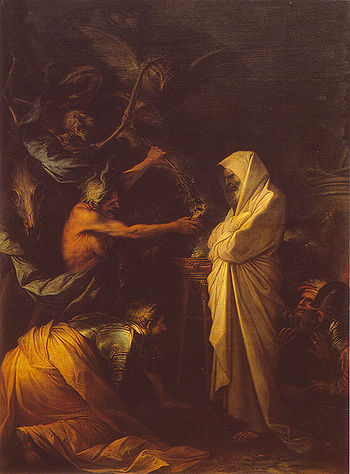
Samuel's death, however, is not completely the end of his appearance in the narrative. In the passage concerning Saul's visit to the Witch of Endor
, ascribed by textual scholars to the republican source, Samuel is temporarily raised from the dead
so that he can tell Saul his future. Many Christian interpretations of this event portray Samuel's appearance as being a deception from Satan, or even a demon in disguise. There are other interpretations which say that Saul and the witch having been frightened by his appearance, and Samuel as having been composed, classical rabbinical sources argue that Samuel was terrified by the ordeal, having expected to be appearing to face God's judgement, and had therefore brought Moses with him (to the land of the living) as a witness to his adherence to the mitzvot.
, and one of the Psalms
, Samuel had a high devotion to God. Classical Rabbinical literature adds that he was more than an equal to Moses, God speaking directly to Samuel, rather than Samuel having to attend the tabernacle to hear God. Samuel is also described by the Rabbis as having been extremely intelligent; he argued that it was legitimate for laymen to slaughter sacrifices, since the Halakha
only insisted that the priests bring the blood (cf , Zebahim 32a). Eli, who was viewed negatively by many Classical Rabbis, is said to have reacted to this logic of Samuel by arguing that it was technically true, but Samuel should be put to death for making legal statements while Eli (his mentor) was present.
Samuel is also treated by the Classical Rabbis as a much more sympathetic character than he appears at face value in the Bible; his annual circuit is explained as being due to his wish to spare people the task of having to journey to him; Samuel is said to have been very rich, taking his entire household with him on the circuit so that he didn't need to impose himself on anyone's hospitality; when Saul fell out of God's favour, Samuel is described as having grieved copiously and having prematurely aged.
liturgical calendar
, his feast day is August 20. He is commemorated as one of the Holy Forefathers in the Calendar of Saints
of the Armenian Apostolic Church
on July 30. In the Coptic Orthodox Church, the commemoration of the departure of Samuel the Prophet is celebrated on 9 Paoni
.
and seer
in the Islamic faith. The narrative of Samuel in Muslim
literature
focuses specifically on his birth and the anointing of Saul
. Other elements from his narrative are in accordance with the narratives of other prophet
s of Israel
, as exegesis
recounts Samuel's preaching against idolatry
. Although he is mentioned in the Qur'an
, his name is not given but he is instead referred to as "a Prophet". According to Islamic history, the Israelites, after the time of the prophet Moses
, wanted a king
to rule over their country. Thus, God
sent the prophet Samuel to anoint Saul
as the first king for the Israelites. The Qur'an states:
The Qur'an goes onto state that a king was anointed by the prophet, whose name was Talut (Saul
in the Hebrew Bible
). However, it states that the Israelites mocked and reviled the newly appointed king, as he was not wealthy from birth. But, in sharp contrast to the Hebrew Bible
, the Qur'an praises Saul greatly, and mentions that he was gifted with great spiritual and physical strength. In the Qur'anic account, Samuel prophesies to the children of Israel, telling them that the sign of Saul's kingship will be that the Ark of the Covenant
will come back to the Israelites:
History of ancient Israel and Judah
Israel and Judah were related Iron Age kingdoms of ancient Palestine. The earliest known reference to the name Israel in archaeological records is in the Merneptah stele, an Egyptian record of c. 1209 BCE. By the 9th century BCE the Kingdom of Israel had emerged as an important local power before...
in the Books of Samuel
Books of Samuel
The Books of Samuel in the Jewish bible are part of the Former Prophets, , a theological history of the Israelites affirming and explaining the Torah under the guidance of the prophets.Samuel begins by telling how the prophet Samuel is chosen by...
in the Hebrew Bible
Hebrew Bible
The Hebrew Bible is a term used by biblical scholars outside of Judaism to refer to the Tanakh , a canonical collection of Jewish texts, and the common textual antecedent of the several canonical editions of the Christian Old Testament...
. He is also known as a prophet
Prophet
In religion, a prophet, from the Greek word προφήτης profitis meaning "foreteller", is an individual who is claimed to have been contacted by the supernatural or the divine, and serves as an intermediary with humanity, delivering this newfound knowledge from the supernatural entity to other people...
and is mentioned in the Qur'an
Qur'an
The Quran , also transliterated Qur'an, Koran, Alcoran, Qur’ān, Coran, Kuran, and al-Qur’ān, is the central religious text of Islam, which Muslims consider the verbatim word of God . It is regarded widely as the finest piece of literature in the Arabic language...
.
His status, as viewed by rabbinical literature, is that he was the last of the Hebrew Judges
Biblical judges
A biblical judge is "a ruler or a military leader, as well as someone who presided over legal hearings."...
and the first of the major prophet
Prophet
In religion, a prophet, from the Greek word προφήτης profitis meaning "foreteller", is an individual who is claimed to have been contacted by the supernatural or the divine, and serves as an intermediary with humanity, delivering this newfound knowledge from the supernatural entity to other people...
s who began to prophesy inside the Land of Israel
Land of Israel
The Land of Israel is the Biblical name for the territory roughly corresponding to the area encompassed by the Southern Levant, also known as Canaan and Palestine, Promised Land and Holy Land. The belief that the area is a God-given homeland of the Jewish people is based on the narrative of the...
. He was thus at the cusp between two eras. According to the text of the Books of Samuel, he also anointed the first two kings of the Kingdom of Israel: Saul
Saul
-People:Saul is a given/first name in English, the Anglicized form of the Hebrew name Shaul from the Hebrew Bible:* Saul , including people with this given namein the Bible:* Saul , a king of Edom...
and David
David
David was the second king of the united Kingdom of Israel according to the Hebrew Bible and, according to the Gospels of Matthew and Luke, an ancestor of Jesus Christ through both Saint Joseph and Mary...
.
Biblical account
Family
Samuel's mother was HannahHannah (Bible)
Hannah is the wife of Elkanah mentioned in the Books of Samuel. According to the Hebrew Bible she was the mother of Samuel...
and his father was Elkanah
Elkanah (husband of Hannah)
Elkanah was, according to the Books of Samuel, the husband of Hannah, and the father of her children including her first, Samuel. Elkanah practised polygamy; his other wife, less favoured but bearing more children, was named Peninnah. The names of Elkanah's other children apart from Samuel are...
. Hannah, at the beginning of the narrative, is barren and childless, like Abraham
Abraham
Abraham , whose birth name was Abram, is the eponym of the Abrahamic religions, among which are Judaism, Christianity and Islam...
's wife Sarah
Sarah
Sarah or Sara was the wife of Abraham and the mother of Isaac as described in the Hebrew Bible and the Quran. Her name was originally Sarai...
. Hannah prays to God for a child. Eli who is sitting at the foot of the doorpost in the sanctuary at Shiloh, sees her apparently mumbling and thinks Hannah is drunk, but is soon assured of her motivation and sobriety. Eli was, according to the Books of Samuel
Books of Samuel
The Books of Samuel in the Jewish bible are part of the Former Prophets, , a theological history of the Israelites affirming and explaining the Torah under the guidance of the prophets.Samuel begins by telling how the prophet Samuel is chosen by...
, the name of a priest of Shiloh
Shiloh (Biblical)
Shiloh was an ancient city south of ancient Tirzah and mentioned in the Hebrew Bible. Its site is at modern Khirbet Seilun, West Bank, and north of the Israeli settlement of Beth El in the West Bank....
, and one of the last Israelite Judges
Biblical judges
A biblical judge is "a ruler or a military leader, as well as someone who presided over legal hearings."...
before the rule of kings in ancient Israel. He blesses her after she promises the child to God. Subsequently Hannah becomes pregnant; her child is Samuel. After he is weaned, she leaves him in Eli's care.
Elkanah
Elkanah
Elkanah is a Hebrew name meaning "God has purchased" and may refer to several persons in the Bible called Elkanah:* Elkanah , father of Samuel.* A Levite, ancestor of a certain Berechiah....
is Samuel's father and lives at Ramah
Ramah in Benjamin
Ramah in Benjamin is a city of ancient Israel. It was located near Gibeon and Mizpah to the West, Gibeah to the South, and Geba to the East. It is identified with modern Er-Ram, about 8 km north of Jerusalem. The city is first mentioned in Joshua 18:25, near Gibeah of Benjamin. A Levite came...
(1 Sam. 1:19; 2:11; comp. 28:3), in the district of Zuph. His genealogy is also found in a pedigree of the Kohathites
Kohathites
The Kohathites were one of the four main divisions among the Levites in Biblical times. The Bible claims that the Kohathites were all descended from the eponymous Kohath, a son of Levi, although some biblical scholars regard this as a postdictional metaphor providing an aetiology of the...
(1 Chron. 6:3-15) and in that of Heman
Heman (Bible)
The name 'Heman' is a Jewish name, meaning 'Faithful'. It is found sixteen times in the New International Version of the Bible.Heman was one of 3 Levites assigned by King David to be ministers of music. He was a grandson of Samuel the prophet. He went on to become King David's seer, and to have...
, his great-grandson (ib. vi. 18-22). According to the genealogical tables, Elkanah was, a Levite
Levite
In Jewish tradition, a Levite is a member of the Hebrew tribe of Levi. When Joshua led the Israelites into the land of Canaan, the Levites were the only Israelite tribe that received cities but were not allowed to be landowners "because the Lord the God of Israel himself is their inheritance"...
, a fact otherwise not mentioned in the books of Samuel. The fact that Elkanah, a Levite, was denominated an Ephraimite is analogous to the designation of a Levite belonging to Judah
Tribe of Judah
According to the Hebrew Bible, the Tribe of Judah was one of the Tribes of Israel.Following the completion of the conquest of Canaan by the Israelite tribes after about 1200 BCE, Joshua allocated the land among the twelve tribes....
(Judges 17:7, for example).
Name
According to , HannahHannah (Bible)
Hannah is the wife of Elkanah mentioned in the Books of Samuel. According to the Hebrew Bible she was the mother of Samuel...
named Samuel in memory of her requesting a child from God and God listening. Samuel is translated as Heard of God or possibly as a sentence "God has heard" (from 'Shama', heard and 'El', God — with "Shama" as the verb and "El" as the subject). Samuel in the Hebrew root word is "sha’al" which is mentioned seven times in 1 Samuel 1 and once as "sha’ul" (1:28), which is Saul’s name in Hebrew. Coogan suggests that Saul’s birth narrative was transferred to Samuel by the Deuteronomistic Historians
Deuteronomist
The Deuteronomist, or simply D, is one of the sources underlying the Hebrew bible . It is found in the book of Deuteronomy, in the books of Joshua, Judges, Samuel, and Kings and also in the book of Jeremiah...
.
Calling
One night, around the age of 13 (maturity), Samuel heard a voice calling his name. According to the Jewish historian JosephusJosephus
Titus Flavius Josephus , also called Joseph ben Matityahu , was a 1st-century Romano-Jewish historian and hagiographer of priestly and royal ancestry who recorded Jewish history, with special emphasis on the 1st century AD and the First Jewish–Roman War, which resulted in the Destruction of...
, Samuel was about 12 years old. He initially assumed it was coming from Eli and went to Eli to ask what he wished to say. Eli, however, sent Samuel back to sleep. After this happened three times Eli realized that the voice was God's, and instructed Samuel on how to respond. Once Samuel responded God told him that the wickedness of the sons of Eli had resulted in their dynasty being condemned to destruction. Eli asked Samuel to honestly recount to him what he had been told, and upon receiving the communication merely said that God should do what seems right to himself.
Leader
During Samuel's youth at Shiloh the PhilistinesPhilistines
Philistines , Pleshet or Peleset, were a people who occupied the southern coast of Canaan at the beginning of the Iron Age . According to the Bible, they ruled the five city-states of Gaza, Askelon, Ashdod, Ekron and Gath, from the Wadi Gaza in the south to the Yarqon River in the north, but with...
inflicted a decisive defeat against the Israelites at Eben-Ezer
Eben-Ezer
Eben-Ezer , is the name of a location that is mentioned by the Books of Samuel as the scene of battles between the Israelites and Philistines. It is specified as having been less than a day's journey by foot from Shiloh, near Aphek, in the neighbourhood of Mizpah, near the western entrance of the...
, placed the land under Philistine oppression, and took the sanctuary's Ark for themselves. (Some modern textual scholars consider that the Song of Moses
Song of Moses
The Song of Moses in this article relates to the name sometimes given to the poem that appears in Deuteronomy of the Hebrew Bible written/orated just prior to Moses' death atop Mount Nebo....
, believed to be originally distinct from the surrounding text of Deuteronomy
Deuteronomy
The Book of Deuteronomy is the fifth book of the Hebrew Bible, and of the Jewish Torah/Pentateuch...
and not written by Moses
Moses
Moses was, according to the Hebrew Bible and Qur'an, a religious leader, lawgiver and prophet, to whom the authorship of the Torah is traditionally attributed...
, may in reality have been written in response to the theological implications of this disastrous defeat, possibly by Samuel himself.)
This was decades before the Israelites began to be ruled by a king. After 20 years of such oppression, Samuel, who had gained national prominence as a prophet, summoned the people to Mizpah
Mizpah in Benjamin
Mizpah was a city of Benjamin.Tell en-Nasbeh is one of two sites often identified with Biblical Mizpah of Benjamin, and is located about 8 miles north of Jerusalem. The other suggested location is Neby Samwil, which is some 4 miles north-west of Jerusalem, and situated on the loftiest hill in the...
(one of the highest hills in the land), where he organized them into an army, and led them against the Philistines. The Philistines, having marched to Mizpah to attack the newly amassed Israelite army, were soundly defeated and fled in terror. The retreating Philistines were slaughtered by the Israelites, which the Bible portrays positively. The text then states that Samuel erected a large stone at the battle site as a memorial, and there ensued a long period of peace thereafter.
National prophet, local seer
Some authors see the biblical Samuel as combining descriptions of two distinct roles:- A seer, based at RamahRamathaim-ZophimRamathaim-Zophim , also called Ramah and Ramatha in the Douay-Rheims, is a town that has been identified with the modern Neby Samwil , about 4 or 5 miles north-west of Jerusalem...
, and seemingly known scarcely beyond the immediate neighbourhood of Ramah (Saul, for example, not having heard of him, with his servant informing him of his existence instead). In this role, Samuel is associated with the bands of musical ecstatic roaming prophets (shouters - neb'im) at Gibeah, Bethel, and Gilgal, and some traditional scholars have argued that Samuel was the founder of these groups. At Ramah, Samuel secretly anoints Saul, after having met him for the first time, while Saul was looking for his father's lost donkeyDonkeyThe donkey or ass, Equus africanus asinus, is a domesticated member of the Equidae or horse family. The wild ancestor of the donkey is the African Wild Ass, E...
s, and treated him to a meal. - A prophet, based at Shiloh, who went throughout the land, from place to place, with unwearied zeal, reproving, rebuking, and exhorting the people to repentanceRepentanceRepentance is a change of thought to correct a wrong and gain forgiveness from a person who is wronged. In religious contexts it usually refers to confession to God, ceasing sin against God, and resolving to live according to religious law...
. In this role, Samuel acted as a (biblical) judgeBiblical judgesA biblical judge is "a ruler or a military leader, as well as someone who presided over legal hearings."...
, publicly advising the nation, and also giving private advice to individuals. Eventually Samuel delegates this role to his sons, based at BeershebaBeershebaBeersheba is the largest city in the Negev desert of southern Israel. Often referred to as the "Capital of the Negev", it is the seventh-largest city in Israel with a population of 194,300....
, but they behave corruptly and so the people, facing invasion from the AmmonAmmonAmmon , also referred to as the Ammonites and children of Ammon, was an ancient nation located east of the Jordan River, Gilead, and the Dead Sea, in present-day Jordan. The chief city of the country was Rabbah or Rabbath Ammon, site of the modern city of Amman, Jordan's capital...
ites, persuade Samuel to appoint a king. Samuel reluctantly does so, and anoints Saul in front of the entire nation, who had gathered to see him.
Textual scholars suggest that these two roles come from different sources, which later were spliced together to form the Book(s) of Samuel. The oldest is considered to be that which marks Samuel as the local seer of Ramah, who willingly anoints Saul as King in secret, while the latter is that which presents Samuel as a national figure, who begrudgingly anoints Saul as King in front of a national assembly. This later source is generally known as the republican source, since here, and elsewhere, it denigrates the actions and role of the monarchy (particularly those of Saul) and favours religious figures, in contrast to the other main source – the monarchial source – which treats the monarchy favourably. Theoretically if we had the monarchial source we would see Saul appointed king by public acclamation, due to his military victories, and not by cleromancy
Cleromancy
Cleromancy is a form of divination using sortition, casting of lots, or casting bones or stones, in which an outcome is determined by means that normally would be considered random, such as the rolling of dice, but are sometimes believed to reveal the will of God, or other supernatural entities.-In...
involving Samuel. Another difference between the sources is that the republican source treats the shouters as somewhat independent from Samuel rather than having been led by him . The passage in which Samuel is described as having exercised the functions of a (biblical) judge, during an annual circuit from Ramah to Bethel
Bethel
Bethel was a border city described in the Hebrew Bible as being located between Benjamin and Ephraim...
to Gilgal
Gilgal
Gilgal is a place name mentioned by the Hebrew Bible. It is a matter of debate how many of the places named Gilgal are identical.-The Gilgal associated peacefully with Joshua:...
(the Gilgal between Ebal and Gerizim) to Mizpah and back to Ramah, is thought by textual scholars to be a redaction aimed at harmonizing the two portrayals of Samuel.
The Book(s) of Samuel variously describe Samuel as having carried out sacrifices at sanctuaries, and having constructed and sanctified altar
Altar
An altar is any structure upon which offerings such as sacrifices are made for religious purposes. Altars are usually found at shrines, and they can be located in temples, churches and other places of worship...
s. According to the Mitzvot only Aaron
Aaron
In the Hebrew Bible and the Qur'an, Aaron : Ααρών ), who is often called "'Aaron the Priest"' and once Aaron the Levite , was the older brother of Moses, and a prophet of God. He represented the priestly functions of his tribe, becoming the first High Priest of the Israelites...
ic priests and/or Levites (depending on the Mitzvah
Mitzvah
The primary meaning of the Hebrew word refers to precepts and commandments as commanded by God...
) were permitted to perform these actions, and simply being a nazarite or prophet was insufficient. The books of Samuel and Kings offer numerous examples where this rule is not followed by kings and prophets, but some textual scholars look elsewhere seeking a harmonization of the issues. In the Book of Chronicles, Samuel is described as a Levite, rectifying this situation; however textual scholars widely see the Book of Chronicles as an attempt to redact the Book(s) of Samuel and of Kings
Books of Kings
The Book of Kings presents a narrative history of ancient Israel and Judah from the death of David to the release of his successor Jehoiachin from imprisonment in Babylon, a period of some 400 years...
to conform to later religious sensibilities. Since many of the Mitzvot themselves are thought to postdate the Book(s) of Samuel (according to the documentary hypothesis
Documentary hypothesis
The documentary hypothesis , holds that the Pentateuch was derived from originally independent, parallel and complete narratives, which were subsequently combined into the current form by a series of redactors...
), Chronicles is probably making its claim based on religious bias. The Levitical genealogy of is not historical, according to modern scholarship.
The Deuteronomistic Historians' Portrait of Samuel
The Deuteronomistic HistoriansDeuteronomist
The Deuteronomist, or simply D, is one of the sources underlying the Hebrew bible . It is found in the book of Deuteronomy, in the books of Joshua, Judges, Samuel, and Kings and also in the book of Jeremiah...
, who redacted the Former Prophets (Joshua, Judges, 1 & 2 Samuel, 1 & 2 Kings), idealized Samuel as a figure who is larger than life like Joshua
Joshua
Joshua , is a minor figure in the Torah, being one of the spies for Israel and in few passages as Moses's assistant. He turns to be the central character in the Hebrew Bible's Book of Joshua...
. Samuel is a priest even though he is not of the tribe of Levi from his childhood. Samuel is a judge who leads the military like in the Book of Judges and also who exercises judicial functions. In 1 Sam 12:6-17, the Deuteronomic Historians composed a speech of Samuel that puts him as the judge sent by God to save Israel. In 1 Samuel 9:6-20, Samuel is seen as a local “seer.” The Deuteronomistic Historians preserved this view of Samuel while contributing him as “the first of prophets to articulate the failure of Israel to live up to its covenant with God.” For the Deuteronomistic Historians, Samuel was extension of Moses and continuing Moses’ function as a prophet, judge, and a priest which made historical Samuel uncertain.
Samuel's retirement and death
Gilgal
Gilgal is a place name mentioned by the Hebrew Bible. It is a matter of debate how many of the places named Gilgal are identical.-The Gilgal associated peacefully with Joshua:...
, and gives them a farewell speech, in which he emphasises how prophets and judges were more important than kings, how kings should be held to account, and how the people should not fall into idol worship, or worship of Asherah
Asherah
Asherah , in Semitic mythology, is a Semitic mother goddess, who appears in a number of ancient sources including Akkadian writings by the name of Ashratum/Ashratu and in Hittite as Asherdu or Ashertu or Aserdu or Asertu...
or of Baal
Baal
Baʿal is a Northwest Semitic title and honorific meaning "master" or "lord" that is used for various gods who were patrons of cities in the Levant and Asia Minor, cognate to Akkadian Bēlu...
; Samuel threatens that God would subject the people to foreign invaders should they disobey. This is seen by some people as a deuteronomic redaction
Redaction
Redaction is a form of editing in which multiple source texts are combined and subjected to minor alteration to make them into a single work. Often this is a method of collecting a series of writings on a similar theme and creating a definitive and coherent work...
; being that archaeologically sees that Asherah was still worshipped in Israelite households well into the 6th century. However, the Bible is clear in 1 Kings 11:5, 33, and 2 Kings 23:13 that the Israelites fell into Asherah worship later on.
Samuel then went into retirement, though he reappears briefly in the two accounts of why Saul's dynasty lost divine favour (parts of and ), essentially acting, according to scholars, as the narrator's mouthpiece
Author surrogate
As a literary technique, an author surrogate is a fictional character who expresses the ideas, questions, personality and morality of the author...
. Apart from being the individual who anoints David
David
David was the second king of the united Kingdom of Israel according to the Hebrew Bible and, according to the Gospels of Matthew and Luke, an ancestor of Jesus Christ through both Saint Joseph and Mary...
as king, a role Samuel is abruptly summoned to take, he does not appear any further in the text until his own death at his hometown Ramah
Ramah in Benjamin
Ramah in Benjamin is a city of ancient Israel. It was located near Gibeon and Mizpah to the West, Gibeah to the South, and Geba to the East. It is identified with modern Er-Ram, about 8 km north of Jerusalem. The city is first mentioned in Joshua 18:25, near Gibeah of Benjamin. A Levite came...
, where he is buried (cf. , , and ). According to classical rabbinical sources, this was at the age of fifty-two.
Samuel's death, however, is not completely the end of his appearance in the narrative. In the passage concerning Saul's visit to the Witch of Endor
Witch of Endor
The Witch of Endor, sometimes called the Medium of Endor, was a woman who called up the ghost of the recently deceased prophet Samuel, at the demand of King Saul of the Kingdom of Israel in the First Book of Samuel, chapter...
, ascribed by textual scholars to the republican source, Samuel is temporarily raised from the dead
Sheol
Sheol |Hebrew]] Šʾôl) is the "grave", "pit", or "abyss" in Hebrew. She'ol is the earliest conception of the afterlife in the Jewish scriptures. It is a place of darkness to which all dead go, regardless of the moral choices made in life, and where they are "removed from the light of God"...
so that he can tell Saul his future. Many Christian interpretations of this event portray Samuel's appearance as being a deception from Satan, or even a demon in disguise. There are other interpretations which say that Saul and the witch having been frightened by his appearance, and Samuel as having been composed, classical rabbinical sources argue that Samuel was terrified by the ordeal, having expected to be appearing to face God's judgement, and had therefore brought Moses with him (to the land of the living) as a witness to his adherence to the mitzvot.
Perspectives on Samuel
Judaism
According to the Book of JeremiahBook of Jeremiah
The Book of Jeremiah is the second of the Latter Prophets in the Hebrew Bible, following the book of Isaiah and preceding Ezekiel and the Book of the Twelve....
, and one of the Psalms
Psalms
The Book of Psalms , commonly referred to simply as Psalms, is a book of the Hebrew Bible and the Christian Bible...
, Samuel had a high devotion to God. Classical Rabbinical literature adds that he was more than an equal to Moses, God speaking directly to Samuel, rather than Samuel having to attend the tabernacle to hear God. Samuel is also described by the Rabbis as having been extremely intelligent; he argued that it was legitimate for laymen to slaughter sacrifices, since the Halakha
Halakha
Halakha — also transliterated Halocho , or Halacha — is the collective body of Jewish law, including biblical law and later talmudic and rabbinic law, as well as customs and traditions.Judaism classically draws no distinction in its laws between religious and ostensibly non-religious life; Jewish...
only insisted that the priests bring the blood (cf , Zebahim 32a). Eli, who was viewed negatively by many Classical Rabbis, is said to have reacted to this logic of Samuel by arguing that it was technically true, but Samuel should be put to death for making legal statements while Eli (his mentor) was present.
Samuel is also treated by the Classical Rabbis as a much more sympathetic character than he appears at face value in the Bible; his annual circuit is explained as being due to his wish to spare people the task of having to journey to him; Samuel is said to have been very rich, taking his entire household with him on the circuit so that he didn't need to impose himself on anyone's hospitality; when Saul fell out of God's favour, Samuel is described as having grieved copiously and having prematurely aged.
Christianity
For Evangelical Christians Samuel is considered to be a Prophet, Judge, and wise Leader of Israel, and treated as an example of fulfilled commitments to God. On the Eastern OrthodoxEastern Orthodox Church
The Orthodox Church, officially called the Orthodox Catholic Church and commonly referred to as the Eastern Orthodox Church, is the second largest Christian denomination in the world, with an estimated 300 million adherents mainly in the countries of Belarus, Bulgaria, Cyprus, Georgia, Greece,...
liturgical calendar
Eastern Orthodox liturgical calendar
The Eastern Orthodox liturgical calendar describes and dictates the rhythm of the life of the Eastern Orthodox Church. Associated with each date are passages of Holy Scripture, Saints and events for commemoration, and many times special rules for fasting or feasting that correspond to the day of...
, his feast day is August 20. He is commemorated as one of the Holy Forefathers in the Calendar of Saints
Calendar of Saints (Armenian Apostolic Church)
-January:* 1 Third Day of the Fast of the Nativity* 2 Fourth Day of the Fast of the Nativity* 3 Fifth Day of the Fast of the Nativity* 4 Sixth Day of the Fast of the Nativity* 5 Eve of the Nativity and Theophany of our Lord Jesus Christ...
of the Armenian Apostolic Church
Armenian Apostolic Church
The Armenian Apostolic Church is the world's oldest National Church, is part of Oriental Orthodoxy, and is one of the most ancient Christian communities. Armenia was the first country to adopt Christianity as its official religion in 301 AD, in establishing this church...
on July 30. In the Coptic Orthodox Church, the commemoration of the departure of Samuel the Prophet is celebrated on 9 Paoni
Paoni 9 (Coptic Orthodox liturgics)
8 Paoni - Coptic calendar - 10 Paoni-Fixed commemorations:All fixed commemorations below are observed on 9 Paoni by the Coptic Orthodox Church-Saints:*Departure of Samuel the Prophet*Martyrdom of Saint Lucilianus and his four companions-References:...
.
Islam
Samuel is also a revered prophetProphet
In religion, a prophet, from the Greek word προφήτης profitis meaning "foreteller", is an individual who is claimed to have been contacted by the supernatural or the divine, and serves as an intermediary with humanity, delivering this newfound knowledge from the supernatural entity to other people...
and seer
Seer
Seer or Seers or SEER may refer to:Predicting the future* A clairvoyant, prophet, oracle, or diviner* The Seer , a fictional character on the television series Charmed...
in the Islamic faith. The narrative of Samuel in Muslim
Muslim
A Muslim, also spelled Moslem, is an adherent of Islam, a monotheistic, Abrahamic religion based on the Quran, which Muslims consider the verbatim word of God as revealed to prophet Muhammad. "Muslim" is the Arabic term for "submitter" .Muslims believe that God is one and incomparable...
literature
Literature
Literature is the art of written works, and is not bound to published sources...
focuses specifically on his birth and the anointing of Saul
Saul
-People:Saul is a given/first name in English, the Anglicized form of the Hebrew name Shaul from the Hebrew Bible:* Saul , including people with this given namein the Bible:* Saul , a king of Edom...
. Other elements from his narrative are in accordance with the narratives of other prophet
Prophet
In religion, a prophet, from the Greek word προφήτης profitis meaning "foreteller", is an individual who is claimed to have been contacted by the supernatural or the divine, and serves as an intermediary with humanity, delivering this newfound knowledge from the supernatural entity to other people...
s of Israel
Israel
The State of Israel is a parliamentary republic located in the Middle East, along the eastern shore of the Mediterranean Sea...
, as exegesis
Exegesis
Exegesis is a critical explanation or interpretation of a text, especially a religious text. Traditionally the term was used primarily for exegesis of the Bible; however, in contemporary usage it has broadened to mean a critical explanation of any text, and the term "Biblical exegesis" is used...
recounts Samuel's preaching against idolatry
Idolatry
Idolatry is a pejorative term for the worship of an idol, a physical object such as a cult image, as a god, or practices believed to verge on worship, such as giving undue honour and regard to created forms other than God. In all the Abrahamic religions idolatry is strongly forbidden, although...
. Although he is mentioned in the Qur'an
Qur'an
The Quran , also transliterated Qur'an, Koran, Alcoran, Qur’ān, Coran, Kuran, and al-Qur’ān, is the central religious text of Islam, which Muslims consider the verbatim word of God . It is regarded widely as the finest piece of literature in the Arabic language...
, his name is not given but he is instead referred to as "a Prophet". According to Islamic history, the Israelites, after the time of the prophet Moses
Muša
Mūša is a river in Northern Lithuania and Southern Latvia , having its confluence with river Nemunėlis , in Latvia, near city Bauska. Mūša is a tributary of the river Lielupė. Mūša is 164 kilometres long....
, wanted a king
King
- Centers of population :* King, Ontario, CanadaIn USA:* King, Indiana* King, North Carolina* King, Lincoln County, Wisconsin* King, Waupaca County, Wisconsin* King County, Washington- Moving-image works :Television:...
to rule over their country. Thus, God
God in Islam
In Islamic theology, God is the all-powerful and all-knowing creator, sustainer, ordainer, and judge of the universe. Islam puts a heavy emphasis on the conceptualization of God as strictly singular . God is unique and inherently One , all-merciful and omnipotent. According to the Islamic...
sent the prophet Samuel to anoint Saul
Saul
-People:Saul is a given/first name in English, the Anglicized form of the Hebrew name Shaul from the Hebrew Bible:* Saul , including people with this given namein the Bible:* Saul , a king of Edom...
as the first king for the Israelites. The Qur'an states:
The Qur'an goes onto state that a king was anointed by the prophet, whose name was Talut (Saul
Saul
-People:Saul is a given/first name in English, the Anglicized form of the Hebrew name Shaul from the Hebrew Bible:* Saul , including people with this given namein the Bible:* Saul , a king of Edom...
in the Hebrew Bible
Hebrew Bible
The Hebrew Bible is a term used by biblical scholars outside of Judaism to refer to the Tanakh , a canonical collection of Jewish texts, and the common textual antecedent of the several canonical editions of the Christian Old Testament...
). However, it states that the Israelites mocked and reviled the newly appointed king, as he was not wealthy from birth. But, in sharp contrast to the Hebrew Bible
Hebrew Bible
The Hebrew Bible is a term used by biblical scholars outside of Judaism to refer to the Tanakh , a canonical collection of Jewish texts, and the common textual antecedent of the several canonical editions of the Christian Old Testament...
, the Qur'an praises Saul greatly, and mentions that he was gifted with great spiritual and physical strength. In the Qur'anic account, Samuel prophesies to the children of Israel, telling them that the sign of Saul's kingship will be that the Ark of the Covenant
Ark of the Covenant
The Ark of the Covenant , also known as the Ark of the Testimony, is a chest described in Book of Exodus as solely containing the Tablets of Stone on which the Ten Commandments were inscribed...
will come back to the Israelites:
See also
- Biblical judgesBiblical judgesA biblical judge is "a ruler or a military leader, as well as someone who presided over legal hearings."...
- Books of SamuelBooks of SamuelThe Books of Samuel in the Jewish bible are part of the Former Prophets, , a theological history of the Israelites affirming and explaining the Torah under the guidance of the prophets.Samuel begins by telling how the prophet Samuel is chosen by...
- Book of Samuel the SeerBook of Samuel the SeerThe Book of Samuel the Seer is a lost text.-Description:A description within Books of Chronicles 29:29, the passage reads:"Now the acts of David the king, first and last, behold, they are written in the book of Samuel the seer, and in the book of Nathan the prophet, and in the book of Gad the...
- List of names referring to El
- Midrash SamuelMidrash SamuelMidrash Samuel , a aggadic midrash on the books of Samuel, is quoted for the first time by Rashi in his commentary on I Sam. ii. 30. In his Ha-Pardes Rashi again quotes from this midrash , saying that it is entitled "'Et la-'Asot la-Adonai"; it probably derived this name from Ps. cxix...
- Tomb of SamuelTomb of SamuelThe Tomb of Samuel, , is the traditional burial site of the biblical Hebrew prophet Samuel, atop a steep hill at an elevation of 908 meters above sea level. It is situated to the north of the Jerusalem neighborhood of Ramot. On the site is a building containing a mosque built in the 18th century...