

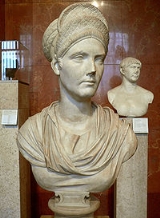
Salonina Matidia

Encyclopedia
Salonina Matidia was the daughter and only child of Ulpia Marciana
and wealthy praetor
Gaius Salonius Matidius Patruinus
. Her maternal uncle was the Roman emperor
Trajan
. Trajan had no children and treated her like his daughter. Her father died in 78 and Matidia went with her mother to live with Trajan and his wife, Pompeia Plotina
.
Between 81 and 82, Matidia married a suffect consul
and former proconsul
Lucius Vibius Sabinus
. Sabinus died in 83 or 84. Matidia bore Sabinus a daughter called Vibia Sabina
, who would marry the future Roman emperor Hadrian
. Matidia was very fond of her second cousin Hadrian and allowed him to marry Vibia Sabina.
In 84, Matidia married for a second time to an otherwise unattested Roman aristocrat called Lucius Mindius
. Matidia bore Mindius a daughter called Mindia Matidia, commonly known as Matidia Minor
. Mindius died in 85.
It is possible that Matidia also married a suffect consul of 88, Lucius Scribonius Libo Rupilius Frugi Bonus
. Frugi had a daughter called Rupilia Faustina
. Faustina would go on to marry the Roman senator
Marcus Annius Verus
, to whom she bore one daughter and two sons. Through her children, she would become the paternal grandmother of the Roman emperor Marcus Aurelius and his wife Faustina the Younger
.
Matidia often traveled with her uncle and assisted him with decision-making. Like her mother, Matidia was honored with monuments and inscriptions in her name throughout the Roman Empire. On August 29, 112, she received the title of Augusta
.
When Trajan died in 117, Matidia and Plotina brought the emperor's ashes back to Rome. In 119 Matidia died, whereupon the Roman Emperor Hadrian
delivered her funeral oration, deified her and granted her a temple and altar in Rome itself.
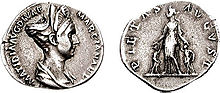
Ulpia Marciana
Ulpia Marciana was the beloved elder sister of Roman Emperor Trajan. She was the eldest child born to Roman woman Marcia and the Spanish Roman senator Marcus Ulpius Traianus. Her second name Marciana she inherited from her mother’s paternal ancestors. Her birthplace is unknown.Marciana married...
and wealthy praetor
Praetor
Praetor was a title granted by the government of Ancient Rome to men acting in one of two official capacities: the commander of an army, usually in the field, or the named commander before mustering the army; and an elected magistratus assigned varied duties...
Gaius Salonius Matidius Patruinus
Gaius Salonius Matidius Patruinus
Gaius Saloninus Matidius Patruinus was a Roman Senator that lived in the Roman Empire during the 1st century and was a contemporary to the reign of the Roman Emperor Vespasian, 69-79....
. Her maternal uncle was the Roman emperor
Roman Emperor
The Roman emperor was the ruler of the Roman State during the imperial period . The Romans had no single term for the office although at any given time, a given title was associated with the emperor...
Trajan
Trajan
Trajan , was Roman Emperor from 98 to 117 AD. Born into a non-patrician family in the province of Hispania Baetica, in Spain Trajan rose to prominence during the reign of emperor Domitian. Serving as a legatus legionis in Hispania Tarraconensis, in Spain, in 89 Trajan supported the emperor against...
. Trajan had no children and treated her like his daughter. Her father died in 78 and Matidia went with her mother to live with Trajan and his wife, Pompeia Plotina
Pompeia Plotina
Pompeia Plotina Claudia Phoebe Piso or Pompeia Plotina was a Roman Empress and wife of Roman Emperor Trajan. She was renowned for her interest in philosophy, and her virtue, dignity and simplicity. She was particularly devoted to the Epicurean philosophical school in Athens, Greece...
.
Between 81 and 82, Matidia married a suffect consul
Consul
Consul was the highest elected office of the Roman Republic and an appointive office under the Empire. The title was also used in other city states and also revived in modern states, notably in the First French Republic...
and former proconsul
Proconsul
A proconsul was a governor of a province in the Roman Republic appointed for one year by the senate. In modern usage, the title has been used for a person from one country ruling another country or bluntly interfering in another country's internal affairs.-Ancient Rome:In the Roman Republic, a...
Lucius Vibius Sabinus
Lucius Vibius Sabinus
Lucius Vibius Sabinus was a Roman Senator that lived in the 1st century. Little is known on his family however Sabinus originally came from a family of consular rank. There is a possibility, Sabinus was related to Lucius Junius Quintus Vibius Crispus and his brother Quintus Vibius Secundus...
. Sabinus died in 83 or 84. Matidia bore Sabinus a daughter called Vibia Sabina
Vibia Sabina
Vibia Sabina was a Roman Empress, wife and second cousin, once removed, to Roman Emperor Hadrian. She was the daughter to Salonina Matidia , and suffect consul Lucius Vibius Sabinus...
, who would marry the future Roman emperor Hadrian
Hadrian
Hadrian , was Roman Emperor from 117 to 138. He is best known for building Hadrian's Wall, which marked the northern limit of Roman Britain. In Rome, he re-built the Pantheon and constructed the Temple of Venus and Roma. In addition to being emperor, Hadrian was a humanist and was philhellene in...
. Matidia was very fond of her second cousin Hadrian and allowed him to marry Vibia Sabina.
In 84, Matidia married for a second time to an otherwise unattested Roman aristocrat called Lucius Mindius
Lucius Mindius
Lucius Mindius is an unattested Roman Aristocrat that lived in the Roman Empire in the second half of the 1st century. Mindius was a Roman Senator of Consular rank. Little is known on his origins. In 84, Mindius married a noblewoman called Salonina Matidia as her second husband and the niece of...
. Matidia bore Mindius a daughter called Mindia Matidia, commonly known as Matidia Minor
Matidia Minor
Mindia Matidia or Matidia Minor was related to several important ancient Roman Emperors. The modern village of Matigge Italy, is named after her....
. Mindius died in 85.
It is possible that Matidia also married a suffect consul of 88, Lucius Scribonius Libo Rupilius Frugi Bonus
Libo Rupilius Frugi
Libo Rupilius Frugi , whose full name may have been Lucius Scribonius Libo Rupilius Frugi Bonus, was a Roman Suffect Consul and an ancestor to Roman Emperor Marcus Aurelius....
. Frugi had a daughter called Rupilia Faustina
Rupilia
Rupilia Faustina was an influential Roman noble woman. She was the daughter of Salonina Matidia and suffect consul Lucius Scribonius Libo Rupilius Frugi Bonus. She possibly had another sister called Rupilia Annia....
. Faustina would go on to marry the Roman senator
Roman Senate
The Senate of the Roman Republic was a political institution in the ancient Roman Republic, however, it was not an elected body, but one whose members were appointed by the consuls, and later by the censors. After a magistrate served his term in office, it usually was followed with automatic...
Marcus Annius Verus
Marcus Annius Verus
Marcus Annius Verus was a Roman man who lived in the 1st and 2nd century. He was the son of an elder Marcus Annius Verus, who gained the rank of senator and praetor. His family originated from Uccibi near Corduba in Spain...
, to whom she bore one daughter and two sons. Through her children, she would become the paternal grandmother of the Roman emperor Marcus Aurelius and his wife Faustina the Younger
Faustina the Younger
Annia Galeria Faustina Minor , Faustina Minor or Faustina the Younger was a daughter of Roman Emperor Antoninus Pius and Roman Empress Faustina the Elder. She was a Roman Empress and wife to her maternal cousin Roman Emperor Marcus Aurelius...
.
Matidia often traveled with her uncle and assisted him with decision-making. Like her mother, Matidia was honored with monuments and inscriptions in her name throughout the Roman Empire. On August 29, 112, she received the title of Augusta
Augusta (honorific)
Augusta was the imperial honorific title of empresses. It was given to the women of the Roman and Byzantine imperial families. In the third century, Augustae could also receive the titles of Mater castrorum and Mater Patriae .The title implied the greatest prestige, with the Augustae able to...
.
When Trajan died in 117, Matidia and Plotina brought the emperor's ashes back to Rome. In 119 Matidia died, whereupon the Roman Emperor Hadrian
Hadrian
Hadrian , was Roman Emperor from 117 to 138. He is best known for building Hadrian's Wall, which marked the northern limit of Roman Britain. In Rome, he re-built the Pantheon and constructed the Temple of Venus and Roma. In addition to being emperor, Hadrian was a humanist and was philhellene in...
delivered her funeral oration, deified her and granted her a temple and altar in Rome itself.