

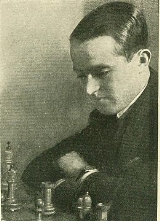
Salo Flohr

Encyclopedia
Salomon Mikhailovich Flohr (November 21, 1908 – July 18, 1983) was a leading Czech
and later Soviet chess
grandmaster of the mid-20th century, who became a national hero in Czechoslovakia during the 1930s. His name was used to sell many of the luxury products of the time, including Salo Flohr cigarettes, slippers and eau-de-cologne. Flohr dominated many tournaments of the pre-World War II years, and by the late 1930s was considered a contender for the world championship
. However, his patient, positional style was overtaken by the sharper, more tactical methods of the younger Soviet echelon after World War II. Flohr was also a well-respected chess author, and an International Arbiter
.
in what was then Galicia, Austria-Hungary
(now in Ukraine
). He and his brother were orphaned during World War I after their parents were killed in a massacre, and they fled to the newly-formed nation of Czechoslovakia.
Flohr settled in Prague
, gradually acquiring a reputation as a skilled chessplayer by playing for stakes in the city's many cafés. During 1924, he participated in simultaneous exhibition
s by Richard Réti
and Rudolf Spielmann
, and he was still giving displays well into his seventies.
, and made his international debut at the Rohitsch-Sauerbrunn (Rogaška Slatina
) tournament in Slovenia
, where he finished second to Akiba Rubinstein
in the latter's final success. Flohr had also taken a job as a chess journalist, and one of his first assignments had been to cover the 1928 Berlin tournament, where he continued to win money on the side by playing chess.
in 1932, where he shared first place with Milan Vidmar
; Scheveningen in 1933; Bad Liebenwerda
in 1934 with 9.5/11; Barcelona in 1935 where he tied for first with George Koltanowski
; Moscow in 1935 where he came 1st= with future World Champion Mikhail Botvinnik
; Poděbrady
in 1936 with the score of +10 =6 -1; and Kemeri
in 1937 where he shared the top spot with Vladimir Petrov
and Samuel Reshevsky
. During this period, he had several other notable high finishes, such as Bern 1932 (tied for second with 11.5/15, after world champion Alexander Alekhine
); Zürich
1934 (tied for second with 12/15, again trailing Alekhine); and Pärnu
1937 (second behind Paul Felix Schmidt
).
Flohr also frequently visited England, regularly playing in the Hastings tournaments
of the 1930s. He was first in 1931/32, 1932/33 and 1933/34, finished 1st= with Max Euwe
and Sir George Thomas
in 1934/35, and was second behind only Reuben Fine
in 1935/36. He also won the Margate
tournament of 1936 ahead of former world champion José Raúl Capablanca
.
s was equally impressive, according to the comprehensive Olympiad site olimpbase.org. He made his debut at Hamburg 1930
on board one, scoring a phenomenal 14.5/17 for the silver medal. On home soil at Prague 1931
, again on board one, he scored 11/18, and led Czechoslovakia to a team bronze medal. At Folkestone 1933
, he again played board one, and made 9/14, helping Czechoslovakia to the team silver, and earning a bronze medal for himself. At Warsaw 1935
, on board one he scored an unbeaten 13/17 for another individual gold medal, and Czechoslovakia finished fifth. Then at Stockholm 1937
, once again on board one, he scored 12.5/16 for a third individual gold medal. In five Olympiads, he won two individual gold medals, a silver and a bronze. His aggregate was 60/82, for a fantastic 73 per cent against the top players in the world. However, it should be noted that the Soviet Union did not compete during those years.
. He drew a 16-game match against Euwe in 1932 (+3 =10 -3), and drew against Botvinnik in 1933 (+2 =8 -2). Flohr beat Gösta Stoltz
by 5.5-2.5 in 1931 and, a year later, beat Mir Sultan Khan
, the 1932 and 1933 British Champion
, by 3.5-2.5. Flohr also defeated Johannes van den Bosch at the Hague in 1932 by 6-2. In 1933, he won two matches in Switzerland, first over Oskar Naegeli
by 4-2 at Bern, and then by 4.5-1.5 over Henri Grob
at Arosa
.
of November 1938. He finished last, and this put an end to his chances of a World Championship match with Alekhine. AVRO may have been the only time in chess history when the top eight players in the world contested an important tournament.
While AVRO was an incredibly strong tournament, and Flohr's last-placed finish was no disgrace, his result may also be explained by his difficult personal circumstances at the time. The German invasion of Czechoslovakia in 1938 had left Flohr, as a Polish-Ukrainian Jew, in grave personal danger. Flohr remained in the Netherlands in early 1939, playing in several small events. He tied 1st-3rd in Amsterdam
KNSB with Max Euwe
and László Szabó
at 3.5/5. He tied 3rd-4th in Amsterdam VARA with 3/5, as Euwe and Salo Landau
won. He won Baarn
I with 2.5/3. Then, he and his family fled, first to Sweden, and then to Moscow with the help of his friend Botvinnik. While in Sweden, he tied 1st-2nd at Gothenburg
with Rudolf Spielmann
on 10/11.
, and then tied for second at Bournemouth
1939 with 8.5/11, behind only former World Champion Euwe.
Flohr did not play in any official strong Soviet events from 1940-42. He did lose a 1942 match to Vladimir Makogonov
in Baku
by 2-0. He became a naturalized Soviet
citizen in 1942, and developed his writing career in his new country, contributing articles to a number of Soviet newspapers and magazines, including Ogonek. As the Soviet Union first stopped then reversed the Nazi invasion, some chess activity started up again, and in 1943 Flohr won a small but strong tournament in Baku
. In 1944 he was again victorious in a Bolshevik Society tournament at Kiev
, tied with Alexei Sokolsky. He withdrew from the 1945 USSR Championship after only three games.
After the War, he was still a contender for a possible World Championship match, and finished 6th at the 1948 Interzonal
in Saltsjöbaden
, thereby qualifying to play in the 1950 Candidates Tournament
in Budapest
. However, he finished joint last with 7 out of 18, and never entered the World Championship cycle again, preferring to concentrate on journalism, and he also developed a role as a chess organiser. He did play periodically at high levels, both within the Soviet Union and abroad, with some success, until the late 1960s. He was awarded the title of International Arbiter
in 1963.
Salo Flohr died in Moscow on July 18, 1983.
title on its inaugural list in 1950. He made a number of important contributions to opening theory: a 'Flohr variation' can be found in no fewer than six major openings, including the Caro-Kann Defence
, the Ruy Lopez
, the English Opening
, and the Grünfeld Defence
. The Flohr-Zaitsev Variation of the Closed Ruy Lopez (1.e4 e5 2.Nf3 Nc6 3.Bb5 a6 4.Ba4 Nf6 5.0-0 Be7 6.Re1 b5 7.Bb3 d6 8.c3 0-0 9.h3 Bb7 10.d4 Re8) was taken up in the 1980s with success by World Champion Anatoly Karpov
.
Flohr was primarily a strategist who excelled in the endgame. He favoured the Closed openings with White, and during the prime of his career, he was especially deadly with the Queen's Gambit
, as the game selection shows. Flohr almost never opened with 1.e4. He was one of the main developers of the Caro-Kann, which was an obscure and poorly-regarded line as late as the 1920s when Flohr took it up.
The Second World War killed off any chance he had of winning the world title, and the stress of becoming a refugee for the second time in his life affected his style of play. He became a much more cautious player in his post-war games and earned a drawish reputation, with many short draws which were hardly contested. He could not keep pace with the new generation of Soviet stars which emerged after World War II. Players such as Vasily Smyslov
, David Bronstein
, Isaac Boleslavsky
, Paul Keres
, Alexander Kotov
, Tigran Petrosian
, Efim Geller
, Mark Taimanov
, Yuri Averbakh
, Boris Spassky
, Mikhail Tal
, Viktor Korchnoi
, and Leonid Stein
dominated the landscape with their sharper styles and innovative openings.
According to the site chessmetrics
.com, which compares historical ratings, Flohr was among the world's top 20 players from 1930 to 1951, except for the war years 1942-44 when he was largely inactive; and his ranking peaked at #2 in the world in 1935.http://chessmetrics.com/cm/CM2/PlayerProfile.asp?Params=199510SSSSS3S038519000000111000000000000010100
But it is noteworthy that Flohr was never able to defeat Alekhine head-to-head, losing five games and drawing seven in their 12 encounters. Alekhine had a sharp, tactical style, and he could also play outstanding positional chess. It is highly unlikely that Flohr could have won a match against him, had he been given the chance.
Czechoslovakia
Czechoslovakia or Czecho-Slovakia was a sovereign state in Central Europe which existed from October 1918, when it declared its independence from the Austro-Hungarian Empire, until 1992...
and later Soviet chess
Chess
Chess is a two-player board game played on a chessboard, a square-checkered board with 64 squares arranged in an eight-by-eight grid. It is one of the world's most popular games, played by millions of people worldwide at home, in clubs, online, by correspondence, and in tournaments.Each player...
grandmaster of the mid-20th century, who became a national hero in Czechoslovakia during the 1930s. His name was used to sell many of the luxury products of the time, including Salo Flohr cigarettes, slippers and eau-de-cologne. Flohr dominated many tournaments of the pre-World War II years, and by the late 1930s was considered a contender for the world championship
World Chess Championship
The World Chess Championship is played to determine the World Champion in the board game chess. Men and women of any age are eligible to contest this title....
. However, his patient, positional style was overtaken by the sharper, more tactical methods of the younger Soviet echelon after World War II. Flohr was also a well-respected chess author, and an International Arbiter
International Arbiter
In chess, International Arbiter is a title awarded by FIDE to individuals deemed capable of acting as arbiter in important chess matches . The title was established in 1951....
.
Early life
Flohr had a troubled childhood beset by personal crises. He was born in a Jewish family in HorodenkaHorodenka
Horodenka is a city located in the Ivano-Frankivsk Oblast, in western Ukraine. It is the administrative center of Horodenka Raion .The current estimated population is around 9,800 .-History:...
in what was then Galicia, Austria-Hungary
Austria-Hungary
Austria-Hungary , more formally known as the Kingdoms and Lands Represented in the Imperial Council and the Lands of the Holy Hungarian Crown of Saint Stephen, was a constitutional monarchic union between the crowns of the Austrian Empire and the Kingdom of Hungary in...
(now in Ukraine
Ukraine
Ukraine is a country in Eastern Europe. It has an area of 603,628 km², making it the second largest contiguous country on the European continent, after Russia...
). He and his brother were orphaned during World War I after their parents were killed in a massacre, and they fled to the newly-formed nation of Czechoslovakia.
Flohr settled in Prague
Prague
Prague is the capital and largest city of the Czech Republic. Situated in the north-west of the country on the Vltava river, the city is home to about 1.3 million people, while its metropolitan area is estimated to have a population of over 2.3 million...
, gradually acquiring a reputation as a skilled chessplayer by playing for stakes in the city's many cafés. During 1924, he participated in simultaneous exhibition
Simultaneous exhibition
A simultaneous exhibition or simultaneous display is a board game exhibition in which one player plays multiple games at a time with a number of other players. Such an exhibition is often referred to simply as a "simul".In a regular simul, no chess clocks are used...
s by Richard Réti
Richard Réti
Réti composed one of the most famous chess studies, shown in this diagram. It was published in Ostrauer Morgenzeitung 4 December 1921. It seems impossible for the white king to catch the advanced black pawn, while the white pawn can be easily stopped by the black king...
and Rudolf Spielmann
Rudolf Spielmann
Rudolf Spielmann was an Austrian-Jewish chess player of the romantic school, and chess writer.-Career:He was a lawyer but never worked as one....
, and he was still giving displays well into his seventies.
Early successes
Flohr won the Kautsky Memorial tournaments of 1928 and 1929 which were held in PraguePrague
Prague is the capital and largest city of the Czech Republic. Situated in the north-west of the country on the Vltava river, the city is home to about 1.3 million people, while its metropolitan area is estimated to have a population of over 2.3 million...
, and made his international debut at the Rohitsch-Sauerbrunn (Rogaška Slatina
Rogaška Slatina
Rogaška Slatina is a settlement and a municipality in Slovenia. It is famous for its curative mineral water, spa and crystal glass.Rogaška Slatina is a synonym for health resort tourism in Slovenia. For centuries the curative mineral water rich in magnesium , the picturesque countryside and other...
) tournament in Slovenia
Slovenia
Slovenia , officially the Republic of Slovenia , is a country in Central and Southeastern Europe touching the Alps and bordering the Mediterranean. Slovenia borders Italy to the west, Croatia to the south and east, Hungary to the northeast, and Austria to the north, and also has a small portion of...
, where he finished second to Akiba Rubinstein
Akiba Rubinstein
Akiba Kiwelowicz Rubinstein was a famous Polish chess Grandmaster at the beginning of the 20th century. He was scheduled to play a match with Emanuel Lasker for the world championship in 1914, but it was cancelled because of the outbreak of World War I...
in the latter's final success. Flohr had also taken a job as a chess journalist, and one of his first assignments had been to cover the 1928 Berlin tournament, where he continued to win money on the side by playing chess.
World title contender
Flohr's playing ability peaked in the mid-1930s, when he became one of the world's strongest players and a leading contender for the world championship. He became champion of Czechoslovakia in 1933 and 1936 and played in many tournaments throughout Europe, generally finishing amongst the top three. Notable victories were at Bad SliačSliac
Sliač is a small spa town located in central Slovakia, on the Hron river, between Banská Bystrica and Zvolen. The town is known for its healing hot springs and for an airport which has been used for military as well as civil purposes...
in 1932, where he shared first place with Milan Vidmar
Milan Vidmar
Milan Vidmar was a Slovene electrical engineer, chess player, chess theorist, philosopher, and writer. He was a specialist in power transformers and transmission of electric current.- Biography :...
; Scheveningen in 1933; Bad Liebenwerda
Bad Liebenwerda
Bad Liebenwerda is a spa town in the Elbe-Elster district, in southwestern Brandenburg, Germany. It is situated on the river Schwarze Elster, 57 km northwest of Dresden, and 28 km east of Torgau.- History :...
in 1934 with 9.5/11; Barcelona in 1935 where he tied for first with George Koltanowski
George Koltanowski
George Koltanowski was a Belgian-born American chess player, promoter, and writer. He was informally known as "Kolty". Koltanowski set the world's blindfold record on 20 September 1937, in Edinburgh, by playing 34 chess games simultaneously while blindfolded, making headline news around the world...
; Moscow in 1935 where he came 1st= with future World Champion Mikhail Botvinnik
Mikhail Botvinnik
Mikhail Moiseyevich Botvinnik, Ph.D. was a Soviet and Russian International Grandmaster and three-time World Chess Champion. Working as an electrical engineer and computer scientist at the same time, he was one of the very few famous chess players who achieved distinction in another career while...
; Poděbrady
Podebrady
Poděbrady is a historical spa town in the Central Bohemian Region, Czech Republic. It lies on the river Labe 50 km east of Prague on the D11 highway. A historic milestone in the life of the town was the year 1905, when it was visited by the German estate owner Prince von Bülow...
in 1936 with the score of +10 =6 -1; and Kemeri
Ķemeri
Ķemeri resort is a part of Jūrmala in Latvia, 44 km from Riga. From 1928 to 1959, Ķemeri was a separate town, famous for the healing mud baths and luxurious hotel. Now about 2 200 inhabitants live there, while the main hotel is under reconstruction....
in 1937 where he shared the top spot with Vladimir Petrov
Vladimirs Petrovs
Vladimirs Petrovs or Vladimir Petrov was a Latvian chess master.He was born in Riga, Latvia. Though he learned the game of chess relatively late, at age thirteen, Petrovs made rapid progress. By 1926, at age 19, he won the Riga Championship and finish third in the national championship...
and Samuel Reshevsky
Samuel Reshevsky
Samuel "Sammy" Herman Reshevsky was a famous chess prodigy and later a leading American chess Grandmaster...
. During this period, he had several other notable high finishes, such as Bern 1932 (tied for second with 11.5/15, after world champion Alexander Alekhine
Alexander Alekhine
Alexander Alexandrovich Alekhine was the fourth World Chess Champion. He is often considered one of the greatest chess players ever.By the age of twenty-two, he was already among the strongest chess players in the world. During the 1920s, he won most of the tournaments in which he played...
); Zürich
Zürich
Zurich is the largest city in Switzerland and the capital of the canton of Zurich. It is located in central Switzerland at the northwestern tip of Lake Zurich...
1934 (tied for second with 12/15, again trailing Alekhine); and Pärnu
Pärnu
Pärnu is a city in southwestern Estonia on the coast of Pärnu Bay, an inlet of the Gulf of Riga in the Baltic Sea. It is a popular summer vacation resort with many hotels, restaurants, and large beaches. The Pärnu River flows through the city and drains into the Gulf of Riga...
1937 (second behind Paul Felix Schmidt
Paul Felix Schmidt
Paul Felix Schmidt was an Estonian chess International Master, chess writer, and chemist.- Biography :In June 1935, he won, ahead of Paul Keres, at Tallinn. In May 1936, he drew a match against Keres at Pärnu. In 1936, he won the 8th Estonian Championship at Tallinn. In December 1936, he placed...
).
Flohr also frequently visited England, regularly playing in the Hastings tournaments
Hastings International Chess Congress
The Hastings International Chess Congress is an annual chess congress which takes place in Hastings, England, around the turn of the year. The main event is the Hastings Premier tournament, which was traditionally a 10 to 16 player round-robin tournament. In 2004/05 the tournament was played in the...
of the 1930s. He was first in 1931/32, 1932/33 and 1933/34, finished 1st= with Max Euwe
Max Euwe
Machgielis Euwe was a Dutch chess Grandmaster, mathematician, and author. He was the fifth player to become World Chess Champion . Euwe also served as President of FIDE, the World Chess Federation, from 1970 to 1978.- Early years :Euwe was born in Watergraafsmeer, near Amsterdam...
and Sir George Thomas
George Alan Thomas
Sir George Alan Thomas, Bart. was a British badminton, tennis and chess player. He was twice British Chess Champion and a 21-time All-England Badminton champion. He also played in the semi-finals of the men's tennis doubles at Wimbledon in 1911...
in 1934/35, and was second behind only Reuben Fine
Reuben Fine
Reuben Fine was one of the strongest chess players in the world from the early 1930s through the 1940s, an International Grandmaster, psychologist, university professor, and author of many books on both chess and psychology.Fine won five medals in three chess Olympiads. Fine won the U.S...
in 1935/36. He also won the Margate
Margate
-Demography:As of the 2001 UK census, Margate had a population of 40,386.The ethnicity of the town was 97.1% white, 1.0% mixed race, 0.5% black, 0.8% Asian, 0.6% Chinese or other ethnicity....
tournament of 1936 ahead of former world champion José Raúl Capablanca
José Raúl Capablanca
José Raúl Capablanca y Graupera was a Cuban chess player who was world chess champion from 1921 to 1927. One of the greatest players of all time, he was renowned for his exceptional endgame skill and speed of play...
.
Excels in Chess Olympiads
His form for his adopted country in the Chess OlympiadChess Olympiad
The Chess Olympiad is a biennial chess tournament in which teams from all over the world compete against each other. The event is organised by FIDE, which selects the host nation.-Birth of the Olympiad:The first Olympiad was unofficial...
s was equally impressive, according to the comprehensive Olympiad site olimpbase.org. He made his debut at Hamburg 1930
3rd Chess Olympiad
The 3rd Chess Olympiad, organized by the FIDE and comprising an open and women's tournament, as well as several events designed to promote the game of chess, took place between July 13 and July 27, 1930, in Hamburg, Germany...
on board one, scoring a phenomenal 14.5/17 for the silver medal. On home soil at Prague 1931
4th Chess Olympiad
The 4th Chess Olympiad, organized by the Fédération Internationale des Échecs and comprising an open and women's tournament, as well as several events designed to promote the game of chess, took place between July 11 and July 26, 1931, in Prague, Czechoslovakia...
, again on board one, he scored 11/18, and led Czechoslovakia to a team bronze medal. At Folkestone 1933
5th Chess Olympiad
The 5th Chess Olympiad, organized by the FIDE and comprising an open and women's tournament, as well as several events designed to promote the game of chess, took place between July 12 and July 23, 1933, in Folkestone, United Kingdom...
, he again played board one, and made 9/14, helping Czechoslovakia to the team silver, and earning a bronze medal for himself. At Warsaw 1935
6th Chess Olympiad
The 6th Chess Olympiad, organized by the FIDE and comprising an open and women's tournament, as well as several events designed to promote the game of chess, took place between August 16 and August 31, 1935, in Warsaw, Poland...
, on board one he scored an unbeaten 13/17 for another individual gold medal, and Czechoslovakia finished fifth. Then at Stockholm 1937
7th Chess Olympiad
The 7th Chess Olympiad, organized by the FIDE and comprising an open and women's tournament, as well as several events designed to promote the game of chess, took place between July 31 and August 14, 1937, in Stockholm, Sweden]....
, once again on board one, he scored 12.5/16 for a third individual gold medal. In five Olympiads, he won two individual gold medals, a silver and a bronze. His aggregate was 60/82, for a fantastic 73 per cent against the top players in the world. However, it should be noted that the Soviet Union did not compete during those years.
Match results
In addition, Flohr enjoyed a fair amount of success in match play, and he played matches with two of his main rivals for the title of challenger to reigning champion Alexander AlekhineAlexander Alekhine
Alexander Alexandrovich Alekhine was the fourth World Chess Champion. He is often considered one of the greatest chess players ever.By the age of twenty-two, he was already among the strongest chess players in the world. During the 1920s, he won most of the tournaments in which he played...
. He drew a 16-game match against Euwe in 1932 (+3 =10 -3), and drew against Botvinnik in 1933 (+2 =8 -2). Flohr beat Gösta Stoltz
Gösta Stoltz
-Biography:Stoltz played a few matches with strong chess masters. In 1926, he lost to Mikhail Botvinnik at a team match Stockholm – Leningrad in Stockholm. In 1927, he drew with Allan Nilsson in Göteborg . In 1930, he won against Isaac Kashdan in Stockholm. In 1930, he lost to Rudolf Spielmann ...
by 5.5-2.5 in 1931 and, a year later, beat Mir Sultan Khan
Mir Sultan Khan
Malik Mir Sultan Khan was the strongest chess master of his time from Asia. This manservant from British India traveled with Colonel Nawab Sir Umar Hayat Khan , his master, to Britain, where he took the chess world by storm...
, the 1932 and 1933 British Champion
British Chess Championship
The British Chess Championship is organised by the English Chess Federation. There are separate championships for men and women. Since 1923 there have been sections for juniors, and since 1982 there has been an over-sixty championship. The championship venue usually changes every year and has been...
, by 3.5-2.5. Flohr also defeated Johannes van den Bosch at the Hague in 1932 by 6-2. In 1933, he won two matches in Switzerland, first over Oskar Naegeli
Oskar Naegeli
Prof. Dr. Oskar Naegeli , was a Swiss dermatologist and chess master. He represented Switzerland at the Chess Olympiads in 1927, 1928, 1931 and 1935, as well as at the unofficial Olympiad in 1936 at Munich.Naegeli won twice Swiss Chess Championship...
by 4-2 at Bern, and then by 4.5-1.5 over Henri Grob
Henri Grob
Henri Grob was a Swiss chess master.Grob represented Switzerland in Chess Olympiads.* In 1927, at fourth board in 1st Chess Olympiad in London ;...
at Arosa
Arosa
Arosa is a town and a municipality in the district of Plessur in the canton of Graubünden in Switzerland. It is both a summer and a winter tourist resort.-History:...
.
Official challenger, personal crisis
Flohr had married in 1935. By 1937, FIDE had nominated him as the official candidate to play Alekhine for the World Championship. However, with World War II looming, it proved impossible for Flohr to raise the stake money in Czechoslovakia, so the plans were dropped. The next year, Flohr was one of the eight elite players invited to the great AVRO tournamentAVRO tournament
The AVRO tournament was a chess tournament held in the Netherlands in 1938, sponsored by the Dutch broadcasting company AVRO. The event was a double round-robin tournament...
of November 1938. He finished last, and this put an end to his chances of a World Championship match with Alekhine. AVRO may have been the only time in chess history when the top eight players in the world contested an important tournament.
While AVRO was an incredibly strong tournament, and Flohr's last-placed finish was no disgrace, his result may also be explained by his difficult personal circumstances at the time. The German invasion of Czechoslovakia in 1938 had left Flohr, as a Polish-Ukrainian Jew, in grave personal danger. Flohr remained in the Netherlands in early 1939, playing in several small events. He tied 1st-3rd in Amsterdam
Amsterdam
Amsterdam is the largest city and the capital of the Netherlands. The current position of Amsterdam as capital city of the Kingdom of the Netherlands is governed by the constitution of August 24, 1815 and its successors. Amsterdam has a population of 783,364 within city limits, an urban population...
KNSB with Max Euwe
Max Euwe
Machgielis Euwe was a Dutch chess Grandmaster, mathematician, and author. He was the fifth player to become World Chess Champion . Euwe also served as President of FIDE, the World Chess Federation, from 1970 to 1978.- Early years :Euwe was born in Watergraafsmeer, near Amsterdam...
and László Szabó
László Szabó (chess player)
László Szabó was a prominent Hungarian Grandmaster of chess.Born in Budapest, he burst onto the international chess scene in 1935, at the unusually young age of 18...
at 3.5/5. He tied 3rd-4th in Amsterdam VARA with 3/5, as Euwe and Salo Landau
Salo Landau
Salo Landau was a Dutch chess player, who died in a Nazi concentration camp.-Early life:...
won. He won Baarn
Baarn
Baarn is a municipality and a town in the Netherlands, in the province of Utrecht.-The municipality Baarn :The municipality of Baarn consists of the following towns: Baarn, Eembrugge, Lage Vuursche.- The town Baarn :...
I with 2.5/3. Then, he and his family fled, first to Sweden, and then to Moscow with the help of his friend Botvinnik. While in Sweden, he tied 1st-2nd at Gothenburg
Gothenburg
Gothenburg is the second-largest city in Sweden and the fifth-largest in the Nordic countries. Situated on the west coast of Sweden, the city proper has a population of 519,399, with 549,839 in the urban area and total of 937,015 inhabitants in the metropolitan area...
with Rudolf Spielmann
Rudolf Spielmann
Rudolf Spielmann was an Austrian-Jewish chess player of the romantic school, and chess writer.-Career:He was a lawyer but never worked as one....
on 10/11.
Soviet citizen, recovers form
Flohr was able to recover his form after reaching safety in Moscow. He won Kemeri 1939 with a wonderful score of 12/15, also captured the very strong 1939 Leningrad / Moscow tournament with 12/17, tied for second at Margate 1939 with 6.5/9 behind only Paul KeresPaul Keres
Paul Keres , was an Estonian chess grandmaster, and a renowned chess writer. He was among the world's top players from the mid-1930s to the mid-1960s....
, and then tied for second at Bournemouth
Bournemouth
Bournemouth is a large coastal resort town in the ceremonial county of Dorset, England. According to the 2001 Census the town has a population of 163,444, making it the largest settlement in Dorset. It is also the largest settlement between Southampton and Plymouth...
1939 with 8.5/11, behind only former World Champion Euwe.
Flohr did not play in any official strong Soviet events from 1940-42. He did lose a 1942 match to Vladimir Makogonov
Vladimir Makogonov
Vladimir Andreevich Makogonov was a chess player from Azerbaijan. He was born in Nakhchivan but lived in Baku for most of his life. He became an International Master in 1950 and was awarded an honorary Grandmaster title in 1987. Makogonov never became well known outside the Soviet Union, but was...
in Baku
Baku
Baku , sometimes spelled as Baki or Bakou, is the capital and largest city of Azerbaijan, as well as the largest city on the Caspian Sea and of the Caucasus region. It is located on the southern shore of the Absheron Peninsula, which projects into the Caspian Sea. The city consists of two principal...
by 2-0. He became a naturalized Soviet
Soviet Union
The Soviet Union , officially the Union of Soviet Socialist Republics , was a constitutionally socialist state that existed in Eurasia between 1922 and 1991....
citizen in 1942, and developed his writing career in his new country, contributing articles to a number of Soviet newspapers and magazines, including Ogonek. As the Soviet Union first stopped then reversed the Nazi invasion, some chess activity started up again, and in 1943 Flohr won a small but strong tournament in Baku
Baku
Baku , sometimes spelled as Baki or Bakou, is the capital and largest city of Azerbaijan, as well as the largest city on the Caspian Sea and of the Caucasus region. It is located on the southern shore of the Absheron Peninsula, which projects into the Caspian Sea. The city consists of two principal...
. In 1944 he was again victorious in a Bolshevik Society tournament at Kiev
Kiev
Kiev or Kyiv is the capital and the largest city of Ukraine, located in the north central part of the country on the Dnieper River. The population as of the 2001 census was 2,611,300. However, higher numbers have been cited in the press....
, tied with Alexei Sokolsky. He withdrew from the 1945 USSR Championship after only three games.
After the War, he was still a contender for a possible World Championship match, and finished 6th at the 1948 Interzonal
Interzonal
Interzonal chess tournaments were tournaments organized by FIDE, the World Chess Federation, and were a stage in the triennial World Chess Championship cycle.- Zonal tournaments :...
in Saltsjöbaden
Saltsjöbaden
Saltsjöbaden is a locality situated in Nacka Municipality, Stockholm County, Sweden with 8,937 inhabitants in 2005. It is located on the coast of the Baltic Sea.- History :...
, thereby qualifying to play in the 1950 Candidates Tournament
Candidates Tournament
The Candidates Tournament is a chess tournament organized by the world chess federation FIDE since 1950, as the final contest to determine the challenger for the World Chess Championship...
in Budapest
Budapest
Budapest is the capital of Hungary. As the largest city of Hungary, it is the country's principal political, cultural, commercial, industrial, and transportation centre. In 2011, Budapest had 1,733,685 inhabitants, down from its 1989 peak of 2,113,645 due to suburbanization. The Budapest Commuter...
. However, he finished joint last with 7 out of 18, and never entered the World Championship cycle again, preferring to concentrate on journalism, and he also developed a role as a chess organiser. He did play periodically at high levels, both within the Soviet Union and abroad, with some success, until the late 1960s. He was awarded the title of International Arbiter
International Arbiter
In chess, International Arbiter is a title awarded by FIDE to individuals deemed capable of acting as arbiter in important chess matches . The title was established in 1951....
in 1963.
Salo Flohr died in Moscow on July 18, 1983.
Achievements and legacy
Flohr was one of Czechoslovakia's greatest chessplayers ever, and proved virtually invincible at the Olympiads of the 1930s. His tournament record was impressive, with his tactical skill and excellent endgame technique securing him many famous victories. FIDE awarded him the International GrandmasterInternational Grandmaster
The title Grandmaster is awarded to strong chess players by the world chess organization FIDE. Apart from World Champion, Grandmaster is the highest title a chess player can attain....
title on its inaugural list in 1950. He made a number of important contributions to opening theory: a 'Flohr variation' can be found in no fewer than six major openings, including the Caro-Kann Defence
Caro-Kann Defence
The Caro-Kann Defence is a chess opening —a common defense against the King's Pawn Opening characterised by the moves:The usual continuation isfollowed by 3.Nc3 , 3.Nd2 , 3.exd5 , or 3.e5 . The classical variation has gained much popularity...
, the Ruy Lopez
Ruy Lopez
The Ruy Lopez, also called the Spanish Opening or Spanish Game, is a chess opening characterised by the moves:-History:The opening is named after the 16th century Spanish priest Ruy López de Segura, who made a systematic study of this and other openings in the 150-page book on chess Libro del...
, the English Opening
English Opening
In chess, the English Opening is the opening where White begins:A flank opening, it is the fourth most popular and, according to various databases, anywhere from one of the two most successful to the fourth most successful of White's twenty possible first moves. White begins the fight for the...
, and the Grünfeld Defence
Grünfeld Defence
The Grünfeld Defence is a chess opening characterised by the moves:-History:The first instance of this opening is in an 1855 game by Moheschunder Bannerjee, an Indian player who had transitioned from Indian chess rules, playing black against John Cochrane in Calcutta, in May 1855: 1. d4 Nf6 2. c4...
. The Flohr-Zaitsev Variation of the Closed Ruy Lopez (1.e4 e5 2.Nf3 Nc6 3.Bb5 a6 4.Ba4 Nf6 5.0-0 Be7 6.Re1 b5 7.Bb3 d6 8.c3 0-0 9.h3 Bb7 10.d4 Re8) was taken up in the 1980s with success by World Champion Anatoly Karpov
Anatoly Karpov
Anatoly Yevgenyevich Karpov is a Russian chess grandmaster and former World Champion. He was the official world champion from 1975 to 1985 when he was defeated by Garry Kasparov. He played three matches against Kasparov for the title from 1986 to 1990, before becoming FIDE World Champion once...
.
Flohr was primarily a strategist who excelled in the endgame. He favoured the Closed openings with White, and during the prime of his career, he was especially deadly with the Queen's Gambit
Queen's Gambit
The Queen's Gambit is a chess opening that starts with the moves:The Queen's Gambit is one of the oldest known chess openings. It was mentioned in the Göttingen manuscript of 1490 and was later analysed by masters such as Gioachino Greco in the seventeenth century...
, as the game selection shows. Flohr almost never opened with 1.e4. He was one of the main developers of the Caro-Kann, which was an obscure and poorly-regarded line as late as the 1920s when Flohr took it up.
The Second World War killed off any chance he had of winning the world title, and the stress of becoming a refugee for the second time in his life affected his style of play. He became a much more cautious player in his post-war games and earned a drawish reputation, with many short draws which were hardly contested. He could not keep pace with the new generation of Soviet stars which emerged after World War II. Players such as Vasily Smyslov
Vasily Smyslov
Vasily Vasilyevich Smyslov was a Soviet and Russian chess grandmaster, and was World Chess Champion from 1957 to 1958. He was a Candidate for the World Chess Championship on eight occasions . Smyslov was twice equal first at the Soviet Championship , and his total of 17 Chess Olympiad medals won...
, David Bronstein
David Bronstein
David Ionovich Bronstein was a Soviet chess grandmaster, who narrowly missed becoming World Chess Champion in 1951. Bronstein was described by his peers as a creative genius and master of tactics...
, Isaac Boleslavsky
Isaac Boleslavsky
Isaac Yefremovich Boleslavsky was a Soviet–Jewish chess Grandmaster.-Early career:Boleslavsky taught himself chess at age 9...
, Paul Keres
Paul Keres
Paul Keres , was an Estonian chess grandmaster, and a renowned chess writer. He was among the world's top players from the mid-1930s to the mid-1960s....
, Alexander Kotov
Alexander Kotov
Alexander Alexandrovich Kotov was a Soviet chess grandmaster and author. He was a Soviet champion, a two-time world title Candidate, and a prolific chess author. Kotov served in high posts in the Soviet Chess Federation and most of his books were written during the period of Cold War between the...
, Tigran Petrosian
Tigran Petrosian
Tigran Vartanovich Petrosian was a Soviet-Armenian grandmaster, and World Chess Champion from 1963 to 1969. He was nicknamed "Iron Tigran" due to his playing style because of his almost impenetrable defence, which emphasised safety above all else...
, Efim Geller
Efim Geller
Efim Petrovich Geller was a Soviet chess player and world-class grandmaster at his peak. He won the Soviet Championship twice and was a Candidate for the World Championship on six occasions...
, Mark Taimanov
Mark Taimanov
Mark Evgenievich Taimanov is a leading Soviet and Russian chess player and concert pianist.-Chess:He was awarded the International Grandmaster title in 1952 and played in the Candidates Tournament in Zurich in 1953, where he tied for eighth place. From 1946 to 1956, he was among the world's top...
, Yuri Averbakh
Yuri Averbakh
Yuri Lvovich Averbakh is a Soviet and Russian chess player and author. He is currently the oldest living chess grandmaster.-Life and career:...
, Boris Spassky
Boris Spassky
Boris Vasilievich Spassky is a Soviet-French chess grandmaster. He was the tenth World Chess Champion, holding the title from late 1969 to 1972...
, Mikhail Tal
Mikhail Tal
Mikhail Tal was a Soviet–Latvian chess player, a Grandmaster, and the eighth World Chess Champion.Widely regarded as a creative genius, and the best attacking player of all time, he played a daring, combinatorial style. His play was known above all for improvisation and unpredictability....
, Viktor Korchnoi
Viktor Korchnoi
Viktor Lvovich Korchnoi ; pronounced in the original Russian as "karch NOY"; Ви́ктор Льво́вич Корчно́й, born March 23, 1931 is a professional chess player, author and currently the oldest active grandmaster on the tournament circuit...
, and Leonid Stein
Leonid Stein
Leonid Zakharovich Stein was a Soviet chess Grandmaster from Ukraine. He won three USSR Chess Championships in the 1960s , and was among the world's top ten players during that era.- Early life :...
dominated the landscape with their sharper styles and innovative openings.
According to the site chessmetrics
Chessmetrics
Chessmetrics is a system for rating chess players devised by Jeff Sonas. It is intended as an improvement over the Elo rating system.-Implementation:...
.com, which compares historical ratings, Flohr was among the world's top 20 players from 1930 to 1951, except for the war years 1942-44 when he was largely inactive; and his ranking peaked at #2 in the world in 1935.http://chessmetrics.com/cm/CM2/PlayerProfile.asp?Params=199510SSSSS3S038519000000111000000000000010100
But it is noteworthy that Flohr was never able to defeat Alekhine head-to-head, losing five games and drawing seven in their 12 encounters. Alekhine had a sharp, tactical style, and he could also play outstanding positional chess. It is highly unlikely that Flohr could have won a match against him, had he been given the chance.
Notable chess games
- Salo Flohr vs Max Euwe, Amsterdam / Karlsbad match 1932, Queen's Gambit, Exchange Variation (D36), 1-0 Virtually perfect game by White showing optimal strategy in this variation.
- Mikhail Botvinnik vs Salo Flohr, Leningrad / Moscow match 1933, Caro-Kann Defence, Panov-Botvinnik Attack (B13), 0-1 Botvinnik adopts his favourite line, but has to concede defeat.
- Salo Flohr vs Isaac Kashdan, Folkestone Olympiad 1933, English Opening, Flohr-Mikenas Attack (A18), 1-0 Flohr adopts one of the lines which will eventually bear his name, with good success here.
- Salo Flohr vs Paul Keres, Warsaw Olympiad 1935, Queen's Gambit Declined, Exchange Variation (D37), 1-0 Keres was the 19-year-old new star making his international debut, but he is out of his league here.
- Salo Flohr vs J.R. Capablanca, Nottingham 1936, Queen's Gambit Declined, Tartakower Variation (D59), 1-0 Even the phenomenal Capablanca, former World Champion and joint winner of Nottingham, can't defend against Flohr's Queen's Gambit.
- Salo Flohr vs Emanuel Lasker, Moscow 1936, Reti Opening (A06), 1-0 Solid positional performance in one of the fashionable hypermodern variations.
- David Bronstein vs Salo Flohr, USSR Championship, Moscow 1944, Ruy Lopez, Open Variation (C82), 0-1 The 20-year-old Bronstein was making his debut at the top Soviet level, but learns a lesson here.
- Salo Flohr vs Tigran Petrosian, USSR Championship, Moscow 1949, Old Indian Defence (A54), 1-0 The 20-year-old Petrosian was making his debut at the top Soviet level, and learns a positional lesson.
- Salo Flohr vs Efim Geller, USSR Championship, Moscow 1950, Reti Opening (A05), 1-0 Another young Master learns that the veteran Flohr still packs a punch.
- Leonid Stein vs Salo Flohr, Ukrainian Championship, Kiev 1957, Caro-Kann Defence, Flohr-Smyslov Modern Variation (B17), 0-1 Another smooth positional massage from the Master of the 'Roach'.
- Salo Flohr vs Bent Larsen, Noordwijk 1965, Sicilian Defence, Accelerated Dragon Variation (B39), 1-0 Flohr takes off one of the Candidates of that time in his last great victory.
Writings and further reading
- 12th Chess Tournament of Nations [Moscow 1956 Olympiad], by Salomon Flohr, Moscow, Fiskultura i Sport, 1957 (Russian).
- Salo Flohr's Best Games of Chess, by Salomon Flohr (translated from the Russian by Gregory S. Donges), Davenport, Iowa, Thinker's Press, 1985, ISBN 0-938650-34-3.
- Grandmaster Flohr, by Viktor D. Baturinsky (Hg), Moscow, Fiskultura i Sport, 1985 (Russian).
- Salo Flohr und das Schachleben in der Tschechoslawakei, by Helmut Wieteck, Hamburg, Neu-Jung Verlag, 2005, ISBN 3-933648-26-2 (German).