

Salal

Encyclopedia
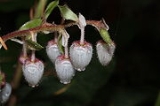
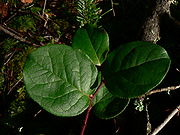
Gaultheria shallon is a leathery-leaved shrub in the heather family
(Ericaceae
), native to western North America
. In English
it is known as salal, shallon, or in Britain simply Gaultheria.
, Alaska
. Western poison oak is a common associate in the California Coast Ranges.
 Its dark blue "berries" (actually swollen sepal
s) and young leaves are both edible and are efficient appetite suppressants, both with a unique flavor. Gaultheria shallon berries were a significant food resource for native people, who both ate them fresh and dried them into cakes. They were also used as a sweetener
, and the Haida used them to thicken salmon eggs. The leaves of the plant were also sometimes used to flavor fish soup.
More recently, Gaultheria shallon berries are used locally in jams, preserves and pies. They are often combined with Oregon-grape
because the tartness of the latter is partially masked by the mild sweetness of Gaultheria shallon.
, who intended the plant to be used as an ornamental
. There it is usually known as shallon, or more commonly simply Gaultheria, and is believed to have been planted as cover for pheasant
s on shooting estates. It readily colonises heathland and acidic woodland habitats in southern England, often forming very tall and dense evergreen stands which smother other vegetation. Although heathland managers widely regard it as a problem weed on unmanaged heathland, it is readily browsed by cattle (especially in winter), and so where traditional grazing management has been restored the dense stands become broken up and the plant becomes a more scattered component of the heathland vegetation.
and anti-cramping herb. By preparing the leaves in a tea or tincture one can take the herb safely to decrease internal inflammation such as bladder inflammation, stomach or duodenal ulcers, heartburn
, indigestion, sinus inflammation, diarrhea, moderate fever, inflamed / irritated throat, and menstrual cramps. A poultice
of the leaf can be used externally to ease discomfort from insect bites and stings.
garden
s.
Family (biology)
In biological classification, family is* a taxonomic rank. Other well-known ranks are life, domain, kingdom, phylum, class, order, genus, and species, with family fitting between order and genus. As for the other well-known ranks, there is the option of an immediately lower rank, indicated by the...
(Ericaceae
Ericaceae
The Ericaceae, commonly known as the heath or heather family, is a group of mostly calcifuge flowering plants. The family is large, with roughly 4000 species spread across 126 genera, making it the 14th most speciose family of flowering plants...
), native to western North America
North America
North America is a continent wholly within the Northern Hemisphere and almost wholly within the Western Hemisphere. It is also considered a northern subcontinent of the Americas...
. In English
English language
English is a West Germanic language that arose in the Anglo-Saxon kingdoms of England and spread into what was to become south-east Scotland under the influence of the Anglian medieval kingdom of Northumbria...
it is known as salal, shallon, or in Britain simply Gaultheria.
Ecology
Gaultheria shallon is very tolerant of both open sun and shady conditions. In coastal areas it can form deep, nearly impenetrable thickets. It grows as far north as Baranof IslandBaranof Island
Baranof Island, also sometimes called Baranov Island, Shee or Sitka Island, is an island in the northern Alexander Archipelago in the Alaska Panhandle, in Alaska. The name Baranof was given in 1805 by Imperial Russian Navy captain U. F. Lisianski to honor Alexander Andreyevich Baranov...
, Alaska
Alaska
Alaska is the largest state in the United States by area. It is situated in the northwest extremity of the North American continent, with Canada to the east, the Arctic Ocean to the north, and the Pacific Ocean to the west and south, with Russia further west across the Bering Strait...
. Western poison oak is a common associate in the California Coast Ranges.
Edibility
Sepal
A sepal is a part of the flower of angiosperms . Collectively the sepals form the calyx, which is the outermost whorl of parts that form a flower. Usually green, sepals have the typical function of protecting the petals when the flower is in bud...
s) and young leaves are both edible and are efficient appetite suppressants, both with a unique flavor. Gaultheria shallon berries were a significant food resource for native people, who both ate them fresh and dried them into cakes. They were also used as a sweetener
Sugar substitute
A sugar substitute is a food additive that duplicates the effect of sugar in taste, usually with less food energy. Some sugar substitutes are natural and some are synthetic. Those that are not natural are, in general, called artificial sweeteners....
, and the Haida used them to thicken salmon eggs. The leaves of the plant were also sometimes used to flavor fish soup.
More recently, Gaultheria shallon berries are used locally in jams, preserves and pies. They are often combined with Oregon-grape
Oregon-grape
Oregon-grape is an evergreen shrub related to the barberry. Some authors place Mahonia in the barberry genus, Berberis...
because the tartness of the latter is partially masked by the mild sweetness of Gaultheria shallon.
In Europe
Gaultheria shallon was introduced to Britain in 1828 by David DouglasDavid Douglas
David Douglas was a Scottish botanist. He worked as a gardener, and explored the Scottish Highlands, North America, and Hawaii, where he died.-Early life:...
, who intended the plant to be used as an ornamental
Ornamental plant
Ornamental plants are plants that are grown for decorative purposes in gardens and landscape design projects, as house plants, for cut flowers and specimen display...
. There it is usually known as shallon, or more commonly simply Gaultheria, and is believed to have been planted as cover for pheasant
Pheasant
Pheasants refer to some members of the Phasianinae subfamily of Phasianidae in the order Galliformes.Pheasants are characterised by strong sexual dimorphism, males being highly ornate with bright colours and adornments such as wattles and long tails. Males are usually larger than females and have...
s on shooting estates. It readily colonises heathland and acidic woodland habitats in southern England, often forming very tall and dense evergreen stands which smother other vegetation. Although heathland managers widely regard it as a problem weed on unmanaged heathland, it is readily browsed by cattle (especially in winter), and so where traditional grazing management has been restored the dense stands become broken up and the plant becomes a more scattered component of the heathland vegetation.
Medicinal properties
Gaultheria shallon has been used for its medicinal properties by local natives for generations. The medicinal uses of this plant are not widely known or used. However, the leaves have an astringent effect, making it an effective anti-inflammatoryAnti-inflammatory
Anti-inflammatory refers to the property of a substance or treatment that reduces inflammation. Anti-inflammatory drugs make up about half of analgesics, remedying pain by reducing inflammation as opposed to opioids, which affect the central nervous system....
and anti-cramping herb. By preparing the leaves in a tea or tincture one can take the herb safely to decrease internal inflammation such as bladder inflammation, stomach or duodenal ulcers, heartburn
Heartburn
Heartburn, also known as pyrosis or acid indigestion is a burning sensation in the chest, just behind the breastbone or in the epigastrium...
, indigestion, sinus inflammation, diarrhea, moderate fever, inflamed / irritated throat, and menstrual cramps. A poultice
Poultice
A poultice, also called cataplasm, is a soft moist mass, often heated and medicated, that is spread on cloth over the skin to treat an aching, inflamed, or painful part of the body. It can be used on wounds such as cuts...
of the leaf can be used externally to ease discomfort from insect bites and stings.
Economic use
In the Pacific Northwest, the harvesting of Gaultheria shallon is the heart of a large industry which supplies cut evergreens worldwide for use in floral arrangements. It is used in native plantNative plant
Native plant is a term to describe plants endemic or naturalized to a given area in geologic time.This includes plants that have developed, occur naturally, or existed for many years in an area...
garden
Garden
A garden is a planned space, usually outdoors, set aside for the display, cultivation, and enjoyment of plants and other forms of nature. The garden can incorporate both natural and man-made materials. The most common form today is known as a residential garden, but the term garden has...
s.