
Home      Discussion      Topics      Dictionary      Almanac
Signup       Login
Sahelanthropus tchadensis

Sahelanthropus tchadensis

Overview


Sahelanthropus tchadensis is a fossil
Fossil
Fossils are the preserved remains or traces of animals, plants, and other organisms from the remote past. The totality of fossils, both discovered and undiscovered, and their placement in fossiliferous rock formations and sedimentary layers is known as the fossil record...

 hominid
Hominidae
The Hominidae The Hominidae The Hominidae (anglicized Hominids, also known as great apes"Great ape" is a common name rather than a taxonomic label and there are differences in usage...

 that lived approximately 7 million years ago. Its position in the Hominid evolution is not widely accepted.


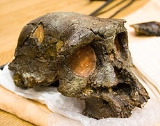
Existing fossils – a relatively small cranium nicknamed Toumaï ("hope of life" in the local Dazaga language of Chad), five pieces of jaw
Jaw
The jaw is any opposable articulated structure at the entrance of the mouth, typically used for grasping and manipulating food. The term jaws is also broadly applied to the whole of the structures constituting the vault of the mouth and serving to open and close it and is part of the body plan of...

 and some teeth – make up a head that has a mixture of derived and primitive features.
Discussion
Ask a question about 'Sahelanthropus tchadensis'
Start a new discussion about 'Sahelanthropus tchadensis'
Answer questions from other users
Full Discussion Forum
 
Encyclopedia


Sahelanthropus tchadensis is a fossil
Fossil
Fossils are the preserved remains or traces of animals, plants, and other organisms from the remote past. The totality of fossils, both discovered and undiscovered, and their placement in fossiliferous rock formations and sedimentary layers is known as the fossil record...

 hominid
Hominidae
The Hominidae The Hominidae The Hominidae (anglicized Hominids, also known as great apes"Great ape" is a common name rather than a taxonomic label and there are differences in usage...

 that lived approximately 7 million years ago. Its position in the Hominid evolution is not widely accepted.

Fossils


Existing fossils – a relatively small cranium nicknamed Toumaï ("hope of life" in the local Dazaga language of Chad), five pieces of jaw
Jaw
The jaw is any opposable articulated structure at the entrance of the mouth, typically used for grasping and manipulating food. The term jaws is also broadly applied to the whole of the structures constituting the vault of the mouth and serving to open and close it and is part of the body plan of...

 and some teeth – make up a head that has a mixture of derived and primitive features. The braincase, being only 340 cm³ to 360 cm³ in volume is similar to that of extant chimpanzees and is notably less than the approximate human volume of 1350 cm³.
The teeth, brow ridges, and facial structure differ markedly from those found in Homo sapiens. Due to the distortion that the cranium has suffered, a 3D computer reconstruction has not been produced.

Since no postcranial remains (bones below the skull) have been discovered, it is as of yet unknown whether
Sahelanthropus tchadensis was indeed bipedal, although claims for an anteriorly placed foramen magnum
Foramen magnum
In anatomy, in the occipital bone, the foramen magnum is one of the several oval or circular apertures in the base of the skull , through which the medulla oblongata enters and exits the skull vault.Apart from the transmission of the medulla oblongata and its membranes, the foramen magnum...

 suggests that this may have been the case, although some paleontologists have disputed this interpretation of the basicranium. Its canine wear is similar to other Miocene apes. Moreover, according to recent information, the femur of an hominid may have been discovered alongside the cranium but never published.

The fossils were discovered in the Djurab desert of Chad
Chad
Chad , officially known as the Republic of Chad, is a landlocked country in central Africa. It is bordered by Libya to the north, Sudan to the east, the Central African Republic to the south, Cameroon and Nigeria to the southwest, and Niger to the west...

 by a team of four lead by Michel Brunet
Michel Brunet (paleontologist)
Michel Brunet is a French paleontologist and a professor at the Collège de France. In 2001 Brunet announced the discovery in Central Africa of the skull and jaw remains of a late Miocene hominid nicknamed Toumaï...

; three Chadians, Adoum Mahamat, Djimdoumalbaye Ahounta and Gongdibé Fanoné, and the French Alain Beauvilain. All known material of Sahelanthropus were found between July 2001 to March 2002 at three sites (TM 247, TM 266 which yielded most of the material, and TM 292). The discoverers claimed that S. tchadensis is the oldest known human ancestor after the split of the human line from that of chimpanzee
Chimpanzee
Chimpanzee, sometimes colloquially chimp, is the common name for the two extant species of ape in the genus Pan. The Congo River forms the boundary between the native habitat of the two species:...

s. The bones were found far from most previous hominin fossil finds, which are from Eastern and Southern Africa
Southern Africa
Southern Africa is the southernmost region of the African continent, variably defined by geography or geopolitics. Within the region are numerous territories, including the Republic of South Africa ; nowadays, the simpler term South Africa is generally reserved for the country in English.-UN...

. However, an
Australopithecus bahrelghazali
Australopithecus bahrelghazali is a fossil hominin that was first discovered in 1993 by the paleontologist Michel Brunet in the Bahr el Ghazal valley near Koro Toro, in Chad, that Brunet named Abel. It was dated using Berylium based Radiometric dating as living circa...

mandible was found in Chad by Beauvilain A., Brunet M. and Moutaye A.H.E. as early as 1995.

Relationship to modern humans and great apes


Sahelanthropus may represent a common ancestor
Common descent
A group of organisms is said to have common descent if they have a common ancestor. In modern biology, it is generally accepted that all living organisms on Earth are descended from a common ancestor or ancestral gene pool....

 of humans and chimpanzees; no consensus has been reached yet by the scientific community. The original placement of this species as a human ancestor but not a chimpanzee ancestor would complicate the picture of human phylogeny. In particular, if Toumaï is a direct human ancestor, then its facial features bring the status of
Australopithecus
Australopithecus
Australopithecus is a genus of extinct hominids, made up of the gracile australopiths, and formerly also included their larger relatives, the robust australopiths...

 into doubt because its thickened brow ridges were reported to be similar to those of some later fossil hominids (notably Homo erectus), whereas this morphology differs from that observed in all australopithecines, most fossil hominids and extant humans.

Another possibility is that Toumaï is related to both humans and chimpanzees, but is the ancestor of neither. Brigitte Senut and Martin Pickford, the discoverers of Orrorin tugenensis
Orrorin tugenensis
Orrorin tugenensis is considered to be the second-oldest known hominin ancestor that is possibly related to modern humans and is the only species classified in genus Orrorin. The name was given by the discoverers who found Orrorin fossils in the Tugen Hills of Kenya...

, suggested that the features of S. tchadensis are consistent with a female proto-gorilla
Gorilla
Gorillas are the largest of the living primates. They are ground-dwelling and predominantly herbivorous. They inhabit the forests of central Africa. Gorillas are divided into two species and either four or five subspecies...

. Even if this claim is upheld, then the find would lose none of its significance, for at present precious few chimpanzee or gorilla ancestors have been found anywhere in Africa. Thus if
S. tchadensis is an ancestral relative of the chimpanzees (or gorillas) then it represents the first known member of their lineage. Furthermore, S. tchadensis does indicate that the last common ancestor of humans and chimpanzees is unlikely to resemble chimpanzees very much, as had been previously supposed by some paleontologists.
Unfortunately, the exact age of the fossil is somewhat hard to determine. While molecular clock
Molecular clock
The molecular clock is a technique in molecular evolution which uses fossil constraints and rates of molecular change to deduce the time in geologic history when two species or other taxa diverged. It is used to estimate the time of occurrence of events called speciation or radiation...

s are increasingly found to be far more unreliable than initially believed sediment
Sediment
Sediment is any particulate matter that can be transported by fluid flow, and which eventually is deposited.Sediments are most often transported by water transported by wind and glaciers...

 isotope analysis
Isotope analysis
Isotope analysis is the identification of isotopic signature, the distribution of certain stable isotopes and chemical elements within chemical compounds. This can be applied to a food web to make it possible to draw direct inferences regarding diet, trophic level, and subsistence...

 which yielded an age of about 7 million years is generally considered quite reliable. In this case however, the fossils were found exposed in loose sand; co-discoverer Beauvilain cautions that such sediment can be easily moved by the wind, unlike packed earth. In fact, Toumaï was probably reburied in the recent past. Taphonomic analysis reveals the likelihood of one, perhaps two, burial(s) which seemingly occurred after the introduction of Islam in the region. Two other hominid fossils (a left femur and a mandible) were in the same “grave” along with various mammal remains.The sediment surrounding the fossils might thus not be the material the bones were originally deposited in, making it necessary to corroborate the fossil's age by some other means. The fauna
Fauna
Fauna is all of the animal life of any particular region or time. The corresponding term for plants is flora.Zoologists and paleontologists use fauna to refer to a typical collection of animals found in a specific time or place, e.g...

 found at the site – namely the anthracotheriid Libycosaurus petrochii and the suid
Suidae
Suidae is the biological family to which pigs and their relatives belong. Up to sixteen species are currently recognized, including the domestic pig Sus scrofa or S. domesticus. They are classified into between four and eight genera...

 Nyanzachoerus syrticus – suggests an age of more than 6 million years, as these species
Species
In biology, a species is:* a taxonomic rank or* a unit at that rank ....

 were probably extinct already by that time.

External links