

Sacred geometry

Encyclopedia
Sacred geometry is the geometry used in the planning and construction of religious structures such as churches, temple
s, mosque
s, religious monuments, altar
s, tabernacles
; as well as for sacred spaces such as temenoi
, sacred grove
s, village green
s and holy well
s, and the creation of religious art
. In sacred geometry, symbolic and sacred meanings
are ascribed to certain geometric shapes and certain geometric proportions
, according to Paul Calter:
attributed the belief to Plato
, writing "Plato said God geometrizes continually" (Convivialium disputationum, liber 8,2). In modern times the mathematician Carl Friedrich Gauss
adapted this quote, saying "God arithmetizes."
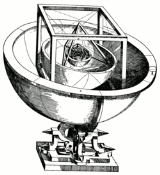
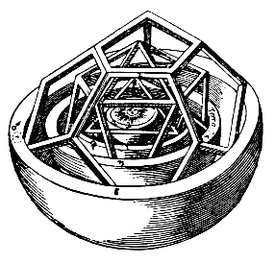
At least as late as Johannes Kepler
(1571–1630), a belief in the geometric underpinnings of the cosmos persisted among scientists. See also Kepler conjecture
, Mysterium Cosmographicum
, Pythagoreanism
at work therein. Many forms observed in nature can be related to geometry, for example, the chambered nautilus
grows at a constant rate and so its shell forms a logarithmic spiral
to accommodate that growth without changing shape. Also, honeybees construct hexagonal cells to hold their honey. These and other correspondences are seen by believers in sacred geometry to be further proof of the cosmic significance of geometric forms. These phenomena can, however, be explained through natural principles.
, geometric ratios, and geometric figures were often employed in the design of Egyptian
, ancient Indian, Greek
and Roman
architecture
. Medieval European cathedrals also incorporated symbolic geometry. Indian and Himalayan spiritual communities often constructed temples and fortification
s on design plans of mandala
and yantra
.
Many of the sacred geometry principles of the human body and of ancient architecture have been compiled into the Vitruvian Man
drawing by Leonardo Da Vinci
, itself based on the much older writings of the roman architect Vitruvius
.
. Scientists see the same geometric and mathematical patterns as arising directly from natural principles.
Among the most prevalent traditional geometric forms ascribed to sacred geometry are the sine wave
, the sphere
, the vesica piscis
, the torus
(donut), the 5 platonic solids, the golden spiral
, the tesseract
(4-dimensional cube), Fractals and the star tetrahedron (2 oppositely oriented and interpenetrating tetrahedrons) which leads to the merkaba.
.
found that an oscillating string stopped halfway along its length produces an octave
relative to the string's fundamental, while a ratio of 2:3 produces a perfect fifth
and 3:4 produces a perfect fourth
. Pythagoreans believed that these harmonic ratios
gave music powers of healing which could "harmonize" an out-of-balance body. This belief has been revived in modern times.
Temple
A temple is a structure reserved for religious or spiritual activities, such as prayer and sacrifice, or analogous rites. A templum constituted a sacred precinct as defined by a priest, or augur. It has the same root as the word "template," a plan in preparation of the building that was marked out...
s, mosque
Mosque
A mosque is a place of worship for followers of Islam. The word is likely to have entered the English language through French , from Portuguese , from Spanish , and from Berber , ultimately originating in — . The Arabic word masjid literally means a place of prostration...
s, religious monuments, altar
Altar
An altar is any structure upon which offerings such as sacrifices are made for religious purposes. Altars are usually found at shrines, and they can be located in temples, churches and other places of worship...
s, tabernacles
Church tabernacle
A tabernacle is the fixed, locked box in which, in some Christian churches, the Eucharist is "reserved" . A less obvious container, set into the wall, is called an aumbry....
; as well as for sacred spaces such as temenoi
Temenos
Temenos is a piece of land cut off and assigned as an official domain, especially to kings and chiefs, or a piece of land marked off from common uses and dedicated to a god, a sanctuary, holy grove or holy precinct: The Pythian race-course is called a temenos, the sacred valley of the Nile is the ...
, sacred grove
Sacred grove
A sacred grove is a grove of trees of special religious importance to a particular culture. Sacred groves were most prominent in the Ancient Near East and prehistoric Europe, but feature in various cultures throughout the world...
s, village green
Village green
A village green is a common open area which is a part of a settlement. Traditionally, such an area was often common grass land at the centre of a small agricultural settlement, used for grazing and sometimes for community events...
s and holy well
Holy well
A holy well, or sacred spring, is a small body of water emerging from underground and revered either in a Pagan or Christian context, often both. Holy wells were frequently pagan sacred sites that later became Christianized. The term 'holy well' is commonly employed to refer to any water source of...
s, and the creation of religious art
Sacred art
Sacred art is imagery intended to uplift the mind to the spiritual. Sacred art involves the ritual and cultic practices and practical and operative aspects of the path of the spiritual realization within the bosom of the tradition in question....
. In sacred geometry, symbolic and sacred meanings
Sacred
Holiness, or sanctity, is in general the state of being holy or sacred...
are ascribed to certain geometric shapes and certain geometric proportions
Proportion (architecture)
Proportion is the relation between elements and a whole.-Architectural proportions:In architecture the whole is not just a building but the set and setting of the site. The things that make a building and its site "well shaped" include the orientation of the site and the buildings on it to the...
, according to Paul Calter:
As worldview and cosmology
The belief that God created the universe according to a geometric plan has ancient origins. PlutarchPlutarch
Plutarch then named, on his becoming a Roman citizen, Lucius Mestrius Plutarchus , c. 46 – 120 AD, was a Greek historian, biographer, essayist, and Middle Platonist known primarily for his Parallel Lives and Moralia...
attributed the belief to Plato
Plato
Plato , was a Classical Greek philosopher, mathematician, student of Socrates, writer of philosophical dialogues, and founder of the Academy in Athens, the first institution of higher learning in the Western world. Along with his mentor, Socrates, and his student, Aristotle, Plato helped to lay the...
, writing "Plato said God geometrizes continually" (Convivialium disputationum, liber 8,2). In modern times the mathematician Carl Friedrich Gauss
Carl Friedrich Gauss
Johann Carl Friedrich Gauss was a German mathematician and scientist who contributed significantly to many fields, including number theory, statistics, analysis, differential geometry, geodesy, geophysics, electrostatics, astronomy and optics.Sometimes referred to as the Princeps mathematicorum...
adapted this quote, saying "God arithmetizes."
At least as late as Johannes Kepler
Johannes Kepler
Johannes Kepler was a German mathematician, astronomer and astrologer. A key figure in the 17th century scientific revolution, he is best known for his eponymous laws of planetary motion, codified by later astronomers, based on his works Astronomia nova, Harmonices Mundi, and Epitome of Copernican...
(1571–1630), a belief in the geometric underpinnings of the cosmos persisted among scientists. See also Kepler conjecture
Kepler conjecture
The Kepler conjecture, named after the 17th-century German astronomer Johannes Kepler, is a mathematical conjecture about sphere packing in three-dimensional Euclidean space. It says that no arrangement of equally sized spheres filling space has a greater average density than that of the cubic...
, Mysterium Cosmographicum
Mysterium Cosmographicum
Mysterium Cosmographicum, is an astronomy book by the German astronomer Johannes Kepler, published at Tübingen in 1596 and in a second edition in 1621...
, Pythagoreanism
Pythagoreanism
Pythagoreanism was the system of esoteric and metaphysical beliefs held by Pythagoras and his followers, the Pythagoreans, who were considerably influenced by mathematics. Pythagoreanism originated in the 5th century BCE and greatly influenced Platonism...
Natural forms
The study of sacred geometry has its roots in the study of nature, and the mathematical principlesFibonacci number
In mathematics, the Fibonacci numbers are the numbers in the following integer sequence:0,\;1,\;1,\;2,\;3,\;5,\;8,\;13,\;21,\;34,\;55,\;89,\;144,\; \ldots\; ....
at work therein. Many forms observed in nature can be related to geometry, for example, the chambered nautilus
Chambered Nautilus
The Chambered Nautilus, Nautilus pompilius, is the best-known species of nautilus. The shell, when cut away reveals a lining of lustrous nacre and displays a nearly perfect equiangular spiral, although it is not a golden spiral. The shell exhibits countershading, being light on the bottom and dark...
grows at a constant rate and so its shell forms a logarithmic spiral
Logarithmic spiral
A logarithmic spiral, equiangular spiral or growth spiral is a special kind of spiral curve which often appears in nature. The logarithmic spiral was first described by Descartes and later extensively investigated by Jacob Bernoulli, who called it Spira mirabilis, "the marvelous...
to accommodate that growth without changing shape. Also, honeybees construct hexagonal cells to hold their honey. These and other correspondences are seen by believers in sacred geometry to be further proof of the cosmic significance of geometric forms. These phenomena can, however, be explained through natural principles.
Art and architecture
The golden ratioGolden ratio
In mathematics and the arts, two quantities are in the golden ratio if the ratio of the sum of the quantities to the larger quantity is equal to the ratio of the larger quantity to the smaller one. The golden ratio is an irrational mathematical constant, approximately 1.61803398874989...
, geometric ratios, and geometric figures were often employed in the design of Egyptian
Ancient Egyptian architecture
The Nile valley has been the site of one of the most influential civilizations which developed a vast array of diverse structures encompassing ancient Egyptian architecture...
, ancient Indian, Greek
Architecture of Ancient Greece
The architecture of Ancient Greece is the architecture produced by the Greek-speaking people whose culture flourished on the Greek mainland and Peloponnesus, the Aegean Islands, and in colonies in Asia Minor and Italy for a period from about 900 BC until the 1st century AD, with the earliest...
and Roman
Roman architecture
Ancient Roman architecture adopted certain aspects of Ancient Greek architecture, creating a new architectural style. The Romans were indebted to their Etruscan neighbors and forefathers who supplied them with a wealth of knowledge essential for future architectural solutions, such as hydraulics...
architecture
Architecture
Architecture is both the process and product of planning, designing and construction. Architectural works, in the material form of buildings, are often perceived as cultural and political symbols and as works of art...
. Medieval European cathedrals also incorporated symbolic geometry. Indian and Himalayan spiritual communities often constructed temples and fortification
Fortification
Fortifications are military constructions and buildings designed for defence in warfare and military bases. Humans have constructed defensive works for many thousands of years, in a variety of increasingly complex designs...
s on design plans of mandala
Mandala
Maṇḍala is a Sanskrit word that means "circle". In the Buddhist and Hindu religious traditions their sacred art often takes a mandala form. The basic form of most Hindu and Buddhist mandalas is a square with four gates containing a circle with a center point...
and yantra
Yantra
Yantra is the Sanskrit word for "instrument" or "machine". Much like the word "instrument" itself, it can stand for symbols, processes, automata, machinery or anything that has structure and organization, depending on context....
.
Many of the sacred geometry principles of the human body and of ancient architecture have been compiled into the Vitruvian Man
Vitruvian Man
The Vitruvian Man is a world-renowned drawing created by Leonardo da Vinci circa 1487. It is accompanied by notes based on the work of the famed architect, Vitruvius. The drawing, which is in pen and ink on paper, depicts a male figure in two superimposed positions with his arms and legs apart and...
drawing by Leonardo Da Vinci
Leonardo da Vinci
Leonardo di ser Piero da Vinci was an Italian Renaissance polymath: painter, sculptor, architect, musician, scientist, mathematician, engineer, inventor, anatomist, geologist, cartographer, botanist and writer whose genius, perhaps more than that of any other figure, epitomized the Renaissance...
, itself based on the much older writings of the roman architect Vitruvius
Vitruvius
Marcus Vitruvius Pollio was a Roman writer, architect and engineer, active in the 1st century BC. He is best known as the author of the multi-volume work De Architectura ....
.
Contemporary usage
A contemporary usage of the term sacred geometry describes assertions of a mathematical order to the intrinsic nature of the universeUniverse
The Universe is commonly defined as the totality of everything that exists, including all matter and energy, the planets, stars, galaxies, and the contents of intergalactic space. Definitions and usage vary and similar terms include the cosmos, the world and nature...
. Scientists see the same geometric and mathematical patterns as arising directly from natural principles.
Among the most prevalent traditional geometric forms ascribed to sacred geometry are the sine wave
Sine wave
The sine wave or sinusoid is a mathematical function that describes a smooth repetitive oscillation. It occurs often in pure mathematics, as well as physics, signal processing, electrical engineering and many other fields...
, the sphere
Sphere
A sphere is a perfectly round geometrical object in three-dimensional space, such as the shape of a round ball. Like a circle in two dimensions, a perfect sphere is completely symmetrical around its center, with all points on the surface lying the same distance r from the center point...
, the vesica piscis
Vesica piscis
The vesica piscis is a shape that is the intersection of two circles with the same radius, intersecting in such a way that the center of each circle lies on the circumference of the other. The name literally means the "bladder of a fish" in Latin...
, the torus
Torus
In geometry, a torus is a surface of revolution generated by revolving a circle in three dimensional space about an axis coplanar with the circle...
(donut), the 5 platonic solids, the golden spiral
Golden spiral
In geometry, a golden spiral is a logarithmic spiral whose growth factor is , the golden ratio. That is, a golden spiral gets wider by a factor of for every quarter turn it makes.-Formula:...
, the tesseract
Tesseract
In geometry, the tesseract, also called an 8-cell or regular octachoron or cubic prism, is the four-dimensional analog of the cube. The tesseract is to the cube as the cube is to the square. Just as the surface of the cube consists of 6 square faces, the hypersurface of the tesseract consists of 8...
(4-dimensional cube), Fractals and the star tetrahedron (2 oppositely oriented and interpenetrating tetrahedrons) which leads to the merkaba.
Fringe theory
As is pointed out by Stephen Skinner in his book Sacred geometry: deciphering the code, it is possible to place a geometric diagram over virtually any image of a natural object or human created structure, and find some lines intersecting the image. If the geometric diagram does not intersect major physical points in the image, the result is what Skinner calls "unanchored geometry." Unanchored geometry, and speculation about the meaning of the geometry itself unsupported by any reliable sources, frequently leads the subject of sacred geometry into the area of New Age fringe theoryFringe theory
A fringe theory is an idea or a collection of ideas that departs significantly from the prevailing or mainstream view in its particular field of study. Examples include ideas that purport to be scientific theories but have little or no scientific support, conspiracy theories, unproven esoteric...
.
Music
PythagorasPythagoras
Pythagoras of Samos was an Ionian Greek philosopher, mathematician, and founder of the religious movement called Pythagoreanism. Most of the information about Pythagoras was written down centuries after he lived, so very little reliable information is known about him...
found that an oscillating string stopped halfway along its length produces an octave
Octave
In music, an octave is the interval between one musical pitch and another with half or double its frequency. The octave relationship is a natural phenomenon that has been referred to as the "basic miracle of music", the use of which is "common in most musical systems"...
relative to the string's fundamental, while a ratio of 2:3 produces a perfect fifth
Perfect fifth
In classical music from Western culture, a fifth is a musical interval encompassing five staff positions , and the perfect fifth is a fifth spanning seven semitones, or in meantone, four diatonic semitones and three chromatic semitones...
and 3:4 produces a perfect fourth
Perfect fourth
In classical music from Western culture, a fourth is a musical interval encompassing four staff positions , and the perfect fourth is a fourth spanning five semitones. For example, the ascending interval from C to the next F is a perfect fourth, as the note F lies five semitones above C, and there...
. Pythagoreans believed that these harmonic ratios
Harmonic series (music)
Pitched musical instruments are often based on an approximate harmonic oscillator such as a string or a column of air, which oscillates at numerous frequencies simultaneously. At these resonant frequencies, waves travel in both directions along the string or air column, reinforcing and canceling...
gave music powers of healing which could "harmonize" an out-of-balance body. This belief has been revived in modern times.
See also
- ArabesqueArabesqueThe arabesque is a form of artistic decoration consisting of "surface decorations based on rhythmic linear patterns of scrolling and interlacing foliage, tendrils" or plain lines, often combined with other elements...
- BinduBinduBindu is a Sanskrit term meaning "point" or "dot". The feminine case ending is bindi which denotes a small ornamental, devotional and/or mystical dot that is cosmetically applied or affixed to the forehead in Hinduism....
- Sri ChakraSri ChakraThe Sri Chakra or Shri Yantra is a yantra formed by nine interlocking triangles that surround and radiate out from the central point, the junction point between the physical universe and its unmanifest source. It represents the goddess in her form of Shri Lalitha Or Tripura Sundari, "the beauty...
- Crop circleCrop circleA crop circle is a sizable pattern created by the flattening of a crop such as wheat, barley, rye, maize, or rapeseed. Crop circles are also referred to as crop formations, because they are not always circular in shape. While the exact date crop circles began to appear is unknown, the documented...
- Bush BarrowBush BarrowBush Barrow is a site of the early British Bronze Age , at the western end of the Normanton Down Barrows cemetery. It is among the most important sites of the Stonehenge complex. It was excavated in 1808 by Sir Richard Colt Hoare and William Cunnington...
- Ley lines
- Folk mathematicsFolk mathematicsAs the term is understood by mathematicians, folk mathematics or mathematical folklore means theorems, definitions, proofs, or mathematical facts or techniques that are found by investigation and may circulate among mathematicians by word-of-mouth but have not appeared in print, either in books or...
- Proportion (architecture)Proportion (architecture)Proportion is the relation between elements and a whole.-Architectural proportions:In architecture the whole is not just a building but the set and setting of the site. The things that make a building and its site "well shaped" include the orientation of the site and the buildings on it to the...
- Platonic solids
- Pythagorean tuningPythagorean tuningPythagorean tuning is a system of musical tuning in which the frequency relationships of all intervals are based on the ratio 3:2. This interval is chosen because it is one of the most consonant...
- Golden ratioGolden ratioIn mathematics and the arts, two quantities are in the golden ratio if the ratio of the sum of the quantities to the larger quantity is equal to the ratio of the larger quantity to the smaller one. The golden ratio is an irrational mathematical constant, approximately 1.61803398874989...
- Golden spiralGolden spiralIn geometry, a golden spiral is a logarithmic spiral whose growth factor is , the golden ratio. That is, a golden spiral gets wider by a factor of for every quarter turn it makes.-Formula:...
- Astrological aspects
- Pythagorean symbols
- SangakuSangakuSangaku or San Gaku are Japanese geometrical puzzles in Euclidean geometry on wooden tablets which were placed as offerings at Shinto shrines or Buddhist temples during the Edo period by members of all social classes.-History:The Sangaku were painted in color on wooden tablets and hung in the...
- Vitruvian ManVitruvian ManThe Vitruvian Man is a world-renowned drawing created by Leonardo da Vinci circa 1487. It is accompanied by notes based on the work of the famed architect, Vitruvius. The drawing, which is in pen and ink on paper, depicts a male figure in two superimposed positions with his arms and legs apart and...
- LabyrinthLabyrinthIn Greek mythology, the Labyrinth was an elaborate structure designed and built by the legendary artificer Daedalus for King Minos of Crete at Knossos...
(an Eulerian pathEulerian pathIn graph theory, an Eulerian trail is a trail in a graph which visits every edge exactly once. Similarly, an Eulerian circuit or Eulerian cycle is a Eulerian trail which starts and ends on the same vertex. They were first discussed by Leonhard Euler while solving the famous Seven Bridges of...
, as distinct from a mazeMazeA maze is a tour puzzle in the form of a complex branching passage through which the solver must find a route. In everyday speech, both maze and labyrinth denote a complex and confusing series of pathways, but technically the maze is distinguished from the labyrinth, as the labyrinth has a single...
) - MandalaMandalaMaṇḍala is a Sanskrit word that means "circle". In the Buddhist and Hindu religious traditions their sacred art often takes a mandala form. The basic form of most Hindu and Buddhist mandalas is a square with four gates containing a circle with a center point...
- ParthenonParthenonThe Parthenon is a temple on the Athenian Acropolis, Greece, dedicated to the Greek goddess Athena, whom the people of Athens considered their virgin patron. Its construction began in 447 BC when the Athenian Empire was at the height of its power. It was completed in 438 BC, although...
- Tree of LifeTree of lifeThe concept of a tree of life, a many-branched tree illustrating the idea that all life on earth is related, has been used in science , religion, philosophy, mythology, and other areas...
- Celtic artCeltic artCeltic art is the art associated with the peoples known as Celts; those who spoke the Celtic languages in Europe from pre-history through to the modern period, as well as the art of ancient peoples whose language is uncertain, but have cultural and stylistic similarities with speakers of Celtic...
such as the Book of KellsBook of KellsThe Book of Kells is an illuminated manuscript Gospel book in Latin, containing the four Gospels of the New Testament together with various prefatory texts and tables. It was created by Celtic monks ca. 800 or slightly earlier...
Further reading
- Beginnings: Geomancy, Builders' Rites and Electional Astrology in the European Tradition by Nigel PennickNigel PennickNigel Campbell Pennick, born 1946 in Guildford, Surrey, England in the United Kingdom, an author publishing on occultism, magic, natural magic, divination, subterranea, rural folk customs, traditional performance and celtic art as well as runosophy....
- Sacred GeometrySacred geometrySacred geometry is the geometry used in the planning and construction of religious structures such as churches, temples, mosques, religious monuments, altars, tabernacles; as well as for sacred spaces such as temenoi, sacred groves, village greens and holy wells, and the creation of religious art...
: Symbolism and Purpose in Religious Structures by Nigel Pennick - The Ancient Science of Geomancy: Living in Harmony with the Earth by Nigel Pennick
- The Sacred Art of Geometry: Temples of the Phoenix by Nigel Pennick
- The Oracle of Geomancy by Nigel Pennick
- The Ancient Science of Geomancy: Man in Harmony with the Earth by Nigel Pennick
- George Bain. Celtic Art: The Methods of Construction. Dover, 1973. ISBN 0-486-22923-8.
- Robert LawlorRobert LawlorRobert Lawlor is a mythographer, symbologist and New Age author of several books.After training as a painter and a sculptor, he became a yoga student of Sri Aurobindo and lived for many years in Pondicherry, India, where he was a founding member of Auroville. In India, he discovered the works of...
. Sacred Geometry: Philosophy and practice (Art and Imagination). Thames & Hudson, 1989 (1st edition 1979, 1980, or 1982). ISBN 0-500-81030-3. - John MichellJohn Michell (writer)John Frederick Carden Michell was an English writer whose key sources of inspiration were Plato and Charles Fort...
. City of Revelation. Abacus, 1972. ISBN 0-349-12320-9. - Michael S. Schneider. A Beginner's Guide to Constructing the Universe: Mathematical Archetypes of Nature, Art, and Science. Harper Paperbacks, 1995. ISBN 0-06-092671-6
- Lucy R Lippard: Overlay: Contemporary Art and the Art of Prehistory. Pantheon Books New York 1983 ISBN 0-394-54812-8
- Johnson, Anthony: Solving Stonehenge, the New Key to an Ancient Enigma. Thames & Hudson 2008 ISBN 978-0-500-05155-9
- The Golden Mean, Parabola magazineParabola (magazine)Parabola: Where Spiritual Traditions Meet, whose founder and editor was D.M. Dooling, began publishing in 1976 as a quarterly magazine on the subjects of mythology and the world's religious and cultural traditions. It is published by The Society for the Study of Myth and Tradition, a not-for-profit...
, v.16, n.4 (1991) - West, John Anthony, Inaugural Lines: Sacred geometry at St. John the Divine, Parabola magazine, v.8, n.1, Spring 1983
- Bamford, Christopher, Homage to Pythagoras: Rediscovering Sacred Science, Lindisfarne Press, 1994, ISBN 0-940262-63-0
- A. T. Mann, Sacred Architecture, Element Books, 1993, ISBN 1-843333-55-4.