

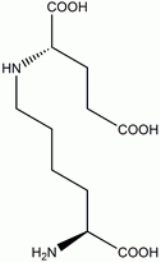
Saccharopine

Encyclopedia
Saccharopine is an intermediate in the metabolism
of amino acid lysine
. It is a precursor of lysine in the alpha-aminoadipate
pathway which occurs in a few lower fungi
, the higher fungi, and euglenid
s. In mammals and higher plants saccharopine is an intermediate in the degradation of lysine, formed by condensation of lysine and alpha-ketoglutarate.
s, are:
(high amounts of saccharopine in the urine) and saccharopinemia (an excess of saccharopine in the blood) are conditions present in some inherited disorders of lysine degradation.
Metabolism
Metabolism is the set of chemical reactions that happen in the cells of living organisms to sustain life. These processes allow organisms to grow and reproduce, maintain their structures, and respond to their environments. Metabolism is usually divided into two categories...
of amino acid lysine
Lysine
Lysine is an α-amino acid with the chemical formula HO2CCH4NH2. It is an essential amino acid, which means that the human body cannot synthesize it. Its codons are AAA and AAG....
. It is a precursor of lysine in the alpha-aminoadipate
Alpha-aminoadipate
α-Aminoadipic acid is an intermediate in the metabolism of lysine and saccharopine.-See also:* Adipic acid...
pathway which occurs in a few lower fungi
Fungus
A fungus is a member of a large group of eukaryotic organisms that includes microorganisms such as yeasts and molds , as well as the more familiar mushrooms. These organisms are classified as a kingdom, Fungi, which is separate from plants, animals, and bacteria...
, the higher fungi, and euglenid
Euglenid
Euglenoids are one of the best-known groups of flagellates, commonly found in freshwater especially when it is rich in organic materials, with a few marine and endosymbiotic members. Most euglenids are unicellular. Many euglenids have chloroplasts and produce energy through photosynthesis, but...
s. In mammals and higher plants saccharopine is an intermediate in the degradation of lysine, formed by condensation of lysine and alpha-ketoglutarate.
Reaction
The reactions involved, catalysed by saccharopine dehydrogenaseSaccharopine dehydrogenase
Saccharopine dehydrogenase is an enzyme involved in the metabolism of lysine, via saccharopine.It can be classified under , , , and ....
s, are:
- lysine + alpha-ketoglutarate ⇌ saccharopine ⇌ glutamate + 2-aminoadipate 6-semialdehyde
Pathology
SaccharopinuriaSaccharopinuria
Saccharopinuria , also called saccharopinemia, saccharopine dehydrogenase deficiency or alpha-aminoadipic semialdehyde synthase deficiency, is a variant form of hyperlysinemia. It is caused by a partial deficiency of the enzyme saccharopine dehydrogenase, which plays a secondary role in the lysine...
(high amounts of saccharopine in the urine) and saccharopinemia (an excess of saccharopine in the blood) are conditions present in some inherited disorders of lysine degradation.