

Sabinus Iulianus

Encyclopedia
Marcus Aurelius Sabinus Iulianus (also known as Julian of Pannonia; d. 285
-286
) was a Roman usurper
(283-285 or 286) against Emperor
Carinus
or Maximian
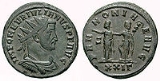
. It is possible that up to four usurpers with a similar name rebelled in a time-frame of a decade, but at least one of them is known by numismatic
evidence.
in northern Italy, in 283/284, (and not a praetorian prefect
as stated by some sources). Soon after the news of the death of Emperor Carus
(in 283
) or Numerian
(in November 284
) arrived in the western provinces, Iulianus revolted in Pannonia
. He issued coins from Siscia, some of them bearing a legend celebrating Pannonia. Emperor Carinus
, brother of Numerian, who had marched from Roman Britain
to deal with the usurpation, met, defeated, and killed Iulianus early in 285, in Italy (possibly in Verona
), or in Illyricum
.
According to some scholars, it is possible that two usurpers actually existed: a M. Aur. Iulianus, corrector in Italy, rebelled after Carus' death, with the control of Pannonia, and defeated in Illyricum; a Sabinus Iulianus, praetorian prefect, usurper in Italy after Numerian's death, defeated near Verona.
Another usurper, simply named Iulianus, raised some turmoil in Africa Province
, against Carinus, with the support of the Quinquegentani tribe. It has been proposed that the Julianus proconsul of Africa attested by an undated letter was put to death by Maximian
with fabricated treason charges; his figure of rebel in Africa should be, therefore, linked to Sabinus Iulianus (see also Amnius Anicius Julianus
).
had been raised to the rank of Augustus
(1 March 286) and the time Constantius Chlorus
and Galerius
became Caesar
(March 1, 293). The revolt of this Iulianus took place in Italy, but ended when, during a siege, a breach was opened in the walls of his city, and he threw himself in the fire.
285
Year 285 was a common year starting on Thursday of the Julian calendar. At the time, it was known as the Year of the Consulship of Carinus and Aurelius...
-286
286
Year 286 was a common year starting on Friday of the Julian calendar. At the time, it was known as the Year of the Consulship of Maximus and Aquilinus...
) was a Roman usurper
Roman usurper
Usurpers are individuals or groups of individuals who obtain and maintain the power or rights of another by force and without legal authority. Usurpation was endemic during roman imperial era, especially from the crisis of the third century onwards, when political instability became the rule.The...
(283-285 or 286) against Emperor
Roman Emperor
The Roman emperor was the ruler of the Roman State during the imperial period . The Romans had no single term for the office although at any given time, a given title was associated with the emperor...
Carinus
Carinus
Carinus , was Roman Emperor 282 to 285. The elder son of emperor Carus, he was appointed Caesar and co-emperor of the western portion of the empire upon his father's accession...
or Maximian
Maximian
Maximian was Roman Emperor from 286 to 305. He was Caesar from 285 to 286, then Augustus from 286 to 305. He shared the latter title with his co-emperor and superior, Diocletian, whose political brain complemented Maximian's military brawn. Maximian established his residence at Trier but spent...
. It is possible that up to four usurpers with a similar name rebelled in a time-frame of a decade, but at least one of them is known by numismatic
Numismatics
Numismatics is the study or collection of currency, including coins, tokens, paper money, and related objects. While numismatists are often characterized as students or collectors of coins, the discipline also includes the broader study of money and other payment media used to resolve debts and the...
evidence.
Usurper against Carinus (283-285)
Iulianus was a correctorCorrector
A corrector is a person who or object that practices correction, usually by removing or rectifying errors.The word is originally a Roman title corrector, derived from the Latin verb corrigēre, meaning "an action to rectify, to make right a wrong."Apart from the general sense of anyone who corrects...
in northern Italy, in 283/284, (and not a praetorian prefect
Praetorian prefect
Praetorian prefect was the title of a high office in the Roman Empire. Originating as the commander of the Praetorian Guard, the office gradually acquired extensive legal and administrative functions, with its holders becoming the Emperor's chief aides...
as stated by some sources). Soon after the news of the death of Emperor Carus
Carus
Carus , was Roman Emperor from 282 to 283. During his short reign, Carus fought the Germanic tribes and Sarmatians along the Danube frontier with success. During his campaign against the Sassanid Empire he sacked their capital Ctesiphon, but died shortly thereafter...
(in 283
283
Year 283 was a common year starting on Monday of the Julian calendar. At the time, it was known as the Year of the Consulship of Carus and Carinus...
) or Numerian
Numerian
Numerian , was a Roman Emperor from 282 to 284 with his older brother Carinus. They were sons of Carus, a general raised to the office of praetorian prefect under Emperor Probus in 282.-Reign:...
(in November 284
284
Year 284 was a leap year starting on Tuesday of the Julian calendar. At the time, it was known as the Year of the Consulship of Carinus and Numerianus...
) arrived in the western provinces, Iulianus revolted in Pannonia
Pannonia
Pannonia was an ancient province of the Roman Empire bounded north and east by the Danube, coterminous westward with Noricum and upper Italy, and southward with Dalmatia and upper Moesia....
. He issued coins from Siscia, some of them bearing a legend celebrating Pannonia. Emperor Carinus
Carinus
Carinus , was Roman Emperor 282 to 285. The elder son of emperor Carus, he was appointed Caesar and co-emperor of the western portion of the empire upon his father's accession...
, brother of Numerian, who had marched from Roman Britain
Roman Britain
Roman Britain was the part of the island of Great Britain controlled by the Roman Empire from AD 43 until ca. AD 410.The Romans referred to the imperial province as Britannia, which eventually comprised all of the island of Great Britain south of the fluid frontier with Caledonia...
to deal with the usurpation, met, defeated, and killed Iulianus early in 285, in Italy (possibly in Verona
Verona
Verona ; German Bern, Dietrichsbern or Welschbern) is a city in the Veneto, northern Italy, with approx. 265,000 inhabitants and one of the seven chef-lieus of the region. It is the second largest city municipality in the region and the third of North-Eastern Italy. The metropolitan area of Verona...
), or in Illyricum
Illyria
In classical antiquity, Illyria was a region in the western part of the Balkan Peninsula inhabited by the Illyrians....
.
According to some scholars, it is possible that two usurpers actually existed: a M. Aur. Iulianus, corrector in Italy, rebelled after Carus' death, with the control of Pannonia, and defeated in Illyricum; a Sabinus Iulianus, praetorian prefect, usurper in Italy after Numerian's death, defeated near Verona.
Another usurper, simply named Iulianus, raised some turmoil in Africa Province
Africa Province
The Roman province of Africa was established after the Romans defeated Carthage in the Third Punic War. It roughly comprised the territory of present-day northern Tunisia, and the small Mediterranean coast of modern-day western Libya along the Syrtis Minor...
, against Carinus, with the support of the Quinquegentani tribe. It has been proposed that the Julianus proconsul of Africa attested by an undated letter was put to death by Maximian
Maximian
Maximian was Roman Emperor from 286 to 305. He was Caesar from 285 to 286, then Augustus from 286 to 305. He shared the latter title with his co-emperor and superior, Diocletian, whose political brain complemented Maximian's military brawn. Maximian established his residence at Trier but spent...
with fabricated treason charges; his figure of rebel in Africa should be, therefore, linked to Sabinus Iulianus (see also Amnius Anicius Julianus
Amnius Anicius Julianus
- Biography :Anicius Julianus was consul in 322 with Petronius Probianus, praefectus urbi Romae between 326 and 329.He is identified with the proconsul of Africa proconsularis who, in 302, received a rescript from emperor Diocletian, which ordered the suppression of the Manichees in Africa,...
).
Usurper against Maximian and Diocletian
A third Iulianus is mentioned revolting between the time MaximianMaximian
Maximian was Roman Emperor from 286 to 305. He was Caesar from 285 to 286, then Augustus from 286 to 305. He shared the latter title with his co-emperor and superior, Diocletian, whose political brain complemented Maximian's military brawn. Maximian established his residence at Trier but spent...
had been raised to the rank of Augustus
Augustus (honorific)
Augustus , Latin for "majestic," "the increaser," or "venerable", was an Ancient Roman title, which was first held by Gaius Julius Caesar Augustus , and subsequently came to be considered one of the titles of what are now known as the Roman Emperors...
(1 March 286) and the time Constantius Chlorus
Constantius Chlorus
Constantius I , commonly known as Constantius Chlorus, was Roman Emperor from 293 to 306. He was the father of Constantine the Great and founder of the Constantinian dynasty. As Caesar he defeated the usurper Allectus in Britain and campaigned extensively along the Rhine frontier, defeating the...
and Galerius
Galerius
Galerius , was Roman Emperor from 305 to 311. During his reign he campaigned, aided by Diocletian, against the Sassanid Empire, sacking their capital Ctesiphon in 299. He also campaigned across the Danube against the Carpi, defeating them in 297 and 300...
became Caesar
Caesar (title)
Caesar is a title of imperial character. It derives from the cognomen of Julius Caesar, the Roman dictator...
(March 1, 293). The revolt of this Iulianus took place in Italy, but ended when, during a siege, a breach was opened in the walls of his city, and he threw himself in the fire.
Primary sources
- Aurelius VictorAurelius VictorSextus Aurelius Victor was a historian and politician of the Roman Empire.Aurelius Victor was the author of a History of Rome from Augustus to Julian , published ca. 361. Julian honoured him and appointed him prefect of Pannonia Secunda...
, Epitome de Caesaribus, 38.6, 39.3-4 - Aurelius Victor, Liber de Caesaribus, 39.10, 39.22
- ZosimusZosimusZosimus was a Byzantine historian, who lived in Constantinople during the reign of the Byzantine Emperor Anastasius I . According to Photius, he was a comes, and held the office of "advocate" of the imperial treasury.- Historia Nova :...
, Historia Nova,
Secondary sources
- Banchich, Thomas, and Michael DiMaio, "Iulianus (ca. 286-293 A.D.)", De Imperatoribus Romanis
- Leadbetter, William, "Carinus (283-285 A.D.)", De Imperatoribus Romanis