


STS-32

Encyclopedia
STS-32 was the 33rd mission of NASA
's Space Shuttle program
, and the 9th launch of Space Shuttle Columbia
. Launching on 9 January 1990, it marked the first time since STS-61-C
that Pad A at Kennedy Space Center
's Complex 39 was used for a launch; it also marked the first use of Mobile Launcher Platform
No. 3 (MLP-3) in the Space Shuttle program. STS-32 was, at the time, the longest shuttle mission yet conducted, with a duration of nearly 11 days. Before STS-32, the only mission of the same duration had been STS-9
in 1983. On 20 January 1990, STS-32 executed the third night landing of shuttle the program.
made improvements to the crew emergency egress system and the shuttle payload room, increased anti-freeze protection for the water systems, installed debris traps used during propellant loading, and added more weather protection features and an umbilical to provide power, instrumentation and controls to the heaters for the solid rocket booster
field joints.
MLP-3, the oldest of the three Apollo-era launch structures, also underwent extensive remodeling for use with the shuttle. These modifications included the removal of the umbilical tower, the reconfiguring of three exhaust holes, and amendments to the electrical and mechanical ground support systems.
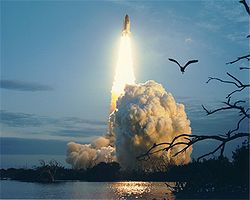
 STS-32 launched from Kennedy Space Center
(KSC), Florida
, on 9 January 1990 at 7:35:00 am EST. The launch was initially scheduled for 18 December 1989, but was later postponed to allow the modifications to Pad A to be completed and verified. The second scheduled launch, on 8 January 1990, was aborted due to weather conditions. Columbia had a mission launch weight of 255,994 lb (116,117 kg).
The primary objectives of the mission were to deploy the SYNCOM
IV-F5 defense communications satellite
(also known as LEASAT 5) and retrieve NASA's Long Duration Exposure Facility
(LDEF), whose retrieval had been delayed for 4 years by scheduling changes and the Challenger disaster of 1986. SYNCOM IV-F5 was deployed on the second flight day, and a third-stage Minuteman solid perigee kick motor propelled it into a geosynchronous orbit
. Dunbar retrieved the LDEF on the fourth day of the flight using the shuttle's Remote Manipulator System. The timeliness of the retrieval was of critical importance, because a high rate of solar flux had increased the density of the LDEF's orbital environment and accelerated its rate of orbital decay
. Specialists who carefully monitored the stability of the craft's orbit had anticipated that if the LDEF was not retrieved in time, it would pass too low for the shuttle to safely reach, and could be destroyed during re-entry in February 1990. Thus, the mission's exact liftoff time was determined about 12 hours before launch, using the latest tracking data on LDEF. It was flown on a 352 kilometres (190.1 nmi) orbit inclined 28.5 degrees to the equator
.
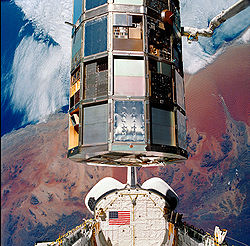
The crew performed a 4-hour photographic survey of the free-flying structure, which held 57 science, technology and applications experiments. The 12-sided cylinder, about the size of a small bus
, was then berthed in the orbiter's payload bay for return to Earth.
NASA had planned to acquire data on the crew members' exposure to long periods of zero gravity, and its effects on the crew's performance while landing the orbiter after an extended mission. STS-32 set a new shuttle duration record of nearly eleven days. An orbiter kit was developed to allow the shuttle to operate for up to 16 days in Earth orbit, and would later make its debut on Columbias STS-50
mission in 1992.
The retrieval of LDEF was filmed with an IMAX
camera, and appeared in the IMAX film Destiny in Space
in 1994. Earth observation footage from the camera also appeared in the 1991 film Blue Planet
.
Columbia landed safely on 20 January 1990 at 1:35:37 am PST on Runway 22 of Edwards Air Force Base
, California
. The shuttle had a landing weight of 103571 kilograms (228,335 lb). The roll-out distance was 3271 metres (10,731.6 ft), and the roll-out time was 62 seconds. The orbiter returned to KSC on 26 January 1990.
.
Each track is specially chosen, often by the astronauts' families, and usually has a special meaning to an individual member of the crew, or is applicable to their daily activities.
NASA
The National Aeronautics and Space Administration is the agency of the United States government that is responsible for the nation's civilian space program and for aeronautics and aerospace research...
's Space Shuttle program
Space Shuttle program
NASA's Space Shuttle program, officially called Space Transportation System , was the United States government's manned launch vehicle program from 1981 to 2011...
, and the 9th launch of Space Shuttle Columbia
Space Shuttle Columbia
Space Shuttle Columbia was the first spaceworthy Space Shuttle in NASA's orbital fleet. First launched on the STS-1 mission, the first of the Space Shuttle program, it completed 27 missions before being destroyed during re-entry on February 1, 2003 near the end of its 28th, STS-107. All seven crew...
. Launching on 9 January 1990, it marked the first time since STS-61-C
STS-61-C
-Mission parameters:*Mass:**Orbiter liftoff: **Orbiter landing: **Payload: *Perigee: *Apogee: *Inclination: 28.5°*Period: 91.2 min-Mission background:...
that Pad A at Kennedy Space Center
Kennedy Space Center
The John F. Kennedy Space Center is the NASA installation that has been the launch site for every United States human space flight since 1968. Although such flights are currently on hiatus, KSC continues to manage and operate unmanned rocket launch facilities for America's civilian space program...
's Complex 39 was used for a launch; it also marked the first use of Mobile Launcher Platform
Mobile Launcher Platform
The Mobile Launcher Platform or MLP is one of three two-story structures used by NASA to support the Space Shuttle stack during its transportation from the Vehicle Assembly Building to Launch Pad 39-A at the Kennedy Space Center as well as serve as the vehicle's launch platform...
No. 3 (MLP-3) in the Space Shuttle program. STS-32 was, at the time, the longest shuttle mission yet conducted, with a duration of nearly 11 days. Before STS-32, the only mission of the same duration had been STS-9
STS-9
STS-9 was a NASA Space Shuttle mission which carried the first Spacelab module into orbit to conduct space-based scientific experiments. It was the sixth mission of the Space Shuttle Columbia, and was Columbia's last flight until STS-61-C in January 1986...
in 1983. On 20 January 1990, STS-32 executed the third night landing of shuttle the program.
Crew
Mission parameters
- MassMassMass can be defined as a quantitive measure of the resistance an object has to change in its velocity.In physics, mass commonly refers to any of the following three properties of matter, which have been shown experimentally to be equivalent:...
:- Orbiter liftoff: 116117 kilograms (255,994.2 lb)
- Orbiter landing: 103571 kilograms (228,335 lb)
- Payload: 12014 kilograms (26,486.3 lb)
- PerigeePerigeePerigee is the point at which an object makes its closest approach to the Earth.. Often the term is used in a broader sense to define the point in an orbit where the orbiting body is closest to the body it orbits. The opposite is the apogee, the farthest or highest point.The Greek prefix "peri"...
: 296 kilometres (183.9 mi) - Apogee: 361 kilometres (224.3 mi)
- InclinationInclinationInclination in general is the angle between a reference plane and another plane or axis of direction.-Orbits:The inclination is one of the six orbital parameters describing the shape and orientation of a celestial orbit...
: 28.5° - PeriodOrbital periodThe orbital period is the time taken for a given object to make one complete orbit about another object.When mentioned without further qualification in astronomy this refers to the sidereal period of an astronomical object, which is calculated with respect to the stars.There are several kinds of...
: 91.1 min
Launch preparations
Launch Complex 39A was modified extensively in preparation for the launch, with STS-32 being the first launch from the refurbished pad since STS-61-C in 1986. NASANASA
The National Aeronautics and Space Administration is the agency of the United States government that is responsible for the nation's civilian space program and for aeronautics and aerospace research...
made improvements to the crew emergency egress system and the shuttle payload room, increased anti-freeze protection for the water systems, installed debris traps used during propellant loading, and added more weather protection features and an umbilical to provide power, instrumentation and controls to the heaters for the solid rocket booster
Solid rocket booster
Solid rocket boosters or Solid Rocket Motors, SRM, are used to provide thrust in spacecraft launches from the launchpad up to burnout of the SRBs. Many launch vehicles include SRBs, including the Ariane 5, Atlas V , and the NASA Space Shuttle...
field joints.
MLP-3, the oldest of the three Apollo-era launch structures, also underwent extensive remodeling for use with the shuttle. These modifications included the removal of the umbilical tower, the reconfiguring of three exhaust holes, and amendments to the electrical and mechanical ground support systems.
Mission summary
Kennedy Space Center
The John F. Kennedy Space Center is the NASA installation that has been the launch site for every United States human space flight since 1968. Although such flights are currently on hiatus, KSC continues to manage and operate unmanned rocket launch facilities for America's civilian space program...
(KSC), Florida
Florida
Florida is a state in the southeastern United States, located on the nation's Atlantic and Gulf coasts. It is bordered to the west by the Gulf of Mexico, to the north by Alabama and Georgia and to the east by the Atlantic Ocean. With a population of 18,801,310 as measured by the 2010 census, it...
, on 9 January 1990 at 7:35:00 am EST. The launch was initially scheduled for 18 December 1989, but was later postponed to allow the modifications to Pad A to be completed and verified. The second scheduled launch, on 8 January 1990, was aborted due to weather conditions. Columbia had a mission launch weight of 255,994 lb (116,117 kg).
The primary objectives of the mission were to deploy the SYNCOM
Syncom
Syncom started as a 1961 NASA program for active geosynchronous communication satellites, all of which were developed and manufactured by Hughes Space and Communications...
IV-F5 defense communications satellite
Satellite
In the context of spaceflight, a satellite is an object which has been placed into orbit by human endeavour. Such objects are sometimes called artificial satellites to distinguish them from natural satellites such as the Moon....
(also known as LEASAT 5) and retrieve NASA's Long Duration Exposure Facility
Long Duration Exposure Facility
NASA's Long Duration Exposure Facility, or LDEF, was a school bus-sized cylindrical space experiment rack that exposed various material samples to outer space for about 5.7 years, completing 32,422 Earth orbits.- Construction :...
(LDEF), whose retrieval had been delayed for 4 years by scheduling changes and the Challenger disaster of 1986. SYNCOM IV-F5 was deployed on the second flight day, and a third-stage Minuteman solid perigee kick motor propelled it into a geosynchronous orbit
Geosynchronous orbit
A geosynchronous orbit is an orbit around the Earth with an orbital period that matches the Earth's sidereal rotation period...
. Dunbar retrieved the LDEF on the fourth day of the flight using the shuttle's Remote Manipulator System. The timeliness of the retrieval was of critical importance, because a high rate of solar flux had increased the density of the LDEF's orbital environment and accelerated its rate of orbital decay
Orbital decay
Orbital decay is the process of prolonged reduction in the altitude of a satellite's orbit.This can be due to drag produced by an atmosphere due to frequent collisions between the satellite and surrounding air molecules. The drag experienced by the object is larger in the case of increased solar...
. Specialists who carefully monitored the stability of the craft's orbit had anticipated that if the LDEF was not retrieved in time, it would pass too low for the shuttle to safely reach, and could be destroyed during re-entry in February 1990. Thus, the mission's exact liftoff time was determined about 12 hours before launch, using the latest tracking data on LDEF. It was flown on a 352 kilometres (190.1 nmi) orbit inclined 28.5 degrees to the equator
Equator
An equator is the intersection of a sphere's surface with the plane perpendicular to the sphere's axis of rotation and containing the sphere's center of mass....
.
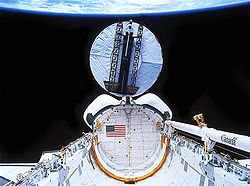
The crew performed a 4-hour photographic survey of the free-flying structure, which held 57 science, technology and applications experiments. The 12-sided cylinder, about the size of a small bus
Bus
A bus is a road vehicle designed to carry passengers. Buses can have a capacity as high as 300 passengers. The most common type of bus is the single-decker bus, with larger loads carried by double-decker buses and articulated buses, and smaller loads carried by midibuses and minibuses; coaches are...
, was then berthed in the orbiter's payload bay for return to Earth.
NASA had planned to acquire data on the crew members' exposure to long periods of zero gravity, and its effects on the crew's performance while landing the orbiter after an extended mission. STS-32 set a new shuttle duration record of nearly eleven days. An orbiter kit was developed to allow the shuttle to operate for up to 16 days in Earth orbit, and would later make its debut on Columbias STS-50
STS-50
-Backup crew:-Mission parameters:*Mass:**Orbiter landing with payload: **Payload: *Perigee: *Apogee: *Inclination: 28.5°*Period: 90.6 min- Mission highlights:...
mission in 1992.
The retrieval of LDEF was filmed with an IMAX
IMAX
IMAX is a motion picture film format and a set of proprietary cinema projection standards created by the Canadian company IMAX Corporation. IMAX has the capacity to record and display images of far greater size and resolution than conventional film systems...
camera, and appeared in the IMAX film Destiny in Space
Destiny in Space
Destiny in Space is a 70mm American documentary film released to IMAX cinemas in 1994. The film is directed in part by Academy Award-winning sound designer Ben Burtt, and is narrated by Leonard Nimoy....
in 1994. Earth observation footage from the camera also appeared in the 1991 film Blue Planet
Blue Planet (film)
Blue Planet is an IMAX film directed by Ben Burtt, and produced by the IMAX Space Technology corporation for the Smithsonian Institution's National Air and Space Museum, as well as Lockheed Corporation...
.
Columbia landed safely on 20 January 1990 at 1:35:37 am PST on Runway 22 of Edwards Air Force Base
Edwards Air Force Base
Edwards Air Force Base is a United States Air Force base located on the border of Kern County, Los Angeles County, and San Bernardino County, California, in the Antelope Valley. It is southwest of the central business district of North Edwards, California and due east of Rosamond.It is named in...
, California
California
California is a state located on the West Coast of the United States. It is by far the most populous U.S. state, and the third-largest by land area...
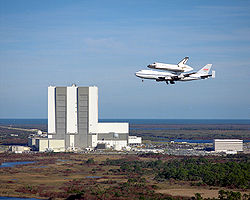
. The shuttle had a landing weight of 103571 kilograms (228,335 lb). The roll-out distance was 3271 metres (10,731.6 ft), and the roll-out time was 62 seconds. The orbiter returned to KSC on 26 January 1990.
Mid-deck payloads
In addition to the SYNCOM IV-F5 satellite, STS-32 carried a number of mid-deck scientific payloads, some of which had already been flown on previous shuttle missions. The experiments included:- Characterization of NeurosporaNeurospora crassaNeurospora crassa is a type of red bread mold of the phylum Ascomycota. The genus name, meaning "nerve spore" refers to the characteristic striations on the spores. The first published account of this fungus was from an infestation of French bakeries in 1843. N...
Circadian Rhythms (CNCR) - Protein Crystal Growth (PCG)
- Fluid Experiment Apparatus (FEA)
- American Flight Echocardiograph (AFE)
- Latitude / Longitude Locator (L3)
- Mesoscale Lightning Experiment(MLE)
- IMAXIMAXIMAX is a motion picture film format and a set of proprietary cinema projection standards created by the Canadian company IMAX Corporation. IMAX has the capacity to record and display images of far greater size and resolution than conventional film systems...
camera - Air Force Maui Optical Site (AMOS) experiment
Mission insignia
The three stars on the left and two stars on the right of STS-32's insignia symbolized the flight's numerical designation in the Space Transportation System's mission sequence.Wake-up calls
NASA began a tradition of playing music to astronauts during the Gemini program, and first used music to wake up a flight crew during Apollo 15Apollo 15
Apollo 15 was the ninth manned mission in the American Apollo space program, the fourth to land on the Moon and the eighth successful manned mission. It was the first of what were termed "J missions", long duration stays on the Moon with a greater focus on science than had been possible on previous...
.
Each track is specially chosen, often by the astronauts' families, and usually has a special meaning to an individual member of the crew, or is applicable to their daily activities.
| Flight Day | Song | Artist/Composer |
|---|---|---|
| Day 2 | "What’s More American?" | Bing Crosby Bing Crosby Harry Lillis "Bing" Crosby was an American singer and actor. Crosby's trademark bass-baritone voice made him one of the best-selling recording artists of the 20th century, with over half a billion records in circulation.... |
| Day 3 | "The Banana Boat Song" parody | |
| Day 4 | "Let It Snow Let It Snow "Let It Snow! Let It Snow! Let It Snow!", also known as "Let It Snow", is a song written by lyricist Sammy Cahn and composer Jule Styne in 1945. The song was written in July 1945 in Hollywood, California during one of the hottest days on record. First recorded by Vaughn Monroe, it became a popular... " parody |
|
| Day 5 | "Hello Dolly Hello, Dolly! (song) "Hello, Dolly!" is the title song of the popular 1964 musical of the same name. Louis Armstrong's version was inducted in the Grammy Hall of Fame in 2001.... " parody |
|
| Day 6 | "Attack of the Killer Tomatoes Attack of the Killer Tomatoes Attack of the Killer Tomatoes is a 1978 comedy film directed by John De Bello and starring David Miller. The film is a spoof of B movies. Made on a budget of less than US$100,000, the story involves tomatoes becoming sentient by unknown means and revolting against humanity. Writing credits were... " |
|
| Day 7 | "Notre Dame Victory March Notre Dame Victory March The "Notre Dame Victory March" is the fight song for the University of Notre Dame. It was written by two brothers who were Notre Dame graduates. The Rev. Michael J. Shea, a 1905 graduate, wrote the music, and his brother, John F. Shea, who earned degrees in 1906 and 1908, wrote the original lyrics... " |
|
| Day 8 | "Bow Down to Washington Bow Down to Washington Bow Down to Washington is the official fight song of the University of Washington. It was written by Lester Wilson in 1915 for a competition requesting a new song for the university; the competition, sponsored by The Daily, had a grand prize of US$25... " |
University of Washington University of Washington University of Washington is a public research university, founded in 1861 in Seattle, Washington, United States. The UW is the largest university in the Northwest and the oldest public university on the West Coast. The university has three campuses, with its largest campus in the University... |
| Day 9 | "Glory, Glory, Colorado Colorado Buffaloes The University of Colorado Boulder sponsors 16 varsity sports teams. Both men's and women's team are called the Buffaloes or Golden Buffaloes . "Lady Buffs" referred to the women's teams beginning in the 1970s, but was officially dropped in 1993... " |
University of Colorado University of Colorado at Boulder The University of Colorado Boulder is a public research university located in Boulder, Colorado... |
| Day 10 | "Danny Boy Danny Boy -Background:The words to "Danny Boy" were written by English lawyer and lyricist Frederic Weatherly in 1910. Although the lyrics were originally written for a different tune, Weatherly modified them to fit the "Londonderry Air" in 1913, after his sister-in-law in the U.S. sent him a copy. Ernestine... " |
Larry Bird Larry Bird Larry Joe Bird is a former American NBA basketball player and coach. Drafted into the NBA sixth overall by the Boston Celtics in 1978, Bird started at small forward and power forward for thirteen seasons, spearheading one of the NBA's most formidable frontcourts that included center Robert Parish... |
| Day 11 | "Washington and Lee" | Washington and Lee University Washington and Lee University Washington and Lee University is a private liberal arts college in Lexington, Virginia, United States.The classical school from which Washington and Lee descended was established in 1749 as Augusta Academy, about north of its present location. In 1776 it was renamed Liberty Hall in a burst of... |
| Day 12 | "Born to Be Wild Born to Be Wild "Born to Be Wild" is a rock song written by Mars Bonfire and made famous by the Canadian-American rock band Steppenwolf. It is often used in popular culture to denote a biker appearance or attitude... " |
Steppenwolf Steppenwolf (band) Steppenwolf are a Canadian-American rock group that was prominent in the late 1960s. The group was formed in 1967 in Los Angeles by vocalist John Kay, guitarist Michael Monarch, bassist Rushton Moreve, keyboardist Goldy McJohn and drummer Jerry Edmonton after the dissolution of Toronto group The... |
| Day 13 | "Anchors Aweigh Anchors Aweigh "Anchors Aweigh" is the fight song of the United States Naval Academy, and strongly associated with the United States Navy, composed in 1906 by Charles A. Zimmerman with lyrics by Alfred Hart Miles. Zimmerman was at the time a Lieutenant, and had been bandmaster of the United States Naval Academy... " |
Charles A. Zimmerman Charles A. Zimmerman Charles A. Zimmermann was an American composer of marches and popular music. A graduate of the Peabody Conservatory of Music in Baltimore, he was appointed bandmaster at the United States Naval Academy in 1887 at the age of 26. He served as the Academy's bandmaster until his death from a brain... |
See also
- Space explorationSpace explorationSpace exploration is the use of space technology to explore outer space. Physical exploration of space is conducted both by human spaceflights and by robotic spacecraft....
- Space Shuttle programSpace Shuttle programNASA's Space Shuttle program, officially called Space Transportation System , was the United States government's manned launch vehicle program from 1981 to 2011...
- List of space shuttle missions
- List of human spaceflights chronologically