


STS-120

Encyclopedia
Crew notes

Eileen Collins
Eileen Marie Collins is a retired American astronaut and a retired U.S. Air Force Colonel. A former military instructor and test pilot, Collins was the first female pilot and first female commander of a Space Shuttle. She was awarded several medals for her work. Col. Collins has logged 38 days 8...
) to command a space shuttle mission. Additionally, the Expedition 16
Expedition 16
Expedition 16 was the 16th expedition to the International Space Station .The first two crew members, Yuri Malenchenko and Peggy Whitson, launched on 10 October 2007, aboard Soyuz TMA-11, and were joined by spaceflight participant Sheikh Muszaphar Shukor, the first Malaysian in space.Expedition 15...
crew that received STS-120 was commanded by Peggy Whitson
Peggy Whitson
Peggy Annette Whitson is an American biochemistry researcher, NASA astronaut, and NASA's Chief Astronaut. Her first space mission was in 2002, with an extended stay aboard the International Space Station as a member of Expedition 5. Her second mission launched October 10, 2007, as the first female...
, the first female ISS commander. The flight of STS-120 thus became the first time two female mission commanders were in space at the same time.
Crew prior to the Space Shuttle Columbia disaster
Prior to the Space Shuttle Columbia disasterSpace Shuttle Columbia disaster
The Space Shuttle Columbia disaster occurred on February 1, 2003, when shortly before it was scheduled to conclude its 28th mission, STS-107, the Space Shuttle Columbia disintegrated over Texas and Louisiana during re-entry into the Earth's atmosphere, resulting in the death of all seven crew members...
, the original crew manifest for STS-120 was:
The STS-120 mission patch was designed by Michael Foreman before he was reassigned to STS-123
STS-123
-Mission parameters:* Mass:* Orbiter liftoff: * Orbiter landing: * Perigee: 336 kilometers * Apogee: 346 kilometers * Inclination: 51.6 degrees* Period: 91.6min-Mission payloads:...
.
Mission parameters
- MassMassMass can be defined as a quantitive measure of the resistance an object has to change in its velocity.In physics, mass commonly refers to any of the following three properties of matter, which have been shown experimentally to be equivalent:...
:- Orbiter liftoff: 286211 lbs
- Orbiter landing: 201895 lbs
- PerigeePerigeePerigee is the point at which an object makes its closest approach to the Earth.. Often the term is used in a broader sense to define the point in an orbit where the orbiting body is closest to the body it orbits. The opposite is the apogee, the farthest or highest point.The Greek prefix "peri"...
: 340 kilometres (211.3 mi) - Apogee: 344 kilometres (213.8 mi)
- InclinationInclinationInclination in general is the angle between a reference plane and another plane or axis of direction.-Orbits:The inclination is one of the six orbital parameters describing the shape and orientation of a celestial orbit...
: 51.6° - PeriodOrbital periodThe orbital period is the time taken for a given object to make one complete orbit about another object.When mentioned without further qualification in astronomy this refers to the sidereal period of an astronomical object, which is calculated with respect to the stars.There are several kinds of...
: 91.6 minutes
Mission payloads

| Location | Cargo | Mass |
|---|---|---|
| Bay 1–2 | Orbiter Docking System EMU Extravehicular Mobility Unit The Space Shuttle/International Space Station Extravehicular Mobility Unit is an independent anthropomorphic system that provides environmental protection, mobility, life support, and communications for a Space Shuttle or International Space Station crew member to perform extra-vehicular activity... 3010 / EMU 3017 |
1800 kilograms (3,968.3 lb) |
| Bay 3P | Shuttle Power Distribution Unit (SPDU) |
~100 kilograms (220.5 lb) |
| Bay 4S | SASA FSE (Fixture for return of S-band Antenna) |
~100 kilograms (220.5 lb) |
| Bay 5P | Power/Data Grapple Fixture (PDGF) for Node 2 |
~50 kilograms (110.2 lb) |
| Bay 6S | Main Bus Switching Unit (MBSU) and adapter |
360 kilograms (793.7 lb) |
| Bay 7P | Shuttle Power Distribution Unit (SPDU) |
~100 kilograms (220.5 lb) |
| Bay 8–12 | Harmony (Node 2) | 14288 kilograms (31,499.6 lb) |
| Sill | OBSS Orbiter Boom Sensor System The Orbiter Boom Sensor System is a 50-foot boom carried on board NASA's Space Shuttles. The boom can be grappled by the Canadarm and serves as an extension of the arm, doubling its length to a combined total of 100 feet... 203 |
~450 kilograms (992.1 lb) |
| Sill | RMS 301 | ~410 kilograms (903.9 lb) |
| Total: | 17300 kilograms (38,140 lb) |
Harmony (Node 2)
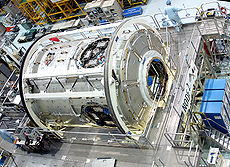

Thales Alenia Space
Thales Alenia Space is an aerospace company born after the Thales Group bought the participation of Alcatel in the two joint-ventures between Alcatel and Finmeccanica, Alcatel Alenia Space and Telespazio.-History:...
in Torino, Italy, as part of an agreement between NASA and the European Space Agency
European Space Agency
The European Space Agency , established in 1975, is an intergovernmental organisation dedicated to the exploration of space, currently with 18 member states...
and was the first pressurized habitable module delivered to the station since the Pirs docking compartment was installed in August 2001.
Since STS-120 docked to the Pressurized Mating Adapter 2
Pressurized Mating Adapter
The International Space Station uses three Pressurized Mating Adapters to interconnect spacecraft and modules with different docking mechanisms. The first two PMAs were launched with the Unity module in 1998 aboard STS-88...
(PMA-2) on the forward port of the Destiny Laboratory Module, installation of Harmony occurred in two stages: STS-120 installed Harmony to the port node of the Unity module. After Discovery undocked, the station's robotic arm detached PMA-2 from Destiny, and moved it to the forward port of Harmony. Following the relocation of PMA-2, the robotic arm has moved Harmony from its initial position, to its final position on the forward port of Destiny.
The final positioning of Harmony allowed for the later installation of the European Columbus
Columbus (ISS module)
Columbus is a science laboratory that is part of the International Space Station and is the largest single contribution to the ISS made by the European Space Agency ....
and Japanese Kibō
Japanese Experiment Module
The Japanese Experiment Module , also known with the nickname , is a Japanese science module for the International Space Station developed by JAXA. It is the largest single ISS module. The first two pieces of the module were launched on space shuttle missions STS-123 and STS-124...
research modules, which were attached to the side ports of Harmony.
P6 relocation
During STS-120, the P6 solar arrays were moved from the Z1 truss on top of Unity, to their final position at the port end of the truss.Outreach
STS-120 carried the signatures of over 500,000 students that participated in the 2007 Student Signatures in Space program, jointly sponsored by NASA and Lockheed Martin. In celebration of Space Day in May 2007, students from over 500 schools around the world signed giant posters. Their signatures were scanned onto a disk, and the disk was manifested on the STS-120 mission.Also during STS-120, the lightsaber
Lightsaber
A lightsaber is a fictional weapon in the Star Wars universe, a "laser sword." It consists of a polished metal hilt which projects a blade of light about 1.33 metres long. The lightsaber is the signature weapon of the Jedi order and their Sith counterparts, both of whom can use them for close...
used by actor Mark Hamill
Mark Hamill
Mark Richard Hamill is an American actor, voice artist, producer, director, and writer, best known for his role as Luke Skywalker in the original trilogy of Star Wars. More recently, he has received acclaim for his voice work, in such roles as the Joker in Batman: The Animated Series, Firelord...
in the 1983 film Star Wars Episode VI: Return of the Jedi
Star Wars Episode VI: Return of the Jedi
Star Wars Episode VI: Return of the Jedi is a 1983 American epic space opera film directed by Richard Marquand and written by George Lucas and Lawrence Kasdan. It is the third film released in the Star Wars saga, and the sixth in terms of the series' internal chronology...
was flown to the station and returned to Earth. Stowed on-board Discovery for the length of the mission, the prop
Theatrical property
A theatrical property, commonly referred to as a prop, is an object used on stage by actors to further the plot or story line of a theatrical production. Smaller props are referred to as "hand props". Larger props may also be set decoration, such as a chair or table. The difference between a set...
was flown in honor of the 30th anniversary of the Star Wars
Star Wars
Star Wars is an American epic space opera film series created by George Lucas. The first film in the series was originally released on May 25, 1977, under the title Star Wars, by 20th Century Fox, and became a worldwide pop culture phenomenon, followed by two sequels, released at three-year...
franchise. On 28 August 2007, Chewbacca
Chewbacca
Chewbacca, also known as Chewie, is a character in the Star Wars franchise, portrayed by Peter Mayhew. In the series' narrative chronology, he appears in Episode III: Revenge of the Sith, Episode IV: A New Hope, Episode V: The Empire Strikes Back and Episode VI: Return of the Jedi...
from the Star Wars films presented the lightsaber to NASA officials from Space Center Houston
Space Center Houston
Space Center Houston is the official visitors' center of the Lyndon B. Johnson Space Center—the National Aeronautics and Space Administration's center for human spaceflight activities—located in Houston...
, in an official ceremony at Oakland International Airport
Oakland International Airport
Oakland International Airport , also known as Metropolitan Oakland International Airport, is a public airport located south of the central business district of Oakland, a city in Alameda County, California, United States...
. The lightsaber was then flown to Houston, where it was greeted by Stormtroopers
Imperial stormtrooper
The Imperial Stormtroopers are fictional soldiers from George Lucas' Star Wars universe. Stormtroopers are the soldiers of the imperial army under the leadership of the evil Sith Lord and Emperor Palpatine and his commanders, most notably Darth Vader and Grand Moff Tarkin.They are shown in...
. The lightsaber will be displayed at Space Center Houston.
Mission background
At the time of the ColumbiaSpace Shuttle Columbia disaster
The Space Shuttle Columbia disaster occurred on February 1, 2003, when shortly before it was scheduled to conclude its 28th mission, STS-107, the Space Shuttle Columbia disintegrated over Texas and Louisiana during re-entry into the Earth's atmosphere, resulting in the death of all seven crew members...
disaster, STS-120 was scheduled for early 2004. It was delayed repeatedly until 23 October 2007.
NASA originally scheduled the launch for 20 October 2007, but due to the International Space Station program requirement, launch was delayed to 23 October 2007.
In light of the small gouge to the underside of Endeavour that occurred on STS-118
STS-118
- Crew notes :Astronaut Clayton Anderson originally was slated to be launched to the ISS on this mission, but was moved to STS-117. His replacement was Alvin Drew....
, in August 2007, NASA managers announced that they expected to add a fifth spacewalk to the STS-120 mission, designed to test a heat-shield repair tool. The repair technique was originally scheduled for a flight in 2008, but following STS-118, it was decided to move up the testing. The repair tool, called a TPS
Space Shuttle thermal protection system
The Space Shuttle thermal protection system is the barrier that protects the Space Shuttle Orbiter during the searing heat of atmospheric reentry...
(thermal protection system) repair ablator
Ablation
Ablation is removal of material from the surface of an object by vaporization, chipping, or other erosive processes. This occurs in spaceflight during ascent and atmospheric reentry, glaciology, medicine, and passive fire protection.-Spaceflight:...
dispenser (T-RAD), has never been tested in space, so the spacewalk would have allowed managers to evaluate its effectiveness in low gravity environments. During the course of the mission, issues with the S4 starboard Solar Alpha Rotary Joint (SARJ), and P6 Solar Array, deferred this test objective to a future mission.
The mission marked:
- 151st NASA manned spaceflight.
- 120th space shuttle flight since STS-1STS-1STS-1 was the first orbital flight of NASA's Space Shuttle program. Space Shuttle Columbia launched on 12 April 1981, and returned to Earth on 14 April, having orbited the Earth 37 times during the 54.5-hour mission. It was the first American manned space flight since the Apollo-Soyuz Test Project...
. - 34th flight of DiscoverySpace Shuttle DiscoverySpace Shuttle Discovery is one of the retired orbiters of the Space Shuttle program of NASA, the space agency of the United States, and was operational from its maiden flight, STS-41-D on August 30, 1984, until its final landing during STS-133 on March 9, 2011...
. - 95th post-ChallengerSpace Shuttle Challenger disasterThe Space Shuttle Challenger disaster occurred on January 28, 1986, when Space Shuttle Challenger broke apart 73 seconds into its flight, leading to the deaths of its seven crew members. The spacecraft disintegrated over the Atlantic Ocean, off the coast of central Florida at 11:38 am EST...
mission. - 7th post-Columbia mission.
Launch preparations
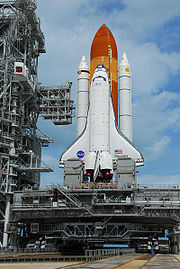

Space Shuttle external tank
A Space Shuttle External Tank is the component of the Space Shuttle launch vehicle that contains the liquid hydrogen fuel and liquid oxygen oxidizer. During lift-off and ascent it supplies the fuel and oxidizer under pressure to the three Space Shuttle Main Engines in the orbiter...
to be used on STS-120, and modify the liquid oxygen
Liquid oxygen
Liquid oxygen — abbreviated LOx, LOX or Lox in the aerospace, submarine and gas industries — is one of the physical forms of elemental oxygen.-Physical properties:...
feed-line brackets. The change involved a new low-density foam application, and thinner gaskets. Shuttle Program Managers decided to do this to reduce the foam loss from the area that had been noted since STS-114
STS-114
-Original crew:This mission was to carry the Expedition 7 crew to the ISS and bring home the Expedition 6 crew. The original crew was to be:-Mission highlights:...
's "Return to Flight" mission in 2005. STS-118 had a small gouge on the belly of the orbiter due to a chunk of foam that impacted during launch in August 2007. The week of 17 September 2007, NASA managers decided to delay Discovery's rollover to the Vehicle Assembly Building
Vehicle Assembly Building
The Vehicle Assembly Building, or VAB, at NASA's Kennedy Space Center was used to assemble and house American manned launch vehicles from 1968-2011. It is the fourth largest building in the world by volume...
(VAB), due to a hydraulic fluid leak from the right main landing gear strut. The strut repair was successfully completed on 19 September 2007. Discovery then moved to the VAB, and was mated to the External Tank and Solid Rocket Boosters
Solid rocket booster
Solid rocket boosters or Solid Rocket Motors, SRM, are used to provide thrust in spacecraft launches from the launchpad up to burnout of the SRBs. Many launch vehicles include SRBs, including the Ariane 5, Atlas V , and the NASA Space Shuttle...
. Perched atop the Mobile Launcher Platform
Mobile Launcher Platform
The Mobile Launcher Platform or MLP is one of three two-story structures used by NASA to support the Space Shuttle stack during its transportation from the Vehicle Assembly Building to Launch Pad 39-A at the Kennedy Space Center as well as serve as the vehicle's launch platform...
, Discovery arrived at Launch complex 39A on 30 September 2007.
The crew of STS-120 arrived at Kennedy Space Center on 7 October 2007 and began final preparations, including the terminal countdown demonstration test
Terminal countdown demonstration test
A terminal countdown demonstration test is a simulation of the final hours of a launch countdown and serves as a practice exercise in which both the launch team and flight crew rehearse launch day timelines and procedures...
, or "Dress Rehearsal", scheduled for 7 October 2007 through 10 October 2007.
On 9 October 2007, NASA's Engineering and Safety Center, an independent review group set up after the 2003 Columbia disaster, advised replacement of three of Discovery's reinforced carbon-carbon
Reinforced carbon-carbon
Carbon fibre-reinforced carbon is a composite material consisting of carbon fibre reinforcement in a matrix of graphite. It was developed for the nose cones of intercontinental ballistic missiles, and is most widely known as the material for the nose cone and wing leading edges of the Space Shuttle...
(RCC) panels on the leading wing edge, due to a loss of small amounts of the protective silicon
Silicon
Silicon is a chemical element with the symbol Si and atomic number 14. A tetravalent metalloid, it is less reactive than its chemical analog carbon, the nonmetal directly above it in the periodic table, but more reactive than germanium, the metalloid directly below it in the table...
-carbide
Carbide
In chemistry, a carbide is a compound composed of carbon and a less electronegative element. Carbides can be generally classified by chemical bonding type as follows: salt-like, covalent compounds, interstitial compounds, and "intermediate" transition metal carbides...
coating. NASA reviewed the issue of oxidation of the panels for several months, using a variety of specialized testing methods, including thermography
Thermography
Infrared thermography, thermal imaging, and thermal video are examples of infrared imaging science. Thermal imaging cameras detect radiation in the infrared range of the electromagnetic spectrum and produce images of that radiation, called thermograms...
. These tests showed that the panels had not worsened over the course of the past two flights of Discovery, and the orbiter project engineers concluded in August that Discovery was safe to launch as is. Had a decision been made to repair the panels, the orbiter would have been rolled back to the VAB, delaying the launch.
On 16 October 2007, NASA Managers completed the Flight Readiness Review, and held a press conference to announce the mission plan. The issue of the RCC panels raised by NESC was found to be of little immediate concern, because the NESC took pre-flight thermography data from Endeavour and compared it with Discovery, but there was no commonality in flight history between the two vehicles. The research showed no significant difference between the panels prior to STS-114, and the panels today, which indicates the coating has not worsened during the previous flights, adding confidence that Discovery's RCC panels have had no deterioration in the flights since. NASA announced on the main shuttle page that "The Space Shuttle Program has determined that Discovery's astronauts can safely carry out their mission without having to replace the panels."
23 October (Flight Day 1, Launch)
Discovery launched on time at 11:38 EDT (15:38 UTC). In the countdown's final minutes, a piece of ice, measuring 4 inches (10.2 cm) x 0.5 inches (1.3 cm) was seen on the hydrogen umbilical between the orbiter and the external tank. The inspection team was called back to the pad (a contingency that has been practiced, and used before), to get a closer look at the ice build-up. NASA flight controllers deemed it too small to pose a threat to the thermal protection system. The ice was attached to a KaptonKapton
Kapton is a polyimide film developed by DuPont which can remain stable in a wide range of temperatures, from -273 to +400 °C...
purge barrier near the LH2 umbilical pyrotechnic
Pyrotechnic fastener
A pyrotechnic fastener is a fastener, usually a nut or bolt, that incorporates a pyrotechnic charge that can be initiated remotely. One or more explosive charges embedded within the bolt are typically activated by an electric current, and the charge breaks the bolt into two or more pieces...
canister closeout. It had been shown in tests that ice on this liner, sometimes called a "baggie"
Baggies
Baggies may refer to:* Baggies, made by Pactiv Corporation, were the first brand of food storage bags. Twist-tie-sealed bags that keep food fresh, they are available in quart , gallon and 2-gallon bags...
, would likely come off at main engine ignition. Had it been on other metal surfaces around the liner, this may have posed a threat of staying on and breaking off at a critical part of launch. Despite these issues, the launch continued as planned. The forecast for launch initially was a 60% chance of weather prohibiting launch, and although the launch team weather officers were tracking an incoming storm, the weather remained favorable for launch. Present for the launch was George Lucas
George Lucas
George Walton Lucas, Jr. is an American film producer, screenwriter, and director, and entrepreneur. He is the founder, chairman and chief executive of Lucasfilm. He is best known as the creator of the space opera franchise Star Wars and the archaeologist-adventurer character Indiana Jones...
, to see off the Star Wars lightsaber. In a press briefing following launch, NASA managers noted a few "events" involving debris, but they occurred later in ascent, after the period of maximum aerodynamic velocity
Velocity
In physics, velocity is speed in a given direction. Speed describes only how fast an object is moving, whereas velocity gives both the speed and direction of the object's motion. To have a constant velocity, an object must have a constant speed and motion in a constant direction. Constant ...
and speed, and were not concerning.
24 October (Flight day 2)
The crew of STS-120 spent their first full day in space by performing the RCC survey, using the Shuttle Remote Manipulator System (SRMS), and the Orbiter Boom Sensor SystemOrbiter Boom Sensor System
The Orbiter Boom Sensor System is a 50-foot boom carried on board NASA's Space Shuttles. The boom can be grappled by the Canadarm and serves as an extension of the arm, doubling its length to a combined total of 100 feet...
(OBSS). The crew also worked on various tasks such as inspecting the Extravehicular Mobility Unit
Extravehicular Mobility Unit
The Space Shuttle/International Space Station Extravehicular Mobility Unit is an independent anthropomorphic system that provides environmental protection, mobility, life support, and communications for a Space Shuttle or International Space Station crew member to perform extra-vehicular activity...
s (EMUs, or spacesuits) that will be used on the EVAs, and doing some preliminary work to get ready for docking with the International Space Station on Thursday. Deputy Shuttle Program Manager and Mission Management Team (MMT) chairman John Shannon noted during the status briefing that the preliminary data the team had reviewed showed no items of concern, and the ascent imagery showed no significant losses prior to SRB separation. Shannon said there were several items the team was waiting for higher resolution imagery to assess, including a possible protruding gap filler, and some external tank foam losses, but there was nothing to indicate any problems. Shannon also noted that a vapor trail was seen coming off the external tank for several seconds during launch, but noted that this was a condition seen during both STS-114, and STS-121
STS-121
STS-121 was a space shuttle mission to the International Space Station flown by Space Shuttle Discovery. The main purposes of the mission were to test new safety and repair techniques introduced following the Columbia disaster of February 2003 as well as to deliver supplies, equipment and...
, and was found to be condensate coming off the back side of the tank. Due to the temperature and humidity, combined with the angle of the sun for Discovery's launch, the plume appeared more dramatic in some of the imagery. This was considered an "expected condition", and Shannon confirmed it was of no concern.
25 October (Flight day 3)
The crew of STS-120 worked through the rendezvous procedures in the morning leading to the rendezvous pitch maneuverRendezvous pitch maneuver
The R-bar pitch maneuver , popularly called the rendezvous pitch maneuver, was a maneuver performed by the space shuttle as it rendezvoused with the International Space Station prior to docking. The shuttle performed a backflip that exposed its heat-shield to the crew of the ISS that made...
which began at 11:34 UTC. Following the RPM, the crew was given the "Go" to dock with the station, and successful docking to the International Space Station occurred at 12:40 UTC. Following docking, the joint crews conducted a station safety review, and Tani's custom Soyuz seatliner was transferred from Discovery to the Soyuz TMA-11
Soyuz TMA-11
Soyuz TMA-11 was a human spaceflight mission using a Soyuz-TMA spacecraft to transport personnel to and from the International Space Station . The mission began at 13:22 UTC on October 10, 2007 when the spacecraft was launched from the Baikonur Cosmodrome by a Soyuz FG launch vehicle...
, with Anderson's seat liner taken into Discovery. This marked the official end of Expedition 16 for Anderson, and the start of Tani's increment. Just before the two crews signed off to sleep, they were informed that after preliminary review of the RPM photography, focused inspection of the orbiter's heat shield would not be required. During the MMT briefing, Shannon confirmed that initial evaluation of the available data showed Discovery to be a "pretty clean vehicle". He also confirmed they were not working any issues or items of interest. Shannon said the piece of ice that was looked at prior to launch dislodged during main engine ignition, and as it fell, the ice appeared to graze the underside of the orbiter at the beginning of ascent, but the area around the impact site was in good condition, and the ice did not appear to have caused any damage. Shannon said the teams would continue to evaluate the imagery and data, but the shuttle was in a good configuration.
26 October (Flight day 4)
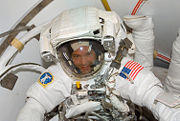
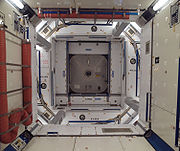
Unity Module
thumb|right|300px|ISS Unity connecting module The Unity connecting module was the first U.S.-built component of the International Space Station....
. At 15:38 UTC, Harmony was officially mated to the space station. The station's new addition adds 2666 cubic feet (75.5 m³) to the station's living volume, an increase of almost 20%, from 15000 ft3 to 17666 ft3.
At the Mission Management Team meeting, managers cleared Discovery's heat shield for reentry, and verified that focused inspection was not required, but noted that late inspection will still be performed on flight day 13 following undocking. John Shannon mentioned that managers have decided to add a task to the second EVA, asking the astronauts to visually inspect the Solar Alpha Rotary Joint (SARJ) on the starboard side, as the joint has registered some vibration for the past month and a half. While the friction is not constant or severe, managers will have Tani remove the insulation covers from the joint to photograph the swing bolts on the joint since Tani would be near the area during the EVA.
27 October (Flight day 5)

CBS
CBS Broadcasting Inc. is a major US commercial broadcasting television network, which started as a radio network. The name is derived from the initials of the network's former name, Columbia Broadcasting System. The network is sometimes referred to as the "Eye Network" in reference to the shape of...
, Fox News, and WHAM-TV
WHAM-TV
WHAM-TV is the ABC-affiliated television station for Rochester, New York. It broadcasts a high definition digital signal on VHF channel 13 from a transmitter on Pinnacle Hill on the border between Rochester and Brighton. The station can also be seen on Time Warner channel 13 and in high definition...
from inside Harmony.
28 October (Flight day 6)
The two crews awoke at 05:08 UTC, and began preparing for the second EVA. Parazynski and Tani began the spacewalk at 09:32 UTC, a half hour ahead of the planned timeline. The pair started with the P6 truss, removing the attachments to the Z1 truss, which allowed Wilson and Wheelock to use the station's robotic arm to move the truss to a position where it was "parked" for the night. Joking to Wilson "Don't drop it!", Parazynski then moved on and installed handrails onto Harmony, while Tani went to inspect some items requested by the managers, including handrails on a Crew and Equipment Translation Aid (CETA) cart, that was considered as a possible cause of Rick MastracchioRichard Mastracchio
Richard Alan "Rick" Mastracchio is an American engineer and a NASA astronaut. He has flown on three NASA Space Shuttle missions as a mission specialist...
's glove tear on STS-118. Tani noted the handrail appeared to be intact, with no obvious sharp edges. Tani then moved on to the Solar Alpha Rotary Joint (SARJ) that has had an intermittent vibration for over a month. After removing the cover from the joint, Tani called down to the team to let them know he saw some metal shavings, and some wear patterns and discoloration on one of the rings inside the joint. "It's like the result that you get with the metal, iron filings and you put a magnet under it and they stand straight up." Tani collected some of the shavings onto some tape, which returned to Earth with the shuttle for further analysis. Managers decided to add a task to Tuesday's EVA, having Parazynski inspect the port (left side) SARJ, using photography and video to compare it to the starboard SARJ inspected by Tani.
29 October (Flight day 7)

Ferrous
Ferrous , in chemistry, indicates a divalent iron compound , as opposed to ferric, which indicates a trivalent iron compound ....
. This information allowed the managers on the ground to rule out some possibilities of the origin of the particles, such as the thermal covers, which are made of aluminized mylar.
The Mission Management Team discussed the SARJ issues with the ISS team, and decided to add an extra docked day to the mission, between flight days 11 and 12. The new plan changed the objectives of EVA four from the heat shield repair materials testing, to a more thorough inspection of the starboard SARJ. With the new flight plan, Discovery would undock on 5 November 2007 with a landing on 7 November 2007, at approximately 05:11 EST.
30 October (Flight day 8)

31 October (Flight day 9)

Giorgio Napolitano
Giorgio Napolitano is an Italian politician who has been the 11th President of Italy since 2006. A long-time member of the Italian Communist Party and later the Democrats of the Left, he served as President of the Chamber of Deputies from 1992 to 1994 and as Minister of the Interior from 1996 to...
. The entire crew took part in a second PAO event, fielding calls from news agencies from the United States, Europe, and Russia. Around 15:00 UTC, mission control informed the crew that Thursday's planned EVA would be postponed to either Friday, or perhaps Saturday, to allow for a new EVA plan to be worked out, which would include troubleshooting of the P6 solar arrays.
1 November (Flight day 10)

George H. W. Bush
George Herbert Walker Bush is an American politician who served as the 41st President of the United States . He had previously served as the 43rd Vice President of the United States , a congressman, an ambassador, and Director of Central Intelligence.Bush was born in Milton, Massachusetts, to...
and his wife, Barbara, who were visiting Johnson Space Center.
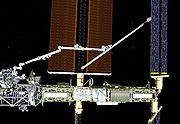
The rest of the day was devoted to assembling and configuring the new equipment and tools that would be required for the solar array repair, including a tool termed a "cufflink". The tear in the array is located at one of the hinges, which carries the load of the array, so the cufflink will be a load-bearing strap to relieve the pressure from the snagged area, transferring the load from the hinge, to the cufflink. The cufflink is made up of two wires, with two tabs at the end, that are threaded through existing reinforced aluminum holes in the solar array panels. The EVA plans call for the space station's robotic arm to grapple the shuttle's orbital inspection boom, with an extension on the end, to allow Parazynski to reach the solar array while positioned on a foot restraint at the end of the system. Wheelock will be watching to let the team know the clearances, and to assist Parazynski and the robotics team with positioning. With the changes to the timeline, the crew would be shifting their sleep schedule, to allow for a daylight landing on Wednesday, rather than the early morning landing that was originally planned. The fifth EVA that was planned for the Expedition 16 crew during the mission was delayed, and will be performed by the station crew after the shuttle departs.
2 November (Flight day 11)
The shuttle and station crews spent the day discussing the new EVA plan with managers on the ground, reviewing the procedures, completing the tool configurations, and going over the timeline for the fourth EVA, scheduled for Saturday. The crew also positioned the station's mobile transporter and robotic arm on the end of the truss, to allow the apparatus to reach the solar array. Saturday's EVA would be the first operational use of the Orbiter Boom Sensor System (OBSS) to reach a worksite, although the task was tested and demonstrated during STS-121 to show the boom could provide a stable work platform for EVA activities.3 November (Flight day 12)
Star Wars music
The music of Star Wars consists of the scores written for all six Star Wars films by composer John Williams from 1977 to 1983 for the Original Trilogy, and 1999 to 2005 for the Prequel Trilogy. It includes the Star Wars: The Clone Wars music written by Kevin Kiner...
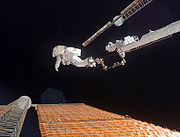
, the station and shuttle crews got to work preparing for the mission's fourth EVA. The spacewalk began at 10:03 UTC. After translating out to the robotic arm, Parazynski attached himself to the adjustable portable foot restraint (APFR), and was taken to the solar array worksite. Working slowly, with direction from Wheelock and the ground team, Parazynski secured the five cufflinks to the array, and then backed away to observe the deploy action. Inside the station, the crew deployed the array a half a "bay" at a time, and the array was fully deployed at 15:23 UTC. After performing additional inspections of both the 2B, and 4B arrays, Parazynski and Wheelock finished the EVA at 17:22 UTC. With the mission's final spacewalk completed, Parazynski has completed seven EVAs, for a total time of 47 hours, 05 minutes, placing him 5th overall for total EVA duration. Wheelock completed three EVAs, for a total time of 20 hours, 41 minutes, and the total EVA time for STS-120 was 27 hours, 14 minutes. During the EVA, a pair of needlenose pliers floated free of the equipment, and was observed floating nearby the window by the crew inside the station. The tool floated clear of the station, and was not a hazard.
| Illustration of plan | Repair images | |
|---|---|---|
 |
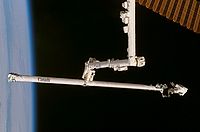 |
OBSS used as an extension boom for Canadarm2. |
 |
 |
The placement of the five cufflinks designed to relieve tension from the damaged solar array hinge. |
4 November (Flight day 13)

5 November (Flight day 14)
The two crews spent the morning preparing for Discovery's undocking from the International Space Station. At 10:32 UTC, the orbiter successfully backed away from the Pressurized Mating Adapter on the Destiny Laboratory, and pilot Zamka began the fly-around to allow the shuttle crew to photograph the new configuration of the station. After performing the final separation burn, focused inspection began, to scan the wing leading edges and nose cap, the final analysis that allows the ground team to clear the orbiter for re-entry on Wednesday.6 November (Flight day 15)
The crew of Discovery spent the day preparing Wednesday's landing. In addition to doing final packing and stowing activities, Melroy and Zamka did a check of the orbiter's systems, including the flight control systems, and the reaction control system jets. The crew took some time out in the morning to speak to the media, and then had a deorbit preparation briefing with the ground team. Melroy performed a burn of the orbiter's engines in the afternoon, an orbit adjustment burn done to refine the orbiter's trajectory for the two Wednesday landing opportunities at Kennedy Space Center. NASA managers officially cleared Discoverys heat shield for landing after reviewing the data sent down by the final inspection on Monday.7 November (Flight day 16, Landing)

Edwards Air Force Base
Edwards Air Force Base is a United States Air Force base located on the border of Kern County, Los Angeles County, and San Bernardino County, California, in the Antelope Valley. It is southwest of the central business district of North Edwards, California and due east of Rosamond.It is named in...
, or White Sands
White Sands Missile Range
White Sands Missile Range is a rocket range of almost in parts of five counties in southern New Mexico. The largest military installation in the United States, WSMR includes the and the WSMR Otera Mesa bombing range...
, as the weather looked favorable for both landing opportunities at Kennedy. The weather forecast at the Shuttle Landing Facility called for good visibility, with mostly sunny skies, although the headwinds would be evaluated, as they had been peaking at 23 knots (45.1 km/h). Due to the sleep shifting done by the crew earlier in the mission to schedule the extra mission days, the landing was done on what is called a "descending" node entry. Unlike ascending node entries, this entry trajectory brought the shuttle diagonally across the United States for the first time since STS-107
STS-107
-Mission parameters:*Mass:**Orbiter Liftoff: **Orbiter Landing: **Payload: *Perigee: *Apogee: *Inclination: 39.0°*Period: 90.1 min- Insignia :...
. The shuttle passed over Vancouver, British Columbia
British Columbia
British Columbia is the westernmost of Canada's provinces and is known for its natural beauty, as reflected in its Latin motto, Splendor sine occasu . Its name was chosen by Queen Victoria in 1858...
, Canada, and angled down towards Florida. Once the orbiter reached Florida, Melroy performed a 195-degree right overhead turn along the heading alignment cone (HAC) in order to line up for a landing on Runway 33. The first landing opportunity began with a deorbit burn at 16:59 UTC and finished with a landing at 13:01 EST. The deorbit burns were done to slow the orbiter's speed and to drop it out of freefall orbit and on target for the designated runway.
Discovery's payload bay doors were closed at 14:13 UTC, and the crew began fluid loading at 16:00 UTC. Fluid loading is a procedure that involves drinking high salt content fluids, which allows the astronauts to adjust to the return to gravity, and reduces the chance of hypotension
Hypotension
In physiology and medicine, hypotension is abnormally low blood pressure, especially in the arteries of the systemic circulation. It is best understood as a physiologic state, rather than a disease. It is often associated with shock, though not necessarily indicative of it. Hypotension is the...
upon returning to Earth. Shortly after 16:00 UTC, the crew began to get into their launch and entry suits, and ingress into their respective seats for landing. At 16:50 UTC, Entry Flight Director Bryan Lunney
Bryan Lunney
Bryan Lunney is formerly a NASA flight director.-Early life:The son of Apollo-era flight director Glynn Lunney, Bryan Lunney grew up in Friendswood, Texas and attended Friendswood High School...
gave the crew the "go" for deorbit burn. The initiation of the burn committed Discovery to landing. The burn was initiated at 16:59 UTC, and was one minute and 53 seconds in duration. The deorbit burn is performed while the orbiter is facing opposite its direction of travel, which allows the engines to act as a braking system, slowing its speed by approximately 215 feet per second (65.5 m/s). After the burn, the remaining propellant in the orbiter's maneuvering thrusters was dumped overboard, at 17:13 UTC. Discovery began to feel the effects of gravity around 400000 feet (121,920 m), as it traveled above the North Pacific Ocean at 17:30 UTC. As the orbiter descended, Melroy initiated a series of "rolls", and roll reversals, which serve to create friction and bleed off additional speed. At 17:40 UTC, Discovery entered the United States, flying over Montana
Montana
Montana is a state in the Western United States. The western third of Montana contains numerous mountain ranges. Smaller, "island ranges" are found in the central third of the state, for a total of 77 named ranges of the Rocky Mountains. This geographical fact is reflected in the state's name,...
. At 17:53, the orbiter entered Florida, flying at a speed of 3500 mi/h, and an altitude of 118000 feet (35,966.4 m).
Discovery touched down on runway 33 at 13:01:18 EST, the rear landing gear touching down first, the nose gear touching down at 13:01:32 EDT, and the orbiter came to a complete stop at 13:02:13 EDT. Total mission time was 15 days, 2 hours, 23 minutes, 55 seconds, for a distance of 6.25 million miles in 238 orbits. The completion of STS-120 marks the longest duration mission for Discovery.
Extra-vehicular activity
Four spacewalks were scheduled and completed during STS-120. The cumulative time in extra-vehicular activity during the mission was 27 hours and 14 minutes.| EVA | Spacewalkers | Start (UTC Coordinated Universal Time Coordinated Universal Time is the primary time standard by which the world regulates clocks and time. It is one of several closely related successors to Greenwich Mean Time. Computer servers, online services and other entities that rely on having a universally accepted time use UTC for that purpose... ) |
End | Duration | Mission |
|---|---|---|---|---|---|
| EVA1 | Scott E. Parazynski Scott E. Parazynski Scott Edward Parazynski, M.D. is an American physician and a former NASA astronaut. A veteran of five Space Shuttle flights and seven spacewalks, Parazynski's latest mission was STS-120 in October, 2007 --- highlighted by a dramatic, unplanned EVA to repair a live solar array... Douglas H. Wheelock Douglas H. Wheelock Douglas Harry "Wheels" Wheelock is an American astronaut. He has flown in space twice logging 178 days on the Space Shuttle, International Space Station, and Russian Soyuz... |
26 October 2007 10:02 UTC |
26 October 2007 16:16 UTC |
6 hours, 14 minutes | Harmony (Node 2) installation preparation, S-Band S band The S band is defined by an IEEE standard for radio waves with frequencies that range from 2 to 4 GHz, crossing the conventional boundary between UHF and SHF at 3.0 GHz. It is part of the microwave band of the electromagnetic spectrum... Antenna Antenna (radio) An antenna is an electrical device which converts electric currents into radio waves, and vice versa. It is usually used with a radio transmitter or radio receiver... Support Assembly (SASA) retrieval, P6/Z1 fluid line disconnections, P6 aft radiator shroud installations. |
| EVA2 | Scott E. Parazynski Daniel M. Tani Daniel M. Tani Daniel Tani is an American engineer and a NASA astronaut. Although born in Ridley Park, Pennsylvania, he considers Lombard, Illinois, to be his hometown... |
28 October 2007 09:32 UTC |
28 October 2007 16:05 UTC |
6 hours, 33 minutes | Z1 to P6 umbilical disconnections, P6 detach from Z1, S1 radiator configuration, Node 2 handrail installations, S4 starboard Solar Alpha Rotary Joint (SARJ) inspection. |
| EVA3 | Scott E. Parazynski Douglas H. Wheelock |
30 October 2007 08:45 UTC |
30 October 2007 15:53 UTC |
7 hours, 08 minutes | P6 to P5 attachment. P6/P5 umbilical connections, S1 configure post-redeploy, port SARJ inspection. |
| EVA4 | Scott E. Parazynski Douglas H. Wheelock |
3 November 2007 10:03 UTC |
3 November 2007 17:22 UTC |
7 hours, 19 minutes | Inspection and repair of P6 Solar Array. |
ESA Esperia mission
In addition to his participation in the ISS assembly mission during the STS-120 flight, Paolo Nespoli conducted science research as part of the Esperia mission for ESA. According to the STS-120 press kit, Nespoli was to carry out a number of experiments on behalf of the European science community. Two of these experiments (Chromosome‐2 and Neocytolysis) were sponsored by ESA. The other three (HPA, FRTL‐5 and SPORE) were sponsored by the Italian Space AgencyItalian Space Agency
The Italian Space Agency is a government agency established in 1988 to fund, regulate and coordinate space exploration activities in Italy...
. Chromosome‐2, Neocytolysis and HPA were experiments in the field of human physiology. FRTL‐5 and SPORE were biology experiments.
Wake-up calls
NASA began a tradition of playing music to astronauts during the Gemini program, which was first used to wake up a flight crew during Apollo 15Apollo 15
Apollo 15 was the ninth manned mission in the American Apollo space program, the fourth to land on the Moon and the eighth successful manned mission. It was the first of what were termed "J missions", long duration stays on the Moon with a greater focus on science than had been possible on previous...
.
Each track is specially chosen, often by their families, and usually has a special meaning to an individual member of the crew, or is applicable to their daily activities.
| Flight Day | Song | Artist/Composer | Played for | Links |
|---|---|---|---|---|
| Day 2 | "Lord of the Dance Lord of the Dance (hymn) Lord of the Dance is a hymn with words written by English songwriter Sydney Carter in 1967. He adapted the tune from the American Shaker song "Simple Gifts"... " |
John Langstaff John Langstaff John Langstaff , a concert baritone, and early music revivalist was the founder of the Northeast United States tradition of the Christmas Revels, as well as a respected musician and educator. He attended the Curtis Institute of Music as well as Juilliard. In 1943 he married Diane Hamilton... |
Pam Melroy | wav mp3 Transcript |
| Day 3 | "Dancing in the Moonlight Dancing in the Moonlight "Dancing In The Moonlight" is the title song on the 1973 King Harvest album. The track was released as a single in 1972 and it reached #13 on the Billboard Hot 100. They released other singles but these were never able to match the success of "Dancing in the Moonlight"... " |
King Harvest King Harvest King Harvest was a 1970s American rock band, best known for their 1973 hit single, "Dancing in the Moonlight".-Background:Formed by a group of four American expatriates in Paris in 1970, King Harvest was best known for its one US hit single, "Dancing In The Moonlight," which was released in 1972... |
Dan Tani | wav mp3 Transcript |
| Day 4 | "Rocket Man" | Elton John Elton John Sir Elton Hercules John, CBE, Hon DMus is an English rock singer-songwriter, composer, pianist and occasional actor... |
Douglas Wheelock | wav mp3 Transcript |
| Day 5 | "Bellissime stelle" | Andrea Bocelli Andrea Bocelli Andrea Bocelli, is an Italian tenor, multi-instrumentalist and classical crossover artist. Born with poor eyesight, he became blind at the age of twelve following a soccer accident.... |
Paolo Nespoli | wav mp3 Transcript |
| Day 6 | "What a Wonderful World What a Wonderful World "What a Wonderful World" is a song written by Bob Thiele and George David Weiss. It was first recorded by Louis Armstrong and released as a single in 1968. Thiele and Weiss were both prominent in the music world . Armstrong's recording was inducted in the Grammy Hall of Fame in 1999... " |
Louis Armstrong Louis Armstrong Louis Armstrong , nicknamed Satchmo or Pops, was an American jazz trumpeter and singer from New Orleans, Louisiana.... |
Scott Parazynski | wav mp3 Transcript |
| Day 7 | "One by One" | Wynton Marsalis Wynton Marsalis Wynton Learson Marsalis is a trumpeter, composer, bandleader, music educator, and Artistic Director of Jazz at Lincoln Center. Marsalis has promoted the appreciation of classical and jazz music often to young audiences... |
Stephanie Wilson Stephanie Wilson Stephanie Diana Wilson is an American engineer and a NASA astronaut. She flew on her first mission in space on board the Space Shuttle mission STS-121, and is the second African American woman to go into space, after Mae Jemison.-Education:In middle school, Wilson interviewed an Astronomy professor... |
wav mp3 Transcript |
| Day 8 | "Malagueña Salerosa Malagueña Salerosa Malagueña Salerosa also known as La Malagueña is a well-known Son Huasteco or Huapango song from Mexico, which has been covered by many performers.... " |
Chingon Chingon (band) Chingon is a Mexican rock band based in Austin, Texas. Their sound is heavily influenced by mariachi, ranchera, and Texan rock 'n roll music.-History:... |
George Zamka | wav mp3 Transcript |
| Day 9 | "Nel blu dipinto di blu" | Domenico Modugno Domenico Modugno Domenico Modugno was an Italian singer, songwriter, actor, and later in life, a member of the Italian Parliament. He is known for his 1958 international hit song "Nel Blu Dipinto Di Blu "... |
Paolo Nespoli | wav mp3 Transcript |
| Day 10 | "The Lion Sleeps Tonight The Lion Sleeps Tonight "The Lion Sleeps Tonight", also known as "Wimoweh" and originally as "Mbube", is a song recorded by Solomon Linda and his group The Evening Birds for the South African Gallo Record Company in 1939. It was covered internationally by many 1950s pop and folk revival artists, including The Weavers,... " |
Robert John Robert John Robert John is an American singer-songwriter.- Biography :He is best remembered for the 1979 hit, "Sad Eyes". This song, which features John's falsetto vocals, reached Number One on the Billboard Hot 100. Earlier, in 1963 he recorded as the lead singer with Bobby & the Consoles... |
wav mp3 Transcript |
|
| Day 11 | "World World (Five for Fighting song) "World" is the title of a song written and recorded by American singer-songwriter Five for Fighting. It was released in November 2006 as the second single from the album Two Lights. It reached number 14 on the U.S... " |
Five for Fighting Five for Fighting Five for Fighting is the stage name of American singer-songwriter John Ondrasik. He is best known for his piano-based rock, such as the Top 40 songs "Superman " , "100 Years" , and "The Riddle" .-Early years:... |
Doug Wheelock | wav mp3 Transcript |
| Day 12 | "Star Wars Star Wars music The music of Star Wars consists of the scores written for all six Star Wars films by composer John Williams from 1977 to 1983 for the Original Trilogy, and 1999 to 2005 for the Prequel Trilogy. It includes the Star Wars: The Clone Wars music written by Kevin Kiner... " |
John Williams John Williams John Towner Williams is an American composer, conductor, and pianist. In a career spanning almost six decades, he has composed some of the most recognizable film scores in the history of motion pictures, including the Star Wars saga, Jaws, Superman, the Indiana Jones films, E.T... |
Scott Parazynski | wav mp3 Transcript |
| Day 13 | "The Presence of the Lord Is Here The Presence of the Lord Is Here "The Presence of the Lord Is Here" is a contemporary worship song, written by gospel musician, Kurt Carr, that was originally recorded by Byron Cage on the Live at New Birth Cathedral CD. Since its release in 2003, it has become a common praise & worship song. The presence of the Lord was very... " |
Byron Cage Byron Cage Byron Cage is an American gospel recording artist.-Early years:Inspired by the singing of the late Rev. Donald Vails and Thomas Whitfield, Cage began singing gospel music as a teenager. Cage went on to attend Morehouse College in Atlanta, GA, where he was a member of the Morehouse College Glee... |
Stephanie Wilson Stephanie Wilson Stephanie Diana Wilson is an American engineer and a NASA astronaut. She flew on her first mission in space on board the Space Shuttle mission STS-121, and is the second African American woman to go into space, after Mae Jemison.-Education:In middle school, Wilson interviewed an Astronomy professor... |
wav mp3 Transcript |
| Day 14 | "Roll Me Away Roll Me Away "Roll Me Away" is the title of a song written by American rock artist Bob Seger on the album The Distance by Bob Seger and the Silver Bullet Band. The song peaked at #27 on the Billboard Hot 100 chart.-In popular culture:... " |
Bob Seger Bob Seger Robert Clark "Bob" Seger is an American rock and roll singer-songwriter, guitarist and pianist.As a locally successful Detroit-area artist, he performed and recorded as Bob Seger and the Last Heard and Bob Seger System throughout the 1960s... |
George Zamka | wav mp3 Transcript |
| Day 15 | "Space Truckin' Space Truckin' "Space Truckin" is a song by British hard rock band Deep Purple. It is the seventh and final track on the Machine Head album. Its lyrics talk of space travel and it showcases the vocal abilities of singer Ian Gillan and powerful drumming of Ian Paice... " |
Deep Purple Deep Purple Deep Purple are an English rock band formed in Hertford in 1968. Along with Led Zeppelin and Black Sabbath, they are considered to be among the pioneers of heavy metal and modern hard rock, although some band members believe that their music cannot be categorised as belonging to any one genre... |
Expedition 15 Expedition 15 Expedition 15 was the 15th expedition to the International Space Station . Four crew members participated in the expedition, although for most of the expedition's duration only three were on the station at any one time... |
wav mp3 Transcript |
| Day 16 | "Chitty Chitty Bang Bang Chitty Chitty Bang Bang (song) "Chitty Chitty Bang Bang" is the Academy Award nominated song from Chitty Chitty Bang Bang, the 1968 musical motion picture. In the film it is sung by Dick Van Dyke and Sally Ann Howes... " |
Sherman Brothers Sherman Brothers The Sherman Brothers are an American songwriting duo that specialize in musical films, made up of Robert B. Sherman and Richard M. Sherman .... |
Pamela Melroy Pamela Melroy Pamela Anne Melroy is a retired United States Air Force officer and a former NASA astronaut. She served as pilot on Space Shuttle missions STS-92 and STS-112 and commanded mission STS-120.-Early life and education:... |
wav mp3 Transcript |
Contingency mission
STS-320STS-3xx
Space Shuttle missions designated STS-3xx were rescue missions which would have been mounted to rescue the crew of a Space Shuttle if their vehicle was damaged and deemed unable to make a successful reentry...
was the designation given to the Contingency Shuttle Crew Support mission which would have been launched in the event Space Shuttle Discovery became disabled during STS-120. It would have been a modified version of the STS-122
STS-122
STS-122 was a NASA Space Shuttle mission to the International Space Station , flown by the Space Shuttle Atlantis. STS-122 marked the 24th shuttle mission to the ISS, and the 121st space shuttle flight since STS-1....
mission, which would have involved the launch date being brought forward. If it had been needed, it would have been launched no later than 5 January 2008. The crew for this mission would have been a four-person subset of the full STS-122 crew.
Media
See also
- Space Shuttles
- 2007 in spaceflight
- List of ISS spacewalks
- List of space shuttle missions
- List of spacewalks and moonwalks
- List of human spaceflights chronologically