


STS-115

Encyclopedia
Note:The P3/P4 Truss segment and batteries were so heavy (more than 17.5 short ton
s, or roughly 16 metric tons) that the crew count was reduced from seven to six.
to do so.
The mission patch worn on the clothing used by the astronauts of STS-115 was designed by Graham Huber, Peter Hui, and Gigi Lui, three students at York University
in Toronto, Ontario, the same university that Steve MacLean attended. The students also designed Steve MacLean's personal patch for this mission.
segment, a pair of solar arrays, and associated batteries.
launch in mid-September, which delivered a new ISS crew and fresh supplies to the station. The Soyuz spacecraft
operationally will not dock to the station while the space shuttle
is there.
The mission marks:

 Atlantis was rolled out from the Orbiter Processing Facility
to the Vehicle Assembly Building
(VAB) on 24 July 2006. It was lowered onto the Mobile Launcher Platform
on 26 July and rolled out to Pad 39B in the early morning hours of 2 August. The rollout was scheduled for 31 July, but a storm in the vicinity of the Kennedy Space Center
resulted in a delay of two days from fears of the orbiter being hit by lightning, which could cause immeasurable damage.
On the weekend of 5 August to 6 August 2006, engineers completed a "flight readiness" check of the shuttle's main engines, which were deemed ready for launch. The crew arrived at the Kennedy Space Center 7 August 2006 for four days of launch rehearsals, including a practice countdown 10 August.
Top NASA managers held a Flight Readiness Review (FRR) meeting 15–16 August 2006 to finalize the launch date. Foam loss from the external tank was a key issue at this meeting because on 13 August 2006, NASA announced there was an average amount of loss from the external tank of STS-121, the previous mission. Columbias demise was due to a piece of foam, shed from its external tank, striking the shuttle's left wing during launch and causing a hole that was breached during re-entry.
 The meeting also discussed problems with the bolts securing the shuttle's Ku-band antenna, which might not have been threaded correctly. The installation had been in place for several flights and hadn't experienced any problems. At the end of the two day meeting, NASA managers had decided to proceed with the launch on 27 August 2006. However, on 18 August 2006, NASA decided to replace the antenna bolts with Atlantis still on the launch pad. NASA had no procedure to replace these on the pad, but the work was nonetheless completed by 20 August, without affecting the planned launch date.
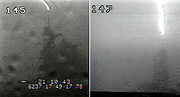 On 25 August 2006, a direct lightning strike, the most powerful recorded at Kennedy Space Center, hit the lightning rod atop the launch pad. As a result, on 26 August the Mission Management Team ordered the mission postponed for at least 24 hours to assess damage. On 27 August, the decision was made to postpone the launch for another 24 hours, making the earliest possible launch date 29 August 2006, still unassured that there was no damage from the lightning strike and taking into account the possible threat from Hurricane Ernesto
.
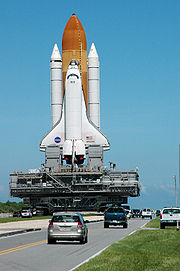 On 28 August 2006 it was decided to postpone the launch and rollback Atlantis to the VAB
after updated forecasts projected Hurricane Ernesto would regain its strength and pass closer to Kennedy Space Center than previously anticipated. NASA began rolling back the shuttle on 29 August 2006 in the late morning, but by early afternoon the decision was made to move Atlantis back to the launch pad (something that has never been done before) to weather out Tropical Storm Ernesto
instead. The change came after weather forecasters determined that the storm wouldn't hit Kennedy Space Center
as forcefully as they once thought. Its peak winds were expected to be less than 79 mph (126 kilometers per hour), NASA's limit for keeping the shuttle outdoors.
By the early morning of 31 August 2006, the storm had passed and inspection teams began a survey for damage to the launch facilities. Only three problems were discovered, all of which were simple repairs. A target date for launch was set for 6 September with the option to launch for another two days after NASA and Russian space managers agreed to extend the launch window by one day.
On the morning of 3 September 2006, the official countdown began at the T minus 43 hour mark, with about 30 hours of scheduled holds. In the early morning of 6 September 2006, engineers observed an apparent internal short when one of the three electricity producing fuel cells was powered up. When engineers couldn't figure out the problem in time, the launch was scrubbed for the day to further analyze the fuel cell problem. Late Wednesday evening NASA managers decided that they would not attempt a launch on Thursday, and scheduled the next launch attempt for 8 September 2006. Originally they had ruled out 9 September as a potential launch date due to a conflict with the planned Russian Soyuz mission Soyuz TMA-9
, which was scheduled to, and did, launch on 18 September 2006. This caused some news agencies to report that Friday as the last chance for a launch until October.
The 8 September 2006 launch attempt was the 200th time that NASA had fueled a Space Shuttle external tank. As a practical joke, workers changed a commemorative sign to read 201 instead of 200, after the scrub that caused a tank refill on 9 September 2006.
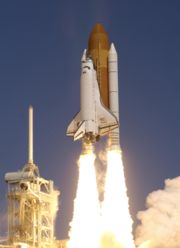 On 9 September 2006, all of the engine cut-off sensors were working properly, and following a flawless countdown, at 15:15 UTC (11:15 EDT), Atlantis lifted off the launch pad to the International Space Station
. As Atlantis launched, the International Space Station
was 350 kilometres (217.5 mi) (220 mi) above the northern Atlantic Ocean, between Greenland
and Iceland
.
During the climb to orbit, Mission Control asked the crew to reconfigure a cooling system that apparently had ice build up. The reconfiguration cleared the system, called the Flash Evaporator System, and it operated normally. Temporary ice in that cooling unit is not uncommon and has occurred on previous missions.
Moments after main engine cutoff, 8.5 minutes after liftoff, Tanner and MacLean used hand-held video and digital still cameras to document the external tank after it separated from the shuttle. That imagery, as well as imagery gathered by cameras in the shuttle’s umbilical well where the tank was connected, was transmitted to the ground for review.
 During their first full day in space, the crew thoroughly examined Atlantis with the Orbiter Boom Sensor System
, the 15 meter (50-foot) long extension for the shuttle's robotic arm. Pilot Chris Ferguson and mission specialists Dan Burbank
and Steve MacLean
performed a slow, steady inspection of the reinforced carbon-carbon panels along the leading edge of Atlantis starboard and port wings and the nose cap.
The crew worked ahead of schedule for most of the day readying the ship for docking and preparing for the mission's three planned spacewalks
. Mission specialists Joe Tanner
and Heide Stefanyshyn-Piper
checked out the spacesuits and tools that they, Burbank and MacLean used during spacewalks set for Days 4, 5, and 7. The spacewalks installed the girder-like P3/P4 truss, deploy new solar arrays, and prepare them for operation.
On the space station, Expedition 13
Flight Engineer Jeffrey Williams prepared the orbiting laboratory for Atlantis arrival on Day 3. He readied the digital cameras that was used to take high-resolution photos of the shuttle's heat shield. With help from Commander Pavel Vinogradov, Williams pressurized the Pressurized Mating Adapter 2 at the end of the Destiny Laboratory Module
, where Atlantis later docked. Vinogradov also prepacked equipment to be returned.


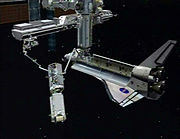
Prior to docking, Jett flew Atlantis through an orbital back flip while stationed about 180 meters (600 feet) below the space station. The maneuver allowed the Expedition 13 crew to take a series of high-resolution photographs of the orbiter's heat shield.
At about 10:46 UTC Atlantis docked with the International Space Station
, and almost two hours later the hatch between them was opened, and the crew was welcomed aboard the station at 12:35 UTC.
Following docking, Ferguson and Burbank attached the shuttle's robotic Canadarm to the 17.5-ton P3/P4 truss, lifted it from its berth in the payload bay, and maneuvered it for handover to the station's Canadarm2.
After hatch opening, MacLean and Expedition 13 Flight Engineer Jeff Williams then used the Canadarm2 to take the truss from the shuttle's robotic arm. MacLean is the first Canadian to operate the Canadarm2 in space.
Tanner and Stefanyshyn-Piper began the "camping out" preparations in the Quest Airlock to prepare for a Day 4 spacewalk
. The "camping out" preparations are new pre-breathing measures on the part of NASA, to avoid decompression sickness
, or the bends, by getting rid of some nitrogen
in their bloodstreams. The preparations involve wearing oxygen masks and sleeping overnight in the airlock with the airlock at under 69 kPa (10 psi), to acclimate their bodies the low pressures they will encounter when wearing their spacesuits.
 Following the installation of the P3/P4 Truss to the ISS by the Canadarm2, Tanner and Stefanyshyn-Piper began their spacewalk
to activate the truss at 09:17 UTC. During the EVA they installed power and data cables between the P1 & P3/P4 trusses, released the P3/P4 truss' launch restraints and a number of other tasks to configure the truss for upcoming activities. The spacewalk was so successful that the astronauts carried out a number of tasks scheduled for later EVAs, with the eventual completion of the EVA at 15:43 UTC. A bolt, spring and washer assembly from a launch lock was lost during these extra activities and floated off into space.
Following the completion of the EVA
, the station's crew began preparing for Day 5's spacewalk, with astronauts Burbank and MacLean entering the Quest Airlock for their "camp out" at 18:40 UTC, ready for the scheduled 09:15 UTC EVA.
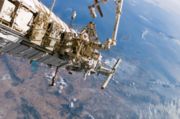 On Day 5, the second spacewalk
of the mission was conducted, this time by first-time spacewalkers Burbank and MacLean. They devoted the day to the final tasks required for activation of the Solar Alpha Rotary Joint
(SARJ). The SARJ is an automobile-sized joint that will allow the station's solar arrays to turn and point toward the sun
. Burbank and MacLean released locks that had held the joint secure during its launch to orbit aboard Atlantis
. As they worked, the spacewalkers overcame several minor problems, including a malfunctioning helmet camera
, a broken socket tool, a stubborn bolt, and a bolt that came loose from the mechanism designed to hold it captive. The stubborn bolt required the force of both spacewalkers to finally remove it.
Burbank and MacLean spent 7 hours and 11 minutes outside the station, beginning their spacewalk at 09:05 UTC and completing it at 16:16 UTC. In addition to the SARJ work, they completed several "get-ahead" tasks during their time outside.
Engineers encountered a glitch during the four-hour activation and checkout of SARJ, and had temporarily delayed starting the deployment of the new solar arrays pending further work and checkout of the SARJ. The timeline allowed ample time to continue working on the problem during the night and still complete the deploy of the arrays on Thursday as scheduled.
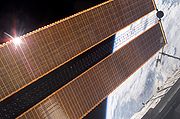 Day 6 continued the installation of the solar array. The unfurling of the solar panel
s themselves began a little behind schedule due to the problem encountered on Day 5 with SARJ. This problem was determined to be in the software, and a workaround was developed. The unfurling of the panels continued throughout the morning in stages to prevent the panels sticking, as they did during STS-97
. It was still noted by the crew that some of the panels were sticking together, but this didn't cause any problems. Although the installation has been completed, the solar arrays will not provide power to the station until the next shuttle mission, STS-116
, scheduled for December 2006, when the station will undergo a major electrical system rewiring.
Other activities of Day 6 included a "double walk off" of the station's Canadarm2
from its current location at the Mobile Base System
to the Destiny Laboratory Module
and the preparation for the mission's third spacewalk
. A number of interviews were also conducted later in the day, between Jett & MacLean and Canadian Prime Minister Stephen Harper
& students.
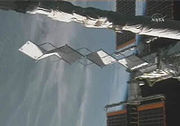 Flight day 7 featured the third and final spacewalk
of mission STS-115.
The start of the spacewalk was delayed after a circuit-breaker
-like remote power controller (RPC) tripped, causing loss of power to the airlock's depressurization pump. This was attributed to a momentary spike in the electrical current of the depressurization pump. After assessing data to ensure the system had no short circuit
, the breaker was reset and pump reactivated. Joe Tanner and Heide Stefanyshyn-Piper began their spacewalk at 10:00 UTC after a 45-minute delay
During the 6 hour and 42 minute spacewalk, the astronauts carried out numerous maintenance and repair tasks including removal of hardware used to secure the P3/P4 radiator during launch. Ground Flight Controllers subsequently unfurled the radiator, increasing the ability of the station to dissipate heat into space. Also completed during this spacewalk was the retrieval of a materials exposure experiment from the outside of the ISS, maintenance on the P6 truss, installation of a wireless TV aerial and the replacement of the S1 truss' S-band antenna assembly.
A number of "get-ahead" tasks previously scheduled for future missions were also performed during this spacewalk. Near the end of the spacewalk, the astronauts carried out a test to evaluate using infrared video of the leading edge of Atlantis
wing to detect debris damage.
After the spacewalk, the station's mobile transporter was moved to a worksite on the P3 truss to inspect portions of that truss.
docked to the ISS, was mainly spent in preparation for the undocking procedures to occur in flight day 9. The crew spent the morning resting following their highly successful mission, and then began getting ready for the undocking by carrying out transfers of ISS equipment and science experiments onto Atlantis ready for the trip home.
The crews of Expedition 13
and STS-115 also took part in the traditional joint-crew news conference, with mission Commander Brent Jett commenting on the success of the mission and on the construction missions to follow:
"All of the rest of the assembly missions are going to be challenging. We have similar payloads flying in the future. We are off to a good start on assembly. I think we can pass along a lot of the lessons to the future crews."
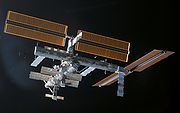 Flight day 9 saw the end of STS-115's tasks at the ISS as Atlantis
undocked from the International Space Station at 12:50 UTC.
Following the traditional farewell ceremonies between Expedition 13 and STS-115, the hatch between Atlantis and the ISS was closed and locked at 10:27 UTC. Then, after a series of checks for leaks, Atlantis left the dock to begin its 360 degree flyaround of the expanded ISS to document the new configuration.
heat shield in preparation for re-entry on flight day 12.
Orbiting around 80 kilometres (49.7 mi) behind the ISS, the crew used the Orbiter's robotic arm and boom sensor system to make sure that no damage had been done to Atlantis' nose & wing leading edges by micrometeoroids and other space junk. The crew spent the rest of this light duty day to stow equipment in preparation for their return to Earth. 18 September 2006 also saw the launch of the next expedition to the ISS, Expedition 14
, aboard Soyuz TMA-9
 During the morning of day 11, astronauts Jett & Ferguson tested Atlantis reaction control thrusters and practiced for landing using on-board computers. The thrusters will be used to position the shuttle during re-entry.
The crew also took some time for interviews, with Ferguson telling the media that everyone on board was looking forward to landing. "I think we all, thus far, feel pretty good about the job that we did," Ferguson said. "We are looking forward to a successful re-entry and landing sometime tomorrow."
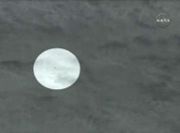
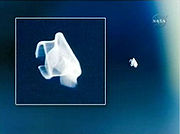
Following the interviews, the crew continued their preparations for re-entry by stowing unnecessary equipment and other tasks prior to landing. However, the crew informed the Mission Control Center later in the day that, following the test of the reaction control system, an object was seen moving in a co-orbital path with the Orbiter. The astronauts spotted the object using an on-board TV camera, but unfortunately the resolution of the images was not high enough to identify the object.
The images were sent down to the MCC
for further analysis by flight controllers, who were concerned about the possibility that the object may have come off Atlantis, and as such wished to identify the object. The most likely scenario was that the object was benign, such as ice or a piece of shimstock (observed earlier in the flight protruding from the heat shield) that may have shaken loose. However, the possibility remained that the object may be of critical importance, such as a tile from the Orbiter's thermal protection system.
As such, the Mission Control Center asked Atlantis' crew to power up the shuttle's robotic arm ready to reinspect the orbiter, and drew up plans for a series of tests which took place on flight day 12 to determine whether or not the shuttle was safe for re-entry. This extra inspection, added to poor weather forecasts predicted for the Shuttle Landing Facility for Wednesday, meant that the de-orbit burn and landing were delayed by a day.
Following the review of these scans, together with an overnight analysis of the payload bay by Ground Flight Controllers, it was determined that there remained no safety issue with Atlantis, and Mission Controllers cleared the Orbiter for re-entry. This clean bill of health, added to a favorable weather forecast for the Shuttle Landing Facility for Thursday morning, permitted Atlantis to be cleared for a landing the next day.
The crew spent the remainder of the day in preparation for landing, packing up gear and stowing the Ku band
antenna used for TV broadcasts. During the inspection, the crew was notified that the Soyuz TMA-9
spacecraft was docked with the ISS above, which carried the first half of the Expedition 14
crew.

 Flight day 13 was the last day of the mission, with the final re-entry procedures and landing taking place during the morning, and numerous debriefs and conferences in the afternoon. The landing process began hours before the actual landing at Kennedy Space Center. The process began with the APU prestart at 04:37 EDT
, followed by the closing of the payload bay doors and sealing of the Orbiter at 04:45 EDT. Atlantis crew received the final "Go" for the prime re-entry window from Mission Control in Houston at 04:52 EDT. The crew then started the deorbit reorientation of the shuttle so that its engines faced in its direction of travel, meaning that by firing the engines for the deorbit burn Atlantis would slow down and begin its descent out of orbit.
The de-orbit burn was initiated at 05:15 EDT, lasting 2 minutes 40 seconds with two engines burning well throughout. The astronauts aboard the Orbiter were informed at 05:17 EDT that their burn was perfect, with no alterations required as Atlantis began her drop through the atmosphere above the Indian Ocean.
Following the deorbit burn, the crew of Atlantis began dumping excess propellant overboard, a process lasting 3 minutes, concluding at 05:26 EDT, with the Orbiter 55 minutes away from landing. Twenty-five minutes later, at 05:51 EDT, Atlantis began feeling the effects of the atmosphere at an altitude of approximately 130 kilometres (80.8 mi) (80 mi), and soon after began her "roll reversal banking" in order to bleed off most of the 27000 kilometres (16,777.1 mi)/h (17,000 mph) she was traveling at, ready for landing at less than 760 kilometres (472.2 mi)/h (470 mph). The ISS was positioned in such a way as to be above the reentry path taken by Atlantis, so the astronauts were able to observe the entire maneuver from above.
At 06:08 EDT, the downlink from the Shuttle was acquired by the MILA tracking station on Merritt Island, Florida, with GPS data beginning to be accepted by the Orbiter three minutes later. Ten minutes following the first detection of Atlantis, two sonic boom
s were heard at Kennedy Space Center as the Orbiter dropped below the sound barrier three minutes prior to touchdown. Commander Jett took control of Atlantis a minute later, and, with Kennedy Space Center Runway 33 in sight, began bringing his ship in for a landing.
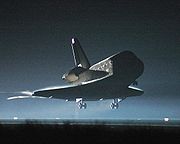
Atlantis main gear touched down at 06:21:30 EDT on Runway 33 at the Space Shuttle Landing Facility at Kennedy Space Center, with the nose gear following 6 seconds later at 06:21:36 EDT, and, 8 million kilometers (5 million miles) after launch, the Orbiter's wheels came to a stop at 06:22:16 EDT, bringing mission STS-115 to an end.
The morning's landing was considered a night landing as it took place about 48 minutes before sunrise, and as such was the 21st night landing for the Space Shuttle Program. It was the 63rd landing at Kennedy Space Center, as well as the 27th mission for Atlantis.
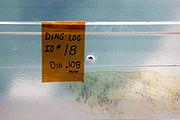
 While working on the Atlantis orbiter, NASA technicians discovered that one of the spacecraft's radiator panels showed evidence of micrometeorite damage. A hole was observed which was reported to be about 2.7 mm (0.108 in) in diameter.
Not mentioned was a large debris event during launch at 48 seconds near max Q. Because it happened on the ET side opposite the Orbiter it never was a danger to the Shuttle. By the origin from near the top of the ET it presents a new source of debris and is therefore of concern for further missions.
, mission crews are played a special musical track at the start of each day in space. Each track is specially chosen, often by their family, and usually has special meaning to an individual member of the crew, or is applicable to their daily activities.
was the designation given to the Contingency Shuttle Crew Support mission which would have launched in the event Space Shuttle Discovery
became disabled during STS-114
or STS-121
. This rescue mission would have been a modified version of the STS-115 mission with the launch date being brought forward and the crew reduced.
STS-300
would have launched no earlier than 17 August 2006, and the crew for STS-300 would have been a four-person subset of the full STS-115 crew:"STS-121 Nasa Press Kit" NASA Press Kit – STS-121, May 2006.
Short ton
The short ton is a unit of mass equal to . In the United States it is often called simply ton without distinguishing it from the metric ton or the long ton ; rather, the other two are specifically noted. There are, however, some U.S...
s, or roughly 16 metric tons) that the crew count was reduced from seven to six.
Crew notes
Canadian Space Agency astronaut MacLean became the first Canadian to operate Canadarm2 and its Mobile Base in space as he was handed a new set of solar arrays from Tanner controlling the original Canadian robotic arm, the Canadarm. MacLean performed a spacewalk, becoming only the second Canadian, after Chris HadfieldChris Hadfield
Chris Austin "Chris" Hadfield, O.Ont, MSC, CD is a Canadian astronaut from the Canadian Space Agency who was the first Canadian to walk in space. Hadfield has flown two space shuttle missions, STS-74 in 1995 and STS-100 in 2001. He has served as CAPCOM for both Space Shuttle and International...
to do so.
The mission patch worn on the clothing used by the astronauts of STS-115 was designed by Graham Huber, Peter Hui, and Gigi Lui, three students at York University
York University
York University is a public research university in Toronto, Ontario, Canada. It is Canada's third-largest university, Ontario's second-largest graduate school, and Canada's leading interdisciplinary university....
in Toronto, Ontario, the same university that Steve MacLean attended. The students also designed Steve MacLean's personal patch for this mission.
Mission parameters
- MassMassMass can be defined as a quantitive measure of the resistance an object has to change in its velocity.In physics, mass commonly refers to any of the following three properties of matter, which have been shown experimentally to be equivalent:...
: ≈ 2,000 metric tons (4,400,000 lb) (at launch) - PerigeePerigeePerigee is the point at which an object makes its closest approach to the Earth.. Often the term is used in a broader sense to define the point in an orbit where the orbiting body is closest to the body it orbits. The opposite is the apogee, the farthest or highest point.The Greek prefix "peri"...
: 157.4 kilometres (97.8 mi) - Apogee: 226.6 kilometres (140.8 mi)
- InclinationInclinationInclination in general is the angle between a reference plane and another plane or axis of direction.-Orbits:The inclination is one of the six orbital parameters describing the shape and orientation of a celestial orbit...
: 51.6° - PeriodOrbital periodThe orbital period is the time taken for a given object to make one complete orbit about another object.When mentioned without further qualification in astronomy this refers to the sidereal period of an astronomical object, which is calculated with respect to the stars.There are several kinds of...
: 91.6 minutes
Mission payloads
The primary payload was the second left-side ITS P3/P4 TrussIntegrated Truss Structure
the Integrated Truss Structure forms the backbone of the International Space Station, with mountings for unpressurized logistics carriers, radiators, solar arrays, and other equipment.-History:...
segment, a pair of solar arrays, and associated batteries.
Mission objectives
- Delivery and installation of two truss segments (P3 and P4)
- Delivery and deployment of two new solar arrays (4A and 2A)
- Perform three spacewalks to connect truss segments, remove restraints on solar arrays, and prepare the station for the next assembly mission by STS-116STS-116-Crew notes:Originally this mission was to carry the Expedition 8 crew to the ISS. The original crew was to be:-Mission highlights:* The STS-116 mission delivered and attached the International Space Station's third port truss segment, the P5 truss....
Mission background
For the first time, NASA managers decided to move the STS-115 launch date forward to 27 August to obtain better lighting conditions to photograph the external tank. The launch window was co-ordinated with the Soyuz TMA-9Soyuz TMA-9
-Crew notes:Daisuke Enomoto Was originally scheduled to be the spaceflight participant, but on on 21 August 2006, he was determined to be unfit for the flight due to medical reasons, and replaced by Anousheh Ansari, his back-up crew member.-Docking with ISS:...
launch in mid-September, which delivered a new ISS crew and fresh supplies to the station. The Soyuz spacecraft
Soyuz spacecraft
Soyuz , Union) is a series of spacecraft initially designed for the Soviet space programme by the Korolyov Design Bureau in the 1960s, and still in service today...
operationally will not dock to the station while the space shuttle
Space Shuttle
The Space Shuttle was a manned orbital rocket and spacecraft system operated by NASA on 135 missions from 1981 to 2011. The system combined rocket launch, orbital spacecraft, and re-entry spaceplane with modular add-ons...
is there.
The mission marks:
- 147th NASA manned space flight.
- 116th space shuttle flight since STS-1STS-1STS-1 was the first orbital flight of NASA's Space Shuttle program. Space Shuttle Columbia launched on 12 April 1981, and returned to Earth on 14 April, having orbited the Earth 37 times during the 54.5-hour mission. It was the first American manned space flight since the Apollo-Soyuz Test Project...
. - 27th flight of Atlantis.
- 91st post-Challenger mission.
- 3rd post-Columbia mission.
Launch preparations
Orbiter Processing Facility
An Orbiter Processing Facility was one of three hangars where U.S. space shuttle orbiters underwent maintenance between flights. All three such facilities, OPF-1, OPF-2 and OPF-3, were located at NASA's Kennedy Space Center in Florida at Launch Complex 39.They were located west of the Vehicle...
to the Vehicle Assembly Building
Vehicle Assembly Building
The Vehicle Assembly Building, or VAB, at NASA's Kennedy Space Center was used to assemble and house American manned launch vehicles from 1968-2011. It is the fourth largest building in the world by volume...
(VAB) on 24 July 2006. It was lowered onto the Mobile Launcher Platform
Mobile Launcher Platform
The Mobile Launcher Platform or MLP is one of three two-story structures used by NASA to support the Space Shuttle stack during its transportation from the Vehicle Assembly Building to Launch Pad 39-A at the Kennedy Space Center as well as serve as the vehicle's launch platform...
on 26 July and rolled out to Pad 39B in the early morning hours of 2 August. The rollout was scheduled for 31 July, but a storm in the vicinity of the Kennedy Space Center
Kennedy Space Center
The John F. Kennedy Space Center is the NASA installation that has been the launch site for every United States human space flight since 1968. Although such flights are currently on hiatus, KSC continues to manage and operate unmanned rocket launch facilities for America's civilian space program...
resulted in a delay of two days from fears of the orbiter being hit by lightning, which could cause immeasurable damage.
On the weekend of 5 August to 6 August 2006, engineers completed a "flight readiness" check of the shuttle's main engines, which were deemed ready for launch. The crew arrived at the Kennedy Space Center 7 August 2006 for four days of launch rehearsals, including a practice countdown 10 August.
Top NASA managers held a Flight Readiness Review (FRR) meeting 15–16 August 2006 to finalize the launch date. Foam loss from the external tank was a key issue at this meeting because on 13 August 2006, NASA announced there was an average amount of loss from the external tank of STS-121, the previous mission. Columbias demise was due to a piece of foam, shed from its external tank, striking the shuttle's left wing during launch and causing a hole that was breached during re-entry.
Hurricane Ernesto (2006)
Hurricane Ernesto was the costliest tropical cyclone of the 2006 Atlantic hurricane season. The sixth tropical storm and first hurricane of the season, Ernesto developed from a tropical wave on August 24 in the eastern Caribbean Sea...
.
Vehicle Assembly Building
The Vehicle Assembly Building, or VAB, at NASA's Kennedy Space Center was used to assemble and house American manned launch vehicles from 1968-2011. It is the fourth largest building in the world by volume...
after updated forecasts projected Hurricane Ernesto would regain its strength and pass closer to Kennedy Space Center than previously anticipated. NASA began rolling back the shuttle on 29 August 2006 in the late morning, but by early afternoon the decision was made to move Atlantis back to the launch pad (something that has never been done before) to weather out Tropical Storm Ernesto
Hurricane Ernesto (2006)
Hurricane Ernesto was the costliest tropical cyclone of the 2006 Atlantic hurricane season. The sixth tropical storm and first hurricane of the season, Ernesto developed from a tropical wave on August 24 in the eastern Caribbean Sea...
instead. The change came after weather forecasters determined that the storm wouldn't hit Kennedy Space Center
Kennedy Space Center
The John F. Kennedy Space Center is the NASA installation that has been the launch site for every United States human space flight since 1968. Although such flights are currently on hiatus, KSC continues to manage and operate unmanned rocket launch facilities for America's civilian space program...
as forcefully as they once thought. Its peak winds were expected to be less than 79 mph (126 kilometers per hour), NASA's limit for keeping the shuttle outdoors.
By the early morning of 31 August 2006, the storm had passed and inspection teams began a survey for damage to the launch facilities. Only three problems were discovered, all of which were simple repairs. A target date for launch was set for 6 September with the option to launch for another two days after NASA and Russian space managers agreed to extend the launch window by one day.
On the morning of 3 September 2006, the official countdown began at the T minus 43 hour mark, with about 30 hours of scheduled holds. In the early morning of 6 September 2006, engineers observed an apparent internal short when one of the three electricity producing fuel cells was powered up. When engineers couldn't figure out the problem in time, the launch was scrubbed for the day to further analyze the fuel cell problem. Late Wednesday evening NASA managers decided that they would not attempt a launch on Thursday, and scheduled the next launch attempt for 8 September 2006. Originally they had ruled out 9 September as a potential launch date due to a conflict with the planned Russian Soyuz mission Soyuz TMA-9
Soyuz TMA-9
-Crew notes:Daisuke Enomoto Was originally scheduled to be the spaceflight participant, but on on 21 August 2006, he was determined to be unfit for the flight due to medical reasons, and replaced by Anousheh Ansari, his back-up crew member.-Docking with ISS:...
, which was scheduled to, and did, launch on 18 September 2006. This caused some news agencies to report that Friday as the last chance for a launch until October.
8 September (Launch attempt 1)
On the morning of 8 September 2006, it was reported that one of the engine cut-off (ECO) sensors in the external tank had failed. About half an hour before the scheduled launch time, NASA announced it had decided to delay the launch for another 24 hours while the fuel was drained out of the external tank and the problem assessed. The sensor in question, ECO sensor No. 3, was proved to be faulty when it indicated that there was still liquid hydrogen in the external tank despite all of it being drained out. The other three ECO sensors correctly indicated a dry tank; and as long as they didn't start to malfunction, NASA could allow a launch with three out of the four ECO sensors operational.The 8 September 2006 launch attempt was the 200th time that NASA had fueled a Space Shuttle external tank. As a practical joke, workers changed a commemorative sign to read 201 instead of 200, after the scrub that caused a tank refill on 9 September 2006.
9 September (Flight day 1, Launch)
International Space Station
The International Space Station is a habitable, artificial satellite in low Earth orbit. The ISS follows the Salyut, Almaz, Cosmos, Skylab, and Mir space stations, as the 11th space station launched, not including the Genesis I and II prototypes...
. As Atlantis launched, the International Space Station
International Space Station
The International Space Station is a habitable, artificial satellite in low Earth orbit. The ISS follows the Salyut, Almaz, Cosmos, Skylab, and Mir space stations, as the 11th space station launched, not including the Genesis I and II prototypes...
was 350 kilometres (217.5 mi) (220 mi) above the northern Atlantic Ocean, between Greenland
Greenland
Greenland is an autonomous country within the Kingdom of Denmark, located between the Arctic and Atlantic Oceans, east of the Canadian Arctic Archipelago. Though physiographically a part of the continent of North America, Greenland has been politically and culturally associated with Europe for...
and Iceland
Iceland
Iceland , described as the Republic of Iceland, is a Nordic and European island country in the North Atlantic Ocean, on the Mid-Atlantic Ridge. Iceland also refers to the main island of the country, which contains almost all the population and almost all the land area. The country has a population...
.
During the climb to orbit, Mission Control asked the crew to reconfigure a cooling system that apparently had ice build up. The reconfiguration cleared the system, called the Flash Evaporator System, and it operated normally. Temporary ice in that cooling unit is not uncommon and has occurred on previous missions.
Moments after main engine cutoff, 8.5 minutes after liftoff, Tanner and MacLean used hand-held video and digital still cameras to document the external tank after it separated from the shuttle. That imagery, as well as imagery gathered by cameras in the shuttle’s umbilical well where the tank was connected, was transmitted to the ground for review.
10 September (Flight day 2)
Orbiter Boom Sensor System
The Orbiter Boom Sensor System is a 50-foot boom carried on board NASA's Space Shuttles. The boom can be grappled by the Canadarm and serves as an extension of the arm, doubling its length to a combined total of 100 feet...
, the 15 meter (50-foot) long extension for the shuttle's robotic arm. Pilot Chris Ferguson and mission specialists Dan Burbank
Daniel C. Burbank
Daniel Christopher Burbank is an American astronaut and a veteran of two space shuttle missions. Burbank, a Captain in the United States Coast Guard, is the second Coast Guard astronaut after Bruce Melnick....
and Steve MacLean
Steven MacLean (astronaut)
Steven Glenwood MacLean is a Canadian astronaut. He is the current President of the Canadian Space Agency, appointed on September 1, 2008....
performed a slow, steady inspection of the reinforced carbon-carbon panels along the leading edge of Atlantis starboard and port wings and the nose cap.
The crew worked ahead of schedule for most of the day readying the ship for docking and preparing for the mission's three planned spacewalks
Extra-vehicular activity
Extra-vehicular activity is work done by an astronaut away from the Earth, and outside of a spacecraft. The term most commonly applies to an EVA made outside a craft orbiting Earth , but also applies to an EVA made on the surface of the Moon...
. Mission specialists Joe Tanner
Joseph R. Tanner
Joseph Richard "Joe" Tanner is an American instructor at the University of Colorado at Boulder, a former military jet pilot, and a former NASA astronaut. He was born in Danville, Illinois. He is unusual among astronauts as he did not have a background in flight test nor did he earn any advanced...
and Heide Stefanyshyn-Piper
Heidemarie M. Stefanyshyn-Piper
Heidemarie Martha Stefanyshyn-Piper is an American Naval officer and a former NASAastronaut. She has achieved the rank of captain in the United States Navy. She is also a qualified and experienced salvage officer...
checked out the spacesuits and tools that they, Burbank and MacLean used during spacewalks set for Days 4, 5, and 7. The spacewalks installed the girder-like P3/P4 truss, deploy new solar arrays, and prepare them for operation.
On the space station, Expedition 13
Expedition 13
Expedition 13 was the 13th expedition to the International Space Station , and launched at 02:30 UTC on 30 March 2006. The expedition used the Soyuz TMA-8 spacecraft, which stayed at the station for the duration of the expedition for emergency evacuation....
Flight Engineer Jeffrey Williams prepared the orbiting laboratory for Atlantis arrival on Day 3. He readied the digital cameras that was used to take high-resolution photos of the shuttle's heat shield. With help from Commander Pavel Vinogradov, Williams pressurized the Pressurized Mating Adapter 2 at the end of the Destiny Laboratory Module
Destiny Laboratory Module
The Destiny module is the primary operating facility for U.S. research payloads aboard the International Space Station . It was berthed to the Unity module and activated over a period of five days in February, 2001...
, where Atlantis later docked. Vinogradov also prepacked equipment to be returned.
11 September (Flight day 3)
Prior to docking, Jett flew Atlantis through an orbital back flip while stationed about 180 meters (600 feet) below the space station. The maneuver allowed the Expedition 13 crew to take a series of high-resolution photographs of the orbiter's heat shield.
At about 10:46 UTC Atlantis docked with the International Space Station
International Space Station
The International Space Station is a habitable, artificial satellite in low Earth orbit. The ISS follows the Salyut, Almaz, Cosmos, Skylab, and Mir space stations, as the 11th space station launched, not including the Genesis I and II prototypes...
, and almost two hours later the hatch between them was opened, and the crew was welcomed aboard the station at 12:35 UTC.
Following docking, Ferguson and Burbank attached the shuttle's robotic Canadarm to the 17.5-ton P3/P4 truss, lifted it from its berth in the payload bay, and maneuvered it for handover to the station's Canadarm2.
After hatch opening, MacLean and Expedition 13 Flight Engineer Jeff Williams then used the Canadarm2 to take the truss from the shuttle's robotic arm. MacLean is the first Canadian to operate the Canadarm2 in space.
Tanner and Stefanyshyn-Piper began the "camping out" preparations in the Quest Airlock to prepare for a Day 4 spacewalk
Extra-vehicular activity
Extra-vehicular activity is work done by an astronaut away from the Earth, and outside of a spacecraft. The term most commonly applies to an EVA made outside a craft orbiting Earth , but also applies to an EVA made on the surface of the Moon...
. The "camping out" preparations are new pre-breathing measures on the part of NASA, to avoid decompression sickness
Decompression sickness
Decompression sickness describes a condition arising from dissolved gases coming out of solution into bubbles inside the body on depressurization...
, or the bends, by getting rid of some nitrogen
Nitrogen
Nitrogen is a chemical element that has the symbol N, atomic number of 7 and atomic mass 14.00674 u. Elemental nitrogen is a colorless, odorless, tasteless, and mostly inert diatomic gas at standard conditions, constituting 78.08% by volume of Earth's atmosphere...
in their bloodstreams. The preparations involve wearing oxygen masks and sleeping overnight in the airlock with the airlock at under 69 kPa (10 psi), to acclimate their bodies the low pressures they will encounter when wearing their spacesuits.
12 September (Flight day 4)
Extra-vehicular activity
Extra-vehicular activity is work done by an astronaut away from the Earth, and outside of a spacecraft. The term most commonly applies to an EVA made outside a craft orbiting Earth , but also applies to an EVA made on the surface of the Moon...
to activate the truss at 09:17 UTC. During the EVA they installed power and data cables between the P1 & P3/P4 trusses, released the P3/P4 truss' launch restraints and a number of other tasks to configure the truss for upcoming activities. The spacewalk was so successful that the astronauts carried out a number of tasks scheduled for later EVAs, with the eventual completion of the EVA at 15:43 UTC. A bolt, spring and washer assembly from a launch lock was lost during these extra activities and floated off into space.
Following the completion of the EVA
Extra-vehicular activity
Extra-vehicular activity is work done by an astronaut away from the Earth, and outside of a spacecraft. The term most commonly applies to an EVA made outside a craft orbiting Earth , but also applies to an EVA made on the surface of the Moon...
, the station's crew began preparing for Day 5's spacewalk, with astronauts Burbank and MacLean entering the Quest Airlock for their "camp out" at 18:40 UTC, ready for the scheduled 09:15 UTC EVA.
13 September (Flight day 5)
Extra-vehicular activity
Extra-vehicular activity is work done by an astronaut away from the Earth, and outside of a spacecraft. The term most commonly applies to an EVA made outside a craft orbiting Earth , but also applies to an EVA made on the surface of the Moon...
of the mission was conducted, this time by first-time spacewalkers Burbank and MacLean. They devoted the day to the final tasks required for activation of the Solar Alpha Rotary Joint
Integrated Truss Structure
the Integrated Truss Structure forms the backbone of the International Space Station, with mountings for unpressurized logistics carriers, radiators, solar arrays, and other equipment.-History:...
(SARJ). The SARJ is an automobile-sized joint that will allow the station's solar arrays to turn and point toward the sun
Sun
The Sun is the star at the center of the Solar System. It is almost perfectly spherical and consists of hot plasma interwoven with magnetic fields...
. Burbank and MacLean released locks that had held the joint secure during its launch to orbit aboard Atlantis
Space Shuttle Atlantis
The Space Shuttle Atlantis is a retired Space Shuttle orbiter in the Space Shuttle fleet belonging to the National Aeronautics and Space Administration , the spaceflight and space exploration agency of the United States...
. As they worked, the spacewalkers overcame several minor problems, including a malfunctioning helmet camera
Helmet camera
A helmet camera, otherwise known as a micro video camera, bullet camera, or lipstick camera, is a camera attached to a helmet allowing someone to make a visual record from their point of view , while keeping their hands and vision free....
, a broken socket tool, a stubborn bolt, and a bolt that came loose from the mechanism designed to hold it captive. The stubborn bolt required the force of both spacewalkers to finally remove it.
Burbank and MacLean spent 7 hours and 11 minutes outside the station, beginning their spacewalk at 09:05 UTC and completing it at 16:16 UTC. In addition to the SARJ work, they completed several "get-ahead" tasks during their time outside.
Engineers encountered a glitch during the four-hour activation and checkout of SARJ, and had temporarily delayed starting the deployment of the new solar arrays pending further work and checkout of the SARJ. The timeline allowed ample time to continue working on the problem during the night and still complete the deploy of the arrays on Thursday as scheduled.
14 September (Flight day 6)
Photovoltaic module
A solar panel is a packaged, connected assembly of solar cells, also known as photovoltaic cells...
s themselves began a little behind schedule due to the problem encountered on Day 5 with SARJ. This problem was determined to be in the software, and a workaround was developed. The unfurling of the panels continued throughout the morning in stages to prevent the panels sticking, as they did during STS-97
STS-97
STS-97 was a Space Shuttle mission to the International Space Station flown by Space Shuttle Endeavour. The crew installed the first set of solar arrays to the ISS, prepared a docking port for arrival of the Destiny Laboratory Module, and delivered supplies for the station's crew.-Crew:-Mission...
. It was still noted by the crew that some of the panels were sticking together, but this didn't cause any problems. Although the installation has been completed, the solar arrays will not provide power to the station until the next shuttle mission, STS-116
STS-116
-Crew notes:Originally this mission was to carry the Expedition 8 crew to the ISS. The original crew was to be:-Mission highlights:* The STS-116 mission delivered and attached the International Space Station's third port truss segment, the P5 truss....
, scheduled for December 2006, when the station will undergo a major electrical system rewiring.
Other activities of Day 6 included a "double walk off" of the station's Canadarm2
Mobile Servicing System
The Mobile Servicing System , better known by its primary component Canadarm2, is a robotic system and associated equipment on the International Space Station...
from its current location at the Mobile Base System
Mobile Servicing System
The Mobile Servicing System , better known by its primary component Canadarm2, is a robotic system and associated equipment on the International Space Station...
to the Destiny Laboratory Module
Destiny Laboratory Module
The Destiny module is the primary operating facility for U.S. research payloads aboard the International Space Station . It was berthed to the Unity module and activated over a period of five days in February, 2001...
and the preparation for the mission's third spacewalk
Extra-vehicular activity
Extra-vehicular activity is work done by an astronaut away from the Earth, and outside of a spacecraft. The term most commonly applies to an EVA made outside a craft orbiting Earth , but also applies to an EVA made on the surface of the Moon...
. A number of interviews were also conducted later in the day, between Jett & MacLean and Canadian Prime Minister Stephen Harper
Stephen Harper
Stephen Joseph Harper is the 22nd and current Prime Minister of Canada and leader of the Conservative Party. Harper became prime minister when his party formed a minority government after the 2006 federal election...
& students.
15 September (Flight day 7)
Extra-vehicular activity
Extra-vehicular activity is work done by an astronaut away from the Earth, and outside of a spacecraft. The term most commonly applies to an EVA made outside a craft orbiting Earth , but also applies to an EVA made on the surface of the Moon...
of mission STS-115.
The start of the spacewalk was delayed after a circuit-breaker
Circuit breaker
A circuit breaker is an automatically operated electrical switch designed to protect an electrical circuit from damage caused by overload or short circuit. Its basic function is to detect a fault condition and, by interrupting continuity, to immediately discontinue electrical flow...
-like remote power controller (RPC) tripped, causing loss of power to the airlock's depressurization pump. This was attributed to a momentary spike in the electrical current of the depressurization pump. After assessing data to ensure the system had no short circuit
Short circuit
A short circuit in an electrical circuit that allows a current to travel along an unintended path, often where essentially no electrical impedance is encountered....
, the breaker was reset and pump reactivated. Joe Tanner and Heide Stefanyshyn-Piper began their spacewalk at 10:00 UTC after a 45-minute delay
During the 6 hour and 42 minute spacewalk, the astronauts carried out numerous maintenance and repair tasks including removal of hardware used to secure the P3/P4 radiator during launch. Ground Flight Controllers subsequently unfurled the radiator, increasing the ability of the station to dissipate heat into space. Also completed during this spacewalk was the retrieval of a materials exposure experiment from the outside of the ISS, maintenance on the P6 truss, installation of a wireless TV aerial and the replacement of the S1 truss' S-band antenna assembly.
A number of "get-ahead" tasks previously scheduled for future missions were also performed during this spacewalk. Near the end of the spacewalk, the astronauts carried out a test to evaluate using infrared video of the leading edge of Atlantis
Space Shuttle Atlantis
The Space Shuttle Atlantis is a retired Space Shuttle orbiter in the Space Shuttle fleet belonging to the National Aeronautics and Space Administration , the spaceflight and space exploration agency of the United States...
wing to detect debris damage.
After the spacewalk, the station's mobile transporter was moved to a worksite on the P3 truss to inspect portions of that truss.
16 September (Flight day 8)
Day 8 of STS-115, the last full day with Space Shuttle AtlantisSpace Shuttle Atlantis
The Space Shuttle Atlantis is a retired Space Shuttle orbiter in the Space Shuttle fleet belonging to the National Aeronautics and Space Administration , the spaceflight and space exploration agency of the United States...
docked to the ISS, was mainly spent in preparation for the undocking procedures to occur in flight day 9. The crew spent the morning resting following their highly successful mission, and then began getting ready for the undocking by carrying out transfers of ISS equipment and science experiments onto Atlantis ready for the trip home.
The crews of Expedition 13
Expedition 13
Expedition 13 was the 13th expedition to the International Space Station , and launched at 02:30 UTC on 30 March 2006. The expedition used the Soyuz TMA-8 spacecraft, which stayed at the station for the duration of the expedition for emergency evacuation....
and STS-115 also took part in the traditional joint-crew news conference, with mission Commander Brent Jett commenting on the success of the mission and on the construction missions to follow:
"All of the rest of the assembly missions are going to be challenging. We have similar payloads flying in the future. We are off to a good start on assembly. I think we can pass along a lot of the lessons to the future crews."
17 September (Flight day 9)
Space Shuttle Atlantis
The Space Shuttle Atlantis is a retired Space Shuttle orbiter in the Space Shuttle fleet belonging to the National Aeronautics and Space Administration , the spaceflight and space exploration agency of the United States...
undocked from the International Space Station at 12:50 UTC.
Following the traditional farewell ceremonies between Expedition 13 and STS-115, the hatch between Atlantis and the ISS was closed and locked at 10:27 UTC. Then, after a series of checks for leaks, Atlantis left the dock to begin its 360 degree flyaround of the expanded ISS to document the new configuration.
18 September (Flight day 10)
The crew of STS-115 spent the morning of Flight Day 10 carrying out final inspections of Atlantis'Space Shuttle Atlantis
The Space Shuttle Atlantis is a retired Space Shuttle orbiter in the Space Shuttle fleet belonging to the National Aeronautics and Space Administration , the spaceflight and space exploration agency of the United States...
heat shield in preparation for re-entry on flight day 12.
Orbiting around 80 kilometres (49.7 mi) behind the ISS, the crew used the Orbiter's robotic arm and boom sensor system to make sure that no damage had been done to Atlantis' nose & wing leading edges by micrometeoroids and other space junk. The crew spent the rest of this light duty day to stow equipment in preparation for their return to Earth. 18 September 2006 also saw the launch of the next expedition to the ISS, Expedition 14
Expedition 14
Expedition 14 was the 14th expedition to the International Space Station . Commander Michael Lopez-Alegria, and flight engineer Mikhail Tyurin launched from Baikonur Cosmodrome on 18 September 2006, 04:09 UTC, aboard Soyuz TMA-9. They joined Thomas Reiter, who had arrived at the ISS on 6 July 2006...
, aboard Soyuz TMA-9
Soyuz TMA-9
-Crew notes:Daisuke Enomoto Was originally scheduled to be the spaceflight participant, but on on 21 August 2006, he was determined to be unfit for the flight due to medical reasons, and replaced by Anousheh Ansari, his back-up crew member.-Docking with ISS:...
19 September (Flight day 11)
The crew also took some time for interviews, with Ferguson telling the media that everyone on board was looking forward to landing. "I think we all, thus far, feel pretty good about the job that we did," Ferguson said. "We are looking forward to a successful re-entry and landing sometime tomorrow."
Following the interviews, the crew continued their preparations for re-entry by stowing unnecessary equipment and other tasks prior to landing. However, the crew informed the Mission Control Center later in the day that, following the test of the reaction control system, an object was seen moving in a co-orbital path with the Orbiter. The astronauts spotted the object using an on-board TV camera, but unfortunately the resolution of the images was not high enough to identify the object.
The images were sent down to the MCC
Mission Control Center
A mission control center is an entity that manages aerospace vehicle flights, usually from the point of lift-off until the landing or the end of the mission. A staff of flight controllers and other support personnel monitor all aspects of the mission using telemetry, and send commands to the...
for further analysis by flight controllers, who were concerned about the possibility that the object may have come off Atlantis, and as such wished to identify the object. The most likely scenario was that the object was benign, such as ice or a piece of shimstock (observed earlier in the flight protruding from the heat shield) that may have shaken loose. However, the possibility remained that the object may be of critical importance, such as a tile from the Orbiter's thermal protection system.
As such, the Mission Control Center asked Atlantis' crew to power up the shuttle's robotic arm ready to reinspect the orbiter, and drew up plans for a series of tests which took place on flight day 12 to determine whether or not the shuttle was safe for re-entry. This extra inspection, added to poor weather forecasts predicted for the Shuttle Landing Facility for Wednesday, meant that the de-orbit burn and landing were delayed by a day.
20 September (Flight day 12)
Following the discovery of a co-orbiting object on flight day 11, Flight Controllers spent the early hours of the morning using the Orbiter's robotic arm to inspect the upper surface of Atlantis, with the astronauts on board the Orbiter spending the rest of the morning scanning the underside of the shuttle for any areas of concern. Following these scans, the crew received word from the Mission Control Center in Houston to use the orbiter boom sensor system to conduct more inspections of Atlantis heat shield.Following the review of these scans, together with an overnight analysis of the payload bay by Ground Flight Controllers, it was determined that there remained no safety issue with Atlantis, and Mission Controllers cleared the Orbiter for re-entry. This clean bill of health, added to a favorable weather forecast for the Shuttle Landing Facility for Thursday morning, permitted Atlantis to be cleared for a landing the next day.
The crew spent the remainder of the day in preparation for landing, packing up gear and stowing the Ku band
Ku band
The Kμ band is a portion of the electromagnetic spectrum in the microwave range of frequencies. This symbol refers to —in other words, the band directly below the K-band...
antenna used for TV broadcasts. During the inspection, the crew was notified that the Soyuz TMA-9
Soyuz TMA-9
-Crew notes:Daisuke Enomoto Was originally scheduled to be the spaceflight participant, but on on 21 August 2006, he was determined to be unfit for the flight due to medical reasons, and replaced by Anousheh Ansari, his back-up crew member.-Docking with ISS:...
spacecraft was docked with the ISS above, which carried the first half of the Expedition 14
Expedition 14
Expedition 14 was the 14th expedition to the International Space Station . Commander Michael Lopez-Alegria, and flight engineer Mikhail Tyurin launched from Baikonur Cosmodrome on 18 September 2006, 04:09 UTC, aboard Soyuz TMA-9. They joined Thomas Reiter, who had arrived at the ISS on 6 July 2006...
crew.
21 September (Flight day 13 and landing)
Eastern Time Zone
The Eastern Time Zone of the United States and Canada is a time zone that falls mostly along the east coast of North America. Its UTC time offset is −5 hrs during standard time and −4 hrs during daylight saving time...
, followed by the closing of the payload bay doors and sealing of the Orbiter at 04:45 EDT. Atlantis crew received the final "Go" for the prime re-entry window from Mission Control in Houston at 04:52 EDT. The crew then started the deorbit reorientation of the shuttle so that its engines faced in its direction of travel, meaning that by firing the engines for the deorbit burn Atlantis would slow down and begin its descent out of orbit.
The de-orbit burn was initiated at 05:15 EDT, lasting 2 minutes 40 seconds with two engines burning well throughout. The astronauts aboard the Orbiter were informed at 05:17 EDT that their burn was perfect, with no alterations required as Atlantis began her drop through the atmosphere above the Indian Ocean.
Following the deorbit burn, the crew of Atlantis began dumping excess propellant overboard, a process lasting 3 minutes, concluding at 05:26 EDT, with the Orbiter 55 minutes away from landing. Twenty-five minutes later, at 05:51 EDT, Atlantis began feeling the effects of the atmosphere at an altitude of approximately 130 kilometres (80.8 mi) (80 mi), and soon after began her "roll reversal banking" in order to bleed off most of the 27000 kilometres (16,777.1 mi)/h (17,000 mph) she was traveling at, ready for landing at less than 760 kilometres (472.2 mi)/h (470 mph). The ISS was positioned in such a way as to be above the reentry path taken by Atlantis, so the astronauts were able to observe the entire maneuver from above.
At 06:08 EDT, the downlink from the Shuttle was acquired by the MILA tracking station on Merritt Island, Florida, with GPS data beginning to be accepted by the Orbiter three minutes later. Ten minutes following the first detection of Atlantis, two sonic boom
Sonic boom
A sonic boom is the sound associated with the shock waves created by an object traveling through the air faster than the speed of sound. Sonic booms generate enormous amounts of sound energy, sounding much like an explosion...
s were heard at Kennedy Space Center as the Orbiter dropped below the sound barrier three minutes prior to touchdown. Commander Jett took control of Atlantis a minute later, and, with Kennedy Space Center Runway 33 in sight, began bringing his ship in for a landing.
Atlantis main gear touched down at 06:21:30 EDT on Runway 33 at the Space Shuttle Landing Facility at Kennedy Space Center, with the nose gear following 6 seconds later at 06:21:36 EDT, and, 8 million kilometers (5 million miles) after launch, the Orbiter's wheels came to a stop at 06:22:16 EDT, bringing mission STS-115 to an end.
The morning's landing was considered a night landing as it took place about 48 minutes before sunrise, and as such was the 21st night landing for the Space Shuttle Program. It was the 63rd landing at Kennedy Space Center, as well as the 27th mission for Atlantis.
Post flight
Debris analysis
NASA's Mission Management Team conducted a detailed analysis of data from many sources including ground imagery, radar, shuttle inspections using the Canadarm and from the space station. By Day 2 they pinpointed a handful of launch debris events, and drew a preliminary conclusion that the effect was minimal. Later that day NASA agency engineers decided that additional heat shield inspections were not required. The preceding only relates to debris shed immediately during or after launch, and not the debris observed on 19 September 2006.Not mentioned was a large debris event during launch at 48 seconds near max Q. Because it happened on the ET side opposite the Orbiter it never was a danger to the Shuttle. By the origin from near the top of the ET it presents a new source of debris and is therefore of concern for further missions.
Wake-up calls
A tradition for NASA spaceflights since the days of GeminiProject Gemini
Project Gemini was the second human spaceflight program of NASA, the civilian space agency of the United States government. Project Gemini was conducted between projects Mercury and Apollo, with ten manned flights occurring in 1965 and 1966....
, mission crews are played a special musical track at the start of each day in space. Each track is specially chosen, often by their family, and usually has special meaning to an individual member of the crew, or is applicable to their daily activities.
| Flight Day | Song | Artist | Played for | Links |
|---|---|---|---|---|
| Day 2 |
“Moon River Moon River "Moon River" is a song composed by Johnny Mercer and Henry Mancini in 1961, for whom it won that year's Academy Award for Best Original Song. It was originally sung in the movie Breakfast at Tiffany's by Audrey Hepburn, although it has been covered by many other artists... ” |
Audrey Hepburn Audrey Hepburn Audrey Hepburn was a British actress and humanitarian. Although modest about her acting ability, Hepburn remains one of the world's most famous actresses of all time, remembered as a film and fashion icon of the twentieth century... |
Brent Jett | wav mp3 Transcript |
| Day 3 |
“cello & double bass Double bass The double bass, also called the string bass, upright bass, standup bass or contrabass, is the largest and lowest-pitched bowed string instrument in the modern symphony orchestra, with strings usually tuned to E1, A1, D2 and G2... ” |
Daniel Burbank's children | Daniel Burbank | wav mp3 Transcript |
| Day 4 |
“My Friendly Epistle” | Taras Shevchenko Taras Shevchenko Taras Hryhorovych Shevchenko -Life:Born into a serf family of Hryhoriy Ivanovych Shevchenko and Kateryna Yakymivna Shevchenko in the village of Moryntsi, of Kiev Governorate of the Russian Empire Shevchenko was orphaned at the age of eleven... |
Heidemarie Stefanyshyn-Piper | wav mp3 Transcript |
| Day 5 |
“Takin' Care of Business Takin' Care of Business "Takin' Care of Business" is a song written by Randy Bachman and first recorded by Canadian rock group Bachman–Turner Overdrive for their 1973 album Bachman–Turner Overdrive II.-Development:... ” |
Bachman–Turner Overdrive | Steve MacLean Steven MacLean (astronaut) Steven Glenwood MacLean is a Canadian astronaut. He is the current President of the Canadian Space Agency, appointed on September 1, 2008.... |
wav mp3 Transcript |
| Day 6 |
“Wipe Out Wipe Out (Surfaris song) "Wipe Out" is a Twelve-bar blues written by Bob Berryhill, Pat Connolly, Jim Fuller and Ron Wilson. The tune was first performed and recorded by The Surfaris, who were elevated to international status with the release of the "Surfer Joe" and "Wipe Out" single in 1963.The song – both the Surfaris'... ” |
The Surfaris The Surfaris The Surfaris were an American surf rock band formed in Glendora, California in 1962. They are best known for two songs that hit the charts in the Los Angeles, California area, and nationally by May 1963: "Surfer Joe" on the A-side and "Wipe Out" on the B-side of a 45 RPM single.-Career:The original... |
Chris Ferguson Chris Ferguson Christopher Philip Ferguson is an American professional poker player. He has won five World Series of Poker events, including the 2000 WSOP Main Event, and the 2008 NBC National Heads-Up Poker Championship. On September 20, 2011, the U.S... |
wav mp3 Transcript |
| Day 7 |
“Hotel California Hotel California (song) "Hotel California" is the title song from the Eagles' album of the same name and was released as a single in February 1977. It is one of the best-known songs of the album-oriented rock era. Writing credits for the song are shared by Don Felder, Don Henley and Glenn Frey... ” |
The Eagles | Joseph Tanner Joseph R. Tanner Joseph Richard "Joe" Tanner is an American instructor at the University of Colorado at Boulder, a former military jet pilot, and a former NASA astronaut. He was born in Danville, Illinois. He is unusual among astronauts as he did not have a background in flight test nor did he earn any advanced... |
wav mp3 Transcript |
| Day 8 |
“Twelve Volt Man” | Jimmy Buffett Jimmy Buffett James William "Jimmy" Buffett is a singer-songwriter, author, entrepreneur, and film producer. He is best known for his music, which often portrays an "island escapism" lifestyle. Together with his Coral Reefer Band, Buffett's musical hits include "Margaritaville" , and "Come Monday"... |
Daniel Burbank | wav mp3 Transcript |
| Day 9 |
“Danger Zone Danger Zone (Top Gun song) "Danger Zone" is the title of a song written by Giorgio Moroder and Tom Whitlock, and recorded by American singer-songwriter Kenny Loggins. The song appeared on the soundtrack to the 1986 American motion picture Top Gun.-Overview:... ” |
Kenny Loggins Kenny Loggins During the next decade, Loggins recorded so many successful songs for film soundtracks that he was referred to as, King of the Movie Soundtrack.He began with "I'm Alright" , "Mr. Night", and "Lead the Way" from Caddyshack... |
Chris Ferguson Chris Ferguson Christopher Philip Ferguson is an American professional poker player. He has won five World Series of Poker events, including the 2000 WSOP Main Event, and the 2008 NBC National Heads-Up Poker Championship. On September 20, 2011, the U.S... |
wav mp3 Transcript |
| Day 10 |
“Rocky Mountain High Rocky Mountain High "Rocky Mountain High" is a folk-rock song written by John Denver and Mike Taylor about Colorado, and is one of the two official state songs of Colorado. Recorded by Denver, it went to number nine on the US Hot 100 in 1973... ” |
John Denver John Denver Henry John Deutschendorf, Jr. , known professionally as John Denver, was an American singer/songwriter, activist, and humanitarian. After growing up in numerous locations with his military family, Denver began his music career in folk music groups in the late 1960s. His greatest commercial success... |
Joseph Tanner Joseph R. Tanner Joseph Richard "Joe" Tanner is an American instructor at the University of Colorado at Boulder, a former military jet pilot, and a former NASA astronaut. He was born in Danville, Illinois. He is unusual among astronauts as he did not have a background in flight test nor did he earn any advanced... |
wav mp3 Transcript |
| Day 11 |
“Ne Partez Pas Sans Moi Ne Partez Pas Sans Moi "Ne partez pas sans moi" is the Swiss winning entry in the Eurovision Song Contest 1988, performed by Céline Dion. It was released as a single in Europe on May 6, 1988... ” |
Celine Dion Celine Dion Céline Marie Claudette Dion, , , is a Canadian singer. Born to a large family from Charlemagne, Quebec, Dion emerged as a teen star in the French-speaking world after her manager and future husband René Angélil mortgaged his home to finance her first record... |
Steve MacLean Steven MacLean (astronaut) Steven Glenwood MacLean is a Canadian astronaut. He is the current President of the Canadian Space Agency, appointed on September 1, 2008.... |
wav mp3 Transcript |
| Day 12 |
“Beautiful Day Beautiful Day "Beautiful Day" is a song by the rock band U2. It is the first track from their 2000 album, All That You Can't Leave Behind, and it was released as the album's lead single. It was a commercial success, helping launch the album to multi-platinum status, and is one of U2's biggest hits to date... ” |
U2 U2 U2 are an Irish rock band from Dublin. Formed in 1976, the group consists of Bono , The Edge , Adam Clayton , and Larry Mullen, Jr. . U2's early sound was rooted in post-punk but eventually grew to incorporate influences from many genres of popular music... |
Heidemarie Stefanyshyn-Piper | wav mp3 Transcript |
| Day 13 |
“WWOZ WWOZ WWOZ is a non-profit community-supported radio station in New Orleans, Louisiana broadcasting at 90.7 FM. The station specializes in music from or relating to the cultural heritage of New Orleans and the surrounding region of Louisiana.-Programming:... ” |
Better Than Ezra Better Than Ezra Better Than Ezra is an American alternative rock trio based in New Orleans, Louisiana.-Formation and early success:Better Than Ezra was formed in 1988 by its four original members - vocalist and guitarist Kevin Griffin; Joel Rundell, the lead guitarist; bassist Tom Drummond; and drummer, Cary... |
Brent Jett | wav mp3 Transcript |
Contingency mission
STS-300STS-3xx
Space Shuttle missions designated STS-3xx were rescue missions which would have been mounted to rescue the crew of a Space Shuttle if their vehicle was damaged and deemed unable to make a successful reentry...
was the designation given to the Contingency Shuttle Crew Support mission which would have launched in the event Space Shuttle Discovery
Space Shuttle Discovery
Space Shuttle Discovery is one of the retired orbiters of the Space Shuttle program of NASA, the space agency of the United States, and was operational from its maiden flight, STS-41-D on August 30, 1984, until its final landing during STS-133 on March 9, 2011...
became disabled during STS-114
STS-114
-Original crew:This mission was to carry the Expedition 7 crew to the ISS and bring home the Expedition 6 crew. The original crew was to be:-Mission highlights:...
or STS-121
STS-121
STS-121 was a space shuttle mission to the International Space Station flown by Space Shuttle Discovery. The main purposes of the mission were to test new safety and repair techniques introduced following the Columbia disaster of February 2003 as well as to deliver supplies, equipment and...
. This rescue mission would have been a modified version of the STS-115 mission with the launch date being brought forward and the crew reduced.
STS-300
STS-3xx
Space Shuttle missions designated STS-3xx were rescue missions which would have been mounted to rescue the crew of a Space Shuttle if their vehicle was damaged and deemed unable to make a successful reentry...
would have launched no earlier than 17 August 2006, and the crew for STS-300 would have been a four-person subset of the full STS-115 crew:"STS-121 Nasa Press Kit" NASA Press Kit – STS-121, May 2006.
- Brent Jett, commander
- Christopher Ferguson, pilot and backup Remote Manipulator System (RMS) operator
- Joseph Tanner, mission specialist 1, Extravehicular 1 and prime RMS operator
- Daniel Burbank, mission specialist 2 and Extravehicular 2
See also
- Space scienceSpace scienceThe term space science may mean:* The study of issues specifically related to space travel and space exploration, including space medicine.* Science performed in outer space ....
- Space Shuttles
- 2006 in spaceflight
- Extra-vehicular activityExtra-vehicular activityExtra-vehicular activity is work done by an astronaut away from the Earth, and outside of a spacecraft. The term most commonly applies to an EVA made outside a craft orbiting Earth , but also applies to an EVA made on the surface of the Moon...
- List of ISS spacewalks
- List of space shuttle missions
- List of spacewalks and moonwalks
- List of human spaceflights chronologically
External links
- STS-115 Official NASA Page
- STS-115 Multimedia Gallery – Images and videos.
- http://www.nasa.gov/mission_pages/shuttle/main/index.htmlNASANASAThe National Aeronautics and Space Administration is the agency of the United States government that is responsible for the nation's civilian space program and for aeronautics and aerospace research...
's Space Shuttle site with frequent news updates.] - SpaceFlightNow blog
- Space-Astronautics.com
- Canadian Space Agency: Missions overview, updates, timeline, and gallery
- SpaceflightWeb Mission Profile
- Spacefacts.de
Videos
- Mission Timeline – Canadian Space Agency: with animations of key parts of the mission
- STS-115 Video Highlights