

SN 1572

Encyclopedia
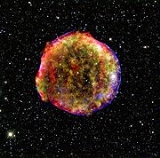
SN 1572 "B Cassiopeiae" (B Cas), or 3C 10 was a supernova
of Type Ia
in the constellation Cassiopeia
, one of about eight supernovae visible to the naked eye in historical records. It burst forth in early November 1572 and was independently discovered by many individuals.
supernova of 1572 was perhaps one of the two or three most important events in the history of astronomy. The "new star" helped to revise ancient models of the heavens
and to inaugurate a revolution in astronomy that began with the realized need to produce better astrometric star catalogue
s (and thus the need for more precise astronomical observing instruments). The supernova of 1572 is often called "Tycho's supernova", because of the extensive work De nova et nullius aevi memoria prius visa stella ("Concerning the New Star, never before seen in the life or memory of anyone," published in 1573, 1602, and 1610) that contains both Tycho Brahe
's own observations and the analysis of those of many other observers. But Tycho was not even close to being the first to observe the 1572 supernova, although he was apparently the most accurate observer of the object (though not by much over some of his European colleagues like Wolfgang Schuler
, Thomas Digges
, John Dee
and Francesco Maurolico
).
In England, Queen Elizabeth called to her the mathematician and astrologer Thomas Allen
, "to have his advice about the new Star that appeared in the Cassiopeia to which he gave his Judgement very learnedly," the antiquary John Aubrey
recorded in his memoranda a century later.
The more reliable contemporary reports state that the new star itself burst forth sometime between November 2 and 6, in 1572, when it rivalled Venus
in brightness. The supernova remained visible to the naked eye into 1574, gradually fading until it disappeared from view.
of B Cas was discovered in the 1960s by scientists with a Palomar Mountain
telescope as a very faint nebula
. It was later photographed by a telescope on the international ROSAT
spacecraft. The supernova has been confirmed as Type Ia
, in which a white dwarf star has accreted matter from a companion until it approaches the Chandrasekhar limit
and explodes. This type of supernova does not typically create the spectacular nebula
more typical of Type II supernova
s, such as SN 1054
which created the Crab Nebula
. A shell of gas is still expanding from its center at about 9,000 km/s. A recent study indicates a rate of expansion below 5,000 km/s.
reported the discovery of a G2 star, similar in type to our own Sun
. It is thought to be the companion star that contributed mass to the white dwarf
that ultimately resulted in the supernova. A subsequent study, published in March 2005, revealed further details about this star: labeled Tycho G
, it was probably a main-sequence star or subgiant prior to the explosion, but had some of its mass stripped away and its outer layers shock-heated from the effects of the supernova. Tycho G's current velocity is perhaps the strongest evidence that it was the companion star to the white dwarf, as it is traveling at a rate of 136 km/s, which is more than four times faster than the mean velocity of other stars in its stellar neighbourhood.
This find has been challenged in recent years. The star is relatively far away from the center and does not show rotation which might be expected of a companion star.
telescope obtained the optical spectrum of Tycho Brahe's supernova near maximum brightness from a scattered-light echo
. It has been confirmed that SN 1572 belongs to the majority class of normal SNe Ia.
X-ray observatory at 4U 0022+63. Earlier catalog designations are X120+2 and XRS 00224+638. Cepheus X-1 is actually in the constellation Cassiopeia
, and it is SN 1572, the Tycho SNR.
Supernova
A supernova is a stellar explosion that is more energetic than a nova. It is pronounced with the plural supernovae or supernovas. Supernovae are extremely luminous and cause a burst of radiation that often briefly outshines an entire galaxy, before fading from view over several weeks or months...
of Type Ia
Type Ia supernova
A Type Ia supernova is a sub-category of supernovae, which in turn are a sub-category of cataclysmic variable stars, that results from the violent explosion of a white dwarf star. A white dwarf is the remnant of a star that has completed its normal life cycle and has ceased nuclear fusion...
in the constellation Cassiopeia
Cassiopeia (constellation)
Cassiopeia is a constellation in the northern sky, named after the vain queen Cassiopeia in Greek mythology, who boasted about her unrivalled beauty. Cassiopea was one of the 48 constellations listed by the 2nd century Greek astronomer Ptolemy, and it remains one of the 88 modern constellations today...
, one of about eight supernovae visible to the naked eye in historical records. It burst forth in early November 1572 and was independently discovered by many individuals.
Historic description
The appearance of the Milky WayMilky Way
The Milky Way is the galaxy that contains the Solar System. This name derives from its appearance as a dim un-resolved "milky" glowing band arching across the night sky...
supernova of 1572 was perhaps one of the two or three most important events in the history of astronomy. The "new star" helped to revise ancient models of the heavens
Archaeoastronomy
Archaeoastronomy is the study of how people in the past "have understood the phenomena in the sky how they used phenomena in the sky and what role the sky played in their cultures." Clive Ruggles argues it is misleading to consider archaeoastronomy to be the study of ancient astronomy, as modern...
and to inaugurate a revolution in astronomy that began with the realized need to produce better astrometric star catalogue
Star catalogue
A star catalogue, or star catalog, is an astronomical catalogue that lists stars. In astronomy, many stars are referred to simply by catalogue numbers. There are a great many different star catalogues which have been produced for different purposes over the years, and this article covers only some...
s (and thus the need for more precise astronomical observing instruments). The supernova of 1572 is often called "Tycho's supernova", because of the extensive work De nova et nullius aevi memoria prius visa stella ("Concerning the New Star, never before seen in the life or memory of anyone," published in 1573, 1602, and 1610) that contains both Tycho Brahe
Tycho Brahe
Tycho Brahe , born Tyge Ottesen Brahe, was a Danish nobleman known for his accurate and comprehensive astronomical and planetary observations...
's own observations and the analysis of those of many other observers. But Tycho was not even close to being the first to observe the 1572 supernova, although he was apparently the most accurate observer of the object (though not by much over some of his European colleagues like Wolfgang Schuler
Wolfgang Schüler
Wolfgang Schüler is a retired German football player.-External links:...
, Thomas Digges
Thomas Digges
Sir Thomas Digges was an English mathematician and astronomer. He was the first to expound the Copernican system in English but discarded the notion of a fixed shell of immoveable stars to postulate infinitely many stars at varying distances; he was also first to postulate the "dark night sky...
, John Dee
John Dee (mathematician)
John Dee was an English mathematician, astronomer, astrologer, occultist, navigator, imperialist and consultant to Queen Elizabeth I. He devoted much of his life to the study of alchemy, divination and Hermetic philosophy....
and Francesco Maurolico
Francesco Maurolico
Francesco Maurolico was a Greek mathematician and astronomer of Sicily. Throughout his lifetime, he made contributions to the fields of geometry, optics, conics, mechanics, music, and astronomy...
).
In England, Queen Elizabeth called to her the mathematician and astrologer Thomas Allen
Thomas Allen (mathematician)
Thomas Allen was an English mathematician and astrologer.-Life:He was admitted scholar of Trinity College, Oxford, in 1561; and graduated as M.A. in 1567...
, "to have his advice about the new Star that appeared in the Cassiopeia to which he gave his Judgement very learnedly," the antiquary John Aubrey
John Aubrey
John Aubrey FRS, was an English antiquary, natural philosopher and writer. He is perhaps best known as the author of the collection of short biographical pieces usually referred to as Brief Lives...
recorded in his memoranda a century later.
The more reliable contemporary reports state that the new star itself burst forth sometime between November 2 and 6, in 1572, when it rivalled Venus
Venus
Venus is the second planet from the Sun, orbiting it every 224.7 Earth days. The planet is named after Venus, the Roman goddess of love and beauty. After the Moon, it is the brightest natural object in the night sky, reaching an apparent magnitude of −4.6, bright enough to cast shadows...
in brightness. The supernova remained visible to the naked eye into 1574, gradually fading until it disappeared from view.
Supernova remnant
The distance to the supernova remnant has been estimated to between 2 and 5 kpc (approx. 6,500 and 16,300 light-years), but recent studies suggest a value closer to 2.5 and 3 kpc (approx. 8,000 and 9,800 light-years).Radio detection
The search for a supernova remnant was negative until 1952, when Hanbury Brown and Hazard reported a radio detection at 158.5 MHz. This was confirmed at wavelength 1.9 m by Baldwin and Edge (1957), and the remnant was also identified tentatively in the second Cambridge radio-source catalogue as object "2C 34" and identified more firmly as "3C 10" in the third Cambridge list (Edge et al. 1959). There is no dispute that 3C 10 is the remnant of the supernova observed in 1572-1573. Following a review article by Minkowski (1964), the designation 3C 10 appears to be that most commonly used in the literature when referring to the radio remnant of B Cas (though some authors use the tabulated Galactic designation G120.7+2.1 of Green 1984, and many authors commonly refer to it as "Tycho's supernova remnant"—somewhat of a misnomer, as Tycho saw the pointlike supernova, not the expansive radio remnant). Because the radio remnant was reported before the optical supernova-remnant wisps were discovered, the designation 3C 10 is used by some to signify the remnant at all wavelengths.Optical detection
The supernova remnantSupernova remnant
A supernova remnant is the structure resulting from the explosion of a star in a supernova. The supernova remnant is bounded by an expanding shock wave, and consists of ejected material expanding from the explosion, and the interstellar material it sweeps up and shocks along the way.There are two...
of B Cas was discovered in the 1960s by scientists with a Palomar Mountain
Palomar Observatory
Palomar Observatory is a privately owned observatory located in San Diego County, California, southeast of Pasadena's Mount Wilson Observatory, in the Palomar Mountain Range. At approximately elevation, it is owned and operated by the California Institute of Technology...
telescope as a very faint nebula
Nebula
A nebula is an interstellar cloud of dust, hydrogen gas, helium gas and other ionized gases...
. It was later photographed by a telescope on the international ROSAT
ROSAT
ROSAT was a German Aerospace Center-led satellite X-ray telescope, with instruments built by Germany, the UK and the US...
spacecraft. The supernova has been confirmed as Type Ia
Type Ia supernova
A Type Ia supernova is a sub-category of supernovae, which in turn are a sub-category of cataclysmic variable stars, that results from the violent explosion of a white dwarf star. A white dwarf is the remnant of a star that has completed its normal life cycle and has ceased nuclear fusion...
, in which a white dwarf star has accreted matter from a companion until it approaches the Chandrasekhar limit
Chandrasekhar limit
When a star starts running out of fuel, it usually cools off and collapses into one of three compact forms, depending on its total mass:* a White Dwarf, a big lump of Carbon and Oxygen atoms, almost like one huge molecule...
and explodes. This type of supernova does not typically create the spectacular nebula
Nebula
A nebula is an interstellar cloud of dust, hydrogen gas, helium gas and other ionized gases...
more typical of Type II supernova
Type II supernova
A Type II supernova results from the rapid collapse and violent explosion of a massive star. A star must have at least 9 times, and no more than 40–50 times the mass of the Sun for this type of explosion. It is distinguished from other types of supernova by the presence of hydrogen in its spectrum...
s, such as SN 1054
SN 1054
SN 1054 is a supernova that was first observed as a new "star" in the sky on July 4, 1054 AD, hence its name, and that lasted for a period of around two years. The event was recorded in multiple Chinese and Japanese documents and in one document from the Arab world...
which created the Crab Nebula
Crab Nebula
The Crab Nebula is a supernova remnant and pulsar wind nebula in the constellation of Taurus...
. A shell of gas is still expanding from its center at about 9,000 km/s. A recent study indicates a rate of expansion below 5,000 km/s.
Discovery of the companion star
In October 2004, a letter in NatureNature (journal)
Nature, first published on 4 November 1869, is ranked the world's most cited interdisciplinary scientific journal by the Science Edition of the 2010 Journal Citation Reports...
reported the discovery of a G2 star, similar in type to our own Sun
Sun
The Sun is the star at the center of the Solar System. It is almost perfectly spherical and consists of hot plasma interwoven with magnetic fields...
. It is thought to be the companion star that contributed mass to the white dwarf
White dwarf
A white dwarf, also called a degenerate dwarf, is a small star composed mostly of electron-degenerate matter. They are very dense; a white dwarf's mass is comparable to that of the Sun and its volume is comparable to that of the Earth. Its faint luminosity comes from the emission of stored...
that ultimately resulted in the supernova. A subsequent study, published in March 2005, revealed further details about this star: labeled Tycho G
Tycho G
Tycho G is the surviving binary companion star of the SN 1572 supernova event.The star is located about 7500 light-years away in the constellation Cassiopeia...
, it was probably a main-sequence star or subgiant prior to the explosion, but had some of its mass stripped away and its outer layers shock-heated from the effects of the supernova. Tycho G's current velocity is perhaps the strongest evidence that it was the companion star to the white dwarf, as it is traveling at a rate of 136 km/s, which is more than four times faster than the mean velocity of other stars in its stellar neighbourhood.
This find has been challenged in recent years. The star is relatively far away from the center and does not show rotation which might be expected of a companion star.
Observation of light echo
In September 2008, the SubaruSubaru (telescope)
Subaru Telescope is the 8.2 metre flagship telescope of the National Astronomical Observatory of Japan, located at the Mauna Kea Observatory on Hawaii. It is named after the open star cluster known in English as the Pleiades...
telescope obtained the optical spectrum of Tycho Brahe's supernova near maximum brightness from a scattered-light echo
Light echo
thumb|right|250px|Reflected light following path B arrives shortly after the direct flash following path A but before light following path C. B and C have the same apparent distance from the star as seen from [[Earth]]....
. It has been confirmed that SN 1572 belongs to the majority class of normal SNe Ia.
X-ray observation
An X-ray source designated Cepheus X-1 (or Cep X-1) was detected by the UhuruUhuru (satellite)
Uhuru was the first satellite launched specifically for the purpose of X-ray astronomy. It was also known as the X-ray Explorer Satellite, SAS-A , SAS 1, or Explorer 42.The observatory was launched on 12 December 1970 into an initial orbit of about 560 km apogee, 520 km...
X-ray observatory at 4U 0022+63. Earlier catalog designations are X120+2 and XRS 00224+638. Cepheus X-1 is actually in the constellation Cassiopeia
Cassiopeia (constellation)
Cassiopeia is a constellation in the northern sky, named after the vain queen Cassiopeia in Greek mythology, who boasted about her unrivalled beauty. Cassiopea was one of the 48 constellations listed by the 2nd century Greek astronomer Ptolemy, and it remains one of the 88 modern constellations today...
, and it is SN 1572, the Tycho SNR.