


Russian Orthodox Church Outside Russia

Encyclopedia
The Russian Orthodox Church Outside Russia , also called the Russian Orthodox Church Abroad, ROCA, or ROCOR) is a semi-autonomous part of the Russian Orthodox Church
.
ROCOR was formed as a jurisdiction of Eastern Orthodoxy as a response against the policy of Bolshevik
s with respect to religion in the Soviet Union
soon after the Russian Revolution of 1917
, and separated from the Russian Church of the Moscow Patriarchate
in 1927 after an imprisoned Patriarch Sergius I of Moscow
pledged the Church’s qualified loyalty to the Bolshevik state. The Russian Orthodox Church Outside of Russia officially signed the Act of Canonical Communion with the Moscow Patriarchate
on May 17, 2007 restoring the canonical link between the churches. Critics of the reunification argue that the issue of KGB
infiltration of the Moscow Patriarchate church hierarchy has not been addressed by the Russian Orthodox Church.
The Church has over 400 parishes worldwide, and an estimated membership of over 15,000 people. Within the ROCOR there are 13 hierarchs, and also monasteries and nunneries in the United States, Canada, Australia, New Zealand, Germany, and South America.
, after the White Russian Army
under Admiral Aleksandr Kolchak
was defeated and the Bolshevik
s occupied Siberia
, a mass exodus of Russian refugees moved into Manchuria
. Over ninety thousand refugees settled in Harbin
, Shanghai
, Dairen, Hailar and the smaller towns along the Chinese branch of the Trans-Siberian Railway
within three years. Lacking adequate lodgings or employment many migrated to America, Europe or Australia.
Also in 1920 the Soviet government revealed that it was hostile to the Russian Orthodox Church
. On November 7, 1920, Tikhon
, Patriarch of Moscow, issued an ukase
(decree) instructing all Orthodox Christian bishops currently under the authority and protection of his Patriarchate, should they be unable to contact the Higher Church Administration, to seek protection and guidance by organizing among themselves.
Among some Russia
n Bishop
s and other hierarchs, this was interpreted as an authorization to form an emergency synod
of all Russian Orthodox hierarchs to permit the Church to continue to function outside Russia. To add urgency to the synod's motives, in May 1922, the Soviet government proclaimed its own "Living Church
" as a "reform" of the Russian Orthodox Church
.
On September 13, 1922, Russian Orthodox hierarchs in Serbia met in the town of Sremski Karlovci
and established a Synod of Bishops of the Russian Church Abroad, the foundation of ROCOR. In November 1922, Russian Orthodox in North America
held a synod and elected Metropolitan Platon as the primate of an autonomous Russian exarchate in the Americas. This led to a three-way conflict in the United States
among the Exarchate, ROCOR (sometimes known as "the Synod" in this period), and the Living Church
, which asserted that it was the legitimate (Soviet-government-recognized) owner of all Eastern Orthodox properties in the USA.
(one of the Assistant Deputy Patriarchs) agreed in 1927 to negotiations with the State Political Directorate
from his prison cell. Sergiy pledged the Church’s qualified loyalty to the Bolshevik state (an act his defenders claim saved the Church from total liquidation). This pledge caused a deep schism that prompted many disillusioned believers to go underground where they formed what became called the Russian True Orthodox Church
. Sergiy’s accommodation also alienated the Russian Orthodox Church Outside Russia.
Despite distancing itself from both the Bolsheviks and Sergiy, in 1927 ROCOR declared "The part of the Russian Church that finds itself abroad considers itself an inseparable, spiritually united branch of the Great Russian Church. It doesn't separate itself from its Mother Church and doesn't consider itself autocephalous", indicating that ROCOR considered itself to speak for all of the Russian Orthodox outside Russia.
 During World War II
, when the Church of England
requested the right to pay a high level visit to the Russian Orthodox Church, General Secretary Joseph Stalin
met with its metropolitans. Though it's sometimes stated that Stalin needed the Church to win the war, this is inaccurate as by that point the victorious battles of Stalingrad
and Kursk
had already put the USSR and its allies in a superior position. Stalin’s move was on the eve of the Teheran Conference and he wanted the ROC to impress the Anglican delegation and convince them that there was no religious persecution. He hoped that this would sway British public opinion and cause them to pressure their government to support an early invasion of Normandy to divert Nazi efforts away from his front.
Stalin was told by Metropolitan Sergii that the most pressing needs of the Church was to convoke a sobor
, elect a Patriarch, and restore the Synod
(which had been dissolved in 1935). Stalin approved everything and used military air transport to bring the bishops to Moscow allowing the sobor to open four days from his meeting with the metropolitans. He appointed Georgii Karpov (a major general in the NKVD
) as the Council for the Russian Orthodox Church Affairs and all matters concerning Church-State relations were to go through him. Sergii turned down Stalin’s offer to fully subsidize the sobor and his offer of financial aid. He succeeded in obtaining Stalin’s permission to reopen the seminaries and theological schools "in as many eparchies as the Church would see fit". He also allowed the reopening of churches and the return of the monthly Journal of the Moscow Patriarchate to publication.
Upon Metropolitan Alexii’s suggestion Stalin allowed a list of imprisoned priests and bishops to be handed over to Karpov for consideration of release (unfortunately many of those on the list had been executed in the persecution of 1937-38). The former German Embassy was requisitioned to serve as the official residence of the Patriarch and as his offices. Despite Stalin’s remarks at the meeting that Karpov would only be a liaison between the Church and the government his CROCA interfered into many internal Church affairs. Karpov was the decisive voice in the creation of the Church Statute of 1945, its main author being one of his assistants. He also ignored protests of the Patriarch when the USSR began liquidating monasteries again in 1946 and forced the hierarchy to submit.
While churches were opened relatively quickly in land conquered from the Nazis, a long bureaucratic process was needed to open a church on Russian soil (taking up to three years and instantly derailed by anyone in the bureaucratic chain). The hierarchs of the ROCOR condemned this new arrangement with Stalin, saying that the Moscow patriarch had “made an alliance with Satan.”
The relationship between members of the ROCOR and the Nazis during World War II (when Germany turned against the USSR
) has long been an issue addressed by both the Church and its critics. A 1938 letter written by Metropolitan Anastassy to Adolf Hitler, thanks him for his aid to the Russian Diaspora in allowing the building of a Russian Orthodox Cathedral in Berlin and praises his patriotism
. This has, however, been defended as an act that occurred when "little was known…of the inner workings of the Third Reich."
The ROCOR itself has stressed how well its clergy handled themselves at this time. In a document made during their Second Ecclesio-Historical Conference in 2002, a statement was released noting “the attempt of the Nazi leadership to divide the Church into separate and even inimical church formations was met with internal church opposition.”
After the end of World War II
, the Patriarchate of Moscow broached the possibility of reunification between Moscow and ROCOR, presumably at the behest of the Soviet government, which had adopted a more conciliatory attitude towards religion during the war and was presumably trying to capitalize on its wartime alliances to win a more respectable position internationally. This wasn't deemed possible at that time by the ROCOR, given that the USSR was still a communist state
.
, ROCOR has maintained its administrative independence from the Russian Orthodox Church
.
ordered the churches reopened. An invitation was extended by the Soviets for all Orthodox prelates in the Middle East to come to Moscow to witness the installation of Patriarch Alexei I. In 1952 the Soviets reopened the Russian Palestine Society under the direction of Communist Party agents from Moscow, replaced Archimandrite Vladimir with communist trained Ignaty Polikarp, and won over many Christian Arabs with communist sympathies to the ROC. The members of other branches of Orthodoxy refused to associate with the Soviet led ROC in Palestine. When Israel
became a state in 1948, all of the property under the control of the ROCOR within its borders was handed over to the Soviet dominated ROC in appreciation for Moscow's support of the Jewish state (this support was short-lived). The ROCOR maintained control over churches and properties in the Jordanian-ruled West Bank and eastern Jerusalem
unmolested until the late 1980s.
In 1997 Patriarch of Moscow Alexei II
attempted to visit a ROCOR held monastery
in Hebron
with Yasser Arafat
. It has been noted that "The Moscow-based church has enjoyed a close relationship with Arafat since his guerilla fighter days." Upon arrival Arafat and the patriarch were refused entry by the ROCOR clergy, who held that Alexy had no legitimate authority. Two weeks afterwards police officers of the Palestinian Authority arrived and by "assaulting and cursing priests and nuns" they managed to evict the ROCOR clergy and then turned over the property to the ROC.
Alexy made another visit in early January 2000 to meet with Arafat and asked "for help in recovering church properties" as part of a "worldwide campaign to recover properties lost to churches that split off during the Communist era". Later that month the Palestinian Authority again moved to evict ROCOR clergy, this time from the 3 acres (12,140.6 m²) Monastery of Abraham's Oak in Hebron.
There are certain basic facts about the official position of ROCOR that should be understood. Historically, ROCOR has always affirmed that it was an inseparable part of the Russian Church, and that its autonomous status was only temporary, based upon Ukaz 362, until such time as the domination of the Soviet government over the affairs of the Church should cease:
Similarly, Metropolitan Anastasy wrote in his Last Will and Testament:
ROCOR viewed the Russian Church as consisting of three parts during the Soviet period: 1. The Moscow Patriarchate, 2. the Catacomb Church, and 3. The Free Russian Church (ROCOR). The Catacomb Church had been a significant part of the Russian Church prior to World War II. Most of those in ROCOR had left Russia during or well before World War II. They were unaware of the changes that had occurred immediately after World War II—most significantly that with the election of Patriarch Alexei I, most of the Catacomb Church was reconciled with the Moscow Patriarchate. By the 1970s, due to this reconciliation, as well as to continued persecution by the Soviets, there was very little left of the Catacomb Church. Alexander Solzhenitsyn made this point in a letter to the 1974 All-Diaspora Sobor of ROCOR, in which he stated that ROCOR should not "show solidarity with a mysterious, sinless, but also bodiless catacomb." The fact that the catacomb Church had essentially ceased to exist was de facto recognized when, as Communism was about to finally collapse in Russia, ROCOR began to establish "Free Russian" parishes in Russia, and to consecrate bishops to oversee such parishes, and never recognized any alleged Catacomb bishop as having a legitimate episcopacy.
Finally, the collapse of Communism in the Soviet Union precipitated a crisis in ROCOR, because the very reason that had initially resulted in its separation from the Moscow Patriarchate had been removed, and so the basis of the consensus that had previously united ROCOR began to unravel. There were those who did not believe that the Moscow Patriarchate was yet free from the control of the KGB, and that in any case they had not sufficiently renounced the policies of Metropolitan Sergius. There were also those who believed that regardless of the political situation in Russia, that the question of Ecumenism had become sufficient grounds for continued separation. But after the August 2000 All-Russian Sobor of the Moscow Patriarchate, in which the MP officially condemned the Branch Theory of Ecumenism, and also renounced in principle, if not in name, the policies of Metropolitan Sergius, the question of reconciliation with the Moscow Patriarchate become an unavoidable question that had to be resolved, one way or another.
.
Some of these concerns were ended with the jubilee Council of Bishops in 2000, which canonized Tsar Nicholas and his family
, along with more than 1,000 martyr
s and confessor
s. This Council also enacted a document on relations between the Church and the secular authorities, censoring servility and complaisance. They also rejected the idea of any connection between Orthodoxy and Catholicism.
In 2001, the Synod of the Patriarchate of Moscow and ROCOR exchanged formal correspondence. The Muscovite letter held the position that previous and current separation were purely political matters. ROCOR's response is that they were still worried about continued Muscovite involvement in ecumenism
as compromising Moscow's Orthodoxy. Nevertheless, this was far more friendly a discourse than previous decades had seen.
In 2003 Vladimir Putin
met with Metropolitan Laurus in New York. This event was later hailed as an important step by Patriarch Alexy II who said that it showed the ROCOR that "not a fighter against God, but an Orthodox Christian is at the country's helm."
In May 2004, Metropolitan Laurus, the head of the ROCOR, visited Russia participating in several joint services. In
June 2004, a contingent of ROCOR clergy meeting with Patriarch Alexey II. Committees were set up by both the Patriarchate and ROCOR to begin dialogue towards rapprochement. Both sides decided to set up joint commissions, and determined the range of issues to be discussed at the All-Diaspora Council, which met for the first time since 1974.
The possibility of rapprochement, however, led to a minor schism
from the ROCOR in 2001, taking with it ROCOR's self-retired former First Hierarch, Metropolitan Vitaly (Oustinoff)
, and the suspended Bishop Varnava (Prokofieff) of Cannes. The two formed a loosely associated jurisdiction under the name Russian Orthodox Church in Exile (ROCiE). It was claimed that Metropolitan Vitaly's entourage forged his signature on epistles and documents. Bishop Varnava subsequently issued a letter of apology, and was received back into the ROCOR in 2006 as a retired bishop. Even before the repose of Metropolitan Vitaly in 2006, the ROCiE began to break up into eventually four rival factions, each claiming to be the true ROCOR.
talks were leading toward the resumption of full relations between the ROCOR and the Patriarchate of Moscow; and that the ROCOR would be given autonomy status
. In this arrangement the ROCOR "will now join the Moscow Patriarchate as a self-governed branch, similar to the Ukrainian Orthodox Church
. It will retain its autonomy in terms of pastoral, educational, administrative, economic, property and secular issues." While Patriarchate Alexy said that the ROCOR would keep its property and fiscal independence and stated that its autonomy would not change "in the foreseeable future", he added that "Maybe this will change in decades and there will be some new wishes. But today we have enough concerns and will not make guesses.”
On May 12, 2006, the general congress of the ROCOR confirmed its willingness to reunite with the Russian Orthodox Church, which hailed this resolution as:
In September 2006, the ROCOR Synod of Bishops approved the text of the document worked out by the commissions, an Act of Canonical Communion, and in October 2006, the commissions met again to propose procedures and a time for signing the document. The Act of Canonical Communion went into effect upon its confirmation by the Holy Synod of the Russian Orthodox Church, based the decision of the Holy Council of Bishops of the Russian Orthodox Church on the Relationship with the Russian Orthodox Church Outside of Russia, held in Moscow on October 3–October 8, 2004; as well as by decision of the Synod of Bishops of the ROCOR, on the basis of the resolution regarding the Act on Canonical Communion of the Council of Bishops of the Russian Orthodox Church Outside of Russia, held in San Francisco on May 15–May 19, 2006.
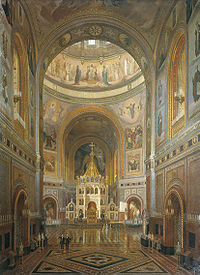 On December 28, 2006, it was officially announced that the Act of Canonical Communion would finally be signed. The signing took place on the May 17, 2007, followed immediately by a full restoration of communion
with the Moscow Patriarchate, celebrated by a Divine Liturgy at the Cathedral of Christ the Saviour in Moscow
, at which the Patriarch of Moscow and All Russia Alexius II
and the First Hierarch of ROCOR concelebrated for the first time in history.
On May 17, 2007, at 9:15 a.m., Metropolitan Laurus
was greeted at Christ the Saviour Cathedral in Moscow by a special peal of the bells, and shortly thereafter, Patriarch Alexey II entered the Cathedral. After the Patriarch read the prayer for the unity of the Russian Church, the Act of Canonical Communion was read aloud, and two copies were each signed by both Metropolitan Laurus and Patriarch Alexey II. The two hierarchs then exchanged the "kiss of peace," and they and the entire Russian Church sang "God Grant You Many Years." Following this, the Divine Liturgy of the Feast of the Ascension of Our Lord began, culminating with the entirety of the bishops of both ROCOR and MP partaking of the same Eucharist.
Present at the signing of the Act and at the Divine Liturgy, was Russian President Vladimir Putin
, who was thanked by Patriarch Alexey for helping to facilitate the reconciliation between the two parts of the Russian Church. Putin then gave his remarks to an audience of Orthodox Christians, visitors, clergy, and press, saying "The split in the church was caused by an extremely deep political split within Russian society itself. We have realized that national revival and development in Russia are impossible without reliance on the historical and spiritual experience of our people. We understand well, and value, the power of pastoral words which unite the people of Russia. That is why restoring the unity of the church serves our common goals."
The entire ceremony was broadcast live on Russian television
, as well as live on the official website of Christ the Savior Cathedral in Moscow. The entire ceremony can be viewed on the Internet
. The Royal Doors
were open during the entire event, which usually occurs only during the Bright Week
.
The Hierarchs of the Russian Church Abroad then served again with the Patriarch on May 19, in the consecration of the Church of the New Martyrs in Butovo, where they had laid the cornerstone during their initial visit in 2004. Butovo Field was the site of numerous massacres by the NKVD
, who executed tens of thousands of people from the 1930s to the 1950s. During fifteen months in 1937 and 1938 alone, 20,765 people were shot there. Finally, on Sunday, May 20, they concelebrated in a Liturgy at the Cathedral of the Dormition
in the Kremlin
.
President Vladimir Putin gave a reception at the Kremlin to celebrate the reunification. In attendance were Patriarch Alexy II of Moscow and All Russia and members of the Holy Synod for the Russian Orthodox Church; Metropolitan Laurus for the Russian Orthodox Church Outside of Russia; Presidential chief of staff Sergei Sobyanin, First Deputy Prime Minister Dmitry Medvedev
, and Minister of Culture and Mass Communications Alexander Sokolov
. Before the reception the participants posed for photographs by the Assumption Cathedral.
The signing of the act led to yet another small schism from the ROCOR, this time taking with it Bishop Agafangel (Pashkovsky) of Odessa and Tauria, and with him some of ROCOR's parishes in the Ukraine, which refused to enter the jurisdiction of the Ukrainian Orthodox Church
. Agafangel was subsequently suspended by the ROCOR synod for disobedience.
Despite censure, Agafangel persisted with the support of ROCOR parishes inside and outside of the Ukraine which had also refused to submit to the Act of Canonical Communion. Agafangel subsequently ordained Bishop Andronik (Kotliaroff) with the assistance of Greek bishops from the Holy Synod in Resistance; these ordinations signified the breach between ROCOR and those who would refused communion with Moscow. At a Fifth All-Diaspora Council (composed of clergy who did not accept the Act of Canonical Communion), Bishop Agafangel was elevated to the rank of metropolitan
; he now heads the Russian Orthodox Church Abroad - Provisional Supreme Church Authority (ROCA-PSCA) as Metropolitan Agafangel of New York
and Eastern America.
es and 51 monasteries
for men and women in 43 countries throughout the world, served by 672 clergy. The distribution of parishes is as follows: 194 parishes and 11 monasteries in the United States; 67 parishes and 11 monasteries in the Australian diocese; 48 parishes in Germany; 25 parishes and 3 monasteries in Canada; 22 parishes in Indonesia. ROCOR churches and communities also exist in Austria, Belgium, Brazil, Canada, Chile, Costa Rica, Denmark, Dominican Republic, France, Haiti, Indonesia, Ireland, Israel, Italy, Luxembourg, Mexico, Morocco, Portugual, South Korea, Netherlands, New Zealand, Paraguay, Spain, Switzerland, Turkey, Uganda, United Kingdom, Uruguay and Venezuela.
There are twelve ROCOR monasteries for men and women in North America, the most important and largest of which is Holy Trinity Monastery (Jordanville, New York)
, to which is attached ROCOR's seminary, Holy Trinity Orthodox Seminary.
ROCOR also oversees the Russian Ecclesiastical Mission in Jerusalem, which acts as caretaker to three holy sites in the State of Israel including Samaria and Judea, all of which are monasteries.
The current First Hierarch of the Russian Orthodox Church outside of Russia is Metropolitan Hilarion (Kapral).
The occupants of the Synod Headquarters have had several run-ins with their neighbors, after having tried to convert their Landmark Building into a commercial enterprise. They have filed several permits to have their headquarters converted to a restaurant and cafe, install cell tower antennaes on their roof and leased to several tv and film productions, raising the ire of their parishioners. The luxurious lifestyle of the priests have also been called into question as they have used church funds for personal expenses such as luxury cars and houses in the Hamptons, having sequestered funds intended for use to help the needy and downtrodden.
in ROCOR, although attitudes toward it have varied, and the number of Western Rite parishes is relatively small. Currently there is a Western Rite monastery in Tasmania, Australia—the St. Petroc Monastery. The Christ the Saviour Monastery
, founded in 1993 in Rhode Island
and moved to Hamilton
, Ontario
in 2008 (see main article for references) has incorporated the Oratory of Our Lady of Glastonbury as its monastery chapel
. The oratory had previously been a mission of the Antiochian Western Rite Vicariate
in the Antiochian Orthodox Christian Archdiocese of North America
but since October 2007 has been a part of ROCOR. There are a few other parishes that either use the Western Rite exclusively, or in part. An American parish, St Benedict of Nursia, in Oklahoma City, serves both the Western Rite and the Byzantine Rite.
Russian Orthodox Church
The Russian Orthodox Church or, alternatively, the Moscow Patriarchate The ROC is often said to be the largest of the Eastern Orthodox churches in the world; including all the autocephalous churches under its umbrella, its adherents number over 150 million worldwide—about half of the 300 million...
.
ROCOR was formed as a jurisdiction of Eastern Orthodoxy as a response against the policy of Bolshevik
Bolshevik
The Bolsheviks, originally also Bolshevists , derived from bol'shinstvo, "majority") were a faction of the Marxist Russian Social Democratic Labour Party which split apart from the Menshevik faction at the Second Party Congress in 1903....
s with respect to religion in the Soviet Union
Soviet Union
The Soviet Union , officially the Union of Soviet Socialist Republics , was a constitutionally socialist state that existed in Eurasia between 1922 and 1991....
soon after the Russian Revolution of 1917
Russian Revolution of 1917
The Russian Revolution is the collective term for a series of revolutions in Russia in 1917, which destroyed the Tsarist autocracy and led to the creation of the Soviet Union. The Tsar was deposed and replaced by a provisional government in the first revolution of February 1917...
, and separated from the Russian Church of the Moscow Patriarchate
Russian Orthodox Church
The Russian Orthodox Church or, alternatively, the Moscow Patriarchate The ROC is often said to be the largest of the Eastern Orthodox churches in the world; including all the autocephalous churches under its umbrella, its adherents number over 150 million worldwide—about half of the 300 million...
in 1927 after an imprisoned Patriarch Sergius I of Moscow
Patriarch Sergius I of Moscow
Patriarch Sergius I , – May 15, 1944) was the 12th Patriarch of Moscow and All Russia, from September 8, 1943 until his death. He was also the de facto head of the Russian Orthodox Church as Patriarchal locum tenens in 1925-1943.-Early life:...
pledged the Church’s qualified loyalty to the Bolshevik state. The Russian Orthodox Church Outside of Russia officially signed the Act of Canonical Communion with the Moscow Patriarchate
Act of Canonical Communion with the Moscow Patriarchate
The Act of Canonical Communion of the Russian Orthodox Church Outside Russia with the Russian orthodox Church Moscow Patriarchate reunited the two branches of the Russian Orthodox Church: the Russian Orthodox Church Outside Russia and the Moscow Patriarchate...
on May 17, 2007 restoring the canonical link between the churches. Critics of the reunification argue that the issue of KGB
KGB
The KGB was the commonly used acronym for the . It was the national security agency of the Soviet Union from 1954 until 1991, and was the premier internal security, intelligence, and secret police organization during that time.The State Security Agency of the Republic of Belarus currently uses the...
infiltration of the Moscow Patriarchate church hierarchy has not been addressed by the Russian Orthodox Church.
The Church has over 400 parishes worldwide, and an estimated membership of over 15,000 people. Within the ROCOR there are 13 hierarchs, and also monasteries and nunneries in the United States, Canada, Australia, New Zealand, Germany, and South America.
Formation and early years
In 1920 near the end of the Russian Civil WarRussian Civil War
The Russian Civil War was a multi-party war that occurred within the former Russian Empire after the Russian provisional government collapsed to the Soviets, under the domination of the Bolshevik party. Soviet forces first assumed power in Petrograd The Russian Civil War (1917–1923) was a...
, after the White Russian Army
White movement
The White movement and its military arm the White Army - known as the White Guard or the Whites - was a loose confederation of Anti-Communist forces.The movement comprised one of the politico-military Russian forces who fought...
under Admiral Aleksandr Kolchak
Aleksandr Kolchak
Aleksandr Vasiliyevich Kolchak was a Russian naval commander, polar explorer and later - Supreme ruler . Supreme ruler of Russia , was recognized in this position by all the heads of the White movement, "De jure" - Kingdom of Serbs, Croats and Slovenes, "De facto" - Entente States...
was defeated and the Bolshevik
Bolshevik
The Bolsheviks, originally also Bolshevists , derived from bol'shinstvo, "majority") were a faction of the Marxist Russian Social Democratic Labour Party which split apart from the Menshevik faction at the Second Party Congress in 1903....
s occupied Siberia
Siberia
Siberia is an extensive region constituting almost all of Northern Asia. Comprising the central and eastern portion of the Russian Federation, it was part of the Soviet Union from its beginning, as its predecessor states, the Tsardom of Russia and the Russian Empire, conquered it during the 16th...
, a mass exodus of Russian refugees moved into Manchuria
Manchuria
Manchuria is a historical name given to a large geographic region in northeast Asia. Depending on the definition of its extent, Manchuria usually falls entirely within the People's Republic of China, or is sometimes divided between China and Russia. The region is commonly referred to as Northeast...
. Over ninety thousand refugees settled in Harbin
Harbin
Harbin ; Manchu language: , Harbin; Russian: Харби́н Kharbin ), is the capital and largest city of Heilongjiang Province in Northeast China, lying on the southern bank of the Songhua River...
, Shanghai
Shanghai
Shanghai is the largest city by population in China and the largest city proper in the world. It is one of the four province-level municipalities in the People's Republic of China, with a total population of over 23 million as of 2010...
, Dairen, Hailar and the smaller towns along the Chinese branch of the Trans-Siberian Railway
Trans-Siberian Railway
The Trans-Siberian Railway is a network of railways connecting Moscow with the Russian Far East and the Sea of Japan. It is the longest railway in the world...
within three years. Lacking adequate lodgings or employment many migrated to America, Europe or Australia.
Also in 1920 the Soviet government revealed that it was hostile to the Russian Orthodox Church
Russian Orthodox Church
The Russian Orthodox Church or, alternatively, the Moscow Patriarchate The ROC is often said to be the largest of the Eastern Orthodox churches in the world; including all the autocephalous churches under its umbrella, its adherents number over 150 million worldwide—about half of the 300 million...
. On November 7, 1920, Tikhon
Tikhon of Moscow
Saint Tikhon of Moscow , born Vasily Ivanovich Bellavin , was the 11th Patriarch of Moscow and All Russia of the Russian Orthodox Church during the early years of the Soviet Union, 1917 through 1925.-Early life:...
, Patriarch of Moscow, issued an ukase
Ukase
A ukase , in Imperial Russia, was a proclamation of the tsar, government, or a religious leader that had the force of law...
(decree) instructing all Orthodox Christian bishops currently under the authority and protection of his Patriarchate, should they be unable to contact the Higher Church Administration, to seek protection and guidance by organizing among themselves.
Among some Russia
Russia
Russia or , officially known as both Russia and the Russian Federation , is a country in northern Eurasia. It is a federal semi-presidential republic, comprising 83 federal subjects...
n Bishop
Bishop
A bishop is an ordained or consecrated member of the Christian clergy who is generally entrusted with a position of authority and oversight. Within the Catholic Church, Eastern Orthodox, Oriental Orthodox Churches, in the Assyrian Church of the East, in the Independent Catholic Churches, and in the...
s and other hierarchs, this was interpreted as an authorization to form an emergency synod
Synod
A synod historically is a council of a church, usually convened to decide an issue of doctrine, administration or application. In modern usage, the word often refers to the governing body of a particular church, whether its members are meeting or not...
of all Russian Orthodox hierarchs to permit the Church to continue to function outside Russia. To add urgency to the synod's motives, in May 1922, the Soviet government proclaimed its own "Living Church
Living Church
The Living Church , also called Renovationist Church or Renovationism was a schism in the Russian Orthodox Church in 1922–1946...
" as a "reform" of the Russian Orthodox Church
Russian Orthodox Church
The Russian Orthodox Church or, alternatively, the Moscow Patriarchate The ROC is often said to be the largest of the Eastern Orthodox churches in the world; including all the autocephalous churches under its umbrella, its adherents number over 150 million worldwide—about half of the 300 million...
.
On September 13, 1922, Russian Orthodox hierarchs in Serbia met in the town of Sremski Karlovci
Sremski Karlovci
Sremski Karlovci is a town and municipality in Serbia, in the autonomous province of Vojvodina, situated on the bank of the river Danube, 8 km from Novi Sad...
and established a Synod of Bishops of the Russian Church Abroad, the foundation of ROCOR. In November 1922, Russian Orthodox in North America
North America
North America is a continent wholly within the Northern Hemisphere and almost wholly within the Western Hemisphere. It is also considered a northern subcontinent of the Americas...
held a synod and elected Metropolitan Platon as the primate of an autonomous Russian exarchate in the Americas. This led to a three-way conflict in the United States
United States
The United States of America is a federal constitutional republic comprising fifty states and a federal district...
among the Exarchate, ROCOR (sometimes known as "the Synod" in this period), and the Living Church
Living Church
The Living Church , also called Renovationist Church or Renovationism was a schism in the Russian Orthodox Church in 1922–1946...
, which asserted that it was the legitimate (Soviet-government-recognized) owner of all Eastern Orthodox properties in the USA.
Church of the refugees (1922 - 1991)
At first the Russian Orthodox Church's hierarchy within Russia had resisted Bolshevik rule. After arrests and persecution of much of the Church’s leadership, Metropolitan Sergiy StragorodskyPatriarch Sergius I of Moscow
Patriarch Sergius I , – May 15, 1944) was the 12th Patriarch of Moscow and All Russia, from September 8, 1943 until his death. He was also the de facto head of the Russian Orthodox Church as Patriarchal locum tenens in 1925-1943.-Early life:...
(one of the Assistant Deputy Patriarchs) agreed in 1927 to negotiations with the State Political Directorate
State Political Directorate
The State Political Directorate was the secret police of the Russian Soviet Federative Socialist Republic and the Soviet Union from 1922 until 1934...
from his prison cell. Sergiy pledged the Church’s qualified loyalty to the Bolshevik state (an act his defenders claim saved the Church from total liquidation). This pledge caused a deep schism that prompted many disillusioned believers to go underground where they formed what became called the Russian True Orthodox Church
Russian True Orthodox Church
The Russian True Orthodox Church is a denomination that separated from the Russian Orthodox Church during the early years of Communist rule in the Soviet Union. While the True Orthodox Church in Russia was never a single organization, many of its followers were labeled Josephites, after...
. Sergiy’s accommodation also alienated the Russian Orthodox Church Outside Russia.
Despite distancing itself from both the Bolsheviks and Sergiy, in 1927 ROCOR declared "The part of the Russian Church that finds itself abroad considers itself an inseparable, spiritually united branch of the Great Russian Church. It doesn't separate itself from its Mother Church and doesn't consider itself autocephalous", indicating that ROCOR considered itself to speak for all of the Russian Orthodox outside Russia.
World War II
World War II
World War II, or the Second World War , was a global conflict lasting from 1939 to 1945, involving most of the world's nations—including all of the great powers—eventually forming two opposing military alliances: the Allies and the Axis...
, when the Church of England
Church of England
The Church of England is the officially established Christian church in England and the Mother Church of the worldwide Anglican Communion. The church considers itself within the tradition of Western Christianity and dates its formal establishment principally to the mission to England by St...
requested the right to pay a high level visit to the Russian Orthodox Church, General Secretary Joseph Stalin
Joseph Stalin
Joseph Vissarionovich Stalin was the Premier of the Soviet Union from 6 May 1941 to 5 March 1953. He was among the Bolshevik revolutionaries who brought about the October Revolution and had held the position of first General Secretary of the Communist Party of the Soviet Union's Central Committee...
met with its metropolitans. Though it's sometimes stated that Stalin needed the Church to win the war, this is inaccurate as by that point the victorious battles of Stalingrad
Battle of Stalingrad
The Battle of Stalingrad was a major battle of World War II in which Nazi Germany and its allies fought the Soviet Union for control of the city of Stalingrad in southwestern Russia. The battle took place between 23 August 1942 and 2 February 1943...
and Kursk
Battle of Kursk
The Battle of Kursk took place when German and Soviet forces confronted each other on the Eastern Front during World War II in the vicinity of the city of Kursk, in the Soviet Union in July and August 1943. It remains both the largest series of armored clashes, including the Battle of Prokhorovka,...
had already put the USSR and its allies in a superior position. Stalin’s move was on the eve of the Teheran Conference and he wanted the ROC to impress the Anglican delegation and convince them that there was no religious persecution. He hoped that this would sway British public opinion and cause them to pressure their government to support an early invasion of Normandy to divert Nazi efforts away from his front.
Stalin was told by Metropolitan Sergii that the most pressing needs of the Church was to convoke a sobor
Sobor
A sobor is a council of bishops together with other clerical and lay delegates representing the church as a whole in matters of importance...
, elect a Patriarch, and restore the Synod
Synod
A synod historically is a council of a church, usually convened to decide an issue of doctrine, administration or application. In modern usage, the word often refers to the governing body of a particular church, whether its members are meeting or not...
(which had been dissolved in 1935). Stalin approved everything and used military air transport to bring the bishops to Moscow allowing the sobor to open four days from his meeting with the metropolitans. He appointed Georgii Karpov (a major general in the NKVD
NKVD
The People's Commissariat for Internal Affairs was the public and secret police organization of the Soviet Union that directly executed the rule of power of the Soviets, including political repression, during the era of Joseph Stalin....
) as the Council for the Russian Orthodox Church Affairs and all matters concerning Church-State relations were to go through him. Sergii turned down Stalin’s offer to fully subsidize the sobor and his offer of financial aid. He succeeded in obtaining Stalin’s permission to reopen the seminaries and theological schools "in as many eparchies as the Church would see fit". He also allowed the reopening of churches and the return of the monthly Journal of the Moscow Patriarchate to publication.
Upon Metropolitan Alexii’s suggestion Stalin allowed a list of imprisoned priests and bishops to be handed over to Karpov for consideration of release (unfortunately many of those on the list had been executed in the persecution of 1937-38). The former German Embassy was requisitioned to serve as the official residence of the Patriarch and as his offices. Despite Stalin’s remarks at the meeting that Karpov would only be a liaison between the Church and the government his CROCA interfered into many internal Church affairs. Karpov was the decisive voice in the creation of the Church Statute of 1945, its main author being one of his assistants. He also ignored protests of the Patriarch when the USSR began liquidating monasteries again in 1946 and forced the hierarchy to submit.
While churches were opened relatively quickly in land conquered from the Nazis, a long bureaucratic process was needed to open a church on Russian soil (taking up to three years and instantly derailed by anyone in the bureaucratic chain). The hierarchs of the ROCOR condemned this new arrangement with Stalin, saying that the Moscow patriarch had “made an alliance with Satan.”
The relationship between members of the ROCOR and the Nazis during World War II (when Germany turned against the USSR
Operation Barbarossa
Operation Barbarossa was the code name for Germany's invasion of the Soviet Union during World War II that began on 22 June 1941. Over 4.5 million troops of the Axis powers invaded the USSR along a front., the largest invasion in the history of warfare...
) has long been an issue addressed by both the Church and its critics. A 1938 letter written by Metropolitan Anastassy to Adolf Hitler, thanks him for his aid to the Russian Diaspora in allowing the building of a Russian Orthodox Cathedral in Berlin and praises his patriotism
Patriotism
Patriotism is a devotion to one's country, excluding differences caused by the dependencies of the term's meaning upon context, geography and philosophy...
. This has, however, been defended as an act that occurred when "little was known…of the inner workings of the Third Reich."
The ROCOR itself has stressed how well its clergy handled themselves at this time. In a document made during their Second Ecclesio-Historical Conference in 2002, a statement was released noting “the attempt of the Nazi leadership to divide the Church into separate and even inimical church formations was met with internal church opposition.”
After the end of World War II
World War II
World War II, or the Second World War , was a global conflict lasting from 1939 to 1945, involving most of the world's nations—including all of the great powers—eventually forming two opposing military alliances: the Allies and the Axis...
, the Patriarchate of Moscow broached the possibility of reunification between Moscow and ROCOR, presumably at the behest of the Soviet government, which had adopted a more conciliatory attitude towards religion during the war and was presumably trying to capitalize on its wartime alliances to win a more respectable position internationally. This wasn't deemed possible at that time by the ROCOR, given that the USSR was still a communist state
Communist state
A communist state is a state with a form of government characterized by single-party rule or dominant-party rule of a communist party and a professed allegiance to a Leninist or Marxist-Leninist communist ideology as the guiding principle of the state...
.
Conflict with ROC after the Soviet fall
Since the end of the Soviet UnionSoviet Union
The Soviet Union , officially the Union of Soviet Socialist Republics , was a constitutionally socialist state that existed in Eurasia between 1922 and 1991....
, ROCOR has maintained its administrative independence from the Russian Orthodox Church
Russian Orthodox Church
The Russian Orthodox Church or, alternatively, the Moscow Patriarchate The ROC is often said to be the largest of the Eastern Orthodox churches in the world; including all the autocephalous churches under its umbrella, its adherents number over 150 million worldwide—about half of the 300 million...
.
ROCOR & ROC conflict over Palestinian properties
With the rise of the communists most of the Church properties in Palestine remained in the hands of those at odds with the Bolsheviks, and the majority of these joined with the ROCOR. Some properties of the ROC remained completely closed until 1941, when the PolitburoPolitburo
Politburo , literally "Political Bureau [of the Central Committee]," is the executive committee for a number of communist political parties.-Marxist-Leninist states:...
ordered the churches reopened. An invitation was extended by the Soviets for all Orthodox prelates in the Middle East to come to Moscow to witness the installation of Patriarch Alexei I. In 1952 the Soviets reopened the Russian Palestine Society under the direction of Communist Party agents from Moscow, replaced Archimandrite Vladimir with communist trained Ignaty Polikarp, and won over many Christian Arabs with communist sympathies to the ROC. The members of other branches of Orthodoxy refused to associate with the Soviet led ROC in Palestine. When Israel
Israel
The State of Israel is a parliamentary republic located in the Middle East, along the eastern shore of the Mediterranean Sea...
became a state in 1948, all of the property under the control of the ROCOR within its borders was handed over to the Soviet dominated ROC in appreciation for Moscow's support of the Jewish state (this support was short-lived). The ROCOR maintained control over churches and properties in the Jordanian-ruled West Bank and eastern Jerusalem
Rule of the West Bank and East Jerusalem by Jordan
The West Bank and East Jerusalem were occupied by Jordan for a period of nearly two decades starting from the 1948 Arab-Israeli War. In 1950, the British extended formal recognition to the union between the Hashemite Kingdom and of that part of Palestine under Jordanian occupation and control -...
unmolested until the late 1980s.
In 1997 Patriarch of Moscow Alexei II
Patriarch Alexius II
Patriarch Alexy II was the 15th Patriarch of Moscow and All Russia, the primate of the Russian Orthodox Church....
attempted to visit a ROCOR held monastery
Abraham's Oak Holy Trinity Monastery
Abraham's Oak Holy Trinity Monastery is a Russian Orthodox monastery in Hebron founded in the 20th century on the site of the ancient Oak of Mamre. The lands were acquired by the Russian Church in the 19th century and later expanded...
in Hebron
Hebron
Hebron , is located in the southern West Bank, south of Jerusalem. Nestled in the Judean Mountains, it lies 930 meters above sea level. It is the largest city in the West Bank and home to around 165,000 Palestinians, and over 500 Jewish settlers concentrated in and around the old quarter...
with Yasser Arafat
Yasser Arafat
Mohammed Yasser Abdel Rahman Abdel Raouf Arafat al-Qudwa al-Husseini , popularly known as Yasser Arafat or by his kunya Abu Ammar , was a Palestinian leader and a Laureate of the Nobel Prize. He was Chairman of the Palestine Liberation Organization , President of the Palestinian National Authority...
. It has been noted that "The Moscow-based church has enjoyed a close relationship with Arafat since his guerilla fighter days." Upon arrival Arafat and the patriarch were refused entry by the ROCOR clergy, who held that Alexy had no legitimate authority. Two weeks afterwards police officers of the Palestinian Authority arrived and by "assaulting and cursing priests and nuns" they managed to evict the ROCOR clergy and then turned over the property to the ROC.
Alexy made another visit in early January 2000 to meet with Arafat and asked "for help in recovering church properties" as part of a "worldwide campaign to recover properties lost to churches that split off during the Communist era". Later that month the Palestinian Authority again moved to evict ROCOR clergy, this time from the 3 acres (12,140.6 m²) Monastery of Abraham's Oak in Hebron.
Views on the Moscow Patriarchate, Pre-reconciliation
After the declaration of Metropolitan Sergius of 1927, there were a range of opinions regarding the Moscow Patriarchate within ROCOR. A distinction must be made between the various opinions of bishops, clergy, and laity within ROCOR, and official statements from the Synod of Bishops. There was a general belief in ROCOR that the Soviet government was manipulating the Moscow Patriarchate to one extent or another, and that under such circumstances administrative ties were impossible. There were also official statements made that the elections of the patriarchs of Moscow which occurred after 1927 were invalid because they were not conducted freely (without the interference of the Soviets) or with the participation of the entire Russian Church. However, these statements only declared that ROCOR did not recognize the Patriarchs of Moscow who were elected after 1927 as being the legitimate primates of the Russian Church—they did not declare that the Bishops of the Moscow Patriarchate were illegitimate bishops, or without grace. There were, however, under the umbrella of this general consensus, various opinions about the Moscow Patriarchate, ranging for those who held the extreme view that the Moscow Patriarchate had apostatized from the Church (those in the orbit of Holy Transfiguration Monastery being the most vocal advocates of this position), to those who considered them to be innocent sufferers at the hands of the Soviets, and all points in between. Advocates of the more extreme view of the Moscow Patriarchate became increasingly strident in the 1970s, at a time when ROCOR was increasingly isolating itself from much of the rest of the Orthodox Church due to concerns over the direction of Orthodox involvement in the Ecumenical Movement. Prior to the collapse of the Soviet Union, there wasn't a burning need to settle the question of what should be made of the status of the Moscow Patriarchate, although beginning in the mid 1980's (as the period of Glaznost began in the Soviet Union, which culminated in the ultimate collapse of the Soviet government in 1991), these questions resulted in a number of schisms, and increasingly occupied the attention of those in ROCOR.There are certain basic facts about the official position of ROCOR that should be understood. Historically, ROCOR has always affirmed that it was an inseparable part of the Russian Church, and that its autonomous status was only temporary, based upon Ukaz 362, until such time as the domination of the Soviet government over the affairs of the Church should cease:
- "The Russian Orthodox Church Outside of Russia is an indissoluble part of the Russian Orthodox Church, and for the time until the extermination in Russia of the atheist government, is self-governing on conciliar principles in accordance with the resolution of the Patriarch, the Most Holy Synod, and the Highest Church Council [Sobor] of the Russian Church dated 7/20 November 1920, No. 362."
Similarly, Metropolitan Anastasy wrote in his Last Will and Testament:
- "As regards the Moscow Patriarchate and its hierarchs, then, so long as they continue in close, active and benevolent cooperation with the Soviet Government, which openly professes its complete godlessness and strives to implant atheism in the entire Russian nation, then the Church Abroad, maintaining Her purity, must not have any canonical, liturgical or even simply external communion with them whatsoever, leaving each one of them at the same time to the final judgment of the Council (Sobor) of the future free Russian Church."
ROCOR viewed the Russian Church as consisting of three parts during the Soviet period: 1. The Moscow Patriarchate, 2. the Catacomb Church, and 3. The Free Russian Church (ROCOR). The Catacomb Church had been a significant part of the Russian Church prior to World War II. Most of those in ROCOR had left Russia during or well before World War II. They were unaware of the changes that had occurred immediately after World War II—most significantly that with the election of Patriarch Alexei I, most of the Catacomb Church was reconciled with the Moscow Patriarchate. By the 1970s, due to this reconciliation, as well as to continued persecution by the Soviets, there was very little left of the Catacomb Church. Alexander Solzhenitsyn made this point in a letter to the 1974 All-Diaspora Sobor of ROCOR, in which he stated that ROCOR should not "show solidarity with a mysterious, sinless, but also bodiless catacomb." The fact that the catacomb Church had essentially ceased to exist was de facto recognized when, as Communism was about to finally collapse in Russia, ROCOR began to establish "Free Russian" parishes in Russia, and to consecrate bishops to oversee such parishes, and never recognized any alleged Catacomb bishop as having a legitimate episcopacy.
Finally, the collapse of Communism in the Soviet Union precipitated a crisis in ROCOR, because the very reason that had initially resulted in its separation from the Moscow Patriarchate had been removed, and so the basis of the consensus that had previously united ROCOR began to unravel. There were those who did not believe that the Moscow Patriarchate was yet free from the control of the KGB, and that in any case they had not sufficiently renounced the policies of Metropolitan Sergius. There were also those who believed that regardless of the political situation in Russia, that the question of Ecumenism had become sufficient grounds for continued separation. But after the August 2000 All-Russian Sobor of the Moscow Patriarchate, in which the MP officially condemned the Branch Theory of Ecumenism, and also renounced in principle, if not in name, the policies of Metropolitan Sergius, the question of reconciliation with the Moscow Patriarchate become an unavoidable question that had to be resolved, one way or another.
Movement towards reconciliation
In 2000 Metropolitan Laurus became the First Hierarch of the ROCOR and expressed interest in the idea of reunification. The sticking point at the time was the ROCOR's insistence that the Moscow Patriarchate address the slaying of Tsar Nicholas II and his family in 1918 by the Bolsheviks. The ROCOR held that "the Moscow Patriarchy must speak clearly and passionately about the murder of the tsar's family, the defeat of the anti-Bolshevik movement, and the execution and persecution of priests." The ROCOR also accused the leadership of the ROC as being submissive to the Russian government and were alarmed by their ties with other denominations of Christianity, especially CatholicismCatholicism
Catholicism is a broad term for the body of the Catholic faith, its theologies and doctrines, its liturgical, ethical, spiritual, and behavioral characteristics, as well as a religious people as a whole....
.
Some of these concerns were ended with the jubilee Council of Bishops in 2000, which canonized Tsar Nicholas and his family
Romanov sainthood
Tsar Nicholas II of Russia, his wife Tsarina Alexandra, and their five children Olga, Tatiana, Maria, Anastasia, and Alexei are saints of the Orthodox Church...
, along with more than 1,000 martyr
Martyr
A martyr is somebody who suffers persecution and death for refusing to renounce, or accept, a belief or cause, usually religious.-Meaning:...
s and confessor
Confessor
-Confessor of the Faith:Its oldest use is to indicate a saint who has suffered persecution and torture for the faith, but not to the point of death. The term is still used in this way in the East. In Latin Christianity it has come to signify any saint, as well as those who have been declared...
s. This Council also enacted a document on relations between the Church and the secular authorities, censoring servility and complaisance. They also rejected the idea of any connection between Orthodoxy and Catholicism.
In 2001, the Synod of the Patriarchate of Moscow and ROCOR exchanged formal correspondence. The Muscovite letter held the position that previous and current separation were purely political matters. ROCOR's response is that they were still worried about continued Muscovite involvement in ecumenism
Ecumenism
Ecumenism or oecumenism mainly refers to initiatives aimed at greater Christian unity or cooperation. It is used predominantly by and with reference to Christian denominations and Christian Churches separated by doctrine, history, and practice...
as compromising Moscow's Orthodoxy. Nevertheless, this was far more friendly a discourse than previous decades had seen.
In 2003 Vladimir Putin
Vladimir Putin
Vladimir Vladimirovich Putin served as the second President of the Russian Federation and is the current Prime Minister of Russia, as well as chairman of United Russia and Chairman of the Council of Ministers of the Union of Russia and Belarus. He became acting President on 31 December 1999, when...
met with Metropolitan Laurus in New York. This event was later hailed as an important step by Patriarch Alexy II who said that it showed the ROCOR that "not a fighter against God, but an Orthodox Christian is at the country's helm."
In May 2004, Metropolitan Laurus, the head of the ROCOR, visited Russia participating in several joint services. In
June 2004, a contingent of ROCOR clergy meeting with Patriarch Alexey II. Committees were set up by both the Patriarchate and ROCOR to begin dialogue towards rapprochement. Both sides decided to set up joint commissions, and determined the range of issues to be discussed at the All-Diaspora Council, which met for the first time since 1974.
The possibility of rapprochement, however, led to a minor schism
Schism (religion)
A schism , from Greek σχίσμα, skhísma , is a division between people, usually belonging to an organization or movement religious denomination. The word is most frequently applied to a break of communion between two sections of Christianity that were previously a single body, or to a division within...
from the ROCOR in 2001, taking with it ROCOR's self-retired former First Hierarch, Metropolitan Vitaly (Oustinoff)
Metropolitan Vitaly Ustinov
Metropolitan Vitaly was the first Hierarch of the Russian Orthodox Church Outside Russia from 1985 until his retirement in 2001.-Biography:Rostislav Petrovich Ustinov was born to naval officer Peter Ustinov and Lydia Andreevna , daughter of the General of Police in the Caucasus...
, and the suspended Bishop Varnava (Prokofieff) of Cannes. The two formed a loosely associated jurisdiction under the name Russian Orthodox Church in Exile (ROCiE). It was claimed that Metropolitan Vitaly's entourage forged his signature on epistles and documents. Bishop Varnava subsequently issued a letter of apology, and was received back into the ROCOR in 2006 as a retired bishop. Even before the repose of Metropolitan Vitaly in 2006, the ROCiE began to break up into eventually four rival factions, each claiming to be the true ROCOR.
Reconciliation talks
After a series of six reconcilitation meetings, the ROCOR and the Patriarchate of Moscow, on June 21, 2005, simultaneously announced that rapprochementRapprochement
In international relations, a rapprochement, which comes from the French word rapprocher , is a re-establishment of cordial relations, as between two countries...
talks were leading toward the resumption of full relations between the ROCOR and the Patriarchate of Moscow; and that the ROCOR would be given autonomy status
Autocephaly
Autocephaly , in hierarchical Christian churches and especially Eastern Orthodox and Oriental Orthodox churches, is the status of a hierarchical church whose head bishop does not report to any higher-ranking bishop...
. In this arrangement the ROCOR "will now join the Moscow Patriarchate as a self-governed branch, similar to the Ukrainian Orthodox Church
Ukrainian Orthodox Church (Moscow Patriarchate)
The Ukrainian Orthodox Church is an autonomous Church of Eastern Orthodoxy in Ukraine, under the ecclesiastic jurisdiction of the Moscow Patriarchate...
. It will retain its autonomy in terms of pastoral, educational, administrative, economic, property and secular issues." While Patriarchate Alexy said that the ROCOR would keep its property and fiscal independence and stated that its autonomy would not change "in the foreseeable future", he added that "Maybe this will change in decades and there will be some new wishes. But today we have enough concerns and will not make guesses.”
On May 12, 2006, the general congress of the ROCOR confirmed its willingness to reunite with the Russian Orthodox Church, which hailed this resolution as:
"an important step toward restoring full unity between the Moscow Patriarchate and the part of the Russian emigration that was isolated from it as a result of the revolution, the civil war in Russia, and the ensuing impious persecution against the Orthodox Church."
In September 2006, the ROCOR Synod of Bishops approved the text of the document worked out by the commissions, an Act of Canonical Communion, and in October 2006, the commissions met again to propose procedures and a time for signing the document. The Act of Canonical Communion went into effect upon its confirmation by the Holy Synod of the Russian Orthodox Church, based the decision of the Holy Council of Bishops of the Russian Orthodox Church on the Relationship with the Russian Orthodox Church Outside of Russia, held in Moscow on October 3–October 8, 2004; as well as by decision of the Synod of Bishops of the ROCOR, on the basis of the resolution regarding the Act on Canonical Communion of the Council of Bishops of the Russian Orthodox Church Outside of Russia, held in San Francisco on May 15–May 19, 2006.
Signing of the Act of Canonical Communion
Full communion
In Christian ecclesiology, full communion is a relationship between church organizations or groups that mutually recognize their sharing the essential doctrines....
with the Moscow Patriarchate, celebrated by a Divine Liturgy at the Cathedral of Christ the Saviour in Moscow
Moscow
Moscow is the capital, the most populous city, and the most populous federal subject of Russia. The city is a major political, economic, cultural, scientific, religious, financial, educational, and transportation centre of Russia and the continent...
, at which the Patriarch of Moscow and All Russia Alexius II
Patriarch Alexius II
Patriarch Alexy II was the 15th Patriarch of Moscow and All Russia, the primate of the Russian Orthodox Church....
and the First Hierarch of ROCOR concelebrated for the first time in history.
On May 17, 2007, at 9:15 a.m., Metropolitan Laurus
Metropolitan Laurus
Metropolitan Laurus of New York was First Hierarch of the Russian Orthodox Church Outside Russia, the fifth cleric to hold that position...
was greeted at Christ the Saviour Cathedral in Moscow by a special peal of the bells, and shortly thereafter, Patriarch Alexey II entered the Cathedral. After the Patriarch read the prayer for the unity of the Russian Church, the Act of Canonical Communion was read aloud, and two copies were each signed by both Metropolitan Laurus and Patriarch Alexey II. The two hierarchs then exchanged the "kiss of peace," and they and the entire Russian Church sang "God Grant You Many Years." Following this, the Divine Liturgy of the Feast of the Ascension of Our Lord began, culminating with the entirety of the bishops of both ROCOR and MP partaking of the same Eucharist.
Present at the signing of the Act and at the Divine Liturgy, was Russian President Vladimir Putin
Vladimir Putin
Vladimir Vladimirovich Putin served as the second President of the Russian Federation and is the current Prime Minister of Russia, as well as chairman of United Russia and Chairman of the Council of Ministers of the Union of Russia and Belarus. He became acting President on 31 December 1999, when...
, who was thanked by Patriarch Alexey for helping to facilitate the reconciliation between the two parts of the Russian Church. Putin then gave his remarks to an audience of Orthodox Christians, visitors, clergy, and press, saying "The split in the church was caused by an extremely deep political split within Russian society itself. We have realized that national revival and development in Russia are impossible without reliance on the historical and spiritual experience of our people. We understand well, and value, the power of pastoral words which unite the people of Russia. That is why restoring the unity of the church serves our common goals."
The entire ceremony was broadcast live on Russian television
Television
Television is a telecommunication medium for transmitting and receiving moving images that can be monochrome or colored, with accompanying sound...
, as well as live on the official website of Christ the Savior Cathedral in Moscow. The entire ceremony can be viewed on the Internet
Internet
The Internet is a global system of interconnected computer networks that use the standard Internet protocol suite to serve billions of users worldwide...
. The Royal Doors
Royal Doors
The royal doors, holy doors, or beautiful gates are the central doors of the iconostasis in an Eastern Orthodox or Greek-Catholic Church....
were open during the entire event, which usually occurs only during the Bright Week
Bright Week
Bright Week or Renewal Week is the name used by the Eastern Orthodox Church and Eastern Catholic Churches of the Byzantine Rite for the period of seven days beginning on Pascha and continuing up to the following Sunday, which is known as Thomas Sunday...
.
The Hierarchs of the Russian Church Abroad then served again with the Patriarch on May 19, in the consecration of the Church of the New Martyrs in Butovo, where they had laid the cornerstone during their initial visit in 2004. Butovo Field was the site of numerous massacres by the NKVD
NKVD
The People's Commissariat for Internal Affairs was the public and secret police organization of the Soviet Union that directly executed the rule of power of the Soviets, including political repression, during the era of Joseph Stalin....
, who executed tens of thousands of people from the 1930s to the 1950s. During fifteen months in 1937 and 1938 alone, 20,765 people were shot there. Finally, on Sunday, May 20, they concelebrated in a Liturgy at the Cathedral of the Dormition
Cathedral of the Dormition
The Cathedral of the Dormition is a Russian Orthodox church dedicated to the Dormition of the Theotokos. It is located on the north side of Cathedral Square of the Moscow Kremlin in Russia, where a narrow alley separates the north from the Patriarch's Palace with the Twelve Apostles Church....
in the Kremlin
Kremlin
A kremlin , same root as in kremen is a major fortified central complex found in historic Russian cities. This word is often used to refer to the best-known one, the Moscow Kremlin, or metonymically to the government that is based there...
.
President Vladimir Putin gave a reception at the Kremlin to celebrate the reunification. In attendance were Patriarch Alexy II of Moscow and All Russia and members of the Holy Synod for the Russian Orthodox Church; Metropolitan Laurus for the Russian Orthodox Church Outside of Russia; Presidential chief of staff Sergei Sobyanin, First Deputy Prime Minister Dmitry Medvedev
Dmitry Medvedev
Dmitry Anatolyevich Medvedev is the third President of the Russian Federation.Born to a family of academics, Medvedev graduated from the Law Department of Leningrad State University in 1987. He defended his dissertation in 1990 and worked as a docent at his alma mater, now renamed to Saint...
, and Minister of Culture and Mass Communications Alexander Sokolov
Alexander Sokolov
Alexander Sokolov is a direct-carving or taille directe marble sculptor. He has spent about half his life in Spain, which has led to the distribution of his more central continental style within Iberia...
. Before the reception the participants posed for photographs by the Assumption Cathedral.
Post-reconciliation schism
Critics of the reunification argue that "the hierarchy in Moscow still has not properly addressed the issue of KGB infiltration of the church hierarchy during the Soviet period." It has also been noted that "some parishes and priests of the ROCOR have always rejected the idea of a reunification with the ROC and said they would leave the ROCOR if this happened. The communion in Moscow may accelerate their departure."The signing of the act led to yet another small schism from the ROCOR, this time taking with it Bishop Agafangel (Pashkovsky) of Odessa and Tauria, and with him some of ROCOR's parishes in the Ukraine, which refused to enter the jurisdiction of the Ukrainian Orthodox Church
Ukrainian Orthodox Church (Moscow Patriarchate)
The Ukrainian Orthodox Church is an autonomous Church of Eastern Orthodoxy in Ukraine, under the ecclesiastic jurisdiction of the Moscow Patriarchate...
. Agafangel was subsequently suspended by the ROCOR synod for disobedience.
Despite censure, Agafangel persisted with the support of ROCOR parishes inside and outside of the Ukraine which had also refused to submit to the Act of Canonical Communion. Agafangel subsequently ordained Bishop Andronik (Kotliaroff) with the assistance of Greek bishops from the Holy Synod in Resistance; these ordinations signified the breach between ROCOR and those who would refused communion with Moscow. At a Fifth All-Diaspora Council (composed of clergy who did not accept the Act of Canonical Communion), Bishop Agafangel was elevated to the rank of metropolitan
Metropolitan bishop
In Christian churches with episcopal polity, the rank of metropolitan bishop, or simply metropolitan, pertains to the diocesan bishop or archbishop of a metropolis; that is, the chief city of a historical Roman province, ecclesiastical province, or regional capital.Before the establishment of...
; he now heads the Russian Orthodox Church Abroad - Provisional Supreme Church Authority (ROCA-PSCA) as Metropolitan Agafangel of New York
New York
New York is a state in the Northeastern region of the United States. It is the nation's third most populous state. New York is bordered by New Jersey and Pennsylvania to the south, and by Connecticut, Massachusetts and Vermont to the east...
and Eastern America.
Present
ROCOR currently has 593 parishParish
A parish is a territorial unit historically under the pastoral care and clerical jurisdiction of one parish priest, who might be assisted in his pastoral duties by a curate or curates - also priests but not the parish priest - from a more or less central parish church with its associated organization...
es and 51 monasteries
Monastery
Monastery denotes the building, or complex of buildings, that houses a room reserved for prayer as well as the domestic quarters and workplace of monastics, whether monks or nuns, and whether living in community or alone .Monasteries may vary greatly in size – a small dwelling accommodating only...
for men and women in 43 countries throughout the world, served by 672 clergy. The distribution of parishes is as follows: 194 parishes and 11 monasteries in the United States; 67 parishes and 11 monasteries in the Australian diocese; 48 parishes in Germany; 25 parishes and 3 monasteries in Canada; 22 parishes in Indonesia. ROCOR churches and communities also exist in Austria, Belgium, Brazil, Canada, Chile, Costa Rica, Denmark, Dominican Republic, France, Haiti, Indonesia, Ireland, Israel, Italy, Luxembourg, Mexico, Morocco, Portugual, South Korea, Netherlands, New Zealand, Paraguay, Spain, Switzerland, Turkey, Uganda, United Kingdom, Uruguay and Venezuela.
There are twelve ROCOR monasteries for men and women in North America, the most important and largest of which is Holy Trinity Monastery (Jordanville, New York)
Holy Trinity Monastery (Jordanville, New York)
Holy Trinity Monastery is a male monastic community in Jordanville, New York. It is under the auspices of the Russian Orthodox Church Outside Russia. The monastery is dedicated to the Holy Trinity, and its patronal feast day is Pentecost.-History:...
, to which is attached ROCOR's seminary, Holy Trinity Orthodox Seminary.
ROCOR also oversees the Russian Ecclesiastical Mission in Jerusalem, which acts as caretaker to three holy sites in the State of Israel including Samaria and Judea, all of which are monasteries.
The current First Hierarch of the Russian Orthodox Church outside of Russia is Metropolitan Hilarion (Kapral).
The occupants of the Synod Headquarters have had several run-ins with their neighbors, after having tried to convert their Landmark Building into a commercial enterprise. They have filed several permits to have their headquarters converted to a restaurant and cafe, install cell tower antennaes on their roof and leased to several tv and film productions, raising the ire of their parishioners. The luxurious lifestyle of the priests have also been called into question as they have used church funds for personal expenses such as luxury cars and houses in the Hamptons, having sequestered funds intended for use to help the needy and downtrodden.
Western Rite
There is a long history of the Western RiteWestern Rite Orthodoxy
Western Rite Orthodoxy or Western Orthodoxy or Orthodox Western Rite are terms used to describe congregations and groups which are in communion with Eastern Orthodox Churches or Oriental Orthodox Churches using traditional Western liturgies rather than adopting Eastern liturgies such as the Divine...
in ROCOR, although attitudes toward it have varied, and the number of Western Rite parishes is relatively small. Currently there is a Western Rite monastery in Tasmania, Australia—the St. Petroc Monastery. The Christ the Saviour Monastery
Christ the Saviour Monastery
Christ the Saviour Monastery is a Benedictine monastery of the Russian Orthodox Church Outside Russia. The monastery is an institution of Western Rite Orthodoxy....
, founded in 1993 in Rhode Island
Rhode Island
The state of Rhode Island and Providence Plantations, more commonly referred to as Rhode Island , is a state in the New England region of the United States. It is the smallest U.S. state by area...
and moved to Hamilton
Hamilton, Ontario
Hamilton is a port city in the Canadian province of Ontario. Conceived by George Hamilton when he purchased the Durand farm shortly after the War of 1812, Hamilton has become the centre of a densely populated and industrialized region at the west end of Lake Ontario known as the Golden Horseshoe...
, Ontario
Ontario
Ontario is a province of Canada, located in east-central Canada. It is Canada's most populous province and second largest in total area. It is home to the nation's most populous city, Toronto, and the nation's capital, Ottawa....
in 2008 (see main article for references) has incorporated the Oratory of Our Lady of Glastonbury as its monastery chapel
Chapel
A chapel is a building used by Christians as a place of fellowship and worship. It may be part of a larger structure or complex, such as a church, college, hospital, palace, prison or funeral home, located on board a military or commercial ship, or it may be an entirely free-standing building,...
. The oratory had previously been a mission of the Antiochian Western Rite Vicariate
Antiochian Western Rite Vicariate
The Antiochian Western Rite Vicariate is the successor within canonical Orthodoxy of the Society of St. Basil.-Origins:The Western Rite Vicariate began when the Society of St...
in the Antiochian Orthodox Christian Archdiocese of North America
Antiochian Orthodox Christian Archdiocese of North America
The Antiochian Orthodox Christian Archdiocese of North America is the sole jurisdiction of the Antiochian Orthodox Church in the United States and Canada with exclusive jurisdiction over the Antiochian Orthodox faithful in those countries, though these faithful were originally cared for by the...
but since October 2007 has been a part of ROCOR. There are a few other parishes that either use the Western Rite exclusively, or in part. An American parish, St Benedict of Nursia, in Oklahoma City, serves both the Western Rite and the Byzantine Rite.
See also
- List of bishops of the Russian Orthodox Church Outside Russia
- List of Orthodox Churches
- White EmigreWhite EmigreA white émigré was a Russian who emigrated from Russia in the wake of the Russian Revolution and Russian Civil War, and who was in opposition to the contemporary Russian political climate....
- Theodore JurewiczTheodore JurewiczFr. Theodore Jurewicz is a Polish-American Orthodox priest and artist specializing in painting Byzantine icons and frescoes. Father Jurewicz is also a priest of the Russian Orthodox Church Outside Russia, and serves the parish of the Nativity of the Lord in Erie, Pennsylvania.-Art:Fr...
- Ivan IlyinIvan IlyinIvan Alexandrovich Ilyin was a Russian religious and political philosopher, White emigre publicist and an ideologue of the Russian All-Military Union.-Young years:...
External links
- http://www.russianorthodoxchurch.ws/ ROCOR official Web site (in Russian)
- http://www.russianorthodoxchurch.ws/synod/indexeng.htm (English version)
- Great Britain & Ireland Diocese
- Russian Orthodox Churches in Germany. Foto album (in German)
- L.Regelson. Tragedy of Russian Church. 1917-1953.