

Rumpelstiltskin

Encyclopedia
Rumpelstiltskin is the eponymous character
and protagonist of a fairy tale
which originated in Germany
(where he is known as Rumpelstilzchen). The tale was collected by the Brothers Grimm
, who first published it in the 1812 edition of Children's and Household Tales. It was subsequently revised in later editions.
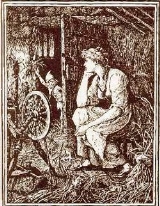
lied to a king, telling him that his daughter could spin straw into gold. The king called for the girl, shut her in a tower room with straw and a spinning wheel
, and demanded that she spin the straw into gold by morning, for three nights, or be executed (other versions have the king threatening to lock her up in a dungeon forever). She had given up all hope, when an impish creature appeared in the room and spun straw into gold for her in return for her necklace, then again the following night for her ring. On the third
night, when she had nothing with which to reward him, the strange creature spun straw into gold for a promise that the girl's first-born child would become his.
The king was so impressed that he married the miller's daughter, but when their first child was born, the imp returned to claim his payment: "Now give me what you promised". The queen was frightened and offered him all the wealth she had if she could keep the child. The imp
refused but finally agreed to give up his claim to the child if the queen could guess his name in three days. At first she failed, but before the final night, her messenger discovered the imp's remote mountain cottage and, unseen, overheard the imp hopping about his fire and singing
. While there are many variations in this song, the 1886 translation by Lucy Crane reads:
However, most American
children today know it as:
(German:
When the imp came to the queen on the third day and she revealed his name, Rumpelstiltskin lost his bargain. In the 1812 edition of the Brothers Grimm tales, Rumpelstiltskin then "ran away angrily, and never came back". The ending was revised in a final 1857 edition to a more gruesome version where Rumpelstiltskin "in his rage drove his right foot so far into the ground that it sank in up to his waist; then in a passion he seized the left foot with both hands and tore himself in two." Other versions have Rumpelstiltskin driving his right foot so far into the ground that he creates a chasm and falls into it, never to be seen again. In the oral version originally collected by the brothers Grimm, Rumpelstiltskin flies out of the window on a cooking ladle
(Heidi Anne Heiner).
(from English Fairy Tales by Joseph Jacobs
), Whuppity Stoorie
in Scotland (from Robert Chambers's Popular Rhymes of Scotland), Gilitrutt in Iceland, Joaidane جعيدان in Arabic (he who talks too much), Khlamushka Хламушка (junker) in Russia
, Rampelnik in Czech Republic, Martinko Klingáč in Slovakia
, Ruidoquedito (meaning "little noise") in South America
, Pancimanci in Hungary
(from A Csodafurulya by Kolozsvari Grandpierre Emil) and Cvilidreta (whine-screamer) in Croatia
, Ootz-li Gootz-li עוּץ-לי גוּץ-לי in Israel
(a compact and rhymy touch to the original sentence and meaning of the story, "He advised me and then turned me into a joke"), Daiku to Oniroku (daiku means "a carpenter", to means "and", and Oniroku is an ogre's name.) 大工と鬼六 in Japan
.
These tales are Aarne-Thompson type 500, The Name of the Helper.
Another of the Grimm fairy tales revolves about a girl trapped by false claims about her spinning abilities: The Three Spinners
. However, the three women who assist that girl do not demand her first born, but that she invite them to her wedding and say that they are relatives of hers. With this more reasonable request, she complies, and is freed from her hated spinning when they tell the king that their hideous looks spring from their endless spinning. In one Italian variant, she must discover their names, as with Rumpelstiltskin, but not for the same reason: she must use their names to invite them, and she has forgotten them.
means literally "little rattle stilt". (A stilt is a post or pole which provides support for a structure.) A rumpelstilt or rumpelstilz was the name of a type of goblin, also called a pophart or poppart that makes noises by rattling posts and rapping on planks. The meaning is similar to rumpelgeist ("rattle ghost") or poltergeist
, a mischievous spirit that clatters and moves household objects. (Other related concepts are mummarts or boggart
s and hobs
that are mischievous household spirits that disguise themselves.)
The earliest known mention of Rumpelstiltskin occurs in Johann Fischart
's Geschichtklitterung, or Gargantua of 1577 (a loose adaptation of Rabelais'
Gargantua and Pantagruel
) which refers to an "amusement" for children named "Rumpele stilt or the Poppart".
For some languages, a name was chosen that comes close in sound to the German name: Rumpelstiltskin in English, Repelsteeltje in Dutch
, and Rumpelstichen in Portuguese
. He is known as Päronskaft in Swedish
(literally "Pear stalk"); the sense of stilt or stalk of the second part is retained.
In Danish, he is known as Rumleskaft (literally "Rumble shank"). In other languages an entirely different and generally meaningless name was selected, such as Barbichu, Broumpristoche, Grigrigredinmenufretin, Outroupistache, Tracassin or Perlimpinpin in various translations to French. Polish translations use Titelitury, Greek translations use Κουτσοκαλιγέρης, Slovak translations use Martinko Klingáč, and Finnish ones Tittelintuure. Italian has Tremotino, Bosnian and Croatian Cvilidreta, and Hebrew (Utzli-Gutzli), a name chosen by the poet Avraham Shlonsky
when using the fairy tale as the basis of a children's play
, now a classic among Hebrew children's plays. In Spain, the character's name is "El enano saltarín" (something like "the leaping midget".)
Fictional character
A character is the representation of a person in a narrative work of art . Derived from the ancient Greek word kharaktêr , the earliest use in English, in this sense, dates from the Restoration, although it became widely used after its appearance in Tom Jones in 1749. From this, the sense of...
and protagonist of a fairy tale
Fairy tale
A fairy tale is a type of short story that typically features such folkloric characters, such as fairies, goblins, elves, trolls, dwarves, giants or gnomes, and usually magic or enchantments. However, only a small number of the stories refer to fairies...
which originated in Germany
Germany
Germany , officially the Federal Republic of Germany , is a federal parliamentary republic in Europe. The country consists of 16 states while the capital and largest city is Berlin. Germany covers an area of 357,021 km2 and has a largely temperate seasonal climate...
(where he is known as Rumpelstilzchen). The tale was collected by the Brothers Grimm
Brothers Grimm
The Brothers Grimm , Jacob Grimm and Wilhelm Grimm , were German academics, linguists, cultural researchers, and authors who collected folklore and published several collections of it as Grimm's Fairy Tales, which became very popular...
, who first published it in the 1812 edition of Children's and Household Tales. It was subsequently revised in later editions.
Plot
In order to make himself appear more important, a millerMiller
A miller usually refers to a person who operates a mill, a machine to grind a cereal crop to make flour. Milling is among the oldest of human occupations. "Miller", "Milne" and other variants are common surnames, as are their equivalents in other languages around the world...
lied to a king, telling him that his daughter could spin straw into gold. The king called for the girl, shut her in a tower room with straw and a spinning wheel
Spinning wheel
A spinning wheel is a device for spinning thread or yarn from natural or synthetic fibers. Spinning wheels appeared in Asia, probably in the 11th century, and very gradually replaced hand spinning with spindle and distaff...
, and demanded that she spin the straw into gold by morning, for three nights, or be executed (other versions have the king threatening to lock her up in a dungeon forever). She had given up all hope, when an impish creature appeared in the room and spun straw into gold for her in return for her necklace, then again the following night for her ring. On the third
Rule of three (writing)
The "rule of three" is a principle in writing that suggests that things that come in threes are inherently funnier, more satisfying, or more effective than other numbers of things. The reader/audience of this form of text is also more likely to consume information if it is written in groups of...
night, when she had nothing with which to reward him, the strange creature spun straw into gold for a promise that the girl's first-born child would become his.
The king was so impressed that he married the miller's daughter, but when their first child was born, the imp returned to claim his payment: "Now give me what you promised". The queen was frightened and offered him all the wealth she had if she could keep the child. The imp
Imp
An imp is a mythological being similar to a fairy or demon, frequently described in folklore and superstition. The word may perhaps derive from the term ympe, used to denote a young grafted tree.-Folklore:...
refused but finally agreed to give up his claim to the child if the queen could guess his name in three days. At first she failed, but before the final night, her messenger discovered the imp's remote mountain cottage and, unseen, overheard the imp hopping about his fire and singing
Singing
Singing is the act of producing musical sounds with the voice, and augments regular speech by the use of both tonality and rhythm. One who sings is called a singer or vocalist. Singers perform music known as songs that can be sung either with or without accompaniment by musical instruments...
. While there are many variations in this song, the 1886 translation by Lucy Crane reads:
- Today do I bake, to-morrow I brew,
- The day after that the queen's child comes in;
- And oh! I am glad that nobody knew
- That the name I am called is Rumpelstiltskin!"
However, most American
Americans
The people of the United States, also known as simply Americans or American people, are the inhabitants or citizens of the United States. The United States is a multi-ethnic nation, home to people of different ethnic and national backgrounds...
children today know it as:
- Today I brew, tomorrow I bake;
- And then the Prince child I will take;
- For no one knows my little game
- That Rumpelstiltskin is my name!
(German:
- Heute back ich, morgen brau ich,
- Übermorgen hol ich mir der Königin ihr Kind;
- Ach, wie gut, dass niemand weiß,
- dass ich Rumpelstilzchen heiß")
When the imp came to the queen on the third day and she revealed his name, Rumpelstiltskin lost his bargain. In the 1812 edition of the Brothers Grimm tales, Rumpelstiltskin then "ran away angrily, and never came back". The ending was revised in a final 1857 edition to a more gruesome version where Rumpelstiltskin "in his rage drove his right foot so far into the ground that it sank in up to his waist; then in a passion he seized the left foot with both hands and tore himself in two." Other versions have Rumpelstiltskin driving his right foot so far into the ground that he creates a chasm and falls into it, never to be seen again. In the oral version originally collected by the brothers Grimm, Rumpelstiltskin flies out of the window on a cooking ladle
Ladle (spoon)
A ladle is a type of spoon used to scoop up and serve soup, stew, or other foods. Although designs vary, a typical ladle has a long handle terminating in a deep bowl, frequently with the bowl oriented at an angle to the handle to facilitate lifting liquid out of a pot or other vessel and conveying...
(Heidi Anne Heiner).
Variants
The same story pattern appears in numerous other cultures: Tom Tit Tot in EnglandEngland
England is a country that is part of the United Kingdom. It shares land borders with Scotland to the north and Wales to the west; the Irish Sea is to the north west, the Celtic Sea to the south west, with the North Sea to the east and the English Channel to the south separating it from continental...
(from English Fairy Tales by Joseph Jacobs
Joseph Jacobs
Joseph Jacobs was a folklorist, literary critic and historian. His works included contributions to the Jewish Encyclopaedia, translations of European works, and critical editions of early English literature...
), Whuppity Stoorie
Whuppity Stoorie
Whuppity Stoorie is a Scottish fairy tale collected by Robert Chambers in Popular Rhymes of Scotland. It is Aarne-Thompson type 500, The Name of the Helper...
in Scotland (from Robert Chambers's Popular Rhymes of Scotland), Gilitrutt in Iceland, Joaidane جعيدان in Arabic (he who talks too much), Khlamushka Хламушка (junker) in Russia
Russia
Russia or , officially known as both Russia and the Russian Federation , is a country in northern Eurasia. It is a federal semi-presidential republic, comprising 83 federal subjects...
, Rampelnik in Czech Republic, Martinko Klingáč in Slovakia
Slovakia
The Slovak Republic is a landlocked state in Central Europe. It has a population of over five million and an area of about . Slovakia is bordered by the Czech Republic and Austria to the west, Poland to the north, Ukraine to the east and Hungary to the south...
, Ruidoquedito (meaning "little noise") in South America
South America
South America is a continent situated in the Western Hemisphere, mostly in the Southern Hemisphere, with a relatively small portion in the Northern Hemisphere. The continent is also considered a subcontinent of the Americas. It is bordered on the west by the Pacific Ocean and on the north and east...
, Pancimanci in Hungary
Hungary
Hungary , officially the Republic of Hungary , is a landlocked country in Central Europe. It is situated in the Carpathian Basin and is bordered by Slovakia to the north, Ukraine and Romania to the east, Serbia and Croatia to the south, Slovenia to the southwest and Austria to the west. The...
(from A Csodafurulya by Kolozsvari Grandpierre Emil) and Cvilidreta (whine-screamer) in Croatia
Croatia
Croatia , officially the Republic of Croatia , is a unitary democratic parliamentary republic in Europe at the crossroads of the Mitteleuropa, the Balkans, and the Mediterranean. Its capital and largest city is Zagreb. The country is divided into 20 counties and the city of Zagreb. Croatia covers ...
, Ootz-li Gootz-li עוּץ-לי גוּץ-לי in Israel
Israel
The State of Israel is a parliamentary republic located in the Middle East, along the eastern shore of the Mediterranean Sea...
(a compact and rhymy touch to the original sentence and meaning of the story, "He advised me and then turned me into a joke"), Daiku to Oniroku (daiku means "a carpenter", to means "and", and Oniroku is an ogre's name.) 大工と鬼六 in Japan
Japan
Japan is an island nation in East Asia. Located in the Pacific Ocean, it lies to the east of the Sea of Japan, China, North Korea, South Korea and Russia, stretching from the Sea of Okhotsk in the north to the East China Sea and Taiwan in the south...
.
These tales are Aarne-Thompson type 500, The Name of the Helper.
Another of the Grimm fairy tales revolves about a girl trapped by false claims about her spinning abilities: The Three Spinners
The Three Spinners
The Three Spinners is a German fairy tale collected by the Brothers Grimm. It is tale no 14 and Aarne-Thompson type 501. It is widespread throughout Europe.It has obvious parallels to Rumpelstiltskin, and obvious differences, so that they are often compared....
. However, the three women who assist that girl do not demand her first born, but that she invite them to her wedding and say that they are relatives of hers. With this more reasonable request, she complies, and is freed from her hated spinning when they tell the king that their hideous looks spring from their endless spinning. In one Italian variant, she must discover their names, as with Rumpelstiltskin, but not for the same reason: she must use their names to invite them, and she has forgotten them.
Name origins
The name Rumpelstilzchen in GermanGerman language
German is a West Germanic language, related to and classified alongside English and Dutch. With an estimated 90 – 98 million native speakers, German is one of the world's major languages and is the most widely-spoken first language in the European Union....
means literally "little rattle stilt". (A stilt is a post or pole which provides support for a structure.) A rumpelstilt or rumpelstilz was the name of a type of goblin, also called a pophart or poppart that makes noises by rattling posts and rapping on planks. The meaning is similar to rumpelgeist ("rattle ghost") or poltergeist
Poltergeist
A poltergeist is a paranormal phenomenon which consists of events alluding to the manifestation of an imperceptible entity. Such manifestation typically includes inanimate objects moving or being thrown about, sentient noises and, on some occasions, physical attacks on those witnessing the...
, a mischievous spirit that clatters and moves household objects. (Other related concepts are mummarts or boggart
Boggart
In Englishfolklore, a boggart is a household fairy which causes things to disappear, milk to sour, and dogs to go lame. Always malevolent, the boggart will follow its family wherever they flee...
s and hobs
Hob (folklore)
A hob is a type of small mythological household spirit found in the north and midlands of England, but especially on the Anglo-Scottish border, according to traditional folklore of those regions. They could live inside the house or outdoors. They are said to work in farmyards and thus could be...
that are mischievous household spirits that disguise themselves.)
The earliest known mention of Rumpelstiltskin occurs in Johann Fischart
Johann Fischart
Johann Fischart was a German satirist and publicist.-Biography:Fischart was born, probably, at Strasbourg , in or about the year 1545, and was educated at Worms in the house of Kaspar Scheid, whom in the preface to his Eulenspiegel he mentions as his cousin and preceptor...
's Geschichtklitterung, or Gargantua of 1577 (a loose adaptation of Rabelais'
François Rabelais
François Rabelais was a major French Renaissance writer, doctor, Renaissance humanist, monk and Greek scholar. He has historically been regarded as a writer of fantasy, satire, the grotesque, bawdy jokes and songs...
Gargantua and Pantagruel
Gargantua and Pantagruel
The Life of Gargantua and of Pantagruel is a connected series of five novels written in the 16th century by François Rabelais. It is the story of two giants, a father and his son and their adventures, written in an amusing, extravagant, satirical vein...
) which refers to an "amusement" for children named "Rumpele stilt or the Poppart".
Names used in translations
Translations of the original Grimm fairy tale (KHM 55) into various languages have generally substituted different names for the dwarf, whose name is Rumpelstilzchen in the original.For some languages, a name was chosen that comes close in sound to the German name: Rumpelstiltskin in English, Repelsteeltje in Dutch
Dutch language
Dutch is a West Germanic language and the native language of the majority of the population of the Netherlands, Belgium, and Suriname, the three member states of the Dutch Language Union. Most speakers live in the European Union, where it is a first language for about 23 million and a second...
, and Rumpelstichen in Portuguese
Portuguese language
Portuguese is a Romance language that arose in the medieval Kingdom of Galicia, nowadays Galicia and Northern Portugal. The southern part of the Kingdom of Galicia became independent as the County of Portugal in 1095...
. He is known as Päronskaft in Swedish
Swedish language
Swedish is a North Germanic language, spoken by approximately 10 million people, predominantly in Sweden and parts of Finland, especially along its coast and on the Åland islands. It is largely mutually intelligible with Norwegian and Danish...
(literally "Pear stalk"); the sense of stilt or stalk of the second part is retained.
In Danish, he is known as Rumleskaft (literally "Rumble shank"). In other languages an entirely different and generally meaningless name was selected, such as Barbichu, Broumpristoche, Grigrigredinmenufretin, Outroupistache, Tracassin or Perlimpinpin in various translations to French. Polish translations use Titelitury, Greek translations use Κουτσοκαλιγέρης, Slovak translations use Martinko Klingáč, and Finnish ones Tittelintuure. Italian has Tremotino, Bosnian and Croatian Cvilidreta, and Hebrew (Utzli-Gutzli), a name chosen by the poet Avraham Shlonsky
Avraham Shlonsky
Avraham Shlonsky was a significant and dynamic Israeli poet and editor born in Russian Empire.He was influential in the development of modern Hebrew and its literature in Israel through his many acclaimed translations of literary classics, particularly from Russian, as well as his own original...
when using the fairy tale as the basis of a children's play
Play (theatre)
A play is a form of literature written by a playwright, usually consisting of scripted dialogue between characters, intended for theatrical performance rather than just reading. There are rare dramatists, notably George Bernard Shaw, who have had little preference whether their plays were performed...
, now a classic among Hebrew children's plays. In Spain, the character's name is "El enano saltarín" (something like "the leaping midget".)
In literature
- In written fiction, Vivian Vande VeldeVivian Vande VeldeVivian Vande Velde is an American author who writes books primarily aimed at young adults. She currently resides in Rochester, New York....
's book The Rumpelstiltskin Problem presents a handful of alternative versions of the tale in a humorous attempt to address perceived plot holePlot holeA plot hole, or plothole, is a gap or inconsistency in a storyline that goes against the flow of logic established by the story's plot, or constitutes a blatant omission of relevant information regarding the plot...
s in the story. - Rumpelstiltskin has also appeared in The Witch's Boy by Michael Gruber, wherein the character is an unnaturally ugly baby is raised by a witch, who names him Lump when she finds him abandoned in a tree. As a child, he was isolated by the witch to protect him, but when he goes out into the world he becomes consumed by the desire for money and revenge against those who have hurt him. Through a ritual, the witch helps him find his rname (i.e., the name of his soul), Rumpelstiltskin, which he is not to tell anyone for it will give them power over him. His childhood innocence is trialed through the cruelty of the world, giving a more in-depth look into his character.
In music
- The third movement of Robert SchumannRobert SchumannRobert Schumann, sometimes known as Robert Alexander Schumann, was a German composer, aesthete and influential music critic. He is regarded as one of the greatest and most representative composers of the Romantic era....
's MärchenbilderMärchenbilder (Schumann)Märchenbilder or Fairy Tale Pictures, for Viola and Piano, Op. 113, was written by Robert Schumann in March 1851. The work is dedicated to the German violinist and conductor Wilhelm Joseph von Wasielewski...
is inspired by the story - Rumpelstiltskin GrinderRumpelstiltskin GrinderRumpelstiltskin Grinder is a thrash band from the U.S. state of Pennsylvania. They first released their live album "Raped by Bears". After that they released a single song split 7" entitled "Equipment Crusher" with Jumbo's Kill Crane on Red Candle Records. They then released a live CDR entitled...
is a thrash band from Pennsylvania signed to Relapse Records. - StiltskinStiltskinStiltskin is a Scottish post-grunge/rock band, who first achieved widespread popularity in the mid 1990s. Currently, Stiltskin's only original member is vocalist Ray Wilson...
is an English rock bandRock BandRock Band is a music video game developed by Harmonix Music Systems, published by MTV Games and Electronic Arts. It is the first title in the Rock Band series. The PlayStation 3 and Xbox 360 versions were released in the United States on November 20, 2007, while the PlayStation 2 version was...
, notable for the fact that one of its band members, Ray WilsonRay Wilson (musician)Ray Wilson is a Scottish musician, best known as vocalist in the post-grunge band Stiltskin, and in Genesis between 1996 and 1998.Wilson started off in a band called Guaranteed Pure in the early 1990s...
, was a temporarily lead vocalist of world-famous progressive rockProgressive rockProgressive rock is a subgenre of rock music that developed in the late 1960s and early 1970s as part of a "mostly British attempt to elevate rock music to new levels of artistic credibility." John Covach, in Contemporary Music Review, says that many thought it would not just "succeed the pop of...
band GenesisGenesis (band)Genesis are an English rock band that formed in 1967. The band currently comprises the longest-tenured members Tony Banks , Mike Rutherford and Phil Collins . Past members Peter Gabriel , Steve Hackett and Anthony Phillips , also played major roles in the band in its early years...
. - The band MegaherzMegaherzMegaherz is an industrial metal group formed in Munich, Germany in 1993. One of the band's most famous songs is "Gott sein" on their first full album Wer Bist Du? . Megaherz has gone through many changes in musical style since their founding...
released a song named I.M. Rumpelstilzchen on their album Herzwerk IIHerzwerk IIHerzwerk II is the fourth full album from the German band Megaherz. It is the last CD to feature singer Alexx Wesselsky before he left with Noel Pix to form Eisbrecher...
which quotes the original German fairy tale.
On Screen
- In an episode of the TV show Courage the Cowardly DogCourage the Cowardly DogCourage the Cowardly Dog is an American animated television series created by John R. Dilworth for Cartoon Network. Its central plot revolves around a somewhat anthropomorphic dog named Courage who lives with his owners, Muriel and Eustace Bagge, an elderly, married farming couple in the "Middle of...
, Muriel is forced by a short Scotsman to stay in a tower and knit sheep wool into kilts. Courage tries to learn the man’s name after learning that the man won’t let anyone who knows his name (which turns out to be Rumpoldkiltskin) work for him. Muriel later suggests that he legally change his name, suggesting "Rumpelstiltskin", which he thinks is a good idea.
- In the Shrek films:
- The character has also appeared as the antagonist and archenemy in the film Shrek Forever AfterShrek Forever AfterShrek Forever After, taglined as The Final Chapter, is a 2010 animated fantasy-comedy film, and the fourth and final installment in the Shrek film series, produced by DreamWorks Animation. The film was released by Paramount Pictures in cinemas on May 20, 2010 in Russia, and on May 21 in the United...
, voiced by Walt DohrnWalt DohrnWalter "Walt" Dohrn is an American writer, director, artist, actor, animator, musician, screenwriter, and voice artist. He is best known as the voice of Rumpelstiltskin in Shrek Forever After. He also provided the voices of a van student, Xavier, Principal Pynchley, a nanny dwarf, an evil knight,...
, manipulating Shrek into making a wish that would erase Shrek from existence after the ogre indirectly thwarted Rumpelstiltskin's chance to become the ruler of The Kingdom Of Far Far Away ("Far, Far Away"). - Rumpelstiltskin already made an earlier appearance in Shrek the ThirdShrek the ThirdShrek the Third is a 2007 American animated film, and the third film in the Shrek series. It was produced by Jeffrey Katzenberg for DreamWorks Animation, and is distributed by Paramount Pictures. It was released in U.S. theaters on May 18, 2007...
as a member of the gang of fairy tale villains Prince CharmingPrince CharmingPrince Charming is a stock character who appears in a number of fairy tales. He is the prince who comes to rescue of the damsel in distress, and stereotypically, must engage in a quest to liberate her from an evil spell...
rounds up in an attempt to take over Far, Far Away.
- The character has also appeared as the antagonist and archenemy in the film Shrek Forever After
- Rumpelstiltskin
- A 1987 live-action musical film, a fairly direct retelling of the fairy tale, starring Amy IrvingAmy IrvingAmy Davis Irving is an American actress, known for her roles in the films Crossing Delancey, The Fury, Carrie, and Yentl as well as acclaimed roles on Broadway and Off-Broadway. She has been nominated for an Academy Award, two Golden Globes, and has won an Obie award...
as the miller's daughter and Billy BartyBilly BartyBilly Barty was an American film actor.-Biography:Barty, an Italian American, was born William John Bertanzetti in Millsboro, Pennsylvania...
as the title character. - A 1996 Supernatural B-Horror movie where Rumpelstiltskin is trapped as a rock of Jade for 500 years until a woman is compelled to purchase it from an unusual antique shop. The woman makes a wish that her dead husband could come back to life to see their child. Rumpelstiltskin grants her wish, bringing her husband back for one night. Then tries to steal her baby from her mother with an attempt to eat the baby's soul. This movie stars Max GrodenchikMax GrodénchikMax Grodénchik , also known as Michael Grodénchik, is an American stage, film, and television actor, best known for his role as Rom on the television series Star Trek: Deep Space Nine.- Background :...
(as Rumpelstiltskin), and Kim Johnston UlrichKim Johnston UlrichKim Johnston Ulrich is an American actress. She played the role of Ivy Winthrop Crane on NBC's daytime drama Passions, from 1999 to 2008. In 1990, Ulrich appeared on the TV series Wings as Carol, Brian's ex-wife...
(as the mother of the child).
- A 1987 live-action musical film, a fairly direct retelling of the fairy tale, starring Amy Irving
- Rumpelstiltskin is one of the characters in the TV show Once Upon a TimeOnce Upon a Time (TV series)Once Upon a Time is an American fairy tale drama television series that premiered on Sunday October 23, 2011, on ABC. New episodes air Sunday nights at 8:00 pm ET/7:00 pm CT....
from ABC, where he is the pawn-shop owner Mr. Gold in the town of Storybrooke, Maine, where fairy tales are real. He is played by Robert CarlyleRobert CarlyleRobert Carlyle, OBE is a Scottish film and television actor. He is known for a variety of roles including those in Trainspotting, Hamish Macbeth, The Full Monty, The World Is Not Enough, Angela's Ashes, The 51st State, and 28 Weeks Later...
. He also makes a deal with Snow White in the first episode, where his reward is knowing the name of her soon to come daughter. Then, in the fourth episode (A Cinderella Story), he and Cinderella make another deal involving Cinderella's firstborn child. He also makes a deal with JiminyJiminy CricketJiminy Cricket is the Walt Disney version of "The Talking Cricket" , a fictional character created by Carlo Collodi for his children's book Pinocchio, which was adapted into an animated film by Disney in 1940...
that tragically leads to GeppettoMister GeppettoMister Geppetto is a fictional character in the novel The Adventures of Pinocchio by Carlo Collodi. Geppetto is an elderly, impoverished woodcarver and the creator of Pinocchio...
losing his parents.
- During The 10th KingdomThe 10th KingdomThe 10th Kingdom is an American epic fantasy miniseries written by Simon Moore and produced by Britain's Carnival Films, Germany's Babelsberg Film und Fernsehen, and the USA's Hallmark Entertainment...
series, protagonists Tony Lewis and Wolf encounter a blind woodsman who will only give them his magic axe, capable of cutting through anything, if they can guess his name, but will cut Wolf's head off if Tony doesn't guess it in time. Although Tony assumes that the man's name is Rumpelstiltskin due to the similarities between the situations, he is eventually revealed to actually be named Juliet.
- In an episode of the TV show Star Trek: Deep Space NineStar Trek: Deep Space NineStar Trek: Deep Space Nine is a science fiction television series set in the Star Trek universe...
titled "If Wishes Were Horses". Miles O'Brien reads his child the story of Rumpelstiltskin at bed time and then leaves her room. She comes out shortly later to inform her parent that Rumpelstiltskin is in the room with her. Miles O'Brien assumes that it is just her imagination and goes in to the room with her only to discover that Rumpelstiltskin is in fact in her room. At the end of the episode it is revealed that Rumpelstiltskin (along with various other manifestations) were in fact aliens that were studying imagination.
- In the TV show "Shelley Duvall's Faerie Tale Theatre", the second episode aired on 1982 titled "Rumpelstiltskin". In this episode the tale of miller's daughter is told. Hervé VillechaizeHervé VillechaizeHervé Jean-Pierre Villechaize was a French actor who achieved worldwide recognition for his role as Mr. Roarke's assistant, Tattoo, in the television series Fantasy Island...
plays Rumpelstiltskin, Ned BeattyNed BeattyNed Thomas Beatty is an American actor who has appeared in more than 100 films and has been nominated for an Academy Award, two Emmy Awards, an MTV Movie Award for Best Villain and a Golden Globe Award; won a Drama Desk Award....
is the king and Shelley DuvallShelley DuvallShelley Alexis Duvall is an American film and television actress best known for her roles in The Shining, Popeye, Thieves Like Us and 3 Women....
as the miller's daughter.