

Rugby union in Scotland

Encyclopedia
Rugby union
is a popular team sport
in Scotland
. The national side today competes in the annual Six Nations Championship
and the Rugby World Cup
. The first ever international rugby
match was played on March 27, 1871, at Raeburn Place
in Edinburgh
, when Scotland
defeated England
in front of 4,000 people. Professional clubs compete in the Magners League
and the Heineken Cup
, while the Scottish League Championship exists for over 200 amateur and semi-professional clubs, as does a knock-out competition, the Scottish Cup. Today, the governing body, the Scottish Rugby Union
(SRU), is one of only ten first-tier member nations of the IRB
.
(SRU), who operate the national team
.
 There is a long tradition of "football" games in Scotland, and many of these such as Jeddart Ball bear more resemblance to rugby than association football, since passing and carrying by hand play a large part in them. The Kirkwall Ba game
still takes place, and involves scrummaging. Scottish soccer enthusiasts also cite these games as ancestral to their sport.
There is evidence for schoolboys playing a "football" ball game in Aberdeen in 1633 (some references cite 1636) which is notable as an early allusion to what some have considered to be passing the ball. The word "pass" in the most recent translation is derived from "huc percute" (strike it here) and later (strike the ball again) in the original Latin. It is not certain that the ball was being struck between members of the same team. The original word translated as "goal" is , literally meaning the "pillar at each end of the circus course" in a Roman
chariot race. There is a reference to "get hold of the ball before [another player] does" (Praeripe illi pilam si possis agere) suggesting that handling of the ball was allowed. One sentence states in the original 1930 translation "Throw yourself against him" (). It is clear that the game was rough and tackles allowed included the "charging" and pushing/holding of opposing players ("drive that man back" in the original translation, "repelle eum" in original Latin). It has been suggested that this game bears similarities to rugby football
.
Contrary to media reports in 2006 there is no reference to forward passing, game rules, marking players or team formation. These reports described it as "an amazing new discovery" but has actually been well documented in football history literature since the early twentieth century and available on the internet since at least 2000.
The world's oldest continual rugby fixture was first played in 1858 between Merchiston Castle School
and the former pupils of The Edinburgh Academy
.
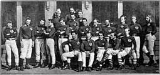
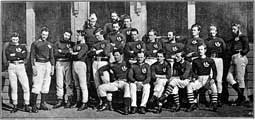
Scotland was responsible for organising the very first rugby international when a side representing England
met the Scottish national side on the cricket field of the Edinburgh Academy at their Raeburn Place
ground in 27 March 1871; Scotland won by one goal. The Scottish Football Union (SFU) - later to be SRU - was founded in 1873 (in the Staff Common Room at The Glasgow Academy) and was to be a founding member of the International Rugby Board
in 1886 with Ireland
and Wales
. (England refused to join until 1890).
Since that time, Scotland have been regular winners of the Calcutta Cup
, the Six Nations Championship
, and have participated in every Rugby World Cup
. Many of the world's most famous players have worn the blue jersey.
Scotland has played a seminal role in the development of rugby, notably in
Rugby sevens
, which were initially conceived by Ned Haig
, a butcher from Melrose
as a fundraising event for his local club in 1883. The first ever officially sanctioned international tournament of rugby occurred at Murrayfield
as part of the "Scottish Rugby Union's celebration of rugby" centenary celebrations in 1973. Due to the success of the format, the ongoing Hong Kong Sevens
was launched three years later. In 1993, the Rugby World Cup Sevens
was launched and the trophy is known as the Melrose Cup in memory of Ned Haig's invention.
In 1924 the SFU changed its name to become the Scottish Rugby Union. International games were played at Inverleith
from 1899 to 1925 when Murrayfield was opened.
 Historically rugby union was an amateur
sport, but the dawn of professionalism changed the way in which the game was structured. The game is now divided into professional and non-professional spheres.
Previously there had been a domestic league that covered the country, the top division of which was essentially the elite of club rugby in Scotland. This league was established in the early 1970s to replace the complicated "unofficial championship" that had been competed for previously. Starting in 1973-74 season, the clubs were organised into a league of six divisions - what today comprises the Scottish Premiership and National League elements of the League Championship. Originally, below the six divisions (but not connected by promotion or relegation) were a series of District Leagues, covering smaller geographical areas, organised by District Unions and sometimes involving 2nd XVs. Over a period of time, these District divisions have been reformed and integrated into the Scottish rugby union system
meaning that today, only four clubs don't have their first XVs in the interconnected league structure.
The entire system is currently sponsored by the Royal Bank of Scotland
(or RBS), making it known as the RBS League Championship. This league contains Scottish rugby union's traditional big name clubs, such as Melrose RFC
and Hawick RFC
, as well as major city clubs such as Boroughmuir RFC
, Heriots RFC
and Watsonians RFC
from Edinburgh, and Glasgow Hawks
from Glasgow who were formed from an amalgamation of clubs in the 1990s.
However, with the introduction of the league system in the 1970s, and the resulting increase in competitiveness and standard of play, most of these clubs have had to loosen their participation criteria to include non ex-pupils, although in most cases the clubs squads do still comprise a large proportion of individuals with connections to the schools. Often the clubs will be part-financed, and their grounds maintained or even owned, by the schools themselves.
Amalgamations of clubs are also reasonably frequent, and when this occurs the clubs often combine names, as in Hillhead/Jordanhill RFC
, Hillfoots/Alloa RFC or Waysiders/Drumpellier RFC.
, which was formed in 1901. The Border League does not take part in the pyramid structure of the National League, but all its clubs participate in it (and thus the Border League is now effectively a supplementary competition). Two small 'independent' leagues remain outside the system, the Highland Alliance League
and the Grampian Alliance League
but they have only four clubs between them (the remaining membership being 2nd XVs of clubs in the League Championship) and are not likely to remain in existence for much longer.
Aside from the schools, the other 'traditional powerhouse' of rugby in Scotland was the universities, and to this day the Scottish universities have their own league system
independent of the BUCS system which covers the rest of Great Britain. However, the BUCS Scottish Conference comprises divisions of 4 or 5 teams, and therefore not many fixtures each season, so unofficial Saturday University Leagues are organised (somewhat informally) between the universities. As well as havin their own leagues the universities often compete in the SRU league structure and cup competitions to a high standard, most notably in 2007/08 Aberdeen University Rugby Football Club
became the first university side to make the SHE SRU finals day winning the Plate competition. The significance of the universities to the history of the SRU is evident when it is noted that four of the oldest 17 SRU affiliated clubs are university teams.
Due to the social and amateur nature of the game, most clubs try to run as many teams as possible so that all their players get games on most weekends, and therefore a large system of what are effectively reserve leagues operate. Known as 2nd XV, 3rd XV, 4th XV etc. depending on the quality of the players making up each team, their competitive activities were formally all supervised by The Scottish 2nd XV League
- however in recent years disputes and breakaways have led to the formation of independent 2nd XV leagues in the Scottish Borders
and in and around Edinburgh
.
See University Leagues in Scotland
and 2nd XV Leagues in Scotland
for details.
created for clubs across Europe, the SRU decided that the existing clubs operating in the Scottish leagues were not competitive enough. They were predominantly amateur, or at best paid small wages; they had low supports and small old-fashioned venues; and the quality of their play was, by the nature of these factors, comparatively low versus new professional clubs and super-teams in other countries. As a rule their players trained only two nights a week.
After a short spell using District teams (effectively select teams drawing together the best amateur players from clubs in a given area), the SRU decided to create professional clubs to compete in the Celtic League
, a competition which grew out of a Welsh-Scottish league (and for a time had a cup competition, the Celtic Cup. It is now known as the Magners League and consists of Scottish, Welsh and Irish sides. The aim of creating these 'pro-teams' or 'super-teams' was ensure that Scotland had fairly competitive sides operating in the European competitions, the Heineken Cup
and European Challenge Cup
(as well as the European Shield
during its short existence), and to drive up standards of rugby in the country.
Originally, before the Celtic League
started, the SRU created four pro-teams, based roughly on the old districts: the Border Reivers
based in Galashiels (with occasional matches elsewhere), the Caledonia Reds
based in Aberdeen and Perth, Edinburgh and Glasgow
.
they were amalgamated into Edinburgh Reivers and Glasgow Caledonian Reds
playing in Edinburgh and Glasgow respectively, and later renamed simply Edinburgh and Glasgow
.
After a few seasons with two teams, the SRU then reformed a Borders team, initially known as Border Reivers
, then renamed The Borders
, before reverting to Border Reivers
again. At the time of this last change the other two sides were renamed Edinburgh Gunners and Glasgow Warriors
. However, the SRU's extreme financial difficulties (they were, and still are, over £20M in debt) forced yet another re-think (especially when the Border Reivers were rooted to the bottom of the Celtic League
season after season) - at the end of season 2005-2006, Edinburgh Gunners were sold to a private consortium led by Alex Carruthers, and renamed Edinburgh Rugby.
, leaving Scotland with two pro-teams, one under private and one under SRU control.
However, the relationship with Alex Carruthers and his ERC Group which owned Edinburgh Rugby proved to be very uncomfortable. The SRU defaulted in a number of payments of competition prize money to ERC, requiring the consortium to invest their own additional funds, and the SRU refused to share bar takings from Edinburgh Rugby matches at Murrayfield with ERC - at the same time, the SRU was unhappy about the signing policy and the unavailability of players for international team training.
Following a bitter dispute in the press and media during 2007, in which legal action was started, and for a time Edinburgh Rugby was banned from participating in matches, the SRU agreed to buy back Edinburgh Rugby from Alex Carruthers. This caused much unrest in the Scottish Borders, as their team had been wound up only months before, when the SRU insisted it couldn't finance two pro-teams on its own.
The SRU announced shortly after its buy-back that it intends to re-name Edinburgh Rugby as Edinburgh RFC at some point in the future.
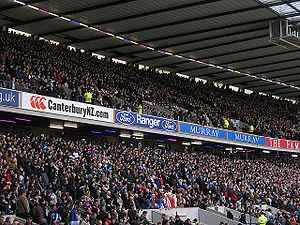 Rugby union
is not the national sport
in Scotland
, being far behind football. It is most popular in the Borders region
where it is played widely, although even here ground is being lost to football with professionalism and migration contributing to the challenges facing the game . In the rest of the country rugby tends to be played mainly by private schools.
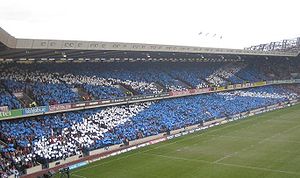
Whilst attendances at club matches in Scotland are fairly poor, the national team draws a sizeable crowd to Murrayfield
for Six Nations
matches. Some traditionalists claim that in recent years the national rugby union team has become a focal point for football-type sporting nationalism.
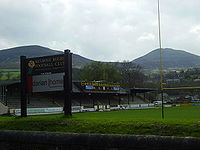
Aside from Murrayfield, there are few major rugby stadiums in Scotland. Many clubs in the Scottish Borders
have grandstands and city sides in Edinburgh and Glasgow also have seated, covered stands.
as of September 2010, Scotland has 241 rugby union clubs; 343 referees; 7,556 pre-teen male players; 13,402 teen male players; 10,556 senior male players (total male players 31,514) as well as 1,303 (total) female players.http://www.irb.com/unions/union=11000004/index.html However, many more pre teen players are not registered with the SRU
.
region. The towns of Hawick
, Galashiels
, Jedburgh
and Selkirk have produced many international players.
. They usually play their home matches at Murrayfield Stadium
in the West End of Edinburgh
.
Scotland contest the Calcutta Cup
with England as part of the Six Nations Championship
.
Every four years the British and Irish Lions
go on tour with players from Scotland as well as England, Ireland and Wales. Scottish players are also regularly selected to represent Barbarian F.C.
.
:
Also Leslie Balfour-Melville
(1854–1937), as an all-rounder, since he played many other sports.
Rugby union
Rugby union, often simply referred to as rugby, is a full contact team sport which originated in England in the early 19th century. One of the two codes of rugby football, it is based on running with the ball in hand...
is a popular team sport
Team sport
A team sport includes any sport which involves players working together towards a shared objective. A team sport is an activity in which a group of individuals, on the same team, work together to accomplish an ultimate goal which is usually to win. This can be done in a number of ways such as...
in Scotland
Scotland
Scotland is a country that is part of the United Kingdom. Occupying the northern third of the island of Great Britain, it shares a border with England to the south and is bounded by the North Sea to the east, the Atlantic Ocean to the north and west, and the North Channel and Irish Sea to the...
. The national side today competes in the annual Six Nations Championship
Six Nations Championship
The Six Nations Championship is an annual international rugby union competition involving six European sides: England, France, Ireland, Italy, Scotland and Wales....
and the Rugby World Cup
Rugby World Cup
The Rugby World Cup is an international rugby union competition organised by the International Rugby Board and held every four years since 1987....
. The first ever international rugby
Rugby union
Rugby union, often simply referred to as rugby, is a full contact team sport which originated in England in the early 19th century. One of the two codes of rugby football, it is based on running with the ball in hand...
match was played on March 27, 1871, at Raeburn Place
Raeburn Place
Raeburn Place is the main street of Stockbridge, Edinburgh, and the name of the playing fields there.-Rugby:The first international rugby football game was played on the playing fields at Raeburn Place on 27 March 1871 between England and Scotland. It was won by Scotland, though England got revenge...
in Edinburgh
Edinburgh
Edinburgh is the capital city of Scotland, the second largest city in Scotland, and the eighth most populous in the United Kingdom. The City of Edinburgh Council governs one of Scotland's 32 local government council areas. The council area includes urban Edinburgh and a rural area...
, when Scotland
Scotland
Scotland is a country that is part of the United Kingdom. Occupying the northern third of the island of Great Britain, it shares a border with England to the south and is bounded by the North Sea to the east, the Atlantic Ocean to the north and west, and the North Channel and Irish Sea to the...
defeated England
England
England is a country that is part of the United Kingdom. It shares land borders with Scotland to the north and Wales to the west; the Irish Sea is to the north west, the Celtic Sea to the south west, with the North Sea to the east and the English Channel to the south separating it from continental...
in front of 4,000 people. Professional clubs compete in the Magners League
Celtic League (rugby union)
The Celtic League is an annual rugby union competition involving professional sides from Ireland, Italy, Scotland and Wales....
and the Heineken Cup
Heineken Cup
The Heineken Cup is one of two annual rugby union competitions organised by European Rugby Cup involving leading club, regional and provincial teams from the six International Rugby Board countries in Europe whose national teams compete in the Six Nations Championship: England, France, Ireland,...
, while the Scottish League Championship exists for over 200 amateur and semi-professional clubs, as does a knock-out competition, the Scottish Cup. Today, the governing body, the Scottish Rugby Union
Scottish Rugby Union
The Scottish Rugby Union is the governing body of rugby union in Scotland. It is the second oldest Rugby Union, having been founded in 1873, as the Scottish Football Union.-History:...
(SRU), is one of only ten first-tier member nations of the IRB
International Rugby Board
The International Rugby Board is the governing body for the sport of rugby union. It was founded in 1886 as the International Rugby Football Board by the unions of Scotland, Wales and Ireland. England refused to join until 1890. The International Rugby Football Board changed its name to the...
.
Governing body
The governing body of the game in Scotland is the Scottish Rugby UnionScottish Rugby Union
The Scottish Rugby Union is the governing body of rugby union in Scotland. It is the second oldest Rugby Union, having been founded in 1873, as the Scottish Football Union.-History:...
(SRU), who operate the national team
Scotland national rugby union team
The Scotland national rugby union team represent Scotland in international rugby union. Rugby union in Scotland is administered by the Scottish Rugby Union. The Scotland rugby union team is currently ranked eighth in the IRB World Rankings as of 19 September 2011...
.
History
Kirkwall Ba game
The Kirkwall Ba Game is one of the main annual events held in the town of Kirkwall, in Orkney, Scotland. It is one of a number of Ba Games played in the streets of towns around Scotland; these are examples of traditional football games which are still played in towns in the United Kingdom and...
still takes place, and involves scrummaging. Scottish soccer enthusiasts also cite these games as ancestral to their sport.
There is evidence for schoolboys playing a "football" ball game in Aberdeen in 1633 (some references cite 1636) which is notable as an early allusion to what some have considered to be passing the ball. The word "pass" in the most recent translation is derived from "huc percute" (strike it here) and later (strike the ball again) in the original Latin. It is not certain that the ball was being struck between members of the same team. The original word translated as "goal" is , literally meaning the "pillar at each end of the circus course" in a Roman
Ancient Rome
Ancient Rome was a thriving civilization that grew on the Italian Peninsula as early as the 8th century BC. Located along the Mediterranean Sea and centered on the city of Rome, it expanded to one of the largest empires in the ancient world....
chariot race. There is a reference to "get hold of the ball before [another player] does" (Praeripe illi pilam si possis agere) suggesting that handling of the ball was allowed. One sentence states in the original 1930 translation "Throw yourself against him" (). It is clear that the game was rough and tackles allowed included the "charging" and pushing/holding of opposing players ("drive that man back" in the original translation, "repelle eum" in original Latin). It has been suggested that this game bears similarities to rugby football
Rugby football
Rugby football is a style of football named after Rugby School in the United Kingdom. It is seen most prominently in two current sports, rugby league and rugby union.-History:...
.
Contrary to media reports in 2006 there is no reference to forward passing, game rules, marking players or team formation. These reports described it as "an amazing new discovery" but has actually been well documented in football history literature since the early twentieth century and available on the internet since at least 2000.
The world's oldest continual rugby fixture was first played in 1858 between Merchiston Castle School
Merchiston Castle School
Merchiston Castle School is an independent school for boys in the village of Colinton in Edinburgh, Scotland. It has about 480 pupils and is open to boys between the ages of 8 and 18 as either boarders or day pupils; day pupils make up 35% of the school....
and the former pupils of The Edinburgh Academy
Edinburgh Academy
The Edinburgh Academy is an independent school which was opened in 1824. The original building, in Henderson Row on the northern fringe of the New Town of Edinburgh, Scotland, is now part of the Senior School...
.
Scotland was responsible for organising the very first rugby international when a side representing England
England national rugby union team
The England national rugby union team represents England in rugby union. They compete in the annual Six Nations Championship with France, Ireland, Scotland, Italy, and Wales. They have won this championship on 26 occasions, 12 times winning the Grand Slam, making them the most successful team in...
met the Scottish national side on the cricket field of the Edinburgh Academy at their Raeburn Place
Raeburn Place
Raeburn Place is the main street of Stockbridge, Edinburgh, and the name of the playing fields there.-Rugby:The first international rugby football game was played on the playing fields at Raeburn Place on 27 March 1871 between England and Scotland. It was won by Scotland, though England got revenge...
ground in 27 March 1871; Scotland won by one goal. The Scottish Football Union (SFU) - later to be SRU - was founded in 1873 (in the Staff Common Room at The Glasgow Academy) and was to be a founding member of the International Rugby Board
International Rugby Board
The International Rugby Board is the governing body for the sport of rugby union. It was founded in 1886 as the International Rugby Football Board by the unions of Scotland, Wales and Ireland. England refused to join until 1890. The International Rugby Football Board changed its name to the...
in 1886 with Ireland
Irish Rugby Football Union
The Irish Rugby Football Union is the body managing rugby union in Ireland. The IRFU has its head office at 10/12 Lansdowne Road and home ground at Aviva Stadium, where Irish rugby union international matches are played...
and Wales
Welsh Rugby Union
The Welsh Rugby Union is the governing body of rugby union in Wales, recognised by the International Rugby Board.The union's patron is Queen Elizabeth II, and her grandson Prince William of Wales became the Vice Royal Patron of the Welsh Rugby Union as of February 2007.-History:The roots of the...
. (England refused to join until 1890).
Since that time, Scotland have been regular winners of the Calcutta Cup
Calcutta Cup
The Calcutta Cup is a rugby union trophy awarded to the winner of the annual Six Nations Championship match between England and Scotland. It is currently England's since the 2009 Six Nations Championship....
, the Six Nations Championship
Six Nations Championship
The Six Nations Championship is an annual international rugby union competition involving six European sides: England, France, Ireland, Italy, Scotland and Wales....
, and have participated in every Rugby World Cup
Rugby World Cup
The Rugby World Cup is an international rugby union competition organised by the International Rugby Board and held every four years since 1987....
. Many of the world's most famous players have worn the blue jersey.
Scotland has played a seminal role in the development of rugby, notably in
Rugby sevens
Rugby sevens
Rugby sevens, also known as seven-a-side or VIIs, is a variant of rugby union in which teams are made up of seven players, instead of the usual 15, with shorter matches. Rugby sevens is administered by the International Rugby Board , the body responsible for rugby union worldwide...
, which were initially conceived by Ned Haig
Ned Haig
Ned Haig was a butcher and rugby union player notable for founding the sport of rugby sevens. He moved to Melrose when he was young. There he took up rugby and joined Melrose Rugby Football Club in 1880...
, a butcher from Melrose
Melrose, Scotland
Melrose is a small town and civil parish in the Scottish Borders, historically in Roxburghshire. It is in the Eildon committee area.-Etymology:...
as a fundraising event for his local club in 1883. The first ever officially sanctioned international tournament of rugby occurred at Murrayfield
Murrayfield Stadium
Murrayfield Stadium is a sports stadium located in the west end of Edinburgh, the capital of Scotland. Its all-seater capacity was recently reduced from 67,800 to 67,130 to incorporate the largest permanent "big screen" in the country though it still remains the largest stadium in Scotland and one...
as part of the "Scottish Rugby Union's celebration of rugby" centenary celebrations in 1973. Due to the success of the format, the ongoing Hong Kong Sevens
Hong Kong Sevens
The Hong Kong Sevens is considered the premier tournament on the IRB Sevens World Series in rugby sevens—a variant of rugby union....
was launched three years later. In 1993, the Rugby World Cup Sevens
Rugby World Cup Sevens
The Rugby World Cup Sevens is the premier international Rugby sevens competition. The event is organised by the sport's governing body, the International Rugby Board , and is contested by the men's national sevens teams every four years. The inaugural tournament was held in 1993 in Scotland, the...
was launched and the trophy is known as the Melrose Cup in memory of Ned Haig's invention.
In 1924 the SFU changed its name to become the Scottish Rugby Union. International games were played at Inverleith
Inverleith
Inverleith is an inner suburb in the northern part of Edinburgh, Scotland, on the fringes of the central region of the city. It is an affluent suburb. Its neighbours include Trinity to the north and the New Town to the south, with Canonmills at the south-east and Stockbridge at the south-west...
from 1899 to 1925 when Murrayfield was opened.
Competitions
- See also Scottish rugby union systemScottish rugby union systemThe top level of competition in the Scottish rugby union system is the Celtic League which is a league of professional clubs from Ireland, Scotland and Wales. Scotland currently has two clubs in the Celtic League; Edinburgh Rugby and Glasgow Warriors. They also participate in the Heineken Cup.The...
Amateur
An amateur is generally considered a person attached to a particular pursuit, study, or science, without pay and often without formal training....
sport, but the dawn of professionalism changed the way in which the game was structured. The game is now divided into professional and non-professional spheres.
Previously there had been a domestic league that covered the country, the top division of which was essentially the elite of club rugby in Scotland. This league was established in the early 1970s to replace the complicated "unofficial championship" that had been competed for previously. Starting in 1973-74 season, the clubs were organised into a league of six divisions - what today comprises the Scottish Premiership and National League elements of the League Championship. Originally, below the six divisions (but not connected by promotion or relegation) were a series of District Leagues, covering smaller geographical areas, organised by District Unions and sometimes involving 2nd XVs. Over a period of time, these District divisions have been reformed and integrated into the Scottish rugby union system
Scottish rugby union system
The top level of competition in the Scottish rugby union system is the Celtic League which is a league of professional clubs from Ireland, Scotland and Wales. Scotland currently has two clubs in the Celtic League; Edinburgh Rugby and Glasgow Warriors. They also participate in the Heineken Cup.The...
meaning that today, only four clubs don't have their first XVs in the interconnected league structure.
The entire system is currently sponsored by the Royal Bank of Scotland
Royal Bank of Scotland
The Royal Bank of Scotland Group is a British banking and insurance holding company in which the UK Government holds an 84% stake. This stake is held and managed through UK Financial Investments Limited, whose voting rights are limited to 75% in order for the bank to retain its listing on the...
(or RBS), making it known as the RBS League Championship. This league contains Scottish rugby union's traditional big name clubs, such as Melrose RFC
Melrose RFC
Melrose Rugby Football Club, located in the town of Melrose in the Scottish Borders, is one of the oldest rugby clubs in the world.-History:The club was formed in 1877 and was elected to full membership of the Scottish Rugby Union in 1880...
and Hawick RFC
Hawick RFC
Hawick Rugby Football Club is a semi-professional rugby union side, currently playing in the Premiership Division One and Border League. The team are based at Mansfield Park at Hawick in the Scottish Borders....
, as well as major city clubs such as Boroughmuir RFC
Boroughmuir RFC
Boroughmuir RFC is a rugby union football club in the Scottish Rugby Union. Founded in 1919 and admitted to the SRU in 1939, it was originally restricted to former pupils of Boroughmuir High School. The badge is derived from Boroughmuir High School and they acquired it in 1913. Although it has lost...
, Heriots RFC
Heriots RFC
Heriot's Rugby Club, also known as Heriot's FP, is one of Scotland's senior rugby football clubs in the Scottish Rugby Union, whose 1st XV play in the Scottish Premier 1 league. The club's home is Goldenacre in Edinburgh...
and Watsonians RFC
Watsonians RFC
Watsonian Football Club is a rugby union club based in Edinburgh and part of the Scottish Rugby Union. The club is connected with George Watson's College as a club for former pupils, but now accepts players who did not attend the school...
from Edinburgh, and Glasgow Hawks
Glasgow Hawks
Glasgow Hawks are an amateur rugby union team in Glasgow, Scotland. They were Premiership Division One champions for 3 consecutive seasons from 2003/04 to 2005/06.-The short history of Glasgow Hawks RFC:...
from Glasgow who were formed from an amalgamation of clubs in the 1990s.
Clubs
Traditionally, rugby clubs were very often formed by universities, ex-pupils of independent schools and large state schools, and many clubs names still to this day include abbreviations such as:- 'High School Former Pupils' (for instance, Dundee HSFP RFC)
- 'Former Pupils' (for instance, Stewart's Melville FP RFC)
- 'Grammar School Former Pupils' (for instance, Aberdeen GSFP RFCAberdeen GSFP RFCAberdeen Grammar School Former Pupils Rugby Football Club is a rugby union club based in Aberdeen, Scotland. They play in the Scottish Premiership division 1.-Notable players:William Dallas Allardice* John Robert Stephen Innes, in 1939 and 1946....
) - 'University' (Aberdeen University Rugby Football ClubAberdeen University Rugby Football ClubAberdeen University Rugby Football Club is a rugby union team at the University of Aberdeen in Scotland.-History:Acknowledged as the equal oldest rugby club in the North East of Scotland, 1871, AURFC has had a long and successful history producing both Scotland and British Lions players...
AURFC)
However, with the introduction of the league system in the 1970s, and the resulting increase in competitiveness and standard of play, most of these clubs have had to loosen their participation criteria to include non ex-pupils, although in most cases the clubs squads do still comprise a large proportion of individuals with connections to the schools. Often the clubs will be part-financed, and their grounds maintained or even owned, by the schools themselves.
Amalgamations of clubs are also reasonably frequent, and when this occurs the clubs often combine names, as in Hillhead/Jordanhill RFC
Hillhead Jordanhill RFC
Hillhead-Jordanhill Rugby Football Club, nicknamed "Hills", is a Premier Two rugby union club who play their home games at Hughenden in the heart of the West End of Glasgow. Despite its name it is not located in either the Hillhead or Jordanhill, although the pre-merger clubs did have historical...
, Hillfoots/Alloa RFC or Waysiders/Drumpellier RFC.
Other leagues
Scotland is also home to the oldest organised rugby union league in the world, the Border LeagueBorder League
For the defunct baseball league, see Border League The Border League, is the oldest established rugby union league in the World, having been formed in 1901...
, which was formed in 1901. The Border League does not take part in the pyramid structure of the National League, but all its clubs participate in it (and thus the Border League is now effectively a supplementary competition). Two small 'independent' leagues remain outside the system, the Highland Alliance League
Highland Alliance League
The Highland Alliance League, is a small rugby union competition participated in by clubs in the far north of Scotland. Together with the Grampian Alliance League, it is one of the few remaining leagues not part of the Scottish rugby union system, and therefore neither it nor its clubs are part of...
and the Grampian Alliance League
Grampian Alliance League
The Grampian Alliance League was a small rugby union competition participated in by clubs in the Grampian region. Together with the Highland Alliance League, it was one of the few remaining leagues not part of the Scottish rugby union system, and therefore neither it nor its clubs were part of the...
but they have only four clubs between them (the remaining membership being 2nd XVs of clubs in the League Championship) and are not likely to remain in existence for much longer.
Aside from the schools, the other 'traditional powerhouse' of rugby in Scotland was the universities, and to this day the Scottish universities have their own league system
League system
A league system is a hierarchy of leagues in a sport, usually with a system of promotion and relegation between consecutive levels of the hierarchy. They are often called pyramids due to their tendency to split into an increasing number of regional divisions the further down the pyramid one descends...
independent of the BUCS system which covers the rest of Great Britain. However, the BUCS Scottish Conference comprises divisions of 4 or 5 teams, and therefore not many fixtures each season, so unofficial Saturday University Leagues are organised (somewhat informally) between the universities. As well as havin their own leagues the universities often compete in the SRU league structure and cup competitions to a high standard, most notably in 2007/08 Aberdeen University Rugby Football Club
Aberdeen University Rugby Football Club
Aberdeen University Rugby Football Club is a rugby union team at the University of Aberdeen in Scotland.-History:Acknowledged as the equal oldest rugby club in the North East of Scotland, 1871, AURFC has had a long and successful history producing both Scotland and British Lions players...
became the first university side to make the SHE SRU finals day winning the Plate competition. The significance of the universities to the history of the SRU is evident when it is noted that four of the oldest 17 SRU affiliated clubs are university teams.
Due to the social and amateur nature of the game, most clubs try to run as many teams as possible so that all their players get games on most weekends, and therefore a large system of what are effectively reserve leagues operate. Known as 2nd XV, 3rd XV, 4th XV etc. depending on the quality of the players making up each team, their competitive activities were formally all supervised by The Scottish 2nd XV League
The Scottish 2nd XV League
The Scottish Reserve League is the largest of the three organisations operating 2nd XV Leagues in Scotland. Originally all 2nd XV rugby union league matches were played under the auspices of the Scottish 2nd XV League, however in recent years a number of breakaways have occurred - clubs in the...
- however in recent years disputes and breakaways have led to the formation of independent 2nd XV leagues in the Scottish Borders
Scottish Borders
The Scottish Borders is one of 32 local government council areas of Scotland. It is bordered by Dumfries and Galloway in the west, South Lanarkshire and West Lothian in the north west, City of Edinburgh, East Lothian, Midlothian to the north; and the non-metropolitan counties of Northumberland...
and in and around Edinburgh
Edinburgh
Edinburgh is the capital city of Scotland, the second largest city in Scotland, and the eighth most populous in the United Kingdom. The City of Edinburgh Council governs one of Scotland's 32 local government council areas. The council area includes urban Edinburgh and a rural area...
.
See University Leagues in Scotland
University Leagues in Scotland
University rugby union in Scotland is predominantly organised through BUCS, the British Universities Sports Association. Unlike in England and Wales, where a pyramid system of 4 regions and a Premier above exists, the Scottish system is separate...
and 2nd XV Leagues in Scotland
2nd XV Leagues in Scotland
There are three organisations operating 2nd XV Leagues in Scotland. These are :* Scottish Reserve League * the Edinburgh & Lothian 2nd XV League * the Borders Championship...
for details.
Changes for the professional era
When professionalism was introduced into rugby union in the 1990s, and the Heineken CupHeineken Cup
The Heineken Cup is one of two annual rugby union competitions organised by European Rugby Cup involving leading club, regional and provincial teams from the six International Rugby Board countries in Europe whose national teams compete in the Six Nations Championship: England, France, Ireland,...
created for clubs across Europe, the SRU decided that the existing clubs operating in the Scottish leagues were not competitive enough. They were predominantly amateur, or at best paid small wages; they had low supports and small old-fashioned venues; and the quality of their play was, by the nature of these factors, comparatively low versus new professional clubs and super-teams in other countries. As a rule their players trained only two nights a week.
After a short spell using District teams (effectively select teams drawing together the best amateur players from clubs in a given area), the SRU decided to create professional clubs to compete in the Celtic League
Celtic League (rugby union)
The Celtic League is an annual rugby union competition involving professional sides from Ireland, Italy, Scotland and Wales....
, a competition which grew out of a Welsh-Scottish league (and for a time had a cup competition, the Celtic Cup. It is now known as the Magners League and consists of Scottish, Welsh and Irish sides. The aim of creating these 'pro-teams' or 'super-teams' was ensure that Scotland had fairly competitive sides operating in the European competitions, the Heineken Cup
Heineken Cup
The Heineken Cup is one of two annual rugby union competitions organised by European Rugby Cup involving leading club, regional and provincial teams from the six International Rugby Board countries in Europe whose national teams compete in the Six Nations Championship: England, France, Ireland,...
and European Challenge Cup
European Challenge Cup
The European Challenge Cup, currently known for sponsorship reasons as the Amlin Challenge Cup, is one of two annual rugby union competitions organised by European Rugby Cup. The cup was known as the Parker Pen Shield from 2001 to 2003 and Parker Pen Challenge Cup from 2003 to 2005. The European...
(as well as the European Shield
European Shield
The European Shield was a reprechage tournament for teams knocked out in the first round of the European Challenge Cup in 2002-03 and 2003-04. The name "European Shield" had previously been used for the now renamed European Challenge Cup....
during its short existence), and to drive up standards of rugby in the country.
Originally, before the Celtic League
Celtic League (rugby union)
The Celtic League is an annual rugby union competition involving professional sides from Ireland, Italy, Scotland and Wales....
started, the SRU created four pro-teams, based roughly on the old districts: the Border Reivers
Border Reivers (Rugby)
Border Reivers, originally known as 'Scottish Borders Rugby' and also known as 'The Borders' were one of four professional rugby union teams in Scotland, alongside Edinburgh, Caledonia Reds and Glasgow Warriors....
based in Galashiels (with occasional matches elsewhere), the Caledonia Reds
Caledonia Reds
Caledonia Reds were a Scottish rugby union district team who participated in the precursor to the Celtic League and in two seasons of the Heineken Cup. They represented one of four districts of Scotland, covering the North and Midlands Caledonia Reds were a Scottish rugby union district team who...
based in Aberdeen and Perth, Edinburgh and Glasgow
Glasgow Warriors
The Glasgow Warriors, formerly Glasgow Rugby, are one of two professional rugby union teams in Scotland, Edinburgh being the other. They play in the RaboDirect Pro12 and their home ground is Firhill Stadium, also the home of Partick Thistle Football Club.-History:Glasgow Rugby were created to...
.
From four teams to two
However these proved a disaster in European competition and for the formation of the Celtic LeagueCeltic League (rugby union)
The Celtic League is an annual rugby union competition involving professional sides from Ireland, Italy, Scotland and Wales....
they were amalgamated into Edinburgh Reivers and Glasgow Caledonian Reds
Glasgow Warriors
The Glasgow Warriors, formerly Glasgow Rugby, are one of two professional rugby union teams in Scotland, Edinburgh being the other. They play in the RaboDirect Pro12 and their home ground is Firhill Stadium, also the home of Partick Thistle Football Club.-History:Glasgow Rugby were created to...
playing in Edinburgh and Glasgow respectively, and later renamed simply Edinburgh and Glasgow
Glasgow Warriors
The Glasgow Warriors, formerly Glasgow Rugby, are one of two professional rugby union teams in Scotland, Edinburgh being the other. They play in the RaboDirect Pro12 and their home ground is Firhill Stadium, also the home of Partick Thistle Football Club.-History:Glasgow Rugby were created to...
.
After a few seasons with two teams, the SRU then reformed a Borders team, initially known as Border Reivers
Border Reivers (Rugby)
Border Reivers, originally known as 'Scottish Borders Rugby' and also known as 'The Borders' were one of four professional rugby union teams in Scotland, alongside Edinburgh, Caledonia Reds and Glasgow Warriors....
, then renamed The Borders
Border Reivers (Rugby)
Border Reivers, originally known as 'Scottish Borders Rugby' and also known as 'The Borders' were one of four professional rugby union teams in Scotland, alongside Edinburgh, Caledonia Reds and Glasgow Warriors....
, before reverting to Border Reivers
Border Reivers (Rugby)
Border Reivers, originally known as 'Scottish Borders Rugby' and also known as 'The Borders' were one of four professional rugby union teams in Scotland, alongside Edinburgh, Caledonia Reds and Glasgow Warriors....
again. At the time of this last change the other two sides were renamed Edinburgh Gunners and Glasgow Warriors
Glasgow Warriors
The Glasgow Warriors, formerly Glasgow Rugby, are one of two professional rugby union teams in Scotland, Edinburgh being the other. They play in the RaboDirect Pro12 and their home ground is Firhill Stadium, also the home of Partick Thistle Football Club.-History:Glasgow Rugby were created to...
. However, the SRU's extreme financial difficulties (they were, and still are, over £20M in debt) forced yet another re-think (especially when the Border Reivers were rooted to the bottom of the Celtic League
Celtic League (rugby union)
The Celtic League is an annual rugby union competition involving professional sides from Ireland, Italy, Scotland and Wales....
season after season) - at the end of season 2005-2006, Edinburgh Gunners were sold to a private consortium led by Alex Carruthers, and renamed Edinburgh Rugby.
Continuing difficulties
However, even with the running costs of two instead of three teams, the SRU were still struggling. Many attempts were made to find private backers for Glasgow or the Borders (although the only investors interested in the latter wanted to move it to Falkirk, Stirling or Aberdeen) but in the end neither of the teams could be sold. As a result, at the end of 2006-2007 the SRU yet again disbanded the Border ReiversBorder Reivers (Rugby)
Border Reivers, originally known as 'Scottish Borders Rugby' and also known as 'The Borders' were one of four professional rugby union teams in Scotland, alongside Edinburgh, Caledonia Reds and Glasgow Warriors....
, leaving Scotland with two pro-teams, one under private and one under SRU control.
However, the relationship with Alex Carruthers and his ERC Group which owned Edinburgh Rugby proved to be very uncomfortable. The SRU defaulted in a number of payments of competition prize money to ERC, requiring the consortium to invest their own additional funds, and the SRU refused to share bar takings from Edinburgh Rugby matches at Murrayfield with ERC - at the same time, the SRU was unhappy about the signing policy and the unavailability of players for international team training.
Following a bitter dispute in the press and media during 2007, in which legal action was started, and for a time Edinburgh Rugby was banned from participating in matches, the SRU agreed to buy back Edinburgh Rugby from Alex Carruthers. This caused much unrest in the Scottish Borders, as their team had been wound up only months before, when the SRU insisted it couldn't finance two pro-teams on its own.
The SRU announced shortly after its buy-back that it intends to re-name Edinburgh Rugby as Edinburgh RFC at some point in the future.
Popularity
Rugby union
Rugby union, often simply referred to as rugby, is a full contact team sport which originated in England in the early 19th century. One of the two codes of rugby football, it is based on running with the ball in hand...
is not the national sport
National sport
A national sport or national pastime is a sport or game that is considered to be an intrinsic part of the culture of a nation. Some sports are de facto national sports, as baseball is in the U.S., while others are de jure as lacrosse and ice hockey are in Canada.-De jure national sports:-De facto...
in Scotland
Scotland
Scotland is a country that is part of the United Kingdom. Occupying the northern third of the island of Great Britain, it shares a border with England to the south and is bounded by the North Sea to the east, the Atlantic Ocean to the north and west, and the North Channel and Irish Sea to the...
, being far behind football. It is most popular in the Borders region
Scottish Borders
The Scottish Borders is one of 32 local government council areas of Scotland. It is bordered by Dumfries and Galloway in the west, South Lanarkshire and West Lothian in the north west, City of Edinburgh, East Lothian, Midlothian to the north; and the non-metropolitan counties of Northumberland...
where it is played widely, although even here ground is being lost to football with professionalism and migration contributing to the challenges facing the game . In the rest of the country rugby tends to be played mainly by private schools.
Whilst attendances at club matches in Scotland are fairly poor, the national team draws a sizeable crowd to Murrayfield
Murrayfield Stadium
Murrayfield Stadium is a sports stadium located in the west end of Edinburgh, the capital of Scotland. Its all-seater capacity was recently reduced from 67,800 to 67,130 to incorporate the largest permanent "big screen" in the country though it still remains the largest stadium in Scotland and one...
for Six Nations
Six Nations
Six Nations may refer to:* Iroquois Confederacy, a group of First Nations/Native American people that originally consisted of five nations, later six...
matches. Some traditionalists claim that in recent years the national rugby union team has become a focal point for football-type sporting nationalism.
Aside from Murrayfield, there are few major rugby stadiums in Scotland. Many clubs in the Scottish Borders
Scottish Borders
The Scottish Borders is one of 32 local government council areas of Scotland. It is bordered by Dumfries and Galloway in the west, South Lanarkshire and West Lothian in the north west, City of Edinburgh, East Lothian, Midlothian to the north; and the non-metropolitan counties of Northumberland...
have grandstands and city sides in Edinburgh and Glasgow also have seated, covered stands.
Statistics
According to the International Rugby BoardInternational Rugby Board
The International Rugby Board is the governing body for the sport of rugby union. It was founded in 1886 as the International Rugby Football Board by the unions of Scotland, Wales and Ireland. England refused to join until 1890. The International Rugby Football Board changed its name to the...
as of September 2010, Scotland has 241 rugby union clubs; 343 referees; 7,556 pre-teen male players; 13,402 teen male players; 10,556 senior male players (total male players 31,514) as well as 1,303 (total) female players.http://www.irb.com/unions/union=11000004/index.html However, many more pre teen players are not registered with the SRU
Scottish Rugby Union
The Scottish Rugby Union is the governing body of rugby union in Scotland. It is the second oldest Rugby Union, having been founded in 1873, as the Scottish Football Union.-History:...
.
Demographics
Rugby union is particularly popular in the BordersScottish Borders
The Scottish Borders is one of 32 local government council areas of Scotland. It is bordered by Dumfries and Galloway in the west, South Lanarkshire and West Lothian in the north west, City of Edinburgh, East Lothian, Midlothian to the north; and the non-metropolitan counties of Northumberland...
region. The towns of Hawick
Hawick
Hawick is a town in the Scottish Borders of south east Scotland. It is south-west of Jedburgh and south-southeast of Selkirk. It is one of the farthest towns from the sea in Scotland, in the heart of Teviotdale, and the biggest town in the former county of Roxburghshire. Hawick's architecture is...
, Galashiels
Galashiels
Galashiels is a burgh in the Scottish Borders, on the Gala Water river. The name is often shortened to "Gala" .Galashiels is a major commercial centre for the Scottish Borders...
, Jedburgh
Jedburgh
Jedburgh is a town and former royal burgh in the Scottish Borders and historically in Roxburghshire.-Location:Jedburgh lies on the Jed Water, a tributary of the River Teviot, it is only ten miles from the border with England and is dominated by the substantial ruins of Jedburgh Abbey...
and Selkirk have produced many international players.
The national team
The first international rugby union match in the world was played between England and Scotland in Edinburgh in 1871. Scotland won 4-1. The national side is considered by the IRB to belong in the top tier of nations, although they are not as competitive as the elite sides such as New Zealand or South AfricaSouth Africa national rugby union team
The South African national rugby union team are 2009 British and Irish Lions Series winners. They are currently ranked as the fourth best team in the IRB World Rankings and were named 2008 World Team of the Year at the prestigious Laureus World Sports Awards.Although South Africa was instrumental...
. They usually play their home matches at Murrayfield Stadium
Murrayfield Stadium
Murrayfield Stadium is a sports stadium located in the west end of Edinburgh, the capital of Scotland. Its all-seater capacity was recently reduced from 67,800 to 67,130 to incorporate the largest permanent "big screen" in the country though it still remains the largest stadium in Scotland and one...
in the West End of Edinburgh
Edinburgh
Edinburgh is the capital city of Scotland, the second largest city in Scotland, and the eighth most populous in the United Kingdom. The City of Edinburgh Council governs one of Scotland's 32 local government council areas. The council area includes urban Edinburgh and a rural area...
.
Scotland contest the Calcutta Cup
Calcutta Cup
The Calcutta Cup is a rugby union trophy awarded to the winner of the annual Six Nations Championship match between England and Scotland. It is currently England's since the 2009 Six Nations Championship....
with England as part of the Six Nations Championship
Six Nations Championship
The Six Nations Championship is an annual international rugby union competition involving six European sides: England, France, Ireland, Italy, Scotland and Wales....
.
Every four years the British and Irish Lions
British and Irish Lions
The British and Irish Lions is a rugby union team made up of players from England, Scotland, Ireland and Wales...
go on tour with players from Scotland as well as England, Ireland and Wales. Scottish players are also regularly selected to represent Barbarian F.C.
Barbarian F.C.
The Barbarian Football Club, usually referred to as the Barbarians and nicknamed the "Baa-Baas", is an invitational rugby union team based in Britain...
.
Scottish Sports Hall of Fame
The following rugby players have been inducted to the Scottish Sports Hall of FameScottish Sports Hall of Fame
The Scottish Sports Hall of Fame is the national sports hall of fame in Scotland, initiated on St Andrew's Day 2001. It is a joint project organised by sportscotland, the national governmental body for Scottish sport, and the National Museums of Scotland. It is also funded by BBC Scotland and...
:
- Finlay CalderFinlay CalderFinlay Calder is a Scottish former rugby union player.Born in Haddington, East Lothian and educated at Stewart's Melville College, Calder played at open side flanker and won 34 caps representing Scotland from 1986-91. He captained the British Lions tour to Australia in 1989...
- Douglas ElliotDouglas ElliotDouglas Elliot also known as W.I.D. Elliot and Doug Elliot is a former Scottish international rugby union player, who played for . He was capped 29 times for Scotland between 1947-54...
- Gavin HastingsGavin HastingsAndrew Gavin Hastings, OBE is a former Scotland rugby union player. He is frequently considered one of the best, if not the best, rugby player to come out of Scotland. His nickname is "Big Gav".Hastings was born in Edinburgh...
- Andy IrvineAndy Irvine (rugby player)Andrew Robertson "Andy" Irvine MBE is a former President of the Scottish Rugby Union , and a former Scottish international rugby player. He earned fifty one Scottish caps, and scored over 250 points for .-Background:...
- George MacPhersonGeorge MacPhersonGeorge MacPherson also known as GPS MacPherson was a Scottish rugby union footballer who played for Scotland in 26 Tests between 1922 and 1932....
- Mark Morrison
- David SoleDavid SoleDavid Sole is a former Scottish rugby union footballer. He was educated at Blairmore prep school and Glenalmond College, a private school in Perthshire....
- Robert Wilson ShawRobert Wilson ShawRobert Wilson Shaw CBE was a Scottish rugby union footballer who played for Scotland in 19 Tests between 1934 and 1939. Shaw played club for Glasgow High School Former Pupils, and could play in several positions in the backline; including wing, centre and fullback...
- Grahame BudgeGrahame BudgeGrahame Morris Budge was a Scotland rugby player. He played 4 times for Scotland and once for the British Isles against New Zealand....
Also Leslie Balfour-Melville
Leslie Balfour-Melville
Leslie Melville Balfour-Melville , born Leslie Melville Balfour, was an outstanding all-round Scottish amateur sportsman. The finest moment in his sporting career was on 29 July 1882. As captain, opening batsman and wicket-keeper, he led Scotland to victory over Australia at cricket...
(1854–1937), as an all-rounder, since he played many other sports.
See also
- Sport in ScotlandSport in ScotlandSport plays a central role in Scottish culture. The temperate, oceanic climate has played a key part in the evolution of sport in Scotland, with all-weather sports like association football, rugby union and golf dominating the national sporting consciousness...
- Sport in the United KingdomSport in the United KingdomThe United Kingdom has given birth to a range of major international sports including: Association football, rugby , cricket, golf, tennis, badminton, squash, rounders, hockey, boxing, snooker, billiards and curling...
- Rugby league in ScotlandRugby league in ScotlandRugby league is comparatively minor sport in Scotland, dwarfed by the popularity of association football, and to a lesser extent sports such as rugby union, curling and shinty...
External links
- Sevens Profile on UR7s.com
- Scottish Rugby Union - the official site of Scottish Rugby
- Magners League official site
- Edinburgh Sevens
- Try and Try Again
Media
- Rugby on The ScotsmanThe ScotsmanThe Scotsman is a British newspaper, published in Edinburgh.As of August 2011 it had an audited circulation of 38,423, down from about 100,000 in the 1980s....
website. - Rugby on The Glasgow Herald website
- Rugby on The Press and Journal website
- Rugby news on the Daily RecordDaily Record (Scotland)The Daily Record is a Scottish tabloid newspaper based in Glasgow. It had been the best-selling daily paper in Scotland for many years with a paid circulation in August 2011 of 307,794 . It is now outsold by its arch-rival the Scottish Sun which in September 2010 had a circulation of 339,586 in...
website. - BBC Scotland rugby pages
- Scottish Television (ITV) rugby pages
- Scottish rugby union news from Planet Rugby
Printed sources
- Bath, Richard (ed.) The Complete Book of Rugby (Seven Oaks Ltd, 1997 ISBN 1 86200 013 3)
- Richards, Huw A Game for Hooligans: The History of Rugby Union (Mainstream PublishingMainstream PublishingMainstream Publishing is a publishing company in Edinburgh, Scotland, founded in 1978. It is associated with the Random House Group, who bought Mainstream in 2005....
, EdinburghEdinburghEdinburgh is the capital city of Scotland, the second largest city in Scotland, and the eighth most populous in the United Kingdom. The City of Edinburgh Council governs one of Scotland's 32 local government council areas. The council area includes urban Edinburgh and a rural area...
, 2007, ISBN 9781845962555)
Electronic
- http://www.irb.com/unions/union=11000004/index.html Scottish statistics from the IRB]