

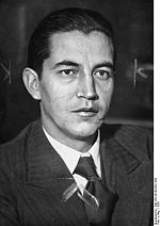
Rudolf Diels

Encyclopedia
Germany
Germany , officially the Federal Republic of Germany , is a federal parliamentary republic in Europe. The country consists of 16 states while the capital and largest city is Berlin. Germany covers an area of 357,021 km2 and has a largely temperate seasonal climate...
politician and SS
Schutzstaffel
The Schutzstaffel |Sig runes]]) was a major paramilitary organization under Adolf Hitler and the Nazi Party. Built upon the Nazi ideology, the SS under Heinrich Himmler's command was responsible for many of the crimes against humanity during World War II...
-Oberführer
Oberführer
Oberführer was an early paramilitary rank of the Nazi Party dating back to 1921. Translated as “Senior Leader”, an Oberführer was typically a Nazi Party member in charge of a group of paramilitary units in a particular geographical region...
. A protégé of Hermann Göring
Hermann Göring
Hermann Wilhelm Göring, was a German politician, military leader, and a leading member of the Nazi Party. He was a veteran of World War I as an ace fighter pilot, and a recipient of the coveted Pour le Mérite, also known as "The Blue Max"...
, Diels was in charge of the Gestapo
Gestapo
The Gestapo was the official secret police of Nazi Germany. Beginning on 20 April 1934, it was under the administration of the SS leader Heinrich Himmler in his position as Chief of German Police...
from 1933 to 1934.
He was born in Berghaus
Berghaus
Berghaus Limited is an outdoor clothing and equipment manufacturer headquartered in Sunderland, Tyne & Wear, England. It is based in the North East of England but distributes worldwide. It was founded in 1966 by climbers and mountaineers Peter Lockey and Gordon Davison, initially as an importer and...
in Taunus
Taunus
The Taunus is a low mountain range in Hesse, Germany that composes part of the Rhenish Slate Mountains. It is bounded by the river valleys of Rhine, Main and Lahn. On the opposite side of the Rhine, the mountains are continued by the Hunsrück...
, the son of a farmer. He served in the army during World War I
World War I
World War I , which was predominantly called the World War or the Great War from its occurrence until 1939, and the First World War or World War I thereafter, was a major war centred in Europe that began on 28 July 1914 and lasted until 11 November 1918...
and afterwards went to study law at the University of Marburg from 1919. He joined the Prussia
Prussia
Prussia was a German kingdom and historic state originating out of the Duchy of Prussia and the Margraviate of Brandenburg. For centuries, the House of Hohenzollern ruled Prussia, successfully expanding its size by way of an unusually well-organized and effective army. Prussia shaped the history...
n
interior ministry in 1930 and was promoted to an advisory position in the Prussian police in 1932, targeting political radicals, both Communists and Nazis. When Adolf Hitler
Adolf Hitler
Adolf Hitler was an Austrian-born German politician and the leader of the National Socialist German Workers Party , commonly referred to as the Nazi Party). He was Chancellor of Germany from 1933 to 1945, and head of state from 1934 to 1945...
came to power, Diels was head of the Prussian political police in Berlin
Berlin
Berlin is the capital city of Germany and is one of the 16 states of Germany. With a population of 3.45 million people, Berlin is Germany's largest city. It is the second most populous city proper and the seventh most populous urban area in the European Union...
.
When Göring was made minister for Prussia in 1933, replacing Karl Severing, he was impressed with Diels' work and new commitment to the Nazi party. Göring appointed him as chief of the new Prussian state police department 1A, concerned with political crimes, in April 1933. Department 1A was soon renamed the Gestapo. He was the main interrogator of Marinus van der Lubbe
Marinus van der Lubbe
Marinus van der Lubbe was a Dutch council communist convicted of, and controversially executed for, setting fire to the German Reichstag building on February 27, 1933, an event known as the Reichstag fire. ....
following the Reichstag fire
Reichstag fire
The Reichstag fire was an arson attack on the Reichstag building in Berlin on 27 February 1933. The event is seen as pivotal in the establishment of Nazi Germany....
of February 27, 1933.
Diels soon attracted the attention of political rivals including Reinhard Heydrich
Reinhard Heydrich
Reinhard Tristan Eugen Heydrich , also known as The Hangman, was a high-ranking German Nazi official.He was SS-Obergruppenführer and General der Polizei, chief of the Reich Main Security Office and Stellvertretender Reichsprotektor of Bohemia and Moravia...
. Effectively smeared, he narrowly avoided execution during the Night of the Long Knives
Night of the Long Knives
The Night of the Long Knives , sometimes called "Operation Hummingbird " or in Germany the "Röhm-Putsch," was a purge that took place in Nazi Germany between June 30 and July 2, 1934, when the Nazi regime carried out a series of political murders...
, fleeing his post for five weeks. When control of the Gestapo was given to Heinrich Himmler
Heinrich Himmler
Heinrich Luitpold Himmler was Reichsführer of the SS, a military commander, and a leading member of the Nazi Party. As Chief of the German Police and the Minister of the Interior from 1943, Himmler oversaw all internal and external police and security forces, including the Gestapo...
, Diels was dismissed on April 1, 1934. He was briefly Deputy Police President of Berlin before being appointed to the local government of Cologne as a Regierungspräsident.
He maintained his association with Göring, marrying a cousin of his protector. Göring saved him from prison on a number of occasions, notably once in 1940 when he declined to order the arrest of Jews and more vitally after the July 20 Plot
July 20 Plot
On 20 July 1944, an attempt was made to assassinate Adolf Hitler, Führer of the Third Reich, inside his Wolf's Lair field headquarters near Rastenburg, East Prussia. The plot was the culmination of the efforts of several groups in the German Resistance to overthrow the Nazi-led German government...
.
He presented an affidavit for the prosecution at the Nuremberg trials
Nuremberg Trials
The Nuremberg Trials were a series of military tribunals, held by the victorious Allied forces of World War II, most notable for the prosecution of prominent members of the political, military, and economic leadership of the defeated Nazi Germany....
but was also summoned to testify by Göring's defence lawyer. He later served in the post-war government of Lower Saxony
Lower Saxony
Lower Saxony is a German state situated in north-western Germany and is second in area and fourth in population among the sixteen states of Germany...
from 1950 and then in the Ministry of the Interior until his retirement in 1953. He died following an accident while hunting.
Diels' memoirs, Lucifer Ante Portas: Von Severing bis Heydrich, were published in 1950. A less cautious work was published after his retirement, Der Fall Otto John
Otto John
Otto John was the first head of the West German Federal Office for the Protection of the Constitution from 1950 to 1954...
s (1954).