

Rudists

Encyclopedia
Rudists are a group of box, tube or ring shaped marine
heterodont
bivalves that arose during the Jurassic
, and became so diverse during the Cretaceous
that they were major reef-building organisms in the Tethys Ocean
.
Their "classic" morphology
consisted of a lower, roughly conical valve
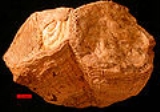
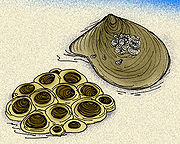
that was attached to the seafloor or to neighboring rudists, and a smaller upper valve that served as a kind of lid for the organism. The small upper valve could take a variety of interesting forms, including: a simple flat lid, a low cone, a spiral, and even a star-shaped form (Johnson, 2002).
Hippuritoida or Rudistes (sometimes Rudista).
would be. However they were one of the most important constituents of reefs during the Cretaceous Period.http://www.palaeos.com/Mesozoic/Cretaceous/Aptian.html During the Cretaceous, rudist reefs were so successful that they drove scleractinia
n corals out of many tropical environments, including shelves that are today the Caribbean
and the Mediterranean. It is likely that their success as reef builders is at least partially due to extreme environment of the Cretaceous. During this period tropical waters were between 6 and 14 C° warmer than today and also more highly saline, and while this may have been a suitable environment for the rudists, it was not nearly so hospitable to corals and other contemporary reef builders (Johnson, 2002). These rudist reefs were sometimes hundreds of meters tall and often ran for hundreds of kilometers on continental shelves, in fact at one point they fringed the North America
n coast from the Gulf of Mexico
to the present-day Maritime Provinces
. Because of their high porosity
, rudist reefs are highly-favored oil traps.
Marine (ocean)
Marine is an umbrella term. As an adjective it is usually applicable to things relating to the sea or ocean, such as marine biology, marine ecology and marine geology...
heterodont
Heterodont
The anatomical term heterodont refers to animals which possess more than a single tooth morphology. For example, members of the Synapsida generally possess incisors, canines , premolars, and molars. The presence of heterodont dentition is evidence of some degree of feeding/hunting specialization...
bivalves that arose during the Jurassic
Jurassic
The Jurassic is a geologic period and system that extends from about Mya to Mya, that is, from the end of the Triassic to the beginning of the Cretaceous. The Jurassic constitutes the middle period of the Mesozoic era, also known as the age of reptiles. The start of the period is marked by...
, and became so diverse during the Cretaceous
Cretaceous
The Cretaceous , derived from the Latin "creta" , usually abbreviated K for its German translation Kreide , is a geologic period and system from circa to million years ago. In the geologic timescale, the Cretaceous follows the Jurassic period and is followed by the Paleogene period of the...
that they were major reef-building organisms in the Tethys Ocean
Tethys Ocean
The Tethys Ocean was an ocean that existed between the continents of Gondwana and Laurasia during the Mesozoic era before the opening of the Indian Ocean.-Modern theory:...
.
Shell description
The Jurassic forms were elongate, with both valves being similarly shaped, often pipe or stake-shaped, while the reef-building forms of the Cretaceous had one valve become a flat lid, with the other valve becoming an inverted spike-like cone. The size of these conical forms ranged widely from just a few centimeters to well over a meter in length.Their "classic" morphology
Morphology (biology)
In biology, morphology is a branch of bioscience dealing with the study of the form and structure of organisms and their specific structural features....
consisted of a lower, roughly conical valve
Valve
A valve is a device that regulates, directs or controls the flow of a fluid by opening, closing, or partially obstructing various passageways. Valves are technically pipe fittings, but are usually discussed as a separate category...
that was attached to the seafloor or to neighboring rudists, and a smaller upper valve that served as a kind of lid for the organism. The small upper valve could take a variety of interesting forms, including: a simple flat lid, a low cone, a spiral, and even a star-shaped form (Johnson, 2002).
Fossil range and extinction
The rudists went extinct at the end of the Cretaceous, apparently as a result of the Cretaceous–Tertiary extinction event. It had been thought that this group began a decline about 2.5 million years earlier which culminated in complete extinction half a million years before the end of the Cretaceous (Johnson, 2002). However, evidence now suggests that rudists survived until the mass extinction event, and perished in it (Steuber et al. 2002).Taxonomy
The rudists are, according to different systematic schemes, placed in the ordersOrder (biology)
In scientific classification used in biology, the order is# a taxonomic rank used in the classification of organisms. Other well-known ranks are life, domain, kingdom, phylum, class, family, genus, and species, with order fitting in between class and family...
Hippuritoida or Rudistes (sometimes Rudista).
Ecology
Their classification as true reef-builders is controversial because they would catch and trap lots of sediment between their lower conical valves, meaning that they are not completely composed of biogenic carbonates as a coral reefCoral reef
Coral reefs are underwater structures made from calcium carbonate secreted by corals. Coral reefs are colonies of tiny living animals found in marine waters that contain few nutrients. Most coral reefs are built from stony corals, which in turn consist of polyps that cluster in groups. The polyps...
would be. However they were one of the most important constituents of reefs during the Cretaceous Period.http://www.palaeos.com/Mesozoic/Cretaceous/Aptian.html During the Cretaceous, rudist reefs were so successful that they drove scleractinia
Scleractinia
Scleractinia, also called stony corals, are exclusively marine animals; they are very similar to sea anemones but generate a hard skeleton. They first appeared in the Middle Triassic and replaced tabulate and rugose corals that went extinct at the end of the Permian...
n corals out of many tropical environments, including shelves that are today the Caribbean
Caribbean
The Caribbean is a crescent-shaped group of islands more than 2,000 miles long separating the Gulf of Mexico and the Caribbean Sea, to the west and south, from the Atlantic Ocean, to the east and north...
and the Mediterranean. It is likely that their success as reef builders is at least partially due to extreme environment of the Cretaceous. During this period tropical waters were between 6 and 14 C° warmer than today and also more highly saline, and while this may have been a suitable environment for the rudists, it was not nearly so hospitable to corals and other contemporary reef builders (Johnson, 2002). These rudist reefs were sometimes hundreds of meters tall and often ran for hundreds of kilometers on continental shelves, in fact at one point they fringed the North America
North America
North America is a continent wholly within the Northern Hemisphere and almost wholly within the Western Hemisphere. It is also considered a northern subcontinent of the Americas...
n coast from the Gulf of Mexico
Gulf of Mexico
The Gulf of Mexico is a partially landlocked ocean basin largely surrounded by the North American continent and the island of Cuba. It is bounded on the northeast, north and northwest by the Gulf Coast of the United States, on the southwest and south by Mexico, and on the southeast by Cuba. In...
to the present-day Maritime Provinces
Maritimes
The Maritime provinces, also called the Maritimes or the Canadian Maritimes, is a region of Eastern Canada consisting of three provinces, New Brunswick, Nova Scotia, and Prince Edward Island. On the Atlantic coast, the Maritimes are a subregion of Atlantic Canada, which also includes the...
. Because of their high porosity
Porosity
Porosity or void fraction is a measure of the void spaces in a material, and is a fraction of the volume of voids over the total volume, between 0–1, or as a percentage between 0–100%...
, rudist reefs are highly-favored oil traps.