


Rubislaw quarry

Encyclopedia
Scotland
Scotland is a country that is part of the United Kingdom. Occupying the northern third of the island of Great Britain, it shares a border with England to the south and is bounded by the North Sea to the east, the Atlantic Ocean to the north and west, and the North Channel and Irish Sea to the...
city of Aberdeen
Aberdeen
Aberdeen is Scotland's third most populous city, one of Scotland's 32 local government council areas and the United Kingdom's 25th most populous city, with an official population estimate of ....
. In 1778, Aberdeen city council sold it to a businessman, as it was not thought to be a source of good building material. However, over the next 200 years, an estimated six million tonnes of granite
Granite
Granite is a common and widely occurring type of intrusive, felsic, igneous rock. Granite usually has a medium- to coarse-grained texture. Occasionally some individual crystals are larger than the groundmass, in which case the texture is known as porphyritic. A granitic rock with a porphyritic...
were excavated from the quarry, giving Aberdeen the name of 'The Granite City'. Rubislaw Quarry is one of the biggest man-made holes in Europe
Europe
Europe is, by convention, one of the world's seven continents. Comprising the westernmost peninsula of Eurasia, Europe is generally 'divided' from Asia to its east by the watershed divides of the Ural and Caucasus Mountains, the Ural River, the Caspian and Black Seas, and the waterways connecting...
.
John Smith
John Smith (architect)
John Smith was a Scottish architect. He was the city architect of Aberdeen, and together with Archibald Simpson he contributed significantly to the architecture of Aberdeen, and many of the granite buildings that gave the city the nickname 'The Granite City'.Among the constructions he worked on...
and Archibald Simpson
Archibald Simpson
Archibald Simpson was one of the major architects of Aberdeen, .Simpson's buildings have contributed significantly to the architecture of Aberdeen. His first commission was for St...
were architects who constructed some of Aberdeen's best known buildings from granite in the early 19th century. Waterloo Bridge
Waterloo Bridge
Waterloo Bridge is a road and foot traffic bridge crossing the River Thames in London, England between Blackfriars Bridge and Hungerford Bridge. The name of the bridge is in memory of the British victory at the Battle of Waterloo in 1815...
in London
London
London is the capital city of :England and the :United Kingdom, the largest metropolitan area in the United Kingdom, and the largest urban zone in the European Union by most measures. Located on the River Thames, London has been a major settlement for two millennia, its history going back to its...
, the terrace of the Houses of Parliament and the Forth Rail Bridge were also constructed with granite from Aberdeen. Matthew Forster Heddle
Matthew Forster Heddle
Matthew Forster Heddle , Scottish mineralogist, was born at Hoy in Orkney.After receiving his early education at Edinburgh Academy, he entered as a medical student at the university in that city, and subsequently studied chemistry and mineralogy at Klausthal and Freiburg...
found the quarry a good source for the minerals tourmaline
Tourmaline
Tourmaline is a crystal boron silicate mineral compounded with elements such as aluminium, iron, magnesium, sodium, lithium, or potassium. Tourmaline is classified as a semi-precious stone and the gem comes in a wide variety of colors...
and beryl
Beryl
The mineral beryl is a beryllium aluminium cyclosilicate with the chemical formula Be3Al26. The hexagonal crystals of beryl may be very small or range to several meters in size. Terminated crystals are relatively rare...
.
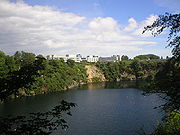
Today, the fine grey granite from the quarry is visible in the majority of Aberdeen's buildings, but Rubislaw quarry has been closed since 1971. Although the quarry is 142 m deep and has a diameter of 120 m it has been neglected and is now filled with water. It has never been marketed as a tourist attraction. The quarry is inaccessible, hidden by trees and surrounded by flats and office buildings.
Scotia Homes has applied for planning permission to build flats and a restaurant on the Northern edge of the Quarry.
The new owners have been revealed as former oil consultant Sandy Whyte and Hugh Black, the former managing director of a construction company.
The sale price was not revealed but offers over £30,000 were sought.
