


Rubber-tyred metro

Encyclopedia
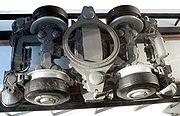
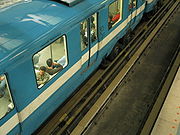
A rubber-tyred metro is a form of rapid transit
Rapid transit
A rapid transit, underground, subway, elevated railway, metro or metropolitan railway system is an electric passenger railway in an urban area with a high capacity and frequency, and grade separation from other traffic. Rapid transit systems are typically located either in underground tunnels or on...
system that uses a mix of road
Road transport
Road transport or road transportation is transport on roads of passengers or goods. A hybrid of road transport and ship transport is the historic horse-drawn boat.-History:...
and rail
Rail transport
Rail transport is a means of conveyance of passengers and goods by way of wheeled vehicles running on rail tracks. In contrast to road transport, where vehicles merely run on a prepared surface, rail vehicles are also directionally guided by the tracks they run on...
technology. The vehicles have wheel
Wheel
A wheel is a device that allows heavy objects to be moved easily through rotating on an axle through its center, facilitating movement or transportation while supporting a load, or performing labor in machines. Common examples found in transport applications. A wheel, together with an axle,...
s with rubber
Rubber
Natural rubber, also called India rubber or caoutchouc, is an elastomer that was originally derived from latex, a milky colloid produced by some plants. The plants would be ‘tapped’, that is, an incision made into the bark of the tree and the sticky, milk colored latex sap collected and refined...
tyre
Tyre
Tyre is a city in the South Governorate of Lebanon. There were approximately 117,000 inhabitants in 2003, however, the government of Lebanon has released only rough estimates of population numbers since 1932, so an accurate statistical accounting is not possible...
s which run on rolling pads inside guide bars for traction, as well as traditional railway steel wheels with deep flange
Flange
A flange is an external or internal ridge, or rim , for strength, as the flange of an iron beam such as an I-beam or a T-beam; or for attachment to another object, as the flange on the end of a pipe, steam cylinder, etc., or on the lens mount of a camera; or for a flange of a rail car or tram wheel...
s on steel tracks
Rail tracks
The track on a railway or railroad, also known as the permanent way, is the structure consisting of the rails, fasteners, sleepers and ballast , plus the underlying subgrade...
for guidance through conventional switches
Railroad switch
A railroad switch, turnout or [set of] points is a mechanical installation enabling railway trains to be guided from one track to another at a railway junction....
as well as guidance in case a tyre fails. Most rubber-tyred trains are purpose-built and designed for the system on which they operate. Guided bus
Guided bus
Guided buses are buses steered for part or all of their route by external means, usually on a dedicated track. This track, which often parallels existing roads, excludes other traffic, permitting the maintenance of reliable schedules on heavily used corridors even during rush hours.Guidance systems...
es are sometimes referred to as 'tram
Tram
A tram is a passenger rail vehicle which runs on tracks along public urban streets and also sometimes on separate rights of way. It may also run between cities and/or towns , and/or partially grade separated even in the cities...
s on tyres', and compared to rubber-tyred metros. See also rubber-tyred trams, Translohr
Translohr
Translohr is a guided bus system manufactured by Lohr Industrie of France. It is used in Clermont-Ferrand, Tianjin, Padua and in the mainland Mestre district of Venice in Italy. Translohr runs on rubber tires and is guided by a single central rail....
, and Bombardier Guided Light Transit
Bombardier Guided Light Transit
Guided Light Transit is a public transport system manufactured by Bombardier Transportation and used in the French cities of Nancy and Caen....
.
History
World War II
World War II, or the Second World War , was a global conflict lasting from 1939 to 1945, involving most of the world's nations—including all of the great powers—eventually forming two opposing military alliances: the Allies and the Axis...
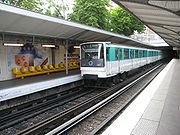
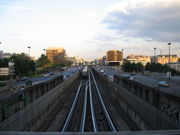
German occupation of Paris, the Metro system was used to capacity, with relatively little maintenance performed. At the end of the war, the system was so worn out that thought was given as to how to renovate it. Rubber-tyred metro technology was first applied to the Paris Métro
Paris Métro
The Paris Métro or Métropolitain is the rapid transit metro system in Paris, France. It has become a symbol of the city, noted for its density within the city limits and its uniform architecture influenced by Art Nouveau. The network's sixteen lines are mostly underground and run to 214 km ...
, developed by Michelin
Michelin
Michelin is a tyre manufacturer based in Clermont-Ferrand in the Auvergne région of France. It is one of the two largest tyre manufacturers in the world along with Bridgestone. In addition to the Michelin brand, it also owns the BFGoodrich, Kleber, Riken, Kormoran and Uniroyal tyre brands...
, who provided the tyres and guidance system, in collaboration with Renault
Renault
Renault S.A. is a French automaker producing cars, vans, and in the past, autorail vehicles, trucks, tractors, vans and also buses/coaches. Its alliance with Nissan makes it the world's third largest automaker...
, who provided the vehicles. Starting in 1951, an experimental vehicle, the MP 51, operated on a test track between Porte des Lilas and Pré Saint Gervais, a section of line not open to the public.
Line 11
Paris Metro Line 11
Paris Métro Line 11 is one of 16 Paris métro lines. It links Les Lilas in the North East of the city to Châtelet in the center of Paris. It is the shortest of the 14 metro lines having independent management...
Châtelet
Châtelet (Paris Metro)
Châtelet is a station on lines 1, 4, 7, 11 and 14 of the Paris Métro in the centre of medieval Paris and the 1st arrondissement. The station is made up of two parts connected by a long corridor:...
- Mairie des Lilas
Mairie des Lilas (Paris Metro)
Mairie des Lilas is a station of the Paris Métro in the commune of Les Lilas.The line 11 platforms opened as part of the extension of the line from Porte des Lilas on 17 February 1937. It is named after the town hall of Les Lilas. The station is much less famous than the poinçonneur immortalized...
was the first line to be converted, in 1956, chosen because of its steep grades. This was followed by Line 1 Château de Vincennes
Château de Vincennes (Paris Metro)
Château de Vincennes is a station of the Paris Métro. It is the eastern terminus of line 1 and serves the Château de Vincennes. It lies on the border between the commune of Vincennes and the Bois de Vincennes, which is part of the 12th arrondissement of Paris....
- Pont de Neuilly
Pont de Neuilly (Paris Metro)
Pont de Neuilly is a station on Paris Métro Line 1, situated in the commune of Neuilly-sur-Seine. Between 1940 and 1950 it was known as Pont de Neuilly, Avenue de Madrid. It is named after the Pont de Neuilly, a nearby bridge....
in 1964, and Line 4 Porte d'Orléans
Porte d'Orléans (Paris Metro)
Porte d'Orléans is a station and southern terminus of line 4 of the Paris Métro and a stop on tramway line 3. It is situated in the 14th Arrondissement, in the quartier of Petit-Montrouge. A terminal loop is provided at the station for trains to turn around to return north towards Porte de...
- Porte de Clignancourt
Porte de Clignancourt (Paris Metro)
Porte de Clignancourt is a station of the Paris Métro, the northern terminus of line 4, situated in the 18th Arrondissement.The station was opened on 21 April 1908 as part of the first section of the line from Châtelet. A terminal loop is provided at the station for trains to turn around to return...
in 1967, converted because they had the heaviest traffic load of all Paris Métro lines. Finally, Line 6 Charles de Gaulle - Étoile
Charles de Gaulle - Étoile (Paris Metro and RER)
Charles de Gaulle – Étoile is a station on Paris Métro Line 1 and of the RER urban rail network. It lies on the boundary of the VIIIe and XVIIe arrondissements of Paris...
- Nation
Nation (Paris Metro and RER)
Nation is a station of the Paris Métro and of Île-de-France's regional high-speed RER. It serves lines 1, 2, 6 and 9 of the Paris Métro and line A of the RER....
was converted in 1974 to cut down noise on its many elevated sections. Because of the high cost of converting existing rail-based lines, this is no longer done in Paris, nor elsewhere; now rubber-tyred metros are used in new systems or lines only, including the new Paris Métro Line 14
Paris Metro Line 14
Line 14 of the Paris Métro system connects the stations Saint Lazare and Olympiades on a north-west south-east diagonal across the centre of Paris. It is the twelfth busiest of sixteen lines on the network, and as of 2011, the only one to be operated completely automatically; the second such line...
.
The first completely rubber-tyred metro system was built in Montreal
Montreal
Montreal is a city in Canada. It is the largest city in the province of Quebec, the second-largest city in Canada and the seventh largest in North America...
, Canada
Canada
Canada is a North American country consisting of ten provinces and three territories. Located in the northern part of the continent, it extends from the Atlantic Ocean in the east to the Pacific Ocean in the west, and northward into the Arctic Ocean...
in 1966; see Montreal Metro
Montreal Metro
The Montreal Metro is a rubber-tired metro system, and the main form of public transportation underground in the city of Montreal, Quebec, Canada....
. Montreal Metro
Montreal Metro
The Montreal Metro is a rubber-tired metro system, and the main form of public transportation underground in the city of Montreal, Quebec, Canada....
, Santiago Metro
Santiago Metro
Metro de Santiago is South America's most extensive metro system with 5 lines, 108 stations and 103 kilometres of track making it the second longest in Latin America after that of Mexico City. The metro system serves the city of Santiago, Chile. Three of the lines are rubber-tyred...
and Mexico City Metro
Mexico City Metro
The Mexico City Metro , officially called Sistema de Transporte Colectivo, is a metro system that serves the metropolitan area of Mexico City...
are based on Paris Métro
Paris Métro
The Paris Métro or Métropolitain is the rapid transit metro system in Paris, France. It has become a symbol of the city, noted for its density within the city limits and its uniform architecture influenced by Art Nouveau. The network's sixteen lines are mostly underground and run to 214 km ...
rubber-tyred trains. A few more recent rubber-tyred systems have used automated, driverless trains; one of the first such systems, developed by Matra
Matra
Mécanique Aviation Traction or Matra was a French company covering a wide range of activities mainly related to automobile, bicycles, aeronautics and weaponry. In 1994, it became a subsidiary of the Lagardère Group and now operates under that name.Matra was owned by the Floirat family...
, opened in 1983 in Lille
Lille
Lille is a city in northern France . It is the principal city of the Lille Métropole, the fourth-largest metropolitan area in the country behind those of Paris, Lyon and Marseille. Lille is situated on the Deûle River, near France's border with Belgium...
, and others have since been built in Toulouse
Toulouse
Toulouse is a city in the Haute-Garonne department in southwestern FranceIt lies on the banks of the River Garonne, 590 km away from Paris and half-way between the Atlantic Ocean and the Mediterranean Sea...
and Rennes
Rennes
Rennes is a city in the east of Brittany in northwestern France. Rennes is the capital of the region of Brittany, as well as the Ille-et-Vilaine department.-History:...
. The first automated rubber-tyred system opened in Kobe
Kobe
, pronounced , is the fifth-largest city in Japan and is the capital city of Hyōgo Prefecture on the southern side of the main island of Honshū, approximately west of Osaka...
, Japan
Japan
Japan is an island nation in East Asia. Located in the Pacific Ocean, it lies to the east of the Sea of Japan, China, North Korea, South Korea and Russia, stretching from the Sea of Okhotsk in the north to the East China Sea and Taiwan in the south...
in February 1981. It is the Portliner linking Sanomiya railway station with Port Island.
Technology
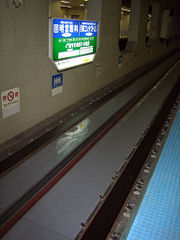
Overview
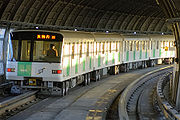
Electric multiple unit
An electric multiple unit or EMU is a multiple unit train consisting of self-propelled carriages, using electricity as the motive power. An EMU requires no separate locomotive, as electric traction motors are incorporated within one or a number of the carriages...
, with power supplied by one, or both, of the guide bars, which thus also serves as the third rail (the current is not picked up through the horizontal wheels, but through a separate lateral pickup shoe). The return current passes through a return shoe to the top of one, or both of the rails, or to the other guide bar, depending on the type of system.
The type of guideway used on a system varies between networks. Two parallel rollways, each the width of a tyre are used, either of concrete
Concrete
Concrete is a composite construction material, composed of cement and other cementitious materials such as fly ash and slag cement, aggregate , water and chemical admixtures.The word concrete comes from the Latin word...
(Montreal Metro
Montreal Metro
The Montreal Metro is a rubber-tired metro system, and the main form of public transportation underground in the city of Montreal, Quebec, Canada....
, Lille Metro
Lille Metro
The Lille metro is a driverless metro in and around Lille, France. The system was inaugurated on 25 April 1983 and was the first to use VAL system....
, Toulouse Metro
Toulouse Metro
The Toulouse metro serves the city of Toulouse, France, and some of the surrounding area. The city's public transport system was initially managed by Société d'économie mixte des voyageurs de l'agglomération toulousaine , which was a company that was 80% owned by local government bodies and 20%...
, most part of Santiago Metro
Santiago Metro
Metro de Santiago is South America's most extensive metro system with 5 lines, 108 stations and 103 kilometres of track making it the second longest in Latin America after that of Mexico City. The metro system serves the city of Santiago, Chile. Three of the lines are rubber-tyred...
, Busan Subway Line 4
Busan Subway Line 4
Busan Subway Line 4 is a line of the Busan Subway network that connects part of Gijang-gun, Busan, and upper Haeundae-gu, Busan, into Dongnae-gu, Busan. It is operated by the Busan Transportation Corporation. Opened on March 30, 2011, the line is a rapid transit system consisting of 14 stations -...
), H-Shape
Structural steel
Structural steel is steel construction material, a profile, formed with a specific shape or cross section and certain standards of chemical composition and mechanical properties...
hot rolled steel (Paris Métro
Paris Métro
The Paris Métro or Métropolitain is the rapid transit metro system in Paris, France. It has become a symbol of the city, noted for its density within the city limits and its uniform architecture influenced by Art Nouveau. The network's sixteen lines are mostly underground and run to 214 km ...
, Mexico City Metro
Mexico City Metro
The Mexico City Metro , officially called Sistema de Transporte Colectivo, is a metro system that serves the metropolitan area of Mexico City...
, the non-underground section of Santiago Metro
Santiago Metro
Metro de Santiago is South America's most extensive metro system with 5 lines, 108 stations and 103 kilometres of track making it the second longest in Latin America after that of Mexico City. The metro system serves the city of Santiago, Chile. Three of the lines are rubber-tyred...
), or flat steel (Sapporo Municipal Subway
Sapporo Municipal Subway
The is an underground rapid transit system in Sapporo, Hokkaidō, Japan. It is operated by the Sapporo City Transportation Bureau.-Lines:The system has 3 lines; the first, the Namboku Line, was opened in 1971 prior to the 1972 Winter Olympics.-Technology:...
). As on a railway, the driver does not have to steer, because the system relies on a redundant system of railway steel wheels with flanges on steel rail tracks
Rail tracks
The track on a railway or railroad, also known as the permanent way, is the structure consisting of the rails, fasteners, sleepers and ballast , plus the underlying subgrade...
. The Sapporo system is an exception as it uses a central guidance rail only. The VAL system used in Lille and Toulouse has conventional track between the guide bars.
On some systems (such as Paris, Montreal, and Mexico City), there is a regular railway track between the rollways and the vehicles also have railway wheels with larger (taller) than normal flange
Flange
A flange is an external or internal ridge, or rim , for strength, as the flange of an iron beam such as an I-beam or a T-beam; or for attachment to another object, as the flange on the end of a pipe, steam cylinder, etc., or on the lens mount of a camera; or for a flange of a rail car or tram wheel...
s, but these are normally at some distance above the rails and are used only in the case of a flat tyre and at switches/points
Railroad switch
A railroad switch, turnout or [set of] points is a mechanical installation enabling railway trains to be guided from one track to another at a railway junction....
and crossings
Level junction
In U.S. railroad practice, a level junction is a railway junction that has a track configuration in which merging or crossing railroad lines provide track connections with each other that require trains to cross over in front of opposing traffic at grade In U.S. railroad practice, a level junction...
. In Paris these rails were also used to enable mixed traffic with rubber-tyred and steel-wheeled trains using the same track, particularly during conversion from normal railway track. Other systems (e.g. Lille and Toulouse) have other sorts of flat tyre compensation and switching methods.
The essential differences between rubber-on-concrete and steel-on-steel are that rubber-on-concrete generates more friction
Friction
Friction is the force resisting the relative motion of solid surfaces, fluid layers, and/or material elements sliding against each other. There are several types of friction:...
and higher rolling resistance which results in various pros and cons.
Advantages
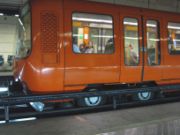
- Smoother rides (with little jostling around)
- Faster accelerationAccelerationIn physics, acceleration is the rate of change of velocity with time. In one dimension, acceleration is the rate at which something speeds up or slows down. However, since velocity is a vector, acceleration describes the rate of change of both the magnitude and the direction of velocity. ...
- Shorter braking distances, allowing trains to be signalledRailway signalA signal is a mechanical or electrical device erected beside a railway line to pass information relating to the state of the line ahead to train/engine drivers. The driver interprets the signal's indication and acts accordingly...
closer together - The ability to climb or descend steeper slopes (~gradient 13%) than would be feasible with conventional rail tracksRail tracksThe track on a railway or railroad, also known as the permanent way, is the structure consisting of the rails, fasteners, sleepers and ballast , plus the underlying subgrade...
so gradient conventional rail tracks would likely need a rackRack railwayA rack-and-pinion railway is a railway with a toothed rack rail, usually between the running rails. The trains are fitted with one or more cog wheels or pinions that mesh with this rack rail...
. - Quieter rides in open air (both inside and outside the train)
Disadvantages
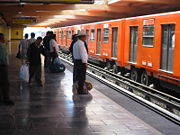
- Higher energy consumption
- Possibility of tyre blow-outs - not possible in railway wheels.
- More heat generated
- Weather variance. (Applicable only to above-ground installations)
- Losing the tractionTraction (engineering)Traction refers to the maximum frictional force that can be produced between surfaces without slipping.The units of traction are those of force, or if expressed as a coefficient of traction a ratio.-Traction:...
-advantage in inclement weather (snow and ice) - Heavier as steel rails remain for switching purposes to provide electricity to the trains and as a safety backup
- Tyre replacement cost
Similar technologies
Automated driverless systemsAutomated guideway transit
Automated guideway transit is a fully automated, driverless, grade-separated transit system in which vehicles are automatically guided along a "guideway". The vehicles are often rubber tired, but other systems including steel wheels, air cushion and maglev systems have also been used in experiments...
are not exclusively rubber-tyred; many have since been built using conventional rail technology, such as London's Docklands Light Railway
Docklands Light Railway
The Docklands Light Railway is an automated light metro or light rail system opened on 31 August 1987 to serve the redeveloped Docklands area of London...
, the Copenhagen metro
Copenhagen Metro
Copenhagen Metro is a rapid transit system serving Copenhagen, Frederiksberg and Tårnby in Denmark. The system opened between 2002 and 2007, and has two lines, M1 and M2. The driverless light metro supplements the larger S-train rapid transit system, and is integrated with DSB local trains and...
and Vancouver's SkyTrain
SkyTrain (Vancouver)
SkyTrain is a light rapid transit system in Metro Vancouver, British Columbia, Canada. SkyTrain has of track and uses fully automated trains on grade-separated tracks, running mostly on elevated guideways, which helps SkyTrain to hold consistently high on-time reliability...
, the Disneyland Resort Line which uses converted rolling stocks from non-driverless trains, as well as AirTrain JFK
AirTrain JFK
AirTrain JFK is a 3-line, -long people mover system and elevated railway in New York City providing service to John F. Kennedy International Airport...
which is linking JFK Airport
John F. Kennedy International Airport
John F. Kennedy International Airport is an international airport located in the borough of Queens in New York City, about southeast of Lower Manhattan. It is the busiest international air passenger gateway to the United States, handling more international traffic than any other airport in North...
in New York City
New York City
New York is the most populous city in the United States and the center of the New York Metropolitan Area, one of the most populous metropolitan areas in the world. New York exerts a significant impact upon global commerce, finance, media, art, fashion, research, technology, education, and...
with local subway and commuter trains. Most monorail
Monorail
A monorail is a rail-based transportation system based on a single rail, which acts as its sole support and its guideway. The term is also used variously to describe the beam of the system, or the vehicles traveling on such a beam or track...
manufacturers prefer rubber tyres.
List of systems
| Country/Region | City/Region | System | Technology |
|---|---|---|---|
 Canada Canada |
Montreal Montreal Montreal is a city in Canada. It is the largest city in the province of Quebec, the second-largest city in Canada and the seventh largest in North America... |
Montreal Metro Montreal Metro The Montreal Metro is a rubber-tired metro system, and the main form of public transportation underground in the city of Montreal, Quebec, Canada.... |
Michelin Michelin Michelin is a tyre manufacturer based in Clermont-Ferrand in the Auvergne région of France. It is one of the two largest tyre manufacturers in the world along with Bridgestone. In addition to the Michelin brand, it also owns the BFGoodrich, Kleber, Riken, Kormoran and Uniroyal tyre brands... |
 Chile Chile |
Santiago Santiago, Chile Santiago , also known as Santiago de Chile, is the capital and largest city of Chile, and the center of its largest conurbation . It is located in the country's central valley, at an elevation of above mean sea level... |
Santiago Metro Santiago Metro Metro de Santiago is South America's most extensive metro system with 5 lines, 108 stations and 103 kilometres of track making it the second longest in Latin America after that of Mexico City. The metro system serves the city of Santiago, Chile. Three of the lines are rubber-tyred... (Lines 1, 2 and 5) |
Michelin |
 Early Modern France Early Modern France |
Laon Laon Laon is the capital city of the Aisne department in Picardy in northern France.-History:The hilly district of Laon, which rises a hundred metres above the otherwise flat Picardy plain, has always held strategic importance... |
Poma 2000 Poma 2000 The Poma 2000 in Laon, France, is an automated guideway transit, a cable-driven people mover which runs between the railway station and the city hall .... |
Cable-driven Cable car (railway) A cable car or cable railway is a mass transit system using rail cars that are hauled by a continuously moving cable running at a constant speed. Individual cars stop and start by releasing and gripping this cable as required... |
| Lille Lille Lille is a city in northern France . It is the principal city of the Lille Métropole, the fourth-largest metropolitan area in the country behind those of Paris, Lyon and Marseille. Lille is situated on the Deûle River, near France's border with Belgium... |
Lille Metro Lille Metro The Lille metro is a driverless metro in and around Lille, France. The system was inaugurated on 25 April 1983 and was the first to use VAL system.... |
VAL 206, 208 | |
| Lyon Lyon Lyon , is a city in east-central France in the Rhône-Alpes region, situated between Paris and Marseille. Lyon is located at from Paris, from Marseille, from Geneva, from Turin, and from Barcelona. The residents of the city are called Lyonnais.... |
Lyon Metro Lyon Metro The Lyon metro, in Lyon, France, first opened in 1978 and now consists of four lines. It is part of the Transports en Commun Lyonnais system of public transport, and is supported by a network of tramways.... (Lines A Lyon Metro Line A Line A of the Lyon Metro was constructed using the cut-and-cover method, and went into service on May 2, 1978... , B Lyon Metro Line B Line B of the Lyon Metro was constructed using the cut-and-cover method, and went into service on May 2, 1978... , and D Lyon Metro Line D Line D of the Lyon Metro, with automatic trains running on tires and with no driver, and also known as MAGGALY commenced operation under human control on September 4, 1991, between Gorge-de-Loup and Grange-Blanche... ) |
Michelin | |
| Marseille Marseille Marseille , known in antiquity as Massalia , is the second largest city in France, after Paris, with a population of 852,395 within its administrative limits on a land area of . The urban area of Marseille extends beyond the city limits with a population of over 1,420,000 on an area of... |
Marseille Metro Marseille Metro The Marseille metro serves the City of Marseille. It is a rubber-tyred metro derived from the technology developed by the RATP for Paris Metro and opened at the end of 1977... |
Michelin | |
| Paris Paris Paris is the capital and largest city in France, situated on the river Seine, in northern France, at the heart of the Île-de-France region... |
Paris Métro Paris Métro The Paris Métro or Métropolitain is the rapid transit metro system in Paris, France. It has become a symbol of the city, noted for its density within the city limits and its uniform architecture influenced by Art Nouveau. The network's sixteen lines are mostly underground and run to 214 km ... (Lines 1 Paris Metro Line 1 Paris Métro Line 1 is one of the sixteen lines composing the Paris Métro . It connects the La Défense – Grande Arche and Château de Vincennes stations. With a 16.5 km length, it constitutes an "East-West" route transportation important for the City of Paris... , 4 Paris Metro Line 4 Line 4 is one of the sixteen lines of the Paris Métro rapid transit system. Situated entirely within the boundaries of the City of Paris, it connects Porte de Clignancourt in the north and Porte d'Orléans in the south, travelling across the heart of the city. As a result, it is sometimes called... , 6 Paris Metro Line 6 Line 6 is one of the sixteen lines of the Paris Métro rapid transit system. Following a semi-circular route around the southern half of the city above boulevards formed by ancient city walls , it runs from Charles de Gaulle – Étoile in the west and Nation in the east.Opened between 1900 and 1906... , 11 Paris Metro Line 11 Paris Métro Line 11 is one of 16 Paris métro lines. It links Les Lilas in the North East of the city to Châtelet in the center of Paris. It is the shortest of the 14 metro lines having independent management... , and 14 Paris Metro Line 14 Line 14 of the Paris Métro system connects the stations Saint Lazare and Olympiades on a north-west south-east diagonal across the centre of Paris. It is the twelfth busiest of sixteen lines on the network, and as of 2011, the only one to be operated completely automatically; the second such line... ) |
Michelin | |
| Paris (Orly) | Orlyval Orlyval Orlyval is a small automatic metro which runs a shuttle service to Paris's Orly Airport from the RER network, with which it connects at Antony station on line RER B.It was opened on 2 October 1991, the second line to use the VAL automatic metro.... |
VAL 206 | |
| Paris (Charles-De-Gaulle Airport Charles de Gaulle International Airport Paris-Charles de Gaulle Airport , also known as Roissy Airport , in the Paris area, is one of the world's principal aviation centres, as well as France's largest airport. It is named after Charles de Gaulle , leader of the Free French Forces and founder of the French Fifth Republic... ) |
CDGVAL CDGVAL CDGVAL is a free automatic shuttle rail service at Paris-Charles de Gaulle Airport consisting in two lines : a first line which opened on 4 April 2007 and a second on 27 June 2007... |
VAL 208 | |
| Rennes Rennes Rennes is a city in the east of Brittany in northwestern France. Rennes is the capital of the region of Brittany, as well as the Ille-et-Vilaine department.-History:... |
Rennes Metro Rennes Metro Opened on 15 March 2002, the metro in Rennes is based on the Siemens Transportation Systems VAL technology. There is one line, the 9.4-km A Line, which runs north-west to south-east from J.F... |
VAL 208 | |
| Toulouse Toulouse Toulouse is a city in the Haute-Garonne department in southwestern FranceIt lies on the banks of the River Garonne, 590 km away from Paris and half-way between the Atlantic Ocean and the Mediterranean Sea... |
Toulouse Metro Toulouse Metro The Toulouse metro serves the city of Toulouse, France, and some of the surrounding area. The city's public transport system was initially managed by Société d'économie mixte des voyageurs de l'agglomération toulousaine , which was a company that was 80% owned by local government bodies and 20%... |
VAL 206, 208 | |
 Italy Italy |
Turin Turin Turin is a city and major business and cultural centre in northern Italy, capital of the Piedmont region, located mainly on the left bank of the Po River and surrounded by the Alpine arch. The population of the city proper is 909,193 while the population of the urban area is estimated by Eurostat... |
Metrotorino | VAL 208 |
 Hong Kong Hong Kong |
Chek Lap Kok Airport | Automated People Mover Hong Kong International Airport Automated People Mover Hong Kong International Airport Automated People Mover is a driverless people mover located within Hong Kong International Airport. It operates in two "segments" and depends on the direction of travel.... |
Mitsubishi Mitsubishi Heavy Industries , or MHI, is a Japanese company. It is one of the core companies of Mitsubishi Group.-History:In 1870 Yataro Iwasaki, the founder of Mitsubishi took a lease of Government-owned Nagasaki Shipyard. He named it Nagasaki Shipyard & Machinery Works, and started the shipbuilding business on a full scale... / Ishikawajima-Harima Ishikawajima-Harima Heavy Industries , formerly known as , is a Japanese company which produces ships, aero-engines, turbochargers for automobiles, industrial machines, power station boilers and other facilities, suspension bridges and other transport-related machinery.... |
 Japan Japan |
Kobe Kobe , pronounced , is the fifth-largest city in Japan and is the capital city of Hyōgo Prefecture on the southern side of the main island of Honshū, approximately west of Osaka... |
Kobe New Transit Kobe New Transit is the third-sector semipublic company that runs Port Island Line and Rokkō Island Line automated guideway transit systems in Kobe, Japan... (Port Island Line / Rokkō Island Line Rokko Island Line The , commonly known as is an automated guideway transit system in Kobe, Japan. Operated by Kobe New Transit, it connects the man-made Rokkō Island to Sumiyoshi Station on the JR Kobe Line.-Stations:*Sumiyoshi... ) |
Kawasaki Kawasaki Heavy Industries Rolling Stock Company is the rolling stock production division of Kawasaki Heavy Industries. Since beginning operations in 1906, the company has produced more than 90,000 railroad vehicles.- Products :... |
| Hiroshima Hiroshima is the capital of Hiroshima Prefecture, and the largest city in the Chūgoku region of western Honshu, the largest island of Japan. It became best known as the first city in history to be destroyed by a nuclear weapon when the United States Army Air Forces dropped an atomic bomb on it at 8:15 A.M... |
Hiroshima Rapid Transit Hiroshima Rapid Transit is a Japanese transportation company based in Hiroshima, Japan.Hiroshima Rapid Transit operate the People mover called "Astram Line" in Hiroshima.The company will accept PASPY, a smart card ticket system, from spring, 2009.-External links:*... (Astram Line Astram Line The is a new transit system operated by Hiroshima Rapid Transit in Hiroshima, Japan.-History:*August 8, 1994 - Opened for the 1994 Asian Games in Hiroshima... ) |
Kawasaki / Mitsubishi Mitsubishi Heavy Industries , or MHI, is a Japanese company. It is one of the core companies of Mitsubishi Group.-History:In 1870 Yataro Iwasaki, the founder of Mitsubishi took a lease of Government-owned Nagasaki Shipyard. He named it Nagasaki Shipyard & Machinery Works, and started the shipbuilding business on a full scale... / Niigata Transys |
|
| Saitama Saitama, Saitama ' is the capital and the most populous city of Saitama Prefecture in Japan, situated in the south-east of the prefecture. Its area incorporates the former cities of Urawa, Ōmiya, Yono and Iwatsuki. It is a city designated by government ordinance... |
New Shuttle | ||
| Sapporo | Sapporo Municipal Subway Sapporo Municipal Subway The is an underground rapid transit system in Sapporo, Hokkaidō, Japan. It is operated by the Sapporo City Transportation Bureau.-Lines:The system has 3 lines; the first, the Namboku Line, was opened in 1971 prior to the 1972 Winter Olympics.-Technology:... |
Kawasaki | |
| Tokyo Tokyo , ; officially , is one of the 47 prefectures of Japan. Tokyo is the capital of Japan, the center of the Greater Tokyo Area, and the largest metropolitan area of Japan. It is the seat of the Japanese government and the Imperial Palace, and the home of the Japanese Imperial Family... |
Yurikamome Yurikamome , formally the is an automated guideway transit service operated by the Tokyo Waterfront New Transit Corporation, connecting Shimbashi to Toyosu, passing through the artificial island of Odaiba in Tokyo, Japan, a market in which it competes with the cheaper Rinkai Line.The line is named after the... |
Mitsubishi / Niigata Transys / Nippon Sharyo Nippon Sharyo , , formed in 1896, is a major rolling stock manufacturer based in Nagoya, Japan. In 1996, it abbreviated its name to "日本車両" Nippon Sharyō. Its shortest abbreviation is Nissha "日車". It was a listed company on Nikkei 225 until 2004. It is listed on the Tokyo Stock Exchange and Nagoya Stock Exchange... / Tokyu Tokyu Car Corporation is a manufacturer of heavy rail cars in Japan. The company is based in Kanazawa Ward, Yokohama, Japan, and a member of Tokyu Group. Tokyu Car manufactures rail vehicles not only for Tokyu Corporation but for other Japanese operators, including various Japan Railways Group companies and... |
|
| Nippori-Toneri Liner | Niigata Transys | ||
| Higashimurayama Higashimurayama, Tokyo is a city located in the western end of Tokyo Metropolis, Japan. As of 2010, the city has an estimated population of 151,279 and a population density of 8,810 persons per km²... / Tokorozawa Tokorozawa, Saitama is a city in Saitama, Japan. It is located in the central part of the Musashino plain, about 30 km west of downtown Tokyo. Tokorozawa can be considered part of the greater Tokyo area; its proximity to the latter and lower housing costs make it a popular bedroom community.-Location:Tokorozawa... |
Seibu Yamaguchi Line Seibu Yamaguchi Line The of Seibu Railway is a manually operated people mover that runs between in Higashimurayama, Tokyo and Seibu-Kyūjōmae Station in Tokorozawa, Saitama in Japan. The line has an official nickname Leo Liner, after 'Leo', the hero of Kimba the White Lion, who is also the mascot of Seibu Lions... |
Niigata Transys | |
| Sakura Sakura, Chiba is a city located in northern Chiba Prefecture, Japan. As of February 2011, the city had an estimated population of 172,176 and a population density of 1660 persons per km². The total area was 103.59 km².-Geography:... |
Yamaman Yūkarigaoka Line | ||
| Yokohama Yokohama is the capital city of Kanagawa Prefecture and the second largest city in Japan by population after Tokyo and most populous municipality of Japan. It lies on Tokyo Bay, south of Tokyo, in the Kantō region of the main island of Honshu... |
Kanazawa Seaside Line Kanazawa Seaside Line is a new transportation system line operated by and transits from Shin-Sugita to Kanazawa-Hakkei in Yokohama. It was opened on July 5, 1989.- Line Data :... |
Mitsubishi / Niigata Transys / Nippon Sharyo / Tokyu | |
| Osaka Osaka is a city in the Kansai region of Japan's main island of Honshu, a designated city under the Local Autonomy Law, the capital city of Osaka Prefecture and also the biggest part of Keihanshin area, which is represented by three major cities of Japan, Kyoto, Osaka and Kobe... |
Nankō Port Town Line | Niigata Transys | |
| Komaki Komaki, Aichi is a city located in Aichi, Japan. It is commonly associated with the former Nagoya Airport, which is partly located in the city. The other part is in the city of Kasugai. As of January 1, 2008, the city has an estimated population of 149,060 and the density of 2,370 persons per km²... |
Peachliner Peachliner The Peachliner, formally the was a people mover in the city of Komaki, Aichi Prefecture, Japan. It operated from 1991 until September 30, 2006, when it became the first people-mover system in Japan to cease operations.-History:... (abandoned) |
Mitsubishi | |
 South Korea South Korea |
Busan Busan Busan , formerly spelled Pusan is South Korea's second largest metropolis after Seoul, with a population of around 3.6 million. The Metropolitan area population is 4,399,515 as of 2010. It is the largest port city in South Korea and the fifth largest port in the world... |
Busan Subway Busan Subway The Busan Subway , operated by the Busan Transportation Corporation is the subway system of Busan, South Korea. The subway network first opened in 1985 with seventeen stations... Line 4 Busan Subway Line 4 Busan Subway Line 4 is a line of the Busan Subway network that connects part of Gijang-gun, Busan, and upper Haeundae-gu, Busan, into Dongnae-gu, Busan. It is operated by the Busan Transportation Corporation. Opened on March 30, 2011, the line is a rapid transit system consisting of 14 stations -... |
|
 Mexico Mexico |
Mexico City Mexico City Mexico City is the Federal District , capital of Mexico and seat of the federal powers of the Mexican Union. It is a federal entity within Mexico which is not part of any one of the 31 Mexican states but belongs to the federation as a whole... |
Mexico City Metro Mexico City Metro The Mexico City Metro , officially called Sistema de Transporte Colectivo, is a metro system that serves the metropolitan area of Mexico City... |
Michelin |
 Singapore Singapore |
Singapore Singapore Singapore , officially the Republic of Singapore, is a Southeast Asian city-state off the southern tip of the Malay Peninsula, north of the equator. An island country made up of 63 islands, it is separated from Malaysia by the Straits of Johor to its north and from Indonesia's Riau Islands by the... |
Light Rail Transit | Bombardier / Mitsubishi |
 Switzerland Switzerland |
Lausanne Lausanne Lausanne is a city in Romandy, the French-speaking part of Switzerland, and is the capital of the canton of Vaud. The seat of the district of Lausanne, the city is situated on the shores of Lake Geneva . It faces the French town of Évian-les-Bains, with the Jura mountains to its north-west... |
Lausanne Metro Lausanne Metro The Lausanne Metro system includes two lines in Lausanne, Switzerland, owned by two distinct companies and operated by a third. The Line M1 is a light metro, while the Line M2 is a fully automated metro which opened on 27 October 2008. A third line M3 is in planning... Line m2 (2008) |
Michelin |
| Taipei Taipei Taipei City is the capital of the Republic of China and the central city of the largest metropolitan area of Taiwan. Situated at the northern tip of the island, Taipei is located on the Tamsui River, and is about 25 km southwest of Keelung, its port on the Pacific Ocean... |
Taipei Metro Brown Line | Bombardier Bombardier Transportation Bombardier Transportation is the rail equipment division of the Canadian firm, Bombardier Inc. Bombardier Transportation is one of the world's largest companies in the rail-equipment manufacturing and servicing industry. Its headquarters are in Berlin, Germany.... 's INNOVIA APM 256 (formerly VAL 256) |
|
| Taoyuan Airport | Inter-terminal Shuttle | ||
| Guangzhou Guangzhou Guangzhou , known historically as Canton or Kwangchow, is the capital and largest city of the Guangdong province in the People's Republic of China. Located in southern China on the Pearl River, about north-northwest of Hong Kong, Guangzhou is a key national transportation hub and trading port... |
Zhujiang New Town Automated People Mover System (2010) | Bombardier Bombardier Transportation Bombardier Transportation is the rail equipment division of the Canadian firm, Bombardier Inc. Bombardier Transportation is one of the world's largest companies in the rail-equipment manufacturing and servicing industry. Its headquarters are in Berlin, Germany.... 's INNOVIA APM 100 |
|
 United Kingdom United Kingdom |
Gatwick Airport | Terminal-Rail Shuttle | Bombardier Bombardier Transportation Bombardier Transportation is the rail equipment division of the Canadian firm, Bombardier Inc. Bombardier Transportation is one of the world's largest companies in the rail-equipment manufacturing and servicing industry. Its headquarters are in Berlin, Germany.... 's INNOVIA APM 100 |
| Stansted Stansted Stansted usually refers to London Stansted Airport.Stansted may also refer to other places in England:*Stansted Mountfitchet, Essex*Stansted, Hampshire*Stansted, Kent*Stansted Park, West Sussex... , Essex Essex Essex is a ceremonial and non-metropolitan county in the East region of England, and one of the home counties. It is located to the northeast of Greater London. It borders with Cambridgeshire and Suffolk to the north, Hertfordshire to the west, Kent to the South and London to the south west... (Stansted Airport) |
Terminal Trams | Bombardier Bombardier Transportation Bombardier Transportation is the rail equipment division of the Canadian firm, Bombardier Inc. Bombardier Transportation is one of the world's largest companies in the rail-equipment manufacturing and servicing industry. Its headquarters are in Berlin, Germany.... 's INNOVIA APM 100 |
|
 United States United States |
Chicago Chicago Chicago is the largest city in the US state of Illinois. With nearly 2.7 million residents, it is the most populous city in the Midwestern United States and the third most populous in the US, after New York City and Los Angeles... , Illinois Illinois Illinois is the fifth-most populous state of the United States of America, and is often noted for being a microcosm of the entire country. With Chicago in the northeast, small industrial cities and great agricultural productivity in central and northern Illinois, and natural resources like coal,... (O'Hare O'Hare International Airport Chicago O'Hare International Airport , also known as O'Hare Airport, O'Hare Field, Chicago Airport, Chicago International Airport, or simply O'Hare, is a major airport located in the northwestern-most corner of Chicago, Illinois, United States, northwest of the Chicago Loop... ) |
Airport Transit System Airport Transit System The Airport Transit System is an automated people mover system at O'Hare International Airport in Chicago, Illinois, United States. The system began its operation on May 6, 1993, and can accommodate up to 2,400 passengers per hour.- Service :... |
VAL 256 |
Under construction
| Country/Region | City/Region | System | Technology |
|---|---|---|---|
| United States |
Phoenix, Arizona Phoenix, Arizona Phoenix is the capital, and largest city, of the U.S. state of Arizona, as well as the sixth most populated city in the United States. Phoenix is home to 1,445,632 people according to the official 2010 U.S. Census Bureau data... |
PHX Sky Train PHX Sky Train The PHX Sky Train is a people mover under construction at Sky Harbor International Airport in Phoenix, Arizona... (2013 Phase 1) |
Bombardier Bombardier Transportation Bombardier Transportation is the rail equipment division of the Canadian firm, Bombardier Inc. Bombardier Transportation is one of the world's largest companies in the rail-equipment manufacturing and servicing industry. Its headquarters are in Berlin, Germany.... 's INNOVIA APM 200 |
| United States |
Pittsburgh, Pennsylvania Pittsburgh, Pennsylvania Pittsburgh is the second-largest city in the US Commonwealth of Pennsylvania and the county seat of Allegheny County. Regionally, it anchors the largest urban area of Appalachia and the Ohio River Valley, and nationally, it is the 22nd-largest urban area in the United States... |
Pittsburgh Sky Train (2014) | |
Planned
| Country/Region | City/Region | System |
|---|---|---|
| South Korea |
Uijeongbu Uijeongbu Uijeongbu is a city in Gyeonggi Province, South Korea.The city is located just north of Seoul with many U.S. and Korean military bases for the defense of the Korean capital. The U.S. Second Infantry Division has established its headquarters in the city with main troops deployed in Dongducheon... |
Uijeongbu Line (Aug 2011) |
| Suwon Suwon Suwon is the provincial capital of Gyeonggi-do, South Korea. A major city of over a million inhabitants, Suwon lies approximately south of Seoul. It is traditionally known as "The City of Filial Piety".... |
one line, name not yet announced | |
| Gwangmyeong Gwangmyeong Gwangmyeong is a city in Gyeonggi Province, South Korea. It borders Seoul to the north and northeast, Anyang to the east and south, and Siheung to the southwest.-Districts:There are 18 administrative districts in Gwangmyeong... |
one line, name not yet announced | |
 Macau Macau |
N/A | Macau Light Transit System Macau Light Transit System The Macau Light Rail Transit is a proposed mass transit system in the Special Administrative Region of Macau... |
 Turkey Turkey |
Istanbul Istanbul Istanbul , historically known as Byzantium and Constantinople , is the largest city of Turkey. Istanbul metropolitan province had 13.26 million people living in it as of December, 2010, which is 18% of Turkey's population and the 3rd largest metropolitan area in Europe after London and... |
three lines, name not yet announced |
| Ankara Ankara Ankara is the capital of Turkey and the country's second largest city after Istanbul. The city has a mean elevation of , and as of 2010 the metropolitan area in the entire Ankara Province had a population of 4.4 million.... |
Ankara Metro |
See also
- Guided busGuided busGuided buses are buses steered for part or all of their route by external means, usually on a dedicated track. This track, which often parallels existing roads, excludes other traffic, permitting the maintenance of reliable schedules on heavily used corridors even during rush hours.Guidance systems...
- Rubber-tyred trams
- VAL (Véhicule Automatique Léger)