

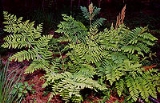
Royal fern

Encyclopedia
Osmunda regalis, the Old World Royal fern, is a species of Osmunda
, native to Europe
, Africa
, and Asia
, growing in woodland bog
s. The species is sometimes known as flowering fern due to the appearance of its fertile fronds.
, herbaceous
plant which produces separate fertile and sterile frond
s. The sterile fronds are spreading, 60-160 cm tall and 30-40 cm broad, bipinnate, with 7-9 pairs of pinnae up to 30 cm long, each pinna with 7-13 pairs of pinnules 2.5-6.5 cm long and 1-2 cm broad. The fertile fronds are erect and shorter, 20-50 cm tall, usually with 2-3 pairs of sterile pinnae at the base, and 7-14 pairs of fertile pinnae above bearing the densely-clustered sporangia
.
The "Royal" name derives from its being one of the largest and most imposing European ferns. In many areas, it has become rare as a result of wetland drainage for agriculture.
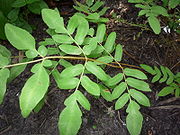 There are three to four varieties
as traditionally construed:
, Osmunda lancea
and Osmunda japonica. Recent genetic analysis (Metzgar et al., 2008) has shown that the New World varieties are in a clade that is sister to the Old World varieties of Osmunda regalis. If this is true, then O. lancea and O. japonica should either be regarded as varieties of O. regalis, or, conversely, O. regalis var. spectabilis should be regarded as a separate species, Osmunda spectabilis Willdenow
. The var. brasiliensis would then be Osmunda spectabilis Willdenow
var. brasiliensis Hooker
& Greville
.
s, along with those of other species of Osmunda, are used for the production of osmunda fibre, used as a growing medium for cultivated orchids and other epiphytic plants
.
According to Slavic mythology
, the sporangia, called "Perun
's flowers", have assorted magical powers, such as giving their holders the ability to defeat demon
s, fulfill wishes, unlock secrets, and understand the language of tree
s. However, collecting the sporangia is a difficult and frightening process. In earlier traditions, they must be collected on Kupala
night; later, after the arrival of Christianity
, the date is changed to Easter
eve. Either way, the person wanting to collect Perun's flowers must stand within a circle drawn around the plant and withstand the taunting or threats of demons.
Seasoned Royal Fern is also used in the dish Namul in Korean royal court cuisine
.
The young shoots of the fern are, along with the similar shoots of many other fern species, known in some places as fiddleheads, and eaten as food, thought to have an asparagus-like taste.
Osmunda
Osmunda is a genus of primarily temperate-zone ferns of family Osmundaceae. Five to ten species have been listed for this genus.The species have completely dimorphic fronds or pinnae , green photosynthetic sterile fronds, and non-photosynthetic spore-bearing fertile pinnae, with large, naked...
, native to Europe
Europe
Europe is, by convention, one of the world's seven continents. Comprising the westernmost peninsula of Eurasia, Europe is generally 'divided' from Asia to its east by the watershed divides of the Ural and Caucasus Mountains, the Ural River, the Caspian and Black Seas, and the waterways connecting...
, Africa
Africa
Africa is the world's second largest and second most populous continent, after Asia. At about 30.2 million km² including adjacent islands, it covers 6% of the Earth's total surface area and 20.4% of the total land area...
, and Asia
Asia
Asia is the world's largest and most populous continent, located primarily in the eastern and northern hemispheres. It covers 8.7% of the Earth's total surface area and with approximately 3.879 billion people, it hosts 60% of the world's current human population...
, growing in woodland bog
Bog
A bog, quagmire or mire is a wetland that accumulates acidic peat, a deposit of dead plant material—often mosses or, in Arctic climates, lichens....
s. The species is sometimes known as flowering fern due to the appearance of its fertile fronds.
Description
Osmunda regalis is a deciduousDeciduous
Deciduous means "falling off at maturity" or "tending to fall off", and is typically used in reference to trees or shrubs that lose their leaves seasonally, and to the shedding of other plant structures such as petals after flowering or fruit when ripe...
, herbaceous
Herbaceous
A herbaceous plant is a plant that has leaves and stems that die down at the end of the growing season to the soil level. They have no persistent woody stem above ground...
plant which produces separate fertile and sterile frond
Frond
The term frond refers to a large, divided leaf. In both common usage and botanical nomenclature, the leaves of ferns are referred to as fronds and some botanists restrict the term to this group...
s. The sterile fronds are spreading, 60-160 cm tall and 30-40 cm broad, bipinnate, with 7-9 pairs of pinnae up to 30 cm long, each pinna with 7-13 pairs of pinnules 2.5-6.5 cm long and 1-2 cm broad. The fertile fronds are erect and shorter, 20-50 cm tall, usually with 2-3 pairs of sterile pinnae at the base, and 7-14 pairs of fertile pinnae above bearing the densely-clustered sporangia
Sporangium
A sporangium is an enclosure in which spores are formed. It can be composed of a single cell or can be multicellular. All plants, fungi, and many other lineages form sporangia at some point in their life cycle...
.
The "Royal" name derives from its being one of the largest and most imposing European ferns. In many areas, it has become rare as a result of wetland drainage for agriculture.
Varieties
Variety (biology)
In botanical nomenclature, variety is a taxonomic rank below that of species: as such, it gets a three-part infraspecific name....
as traditionally construed:
- Osmunda regalis var. regalis. Europe, Africa, southwest Asia. Sterile fronds to 160 cm tall.
- Osmunda regalis var. panigrahiana R.D.Dixit. Southern Asia (India).
- Osmunda regalis var. brasiliensis (Hook. & Grev.) Pic. Serm. Tropical regions of Central and South America; treated as a synonym of var. spectabilis by some authors.
- Osmunda regalis var. spectabilis (Willdenow) A.Gray. Eastern North America. Sterile fronds to 100 cm tall.
Similar species
There are three very similar species, Osmunda spectabilisOsmunda spectabilis
Osmunda spectabilis is a species of fern once thought to be the same as Osmunda regalis, but recent genetic studies have shown it to be a separate species. -Description:...
, Osmunda lancea
Osmunda lancea
Osmunda lancea is a fern in the genus Osmunda, section Euosmunda. It is found in Japan.It often hybridizes with Osmunda japonica to produce O. × intermedia.-External Links:***...
and Osmunda japonica. Recent genetic analysis (Metzgar et al., 2008) has shown that the New World varieties are in a clade that is sister to the Old World varieties of Osmunda regalis. If this is true, then O. lancea and O. japonica should either be regarded as varieties of O. regalis, or, conversely, O. regalis var. spectabilis should be regarded as a separate species, Osmunda spectabilis Willdenow
Carl Ludwig Willdenow
Carl Ludwig Willdenow was a German botanist, pharmacist, and plant taxonomist. He is considered one of the founders of phytogeography, the study of the geographic distribution of plants...
. The var. brasiliensis would then be Osmunda spectabilis Willdenow
Carl Ludwig Willdenow
Carl Ludwig Willdenow was a German botanist, pharmacist, and plant taxonomist. He is considered one of the founders of phytogeography, the study of the geographic distribution of plants...
var. brasiliensis Hooker
William Jackson Hooker
Sir William Jackson Hooker, FRS was an English systematic botanist and organiser. He held the post of Regius Professor of Botany at Glasgow University, and was the first Director of the Royal Botanic Gardens, Kew. He enjoyed the friendship and support of Sir Joseph Banks for his exploring,...
& Greville
Robert Kaye Greville
Robert Kaye Greville was a Scottish mycologist, bryologist, and botanist. He was an accomplished artist and illustrator of natural history. In addition to science he was interested in political causes like abolitionism, capital punishment, keeping Sunday special and the temperance movement...
.
Uses
The rootRoot
In vascular plants, the root is the organ of a plant that typically lies below the surface of the soil. This is not always the case, however, since a root can also be aerial or aerating . Furthermore, a stem normally occurring below ground is not exceptional either...
s, along with those of other species of Osmunda, are used for the production of osmunda fibre, used as a growing medium for cultivated orchids and other epiphytic plants
Epiphyte
An epiphyte is a plant that grows upon another plant non-parasitically or sometimes upon some other object , derives its moisture and nutrients from the air and rain and sometimes from debris accumulating around it, and is found in the temperate zone and in the...
.
According to Slavic mythology
Slavic mythology
Slavic mythology is the mythological aspect of the polytheistic religion that was practised by the Slavs before Christianisation.The religion possesses many common traits with other religions descended from the Proto-Indo-European religion....
, the sporangia, called "Perun
Perun
In Slavic mythology, Perun is the highest god of the pantheon and the god of thunder and lightning. His other attributes were the fire, mountains, the oak, iris, eagle, firmament , horses and carts, weapons and war...
's flowers", have assorted magical powers, such as giving their holders the ability to defeat demon
Demon
call - 1347 531 7769 for more infoIn Ancient Near Eastern religions as well as in the Abrahamic traditions, including ancient and medieval Christian demonology, a demon is considered an "unclean spirit" which may cause demonic possession, to be addressed with an act of exorcism...
s, fulfill wishes, unlock secrets, and understand the language of tree
Tree
A tree is a perennial woody plant. It is most often defined as a woody plant that has many secondary branches supported clear of the ground on a single main stem or trunk with clear apical dominance. A minimum height specification at maturity is cited by some authors, varying from 3 m to...
s. However, collecting the sporangia is a difficult and frightening process. In earlier traditions, they must be collected on Kupala
Kupala
Polish Noc Świętojańska or Sobótka Russian, Ukrainian Ніч на Купала or Купало/Купайло and Belarusian Купала may mean the traditional fest or the name of a putative god...
night; later, after the arrival of Christianity
Christianity
Christianity is a monotheistic religion based on the life and teachings of Jesus as presented in canonical gospels and other New Testament writings...
, the date is changed to Easter
Easter
Easter is the central feast in the Christian liturgical year. According to the Canonical gospels, Jesus rose from the dead on the third day after his crucifixion. His resurrection is celebrated on Easter Day or Easter Sunday...
eve. Either way, the person wanting to collect Perun's flowers must stand within a circle drawn around the plant and withstand the taunting or threats of demons.
Seasoned Royal Fern is also used in the dish Namul in Korean royal court cuisine
Korean royal court cuisine
Korean royal court cuisine was the style of cookery within Korean cuisine traditionally consumed at the court of the Joseon Dynasty, which ruled Korea from 1392 to 1910. There has been a revival of this cookery style in the 21st century...
.
The young shoots of the fern are, along with the similar shoots of many other fern species, known in some places as fiddleheads, and eaten as food, thought to have an asparagus-like taste.