
Home      Discussion      Topics      Dictionary      Almanac
Signup       Login
Royal Military Police

Royal Military Police

Overview
The Royal Military Police (RMP) is the corps of the British Army
British Army
The British Army is the land warfare branch of Her Majesty's Armed Forces in the United Kingdom. It came into being with the unification of the Kingdom of England and Scotland into the Kingdom of Great Britain in 1707. The new British Army incorporated Regiments that had already existed in England...

 responsible for the policing of service personnel, and for providing a military police
Military police
Military police are police organisations connected with, or part of, the military of a state. The word can have different meanings in different countries, and may refer to:...

 presence both in the UK, and whilst service personnel are deployed overseas on operations and exercises.
Discussion
Ask a question about 'Royal Military Police'
Start a new discussion about 'Royal Military Police'
Answer questions from other users
Full Discussion Forum
 
Unanswered Questions
Encyclopedia
The Royal Military Police (RMP) is the corps of the British Army
British Army
The British Army is the land warfare branch of Her Majesty's Armed Forces in the United Kingdom. It came into being with the unification of the Kingdom of England and Scotland into the Kingdom of Great Britain in 1707. The new British Army incorporated Regiments that had already existed in England...

 responsible for the policing of service personnel, and for providing a military police
Military police
Military police are police organisations connected with, or part of, the military of a state. The word can have different meanings in different countries, and may refer to:...

 presence both in the UK, and whilst service personnel are deployed overseas on operations and exercises.

Members of the RMP are generally known as Redcaps because they wear red-topped peaked caps or red beret
Beret
A beret is a soft, round, flat-crowned hat, designated a "cap", usually of woven, hand-knitted wool, crocheted cotton, or wool felt, or acrylic fiber....

s. They normally wear the working uniform of the British Army and carry standard items of police 'belt kit'.

The RMP's origins can be traced back to the 13th Century but it was not until 1877 that a regular corps of military police was formed, with the creation of the Military Mounted Police (MMP). This was followed by the Military Foot Police (MFP) in 1885. The Military Mounted Police first engaged in combat in 1882 at the Battle of Tel el-Kebir. Although technically two independent corps, the two effectively functioned as a single organisation. In 1926 they were fully amalgamated to form the Corps of Military Police (CMP). In recognition of their service in the Second World War, they became the Corps of Royal Military Police (RMP) on 28 November 1946 under Army Order 167.

The RMP and their forbears have been deployed to most significant conflicts of the 20th Century, and more recently have been deployed to Iraq
Iraq
Iraq ; officially the Republic of Iraq is a country in Western Asia spanning most of the northwestern end of the Zagros mountain range, the eastern part of the Syrian Desert and the northern part of the Arabian Desert....

 and Afghanistan
Afghanistan
Afghanistan , officially the Islamic Republic of Afghanistan, is a landlocked country located in the centre of Asia, forming South Asia, Central Asia and the Middle East. With a population of about 29 million, it has an area of , making it the 42nd most populous and 41st largest nation in the world...

 in support of the British commitment in those countries.

Non-commissioned members of the RMP receive their basic training as soldiers, at the Army Training Centre at Pirbright in Surrey
Surrey
Surrey is a county in the South East of England and is one of the Home Counties. The county borders Greater London, Kent, East Sussex, West Sussex, Hampshire and Berkshire. The historic county town is Guildford. Surrey County Council sits at Kingston upon Thames, although this has been part of...

. They then receive further training at the Defence College of Policing and Guarding. RMP commissioned officers are trained at the Royal Military Academy Sandhurst
Royal Military Academy Sandhurst
The Royal Military Academy Sandhurst , commonly known simply as Sandhurst, is a British Army officer initial training centre located in Sandhurst, Berkshire, England...

, as are all other British Army officers.

The regimental march of the RMP is "The Watchtower" or "Hoch Heidecksburg" originally a German Army marching tune from 1912 by Rudolf Herzer. The RMP motto is Exemplo Ducemus, Latin for "By example, shall we lead".

Role


As well as policing service personnel whilst at home in the UK, the Royal Military Police are required to provide a capable military police presence in support of military operations overseas.

In the UK and overseas UK garrisons


Some Royal Military Police NCOs are allocated roles working on Service Family Accommodation (SFA) estates, such as Community Liaison Officer and Crime Reduction Officer. Part of this role involves visiting schools in the SFA catchment area, where the school's children come from service families. In the UK this work is often done in conjunction with the Ministry of Defence Police
Ministry of Defence Police
The Ministry of Defence Police is a civilian police force which is part of the United Kingdom's Ministry of Defence. The force is part of the larger government agency, the Ministry of Defence Police and Guarding Agency , together with the Ministry of Defence Guard Service...

.

In garrison towns, the RMP often patrol local town centres on Friday and Saturday nights at venues where service personnel are likely to frequent. Some of the roles the RMP fulfill include:
  • Assistance to civilian police forces in garrison towns.
  • Law enforcement and crime prevention, within the service community.
  • Provide Close Protection operatives from within the RMP for senior military personnel on operations.

When deployed on operations


The Royal Military Police are required to provide tactical military police support to the Army in all phases of military operations. When deployed, some of the roles the RMP fulfill include:
  • Controlling of mass incidents
  • War crime
    War crime
    War crimes are serious violations of the laws applicable in armed conflict giving rise to individual criminal responsibility...

     investigations
  • Handling criminal evidence
  • Reconnaissance patrols
  • Detainee handling
  • Search operations
  • General policing duties within operational bases
  • Winning the hearts and minds of local people
  • Foreign police and army training

In the UK


Royal Military Police officers are not sworn in as constable
Constable
A constable is a person holding a particular office, most commonly in law enforcement. The office of constable can vary significantly in different jurisdictions.-Etymology:...

s and only have police powers whilst dealing with military personnel. They do not have to be on Ministry of Defence land to exercise their authority over service personnel. They also have police powers over personnel of the other two branches of the Armed Forces: the Royal Navy
Royal Navy
The Royal Navy is the naval warfare service branch of the British Armed Forces. Founded in the 16th century, it is the oldest service branch and is known as the Senior Service...

 and the Royal Air Force
Royal Air Force
The Royal Air Force is the aerial warfare service branch of the British Armed Forces. Formed on 1 April 1918, it is the oldest independent air force in the world...

. The Royal Navy Police and RAF Police
Royal Air Force Police
The Royal Air Force Police is the Service Police branch of the Royal Air Force. It was formed on 1 April 1918, when the RAF was formed by the merger of the Royal Flying Corps and the Royal Naval Air Service . It is responsible for the policing of all service personnel much like there RN or Army...

 also have reciprocal police powers over British Army personnel.

A Military Police Officer can, however, arrest any individual in the UK who he has reasonable grounds to believe to be a member of HM Armed Forces. Military Police Officers can, and do, utilise powers under Sect 24 (A) Police and Criminal Evidence Act 1984 which allows them to arrest ANY individual they have reasonable grounds to suspect is commiting, has commited or is about to commit an indictable offence. They are allowed to use reasonable force, including the application of handcuffs, to achieve this.

Postings overseas


Where service personnel are deployed overseas the Royal Military Police are often called upon to provide a complete policing service. In these situations Royal Military Police Officers can often exercise police powers in respect of civilians subject to service discipline. This includes, not exclusively, service dependents and overseas contractors sponsored by the British Army.

In Germany
British Forces Germany
British Forces Germany , is the name for British Armed Forces service personnel and civilians based in Germany. It was first established following the Second World War as the British Army of the Rhine ....

, under the Status of forces agreement
Status of Forces Agreement
A status of forces agreement is an agreement between a host country and a foreign nation stationing forces in that country. SOFAs are often included, along with other types of military agreements, as part of a comprehensive security arrangement...

, the RMP has jurisdiction and primacy over British Forces personnel, their families, MoD contractors, and NAAFI staff. The German civil police
Law enforcement in Germany
Law enforcement in Germany is constitutionally vested solely with the states, which is one of the main features of the German political system. Therefore, unlike France, Italy, the United States, Canada or many other countries, Germany has no federal police force comparable to the Italian...

 only normally become involved where the interests of a German national are involved. The RMP also maintains a detachment (part of 101 Provost Company) in Belgium
Belgium
Belgium , officially the Kingdom of Belgium, is a federal state in Western Europe. It is a founding member of the European Union and hosts the EU's headquarters, and those of several other major international organisations such as NATO.Belgium is also a member of, or affiliated to, many...

 for working with convoys to and from the North Sea
North Sea
In the southwest, beyond the Straits of Dover, the North Sea becomes the English Channel connecting to the Atlantic Ocean. In the east, it connects to the Baltic Sea via the Skagerrak and Kattegat, narrow straits that separate Denmark from Norway and Sweden respectively...

 ports, through Belgium and the Netherlands
Netherlands
The Netherlands is a constituent country of the Kingdom of the Netherlands, located mainly in North-West Europe and with several islands in the Caribbean. Mainland Netherlands borders the North Sea to the north and west, Belgium to the south, and Germany to the east, and shares maritime borders...

 to the German border. This detachment works closely with both the Koninklijke Marechaussee
Koninklijke Marechaussee
The Koninklijke Marechaussee, the Royal Netherlands Marechaussee, abbreviated to KMar, is one of the four Services of the armed forces of the Netherlands...

 (Royal Dutch Military Police) and the Belgian Military Police Group.

History


The post of Provost Marshal
Provost Marshal
The Provost Marshal is the officer in the armed forces who is in charge of the military police .There may be a Provost Marshal serving at many levels of the hierarchy and he may also be the public safety officer of a military installation, responsible for the provision of fire, gate security, and...

 has existed since William of Cassingham
William of Cassingham
William of Cassingham was a country squire of Cassingham in Kent at the time of the First Barons' War. During that conflict he raised a guerrilla force of archers which opposed the otherwise total occupation of the south-east by Prince Louis of France...

 was appointed by Henry III
Henry III of England
Henry III was the son and successor of John as King of England, reigning for 56 years from 1216 until his death. His contemporaries knew him as Henry of Winchester. He was the first child king in England since the reign of Æthelred the Unready...

 on 28 May 1241 (the original title was Sergeant of the Peace).

During the Peninsula War from 1809-14, Duke of Wellington
Arthur Wellesley, 1st Duke of Wellington
Field Marshal Arthur Wellesley, 1st Duke of Wellington, KG, GCB, GCH, PC, FRS , was an Irish-born British soldier and statesman, and one of the leading military and political figures of the 19th century...

 asked for a Provost Marshal to be appointed to hang looters; by the end of the Peninsular War the Provost Marshal controlled 24 Assistant Provost Marshals. Members of this Staff Corps of Cavalry were identified by a red scarf tied around the right shoulder; whilst some consider this to have been the origin of the famous 'Red Cap' of the Royal Military Police and its forebears, it was more likely a precursor of the 'MP' armband (and now the Tactical Recognition Flash), which identifies the modern Military Policeman or Policewoman.

Although disbanded in 1814 at the end of the Peninsular War, the Duke of Wellington re-formed the Staff Corps of Cavalry to police the occupying British Army in France following Napoleon's defeat at the battle of Waterloo. Later, in the Crimean War
Crimean War
The Crimean War was a conflict fought between the Russian Empire and an alliance of the French Empire, the British Empire, the Ottoman Empire, and the Kingdom of Sardinia. The war was part of a long-running contest between the major European powers for influence over territories of the declining...

, a Mounted Staff Corps of almost 100 troopers from the Police Constabulary of Ireland, with some recruited from the Metropolitan Police, was established to prevent the theft of supplies, and to maintain discipline in camps. This 'Corps' was disbanded with the cessation of hostilities.

The Provost Marshal has always had men detached to assist him, an arrangement formalised by the Duke of Wellington in the Peninsular War; but only since 1877 has there actually existed a regular corps of military police. In that year, the Military Mounted Police (MMP) was formed, followed by the Military Foot Police (MFP) in 1885. The Military Mounted Police first engaged in combat in 1882 at the Battle of Tel el-Kebir. Although technically two independent corps, the two effectively functioned as a single organisation. In 1926 they were fully amalgamated to form the Corps of Military Police (CMP). In recognition of their service in the Second World War, they became the Corps of Royal Military Police (RMP) on 28 November 1946 under Army Order 167.

On 6 April 1992 the RMP lost its status as an independent corps, and together with the Military Provost Staff Corps
Military Provost Staff Corps
The Military Provost Staff Corps was the corps of the British Army which ran its military prisons. As the Military Provost Staff , the corps is now administratively part of the Adjutant General's Corps. It also provides operational support and technical advice for Prisoner of War handling during...

, became the Provost Branch of the Adjutant General's Corps
Adjutant General's Corps
The Adjutant General's Corps is a corps in the British Army responsible for many of its general administrative services. As of 2002, the AGC had a staff of 7,000 people...

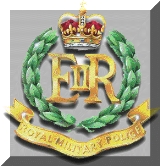
. It was, however, permitted to retain the name "Royal Military Police", together with its cap badge
Cap badge
A cap badge, also known as head badge or hat badge, is a badge worn on uniform headgear and distinguishes the wearer's nationality and/or organisation. The wearing of cap badges is a convention commonly found among military and police forces, as well as uniformed civilian groups such as the Boy...

 and other distinctive insignia including the red cap.

Significant dates


1511 First Provost Marshal of whom a personal record is known

1813-14 Staff Corps of Cavalry raised by Wellington for Peninsular War

1815-18 Staff Corps of Cavalry reformed for Waterloo Campaign

1854-55 Mounted Staff Corps formed for service in the Crimea

1855 Military Mounted Police (MMP) formed to police the new military cantonment at Aldershot

1877 MMP established as a Permanent Corps

1882 Military Foot Police (MFP) formed for campaign service in Egypt

1885 MFP established as a Permanent Corps

1918 Royal Air Force Police and Royal Air Force Police Special Investigations Branch formed

1926 Corps of Military Police (CMP) formed with amalgamation of MMP and MFP

1937 Field Security Police (FSP) Wing formed

1940 Army Special Investigation Branch formed - FSP joins new Intelligence Corps

1946 Royal Prefix granted to CMP

1953 First RMP Direct Entry Officers accepted

1977 HM The Queen becomes Colonel in Chief

1992 Formation of Adjutant Generals Corps of which RMP forms a part of the Provost Branch

First World War


In 1914 the Corps of Military Mounted Police and the Corps of Military Foot Police had a total establishment of nearly 5000 men. When the British Expeditionary Force was sent to France in that year, each division
Division (military)
A division is a large military unit or formation usually consisting of between 10,000 and 20,000 soldiers. In most armies, a division is composed of several regiments or brigades, and in turn several divisions typically make up a corps...

 had one Assistant Provost Marshal in the rank of Major
Major
Major is a rank of commissioned officer, with corresponding ranks existing in almost every military in the world.When used unhyphenated, in conjunction with no other indicator of rank, the term refers to the rank just senior to that of an Army captain and just below the rank of lieutenant colonel. ...

 and several NCOs. The Provost Marshal was a Colonel
Colonel
Colonel , abbreviated Col or COL, is a military rank of a senior commissioned officer. It or a corresponding rank exists in most armies and in many air forces; the naval equivalent rank is generally "Captain". It is also used in some police forces and other paramilitary rank structures...

 until 1915, and a Brigadier-General thenceforward.

During the retreat from Mons
Battle of Mons
The Battle of Mons was the first major action of the British Expeditionary Force in the First World War. It was a subsidiary action of the Battle of the Frontiers, in which the Allies clashed with Germany on the French borders. At Mons, the British army attempted to hold the line of the...

 the MPs were busy dealing with soldiers who, through exhaustion or the general confusion of battle, had either lost or became detached from their units. By operating stragglers posts, the MPs were able to return soldiers to their units. These posts were also well placed to pick out deserters and those Absent With Out Leave (AWOL).

The First World War was the conflict where traffic control became an important function. This was identified particularly after the Battle of Loos
Battle of Loos
The Battle of Loos was one of the major British offensives mounted on the Western Front in 1915 during World War I. It marked the first time the British used poison gas during the war, and is also famous for the fact that it witnessed the first large-scale use of 'new' or Kitchener's Army...

, when there was a lot of confusion involving two British divisions. As well as traffic control, the BEF provost units dealt with the maintenance of law and order (i.e. the detection of crime and the arrest of offenders), custody of prisoners of war until handed over to detention facilities, surveillance, control and protection of civilians.

The work undertaken by MPs was not all carried out behind the lines, and sometimes they came under heavy fire. During this conflict, the Military Police suffered 375 casualties. Sixty-five received the Distinguished Conduct Medal
Distinguished Conduct Medal
The Distinguished Conduct Medal was an extremely high level award for bravery. It was a second level military decoration awarded to other ranks of the British Army and formerly also to non-commissioned personnel of other Commonwealth countries.The medal was instituted in 1854, during the Crimean...

 and 260 received the Military Medal
Military Medal
The Military Medal was a military decoration awarded to personnel of the British Army and other services, and formerly also to personnel of other Commonwealth countries, below commissioned rank, for bravery in battle on land....

.

Second World War


At the beginning of the Second World War, the CMP had several branches:
  • Special Investigation Branch
    Special Investigation Branch
    The Special Investigation Branch is the name given to the detective branches of all three British military police arms: the Royal Navy Police, Royal Military Police and Royal Air Force Police. It is most closely associated with the Royal Military Police, which has the largest SIB. SIB members...

     (SIB); Red Caps, who were responsible for general policing;
  • Blue Caps (Vulnerable Points), responsible for security of static locations and establishments;
  • White Caps (Traffic Control); and
  • Field Security Wing (Green Caps), which was separated from the CMP in 1940 to form the Intelligence Corps, and who wore the CMP cap badge, but without the scroll.

By the end of the war the Red Caps had replaced the Blue and White Caps. The RMP provided support to the British Expeditionary Force
British Expeditionary Force (World War II)
The British Expeditionary Force was the British force in Europe from 1939–1940 during the Second World War. Commanded by General Lord Gort, the BEF constituted one-tenth of the defending Allied force....

 (BEF) in France and these units were also involved in Operation Dynamo
Operation Dynamo
The Dunkirk evacuation, commonly known as the Miracle of Dunkirk, code-named Operation Dynamo by the British, was the evacuation of Allied soldiers from the beaches and harbour of Dunkirk, France, between 26 May and the early hours of 3 June 1940, because the British, French and Belgian troops were...

.

Operation Overlord


On 6 June 1944, the Allies launched Operation Overlord, the invasion of the European mainland. CMP units taking part included:
  • 101st Provost Company, CMP (On 18 July 1944 this company landed, under enemy attack, at Courseilles-Sur-Mer
    Juno Beach
    Juno or Juno Beach was one of five sectors of the Allied invasion of German-occupied France in the Normandy landings on 6 June 1944, during the Second World War. The sector spanned from Saint-Aubin, a village just east of the British Gold sector, to Courseulles, just west of the British Sword sector...

    )
  • 150th Provost Company, CMP


"The Battle of Normandy
Operation Overlord
Operation Overlord was the code name for the Battle of Normandy, the operation that launched the invasion of German-occupied western Europe during World War II by Allied forces. The operation commenced on 6 June 1944 with the Normandy landings...

 and subsequent battles would never have been won but for the work and co-operation of the Provost on the traffic routes." (Field Marshal Montgomery
Bernard Montgomery, 1st Viscount Montgomery of Alamein
Field Marshal Bernard Law Montgomery, 1st Viscount Montgomery of Alamein, KG, GCB, DSO, PC , nicknamed "Monty" and the "Spartan General" was a British Army officer. He saw action in the First World War, when he was seriously wounded, and during the Second World War he commanded the 8th Army from...

, 1945)

Operation Market Garden


In 1944, the Allies launched Operation Market Garden, the airborne assault to capture bridges over the Lower Rhine in the Netherlands. The 1st (Airborne) Divisional Provost Company, CMP
British 1st Airborne Division
The 1st Airborne Division was a division of the British airborne forces during the Second World War. The division was formed in 1941, after British Prime Minister Winston Churchill demanded an airborne force...

 captured the police station in Arnhem
Arnhem
Arnhem is a city and municipality, situated in the eastern part of the Netherlands. It is the capital of the province of Gelderland and located near the river Nederrijn as well as near the St. Jansbeek, which was the source of the city's development. Arnhem has 146,095 residents as one of the...

, but then suffered heavy losses when the II SS Panzer Corps
II SS Panzer Corps
The II SS Panzer Corps was a Nazi German Waffen-SS armoured corps which saw action on both the Eastern and Western Fronts during World War II.- Formation - Kharkov :...

 counter attacked.

Operation Varsity


On 24 March 1945, the British 6th Airborne Division
British 6th Airborne Division
The 6th Airborne Division was an airborne division in the British Army during the Second World War. It took part in Operation Tonga, the airborne landings on the left flank of the invasion beaches in the Normandy Landings. It played a small part in the Battle of the Bulge and was involved in...

 successfully launched Operation Varsity at Wesel
Wesel
Wesel is a city in North Rhine-Westphalia, Germany. It is the capital of the Wesel district.-Division of the town:Suburbs of Wesel include Lackhausen, Obrighoven, Ginderich, Feldmark,Fusternberg, Büderich, Flüren and Blumenkamp.-History:...

, Western Germany. This airborne operation was part of the bigger Operation Plunder
Operation Plunder
Commencing on the night of 23 March 1945 during World War II, Operation Plunder was the crossing of the River Rhine at Rees, Wesel, and south of the Lippe River by the British 2nd Army, under Lieutenant-General Sir Miles Dempsey , and the U.S. Ninth Army , under Lieutenant General William Simpson...

, the crossing of the Rhine.

CMP units taking part in Operation Varsity were:
  • 6th (Airborne) Divisional Provost Company, CMP
  • HQ, 245th Provost Company, CMP


CMP units taking part in Operation Plunder included:
  • 101 Provost Company, CMP, 15th (Scottish) Division
    British 15th (Scottish) Division
    The 15th Infantry Division was a British Army division in both the First and Second World Wars.- First World War :The division was a New Army unit formed in September 1914 as part of the K2 Army Group. The division moved to France in July 1915 and spent the duration of the First World War in...


CMP units also served with British units of the 14th Army in the Burma campaign 1944-1945 (e.g. 2nd Division)

At war's end, General Sir Miles Dempsey
Miles Dempsey
General Sir Miles Christopher Dempsey, GBE, KCB, DSO, MC was commander of the British Second Army during the D-Day landings in the Second World War...

 paid the following tribute:
"The Military Policeman became such a well known figure on every road to the battlefield that his presence became taken for granted. Few soldiers as they hurried over a bridge which was a regular target for the enemy, gave much thought to the man who's duty it was to stand there for hours on end, directing the traffic and ensuring its rapid passage".

Cold War


In 1946 King George VI granted the 'Royal' prefix to the Corps of Royal Military Police (RMP) in recognition of its outstanding wartime record. (CRMP was chosen to avoid confusion with the Royal Canadian Mounted Police
Royal Canadian Mounted Police
The Royal Canadian Mounted Police , literally ‘Royal Gendarmerie of Canada’; colloquially known as The Mounties, and internally as ‘The Force’) is the national police force of Canada, and one of the most recognized of its kind in the world. It is unique in the world as a national, federal,...

 or RCMP)

In 1946, the Robertson-Malinin agreement introduced Military Missions into the post-war Control Zones of Germany. The Soviet Union
Soviet Union
The Soviet Union , officially the Union of Soviet Socialist Republics , was a constitutionally socialist state that existed in Eurasia between 1922 and 1991....

 maintained missions (SOXMIS) in the U.S., French and British zones. In the British sector the Soviet Mission was based in Bünde
Bünde
Bünde is a town in the Herford district, in North Rhine-Westphalia, Germany.-Geography:Bünde is situated between Osnabrück , Hannover and Bielefeld .- Waterways :...

 near Herford
Herford
Herford is a town in North Rhine-Westphalia, Germany, located in the lowlands between the hill chains of the Wiehen Hills and the Teutoburg Forest. It is the capital of the district of Herford.- Geographic location :...

. British Forces maintained a mission (BRIXMIS
BRIXMIS
The British Commanders'-in-Chief Mission to the Soviet Forces in Germany was set up on 16 September 1946 under the Robertson-Malinin Agreement between the chiefs of staff of the British and Soviet forces in occupied Germany....

) in the Soviet Zone (East Germany).

The RMP had the task of policing the Soviet mission in Bünde, and this was tasked to 19 (Support) Platoon RMP, who became known as "white mice". This unit's job was to wait outside the Soviet mission until a SOXMIS vehicle appeared and then follow it.

In restricted areas, Soviet vehicles were not permitted to leave the autobahns (not even in parking areas) unless accompanied by U.S., British or French military police.

The agreements remained in force until 2 October 1990, when all three missions were deactivated on the eve of Germany's reunification
German reunification
German reunification was the process in 1990 in which the German Democratic Republic joined the Federal Republic of Germany , and when Berlin reunited into a single city, as provided by its then Grundgesetz constitution Article 23. The start of this process is commonly referred by Germans as die...

.

In Berlin
Berlin
Berlin is the capital city of Germany and is one of the 16 states of Germany. With a population of 3.45 million people, Berlin is Germany's largest city. It is the second most populous city proper and the seventh most populous urban area in the European Union...

, within 2 Regiment RMP, 247 Provost Company RMP was responsible for manning the British Sector checkpoints and Border Patrols. As part of 2 Regiment, an armed unit of German nationals, 248 German Security Unit, was maintained; its commander was a German national in the rank of Major and an RSM from a British infantry regiment acted as liaison officer. This was disbanded in 1994, when the British Garrison in Berlin was closed. A third company within the 2 Regiment was 246 Provost Company in Helmstedt.

Korean War


The Korean War was fought between 1950 and 1953. As part of British and Commonwealth Forces the RMP deployed:
  • 27 Brigade Provost Section RMP
  • 28 Brigade Provost Section RMP


The Corps had one fatality during this conflict:
  • Sergeant D. R. Kinnear

Malayan Emergency and the Indonesia-Malaysia confrontation


The Malayan Emergency lasted from 1948 to 1960. The UK committed British forces (including the RMP) to combat communist guerilla forces. The Indonesia-Malaysia confrontation
Indonesia-Malaysia confrontation
Indonesia–Malaysia confrontation during 1962–1966 was Indonesia’s political and armed opposition to the creation of Malaysia. It is also known by its Indonesian/Malay name Konfrontasi...

 lasted from 1962 to 1966.

Between 1948 and 1956, thirteen members of the RMP lost their lives in this conflict. Britain still maintains military forces in Brunei
Brunei
Brunei , officially the State of Brunei Darussalam or the Nation of Brunei, the Abode of Peace , is a sovereign state located on the north coast of the island of Borneo, in Southeast Asia...

, including an RMP unit.

The Suez Canal Zone Emergency and Suez Crisis


Between 1951 and 1955, British forces stationed in the Suez canal zone were engaged in operations against terrorists. The RMP lost eight members during this emergency. The RMP were also involved in Operation Musketeer, the Suez Crisis
Suez Crisis
The Suez Crisis, also referred to as the Tripartite Aggression, Suez War was an offensive war fought by France, the United Kingdom, and Israel against Egypt beginning on 29 October 1956. Less than a day after Israel invaded Egypt, Britain and France issued a joint ultimatum to Egypt and Israel,...

 in 1956.

Cyprus Emergency


On 1 April 1955 a terrorist campaign was started by the Ethniki Organosis Kyprion Agoniston (EOKA
EOKA
EOKA was an anticolonial, antiimperialist nationalist organisation with the ultimate goal of "The liberation of Cyprus from the British yoke". Although not stated in its initial declaration of existence which was printed and distributed on the 1st of April 1955, EOKA also had a target of achieving...

) in Cyprus
Cyprus
Cyprus , officially the Republic of Cyprus , is a Eurasian island country, member of the European Union, in the Eastern Mediterranean, east of Greece, south of Turkey, west of Syria and north of Egypt. It is the third largest island in the Mediterranean Sea.The earliest known human activity on the...

. It lasted until 1959.

Units of the RMP involved which were involved during the emergency were:
  • 1st Guards Brigade HQ RMP. Waynes Keep, Nicosia
    Nicosia
    Nicosia from , known locally as Lefkosia , is the capital and largest city in Cyprus, as well as its main business center. Nicosia is the only divided capital in the world, with the southern and the northern portions divided by a Green Line...

  • 1 Independent Infantry Division Provost Company (Detachment) RMP. HQ Nicosia
  • 3 Infantry Division Provost Company RMP. Famagusta
    Famagusta
    Famagusta is a city on the east coast of Cyprus and is capital of the Famagusta District. It is located east of Nicosia, and possesses the deepest harbour of the island.-Name:...

  • No 6 Army Guard Unit RMP. Lakatamia, Larnaca
    Larnaca
    Larnaca, is the third largest city on the southern coast of Cyprus after Nicosia and Limassol. It has a population of 72,000 and is the island's second largest commercial port and an important tourist resort...

    , Dhekelia
  • 227 GHQ Provost Company RMP. Nicosia, with detachments at Famagusta, Limassol
    Limassol
    Limassol is the second-largest city in Cyprus, with a population of 228,000 . It is the largest city in geographical size, and the biggest municipality on the island. The city is located on Akrotiri Bay, on the island's southern coast and it is the capital of Limassol District.Limassol is the...

    , Larnaca, Paphos
    Paphos
    Paphos , sometimes referred to as Pafos, is a coastal city in the southwest of Cyprus and the capital of Paphos District. In antiquity, two locations were called Paphos: Old Paphos and New Paphos. The currently inhabited city is New Paphos. It lies on the Mediterranean coast, about west of the...

    , Kyrenia
    Kyrenia
    Kyrenia is a town on the northern coast of Cyprus, noted for its historic harbour and castle. Internationally recognised as part of the Republic of Cyprus, Kyrenia has been under Turkish control since the Turkish invasion of Cyprus in 1974...

  • 51 Brigade Independent Provost Company RMP
  • Cyprus District Provost Company


The following RMP casualties are buried at the Waynes Keep Cemetery
Commonwealth War Graves Commission
The Commonwealth War Graves Commission is an intergovernmental organisation of six independent member states whose principal function is to mark, record and maintain the graves, and places of commemoration, of Commonwealth of Nations military service members who died in the two World Wars...

, which is located in the United Nations Buffer Zone in Cyprus
United Nations Buffer Zone in Cyprus
The United Nations Buffer Zone in Cyprus runs for more than along what is known as the Green Line and has an area of . The zone partitions the island of Cyprus into a southern area effectively controlled by the government of the Republic of Cyprus , and the northern area...

.
  • Lance-Corporal W. R. Bell, 227 GHQ Provost Company RMP
  • Lance-Corporal W. N. Cameron, 51 Independent Infantry Brigade Provost Company RMP
  • Lance-Corporal R. J. Downing, 3 Infantry Division Provost Company RMP
  • Lance-Corporal R. B. Leitch, 227 Provost Company RMP
  • Lance-Corporal D. W. Perry, HQ 3 Brigade RMP
  • Lance-Corporal A. R. Shaw, 3 Independent Infantry Division Provost Company RMP
  • Lance-Corporal G. A. Todd
  • Lance-Corporal B. F. Turvey
  • Lance-Corporal B. D. Welsh


In 1955, Major Greenaway, who was the Officer Commanding 1 Division Provost Company (Detachment), was paralysed after being shot in the back; he was repatriated to the UK.

United Nations Peacekeeping Force in Cyprus


The United Nations Peacekeeping Force in Cyprus (UNFICYP) was established in 1964 to prevent a recurrence of fighting between the Greek Cypriots and Turkish Cypriots and to contribute to the maintenance and restoration of law and order and a return to normal conditions. After the 1974 Greek coup-d'etat and the Turkish invasion of Cyprus, the UN Security Council extended and expanded the mission to prevent that Cyprus dispute turning into war. RMP have served with the Force Military Police Unit(FMPU), from the outset.

The FMPU is 1 of only 2 multi-national sub units within UNFICYP, the other being the Mobile Force Reserve. The FMPU is commanded by a RMP major who is both OC FMPU and Provost Marshal. 7 other members of the RMP form the spine of the 25 strong unit. Other contributing nationalities are Argentina, Hungary and Slovakia. The British contribution to FMPU is now the longest enduring operational commitment for RMP.

Kenya, 1952–1960


During this period the British Army was conducting operations during the Mau Mau Uprising. An RMP unit was based in Nairobi
Nairobi
Nairobi is the capital and largest city of Kenya. The city and its surrounding area also forms the Nairobi County. The name "Nairobi" comes from the Maasai phrase Enkare Nyirobi, which translates to "the place of cool waters". However, it is popularly known as the "Green City in the Sun" and is...

.

Aden


The following RMP units were involved in the Aden Emergency (1964–1967):
  • 24 Brigade Provost Unit RMP (Falaise Barracks, Little Aden)
  • Port Security Force RMP (based at HMS Sheba until 1967)
  • Joint Services Police (Army Navy and Airforce) based at HQ P&SS Steamer Point until 1967

Northern Ireland: Operation Banner


During the troubles which started in 1969, four members of the RMP have lost their lives.

In 1977, in her Silver Jubilee Year, Her Majesty the Queen became Colonel-in-Chief of the Corp of the Royal Military Police.

Falklands Conflict: Operation Corporate


160 Provost Company RMP, located in Aldershot sent a detachment with the task force for the Falklands conflict. Fortunately all returned home safe and sound.

After the Argentine forces surrendered, 5 Infantry Brigade Provost Unit RMP remained on the islands, sworn in as Special Constable
Special constable
A Special Constable is a law enforcement officer who is not a regular member of a police force. Some like the Royal Canadian Mounted Police carry the same law enforcement powers as regular members, but are employed in specific roles, such as explosive disposal technicians, court security, campus...

s until the Falkland Islands Police Force
Royal Falkland Islands Police
The Royal Falkland Islands Police is the territorial police force responsible for law enforcement within the Falkland Islands. The Force was established on 1 November 1846 with the appointment of Francis Parry as Chief Constable...

 were able to become operational again. After the re-capture of South Georgia (Operation Paraquat), the Argentine commander Lieutenant-Commander Alfredo Astiz
Alfredo Astiz
Alfredo Ignacio Astiz was a Commander, intelligence office and maritime commando in the Argentine Navy during the dictatorial rule of Jorge Rafael Videla in the Proceso de Reorganización Nacional...

 was taken to the UK and questioned by the RMP and Sussex Police
Sussex Police
Sussex Police is the territorial police force responsible for policing East Sussex, West Sussex and City of Brighton and Hove in southern England. Its head office is in Lewes, Lewes District, East Sussex.-History:...

 at the Keep, Roussillon Barracks, Chichester
Chichester
Chichester is a cathedral city in West Sussex, within the historic County of Sussex, South-East England. It has a long history as a settlement; its Roman past and its subsequent importance in Anglo-Saxon times are only its beginnings...

 about the murder of Swedish and French nationals several years before. As there was no jurisdiction for extradition
Extradition
Extradition is the official process whereby one nation or state surrenders a suspected or convicted criminal to another nation or state. Between nation states, extradition is regulated by treaties...

 to Sweden
Sweden
Sweden , officially the Kingdom of Sweden , is a Nordic country on the Scandinavian Peninsula in Northern Europe. Sweden borders with Norway and Finland and is connected to Denmark by a bridge-tunnel across the Öresund....

 or France, he was repatriated to Argentina
Argentina
Argentina , officially the Argentine Republic , is the second largest country in South America by land area, after Brazil. It is constituted as a federation of 23 provinces and an autonomous city, Buenos Aires...

 by the International Committee of the Red Cross
International Committee of the Red Cross
The International Committee of the Red Cross is a private humanitarian institution based in Geneva, Switzerland. States parties to the four Geneva Conventions of 1949 and their Additional Protocols of 1977 and 2005, have given the ICRC a mandate to protect the victims of international and...

.

Middle East: Operation Granby


In 1991, British forces as part of US-led coalition forces invaded Kuwait and Southern Iraq as part of Operation Desert Storm. The British name for this operation was Operation Granby.

RMP units involved were:
  • 203 Provost Company RMP - 7th and 4th Armoured Brigades (1 (British) Armoured Division). This unit was a composite of various RMP units in United Kingdom Land Forces and British Forces Germany
    British Forces Germany
    British Forces Germany , is the name for British Armed Forces service personnel and civilians based in Germany. It was first established following the Second World War as the British Army of the Rhine ....

  • 174 Provost Company RMP - Force Maintenance Area, One section attached to 203 Pro.


The RMP suffered one fatality:
  • Staff Sergeant David Tite

Bosnia and Herzegovina


During 1994 the British Army deployed units to Bosnia
Bosnia and Herzegovina
Bosnia and Herzegovina , sometimes called Bosnia-Herzegovina or simply Bosnia, is a country in Southern Europe, on the Balkan Peninsula. Bordered by Croatia to the north, west and south, Serbia to the east, and Montenegro to the southeast, Bosnia and Herzegovina is almost landlocked, except for the...

 as part of the United Nations Protection Force
United Nations Protection Force
The United Nations Protection Force ', was the first United Nations peacekeeping force in Croatia and in Bosnia and Herzegovina during the Yugoslav wars. It existed between the beginning of UN involvement in February 1992, and its restructuring into other forces in March 1995...

 (UNPROFOR), which was later superseded by IFOR
IFOR
The Implementation Force was a NATO-led multinational peacekeeping force in Bosnia and Herzegovina under a one-year mandate from 20 December 1995 to 20 December 1996 under the codename Operation Joint Endeavour. Its task was to implement the military Annexes of The General Framework Agreement for...

 and then SFOR
SFOR
The Stabilisation Force was a NATO-led multinational peacekeeping force in Bosnia and Herzegovina which was tasked with upholding the Dayton Agreement. It replaced the previous force IFOR...

. These included:
  • 111 Provost Company Coy RMP - Force Military Police Unit (FMPU) support. The company was based in Vitez
    Vitez
    Vitez is a town and municipality in central Bosnia and Herzegovina. It is administratively part of the Central Bosnia Canton of the Federation of Bosnia and Herzegovina.-Name:...

    , Gornji Vakuf
    Gornji Vakuf
    Gornji Vakuf-Uskoplje is a town and municipality in Central Bosnia , located between Bugojno, Prozor, Kupres, Novi Travnik and Konjic. It is under the administration of the Federation of Bosnia and Herzegovina...

    , Kiseljak
    Kiseljak
    Kiseljak is a small town and municipality in central Bosnia and Herzegovina, located northwest of Sarajevo and south of Zenica. Kiseljak lies in the valley of the rivers Fojnica , Lepenica and Kreševka, which are a tributary of the Bosna, and it is on the intersection of roads from Visoko, Fojnica,...

    , Maglaj
    Maglaj
    Maglaj is a town and municipality in Bosnia-Herzegovina. It is situated in the northern part of Bosnia-Herzegovina, in the Zenica-Doboj canton. The city lies south of the city of Doboj, the regional trade, education, culture, entertainment, and business centre. The municipality of Maglaj is one of...

     and Split
    Split (city)
    Split is a Mediterranean city on the eastern shores of the Adriatic Sea, centered around the ancient Roman Palace of the Emperor Diocletian and its wide port bay. With a population of 178,192 citizens, and a metropolitan area numbering up to 467,899, Split is by far the largest Dalmatian city and...


  • Elements of 24 Airmobile Brigade Provost Unit (156 Provost Company, based in Colchester, England) provided the British Force Military Police Unit (FMPU) for UNPROFOR (UK Operation Grapple 5) between Oct 1994 and April 1995 based as above and then re-deployed as the Brigade Provost Unit when 24 Airmobile brigade deployed to Ploce in May/Jun 1995.

  • 115 Provost Company RMP (based in Osnabruck, Germany) provided the British Force Military Police Unit (FMPU) for UNPROFOR (UK Operation Grapple 7) between August and December 1995 and then reverted to its unit designation of 4th (UK) Armoured Brigade Provost Unit RMP as part of IFOR until April 1996.


RMP personnel have also been involved in the European Union Force (EUFOR), which took over in 2004.

Kosovo (Operation AGRICOLA)


On 12 June 1999, the UK sent 19,000 troops into Kosovo
Kosovo
Kosovo is a region in southeastern Europe. Part of the Ottoman Empire for more than five centuries, later the Autonomous Province of Kosovo and Metohija within Serbia...

 as part of KFOR. Lead units of the 5 Airborne Brigade
British 5th Infantry Brigade
The 5th Infantry Brigade was a regular British Army formation from the First World War to disbandment in 1999.- History :During both World War I and the Second World War the 5th Brigade was part of the 2nd Infantry Division. It served in France in 1940, was evacuated to Britain from Dunkirk and...

, which included the Royal Engineers and RMP, had to deal with booby traps in road tunnels before the Force could advance into Kosovo and seize the Kačanik
Kacanik
Kačanik or Kaçanik is a town and municipality in southern Kosovo, in the Uroševac district. The municipality covers an area of , including the town of Kačanik and 31 villages. It has a population of approximately 33,454...

 defile
Defile (geography)
Defile is a geographic term for a narrow pass or gorge between mountains or hills. It has its origins as a military description of a pass through which troops can march only in a narrow column or with a narrow front...

.

Uniform


Royal Military Police officers generally wear the working dress of the British Army. In addition they wear black stab vest
Stab vest
A stab vest, or stab proof vest is a reinforced piece of body armor, worn under or over other items of clothing, which is designed to resist knife attacks to the chest, back and sides...

s which display the RMP cap badge, and are labelled 'Military Police' on the front and rear. They also wear similar duty belt equipment to UK territorial police forces. All RMP officers are issued with a reversible high visibility saffron yellow jacket and/or a high visibility vest to be worn over their stab vests. Unlike other military police around the world, the RMP no longer wear white webbing
Webbing
Webbing is a strong fabric woven as a flat strip or tube of varying width and fibres often used in place of rope. The name webbing comes from the meshed material frequently used in its construction, which resembles a web...

, or white gaiters with barrack dress.

As well as their red caps and red berets, the RMP also wear a red stable belt
Stable belt
A stable belt is an item of uniform used in the armed forces of the United Kingdom and other Commonwealth countries. Stable belts or similar derivatives are also worn by the armed forced of other nations such as Denmark....

. Their stable belt was originally red until 1992, when they were federated into the Adjutant General's Corps
Adjutant General's Corps
The Adjutant General's Corps is a corps in the British Army responsible for many of its general administrative services. As of 2002, the AGC had a staff of 7,000 people...

 and started wearing the blue and red belt adopted by the AGC. Since then the RMP has reverted to the wearing of a new version of the original red stable belt as approved by the Army Dress Committee.

Equipment


The Royal Military Police officers are equipped with standard British Army weapons. It used to be the case that RMP Officers and Soldiers were issued pistols as standard however that is no longer the case and applies in overseas territories only. They are also issued with extendable baton
Baton (law enforcement)
A truncheon or baton is essentially a club of less than arm's length made of wood, plastic, or metal...

s, Hiatt Speedcuffs and personal radios, (linking direct to local civilian police forces).

Most RMP patrol cars have standard police Battenburg markings
Battenburg markings
Battenburg refers to a pattern of high-visibility markings used to maximise conspicuity, primarily used on vehicles of the emergency services, but also in other applications such as uniforms...

. Airwave police radios are fitted to those in the UK. In Germany RMP currently use Opel Vivaro's as their primary patrol vehicles.

The RMP also uses the Home Office Large Major Enquiry System known as HOLMES, as well as having limited access to the Police National Computer
Police National Computer
The Police National Computer is a computer system used extensively by law enforcement organisations across the United Kingdom. It went live in 1974 and now consists of several databases available 24 hours a day, giving access to information of national and local significance.From October 2009, the...

 database.

Organisation


The RMP is headed by the Provost Marshal, now a Brigadier
Brigadier
Brigadier is a senior military rank, the meaning of which is somewhat different in different military services. The brigadier rank is generally superior to the rank of colonel, and subordinate to major general....

. Every formation has a Deputy Provost Marshal (DPM), or Assistant Provost Marshal (APM). As well as being responsible for the Military Provost Staff Corps, the Provost Marshal (A) is also responsible for the Military Provost Guard Service
Military Provost Guard Service
The Military Provost Guard Service is a service responsible for maintaining security at British Armed Forces sites in the United Kingdom. It is one of three parts of the Adjutant General's Corps Provost Branch...

, who provides a guard force of armed soldiers for military establishments and units of all three services.

The RMP is divided into units called Provost Companies
Company (military unit)
A company is a military unit, typically consisting of 80–225 soldiers and usually commanded by a Captain, Major or Commandant. Most companies are formed of three to five platoons although the exact number may vary by country, unit type, and structure...

, subdivided into platoon
Platoon
A platoon is a military unit typically composed of two to four sections or squads and containing 16 to 50 soldiers. Platoons are organized into a company, which typically consists of three, four or five platoons. A platoon is typically the smallest military unit led by a commissioned officer—the...

s, and sometimes grouped into regiment
Regiment
A regiment is a major tactical military unit, composed of variable numbers of batteries, squadrons or battalions, commanded by a colonel or lieutenant colonel...

s. Platoons are commanded by a Second Lieutenant, or Lieutenant with a Staff Sergeant as the Platoons Second-in-Command (2ic). They are further divided into sections
Section (military unit)
A section is a small military unit in some armies. In many armies, it is a squad of seven to twelve soldiers. However in France and armies based on the French model, it is the sub-division of a company .-Australian Army:...

 under the command of Sergeant
Sergeant
Sergeant is a rank used in some form by most militaries, police forces, and other uniformed organizations around the world. Its origins are the Latin serviens, "one who serves", through the French term Sergent....

s. All non-commissioned
Non-commissioned officer
A non-commissioned officer , called a sub-officer in some countries, is a military officer who has not been given a commission...

 RMP personnel are promoted to Lance Corporal
Lance Corporal
Lance corporal is a military rank, used by many armed forces worldwide, and also by some police forces and other uniformed organizations. It is below the rank of corporal, and is typically the lowest non-commissioned officer, usually equivalent to the NATO Rank Grade OR-3.- Etymology :The presumed...

 as soon as they complete training in order to give them authority over other soldiers. Commissioned officers were once attached from other branches of the army, but can now be commissioned directly into the RMP.
The RMP is divided into three branches. Most personnel belong to the General Police Duties Branch, which performs uniformed policing and security duties. The Special Investigation Branch is dedicated to investigating more serious crime. The Close Protection Unit provides bodyguards for senior military officers and other key personnel (nominated by the Foreign and Commonwealth Office
Foreign and Commonwealth Office
The Foreign and Commonwealth Office, commonly called the Foreign Office or the FCO is a British government department responsible for promoting the interests of the United Kingdom overseas, created in 1968 by merging the Foreign Office and the Commonwealth Office.The head of the FCO is the...

) in danger zones. The RMP also trains military personnel in defensive driving techniques. There is also a Covert Operations Team that conducts surveillance operations in accordance with the Regulation of Investigatory Powers Act (RIPA) and Test Purchase operations.

The RMP sometimes shares its police stations with other police forces. At Catterick Garrison
Catterick Garrison
Catterick Garrison is a major Army base located in Northern England. It is the largest British Army garrison in the world with a population of around 12,000, plus a large temporary population of soldiers, and is larger than its older neighbour...

, the RMP station is shared with North Yorkshire Police
North Yorkshire Police
North Yorkshire Police is the territorial police force covering the non-metropolitan county of North Yorkshire and the unitary authority of York in northern England. The force covers England's largest county and comprises three area command units...

 (who man it during daylight hours). Another police station in Wiltshire
Wiltshire
Wiltshire is a ceremonial county in South West England. It is landlocked and borders the counties of Dorset, Somerset, Hampshire, Gloucestershire, Oxfordshire and Berkshire. It contains the unitary authority of Swindon and covers...

 is shared with the Ministry of Defence Police and Wiltshire Constabulary
Wiltshire Constabulary
Wiltshire Police, formerly known as the Wiltshire Constabulary, is the territorial police force responsible for policing Wiltshire and Swindon in the south-west of England.-History:...

. The RMP works closely with the Ministry of Defence Police on aspects of Garrison Policing and Security.

The HQ of the RMP is located at Trenchard lines in Upavon
Upavon
Upavon is a rural village in the English County of Wiltshire, England. As its name suggests, it is on the upper portions of the River Avon which runs from the north to the south through the village. It is situated about south of Pewsey, about southeast of the market town of Devizes, and about ...

, Wiltshire.
The regimental headquarters of the RMP moved to MOD Southwick Park, near Portsmouth
Portsmouth
Portsmouth is the second largest city in the ceremonial county of Hampshire on the south coast of England. Portsmouth is notable for being the United Kingdom's only island city; it is located mainly on Portsea Island...

 in February 2007. It is co-located with the tri-service Defence College of Policing and Guarding. The RMP training centre moved there on 27 September 2005 from the RMP's long-standing RHQ at Roussillon Barracks in Chichester
Chichester
Chichester is a cathedral city in West Sussex, within the historic County of Sussex, South-East England. It has a long history as a settlement; its Roman past and its subsequent importance in Anglo-Saxon times are only its beginnings...

, West Sussex. The Service Police Crime Bureau
Service Police Crime Bureau
The Service Police Crime Bureau is operated by the Royal Military Police, Royal Air Force Police and Royal Navy Police. It is located at the Defence College of Policing and Guarding at Southwick Park, near Portsmouth, England.The Bureau includes:...

 is also located at MOD Southwick Park and is staffed by personnel from the Royal Military Police, Royal Air Force Police and Royal Navy Police.

The RMP museum has also moved to MOD Southwick Park.

Colonel Commandants

  • Field-Marshal Sir James Cassels 1957-68
  • Field-Marshal Sir Geoffrey Baker
    Geoffrey Baker
    Field Marshal Sir Geoffrey Harding Baker GCB, CMG, CBE, MC was Chief of the General Staff, the professional head of the British Army.-Army career:...

     1968-71
  • General
    General (United Kingdom)
    General is currently the highest peace-time rank in the British Army and Royal Marines. It is subordinate to the Army rank of Field Marshal, has a NATO-code of OF-9, and is a four-star rank....

     Sir Cecil Blacker
    Cecil Blacker
    General Sir Cecil Hugh Blacker GCB OBE MC was a senior British Army officer and a former Adjutant-General to the Forces.-Military career:...

     1971-76
  • General Sir Peter Leng
    Peter Leng
    General Sir Peter John Hall Leng, KCB, MBE, MC was a British Army General & Master-General of the Ordnance & Counter Terrorism Expert in Northern Ireland.-Military service:...

     1976-81
  • General Sir James Glover
    James Glover (British Army officer)
    General Sir James Malcolm Glover KCB DL was a former Commander in Chief, UK Land Forces.-Army career:Educated at Wellington College, Jimmy Glover, as he was generally known, was commissioned into the Royal Artillery in 1949. He transferred to the Rifle Brigade in 1956 and served with the Brigade...

     1981-6
  • Field Marshal Peter Inge, Baron Inge
    Peter Inge, Baron Inge
    Field Marshal Peter Anthony Inge, Baron Inge was the Chief of the General Staff, the professional head of the British Army, between 1992 and 1994. He then served as Chief of the Defence Staff before retiring in 1997.-Army career:...

     1986-
  • Lieutenant-General Christopher Wallace -92

Training


RMP commissioned officers attend the Royal Military Academy Sandhurst
Royal Military Academy Sandhurst
The Royal Military Academy Sandhurst , commonly known simply as Sandhurst, is a British Army officer initial training centre located in Sandhurst, Berkshire, England...

, as do all other British Army officers. Other Ranks
Other Ranks
Other Ranks in the British Army, Royal Marines and Royal Air Force are those personnel who are not commissioned officers. In the Royal Navy, these personnel are called ratings...

 recruits undertake their phase 1, Common Military Syllabus (Recruits) training at Army Training Centre Pirbright. They then move onto Phase 2 which is undertaken at the Defence College of Policing and Guarding.

The training syllabus includes:
  • Police and Criminal Evidence Act 1984
    Police and Criminal Evidence Act 1984
    The Police and Criminal Evidence Act 1984 is an Act of Parliament which instituted a legislative framework for the powers of police officers in England and Wales to combat crime, as well as providing codes of practice for the exercise of those powers. Part VI of PACE required the Home Secretary...

     (PACE)
  • Armed Forces Act 2006
    Armed Forces Act 2006
    The Armed Forces Act 2006 is an Act of the Parliament of the United Kingdom.It came into force on 31 October 2009. It replaces the three separate Service Discipline Acts as the system of military law under which the British Armed Forces operate...

     (also Status of Forces in NATO)
  • Serious Organised Crime and Police Act 2005
    Serious Organised Crime and Police Act 2005
    The Serious Organized Crime and Police Act 2005 is an Act of the Parliament of the United Kingdom aimed primarily at creating the Serious Organised Crime Agency, it also significantly extended and simplified the powers of arrest of a constable and introduced restrictions on protests in the...

      (SOCAP 2005)
  • Geneva Conventions
    Geneva Conventions
    The Geneva Conventions comprise four treaties, and three additional protocols, that establish the standards of international law for the humanitarian treatment of the victims of war...

  • HAIG Rules
  • Unarmed Defensive Techniques (UDT)


Recruits are expected to maintain a high level of fitness, this is assessed, and improved upon in two ways:
  • Personal Fitness Test (PFT): An 800 metre warm up as a squad. This is followed by a 2400 metre (1.5 miles) run, to be completed in under ten and a half minutes. For those over 30 the time limit increases at intervals dependent on actual age. After training the PFT is conducted on a twice yearly basis; it is a requirement of service personnel to pass.

  • Combat Fitness Test (CFT): Normally undertaken in a squad wearing combat gear. This is to get the recruit used to "tabbing", a cross between a shuffle and a jog. It is especially useful for airborne troops, who may have been dropped several miles from their objective. This allows troops to get to the objective fast, but not in a way which depletes their fitness to fight and stamina whilst carrying a full kit load.

Professional training and qualifications


All the Service Police organisations use the Defence College of Policing and Guarding for a variety of advanced qualification courses such as level 3 and 4 of the Investigators course, Crime Scene Management, IT (HOLMES, CRIMES, COPPERS and REDCAP systems). Fraud Investigation training is provided and accredited by the Ministry of Defence Police
Ministry of Defence Police
The Ministry of Defence Police is a civilian police force which is part of the United Kingdom's Ministry of Defence. The force is part of the larger government agency, the Ministry of Defence Police and Guarding Agency , together with the Ministry of Defence Guard Service...

 Fraud Squad.

Senior officers


As of October 2010
  • Provost Marshal (PM(A)): Brigadier E. O. Forster-Knight OBE
  • Deputy Provost Marshal (Investigations): Colonel D C N Giles
  • Deputy Provost Marshal (Operations): Colonel I E Prosser
  • Deputy Provost Marshal (Historical Inquiries): Colonel J T Green OBE

Great Britain

  • Allied Rapid Reaction Corps MP Battalion (Worthy Down)

  • 3 Regiment RMP
    • 150 Provost Company (Catterick Garrison
      Catterick Garrison
      Catterick Garrison is a major Army base located in Northern England. It is the largest British Army garrison in the world with a population of around 12,000, plus a large temporary population of soldiers, and is larger than its older neighbour...

      ) (4 Mechanised Brigade)
    • 158 Provost Company (Bulford
      Bulford
      Bulford is a village and civil parish in Wiltshire, England, close to Salisbury Plain. According to the 2001 census the parish had a population of 4,698.The name is derived from the Old English bulut ieg ford meaning 'ragged robin island ford'....

      ) (1 Mechanised Brigade
      British 1st Infantry Brigade (Guards)
      The 1st Mechanized Brigade is a British Army formation with a long history including service during the First and Second World Wars .- History :Initially as 1st Brigade, the formation was part of 1st Division during World War I...

      )
    • 174 Provost Company (Donnington
      Donnington, Telford
      Donnington was not part of the new town of Telford but part of the already oudated Wellington Rural District which had built many council houses from the 1920s onwards. It is located in the borough of Telford and Wrekin and ceremonial county of Shropshire, England...

      ) (12 Mechanised Brigade)

  • 4 Regiment RMP
    • 160 Provost Company (Aldershot Garrison
      Aldershot Garrison
      Aldershot Garrison, also known as Aldershot Military Town, is a major garrison in South East England. Established in 1854, Aldershot has long been seen as the home of the British Army. The garrison was established when the war department brought a large area of land near to the village of...

      ) (101 Logistic Brigade)
    • 116 Provost Company (Volunteers) (Cannock
      Cannock
      Cannock is the most populous of three towns in the district of Cannock Chase in the central southern part of the county of Staffordshire in the West Midlands region of England....

      ) (101 Logistic Brigade))
      • Detachment, Belle Vue
        Belle Vue, Manchester
        Belle Vue is an area of Gorton, in the city of Manchester, England. It lies in the eastern part of the city, close to its boundary with Tameside, and is bordered by the Hope Valley Line on the east and the Glossop Line on the west...

        , Manchester
        Manchester
        Manchester is a city and metropolitan borough in Greater Manchester, England. According to the Office for National Statistics, the 2010 mid-year population estimate for Manchester was 498,800. Manchester lies within one of the UK's largest metropolitan areas, the metropolitan county of Greater...

    • 253 Provost Company
      253 Provost Company
      253 Provost Company Royal Military Police , often shortened to 253 Pro Coy RMP, is a Territorial Army Group A minor unit consisting of a headquarters and two platoons, based in London SW2. Following the recent Defence review, the company is also due to set up a platoon detachment at Southampton....

       (Volunteers) (Tulse Hill
      Tulse Hill
      Tulse Hill is a district in the London Borough of Lambeth in South London, England. It lies to the south of Brixton, east of Brixton Hill, north of West Norwood and west of West Dulwich.-History:...

      , London) (101 Logistic Brigade)
      • Detachment, Southampton
        Southampton
        Southampton is the largest city in the county of Hampshire on the south coast of England, and is situated south-west of London and north-west of Portsmouth. Southampton is a major port and the closest city to the New Forest...


  • Special Investigation Branch (UK) (SIB (UK) RMP)
    • Northern Region
    • Eastern Region
    • Western Region
    • 83 Section SIB (Volunteers) (Worthy Down
      RAF Worthy Down
      Worthy Down Barracks is a British Army barracks near Winchester, Hampshire. It is the headquarters and depot of the Adjutant General's Corps and is part of the Winchester Garrison...

      )

Germany

  • 1 Regiment RMP
    • 110 Provost Company (Paderborn) (20 Armoured Brigade)
    • 111 Provost Company (Bergen Hohne) (7 Armoured Brigade)

  • 5 Regiment RMP
    • RHQ (Gütersloh
      Gütersloh
      Gütersloh is a city in North Rhine-Westphalia, in the area of Westphalia and the administrative region of Detmold. Gütersloh is the administrative centre for a district of the same name and has a population of 96,320 people.- Geography :...

      , Germany) (102 Logistic Brigade)
      • RHQ Rear (Stockton-On-Tees
        Stockton-on-Tees
        Stockton-on-Tees is a market town in north east England. It is the major settlement in the unitary authority and borough of Stockton-on-Tees. For ceremonial purposes, the borough is split between County Durham and North Yorkshire as it also incorporates a number of smaller towns including...

        , UK)
    • 101 Provost Company (Monchengladbach
      Mönchengladbach
      Mönchengladbach , formerly known as Münchengladbach, is a city in North Rhine-Westphalia, Germany. It is located west of the Rhine half way between Düsseldorf and the Dutch border....

      , Germany) (52 Infantry Brigade)
      • Munster Detachment, Munster
    • 114 Provost Company (Gütersloh
      Gütersloh
      Gütersloh is a city in North Rhine-Westphalia, in the area of Westphalia and the administrative region of Detmold. Gütersloh is the administrative centre for a district of the same name and has a population of 96,320 people.- Geography :...

      , Germany) (102 Logistic Brigade)
      • Herford Detachment, Herford
    • 243 Provost Company (Volunteers) (Livingston
      Livingston, Scotland
      Livingston is a town in West Lothian, Scotland. It is the fourth post-WWII new town to be built in Scotland, designated in 1962. It is about 15 miles west of Edinburgh and 30 miles east of Glasgow, and is bordered by the towns of Broxburn to the northeast and Bathgate to the northwest.Livingston...

      ) (102 Logistic Brigade))
      • 2 Platoon, Lisburn
        Lisburn
        DemographicsLisburn Urban Area is within Belfast Metropolitan Urban Area and is classified as a Large Town by the . On census day there were 71,465 people living in Lisburn...

        , Northern Ireland
    • 252 Provost Company (Stockton-On-Tees
      Stockton-on-Tees
      Stockton-on-Tees is a market town in north east England. It is the major settlement in the unitary authority and borough of Stockton-on-Tees. For ceremonial purposes, the borough is split between County Durham and North Yorkshire as it also incorporates a number of smaller towns including...

      ) (102 Logistic Brigade))
      • 2 Pl Detachment, Newcastle Upon Tyne
        Newcastle upon Tyne
        Newcastle upon Tyne is a city and metropolitan borough of Tyne and Wear, in North East England. Historically a part of Northumberland, it is situated on the north bank of the River Tyne...


Each individual regular RMP company will have smaller Police stations and Police posts at other locations in their area where there is a sizeable Army presence.
  • Special Investigation Branch (G) (SIB (G) RMP)
    • HQ SIB (G)
    • Specialist Support Unit (Crime Scene Management and Technical Support)
    • 70 Section SIB (G)
    • 72 Section SIB (G) (Gütersloh)
    • 74 Section SIB (G) (Bielefeld)
    • 76 Section SIB (G)
    • 87 Section SIB (G) (Monchengladbach, co-located with 101 Provost Company)

Other units

  • 156 Provost Company - this is an independent provost company assigned to 16 Air Assault Brigade. Its members are trained in air assault methods, with one platoon being parachute trained.
  • Belize Police Unit
  • Brunei Police Unit
    British Military Garrison Brunei
    The British Military Garrison Brunei is the name given to the British armed forces presence in Brunei. Since the handover ceremony of Hong Kong in 1997, the garrison in Brunei is the only remaining British military base in the Far East, and along with Diego Garcia one of only two East of Suez...

  • British Army Training Unit Suffield
    British Army Training Unit Suffield
    The British Army Training Unit Suffield is a British Army unit located at the vast training area of Canadian Forces Base Suffield in Alberta, Canada...

     (BATUS), Canada
  • Cyprus Joint Police Unit (CJPU)
    Sovereign Base Areas
    The Sovereign Base Areas are military bases located on territory in which the United Kingdom is sovereign, but which are separated from the ordinary British territory....

    • 1 Platoon CJPU
    • 2 Platoon CJPU
    • SIB Cyprus
    • ESBA Section SIB
  • British Contingent, Force Military Police Unit, (FMPU), United Nations Peacekeeping Force in Cyprus
    United Nations Peacekeeping Force in Cyprus
    The United Nations Peacekeeping Force in Cyprus was established in 1964 to prevent a recurrence of fighting between the Greek Cypriots and Turkish Cypriots and to contribute to the maintenance and restoration of law and order and a return to normal conditions...

     (UNFICYP) - Operational Deployment - not part of British Forces Cyprus.
  • Joint Service Police Security Unit (JSPSU), Falkland Islands
  • Joint Provost and Security Unit (JP&SU), Gibraltar
    Gibraltar
    Gibraltar is a British overseas territory located on the southern end of the Iberian Peninsula at the entrance of the Mediterranean. A peninsula with an area of , it has a northern border with Andalusia, Spain. The Rock of Gibraltar is the major landmark of the region...

  • Joint Service Police Unit (JSPU), Diego Garcia
    Diego Garcia
    Diego Garcia is a tropical, footprint-shaped coral atoll located south of the equator in the central Indian Ocean at 7 degrees, 26 minutes south latitude. It is part of the British Indian Ocean Territory [BIOT] and is positioned at 72°23' east longitude....

    , British Indian Ocean Territory
    British Indian Ocean Territory
    The British Indian Ocean Territory or Chagos Islands is an overseas territory of the United Kingdom situated in the Indian Ocean, halfway between Africa and Indonesia...

  • SHAPE /AFNORTH RMP - Supreme Headquarters Allied Powers Europe
    Supreme Headquarters Allied Powers Europe
    Supreme Headquarters Allied Powers Europe is the central command of NATO military forces. It is located at Casteau, north of the Belgian city of Mons...

    , Belgium and Allied Forces North in the Netherlands.


The RMP are also currently deployed (22.5% of manpower) around the world in Kosovo
Kosovo
Kosovo is a region in southeastern Europe. Part of the Ottoman Empire for more than five centuries, later the Autonomous Province of Kosovo and Metohija within Serbia...

, Bosnia
Bosnia and Herzegovina
Bosnia and Herzegovina , sometimes called Bosnia-Herzegovina or simply Bosnia, is a country in Southern Europe, on the Balkan Peninsula. Bordered by Croatia to the north, west and south, Serbia to the east, and Montenegro to the southeast, Bosnia and Herzegovina is almost landlocked, except for the...

, Iraq
Iraq
Iraq ; officially the Republic of Iraq is a country in Western Asia spanning most of the northwestern end of the Zagros mountain range, the eastern part of the Syrian Desert and the northern part of the Arabian Desert....

, and Afghanistan
Afghanistan
Afghanistan , officially the Islamic Republic of Afghanistan, is a landlocked country located in the centre of Asia, forming South Asia, Central Asia and the Middle East. With a population of about 29 million, it has an area of , making it the 42nd most populous and 41st largest nation in the world...

.

83 Section SIB (V) RMP is maintained at Worthy Down at the Central Volunteer Headquarters. They formerly maintained four specialist general police duty companies, in addition to 83 Sec. These were 152, 251, 165 and 164 Provost Companies. These companies were disbanded in 1999 as part of the Strategic Defence Review
Strategic Defence Review
The Strategic Defence Review was a British policy document produced by the Labour Government that came to power in 1997. Then Secretary of State for Defence, George Robertson, set out the initial defence policy of the new government, with a series of key decisions designed to enhance the United...

. The CVHQ is now responsible for providing a specialist RMP territorial Army component known as the Allied Rapid Reaction Corps.

Operation Telic casualties


British operations in Iraq, including the 2003 invasion, were carried out under the name Operation Telic, which claimed the lives of several members of the RMP.
  • 24 June 2003, Al Majar Al Kabir, Iraq
    Iraq
    Iraq ; officially the Republic of Iraq is a country in Western Asia spanning most of the northwestern end of the Zagros mountain range, the eastern part of the Syrian Desert and the northern part of the Arabian Desert....

    :

All personnel shown below were from 156 Provost Company RMP (16 Air Assault Brigade). This incident represented the largest loss of life, on a single day, in RMP history.
    • Sergeant Simon Hamilton-Jewell
    • Corporal Russell Aston
    • Corporal Paul Long
    • Corporal Simon Miller
    • Lance Corporal Benjamin Hyde
    • Lance Corporal Thomas Keys

  • 23 August 2003, Basra
    Basra
    Basra is the capital of Basra Governorate, in southern Iraq near Kuwait and Iran. It had an estimated population of two million as of 2009...

    , Iraq
    • Major Matthew Titchener, 150 Provost Company
    • Company Sergeant Major Colin Wall, 150 Provost Company
    • Corporal Dewi Pritchard, 116 Provost Company (V)

  • 31 October 2004, Basra, Iraq
    • Staff Sergeant Denise Rose, SIB

  • 15 October 2005, Waterloo Lines, Basra, Iraq
    • Captain Ken Masters, Officer Commanding 61 Section SIB

  • 8 July 2007, Basra City, Iraq
    • Corporal Christopher Read, 158 Provost Company, 3rd Regiment RMP

Operation Herrick casualties


  • 30 May 2007, Kajaki, Helmand Province
    • Cpl Mike Gilyeat, Royal Military Police,

  • 7 May 2009,Gereshk, Helmand Province
    • Sgt Benjamin Ross, 173 Pro Coy, Royal Military Police.

  • 22 October 2009, Gereshk, Helmand Province
    • Cpl James Oakland, 156 Provost Company RMP

  • 3 November 2009, Nad-e'Ali, Helmand Province
    • Acting Cpl Steven Boote, 116 Provost Company (V), Royal Military Police
    • Cpl Nicholas Webster-Smith, 160 Provost Company, Royal Military Police

  • 18 November 2009, (Operation Herrick 11) Helmand Province
    • Sgt Robert David Loughran-Dickson, 160 Provost Company, 4th Regiment Royal Military Police

  • 20 December 2009, Sangin, Helmand Province
    • L/Cpl Michael David Pritchard, 160 Provost Company, 4th Regiment Royal Military Police

The RMP in popular culture


Redcap
Redcap (TV series)
Redcap is a British television series produced by ABC Weekend Television and broadcast on the ITV network.It starred John Thaw as Sergeant John Mann, a member of the Special Investigation Branch of the Royal Military Police and ran for two series and 26 episodes between 1964 and 1966, being about...

, an ABC television drama series which aired from 1964 to 1966, starred John Thaw
John Thaw
John Edward Thaw, CBE was an English actor, who appeared in a range of television, stage and cinema roles, his most popular being police and legal dramas such as Redcap, The Sweeney, Inspector Morse and Kavanagh QC.-Early life:Thaw came from a working class background, having been born in Gorton,...

 as SIB investigator Sergeant (later Staff Sergeant) John Mann.

Red Cap
Red Cap (TV series)
Red Cap is a British television series produced by Stormy Pictures for the BBC and broadcast on BBC One. Two series of 6 episodes each were produced following a feature length pilot. It featured the investigations of an SIB unit of the British Army based in Germany...

, another television drama series, which aired in 2003 and 2004, starred Tamzin Outhwaite
Tamzin Outhwaite
Tamzin Maria Outhwaite is an award-winning English actress. She became known for her role as Melanie Owen in the British soap opera EastEnders, whom she portrayed from 1998 until 2002.-Early career:...

 as Sergeant Jo McDonagh, also an SIB investigator .

Soldier Soldier
Soldier Soldier
Soldier Soldier is a British television drama series. The title comes from a traditional song of the same name.Produced by Central Television and broadcast on the ITV network, it ran for a total of seven series and 82 episodes from 1991 to 1997...

, a television drama series about an infantry company which aired from 1991 to 1997, featured Holly Aird as Corporal (later Sergeant) Nancy Thorpe RMP.

The Investigator (aired 1998) stars Helen Baxendale as a RMP Sgt. It is about life in the British forces at a time when being homosexual was banned and had serious repercussions, and is based on a true story.

The Real Redcaps was a television documentary series about the Royal Military Police which aired from 2003 to 2005.

7 Seconds was a Hollywood feature film (released August 2005) starring Wesley Snipes
Wesley Snipes
Wesley Trent Snipes is an American actor, film producer, and martial artist, who has starred in numerous action films, thrillers, and dramatic feature films. Snipes is known for playing the Marvel Comics character Blade in the Blade film trilogy, among various other high profile roles...

, that follows the actions of female Royal Military Police Sgt Kelly Anders (Tamzin Outhwaite
Tamzin Outhwaite
Tamzin Maria Outhwaite is an award-winning English actress. She became known for her role as Melanie Owen in the British soap opera EastEnders, whom she portrayed from 1998 until 2002.-Early career:...

). When an experienced thief accidentally makes off with a Van Gogh, his partner is kidnapped by gangsters in pursuit of the painting, forcing the thief to hatch a rescue plan, in which he joins forces with RMP Sgt Anders along the way.

See also

  • Regimental Provost
  • Service Police
  • Ministry of Defence Police
    Ministry of Defence Police
    The Ministry of Defence Police is a civilian police force which is part of the United Kingdom's Ministry of Defence. The force is part of the larger government agency, the Ministry of Defence Police and Guarding Agency , together with the Ministry of Defence Guard Service...

  • Service Police Crime Bureau
    Service Police Crime Bureau
    The Service Police Crime Bureau is operated by the Royal Military Police, Royal Air Force Police and Royal Navy Police. It is located at the Defence College of Policing and Guarding at Southwick Park, near Portsmouth, England.The Bureau includes:...


External links