
|
|
|
|
Royal Electrical and Mechanical Engineers
|
| |
|
| |
The Corps of Royal Electrical and Mechanical Engineers (REME; pronounced phonetically as "Reemee") is a corps of the British Army that has responsibility for the maintenance, servicing and inspection of almost every electrical and mechanical piece of equipment within the British Army from Challenger II main battle tanks and AH64 Apache helicopters to dental tools and cooking utensils.
World War II's increase in quantity and complexity of equipment exposed the flaws in this system.

Discussion
Ask a question about 'Royal Electrical and Mechanical Engineers'
Start a new discussion about 'Royal Electrical and Mechanical Engineers'
Answer questions from other users
|
Recent Posts

Encyclopedia
The Corps of Royal Electrical and Mechanical Engineers (REME; pronounced phonetically as "Reemee") is a corps of the British Army that has responsibility for the maintenance, servicing and inspection of almost every electrical and mechanical piece of equipment within the British Army from Challenger II main battle tanks and AH64 Apache helicopters to dental tools and cooking utensils.
History Prior to REME's formation, maintenance was the responsibility of several different corps:
World War II's increase in quantity and complexity of equipment exposed the flaws in this system. Pursuant to the recommendation of a committee William Beveridge chaired, the Corps of Royal Electrical and Mechanical Engineers was formed in October 1942. It was unique in being granted the 'Royal' prefix at its inception.
Such a major re-organisation was too complex, however, to be carried out quickly and completely in the middle of a world war. Therefore the changeover should be undertaken in two phases.
In Phase I, which was implemented immediately, REME was formed on the existing framework of the RAOC Engineering Branch, strengthened by the transfer of certain technical units and tradesmen from the RE and RASC. At the same time a number of individual tradesmen were transferred into REME from other corps. The new corps was made responsible for repairing the technical equipment of all arms with certain major exceptions. REME did not yet undertake:
- Those repairs which were carried out by unit tradesmen who were driver/mechanics or fitters in regiments and belonged to the unit rather than being attached to it.
- Repairs of RASC-operated vehicles, which remained the responsibility of the RASC; each RASC Transport Company had its own workshop.
- Repairs of RE specialist equipment, which remained the responsibility of the RE.
In 1949, it was decided that "REME Phase II" should be implemented. This decision was published in Army Council Instruction 110 of 1949, and the necessary reorganisation was carried out in the various arms and services in three stages between July 1951 and January 1952. The main changes were:
- The transfer to REME of most of the unit repair responsibilities of other arms (Infantry, Royal Artillery, Royal Armoured Corps etc).
- The provision of Light Aid Detachments for certain units that had not possessed them under the old organisation.
- The provision of new REME workshops to carry out field repairs in RASC transport companies and to vessels of the RASC fleet.
The Cap Badge:
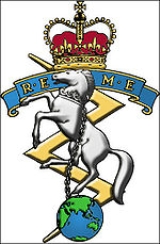
Various REME cap badges have been authorised since the Corps' formation and pictures of these can be found at the REME Museum. In 1947 the cap badge adopted the Horse and Lightning. This badge has a strong significance to the role of the Corps. The capbage consists of a Crown denoting the 'Royal' status granted them, the Horse and Chain represent mechanical power whilst the Lightning bolt represents Electrical and the Globe represents the application of Engineering universally.
The REME motto is 'Arte et Marte' which translated from Latin to English is 'By Skill and By Fighting'.
REME today
With minor exceptions only, REME is now responsible for the examination, modification, repair and recovery of all mechanical, electronic, electrical and optical equipment of the Army beyond the capacity of unit non-technical personnel. REME currently has its Arms and Service Directorate, DEME(A) and Regimental Headquarters collocated with the trade specific Level 2 training and advanced Level 3 training of Electronic and Aeronautical Technicians at Arborfield Garrison, in the county of Berkshire. Levels 1, 2, 3 and Artificer training of Electro/Mechanical trades of REME and various related training to other units within the British army and the Navy and Air Force is conducted at the School of Electrical and Mechanical Engineering (SEME) at Bordon in Hampshire.
Within REME there are a total of seven regular, two integrated and two TA battalions:
- Regular Army
- 1 (Close Support) Battalion, REME - 4 Armoured Brigade
- 2 (Close Support) Battalion, REME - 7 Armoured Brigade
- 3 (Close Support) Battalion, REME - 20 Armoured Brigade
- 4 (Close Support) Battalion, REME - 12 Mechanised Brigade
- 19 Light Brigade Combat Service Support Battalion - 19 Light Brigade
- 6 (Close Support) Battalion, REME - 1 Mechanised Brigade
- 7 Air Assault Battalion, REME - 16 Air Assault Brigade
- Integrated (mixed Regular and TA) 'Force Support' battalions
- 101 (Force Support) Battalions REME - 102 Logistic Brigade
- 104 (Force Support) Battalions REME - 101 Logistic Brigade
- Territorial Army
- 102 Battalion, REME (V) - Regional Forces
- 103 Battalion, REME (V) - Regional Forces
REME also maintains the REME Museum of Technology, which is situated at Arborfield Garrison and which is open to the public.
Former officers
- William Russell - left as a Major in 1947; later designed a coffee percolator in 1952, and the world's first automatic electric kettle in 1955, to be sold by his company Russell Hobbs.
- Ivan Hirst - left as a Major; saved Volkswagen from becoming a part of the spoils of the war reparations act at the end of WWII.
External links
Order of Precedence
|
| |
|
|