


Royal College of Physicians

Encyclopedia
- Not to be confused with the Royal College of Physicians of EdinburghRoyal College of Physicians of EdinburghThe Royal College of Physicians of Edinburgh was established in the 17th century. While the RCPE is based in Edinburgh, it is by no means just a Scottish professional body - more than half of its 7,700 Fellows, Members, Associates and Affiliates live and practice medicine outside Scotland, in 86...
or the Royal College of Physicians of IrelandRoyal College of Physicians of IrelandThe Royal College of Physicians of Ireland , was founded in 1654 and is a postgraduate medical organisation comprising Members and Fellows...
.
Royal Charter
A royal charter is a formal document issued by a monarch as letters patent, granting a right or power to an individual or a body corporate. They were, and are still, used to establish significant organizations such as cities or universities. Charters should be distinguished from warrants and...
of King Henry VIII
Henry VIII of England
Henry VIII was King of England from 21 April 1509 until his death. He was Lord, and later King, of Ireland, as well as continuing the nominal claim by the English monarchs to the Kingdom of France...
in 1518 - the first medical institution in England
England
England is a country that is part of the United Kingdom. It shares land borders with Scotland to the north and Wales to the west; the Irish Sea is to the north west, the Celtic Sea to the south west, with the North Sea to the east and the English Channel to the south separating it from continental...
to receive a royal charter. The college has been continuously active in improving practice medicine since then, primarily though training and qualifying new physicians. The president of the college is Sir Richard Thompson.
Post-nominals
The MRCP (UK) postnominals are obtained by doctors who have passed the Membership of the Royal College of PhysiciansMembership of the Royal College of Physicians
Membership of the Royal Colleges of Physicians is a postgraduate medical diploma. The examinations are run by the Federation of the Medical Royal Colleges of the United Kingdom – the Royal College of Physicians of London, the Royal College of Physicians of Edinburgh, and the Royal College...
examinations, held jointly with the other three Royal Colleges of Physicians in the UK and Ireland, through one of the UK colleges. Since the joint exam was originally set up with the other two UK colleges, the old qualification of MRCP (London) has continued to be awarded to a small number of people without examination. Holders of the MRCP (UK) are entitled to become "Collegiate Members" of this and/or the other two UK colleges. Both kinds of members may be considered for advancement to the fellowship.
Fellows (who use the postnominals FRCP) are elected mostly from the general Membership (MRCP), but also occasionally from among the members of the more specialised faculties within the Royal Colleges of Physicians, e.g., Occupational Medicine (MFOM), Pharmaceutical Medicine (MFPM), and Forensic and Legal Medicine (MFLM), etc. There are also Fellows who are elected de jure (usually medical experts from other countries), and honoris causa (dignitaries, members of the Royal Family, etc.).
The diploma of Licentiate of the Royal College of Physicians (LRCP) is no longer awarded. The LRCP qualification used to be reserved for medical graduates, in practice mainly Bachelors of Medicine from Oxford and Cambridge, but in the mid-nineteenth century became part of a very popular initial qualification in medicine awarded together with the MRCS (Eng) by the Conjoint Board
Conjoint
The conjoint was a basic medical qualification in the United Kingdom administered by the United Examining Board. It is now no longer awarded. The Conjoint Board was superseded in 1994 by the United Examining Board, which lost its permission to hold qualifying medical examinations after 1999.Medical...
which by the end of the twentieth century came to be largely taken by overseas graduates. From 1993 the LRCP was awarded together with the LRCS and LMSSA through the United Examining Board
United Examining Board
The United Examining Board was formed in 1993 to administer non-university qualifying examinations in medicine and surgery. The diplomas offered by the United Examining Board were registerable with the General Medical Council in order to register as a medical practitioner in the United Kingdom,...
until this pathway to medical registration was abolished in 1999.
History
A small group of distinguished physicians, led by the scholar and humanist Thomas LinacreThomas Linacre
Thomas Linacre was a humanist scholar and physician, after whom Linacre College, Oxford and Linacre House The King's School, Canterbury are named....
, petitioned the King to be incorporated into a College similar to those found in a number of other European countries. The main functions of the College, as set down in the founding Charter, were to grant licenses to those qualified to practice and to punish unqualified practitioners and those engaging in malpractice. This included apothecaries
Pharmacy
Pharmacy is the health profession that links the health sciences with the chemical sciences and it is charged with ensuring the safe and effective use of pharmaceutical drugs...
as well as physicians.
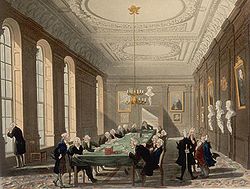
Amen Corner (London)
Amen Corner lies at the junction of Paternoster Row and Ave Maria Lane, just to the west of St Paul's Cathedral in the City of London.- History :...
near St Paul's Cathedral
St Paul's Cathedral
St Paul's Cathedral, London, is a Church of England cathedral and seat of the Bishop of London. Its dedication to Paul the Apostle dates back to the original church on this site, founded in AD 604. St Paul's sits at the top of Ludgate Hill, the highest point in the City of London, and is the mother...
, until it was burnt down in the Great Fire of London
Great Fire of London
The Great Fire of London was a major conflagration that swept through the central parts of the English city of London, from Sunday, 2 September to Wednesday, 5 September 1666. The fire gutted the medieval City of London inside the old Roman City Wall...
of 1666. The first Harveian Librarian was Christopher Merret.
Throughout its history the College has issued advice across the whole range of medical and health matters. College publications include the first ten editions of the London Pharmacopoeia (written in Latin, and used for regulating the composition of medicines from 1618 and, through the College's police the Censors, for enforcing the College's monopoly on medical science, then being challenged by the Society of Apothecaries), and the `Nomenclature of Diseases' in 1869. The latter created the international standard for the classification of diseases which was to last until the World Health Organisation's
Manual of the international classification of diseases
ICD
The International Statistical Classification of Diseases and Related Health Problems is a medical classification that provides codes to classify diseases and a wide variety of signs, symptoms, abnormal findings, complaints, social circumstances, and external causes of injury or disease...
superseded it in the twentieth century.
The College became the licensing body for medical books in the late seventeenth century, and sought to set new standards in learning through its own system of examinations. The College's great tradition of examining continues to this day and it is still perhaps how the College is best known to the general public.
Collections of the Royal College of Physicians
The collections at the Royal College of Physicians relate to the history of the College, and the history of the Physician’s profession. They help to place the history and development of medicine and health care in its widest context. The collections include; portraits, silver, medical instruments, the Symons Collection, commemorative medals and anatomical tables. Each individual item has a story to tell and can provide insights into a continual movement for the advancement of healthcare.The collection of c. 250 portraits provides a pictorial and sculptural record of Presidents, Fellows and other physicians associated with it from its foundation in 1518 to the present day. It includes some outstanding pieces by well-known artists, such as a bust of Baldwin Hamey Junior (1600–1676) by Edward Pierce and one of Richard Mead
Richard Mead
Richard Mead was an English physician. His work, A Short Discourse concerning Pestilential Contagion, and the Method to be used to prevent it , was of historic importance in the understanding of transmissible diseases.-Life:The eleventh child of Matthew Mead , Independent divine, Richard was born...
(1673–1754) by Louis François Roubiliac. But perhaps of more interest are the portraits by lesser-known artists, revealing their best talents, such as Richard Hale
Richard Hale
Richard Hale was an American character actor of film, stage and television. Hale was known for his unusual appearance which usually landed him in the roles of either Middle Eastern or Native American characters....
(1670–1728) by Jonathan Richardson.
The silver collection reflects events in the College’s history as well as the lives and generosity of its Fellows and Members. Few pieces pre-date the Great Fire of London
Great Fire of London
The Great Fire of London was a major conflagration that swept through the central parts of the English city of London, from Sunday, 2 September to Wednesday, 5 September 1666. The fire gutted the medieval City of London inside the old Roman City Wall...
(1666) because of a robbery during the previous year. Baldwin Hamey’s inkstand bell and William Harvey
William Harvey
William Harvey was an English physician who was the first person to describe completely and in detail the systemic circulation and properties of blood being pumped to the body by the heart...
's demonstration rod are two of the pieces that survive. Many pieces of silver are ‘working’ objects and are used to this day for formal occasions in the College. Special objects include the President’s staff of office, the caduceus and the silver-gilt
Silver-gilt
Silver-gilt or gilded/gilt silver, sometimes known in American English by the French term vermeil, is silver gilded with gold. Most large objects made in goldsmithing that appear to be gold are actually silver-gilt; for example most sporting trophies, medals , and many crown jewels...
College mace.
The College also owns six 17th century anatomical tables, probably made by drying and mounting the actual blood vessels and nerves of the human body onto blocks of wood and then varnishing them. They would have been used as a teaching aid for teaching anatomy, because it was difficult to obtain cadavers for dissection.
The Symons Collection of medical instruments is well displayed within the College building. The collection began as a collection of objects relating to self-care in Georgian times and expanded to include items that would have been used by physicians when treating patients, mostly in the eighteenth and nineteenth centuries.
The collections are open to the general public Monday to Friday 9am - 5pm. The Royal College of Physicians is a member of the London Museums of Health & Medicine
The London Museums of Health & Medicine
The London Museums of Health & Medicine is an organization that brings together some of the activities of some of the museums in London related to health and medicine...
.
Facility
The College's former headquarters on Trafalgar Square is now Canada HouseCanada House
The High Commission of Canada in the United Kingdom in London is the diplomatic mission from Canada to the United Kingdom. It is housed in two buildings in London.-History:...
, part of the Canadian high commission in London.
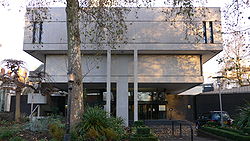
The College is now located in St. Andrews Place, which is at the north end of the road running up the east side of Regent's Park
Regent's Park
Regent's Park is one of the Royal Parks of London. It is in the north-western part of central London, partly in the City of Westminster and partly in the London Borough of Camden...
, Park Square East. The College building itself is notable. It was designed by architect
Architect
An architect is a person trained in the planning, design and oversight of the construction of buildings. To practice architecture means to offer or render services in connection with the design and construction of a building, or group of buildings and the space within the site surrounding the...
Sir Denys Lasdun
Denys Lasdun
Sir Denys Lasdun CH was an eminent English architect. Probably his best known work is the Royal National Theatre, on London's South Bank of the Thames, which is a Grade II* listed building and one of the most notable examples of Brutalist design in the United Kingdom.Lasdun studied at the...
in 1964 and has since been recognised as a building of national importance: it is a Grade I listed building, one of a very select band of post-war buildings sharing this distinction. Lasdun's use of mosaic clad concrete was extremely influential on many later public buildings. An interesting feature of the building was a 'Moving Wall', weighing five tons (5080 kg) and capable of being hydraulically lifted ten feet (3050 mm) to unite or sub-divide a hall of sixty-two feet (18.9 m) width, which was the interior width of the building. The hydraulic equipment and the steel framework for the Moving Wall were produced by Merryweather & Sons
Merryweather & Sons
Merryweather & Sons of Clapham, later Greenwich, London, were builders of steam fire engines and steam tram engines.The founder was Moses Merryweather of Clapham, who was joined by his son Richard Moses .-Fire appliances:...
Ltd of Greenwich
Greenwich
Greenwich is a district of south London, England, located in the London Borough of Greenwich.Greenwich is best known for its maritime history and for giving its name to the Greenwich Meridian and Greenwich Mean Time...
, hydraulic engineers. Although better known for fire fighting equipment it was not the company's first installation of this kind. Technical details of the Moving Wall can be found in Engineering
Engineering
Engineering is the discipline, art, skill and profession of acquiring and applying scientific, mathematical, economic, social, and practical knowledge, in order to design and build structures, machines, devices, systems, materials and processes that safely realize improvements to the lives of...
journal, 1 Jan. 1965.
Publications
Clinical MedicineClinical Medicine
Clinical Medicine is a peer-reviewed medical journal published bimonthly by the Royal College of Physicians. It was established in 1966 as the Journal of the Royal College of Physicians of London. It was doubly named between 1998 and 2000, and since 2001 it has appeared as Clinical Medicine. Its...
is the College's own medical journal
Medical journal
A public health journal is a scientific journal devoted to the field of public health, including epidemiology, biostatistics, and health care . Public health journals, like most scientific journals, are peer-reviewed...
. It appears once every two months. In addition, the college publishes regular reports, clinical guidelines, and the annual series 'Horizons in Medicine'. Their 'Faculty of Occupational Medicine' publishes 'Occupational and Environmental Medicine', a monthly-published journal that contains studies and articles concerting topics related to human health and environmental topics.
Training Faculties
Faculty of Pharmaceutical MedicineFaculty of Pharmaceutical Medicine
The Faculty of Pharmacutical Medicine is a Faculty of the three Royal Colleges of Physicians of the UK...
The Faculty of Pharmaceutical Medicine (FPM) of the Royal Colleges’ of Physicians aims to maintain the highest professional standards in the specialty through activities such as the setting of the Diploma in Pharmaceutical Medicine and other examinations and supervising specialty training in pharmaceutical medicine.
Faculty of Occupational Medicine
The Faculty of Occupational Medicine (FOM) was established to develop and maintain high standards of training and professional integrity in the specialty of occupational medicine. It sets exams, supervises training and supports physicians in their continued professional development. The Faculty also acts as an authoritative body for consultation in matters of education and public interest concerning occupational medicine
College lectures
The College holds an annual lecture, commonly referred to as the Lumleian LecturesLumleian Lectures
The Lumleian Lectures are a series of annual lectures run by the Royal College of Physicians of London, started in 1582 and now run by the Lumleian Trust. The name commemorates John Lumley, 1st Baron Lumley, who with Richard Caldwell of the College endowed the lectures, initially confined to...
, which were named in honour of Lord Lumley
John Lumley, 1st Baron Lumley
John Lumley, 1st Baron Lumley was an English aristocrat.- Early life :John Lumley was born about 1533, was grandson and heir of John, Lord Lumley, being son and heir of his only son and heir apparent George Lumley by Jane second daughter and coheir of Sir Richard Knightly of Upton,...
and established as part of the Lumleian Trust. The trust and lectures were established in 1582 by Dr. Richard Caldwell, a former president of the college. The subject matter of the lectures was initially in surgery, which was later changed to in medicine. The first lecture was given by Richard Forster
Richard Forster
-Life:He was son of Laurence Forster, and was born at Coventry about 1546, and was educated at All Souls' College, Oxford. He graduated at Oxford, M.B. and M.D., both in 1573....
, and the lectures continue to today.
Other annual lectures are the Croonian Lecture
Croonian Lecture
The Croonian Lectures are prestigious lectureships given at the invitation of the Royal Society and the Royal College of Physicians.Among the papers of William Croone at his death in 1684, was a plan to endow one lectureship at both the Royal Society and the Royal College of Physicians...
, the Goulstonian Lecture and the Bradshaw Lecture
Bradshaw Lecture
The Bradshaw Lectures are prestigious lectureships given at the invitation of the Royal College of Physicians and the Royal College of Surgeons of England....
.
Once a year, traditionally on St Lukes Day, a Fellow is appointed to deliver the Harveian Oration
Harveian Oration
The Harveian Oration is a yearly lecture held at the Royal College of Physicians of London. It was instituted in 1656 by William Harvey, discoverer of the systemic circulation. Harvey made financial provision for the college to hold an annual feast on St...
to the assembled college in memory of William Harvey
William Harvey
William Harvey was an English physician who was the first person to describe completely and in detail the systemic circulation and properties of blood being pumped to the body by the heart...
. The oration seeks to honour the founders and benefactors of the college and encourage a spirit of experimentation amongst the members.
Notable Alumni
- Dr. Abdul Malik (professor)Abdul Malik (professor)-Description:Professor Malik is a MBBS , MRCP , FCCP , FCPS , FRCP , FRCP , FACC . He served as:* Member, Expert Panel Committee of World Health Organization on Cardiovascular Disease ;...
, cardiologist and National ProfessorNational ProfessorNational Professor is a prestigious teaching award given by the Government of Bangladesh for outstanding contribution on the field of education. It is awarded by the president of Bangladesh according to Bangladesh National Professor Act 1981...
of BangladeshBangladeshBangladesh , officially the People's Republic of Bangladesh is a sovereign state located in South Asia. It is bordered by India on all sides except for a small border with Burma to the far southeast and by the Bay of Bengal to the south...
.
Further reading
- Dodds, C. (1954) http://www.pubmedcentral.nih.gov/articlerender.fcgi?artid=1919154Christopher MerrettChristopher MerrettChristopher Merret FRS was an English physician and scientist. He was the first to document the deliberate addition of sugar for the production of sparkling wine, and produced the first list of British birds.-Life:Merret was born in Winchcombe, Gloucestershire on 16 February; Hunter gives the...
, F.R.C.P. (1614–1695), First Harveian Librarian] Proc R Soc Med. 1954 December; 47(12): 1053–1056. Old but detailed account of Merrett's time at the College, from the creation of the library to the Great Fire of London.
External links
- Official website RCPLONDON
- Official website MRCPUK
- Notes on the Royal College of Physicians from the Scholarly Societies project (includes information on the journals of the society)