
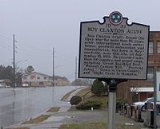
Roy Claxton Acuff was an American
country musicCountry music is a popular American musical style that began in the rural Southern United States in the 1920s. It takes its roots from Western cowboy and folk music...
singer, fiddler, and promoter. Known as the King of Country Music, Acuff is often credited with moving the genre from its early
string bandA string band is an old-time music or jazz ensemble made up mainly or solely of string instruments. String bands were popular in the 1920s and 1930s, and are among the forerunners of modern country music and bluegrass.-String bands in old-time music:...
and "hoedown" format to the star singer-based format that helped make it internationally successful.
Acuff began his music career in the 1930s, and gained regional fame as the singer and fiddler for his group, the Smoky Mountain Boys. He joined the
Grand Ole OpryThe Grand Ole Opry is a weekly country music stage concert in Nashville, Tennessee, that has presented the biggest stars of that genre since 1925. It is also among the longest-running broadcasts in history since its beginnings as a one-hour radio "barn dance" on WSM-AM...
in 1938, and although his popularity as a musician waned in the late 1940s, he remained one of the Opry's key figures and promoters for nearly four decades. In 1942, Acuff co-founded the first major
NashvilleNashville is the capital of the U.S. state of Tennessee and the county seat of Davidson County. It is located on the Cumberland River in Davidson County, in the north-central part of the state. The city is a center for the health care, publishing, banking and transportation industries, and is home...
-based country music publishing company—
Acuff-Rose MusicAcuff-Rose Music was an American music publishing firm formed by Roy Acuff and Fred Rose in Nashville, Tennessee. Acuff-Rose's honest behavior towards their writers set them apart from other music publishing firms at the time and lead them to fame throughout the 50's, 60's, 70's.-History:Acuff-Rose...
—which signed acts such as Hank Williams,
Roy OrbisonRoy Kelton Orbison was an American singer-songwriter, well known for his distinctive, powerful voice, complex compositions, and dark emotional ballads. Orbison grew up in Texas and began singing in a rockabilly/country & western band in high school until he was signed by Sun Records in Memphis...
, and
The Everly BrothersThe Everly Brothers are country-influenced rock and roll performers, known for steel-string guitar playing and close harmony singing...
. In 1962, Acuff became the first living person inducted into the Country Music Hall of Fame.
Early life
Roy Acuff was born in
Maynardville, TennesseeMaynardville is a city in and the county seat of Union County, Tennessee, United States. Its population was 1,782 at the 2000 census. It is included in the Knoxville, Tennessee Metropolitan Statistical Area....
to Ida Carr and Simon E. Neill Acuff, the third of five children. The Acuffs were a fairly prominent
Union County family. Roy's paternal grandfather, Coram Acuff, had been a Tennessee state senator, and Roy's maternal grandfather was a local physician. Roy's father was an accomplished fiddler and a
BaptistBaptists comprise a group of Christian denominations and churches that subscribe to a doctrine that baptism should be performed only for professing believers , and that it must be done by immersion...
preacher, his mother was proficient on the piano, and during Roy's early years the Acuff house was a popular place for local gatherings. At such gatherings, Roy would often amuse people by balancing farm tools on his chin. He also learned to play
harmonicaThe harmonica, also called harp, French harp, blues harp, and mouth organ, is a free reed wind instrument used primarily in blues and American folk music, jazz, country, and rock and roll. It is played by blowing air into it or drawing air out by placing lips over individual holes or multiple holes...
and jaw harp at a young age.
The Acuff family relocated to
Fountain CityFountain City is a neighborhood in northern Knoxville, Tennessee, in the southeastern United States. Although not a census-designated place , the populations of the two zip codes that serve Fountain City— 37918 and 37912— were 36,815 and 18,695, respectively, as of the 2000 U.S. census...
, a suburb of North
KnoxvilleFounded in 1786, Knoxville is the third-largest city in the U.S. state of Tennessee, U.S.A., behind Memphis and Nashville, and is the county seat of Knox County. It is the largest city in East Tennessee, and the second-largest city in the Appalachia region...
, in 1919. Roy attended
Central High SchoolCentral High School is a public high school located at 5321 Jacksboro Pike in the Fountain City neighborhood of Knoxville, Tennessee, operated by the Knox County school system...
, where he sang in the school chapel's choir and performed in "every play they had." Roy's primary passion, however, was athletics. He was a three-sport standout at Central, and after graduating in 1925, he was offered a scholarship to Carson-Newman, but turned it down. He played with several small baseball clubs around Knoxville, worked at odd jobs, and occasionally boxed. In 1929, he tried out for the
Knoxville SmokiesThe Tennessee Smokies are a Minor League Baseball team based in the Knoxville, Tennessee metropolitan area. The team, which plays in the Southern League, is the Double-A affiliate of the Chicago Cubs of Major League Baseball as of the 2011 season...
, at that time a minor league baseball team for the New York Giants (now the
San Francisco GiantsThe San Francisco Giants are a Major League Baseball team based in San Francisco, California, playing in the National League West Division....
). A series of collapses in spring training following a sunstroke, however, ended his baseball career prematurely. The effects left him ill for several years, and he even suffered a
nervous breakdownMental breakdown is a non-medical term used to describe an acute, time-limited phase of a specific disorder that presents primarily with features of depression or anxiety.-Definition:...
in 1930. "I couldn't stand any sunshine at all," he later recalled. While recovering, Acuff began to hone his fiddle skills, often playing on the family's front porch in late afternoons after the sun went down. His father gave him several records of regionally-renowned fiddlers, such as
Fiddlin' John CarsonFiddlin' John Carson was an American old time fiddler and an early-recorded country musician.-Early life:...
and
Gid TannerJames Gideon Tanner was an American old time fiddler and one of the earliest stars of what would come to be known as country music. His band, the Skillet Lickers, was one of the most innovative and influential string bands of the 1920s and 1930s...
, which were important influences on his early style.
Early music career
In 1932, Dr. Hauer's
medicine showMedicine shows were traveling horse and wagon teams which peddled "miracle cure" medications and other products between various entertainment acts. Their precise origins unknown, medicine shows were common in the 19th century United States...
—which toured the Southern Appalachian region—hired Acuff as one of its entertainers. The purpose of the entertainers was to draw a large crowd to whom Hauer could sell medicines (of suspect quality) for various ailments. While on the medicine show circuit, Acuff met legendary Appalachian banjoist
Clarence Ashley"Tom" Clarence Ashley was an American clawhammer banjo player, guitarist and singer. He began performing at medicine shows in the Southern Appalachian region as early as 1911, and gained initial fame during the late 1920s as both a solo recording artist and as a member of various string bands...
, from whom he learned "
The House of the Rising Sun"The House of the Rising Sun" is a folk song from the United States. Also called "House of the Rising Sun" or occasionally "Rising Sun Blues", it tells of a life gone wrong in New Orleans...
" and "Greenback Dollar", both of which Acuff later recorded. As the medicine show lacked microphones, Acuff learned to sing loud enough to be heard above the din, a skill that would later help him stand out on early radio broadcasts.
In 1934, Acuff left the medicine show circuit and began playing at local shows with various musicians in the Knoxville area. That year, guitarist Jess Easterday and Hawaiian guitarist Clell Summey joined Acuff to form the Tennessee Crackerjacks, which performed regularly on Knoxville radio stations WROL and WNOX (the band moved back and forth between stations as Acuff bickered with their managers over pay). Within a year, the group had added bassist Red Jones and had changed its name to the Crazy Tennesseans after being introduced as such by WROL announcer Alan Stout. Fans often remarked to Acuff how "clear" his voice was coming through over the radio, important in an era when singers were often drowned out by string band cacophony. The popularity of Acuff's rendering of the song "
The Great Speckled Bird"The Great Speckled Bird" is a Southern hymn whose lyrics were written by the Reverend Guy Smith. It is an allegory referencing Fundamentalist self-perception during the Fundamentalist-Modernist Controversy. The song is in the form of AABA and has a 12 bar count...
" helped the group land a contract with the
ARCARC, the American Record Company, also referred to as American Record Corporation, or as ARC Records, was a United States based record company...
, for whom they recorded several dozen tracks (including the band's best-known track, "
Wabash Cannonball"The Wabash Cannonball" is an American folk song about a fictional train, thought to have originated in the late nineteenth century. Its first documented appearance was on sheet music published in 1882, titled "" and credited to J. A. Roff...
") in 1936 and 1937 before leaving over a contract dispute.
The Grand Ole Opry
In 1938, the Crazy Tennesseans moved to Nashville to audition for the Grand Ole Opry. Although their first audition went poorly, the band's second audition impressed Opry founder
George D. HayGeorge Dewey Hay was an American radio personality. He was the founder of the original Grand Ole Opry radio program on WSM-AM in Nashville, Tennessee, from which the country music stage show of the same name evolved....
and producer Harry Stone, and they offered the group a contract later that year. On Hay and Stone's suggestion, Acuff changed the group's name to the Smoky Mountain Boys, referring to the
mountainsThe Great Smoky Mountains are a mountain range rising along the Tennessee–North Carolina border in the southeastern United States. They are a subrange of the Appalachian Mountains, and form part of the Blue Ridge Physiographic Province. The range is sometimes called the Smoky Mountains or the...
near where Acuff and his bandmates grew up. Shortly after the band joined the Opry, Clell Summey left the group, and was replaced by
dobroDobro is a registered trademark, now owned by Gibson Guitar Corporation and used for a particular design of resonator guitar.The name has a long and involved history, interwoven with that of the resonator guitar...
player Beecher (Pete) Kirby—best known by his stage name
Bashful Brother OswaldBeecher Ray Kirby , better known as Bashful Brother Oswald, was an American country musician who popularized the use of the resonator guitar and Dobro...
—whom Acuff had met in a Knoxville bakery earlier that year. Acuff's powerful lead vocals and Kirby's dobro playing and high-pitched backing vocals gave the band its distinctive sound. By 1940, Jess Easterday had switched to bass to replace Red Jones, and Acuff had added guitarist Lonnie "Pap" Wilson and banjoist Rachel Veach to fill out the band's line-up. Within a year, Roy Acuff and the Smoky Mountain Boys rivaled long-time Opry banjoist
Uncle Dave MaconUncle Dave Macon , born David Harrison Macon—also known as "The Dixie Dewdrop"—was an American banjo player, singer, songwriter, and comedian...
as the troupe's most popular act.
In spring 1940, Acuff and his band traveled to Hollywood, where they appeared with Hay and Macon in the motion picture,
Grand Ole Opry. Acuff appeared in several subsequent B-movies, including
O, My Darling Clementine (1943) in which Acuff plays a singing sheriff and
Night Train to Memphis (1946), the title of which comes from a song Acuff recorded in 1940. Acuff and his band also joined Macon and other Opry acts at various tent shows held throughout the southeast in the early 1940s. The crowds at these shows were so large that roads leading into the venues were jammed with traffic for miles. Starting in 1939, Acuff hosted the Opry's
Prince Albert segment, but left the show in 1946 after a dispute with management.
In 1942, Acuff and songwriter
Fred RoseFred Rose was an American Hall of Fame songwriter and music publishing executive.-Biography:Born in Evansville, Indiana, Fred Rose started playing piano and singing as a small boy. In his teens, he moved to Chicago, Illinois where he worked in bars busking for tips, and finally vaudeville...
(1897–1954) formed Acuff-Rose Music. Acuff originally sought the company in order to publish his own music, but soon realized there was a high demand from other country artists, many of whom had been exploited by larger publishing firms. Due in large part to Rose's ASCAP connections and gifted ability as a talent scout, Acuff-Rose quickly became the most important publishing company in country music. In 1946, the label signed Hank Williams, and in 1950 published their first major hit,
Patti PageClara Ann Fowler , known by her professional name Patti Page, is an American singer, one of the best-known female artists in traditional pop music. She was the best-selling female artist of the 1950s, and has sold over 100 million records...
's rendition of "Tennessee Waltz".
Politics
In 1943, Acuff invited Tennessee Governor
Prentice CooperWilliam Prentice Cooper was an American politician and Governor of Tennessee from 1939 to 1945.-Life and career:A native of Bedford County, Tennessee, he attended Vanderbilt University and then Harvard University...
to be the guest of honor at a gala held to mark the nationwide premier of the Opry's
Prince Albert show. Cooper rejected the offer, however, and lambasted Acuff and his "disgraceful" music for making Tennessee the "hillbilly capital of the United States." A Nashville journalist reported the governor's comments to Acuff, and suggested Acuff run for governor himself. While Acuff initially did not take the suggestion seriously, he did accept the
Republican PartyThe Republican Party is one of the two major contemporary political parties in the United States, along with the Democratic Party. Founded by anti-slavery expansion activists in 1854, it is often called the GOP . The party's platform generally reflects American conservatism in the U.S...
nomination for governor in 1948.
Acuff's nomination caused great concern for E.H. Crump, the head of a
MemphisMemphis is a city in the southwestern corner of the U.S. state of Tennessee, and the county seat of Shelby County. The city is located on the 4th Chickasaw Bluff, south of the confluence of the Wolf and Mississippi rivers....
Democratic PartyThe Democratic Party is one of two major contemporary political parties in the United States, along with the Republican Party. The party's socially liberal and progressive platform is largely considered center-left in the U.S. political spectrum. The party has the lengthiest record of continuous...
political machine that had dominated Tennessee state politics for nearly a quarter-century. Crump was not worried so much about losing the governor's office—in spite of Acuff's name recognition—but did worry that Acuff would draw large crowds to Republican rallies and bolster other statewide candidates. While Acuff did relatively well and helped reinvigorate Tennessee's Republicans, his opponent,
Gordon BrowningGordon Weaver Browning was an American politician who represented Tennessee in the United States Congress and was later Governor of Tennessee from 1937 to 1939 and again from 1949 to 1953.-Biography:...
, still won with 67 percent of the vote.
Later career
After leaving the Opry, Acuff spent several years touring the Western United States, although demand for his appearances dwindled with the lack of national exposure and the rise of musicians such as
Ernest TubbErnest Dale Tubb , nicknamed the Texas Troubadour, was an American singer and songwriter and one of the pioneers of country music. His biggest career hit song, "Walking the Floor Over You" , marked the rise of the honky tonk style of music...
and
Eddy ArnoldRichard Edward Arnold , known professionally as Eddy Arnold, was an American country music singer who performed for six decades. He was a so-called Nashville sound innovator of the late 1950s, and scored 147 songs on the Billboard country music charts, second only to George Jones. He sold more...
, who were more popular with younger audiences. He eventually returned to the Opry, although by the 1960s, his record sales had dropped off considerably. After nearly losing his life in an automobile accident outside of
Sparta, TennesseeSparta is a city in White County, Tennessee, United States. The population was 4,599 at the 2000 census. It is the county seat of White County. It was the hometown of Lester Flatt of the bluegrass music legends Flatt and Scruggs.-Geography:...
in 1965, Acuff pondered retiring, making only token appearances on the Opry stage and similar shows, and occasionally performing duos with long-time bandmate
Bashful Brother OswaldBeecher Ray Kirby , better known as Bashful Brother Oswald, was an American country musician who popularized the use of the resonator guitar and Dobro...
.
In 1972, Acuff's career received a brief resurgence in the folk revival movement after he appeared on the
Nitty Gritty Dirt BandThe Nitty Gritty Dirt Band is an American country-folk-rock band that has existed in various forms since its founding in Long Beach, California in 1966. The group's membership has had at least a dozen changes over the years, including a period from 1976 to 1981 when the band performed and recorded...
album,
Will the Circle Be UnbrokenWill the Circle Be Unbroken is a 1972 album officially by the Nitty Gritty Dirt Band, but with collaboration from many famous Bluegrass and country-western players, including Roy Acuff, Mother Maybelle Carter, Doc Watson, Earl Scruggs, Merle Travis, Bashful Brother Oswald, Norman Blake, Jimmy...
. The appearance paved the way for one of the defining moments of Acuff's career, which came on the night of March 16, 1974, when the Opry officially moved from the
Ryman AuditoriumThe Ryman Auditorium is a 2,362-seat live performance venue, located at 115 5th Avenue North, in Nashville, Tennessee and is best known as the historic home of the Grand Ole Opry....
to the Grand Ole Opry House at
OprylandOpryland USA was an amusement park located in suburban Nashville, Tennessee. It operated seasonally from 1972 until 1997...
. The first show at the new venue opened with a huge projection of a late-1930s image of Roy Acuff and the Smoky Mountain Boys onto a large screen above the stage. A recording from one of the band's 1939 appearances was played over the sound system, with the iconic voice of George Hay introducing the band, followed by the band's performance of "Wabash Cannonball". That same night, Acuff showed President
Richard NixonRichard Milhous Nixon was the 37th President of the United States, serving from 1969 to 1974. The only president to resign the office, Nixon had previously served as a US representative and senator from California and as the 36th Vice President of the United States from 1953 to 1961 under...
, an honored guest at the event, how to
yo-yoThe yo-yo in its simplest form is an object consisting of an axle connected to two disks, and a length of twine looped around the axle, similar to a slender spool...
, and convinced the president to play several songs on the piano.
In the 1980s, after the death of his wife, Mildred, Acuff moved into a house on the Opryland grounds and continued performing. He arrived early most days at the Opry and performed odd jobs, such as stocking soda in backstage refrigerators. In 1991, he was awarded the
National Medal of ArtsThe National Medal of Arts is an award and title created by the United States Congress in 1984, for the purpose of honoring artists and patrons of the arts. It is the highest honor conferred to an individual artist on behalf of the people. Honorees are selected by the National Endowment for the...
, and given a lifetime achievement award by the
John F. Kennedy Center for the Performing ArtsThe John F. Kennedy Center for the Performing Arts is a performing arts center located on the Potomac River, adjacent to the Watergate complex in Washington, D.C...
. He died in Nashville on November 23, 1992 of
congestive heart failureHeart failure often called congestive heart failure is generally defined as the inability of the heart to supply sufficient blood flow to meet the needs of the body. Heart failure can cause a number of symptoms including shortness of breath, leg swelling, and exercise intolerance. The condition...
.
Repertoire and legacy
Many of Acuff's songs show a strong religious influence, most notably "Great Speckled Bird", "The Prodigal Son" and "Lord Build Me a Cabin". Such songs were typically set to a traditional Anglo-Celtic melody, which is most apparent on "Great Speckled Bird" and the 1940 recording "The Precious Jewel". Acuff also liked to perform popular songs of the day, including
Pee Wee KingJulius Frank Anthony Kuczynski , known professionally as Pee Wee King, was an American country music songwriter and recording artist best known for co-writing "The Tennessee Waltz"....
's Tennessee Waltz and
Dorsey DixonDorsey Murdock Dixon was an American old-time and country music songwriter and musician. He was also a millworker who spent much of his life working in textile mills in North and South Carolina...
's "I Didn't Hear Nobody Pray", the latter of which he appropriated and renamed "Wreck on the Highway". He even recorded a version of
CajunCajuns are an ethnic group mainly living in the U.S. state of Louisiana, consisting of the descendants of Acadian exiles...
fiddler
Harry Choates'Harry Choates was an American Cajun music fiddler....
"Jole Blon". Traditional recordings included "Greenback Dollar", which he probably learned from Clarence Ashley while on the medicine show circuit, and "Lonesome Old River Blues", which he recorded with the Smoky Mountain Boys in the 1940s. Acuff and the Crazy Tennesseans recorded "Wabash Cannonball"—another traditional song—in 1936, although Acuff did not provide the vocals on this early recording. The better-known version of the song with Acuff providing the vocals was recorded in 1947.
In 1979, Opryland opened the Roy Acuff Theatre, which was dedicated in Acuff's honor.
Dunbar Cave State Natural AreaDunbar Cave State Park is a 110 acre park in Clarksville, Tennessee, situated around Dunbar Cave. Dunbar Cave is the 280th largest cave complex in the world, stretching 8.067 miles inward. In front of the cave entrance is a large concrete poured structure with three distinct arches...
was established in 1973 from a recreational area the state had purchased from Mrs. McKay King. The cave was owned by Acuff from 1948 to 1963. Two museums have been named in Acuff's honor—the Roy Acuff Museum at Opryland and the Roy Acuff Union Museum and Library in his hometown of Maynardville. Acuff has a star on the
Hollywood Walk of FameThe Hollywood Walk of Fame consists of more than 2,400 five-pointed terrazzo and brass stars embedded in the sidewalks along fifteen blocks of Hollywood Boulevard and three blocks of Vine Street in Hollywood, California...
located at 1541 Vine Street.
Albums
| Year |
Album |
US Country |
Label |
| 1949 |
Songs of the Smoky Mountains |
— |
Columbia HL 9004 |
| 1951 |
Old Time Barn Dance |
— |
Columbia HL 9010 |
| 1955 |
Songs of the Smoky Mountains |
— |
Capitol T 617 |
| 1958 |
The Great Speckled Bird |
— |
Harmony HS 11289 |
| Favorite Hymns |
— |
MGM E 3707 |
| 1959 |
Once More - It's Roy Acuff |
— |
Hickory LPM 101 |
| 1961 |
That Glory Bound Train |
— |
Harmony HL 7294 |
| 1962 |
Hymn Time |
— |
MGM E 4044 |
| King of Country Music |
— |
Hickory LPS 109 |
| 1963 |
Star of the Grand Ole Opry |
— |
Hickory LPS 113 |
| The World is His Stage |
— |
Hickory LPS 114 |
| American Folk Songs |
— |
Hickory LPS 115 |
| 1964 |
The Great Roy Acuff |
— |
Capitol DT 2103 |
| Hand Clapping Gospel Songs |
— |
Hickory LPS 117 |
| Country Music Hall of Fame |
— |
Hickory LPS 119 |
| 1965 |
The Great Roy Acuff |
— |
Harmony HL 7342 |
| The Voice of Country Music |
— |
Capitol DT 2276 |
| Sacred Songs |
— |
Metro MS 508 |
| Great Train Songs |
— |
Hickory LPS 125 |
| 1966 |
Waiting For My Call To Glory |
— |
Harmony HL 7376 |
| Sings Hank Williams |
— |
Hickory LPS 134 |
| Roy Acuff |
— |
Hilltop JS 6028 |
| 1967 |
Famous Opry Favorites |
— |
Hickory LPS 139 |
| 1968 |
A Living Legend |
— |
Hickory LPS 145 |
| 1969 |
Treasury of Country Hits |
— |
Hickory LPS 147 |
| 1970 |
Greatest Hits |
— |
Columbia CS 1034 |
| Night Train to Memphis |
— |
Harmony HS 11403 |
| Time |
— |
Hickory LPS 156 |
| Country |
— |
Hilltop JS 6090 |
| 1971 |
I Saw the Light |
— |
Hickory LPS 158 |
| 1972 |
Why Is |
— |
Hickory LPS 162 |
| 1974 |
Back in the Country |
44 |
Hickory/MGM H3F 4507 |
| 1975 |
Smoky Mountain Memories |
— |
Hickory MGM H3G 4517 |
| That's Country |
— |
Hickory MGM H3G 4521 |
| Wabash Cannonball |
— |
Hilltop JS 6162 |
| 1978 |
Greatest Hits Vol. 1 |
— |
Elektra 9E 302 |
| 1980 |
Greatest Hits Vol. 2 |
— |
Elektra 9E 303 |
| 1982 |
Back in the Country |
53 |
Elektra E1 60012 |
| 1983 |
Roy Acuff |
— |
Time Life |
| 1984 |
Steamboat Whistle Blues |
— |
Rounder 23 |
| 1985 |
Fly Birdie Fly |
— |
Rounder 24 |
| Roy Acuff |
— |
Columbia 39998 |
| 1987 |
All Time Favorites |
— |
Opryland 101 |
Singles
| Year |
Single |
Chart Positions |
Album |
| US Country Hot Country Songs is a chart published weekly by Billboard magazine in the United States.This 60-position chart lists the most popular country music songs, calculated weekly mostly by airplay and occasionally commercial sales...
|
US The Billboard Hot 100 is the United States music industry standard singles popularity chart issued weekly by Billboard magazine. Chart rankings are based on radio play and sales; the tracking-week for sales begins on Monday and ends on Sunday, while the radio play tracking-week runs from Wednesday...
|
CAN Country |
| 1938 |
"Great Speckled Bird "The Great Speckled Bird" is a Southern hymn whose lyrics were written by the Reverend Guy Smith. It is an allegory referencing Fundamentalist self-perception during the Fundamentalist-Modernist Controversy. The song is in the form of AABA and has a 12 bar count... " |
— |
— |
— |
singles only |
| "Wabash Cannon Ball "The Wabash Cannonball" is an American folk song about a fictional train, thought to have originated in the late nineteenth century. Its first documented appearance was on sheet music published in 1882, titled "" and credited to J. A. Roff... " |
— |
— |
— |
| 1941 |
"Worried Mind". |
- |
- |
— |
| 1944 |
"The Prodigal Son" |
4 |
13 |
— |
| "I'll Forgive You But I Can't Forget" |
3 |
21 |
— |
| "Write Me Sweetheart" |
6 |
— |
— |
| 1947 |
"(Our Own) Jole Blon" |
4 |
— |
— |
| 1948 |
"The Waltz of the Wind" |
8 |
— |
— |
| "Unloved and Unclaimed" |
14 |
— |
— |
| "This World Can't Stand Long" |
12 |
— |
— |
| "Tennessee Waltz "Tennessee Waltz" is a popular/country music song with lyrics by Redd Stewart and music by Pee Wee King written in 1946 and first released in December 1947 as a single by Cowboy Copas that same year... " |
12 |
— |
— |
| "A Sinner's Death" |
14 |
— |
— |
| 1958 |
"Once More" |
8 |
— |
— |
Once More - It's Roy Acuff |
| 1959 |
"So Many Times" |
16 |
— |
— |
| "Come and Knock (On the Door of My Heart)" |
20 |
— |
— |
| 1965 |
"Freight Train Blues" |
45 |
— |
— |
single only |
| 1973 |
"Just a Friend" |
— |
— |
77 |
Smoky Mountain Memories |
| 1974 |
"Back in the Country" |
51 |
— |
15 |
Back in the Country |
| "Old Time Sunshine Song" |
97 |
— |
— |
| 1989 |
"The Precious Jewel" (w/ Charlie Louvin Charles Elzer Loudermilk , known professionally as Charlie Louvin, was an American country music singer and songwriter. He is best known as one of the Louvin Brothers, and was a member of the Grand Ole Opry since 1955.-Biography:Born in Henagar, Alabama, Louvin was one of 7 children... ) |
87 |
— |
— |
single only |
Guest singles
| Year |
Single |
Artist |
US Country Hot Country Songs is a chart published weekly by Billboard magazine in the United States.This 60-position chart lists the most popular country music songs, calculated weekly mostly by airplay and occasionally commercial sales...
|
Album |
| 1971 |
"I Saw the Light" |
Nitty Gritty Dirt Band The Nitty Gritty Dirt Band is an American country-folk-rock band that has existed in various forms since its founding in Long Beach, California in 1966. The group's membership has had at least a dozen changes over the years, including a period from 1976 to 1981 when the band performed and recorded...
|
56 |
Will the Circle Be Unbroken Will the Circle Be Unbroken is a 1972 album officially by the Nitty Gritty Dirt Band, but with collaboration from many famous Bluegrass and country-western players, including Roy Acuff, Mother Maybelle Carter, Doc Watson, Earl Scruggs, Merle Travis, Bashful Brother Oswald, Norman Blake, Jimmy...
|
| 1985 |
"One Big Family" |
Heart of Nashville |
61 |
single only |
External links