
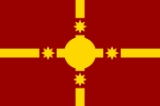
Rotuma is a
FijiFiji , officially the Republic of Fiji , is an island nation in Melanesia in the South Pacific Ocean about northeast of New Zealand's North Island...
an
dependencyFiji is divided administratively into four divisions, which are further subdivided into fourteen provinces; the self-governing island of Rotuma and its dependencies lie outside any of the four divisions. Each division is headed by a Commissioner, appointed by the Fijian government...
, consisting of Rotuma Island and nearby islets. The island group is home to a small but unique indigenous
ethnic groupAn ethnic group is a group of people whose members identify with each other, through a common heritage, often consisting of a common language, a common culture and/or an ideology that stresses common ancestry or endogamy...
which constitutes a recognizable minority within the population of Fiji, known as "
RotumansThe Rotuman people are the indigenous inhabitants of Rotuma, a small island group forming part of the Republic of Fiji. The island itself is a cultural melting pot at the crossroads of the Micronesian, Melanesian and Polynesian divisions of the Pacific Ocean, and due to the seafaring nature of...
". Its population at the 2007
censusA census is the procedure of systematically acquiring and recording information about the members of a given population. It is a regularly occurring and official count of a particular population. The term is used mostly in connection with national population and housing censuses; other common...
was 2,002, although many Rotumans live on mainland Fijian islands, totaling 10,000.
Geography and geology
These volcanic
islandAn island or isle is any piece of sub-continental land that is surrounded by water. Very small islands such as emergent land features on atolls can be called islets, cays or keys. An island in a river or lake may be called an eyot , or holm...
s are located at 12°30′42"S 177°51′9"E, 646 kilometres (
SuvaSuva features a tropical rainforest climate under the Koppen climate classification. The city sees a copious amount of precipitation during the course of the year. Suva averages 3,000 mm of precipitation annually with its driest month, July averaging 125 mm of rain per year. In fact,...
to
AhauAhau may refer to:*Ajaw, a political rulership title from the Maya civilization*Ahau, the government station of Rotuma, a Fijian Dependency* Kinich Ahau, the 16th-century Yucatec name of the Maya sun god...
) north of
FijiFiji , officially the Republic of Fiji , is an island nation in Melanesia in the South Pacific Ocean about northeast of New Zealand's North Island...
. Rotuma Island itself is 13 kilometres long and 4 kilometres wide, with a land area of approximately 43 square kilometres. The island is bisected into a larger eastern part, and a western
peninsulaA peninsula is a piece of land that is bordered by water on three sides but connected to mainland. In many Germanic and Celtic languages and also in Baltic, Slavic and Hungarian, peninsulas are called "half-islands"....
, by a low narrow isthmus only 230 meters wide, the location of Motusa village (
Itu'ti'uItu'ti'u is one of the seven districts on the island of Rotuma, a dependency of Fiji. Rotuma's capital, the village of Ahau, is located in this district. It also includes the villages of Savlei, Lau, Feavai, Tuakoi, Motusa, Ropure, Melsa'a, and Losa....
district). North of the isthmus is Maka Bay, and in the south Hopmafau Bay. The bays are full of
coralCorals are marine animals in class Anthozoa of phylum Cnidaria typically living in compact colonies of many identical individual "polyps". The group includes the important reef builders that inhabit tropical oceans and secrete calcium carbonate to form a hard skeleton.A coral "head" is a colony of...
reefs, through which there are boat passages.
Rotuma is a
shield volcanoA shield volcano is a type of volcano usually built almost entirely of fluid lava flows. They are named for their large size and low profile, resembling a warrior's shield. This is caused by the highly fluid lava they erupt, which travels farther than lava erupted from more explosive volcanoes...
made of alkali-olivine
basaltBasalt is a common extrusive volcanic rock. It is usually grey to black and fine-grained due to rapid cooling of lava at the surface of a planet. It may be porphyritic containing larger crystals in a fine matrix, or vesicular, or frothy scoria. Unweathered basalt is black or grey...
and hawaiite, with many small cones, and reaches 256 metres (840 ft) above sea level at Mount Suelhof near the center of the island. Satarua Peak, 166 meters high, lies near the eastern end of the island. While very secluded from much of Fiji proper, the large reef and untouched beaches are renowned as some of the most beautiful in all of Fiji.
There are some islands located at a distance between 50 meters and 2 kilometers from the main island, but still within the fringing reef:
- Solnoho (south)
- Solkope
Solkope is a small and densely wooded island off the southern coast of Rotuma in the Fiji Islands, at the edge of the fringing coral reef. It is separated from the main island of Rotuma by a channel that is between 50 and 200 meters wide, and lies immediately southeast of the village of Kalvaka in...
and Sari'i (southeast)
- 'Afgaha and Husia Rua (far southeast)
- Husia (Husiati'u) and Husiamea'me'a (close southeast)
- Hạuamea'me'a and Hạua (Hạuati'u) (close together northeast).
Additionally, there is a separate chain of islands between 3-6 kilometers northwest and west of the westernmost point of Rotuma Island. From northeast to southwest, are:
- Uea
Uea is a high rocky offshore island of Rotuma. Uea is one of a number of outliers lying off the west coast of Rotuma. It is the second largest island and is the highest island in the Rotuma Group with an elevation of 260 m. -Flora & Fauna:...
- Hạfhai
- Hạfhahoi
- Hạfhaveiaglolo
- Hatana
Hatana Island is considered the most sacred or "ha'a" islet of the Rotuma Group, Fiji, commonly featuring in various Rotuman Creation myths.-Hatana in Rotuman mythology:The island’s potency is connected to the supposed “founder” of Rotuma, Raho...
- Hạf’liua.
Linguistic evidence
Linguistic evidence suggests an original settlement from Fiji. Linguists include the
Rotuman languageRotuman, also referred to as Rotunan, Rutuman or Fäeag Rotuma, is an Austronesian language spoken by the indigenous people of the South Pacific island group of Rotuma, an island with a Polynesian-influenced culture that was incorporated as a dependency into the Colony of Fiji in 1881...
in a subgroup with the languages of western Fiji, but Rotuman also has a large number of Polynesian loanwords, indicating later contact with
SamoaSamoa , officially the Independent State of Samoa, formerly known as Western Samoa is a country encompassing the western part of the Samoan Islands in the South Pacific Ocean. It became independent from New Zealand in 1962. The two main islands of Samoa are Upolu and one of the biggest islands in...
and
TongaTonga, officially the Kingdom of Tonga , is a state and an archipelago in the South Pacific Ocean, comprising 176 islands scattered over of ocean in the South Pacific...
.
Origins in oral history
Rotuman
oral historyOral history is the collection and study of historical information about individuals, families, important events, or everyday life using audiotapes, videotapes, or transcriptions of planned interviews...
indicates that the islands' first inhabitants came from Samoa, whence they were led by a man named Raho. Shortly thereafter, further settlers arrived from Tonga. Later, additional settlers came from Tonga and
KiribatiKiribati , officially the Republic of Kiribati, is an island nation located in the central tropical Pacific Ocean. The permanent population exceeds just over 100,000 , and is composed of 32 atolls and one raised coral island, dispersed over 3.5 million square kilometres, straddling the...
. In the 1850s and 1860s, Tongan Prince Ma'afu claimed Rotuma, and sent subordinates to administer the main island and islets.
Ratzel wrote about a legend relating to the Samoans and Rotuma as follows:
"Thus the Samoans relate that one of their chiefs fished up Rotuma and planted coco-palm on it. But in a later migration the chief Tokaniua came that way with a canoe full of men and quarrelled with him about the prior right of possession."
European contact
The first known
EuropeEurope is, by convention, one of the world's seven continents. Comprising the westernmost peninsula of Eurasia, Europe is generally 'divided' from Asia to its east by the watershed divides of the Ural and Caucasus Mountains, the Ural River, the Caspian and Black Seas, and the waterways connecting...
an sighting of Rotuma was in 1791, when
CaptainCaptain is the name most often given in English-speaking navies to the rank corresponding to command of the largest ships. The NATO rank code is OF-5, equivalent to an army full colonel....
Edward Edwards and the crew of
HMS PandoraHMS Pandora was a 24-gun Porcupine-class sixth-rate post ship of the Royal Navy launched in May 1779. She is best known as the ship sent in 1790 to search for the Bounty and the mutineers who had taken her...
landed in search of sailors who had disappeared following the Mutiny on the Bounty. There has been some argument whether the island discovered by
QuirósPedro Fernandes de Queirós , was a Portuguese navigator best known for his involvement with Spanish voyages of discovery in the Pacific Ocean, in particular the 1595-1596 voyage of Alvaro de Mendaña de Neira, and for leading a 1605-1606 expedition which crossed the Pacific in search of Terra...
known as
Tuamaco fits the description and location of Rotuma, but so far no claim has been fully substantiated.
Mid-19th century
A favorite of whaling ships in need of reprovisioning, in the mid-nineteenth century Rotuma became a haven for runaway sailors, some of whom were escaped convicts. Some of these deserters married local women and contributed their genes to an already heterogeneous pool; others met violent ends, reportedly at one another's hands. Rotuma was visited as part of the
United States Exploring ExpeditionThe United States Exploring Expedition was an exploring and surveying expedition of the Pacific Ocean and surrounding lands conducted by the United States from 1838 to 1842. The original appointed commanding officer was Commodore Thomas ap Catesby Jones. The voyage was authorized by Congress in...
in 1840.
Ceding to Britain
Wesleyan missionaries from
TongaTonga, officially the Kingdom of Tonga , is a state and an archipelago in the South Pacific Ocean, comprising 176 islands scattered over of ocean in the South Pacific...
arrived on Rotuma in 1842, followed by
MaristThe Society of Mary , is a Roman Catholic religious congregation or order, founded by Father Jean-Claude Colin and a group of other seminarians in France in 1816...
CatholicsThe Catholic Church, also known as the Roman Catholic Church, is the world's largest Christian church, with over a billion members. Led by the Pope, it defines its mission as spreading the gospel of Jesus Christ, administering the sacraments and exercising charity...
in 1847. Conflicts between the two groups, fueled by previous political rivalries among the chiefs of Rotuma's seven districts, resulted in hostilities that led the local chiefs in 1879 to ask
BritainThe United Kingdom of Great Britain and Northern IrelandIn the United Kingdom and Dependencies, other languages have been officially recognised as legitimate autochthonous languages under the European Charter for Regional or Minority Languages...
to annex the island group. On May 13, 1881, an anniversary now celebrated as
Rotuma DayRotuma Day is an annual celebration on the island of Rotuma, a Fijian dependency. It falls on May 13, the anniversary of the island's cession to the United Kingdom in 1881....
, Rotuma was officially ceded to the
United KingdomThe United Kingdom of Great Britain and Northern IrelandIn the United Kingdom and Dependencies, other languages have been officially recognised as legitimate autochthonous languages under the European Charter for Regional or Minority Languages...
, seven years after Fiji became a colony.
Demographics
Although the island has been politically part of Fiji since 1881, Rotuman culture more closely resembles that of the
PolynesiaPolynesia is a subregion of Oceania, made up of over 1,000 islands scattered over the central and southern Pacific Ocean. The indigenous people who inhabit the islands of Polynesia are termed Polynesians and they share many similar traits including language, culture and beliefs...
n islands to the east, most noticeably
TongaTonga, officially the Kingdom of Tonga , is a state and an archipelago in the South Pacific Ocean, comprising 176 islands scattered over of ocean in the South Pacific...
,
SamoaSamoa , officially the Independent State of Samoa, formerly known as Western Samoa is a country encompassing the western part of the Samoan Islands in the South Pacific Ocean. It became independent from New Zealand in 1962. The two main islands of Samoa are Upolu and one of the biggest islands in...
,
FutunaFutuna is an island in the Pacific Ocean belonging to the French overseas collectivity of Wallis and Futuna. It is one of the Hoorn Islands or Îles Horne, nearby Alofi being the other...
, and Uvea. Because of their Polynesian appearance and distinctive
languageRotuman, also referred to as Rotunan, Rutuman or Fäeag Rotuma, is an Austronesian language spoken by the indigenous people of the South Pacific island group of Rotuma, an island with a Polynesian-influenced culture that was incorporated as a dependency into the Colony of Fiji in 1881...
, Rotumans now constitute a recognizable minority group within the Republic of Fiji. The great majority of Rotumans (9,984 according to the 2007 Fiji census) now live elsewhere in Fiji, with 1,953 Rotumans remaining on Rotuma.
RotumansThe Rotuman people are the indigenous inhabitants of Rotuma, a small island group forming part of the Republic of Fiji. The island itself is a cultural melting pot at the crossroads of the Micronesian, Melanesian and Polynesian divisions of the Pacific Ocean, and due to the seafaring nature of...
are culturally conservative and maintain their customs in the face of changes brought about by increased contact with the outside world. As recently as 1985, some 85 percent of Rotumans voted against opening the island up to
tourismTourism is travel for recreational, leisure or business purposes. The World Tourism Organization defines tourists as people "traveling to and staying in places outside their usual environment for not more than one consecutive year for leisure, business and other purposes".Tourism has become a...
, wary of the influence of Western tourists. P&O Cruises landed on the island twice in the 1980s.
Prominent Rotumans and people of Rotuman descent
- The late Principal, Chief and Senator Aisea Aitu.
- Colonel
Colonel , abbreviated Col or COL, is a military rank of a senior commissioned officer. It or a corresponding rank exists in most armies and in many air forces; the naval equivalent rank is generally "Captain". It is also used in some police forces and other paramilitary rank structures...
Paul ManueliColonel Paul Manueli is a former Commander of the Royal Fiji Military Forces, a former Fiji Cabinet minister, Senator and successful businessman.-Military career:...
a former Commander of the Royal Fiji Military Forces, Fiji Cabinet minister, Senator and successful businessman.
- Field Marshal
Field Marshal is a military rank. Traditionally, it is the highest military rank in an army.-Etymology:The origin of the rank of field marshal dates to the early Middle Ages, originally meaning the keeper of the king's horses , from the time of the early Frankish kings.-Usage and hierarchical...
, Major GeneralMajor general or major-general is a military rank used in many countries. It is derived from the older rank of sergeant major general. A major general is a high-ranking officer, normally subordinate to the rank of lieutenant general and senior to the ranks of brigadier and brigadier general...
Jioji Konousi Konrote, a Cabinet MinisterFiji has the Westminster system - executive authority is vested nominally in a President, but exercised in practice by a Cabinet of Ministers, presided over by the Prime Minister. The Prime Minister is formally appointed, but not chosen, by the President: the President must appoint as Prime...
and former High CommissionerHigh Commissioner is the title of various high-ranking, special executive positions held by a commission of appointment.The English term is also used to render various equivalent titles in other languages.-Bilateral diplomacy:...
to AustraliaAustralia , officially the Commonwealth of Australia, is a country in the Southern Hemisphere comprising the mainland of the Australian continent, the island of Tasmania, and numerous smaller islands in the Indian and Pacific Oceans. It is the world's sixth-largest country by total area...
.
- Former Information Minister Marieta Rigamoto
Marieta Rigamoto is a Fijian politician. As as independent candidate campaigning for improved roads and hospital services in Rotuma, she won a hotly contested election for the Rotuman Communal Constituency in the House of Representatives in 1999, and was returned with an increased majority in the...
.
- Chief Justice
The Chief Justice is Fiji's highest judicial officer. He or she is appointed by the President on the advice of the Prime Minister, who is required by the Constitution to consult the Leader of the Opposition. This does not give the Leader of the Opposition a veto, only the right to be consulted. ...
Daniel FatiakiTaniela Vafo'ou Fatiaki CF was the Chief Justice of Fiji from 1 August 2002, when he succeeded Sir Timoci Tuivaga, till 5 December 2008. As Chief Justice, he presided over both the High Court and the Supreme Court, but is constitutionally barred from presiding over, or even sitting on, the...
.
- Irish sportsmen brothers Seán Óg
Seán Óg Ó hAilpín is an iconic Irish-Fijian sportsperson. A former dual player, he currently plays hurling with his local club Na Piarsaigh and is a member of the Cork senior inter-county team. Ó hAilpín captained Cork to the All-Ireland title in 2005...
and Setanta Ó hAilpínSetanta "Carlos" Ó hAilpín is an Australian-Irish sportsman. He was a hurler with the Cork senior team before becoming a professional Australian Rules footballer. He is of mixed Irish and Rotuman background...
.
- NRL
The National Rugby League is the top league of professional rugby league football clubs in Australasia. The NRL's main competition, called the Telstra Premiership , is contested by sixteen teams, fifteen of which are based in Australia with one based in New Zealand...
player John Sutton.
- Dr. Hiagi Wesley (Director of Jonathan Napela Center for Hawaiian and Pacific Islands Studies at Brigham Young University-Hawai'i).
- Professor Victor Narsimulu, Editor of Pacific Rim Journal/Associate Instructor: Pacific Islander-American Studies; University of Utah
The University of Utah, also known as the U or the U of U, is a public, coeducational research university in Salt Lake City, Utah, United States. The university was established in 1850 as the University of Deseret by the General Assembly of the provisional State of Deseret, making it Utah's oldest...
.
- Vilsoni Hereniko
Vilsoni Hereniko is a Fiji Islander playwright, film director and academic. He was the writer and director of Fiji's first ever feature film, The Land Has Eyes .-Biography:...
, playwrightA playwright, also called a dramatist, is a person who writes plays.The term is not a variant spelling of "playwrite", but something quite distinct: the word wright is an archaic English term for a craftsman or builder...
and film directorA film director is a person who directs the actors and film crew in filmmaking. They control a film's artistic and dramatic nathan roach, while guiding the technical crew and actors.-Responsibilities:...
.
- Sapeta Taito
Sapeta Sokag‘aitu Taito is a Fiji Islander actress. She played the lead role in Fiji's first feature film, The Land Has Eyes, in 2004.-Biography:Born in Suva, Fiji, Taito moved to Rotuma at a young age...
, actress (The Land Has EyesThe Land Has Eyes is a 2004 Fiji Islander film written and directed by Vilsoni Hereniko. It is the first ever feature film from Fiji.-Plot:...
).
- Jono Gibbes
Jonathan Brian Gibbes is the forwards coach of Leinster Rugby in Ireland and former New Zealand rugby union player who captained Waikato, the Chiefs and the New Zealand Māori rugby union team, and appeared in various All Blacks teams.Gibbes traditionally plays at the position of Blindside Flanker,...
(maternal side), a New Zealand rugby union player.
- Graham Dewes
Graham Charles Dewes is a Fijian rugby union player. He plays as a prop.-Career:He got his first cap for Fiji on 26 May 2007 in a 30–15 win over Japan...
, a Fiji rugby union player.
- Daniel Rae Costello
Daniel Rae Costello is a renowned Pacific musician. His mother, Jessie Rae was of a Samoan/Rotuman and Scottish descent whereas his father, Dan Costello. was Irish and both were born in Fiji. He was brought up in Tavua. His father owned a cattle ranch. He moved with his family to Lautoka since he...
, a Fijian-born Musician with Rotuman descent.
- Rebecca Tavo, Australian Touch Rugby Player with Rotuman father.
- Selina Gilsenan
Selina Gilsenan is a retired Australian netball player. Gilsenan has Rotuman ancestry form her mother.-Career:After a successful year playing in the Commonwealth Bank Trophy premiership-winning team in 2001, national selectors identified Selina's talent and she received her first invitation to...
, Former Australian Netball Player with Rotuman mother.
- Ngaire Fuata, New Zealand Television producer and singer with Rotuman father.
Politics and society
Rotuma was governed as an integral part of the Colony of Fiji after cession to
Great BritainGreat Britain or Britain is an island situated to the northwest of Continental Europe. It is the ninth largest island in the world, and the largest European island, as well as the largest of the British Isles...
in 1881. Following Fiji's independence in 1970 and the military coups of 1987, Rotuma remained with Fiji.
Social organization
Rotuma is divided into seven autonomous districts, each with its own headman or chief (
Gagaj 'es Itu'uGagaja is a Rotuman word denoting the position of "Chief" or "Lord". This could be a formal chiefly position in one of the seven districts or a village chief as well as to anyone else, such as the Chairman of the Rotuma Island Council to whom respect and deference is owed based on their own...
), with villages:
- Noa'tau (extreme southeast): Fekeioko, Maragte'u, Faf'iasina, Matu'ea, 'Ut'utu, Kalvaka
- Oinafa
Oinafa is one of the seven districts on the island of Rotuma, a dependency of Fiji. It includes the villages of Oinafa, Lopta, and Paptea....
(east): Oinafa, Lopta, Paptea
- Pepjei
Pepjei is one of the seven districts on the island of Rotuma, a dependency of Fiji. It includes the villages of Ujia, Uanheta, and Avave....
(southeast): 'Ujia, Uạnheta, Avave
- Juju
Juju is one of the seven districts on the island of Rotuma, a dependency of Fiji. It includes the villages of Juju, Toai, and Haga....
(south): Tuại, Haga, Juju
- Itu'muta
Itu'muta is one of the seven districts on the island of Rotuma, a dependency of Fiji. It includes the villages of Maftoa and Lopo....
(western peninsula): Maftoa, Lopo
- Itu'ti'u (west, but east of western peninsula): Savlei, Lạu, Feavại, Tuạ'koi, Motusa, Hapmak, Losa, Fapufa, Ahạu (Government Station)
- Malha'a (north): Pepheua, 'Else'e, 'Elsio
The district chiefs and elected district representatives make up the
Rotuma Island CouncilThe Council of Rotuma is a municipal body on the island of Rotuma, a Fijian dependency. Owing to the unique character of Rotuma, the powers of this council are greater than those of other municipal bodies in Fiji and in some ways it approximates a legislative body, though it is in every way...
. The districts are divided into subgroupings of households (ho'aga) that function as work groups under the leadership of a subchief (gagaj 'es ho'aga). All district headmen and the majority of ho'aga headmen are titled. In addition, some men hold titles without headship (as tög), although they are expected to exercise leadership roles in support of the district headman. Titles, which are held for life, belong to specified house sites (fuạg ri). All the descendents of previous occupants of a fuạg ri have a right to participate in the selection of successors to titles.
On formal occasions titled men and dignitaries such as ministers and priests, government officials, and distinguished visitors occupy a place of honor. They are ceremonially served food from special baskets and kava. In the daily routine of Village life, however, they are not especially privileged. As yet no significant class distinctions based on wealth or control of resources have emerged, but investments in elaborate housing and motor vehicles by a few families have led to visible differences in standard of living.
Political organization
At the time of discovery by Europeans there were three pan-Rotuman political positions: the
fakpureThe fakpure is variously considered the secular ruler of Rotuma in the pre-European contact times. It was one of three chiefly roles with direct influence across the island of Rotuma, the other two being the Mua and the Sau...
, the
sạuSau, , refers to the role of spiritual leader in pre-Christian Rotuman society. The title was neither primogenitary nor held for a lifetime, but rather was cycled through the chiefs of each of Rotuma’s districts....
, and the mua. The fakpure acted as convener and presiding officer over the council of district headmen and was responsible for appointing the sạu and ensuring that he was cared for properly. The fakpure was headman of the District that headed the alliance that had won the last war. The sạu's role was to take part in the ritual cycle, oriented toward ensuring prosperity, as an object of veneration. Early European visitors referred to the sạu as "king," but he actually had no secular power. The position of sạu was supposed to rotate between districts, and a breach of this custom was considered to be incitement to war. The role of mua is more obscure, but like the sạu, he was an active participant in the ritual cycle. According to some accounts the mua acted as a kind of high priest.
Following Christianization in the 1860s, the offices of sạu and mua were terminated. Colonial administration involved the appointment by the governor of Fiji of a Resident Commissioner (after 1935, a District Officer) to Rotuma. He was advised by a council composed of the district chiefs. In 1940 the council was expanded to include an elected representative from each district and the Assistant Medical Practitioner. Following Fiji's independence in 1970, the council assumed responsibility for the internal governance of Rotuma, with the District Officer assigned to an advisory role. Up until the first coup, Rotuma was represented in the Fiji legislature by a single senator.
Administratively, Rotuma is fully incorporated into Fiji, but with
local governmentFiji is divided administratively into four divisions, which are further subdivided into fourteen provinces; the self-governing island of Rotuma and its dependencies lie outside any of the four divisions. Each division is headed by a Commissioner, appointed by the Fijian government...
so tailored as to give the island a measure of autonomy greater than that enjoyed by other political subdivisions of Fiji. Rotuma has the status of a
Dependency, and its administrative capital is 'Ahạu in the district of Itu'ti'u, where the "tariạgsạu" (traditionally the name of the sạu's palace) meeting house for the Council of Rotuma is based.
At the national level, Fijian citizens of Rotuman descent elect one representative to the Fijian
House of RepresentativesThe House of Representatives is the lower chamber of Fiji's Parliament. It is the more powerful of the two chambers; it alone has the power to initiate legislation...
, and the Council of Rotuma nominates one representative to the
Fijian SenateThe Senate of Fiji is the upper chamber of Parliament. It is the less powerful of the two chambers; it may not initiate legislation, but may amend or veto it. The Senate's powers over financial bills are more restricted: it may veto them in their entirety, but may not amend them...
. Rotuma is also represented in the influential
Great Council of ChiefsThe Great Council of Chiefs is a now dormant 1997 constitutional body in the Republic of the Fiji Islands. In April 2007 the council was suspended, due to an unworkable relationship with Frank Bainimarama, leader of an "interim government" which came to power through a military coup in December 2006...
by three representatives chosen by the Council of Rotuma. For electoral purposes, Rotumans were formerly classified as
FijiansFijian people are the major indigenous people of the Fiji Islands, and live in an area informally called Melanesia. The Fijian people are believed to have arrived in Fiji from western Melanesia approximately 3,500 years ago, though the exact origins of the Fijian people are unknown...
, but when the
ConstitutionThe 1997 Constitution of Fiji was the supreme law of Fiji from its adoption in 1997 until 2009 when President Josefa Iloilo purported to abrogate it. It was also suspended for a period following the 2000 coup d'état led by Commodore Frank Bainimarama....
was revised in 1997-1998, they were granted separate representation at their own request. (The majority of seats in Fiji's House of Representatives are allocated on a
communal basisCommunal constituencies have been the most durable feature of the Fijian electoral system. In communal constituencies, electors enrolled as ethnic Fijians, Indo-Fijians, Rotuman Islanders, or General Electors vote for a candidate of their own respective ethnic groups, in constituencies that have...
to Fiji's various
ethnic groupsThis article is about the demographic features of the population of Fiji, including population density, ethnicity, education level, health of the populace, economic status, religious affiliations and other aspects of the population....
) In addition, Rotuma forms part (along with
TaveuniTaveuni is the third-largest island in Fiji, after Vanua Levu and Viti Levu, with a total land area of 435 square kilometers . The cigar-shaped island, a massive shield volcano which rises from the floor of the Pacific Ocean, is situated 6.5 kilometers to the east of Vanua Levu, across the...
and the
Lau IslandsThe Lau Islands of Fiji are situated in the southern Pacific Ocean, just east of the Koro Sea. Of this chain of about one hundred islands and islets, about thirty are inhabited...
) of the
Lau Taveuni RotumaLau Taveuni Rotuma Open is an electoral division of Fiji, one of 25 open constituencies elected by universal suffrage . Like the other open electorates, it came into being in 1999 and was used for the parliamentary elections of 1999, 2001, and 2006...
Open ConstituencyOpen constituencies represent one of several electoral models employed in the past and present in the Fijian electoral system. They derive their name from the fact that they are "open": unlike the communal constituencies, the 25 members of the House of Representatives who represent open...
, one of 25 constituencies whose representatives are chosen by
universal suffrageUniversal suffrage consists of the extension of the right to vote to adult citizens as a whole, though it may also mean extending said right to minors and non-citizens...
.
Social control
The basis for social control is a strong socialization emphasis on social responsibility and a sensitivity to shaming. Gossip serves as a mechanism for sanctioning deviation, but the most powerful deterrent to antisocial behavior is an abiding belief in imminent justice, that supernatural forces (the 'atua or ghosts of ancestors) will punish wrongdoing. Rotumans are a rather gentle people; violence is extremely rare and serious crimes nearly nonexistent.
Conflict
Prior to cession, warfare, though conducted on a modest scale, was endemic in Rotuma. During the colonial era political rivalries were muted, since power was concentrated in the offices of Resident Commissioner and District Officer. Following Fiji's independence, however, interdistrict rivalries were again given expression, now in the form of Political contention. Following the second coup, when Fiji left the British Commonwealth of Nations, a segment of the Rotuman population, known as the "Mölmahao Clan" of
Noa’tauNoa'tau is one of the seven districts on the island of Rotuma, a dependency of Fiji. It includes the villages of Maragteu and Fekeoko.Noa'tau is the most easterly district on the island...
rejected the council's decision to remain with the newly declared republic. Arguing that Rotuma had been ceded to Great Britain and not to Fiji, these rebels declared in 1987 independence of
Republic of Rotuma and were charged with sedition. It did not have any substantive support, majority opinion appears to favor remaining with Fiji, but rumblings of discontent remain.
External links
- Rotuma website - an exhaustive website on all things Rotuman by anthropologists Alan Howard and Jan Rensel
- The Land Has Eyes - an award-winning film set in Rotuma made by Rotumans.
- Rotuman Hafa - Rotuman dance (see also Tautoga
The tautoga is considered the most formal and restrained style of Rotuman dance, usually seen performed in large festivities or ceremonies , or in public opportunities to showcase Rotuman culture...
)
- Amateur radio - Amateur radio operations from Rotuma, with information on Rotuman history, culture, flora, fauna, geography, etc.; lengthy bibliography.
- General information, energy supply
- The Vertebrates of Rotuma and Surrounding Waters, by George R. Zug, Victor G. Springer, Jeffrey T. Wiliams and G. David Johnson, Atoll Research Bulletin, No. 316