
Home      Discussion      Topics      Dictionary      Almanac
Signup       Login
Rotordynamics

Rotordynamics

Overview
Rotordynamics is a specialized branch of applied mechanics
Applied mechanics
Applied mechanics is a branch of the physical sciences and the practical application of mechanics. Applied mechanics examines the response of bodies or systems of bodies to external forces...

 concerned with the behavior and diagnosis of rotating structures. It is commonly used to analyze the behavior of structures ranging from jet engines and steam turbine
Steam turbine
A steam turbine is a mechanical device that extracts thermal energy from pressurized steam, and converts it into rotary motion. Its modern manifestation was invented by Sir Charles Parsons in 1884....

s to auto engines and computer disk storage
Disk storage
Disk storage or disc storage is a general category of storage mechanisms, in which data are digitally recorded by various electronic, magnetic, optical, or mechanical methods on a surface layer deposited of one or more planar, round and rotating disks...

. At its most basic level rotordynamics is concerned with one or more mechanical structures (rotors
Rotor (electric)
The rotor is the non-stationary part of a rotary electric motor, electric generator or alternator, which rotates because the wires and magnetic field of the motor are arranged so that a torque is developed about the rotor's axis. In some designs, the rotor can act to serve as the motor's armature,...

) supported by bearings and influenced by internal phenomena that rotate around a single axis. The supporting structure is called a stator. As the speed of rotation increases the amplitude of vibration often passes through a maximum that is called a critical speed
Critical speed
In solid mechanics, in the field of rotordynamics, the critical speed is the theoretical angular velocity which excites the natural frequency of a rotating object, such as a shaft, propeller, leadscrew, or gear. As the speed of rotation approaches the object's natural frequency, the object begins...

. This amplitude is commonly excited by unbalance of the rotating structure; everyday examples include engine balance
Engine balance
Engine balance is the design, construction and tuning of an engine to run smoothly. Improving engine balance reduces vibration and other stresses and can improve the overall performance, efficiency, cost of ownership and reliability of the engine, as well as reducing the stress on other machinery...

 and tire balance
Tire balance
Tire balance, also referred to as tire unbalance or imbalance, describes the distribution of mass within an automobile tire or the wheel to which it is attached. When the tire rotates, asymmetries of mass cause the wheel to wobble, which can cause ride disturbances, usually vertical and lateral...

. If the amplitude of vibration at these critical speeds is excessive then catastrophic failure occurs. In addition to this, turbomachinery often develop instabilities which are related to the internal makeup of turbomachinery, and which must be corrected. This is the chief concern of engineers who design large rotors.
Discussion
Ask a question about 'Rotordynamics'
Start a new discussion about 'Rotordynamics'
Answer questions from other users
Full Discussion Forum
 
Unanswered Questions
Recent Discussions
Encyclopedia
Rotordynamics is a specialized branch of applied mechanics
Applied mechanics
Applied mechanics is a branch of the physical sciences and the practical application of mechanics. Applied mechanics examines the response of bodies or systems of bodies to external forces...

 concerned with the behavior and diagnosis of rotating structures. It is commonly used to analyze the behavior of structures ranging from jet engines and steam turbine
Steam turbine
A steam turbine is a mechanical device that extracts thermal energy from pressurized steam, and converts it into rotary motion. Its modern manifestation was invented by Sir Charles Parsons in 1884....

s to auto engines and computer disk storage
Disk storage
Disk storage or disc storage is a general category of storage mechanisms, in which data are digitally recorded by various electronic, magnetic, optical, or mechanical methods on a surface layer deposited of one or more planar, round and rotating disks...

. At its most basic level rotordynamics is concerned with one or more mechanical structures (rotors
Rotor (electric)
The rotor is the non-stationary part of a rotary electric motor, electric generator or alternator, which rotates because the wires and magnetic field of the motor are arranged so that a torque is developed about the rotor's axis. In some designs, the rotor can act to serve as the motor's armature,...

) supported by bearings and influenced by internal phenomena that rotate around a single axis. The supporting structure is called a stator. As the speed of rotation increases the amplitude of vibration often passes through a maximum that is called a critical speed
Critical speed
In solid mechanics, in the field of rotordynamics, the critical speed is the theoretical angular velocity which excites the natural frequency of a rotating object, such as a shaft, propeller, leadscrew, or gear. As the speed of rotation approaches the object's natural frequency, the object begins...

. This amplitude is commonly excited by unbalance of the rotating structure; everyday examples include engine balance
Engine balance
Engine balance is the design, construction and tuning of an engine to run smoothly. Improving engine balance reduces vibration and other stresses and can improve the overall performance, efficiency, cost of ownership and reliability of the engine, as well as reducing the stress on other machinery...

 and tire balance
Tire balance
Tire balance, also referred to as tire unbalance or imbalance, describes the distribution of mass within an automobile tire or the wheel to which it is attached. When the tire rotates, asymmetries of mass cause the wheel to wobble, which can cause ride disturbances, usually vertical and lateral...

. If the amplitude of vibration at these critical speeds is excessive then catastrophic failure occurs. In addition to this, turbomachinery often develop instabilities which are related to the internal makeup of turbomachinery, and which must be corrected. This is the chief concern of engineers who design large rotors.

Basic principles


The equation of motion
Equation of motion
Equations of motion are equations that describe the behavior of a system in terms of its motion as a function of time...

, in generalized matrix form, for an axially symmetric rotor rotating at a constant spin speed Ω is
where:

M is the symmetric Mass matrix
Mass matrix
In computational mechanics, a mass matrix is a generalization of the concept of mass to generalized coordinates. For example, consider a two-body particle system in one dimension...


C is the symmetric damping matrix
Damping matrix
In applied mathematics, a damping matrix is a matrix corresponding to any of certain systems of linear ordinary differential equations.A damping matrix is defined as follows...


G is the skew-symmetric
Skew-symmetric matrix
In mathematics, and in particular linear algebra, a skew-symmetric matrix is a square matrix A whose transpose is also its negative; that is, it satisfies the equation If the entry in the and is aij, i.e...

 gyroscopic matrix

K is the symmetric bearing or seal stiffness matrix

N is the gyroscopic matrix of deflection for inclusion of e.g., centrifugal elements.

in which q is the generalized coordinates of the rotor in inertial coordinates and f is a forcing function, usually including the unbalance.

The gyroscopic matrix G is proportional to spin speed Ω.
The general solution to the above equation involves complex
Complex number
A complex number is a number consisting of a real part and an imaginary part. Complex numbers extend the idea of the one-dimensional number line to the two-dimensional complex plane by using the number line for the real part and adding a vertical axis to plot the imaginary part...

 eigenvectors which are spin speed dependent.
Engineering specialists in this field rely on the Campbell Diagram
Campbell Diagram
A Campbell diagram plot represents a system's response spectrum as a function of its oscillation regime. It is named for Wilfred Campbell, who has introduced the concept, see .- In rotordynamics :...

 to explore these solutions.

An interesting feature of the rotordynamic system of equations are the off-diagonal terms of stiffness, damping, and mass. These terms are called cross-coupled stiffness, cross-coupled damping, and cross-coupled mass. When there is a positive cross-coupled stiffness, a deflection will cause a reaction force opposite the direction of deflection to react the load, and also a reaction force in the direction of positive whirl. If this force is large enough compared with the available direct damping and stiffness, the rotor will be unstable. When a rotor is unstable it will typically require immediate shutdown of the machine to avoid catastrophic failure.

Campbell diagram


The Campbell diagram
Campbell Diagram
A Campbell diagram plot represents a system's response spectrum as a function of its oscillation regime. It is named for Wilfred Campbell, who has introduced the concept, see .- In rotordynamics :...

, also known as "Whirl Speed Map" or a "Frequency Interference
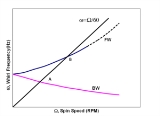
Diagram", of a simple rotor system is shown on the right. The pink and blue curves show the backward whirl (BW) and forward whirl (FW) modes, respectively, which diverge as the spin speed increases. When the BW frequency or the FW frequency equal the spin speed Ω, indicated by the intersections A and B with the synchronous spin speed line, the response of the rotor may show a peak. This is called a critical speed
Critical speed
In solid mechanics, in the field of rotordynamics, the critical speed is the theoretical angular velocity which excites the natural frequency of a rotating object, such as a shaft, propeller, leadscrew, or gear. As the speed of rotation approaches the object's natural frequency, the object begins...

.

Jeffcott rotor


The Jeffcott rotor (named after Henry Homan Jeffcott), also known as the de Laval
Gustaf de Laval
Karl Gustaf Patrik de Laval was a Swedish engineer and inventor who made important contributions to the design of steam turbines and dairy machinery.-Life:De Laval was born at Orsa in Dalarna...

 rotor in Europe, is a simplified lumped parameter model used to solve these equations. The Jeffcott rotor is a mathematical idealization
Idealization
Idealization is the process by which scientific models assume facts about the phenomenon being modeled that are strictly false. Often these assumptions are used to make models easier to understand or solve. Many times idealizations do not harm the predictive accuracy of the model for one reason or...

 that may not reflect actual rotor mechanics.

History


The history of rotordynamics is replete with the interplay of theory and practice. W. J. M. Rankine
William John Macquorn Rankine
William John Macquorn Rankine was a Scottish civil engineer, physicist and mathematician. He was a founding contributor, with Rudolf Clausius and William Thomson , to the science of thermodynamics....

 first performed an analysis of a spinning shaft in 1869, but his model was not adequate and he predicted that supercritical speeds could not be attained. In 1895 Dunkerley published an experimental paper describing supercritical speeds. Gustaf de Laval
Gustaf de Laval
Karl Gustaf Patrik de Laval was a Swedish engineer and inventor who made important contributions to the design of steam turbines and dairy machinery.-Life:De Laval was born at Orsa in Dalarna...

, a Swedish engineer, ran a steam turbine to supercritical speeds in 1889, and Kerr published a paper showing experimental evidence of a second critical speed in 1916.

Henry Jeffcott was commissioned by the Royal Society of London to resolve the conflict between theory and practice. He published a paper now considered classic in the Philosophical Magazine in 1919 in which he confirmed the existence of stable supercritical speeds. August Föppl
August Föppl
August Otto Föppl was a professor of Technical Mechanics and Graphical Statics at the Technical University of Munich, Germany...

 published much the same conclusions in 1895, but history largely ignored his work.

Between the work of Jeffcott and the start of World War II there was much work in the area of instabilities and modeling techniques culminating in the work of Prohl and Myklestad which led to the Transfer Matrix Method (TMM) for analyzing rotors. The most prevalent method used today for rotordynamics analysis is the Finite Element Method
Finite element method
The finite element method is a numerical technique for finding approximate solutions of partial differential equations as well as integral equations...

.

Modern computer models have been commented on in a quote attributed to Dara Childs, "the quality of predictions from a computer code has more to do with the soundness of the basic model and the physical insight of the analyst
Systems analyst
A systems analyst researches problems, plans solutions, recommends software and systems, and coordinates development to meet business or other requirements. They will be familiar with multiple variety of programming languages, operating systems, and computer hardware platforms...

. ... Superior algorithms or computer codes will not cure bad models or a lack of engineering judgment."

Prof. F. Nelson
Frederick Nelson
Frederick Nelson was professor emeritus of mechanical engineering at Tufts University School of Engineering in Medford, Massachusetts, USA. His areas of professional interest included acoustics, vibration, shock and rotordynamics. He wrote or co-authored more than 50 articles in professional...

 has written extensively on the history of rotordynamics and most of this section is based on his work.

Software


There are many software packages that are capable of solving the rotordynamic system of equations. Rotordynamic specific codes are more versatile for design purposes. These codes make it easy to add bearing coefficients, side loads, and many other items only a rotordynamicist would need. The non-rotordynamic specific codes are full featured FEA solvers, and have many years of development in their solving techniques. The non-rotordynamic specific codes can also be used to calibrate a code designed for rotordynamics.

Rotordynamic specific codes:
  • MADYN 2000 (DELTA JS Inc.) - Commercial combined finite element (3D Timoshenko beam) lateral, torsional, axial and coupled solver for multiple rotors and gears, various bearings (fluid film, spring damper, magnetic)
  • iSTRDYN (DynaTech Software LLC) - Commercial 2-D Axis-symmetric finite element solver
  • FEMRDYN (DynaTech Engineering, Inc.) - Commercial 1-D Axis-symmetric finite element solver
  • Dyrobes (Eigen Technologies, Inc.) - Commercial 1-D beam element solver
  • RIMAP (RITEC) - Commercial 1-D beam element solver
  • XLRotor (Rotating Machinery Analysis, Inc.) - Commercial 1-D beam element solver
  • ARMD (Rotor Bearing Technology & Software, Inc.) - Commercial 1-D beam element solver
  • XLTRC2 ( Texas A&M) - Academic 1-D beam element solver
  • ComboRotor (University of Virginia) - Combined finite element lateral, torsional, axial solver for multiple rotors evaluating critical speeds, stability and unbalance response extensively verified by industrial use
  • Dynamics R4 (Alfa-Tranzit Co. Ltd) - Commercial software developed for design and analysis of spatial systems
  • MESWIR (Institute of Fluid-Flow Machinery, Polish Academy of Sciences) - Academic computer code package for analysis of rotor-bearing systems whithin the linear and non-linear range
  • RoDAP (D&M Technology) - Commercial lateral, torsional, axial and coupled solver for multiple rotors, gears and flexible disks(HDD)
  • ROTORINSA (ROTORINSA) - Commercial finite element software developed by a French engineering school (INSA-Lyon) for analysis of steady-state dynamic behavior of rotors in bending.

Non-rotordynamic specific codes:
  • Ansys - Version 11 workbench and classic is capable of solving the rotordynamic equations (3-D/2-D and beam element)
  • Nastran
    Nastran
    NASTRAN is a finite element analysis program that was originally developed for NASA in the late 1960s under United States government funding for the Aerospace industry. The MacNeal-Schwendler Corporation was one of the principal and original developers of the public domain NASTRAN code...

     - Finite element based (3-D/2-D and beam element)
  • SAMCEF
    SAMCEF
    SAMCEF is a finite element analysis software package dedicated to mechanical virtual prototyping. SAMCEF development started in 1965 at the University of Liège and is still developed and sold by SAMTECH, a Belgian company the HQ of which is located in Liège, Belgium.-Software features:SAMCEF...

     - Finite element based (3-D/2-D and beam element)

See also

  • Axle
    Axle
    An axle is a central shaft for a rotating wheel or gear. On wheeled vehicles, the axle may be fixed to the wheels, rotating with them, or fixed to its surroundings, with the wheels rotating around the axle. In the former case, bearings or bushings are provided at the mounting points where the axle...

  • Balancing machine
    Balancing Machine
    A balancing machine is a measuring tool used for balancing rotating machine parts such as rotors for electric motors, fans, turbines, disc brakes, disc drives, propellers and pumps. The machine usually consists of two rigid pedestals, with suspension and bearings on top supporting a mounting...

  • Bearing (mechanical)
    Bearing (mechanical)
    A bearing is a device to allow constrained relative motion between two or more parts, typically rotation or linear movement. Bearings may be classified broadly according to the motions they allow and according to their principle of operation as well as by the directions of applied loads they can...

  • Bently Nevada
    Bently Nevada
    Bently Nevada is a name long associated with condition monitoring instrumentation and services, most notably sensors, systems, and diagnostic services for monitoring machinery vibration...

  • Driveshaft
    Driveshaft
    A drive shaft, driveshaft, driving shaft, propeller shaft, or Cardan shaft is a mechanical component for transmitting torque and rotation, usually used to connect other components of a drive train that cannot be connected directly because of distance or the need to allow for relative movement...

  • Exoskeletal engine
    Exoskeletal engine
    The exoskeletal engine concept represents a paradigm shift in turbomachinery design. Current gas turbine engines have central rotating shafts and discs and are constructed mostly from heavy metals. They require lubricated bearings and need extensive cooling for hot components...

  • Magnetic bearing
    Magnetic bearing
    A magnetic bearing is a bearing which supports a load using magnetic levitation. Magnetic bearings support moving machinery without physical contact; for example, they can levitate a rotating shaft and permit relative motion with very low friction and no mechanical wear...

  • Turbine
    Turbine
    A turbine is a rotary engine that extracts energy from a fluid flow and converts it into useful work.The simplest turbines have one moving part, a rotor assembly, which is a shaft or drum with blades attached. Moving fluid acts on the blades, or the blades react to the flow, so that they move and...