

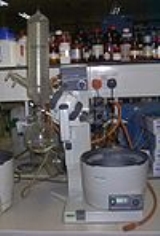
Rotary evaporator

Encyclopedia
A rotary evaporator is a device used in chemical laboratories for the efficient and gentle removal of solvent
s from samples by evaporation
. When referenced in the chemistry research literature, description of the use of this technique and equipment may include the phrase "rotary evaporator", though use is often rather signaled by other language (e.g., "the sample was evaporated under reduced pressure").
Rotary evaporators are also used in molecular cooking for the preparation of distillates and extracts.
A simple rotary evaporator system was invented by Lyman C. Craig. It was first commercialized by the Swiss company Büchi in 1957. Other common evaporator brands are Heidolph
, LabTech, Stuart, SENCO, IKA and EYELA. In research the most common form is the 1L bench-top unit, whereas large scale (e.g., 20L-50L) versions are used in pilot plants in commercial chemical operations.
The vacuum system used with rotary evaporators can be as simple as a water aspirator with a trap immersed in a cold bath (for non-toxic solvents), or as complex as a regulated mechanical vacuum pump with refrigerated trap. Glassware used in the vapor stream and condenser can be simple or complex, depending upon the goals of the evaporation, and any propensities the dissolved compounds might give to the mixture (e.g., to foam or "bump"). Commercial instruments are available that include the basic features, and various traps are manufactured to insert between the evaporation flask and the vapor duct. Modern equipment often adds features such as digital control of vacuum, digital display of temperature and rotational speed, and vapor temperature sensing.
s of the component liquids in it. Generally, the component liquids of interest in applications of rotary evaporation are research solvent
s that one desires to remove from a sample after an extraction, for instance, following a natural product isolation or a step in an organic synthesis. Use of a "rotavap" therefore allows liquid solvents to be removed without excessive heating of what are often complex and sensitive solvent-solute combinations.
Rotary evaporation is most often and conveniently applied to separate "low boiling" solvents such a n-hexane or ethyl acetate from compounds which are solid at room temperature and pressure. However, careful application also allows removal of a solvent from a sample containing a liquid compound if there is minimal co-evaporation (azeotropic behavior), and a sufficient difference in boiling points at the chosen temperature and reduced pressure.
Solvents with higher boiling points such as water (100 °C at standard atmospheric pressure, 760 torr), dimethylformamide
(DMF, 153 °C at the same), or dimethyl sulfoxide
(DMSO, 189 °C at the same), can also be evaporated if the unit's vacuum system is capable of sufficiently low pressure. (For instance, both DMF and DMSO will boil below 50 °C if the vacuum is reduced from 760 torr to 5 torr.) However, more recent developments are often applied in these cases (e.g., evaporation while centrifuging or vortexing at high speeds). Rotary evaporation for high boiling hydrogen bond-forming solvents such as water is often a last recourse, as other evaporation methods or freeze-drying (lyophilization) are available. This is partly due to the fact that in such solvents, the tendency to "bump" is accentuated (see below). The modern centrifugal evaporation technologies are particularly useful when one has many samples to do in parallel, as in medium- to high-throughput synthesis now expanding in industry and academia.
Evaporation under vacuum can also, in principle, be performed using standard organic distillation
glassware — i.e., without rotation of the sample. The key advantages in use of a rotary evaporator are
A key disadvantage in rotary evaporations, besides its single sample nature, is the potential of some sample types to bump, e.g. ethanol and water, which can result in loss of a portion of the material intended to be retained. Even professionals experience periodic mishaps during evaporation, especially bumping, though experienced users become aware of the propensity of some mixtures to bump or foam, and apply precautions that help to avoid most such events. In particular, bumping can often be prevented by taking homogeneous phases into the evaporation, by carefully regulating the strength of the vacuum (or the bath temperature) to provide for an even rate of evaporation, or, in rare cases, through use of added agents such as boiling chip
s (to make the nucleation step of evaporation more uniform). Rotary evaporators can also be equipped with further special traps and condenser arrays that are best suited to particular difficult sample types, including those with the tendency to foam or bump.
solution containing peroxide
s. This can also occur when taking certain unstable compounds, such as organic azide
s and acetylides, nitro-containing compounds, molecules with strain energy, etc. to dryness. Switching the rotation off during evaporation may also result in an 'explosion' through bumping
.
Users of rotary evaporation equipment must take precautions to avoid contact with rotating parts, particularly entanglement of loose clothing, hair, or necklaces. Under these circumstances, the winding action of the rotating parts can draw the users into the apparatus resulting in breakage of glassware, burns, and chemical exposure. Extra caution must also be applied to operations with air reactive materials, especially when under vacuum. A leak can draw air into the apparatus and a violent reaction can occur.
Lastly, rotary evaporation equipment is notoriously expensive and easy to break. To minimize risks, laboratories generally restrict the operation of this type of equipment to specifically trained personnel.
Solvent
A solvent is a liquid, solid, or gas that dissolves another solid, liquid, or gaseous solute, resulting in a solution that is soluble in a certain volume of solvent at a specified temperature...
s from samples by evaporation
Evaporation
Evaporation is a type of vaporization of a liquid that occurs only on the surface of a liquid. The other type of vaporization is boiling, which, instead, occurs on the entire mass of the liquid....
. When referenced in the chemistry research literature, description of the use of this technique and equipment may include the phrase "rotary evaporator", though use is often rather signaled by other language (e.g., "the sample was evaporated under reduced pressure").
Rotary evaporators are also used in molecular cooking for the preparation of distillates and extracts.
A simple rotary evaporator system was invented by Lyman C. Craig. It was first commercialized by the Swiss company Büchi in 1957. Other common evaporator brands are Heidolph
Heidolph
Heidolph Instruments is a manufacturer of laboratory equipment with a presence in more than 100 countries. It sells equipment to laboratories in the pharmaceutical research, the cosmetics, biology, bio-fuel, chemical industries and universities world wide....
, LabTech, Stuart, SENCO, IKA and EYELA. In research the most common form is the 1L bench-top unit, whereas large scale (e.g., 20L-50L) versions are used in pilot plants in commercial chemical operations.
Design
The main components of a rotary evaporator are:- A motor unit that rotates the evaporation flask or vial containing the user's sample.
- A vapor duct that is the axis for sample rotation, and is a vacuum-tight conduit for the vapor being drawn off of the sample.
- A vacuumVacuumIn everyday usage, vacuum is a volume of space that is essentially empty of matter, such that its gaseous pressure is much less than atmospheric pressure. The word comes from the Latin term for "empty". A perfect vacuum would be one with no particles in it at all, which is impossible to achieve in...
system, to substantially reduce the pressure within the evaporator system. - A heated fluid bath (generally water) to heat the sample.
- A condenserCondenser (heat transfer)In systems involving heat transfer, a condenser is a device or unit used to condense a substance from its gaseous to its liquid state, typically by cooling it. In so doing, the latent heat is given up by the substance, and will transfer to the condenser coolant...
with either a coil passing coolant, or a "cold finger" into which coolant mixtures such as dry ice and acetone are placed. - A condensate-collecting flask at the bottom of the condenser, to catch the distilling solvent after it re-condenses.
- A mechanical or motorized mechanism to quickly lift the evaporation flask from the heating bath.
The vacuum system used with rotary evaporators can be as simple as a water aspirator with a trap immersed in a cold bath (for non-toxic solvents), or as complex as a regulated mechanical vacuum pump with refrigerated trap. Glassware used in the vapor stream and condenser can be simple or complex, depending upon the goals of the evaporation, and any propensities the dissolved compounds might give to the mixture (e.g., to foam or "bump"). Commercial instruments are available that include the basic features, and various traps are manufactured to insert between the evaporation flask and the vapor duct. Modern equipment often adds features such as digital control of vacuum, digital display of temperature and rotational speed, and vapor temperature sensing.
Theory
Vacuum evaporators as a class function because lowering the pressure above a bulk liquid lowers the boiling pointBoiling point
The boiling point of an element or a substance is the temperature at which the vapor pressure of the liquid equals the environmental pressure surrounding the liquid....
s of the component liquids in it. Generally, the component liquids of interest in applications of rotary evaporation are research solvent
Solvent
A solvent is a liquid, solid, or gas that dissolves another solid, liquid, or gaseous solute, resulting in a solution that is soluble in a certain volume of solvent at a specified temperature...
s that one desires to remove from a sample after an extraction, for instance, following a natural product isolation or a step in an organic synthesis. Use of a "rotavap" therefore allows liquid solvents to be removed without excessive heating of what are often complex and sensitive solvent-solute combinations.
Rotary evaporation is most often and conveniently applied to separate "low boiling" solvents such a n-hexane or ethyl acetate from compounds which are solid at room temperature and pressure. However, careful application also allows removal of a solvent from a sample containing a liquid compound if there is minimal co-evaporation (azeotropic behavior), and a sufficient difference in boiling points at the chosen temperature and reduced pressure.
Solvents with higher boiling points such as water (100 °C at standard atmospheric pressure, 760 torr), dimethylformamide
Dimethylformamide
Dimethylformamide is an organic compound with the formula 2NCH. Commonly abbreviated as DMF , this colourless liquid is miscible with water and the majority of organic liquids. DMF is a common solvent for chemical reactions...
(DMF, 153 °C at the same), or dimethyl sulfoxide
Dimethyl sulfoxide
Dimethyl sulfoxide is an organosulfur compound with the formula 2SO. This colorless liquid is an important polar aprotic solvent that dissolves both polar and nonpolar compounds and is miscible in a wide range of organic solvents as well as water...
(DMSO, 189 °C at the same), can also be evaporated if the unit's vacuum system is capable of sufficiently low pressure. (For instance, both DMF and DMSO will boil below 50 °C if the vacuum is reduced from 760 torr to 5 torr.) However, more recent developments are often applied in these cases (e.g., evaporation while centrifuging or vortexing at high speeds). Rotary evaporation for high boiling hydrogen bond-forming solvents such as water is often a last recourse, as other evaporation methods or freeze-drying (lyophilization) are available. This is partly due to the fact that in such solvents, the tendency to "bump" is accentuated (see below). The modern centrifugal evaporation technologies are particularly useful when one has many samples to do in parallel, as in medium- to high-throughput synthesis now expanding in industry and academia.
Evaporation under vacuum can also, in principle, be performed using standard organic distillation
Distillation
Distillation is a method of separating mixtures based on differences in volatilities of components in a boiling liquid mixture. Distillation is a unit operation, or a physical separation process, and not a chemical reaction....
glassware — i.e., without rotation of the sample. The key advantages in use of a rotary evaporator are
- that the centrifugal force and the frictional force between the wall of the rotating flask and the liquid sample result in the formation of a thin film of warm solvent being spread over a large surface.
- the forces created by the rotation suppress bumpingBumping (chemistry)Bumping is a phenomenon in chemistry where liquids boiled in a test tube will superheat and, upon nucleation, rapid boiling will expel the liquid from the container....
. The combination of these characteristics and the conveniences built into modern rotary evaporators allow for quick, gentle evaporation of solvents from most samples, even in the hands of relatively inexperienced users. Solvent remaining after rotary evaporation can be removed by exposing the sample to even deeper vacuum, on a more tightly sealed vacuum system, at ambient or higher temperature (e.g., on a Schlenk lineSchlenk line225px|thumb|Vacuum gas manifold set up: 1 inert gas in, 2 inert gas out , 3 vacuum 4 reaction line, 5 Teflon tap to gas, 6 Teflon tap to vacuum 225px|thumb| Vacuum gas manifold set up: 1 inert gas in, 2 inert gas out , 3 vacuum , 4 reaction line, 5 double oblique stopcock...
or in a vacuum oven).
A key disadvantage in rotary evaporations, besides its single sample nature, is the potential of some sample types to bump, e.g. ethanol and water, which can result in loss of a portion of the material intended to be retained. Even professionals experience periodic mishaps during evaporation, especially bumping, though experienced users become aware of the propensity of some mixtures to bump or foam, and apply precautions that help to avoid most such events. In particular, bumping can often be prevented by taking homogeneous phases into the evaporation, by carefully regulating the strength of the vacuum (or the bath temperature) to provide for an even rate of evaporation, or, in rare cases, through use of added agents such as boiling chip
Boiling chip
A boiling chip or boiling stone is a small, irregularly shaped piece of material added to liquids to make them boil more smoothly. Boiling chips are frequently employed in distillation and heating. When a liquid becomes superheated, a particle of dust or a stirring rod can cause flash boiling...
s (to make the nucleation step of evaporation more uniform). Rotary evaporators can also be equipped with further special traps and condenser arrays that are best suited to particular difficult sample types, including those with the tendency to foam or bump.
Safety
There are hazards associated even with simple operations such as evaporation. These include implosions resulting from use of glassware that contains flaws, such as star-cracks. Explosions may occur from concentrating unstable impurities during evaporation, for example when rotavapping an etherealDiethyl ether
Diethyl ether, also known as ethyl ether, simply ether, or ethoxyethane, is an organic compound in the ether class with the formula . It is a colorless, highly volatile flammable liquid with a characteristic odor...
solution containing peroxide
Peroxide
A peroxide is a compound containing an oxygen–oxygen single bond or the peroxide anion .The O−O group is called the peroxide group or peroxo group. In contrast to oxide ions, the oxygen atoms in the peroxide ion have an oxidation state of −1.The simplest stable peroxide is hydrogen peroxide...
s. This can also occur when taking certain unstable compounds, such as organic azide
Azide
Azide is the anion with the formula N3−. It is the conjugate base of hydrazoic acid. N3− is a linear anion that is isoelectronic with CO2 and N2O. Per valence bond theory, azide can be described by several resonance structures, an important one being N−=N+=N−...
s and acetylides, nitro-containing compounds, molecules with strain energy, etc. to dryness. Switching the rotation off during evaporation may also result in an 'explosion' through bumping
Bumping (chemistry)
Bumping is a phenomenon in chemistry where liquids boiled in a test tube will superheat and, upon nucleation, rapid boiling will expel the liquid from the container....
.
Users of rotary evaporation equipment must take precautions to avoid contact with rotating parts, particularly entanglement of loose clothing, hair, or necklaces. Under these circumstances, the winding action of the rotating parts can draw the users into the apparatus resulting in breakage of glassware, burns, and chemical exposure. Extra caution must also be applied to operations with air reactive materials, especially when under vacuum. A leak can draw air into the apparatus and a violent reaction can occur.
Lastly, rotary evaporation equipment is notoriously expensive and easy to break. To minimize risks, laboratories generally restrict the operation of this type of equipment to specifically trained personnel.