

Rossnowlagh

Encyclopedia
Rossnowlagh or Rosnowlagh is a seaside beach resort in south County Donegal
, Ireland
. It is about 8.5 km north of Ballyshannon
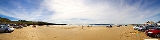
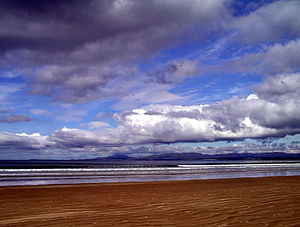
and 16.0 km southwest of Donegal Town. The extensive beach is very popular with families and is frequented by walkers, surfers, wind-surfers, kite-surfers and swimmers, and there are lifeguards on duty during the summer months. There is about 3 km of a good quality wide sandy beach.
's and Europe
's best Blue Flag
surfing
beaches. As the slowly rising beach faces westward into the Atlantic Ocean
, and the fact that Donegal Bay
has a funnel-like shape, it can increase the size of the waves, especially in winter when some huge rollers are generated and it has been known to have waves up to 7 metres (20 ft) high. Rossnowlagh has good safe facilities and has excellent water quality.
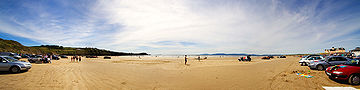 Rossnowlagh has many visitors during the summer months and is very popular as most of the beach is accessible by car which is suitable for young and old alike. Drivers are cautioned however to be aware of soft sand areas where cars can get stuck and to be aware of incoming tides which can move in rapidly and cover most/all of the beach. There may be a Beach Warden on duty and information about full and low tides may be displayed. Drivers on the beach are required to drive very slowly at 15 km/h and to be on the lookout for children and other users of the beach.
A soil erosion study of the beach at Rossnowlagh, known officially as Belalt Strand, has been made. The area consists mainly of sandy beach, but also rocky shore platform, sand dunes, grassland, boulder clay cliffs and rock cliffs. Over the last 60 years it has been determined that the central section of the dune front has been eroding at rates up to 0.6 metres (2 ft) per year, with the highest erosion rate between 1951 and 1977. Starting in 1972, short lengths of rock armour were constructed at first in front of the Sandhouse Hotel and with further additions along the shore-line; this stopped the erosion in protected parts but the dune front has a ragged appearance with up to 35 metres (114.8 ft) of erosion where half of the sandy shoreline has no protection.
The Sandhouse Hotel is located adjacent to the beach, with a Surfers Bar attached. Overlooking the beach and on the cliff is the Smuggler's Creek Inn restaurant and bar, and there are several shops in the area, along with a Post-Office and Shop near the Franciscan Friary as well as The Thatch Tea House nearby.
The Franciscan Friary is located up from the southern end of the beach. The Friary has a Visitor Centre and contains the Donegal Historical Society Museum which houses a small collection including stone age flints and old Irish musical instruments. The Friary also has beautiful gardens which are open to visitors.
To the south-west further along the cliffs in the distance stands the ruined Kilbarron Castle which is accessible via Creevy.
history in Donegal
when the link was broken in the mid-19th century. However, the Franciscan order re-established themselves in County Donegal when new friary buildings were built in Rossnowlagh in the early 1950s. The land for the Friary was donated by Charles Williamson to his brother and Franciscan, Brother Paschal Williamson.
County Donegal
County Donegal is a county in Ireland. It is part of the Border Region and is also located in the province of Ulster. It is named after the town of Donegal. Donegal County Council is the local authority for the county...
, Ireland
Republic of Ireland
Ireland , described as the Republic of Ireland , is a sovereign state in Europe occupying approximately five-sixths of the island of the same name. Its capital is Dublin. Ireland, which had a population of 4.58 million in 2011, is a constitutional republic governed as a parliamentary democracy,...
. It is about 8.5 km north of Ballyshannon
Ballyshannon
Ballyshannon is a town in County Donegal, Ireland. It is located where the N3 and N15 cross the River Erne, and claims to be the oldest town in Ireland.-Location:...
and 16.0 km southwest of Donegal Town. The extensive beach is very popular with families and is frequented by walkers, surfers, wind-surfers, kite-surfers and swimmers, and there are lifeguards on duty during the summer months. There is about 3 km of a good quality wide sandy beach.
Beach
Rossnowlagh is one of IrelandIreland
Ireland is an island to the northwest of continental Europe. It is the third-largest island in Europe and the twentieth-largest island on Earth...
's and Europe
Europe
Europe is, by convention, one of the world's seven continents. Comprising the westernmost peninsula of Eurasia, Europe is generally 'divided' from Asia to its east by the watershed divides of the Ural and Caucasus Mountains, the Ural River, the Caspian and Black Seas, and the waterways connecting...
's best Blue Flag
Blue Flag beach
The Blue Flag is a certification by the Foundation for Environmental Education that a beach or marina meets its stringent standards.The Blue Flag is a trademark owned by FEE which is a not-for-profit, non-governmental organisation consisting of 65 organisations in 60 member countries in Europe,...
surfing
Surfing
Surfing' is a surface water sport in which the surfer rides a surfboard on the crest and face of a wave which is carrying the surfer towards the shore...
beaches. As the slowly rising beach faces westward into the Atlantic Ocean
Atlantic Ocean
The Atlantic Ocean is the second-largest of the world's oceanic divisions. With a total area of about , it covers approximately 20% of the Earth's surface and about 26% of its water surface area...
, and the fact that Donegal Bay
Donegal Bay
Donegal Bay is an inlet in the northwest of Ireland. Three counties – Donegal to the north and west, Leitrim and Sligo to the south – have shorelines on the bay, which is bounded on the west by the Atlantic Ocean...
has a funnel-like shape, it can increase the size of the waves, especially in winter when some huge rollers are generated and it has been known to have waves up to 7 metres (20 ft) high. Rossnowlagh has good safe facilities and has excellent water quality.
A soil erosion study of the beach at Rossnowlagh, known officially as Belalt Strand, has been made. The area consists mainly of sandy beach, but also rocky shore platform, sand dunes, grassland, boulder clay cliffs and rock cliffs. Over the last 60 years it has been determined that the central section of the dune front has been eroding at rates up to 0.6 metres (2 ft) per year, with the highest erosion rate between 1951 and 1977. Starting in 1972, short lengths of rock armour were constructed at first in front of the Sandhouse Hotel and with further additions along the shore-line; this stopped the erosion in protected parts but the dune front has a ragged appearance with up to 35 metres (114.8 ft) of erosion where half of the sandy shoreline has no protection.
Amenities
The main amenity is the extensive beach which is very popular with families. It is frequented by walkers, joggers, sunbathers, surfers, wind-surfers, kite-surfers and swimmers, and is accessible by car via 3 ramps. There is about 3 km of a good quality wide sandy beach although it is possible to walk several more kilometres further along the shore and all the way to Murvagh Beach.The Sandhouse Hotel is located adjacent to the beach, with a Surfers Bar attached. Overlooking the beach and on the cliff is the Smuggler's Creek Inn restaurant and bar, and there are several shops in the area, along with a Post-Office and Shop near the Franciscan Friary as well as The Thatch Tea House nearby.
The Franciscan Friary is located up from the southern end of the beach. The Friary has a Visitor Centre and contains the Donegal Historical Society Museum which houses a small collection including stone age flints and old Irish musical instruments. The Friary also has beautiful gardens which are open to visitors.
To the south-west further along the cliffs in the distance stands the ruined Kilbarron Castle which is accessible via Creevy.
Events
- Rossnowlagh Surf Club hosts several surfing events, some with dozens of young surfers competing. For example competitions are held for U12, U14 and U16 age groups.
- A peaceful Orange Order parade is held each year in Rossnowlagh, usually on the Saturday before 12th of July. The number of participants and marching bands varies each year with most marchers coming from order lodges based in Northern IrelandNorthern IrelandNorthern Ireland is one of the four countries of the United Kingdom. Situated in the north-east of the island of Ireland, it shares a border with the Republic of Ireland to the south and west...
but some come from other areas in Donegal, Monaghan and Cavan. There is no lodge in Rossnowlagh. The participants begin near St John's Church and march for approximately 2 km into the centre of Rossnowlagh, where they congregate for some time. The marchers march back to St John's church area in the late afternoon.
- The Irish National Junior Surfing Championships have been hosted in Rossnowlagh, such as in 2007 where 113 young surfers competed for titles in U12, U14, U16 and U18 levels, including events for bodyboard and longboardLongboardA longboard generally designates a longer board variant in various board sports.* Longboard * Longboard...
. Rossnowlagh Surf Club members have been successful in these and other surfing competitions.
- An annual FeisFéisA Feis or Fèis is a traditional Gaelic arts and culture festival. The plural forms are feiseanna and fèisean .-History:In Ancient Ireland communities placed great importance on local festivals, where Gaels could come together in song, dance, music, theatre and sport...
(Irish Gaelic: pronounced fesh) is held each summer in July or August at the Franciscan Friary in Rossnowlagh. The feis is officially called the Feis of the Four Masters or Feis na gCeithre Maistir in Irish. One of the Four Masters, Michael O'Cleirigh, comes from the nearby locality.
- The Inter-Counties Surfing contest is Ireland's longest-running surfing contest and has been held every year since 1969. As it is normally the last surfing event of the year in Ireland, held in September or October, it is widely viewed as a social event of the surfing calendar, and the actual surfing often takes second place to the craic and social enjoyment. In the last decade the contest has turned into a battle between the two dominant counties in Irish Surfing, hailing from opposite ends of the country - DonegalDonegalDonegal or Donegal Town is a town in County Donegal, Ireland. Its name, which was historically written in English as Dunnagall or Dunagall, translates from Irish as "stronghold of the foreigners" ....
and WaterfordWaterfordWaterford is a city in the South-East Region of Ireland. It is the oldest city in the country and fifth largest by population. Waterford City Council is the local government authority for the city and its immediate hinterland...
.
- The World Rally ChampionshipWorld Rally ChampionshipThe World Rally Championship is a rallying series organised by the FIA, culminating with a champion driver and manufacturer. The driver's world championship and manufacturer's world championship are separate championships, but based on the same point system. The series currently consists of 13...
came to the Rossnowlagh area in 2007 and again in 2009. Rally IrelandRally IrelandRally Ireland was a new addition to the FIA World Rally Championship calendar in 2007. It was not part of the 2008 schedule, but returned as the First round of the championship in 2009. The North-South event is the largest sporting occasion on the island of Ireland with over 250,000 spectators and...
organised both events. The rally which drew a large number of spectators was held in the townland of Cashel on the northern edge of Rossnowlagh and was labelled the Donegal Bay stage. This special stage was 14 km long on narrow single-lane tarmac back roads. In 2007 it was won by Jari-Matti LatvalaJari-Matti LatvalaJari-Matti Latvala is a Finnish rally driver competing in the World Rally Championship. His co-driver has been Miikka Anttila since the 2003 Rallye Deutschland...
and in 2009 by Mikko HirvonenMikko HirvonenMikko Hirvonen is a Finnish rally driver currently driving for the Citroën Total World Rally Team in the World Rally Championship. He placed third in the drivers' championship and helped Ford to the manufacturers' title in both 2006 and 2007. In 2008, 2009 and 2011, he finished runner-up to...
. Sebastian Loeb was the overall winner of both rallies.
History: Franciscan Friary
There had been 500 years of FranciscanFranciscan
Most Franciscans are members of Roman Catholic religious orders founded by Saint Francis of Assisi. Besides Roman Catholic communities, there are also Old Catholic, Anglican, Lutheran, ecumenical and Non-denominational Franciscan communities....
history in Donegal
Donegal
Donegal or Donegal Town is a town in County Donegal, Ireland. Its name, which was historically written in English as Dunnagall or Dunagall, translates from Irish as "stronghold of the foreigners" ....
when the link was broken in the mid-19th century. However, the Franciscan order re-established themselves in County Donegal when new friary buildings were built in Rossnowlagh in the early 1950s. The land for the Friary was donated by Charles Williamson to his brother and Franciscan, Brother Paschal Williamson.
History: Railway Transport
- Rossnowlagh railway station opened in 1905 but closed on 1 January 1960. It was part of the Great Northern RailwayGreat Northern Railway (Ireland)The Great Northern Railway was an Irish gauge railway company in Ireland.The Great Northern was formed in 1876 by a merger of the Irish North Western Railway , Northern Railway of Ireland, and Ulster Railway. The Ulster Railway was the GNRI's oldest constituent, having opened between Belfast and...
network with the train running towards BundoranBundoranBundoran is a town in County Donegal, part of the Province of Ulster in the north of Ireland. The town is located on the N15 road near Ballyshannon, 3 hours drive from Dublin and around two and a quarter hours drive from Belfast...
to the south and to DerryDerryDerry or Londonderry is the second-biggest city in Northern Ireland and the fourth-biggest city on the island of Ireland. The name Derry is an anglicisation of the Irish name Doire or Doire Cholmcille meaning "oak-wood of Colmcille"...
to the north. During the 55 years of its operation, Rossnowlagh, with its 2 miles of golden beach, became a popular venue for excursionists, and it was particularly favoured by families, daytrippers and for groups on their annual outings.
See also
- List of towns and villages in Ireland
- List of abbeys and priories in Ireland (County Donegal)