

Roosevelt Island Tramway

Encyclopedia
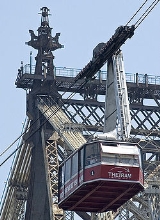
The Roosevelt Island Tramway is an aerial tramway
in New York City
that spans the East River
and connects Roosevelt Island
to Manhattan
. Prior to the completion of the Mississippi Aerial River Transit
in May 1984 and the Portland Aerial Tram
in December 2006, it was the only commuter aerial tramway in North America
. The tramway reopened on November 30, 2010, after a nine-month closure for modernization.
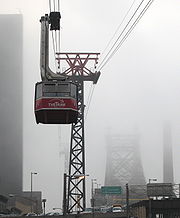
Over 26 million passengers have used the tram since it began operation in 1976. Each cabin has a capacity of up to 110 people and makes approximately 115 trips per day. The tram moves at about 17.9 mph (8 m/s) and travels 3100 feet (944.9 m) in 3 minutes. At its peak it climbs to 250 feet (76.2 m) above the East River as it follows its route on the north side of the Ed Koch Queensboro Bridge, providing views of the East Side of midtown Manhattan
. Two cabins make the run at fifteen minute intervals from 6:00 a.m. to 2:30 a.m. (3:30 a.m. on weekends) and continuously during rush hours. It is one of the few forms of mass transit in New York City not run by the Metropolitan Transportation Authority
, but uses that system's MetroCard
.
The tram is operated by LPOA (Leitner-Poma of America)
on behalf of the Roosevelt Island Operating Corporation of the State of New York, a state public benefit corporation
created in 1984 to run services on the island.
 Roosevelt Island had been connected to Manhattan by a trolley
line that crossed over the Queensboro Bridge from its opening in 1909. Trolleys to and from Queens stopped in the middle of the bridge to meet an elevator, which then took passengers down to the island. As the only connection to the rest of the city from the island, the trolley remained in service until April 7, 1957, long after most other trolley service had been dismantled in the city, and was the last trolley line in New York
State. At that time, a bridge to Queens was completed, requiring a roundabout trip to reach Manhattan.
Beginning in the mid-1970s, Roosevelt Island was redeveloped to accommodate low- to mid-income housing projects, necessitating the construction of a new public transit connection to the city. The trolley tracks had deteriorated beyond repair and the planned subway connection
to the island had not yet been completed. In 1971 The Urban Development Corporation retained Lev Zetlin Associates to select and design a transit connection to Roosevelt Island. James A O'Kon PE led the LZA team in carrying out a feasibility study and design. Three alternate modes were studied: a ferry, an elevator from the bridge, and the aerial tramway. The tramway was selected and the system was designed for bidding. Von Roll was selected to supply and erect the tram and its equipment. It was opened in July 1976 as a temporary solution for the island's commuting needs. As the subway project fell further behind schedule, the "tram" became more popular and was converted into a permanent facility. The subway connection to the island was finally completed in 1989.
The tram was the last holdout for the use of tokens in the New York City transit system
. Initially, it used a special token, which was later replaced by the standard variety for subways and buses. Although tokens were phased out in favor of the MetroCard by 2003, the tram did not start to accept MetroCards until March 1, 2004. The fare is the same as that on the subways: U.S. $2.25 for a one-way trip.
During the 2005 New York City transit strike
, the tramway was one of the few intra-city public transportation systems still in operation.
On April 18, 2006, at about 5:22 p.m. EDT, the two trams were stuck over the East River
for seven hours because of mechanical problems, trapping 69 people. Rescue baskets capable of holding up to 15 people were sent up to the stranded cable cars at 10:55 p.m., with children and elderly going first, and each rescue taking about 20 minutes. These baskets also carried supplies to the trams, such as blankets, baby formula, and food, for the remaining passengers. Passengers on the Roosevelt Island–bound tram were rescued by about 2:55 a.m. on April 19, while those on the Manhattan-bound tram were not rescued until 4:07 a.m.
 The April 2006 incident was the second time in eight months that the tram system lost power. On September 2, 2005, more than 80 people were trapped on the tram for over 90 minutes. After that incident, state inspectors cited the Roosevelt Island Tramway for not having an operational diesel backup, or Motor-generator
system. The State Department of Labor said the system did not pass electrical inspection and could not run when the April 18 power outage took place.
The tramway suspended operations after the April 2006 incident, reopening on September 1, 2006. The tram's backup electrical systems were refurbished, and "in case of an emergency, each car now is equipped with blankets, water, food, and a toilet with a privacy curtain. Car attendants will carry cell phones with their radios."
On March 1, 2010, the tramway was closed as part of a $25 million project to upgrade and modernize the system. With the help of the French company Poma
, all components were replaced except for the three tower bases. Among the improvements, the new tram cables and cars will be allowed to operate independently of each other in a "dual-haul" system. Prior to this, the cars had to travel at the same time, which presented maintenance and emergency response issues. The old cabins may be preserved on Roosevelt Island and/or a museum. The tramway reopened November 30, 2010, at 11 a.m. The project was completed in nine months, two months longer than originally planned.
 The tram is wheelchair accessible. Bicycles are permitted on the tram.
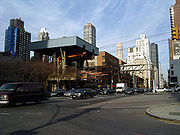
In Manhattan, the entrance to the system is at Tram Plaza, 60th Street and 2nd Avenue. The closest New York City Subway
station is the complex at Lexington Avenue / 59th Street ( trains) on the BMT Broadway Line
and 59th Street ( trains) on the IRT Lexington Avenue Line
. Lexington Avenue – 53rd Street ( trains) on the IND Queens Boulevard Line
and Lexington Avenue – 63rd Street ( train) on the IND 63rd Street Line
are also nearby.
On Roosevelt Island, the "Red Bus" meets the tram and offers transportation around the island for 25 cents. During the tramway reconstruction, the Red Bus is extended to Queens Plaza
and the Manhattan side of the Queensboro Bridge. The public Q102 bus also provides transportation on the island and to Queens and Manhattan. The Roosevelt Island
( train) subway station is located north of the tramway entrance.
, in which the Green Goblin
throws Mary Jane Watson
off the Queensboro Bridge, and Spider-Man
must choose between saving her or passengers on the tramway. Shooting of this movie caused the Tram to be out of service for weeks.
The Spider-Man film was not the first appearance of the tramway; The House on the Edge of the Park
(1980) shows the tram at 6:07 minutes into the film as how it appeared in the late 1970s. The Sylvester Stallone thriller Nighthawks
(1981) depicted the tramway as a terrorist target where United Nations
delegates were taken hostage. It was used in the opening credits of City Slickers
(1991). In the 1994 film Léon (The Professional)
it can be seen when Natalie Portman's character, Mathilda, is traveling on it alone. It also appeared in the 2005 horror movie Dark Water
.
The tram also figured prominently in the Universal Studios Florida
theme park attraction Kongfrontation
, which opened in 1990 and closed in 2002. The ride consisted of passengers boarding a recreation of a Roosevelt Island tram where they promptly came face-to-face with King Kong
. The recreation did take certain liberties with regard to accuracy; the real trams, for example, do not have seats (though they do have benches at either end).
The fate of the tramway was shown in episode 4 of the first season of Life After People: The Series.
A virtual version of the tramway is seen in fictional Liberty City of the Grand Theft Auto
gaming series.
Aerial tramway
An aerial tramway , cable car , ropeway or aerial tram is a type of aerial lift which uses one or two stationary ropes for support while a third moving rope provides propulsion...
in New York City
New York City
New York is the most populous city in the United States and the center of the New York Metropolitan Area, one of the most populous metropolitan areas in the world. New York exerts a significant impact upon global commerce, finance, media, art, fashion, research, technology, education, and...
that spans the East River
East River
The East River is a tidal strait in New York City. It connects Upper New York Bay on its south end to Long Island Sound on its north end. It separates Long Island from the island of Manhattan and the Bronx on the North American mainland...
and connects Roosevelt Island
Roosevelt Island
Roosevelt Island, known as Welfare Island from 1921 to 1973, and before that Blackwell's Island, is a narrow island in the East River of New York City. It lies between the island of Manhattan to its west and the borough of Queens to its east...
to Manhattan
Manhattan
Manhattan is the oldest and the most densely populated of the five boroughs of New York City. Located primarily on the island of Manhattan at the mouth of the Hudson River, the boundaries of the borough are identical to those of New York County, an original county of the state of New York...
. Prior to the completion of the Mississippi Aerial River Transit
Mississippi Aerial River Transit
The Mississippi Aerial River Transit, or simply MART was a gondola lift transport system spanning the Mississippi River in New Orleans, Louisiana, United States. It was constructed for the 1984 Louisiana World Exposition...
in May 1984 and the Portland Aerial Tram
Portland Aerial Tram
The Portland Aerial Tram is an aerial tramway in Portland, Oregon, carrying commuters between the city's South Waterfront district and the main Oregon Health & Science University campus, located in the Marquam Hill neighborhood. It is the second commuter aerial tramway in the United States...
in December 2006, it was the only commuter aerial tramway in North America
North America
North America is a continent wholly within the Northern Hemisphere and almost wholly within the Western Hemisphere. It is also considered a northern subcontinent of the Americas...
. The tramway reopened on November 30, 2010, after a nine-month closure for modernization.
Over 26 million passengers have used the tram since it began operation in 1976. Each cabin has a capacity of up to 110 people and makes approximately 115 trips per day. The tram moves at about 17.9 mph (8 m/s) and travels 3100 feet (944.9 m) in 3 minutes. At its peak it climbs to 250 feet (76.2 m) above the East River as it follows its route on the north side of the Ed Koch Queensboro Bridge, providing views of the East Side of midtown Manhattan
Midtown Manhattan
Midtown Manhattan, or simply Midtown, is an area of Manhattan, New York City home to world-famous commercial zones such as Rockefeller Center, Broadway, and Times Square...
. Two cabins make the run at fifteen minute intervals from 6:00 a.m. to 2:30 a.m. (3:30 a.m. on weekends) and continuously during rush hours. It is one of the few forms of mass transit in New York City not run by the Metropolitan Transportation Authority
Metropolitan Transportation Authority (New York)
The Metropolitan Transportation Authority of the State of New York is a public benefit corporation responsible for public transportation in the U.S...
, but uses that system's MetroCard
MetroCard
The MetroCard is the payment method for the New York City Subway rapid transit system; New York City Transit buses, including routes operated by Atlantic Express under contract to the Metropolitan Transportation Authority ; MTA Bus, and MTA Long Island Bus systems; the PATH subway system; the...
.
The tram is operated by LPOA (Leitner-Poma of America)
Leitner-Poma
Leitner-Poma of America is a North American aerial lift manufacturer based in Grand Junction, Colorado. It is the North American subsidiary of French-based Poma, which is owned by the Italian company Leitner Technologies, part of the Leitner Group. The North American company was formed in 2000 when...
on behalf of the Roosevelt Island Operating Corporation of the State of New York, a state public benefit corporation
Public benefit corporation
A public-benefit corporation is a public corporation chartered by a state designed to perform some public benefit.A public authority is a type of public-benefit corporation that takes on a more bureaucratic role, such as the maintenance of public infrastructure, that often has broad powers to...
created in 1984 to run services on the island.
History
Tram
A tram is a passenger rail vehicle which runs on tracks along public urban streets and also sometimes on separate rights of way. It may also run between cities and/or towns , and/or partially grade separated even in the cities...
line that crossed over the Queensboro Bridge from its opening in 1909. Trolleys to and from Queens stopped in the middle of the bridge to meet an elevator, which then took passengers down to the island. As the only connection to the rest of the city from the island, the trolley remained in service until April 7, 1957, long after most other trolley service had been dismantled in the city, and was the last trolley line in New York
New York
New York is a state in the Northeastern region of the United States. It is the nation's third most populous state. New York is bordered by New Jersey and Pennsylvania to the south, and by Connecticut, Massachusetts and Vermont to the east...
State. At that time, a bridge to Queens was completed, requiring a roundabout trip to reach Manhattan.
Beginning in the mid-1970s, Roosevelt Island was redeveloped to accommodate low- to mid-income housing projects, necessitating the construction of a new public transit connection to the city. The trolley tracks had deteriorated beyond repair and the planned subway connection
Roosevelt Island (IND 63rd Street Line)
Roosevelt Island is a station on the IND 63rd Street Line of the New York City Subway. Located on Roosevelt Island in the East River, between Manhattan and Queens, it is served by the F train at all times. The station opened in 1989 in conjunction with the partial completion of the 63rd Street...
to the island had not yet been completed. In 1971 The Urban Development Corporation retained Lev Zetlin Associates to select and design a transit connection to Roosevelt Island. James A O'Kon PE led the LZA team in carrying out a feasibility study and design. Three alternate modes were studied: a ferry, an elevator from the bridge, and the aerial tramway. The tramway was selected and the system was designed for bidding. Von Roll was selected to supply and erect the tram and its equipment. It was opened in July 1976 as a temporary solution for the island's commuting needs. As the subway project fell further behind schedule, the "tram" became more popular and was converted into a permanent facility. The subway connection to the island was finally completed in 1989.
The tram was the last holdout for the use of tokens in the New York City transit system
Transportation in New York City
The transportation system of New York City is a cooperation of complex systems of infrastructure. New York City, being the largest city in the United States, has a transportation system which includes the largest subway system in the world, measured by track mileage; the world's first mechanically...
. Initially, it used a special token, which was later replaced by the standard variety for subways and buses. Although tokens were phased out in favor of the MetroCard by 2003, the tram did not start to accept MetroCards until March 1, 2004. The fare is the same as that on the subways: U.S. $2.25 for a one-way trip.
During the 2005 New York City transit strike
2005 New York City transit strike
The 2005 New York City transit strike was a strike in New York City called by the Transport Workers Union Local 100 . Negotiations for a new contract with the Metropolitan Transportation Authority broke down over retirement, pension, and wage increases. The strike began at 3:00 a.m. EST on...
, the tramway was one of the few intra-city public transportation systems still in operation.
On April 18, 2006, at about 5:22 p.m. EDT, the two trams were stuck over the East River
East River
The East River is a tidal strait in New York City. It connects Upper New York Bay on its south end to Long Island Sound on its north end. It separates Long Island from the island of Manhattan and the Bronx on the North American mainland...
for seven hours because of mechanical problems, trapping 69 people. Rescue baskets capable of holding up to 15 people were sent up to the stranded cable cars at 10:55 p.m., with children and elderly going first, and each rescue taking about 20 minutes. These baskets also carried supplies to the trams, such as blankets, baby formula, and food, for the remaining passengers. Passengers on the Roosevelt Island–bound tram were rescued by about 2:55 a.m. on April 19, while those on the Manhattan-bound tram were not rescued until 4:07 a.m.
Motor-generator
A motor-generator is a device for converting electrical power to another form. Motor-generator sets are used to convert frequency, voltage, or phase of power. They may also be used to isolate electrical loads from the electrical power supply line...
system. The State Department of Labor said the system did not pass electrical inspection and could not run when the April 18 power outage took place.
The tramway suspended operations after the April 2006 incident, reopening on September 1, 2006. The tram's backup electrical systems were refurbished, and "in case of an emergency, each car now is equipped with blankets, water, food, and a toilet with a privacy curtain. Car attendants will carry cell phones with their radios."
On March 1, 2010, the tramway was closed as part of a $25 million project to upgrade and modernize the system. With the help of the French company Poma
Poma
Poma, also known as Pomagalski S.A. is a French company, specialising in construction of cable-driven lift systems, including fixed and detachable chairlifts, gondola lifts, funiculars, aerial tramways, people movers, and surface lifts. Poma has installed more than 7800 devices on five continents,...
, all components were replaced except for the three tower bases. Among the improvements, the new tram cables and cars will be allowed to operate independently of each other in a "dual-haul" system. Prior to this, the cars had to travel at the same time, which presented maintenance and emergency response issues. The old cabins may be preserved on Roosevelt Island and/or a museum. The tramway reopened November 30, 2010, at 11 a.m. The project was completed in nine months, two months longer than originally planned.
Accessibility and transfers
In Manhattan, the entrance to the system is at Tram Plaza, 60th Street and 2nd Avenue. The closest New York City Subway
New York City Subway
The New York City Subway is a rapid transit system owned by the City of New York and leased to the New York City Transit Authority, a subsidiary agency of the Metropolitan Transportation Authority and also known as MTA New York City Transit...
station is the complex at Lexington Avenue / 59th Street ( trains) on the BMT Broadway Line
BMT Broadway Line
The BMT Broadway Line is a rapid transit line of the B Division of the New York City Subway in Manhattan, New York City, United States. , it is served by three services, all colored yellow: the on the express tracks and the on the local tracks...
and 59th Street ( trains) on the IRT Lexington Avenue Line
IRT Lexington Avenue Line
The Lexington Avenue Line is one of the lines of the IRT division of the New York City Subway, stretching from Downtown Brooklyn or Lower Manhattan north to 125th Street in East Harlem. The portion in Lower and Midtown Manhattan was part of the first subway line in New York...
. Lexington Avenue – 53rd Street ( trains) on the IND Queens Boulevard Line
IND Queens Boulevard Line
The Queens Boulevard Line is a fully underground line of the B Division of the New York City Subway in Manhattan and Queens, New York City, United States. The line provides crosstown service across Manhattan under 53rd Street and east through Queens to Jamaica...
and Lexington Avenue – 63rd Street ( train) on the IND 63rd Street Line
IND 63rd Street Line
The IND 63rd Street Line is a rapid transit line of the IND division of the New York City Subway system. It runs from the IND Sixth Avenue Line at 57th Street east under 63rd Street and the East River through the 63rd Street Tunnel to the IND Queens Boulevard Line in Queens...
are also nearby.
On Roosevelt Island, the "Red Bus" meets the tram and offers transportation around the island for 25 cents. During the tramway reconstruction, the Red Bus is extended to Queens Plaza
Queens Plaza, Queens
Queens Plaza is a plaza located on Queens Boulevard, between North and South Plaza streets, in Long Island City, Queens. The plaza is overlapped by an elevated railway transit , with the Queensboro Bridge starting on the eastern side...
and the Manhattan side of the Queensboro Bridge. The public Q102 bus also provides transportation on the island and to Queens and Manhattan. The Roosevelt Island
Roosevelt Island (IND 63rd Street Line)
Roosevelt Island is a station on the IND 63rd Street Line of the New York City Subway. Located on Roosevelt Island in the East River, between Manhattan and Queens, it is served by the F train at all times. The station opened in 1989 in conjunction with the partial completion of the 63rd Street...
( train) subway station is located north of the tramway entrance.
Media references
The Roosevelt Island Tramway was featured prominently in a climactic battle in the 2002 film Spider-ManSpider-Man (film)
Spider-Man is a 2002 American superhero film, the first in the Spider-Man film series based on the fictional Marvel Comics character Spider-Man. It was directed by Sam Raimi and written by David Koepp...
, in which the Green Goblin
Green Goblin
The Green Goblin is a fictional character, a supervillain who appears in the comic books published by Marvel Comics. The character was created by writer Stan Lee and artist Steve Ditko, and first appeared in The Amazing Spider-Man #14 ....
throws Mary Jane Watson
Mary Jane Watson
Mary Jane Watson, often shortened to MJ, is a fictional supporting character appearing, originally, in Marvel comic books and, later, in multiple spin-offs and dramatizations of the Spider-Man titles as the best friend, love interest, and one-time wife of Peter Parker, the alter ego of Spider-Man...
off the Queensboro Bridge, and Spider-Man
Spider-Man
Spider-Man is a fictional Marvel Comics superhero. The character was created by writer-editor Stan Lee and writer-artist Steve Ditko. He first appeared in Amazing Fantasy #15...
must choose between saving her or passengers on the tramway. Shooting of this movie caused the Tram to be out of service for weeks.
The Spider-Man film was not the first appearance of the tramway; The House on the Edge of the Park
The House on the Edge of the Park
The House on the Edge of the Park is a 1980 crime/horror/thriller film from the Italian director Ruggero Deodato. It stars David Hess from Wes Craven's The Last House on the Left , and Giovanni Lombardo Radice....
(1980) shows the tram at 6:07 minutes into the film as how it appeared in the late 1970s. The Sylvester Stallone thriller Nighthawks
Nighthawks (film)
Nighthawks is a 1981 thriller film starring Sylvester Stallone, Billy Dee Williams, Rutger Hauer, Lindsay Wagner, Persis Khambatta, and Nigel Davenport. It was directed by Bruce Malmuth. The original music score was composed by Keith Emerson.-Storyline:...
(1981) depicted the tramway as a terrorist target where United Nations
United Nations
The United Nations is an international organization whose stated aims are facilitating cooperation in international law, international security, economic development, social progress, human rights, and achievement of world peace...
delegates were taken hostage. It was used in the opening credits of City Slickers
City Slickers
City Slickers is a 1991 American comedy film directed by Ron Underwood and starring Billy Crystal, Daniel Stern, Bruno Kirby, Helen Slater and Jack Palance. Palance won an Academy Award for his performance....
(1991). In the 1994 film Léon (The Professional)
Léon (film)
Léon is a 1994 French thriller film written and directed by Luc Besson...
it can be seen when Natalie Portman's character, Mathilda, is traveling on it alone. It also appeared in the 2005 horror movie Dark Water
Dark Water (2005 film)
Dark Water is a 2005 American horror-thriller film directed by Walter Salles, starring Jennifer Connelly and Tim Roth. The film is a remake of the 2002 Japanese film of the same name, and also stars John C. Reilly, Pete Postlethwaite, Perla Haney-Jardine and Ariel Gade...
.
The tram also figured prominently in the Universal Studios Florida
Universal Studios Florida
Universal Studios Florida is an American theme park located in Orlando, Florida. Opened on June 7, 1990, the park's theme is the entertainment industry, in particular movies and television. Universal Studios Florida inspires its guests to "ride the movies," and it features numerous attractions and...
theme park attraction Kongfrontation
Kongfrontation
Kongfrontation was a ride at the Universal Studios Florida theme park, in Orlando, Florida, the main attraction in the park's New York section. It opened as one of the original attractions at the park on June 7, 1990 and was closed on September 8, 2002. Revenge of the Mummy opened in its place on...
, which opened in 1990 and closed in 2002. The ride consisted of passengers boarding a recreation of a Roosevelt Island tram where they promptly came face-to-face with King Kong
King Kong
King Kong is a fictional character, a giant movie monster resembling a gorilla, that has appeared in several movies since 1933. These include the groundbreaking 1933 movie, the film remakes of 1976 and 2005, as well as various sequels of the first two films...
. The recreation did take certain liberties with regard to accuracy; the real trams, for example, do not have seats (though they do have benches at either end).
The fate of the tramway was shown in episode 4 of the first season of Life After People: The Series.
A virtual version of the tramway is seen in fictional Liberty City of the Grand Theft Auto
Grand Theft Auto (series)
Grand Theft Auto is a multi-award-winning British video game series created in the United Kingdom by Dave Jones, then later by brothers Dan Houser and Sam Houser, and game designer Zachary Clarke. It is primarily developed by Edinburgh based Rockstar North and published by Rockstar Games...
gaming series.
External links
- Official web site
- RIOC Roosevelt Island Tram Modernization Project
- Tram's page at New York City Subway Resources.
- Technical data and pictures about the new ropeway
- Technical data about the old ropeway
- Artistic Tramway Photos & Stories @ Adventures of a GoodMan
- Pictures of the tram and taken from it
- Manhattan entrance (Second Avenue and 60th Street) from Google Maps Street View
- Roosevelt Island entrance from Google Maps Street View