


Roman Catholicism in Romania

Encyclopedia
Romania
Romania is a country located at the crossroads of Central and Southeastern Europe, on the Lower Danube, within and outside the Carpathian arch, bordering on the Black Sea...
is a Latin Rite Christian
Christianity
Christianity is a monotheistic religion based on the life and teachings of Jesus as presented in canonical gospels and other New Testament writings...
church, part of the worldwide Catholic Church, under the spiritual leadership of the Pope
Pope
The Pope is the Bishop of Rome, a position that makes him the leader of the worldwide Catholic Church . In the Catholic Church, the Pope is regarded as the successor of Saint Peter, the Apostle...
and Curia
Roman Curia
The Roman Curia is the administrative apparatus of the Holy See and the central governing body of the entire Catholic Church, together with the Pope...
in Rome
Rome
Rome is the capital of Italy and the country's largest and most populated city and comune, with over 2.7 million residents in . The city is located in the central-western portion of the Italian Peninsula, on the Tiber River within the Lazio region of Italy.Rome's history spans two and a half...
. Its administration is centered in Bucharest
Bucharest
Bucharest is the capital municipality, cultural, industrial, and financial centre of Romania. It is the largest city in Romania, located in the southeast of the country, at , and lies on the banks of the Dâmbovița River....
, and comprises two archdioceses and four other diocese
Diocese
A diocese is the district or see under the supervision of a bishop. It is divided into parishes.An archdiocese is more significant than a diocese. An archdiocese is presided over by an archbishop whose see may have or had importance due to size or historical significance...
s. It is the second largest Romanian denomination after the Romanian Orthodox Church
Romanian Orthodox Church
The Romanian Orthodox Church is an autocephalous Eastern Orthodox church. It is in full communion with other Eastern Orthodox churches, and is ranked seventh in order of precedence. The Primate of the church has the title of Patriarch...
, and one of the 16 state-recognized religions. In 1992, it had 1,144,820 members, of which the largest groups were Hungarians (approx. 770,000, including Székely
Székely
The Székelys or Székely , sometimes also referred to as Szeklers , are a subgroup of the Hungarian people living mostly in the Székely Land, an ethno-cultural region in eastern Transylvania, Romania...
and Csángó
Csángó
The Csango people are a Hungarian ethnographic group of Roman Catholic faith living mostly in the Romanian region of Moldavia, especially in the Bacău County...
), Romanians
Romanians
The Romanians are an ethnic group native to Romania, who speak Romanian; they are the majority inhabitants of Romania....
(approx. 360,000) and Germans
Germans of Romania
The Germans of Romania or Rumäniendeutsche were 760,000 strong in 1930. They are not a single group; thus, to understand their language, culture, and history, one must view them as independent groups:...
(approx. 70,000). Overall data for 2002 indicated that there were 1,028,401 Romanian citizens adhering to the Roman Catholic Church
Roman Catholic Church
The Catholic Church, also known as the Roman Catholic Church, is the world's largest Christian church, with over a billion members. Led by the Pope, it defines its mission as spreading the gospel of Jesus Christ, administering the sacraments and exercising charity...
(4.7% of the population).
Most Roman Catholics inhabit the region of Transylvania
Transylvania
Transylvania is a historical region in the central part of Romania. Bounded on the east and south by the Carpathian mountain range, historical Transylvania extended in the west to the Apuseni Mountains; however, the term sometimes encompasses not only Transylvania proper, but also the historical...
and Bacău County
Bacau County
Bacău is a county of Romania, in Moldavia, with its capital city at Bacău. It has one commune, Ghimeş-Făget, in Transylvania.-Demographics:In 2002, it had a population of 706,623 and the population density was 113/km²....
in Moldavia
Moldavia
Moldavia is a geographic and historical region and former principality in Eastern Europe, corresponding to the territory between the Eastern Carpathians and the Dniester river...
. The smaller Roman Catholic communities include Banat Bulgarians
Banat Bulgarians
The Banat Bulgarians are a distinct Bulgarian minority group which settled in the 18th century in the region of the Banat, which was then ruled by the Habsburgs and after World War I was divided between Romania, Serbia, and Hungary...
, Italians
Italians of Romania
The Italian Romanians are people of Italian descent who reside, or have moved to Romania.-Characteristics:They are an ethnic minority in Romania, numbering 3,288 people according to the 2002 census...
, Poles
Polish minority in Romania
According to the 2002 census, 3,671 Poles live in Romania, mainly in the villages of the Suceava region . There are even three exclusively Polish villages: Nowy Sołoniec , Plesza and Pojana Mikuli...
, Croats
Croats of Romania
The Croats are an ethnic minority in Romania, numbering 6,786 people according to the 2002 census. Croats mainly live in the southwest of the country, particularly in Caraş-Severin County. Declared Croatians form a majority in two Romanian localities: the communes of Caraşova and Lupac...
and Krashovani
Krashovani
The Krashovani are a South Slavic people indigenous to Caraşova and other nearby locations in...
, Czechs
Czechs of Romania
The Czechs are an ethnic minority in Romania, numbering 3,938 people according to the 2002 census. The majority of Romanian Czechs live in the south-west of the country, with around 60% of them living in Caraş-Severin County, where they make up 0.7% of the population.As an officially recognised...
, Slovaks
Slovaks of Romania
The Slovaks are an ethnic minority in Romania, numbering 17,199 people according to the 2002 census and hence making up 0.1% of the total population. Slovaks mainly live in western Romania, with the largest populations found in Bihor and Arad counties, where they make up 1.22% and 1.25% of the...
, and Romani people
Roma minority in Romania
The Roma constitute one of the major minorities in Romania. According to the 2002 census, they number 535,140 people or 2.5% of the total population, being the second-largest ethnic minority in Romania after Hungarians...
.
The Romanian Church United with Rome, Greek-Catholic
Romanian Church United with Rome, Greek-Catholic
The Romanian Church United with Rome, Greek-Catholic is an Eastern Catholic Church which is in full union with the Roman Catholic Church. It is ranked as a Major Archiepiscopal Church and uses the Byzantine liturgical rite in the Romanian language....
is a related sui iuris
Sui iuris
Sui iuris, commonly also spelled sui juris, is a Latin phrase that literally means “of one’s own laws”.-Secular law:In civil law the phrase sui juris indicates legal competence, the capacity to manage one’s own affairs...
Catholic Church which uses the Byzantine Rite
Byzantine Rite
The Byzantine Rite, sometimes called the Rite of Constantinople or Constantinopolitan Rite is the liturgical rite used currently by all the Eastern Orthodox Churches, by the Greek Catholic Churches , and by the Protestant Ukrainian Lutheran Church...
. It has separate jurisdiction, four eparchies, and one archeparchy headed by a major archbishop (thus the church has its own synod
Synod
A synod historically is a council of a church, usually convened to decide an issue of doctrine, administration or application. In modern usage, the word often refers to the governing body of a particular church, whether its members are meeting or not...
). The majority of its members are Romanians, with groups of Ukrainians
Ukrainians of Romania
The Ukrainians are the third-largest ethnic minority in Romania. According to the 2002 Romanian census they number 61,091 people, making up 0.3% of the total population. Ukrainians claim that the number is actually 250,000-300,000. Ukrainians mainly live in northern Romania, in areas close to...
from northern Romania. Members of the Armenian
Armenians in Romania
Armenians have been present in what is now Romania and Moldova for over a millennium, and have been an important presence as traders since the 14th century...
community who adhere to the Armenian Rite
Armenian Rite
The Armenian Rite is an independent liturgy. This rite is used by both the Armenian Apostolic and Armenian Catholic Churches; it is also the rite of a significant number of Eastern Catholic Christians in the Republic of Georgia....
are grouped in the Roman Catholic-led Gherla Vicariate.
Structure
Roman Catholic Archdiocese of Bucharest
The Roman Catholic Archdiocese of Bucharest, Romania was established on 27 April 1883. There had been a Catholic presence in the city since at least the 18th century, but it was only in 1847 that Bishop Josephus Molajoni was able to establish his residence there...
, a metropolitan bishop
Metropolitan bishop
In Christian churches with episcopal polity, the rank of metropolitan bishop, or simply metropolitan, pertains to the diocesan bishop or archbishop of a metropolis; that is, the chief city of a historical Roman province, ecclesiastical province, or regional capital.Before the establishment of...
ric for the entire country, directly overseeing the regions of Muntenia
Muntenia
Muntenia is a historical province of Romania, usually considered Wallachia-proper . It is situated between the Danube , the Carpathian Mountains and Moldavia , and the Olt River to the west...
, Northern Dobruja
Northern Dobruja
Northern Dobruja is the part of Dobruja within the borders of Romania. It lies between the lower Danube river and the Black Sea, bordered in south by Bulgarian Southern Dobruja.-Geography:...
and Oltenia
Oltenia
Oltenia is a historical province and geographical region of Romania, in western Wallachia. It is situated between the Danube, the Southern Carpathians and the Olt river ....
; it has around 52,000 parishioners, most of them Romanians. The other diocese of its rank, the Roman Catholic Archdiocese of Alba Iulia
Roman Catholic Archdiocese of Alba Iulia
The Roman Catholic Archdiocese of Alba Iulia is an archdiocese in Transylvania, Romania. It was established as the Diocese of Transylvania in 1009 by Stephen I of Hungary and was renamed as the Diocese of Alba Iulia on 22 March 1932...
(in Alba Iulia
Alba Iulia
Alba Iulia is a city in Alba County, Transylvania, Romania with a population of 66,747, located on the Mureş River. Since the High Middle Ages, the city has been the seat of Transylvania's Roman Catholic diocese. Between 1541 and 1690 it was the capital of the Principality of Transylvania...
), groups the region of Transylvania-proper (without Maramureş and Crişana
Crisana
Crișana is a geographical and historical region divided today between Romania and Hungary, named after the Criș River and its three tributaries: the Crișul Alb, Crișul Negru and Crișul Repede....
), and has around 480,000 mostly Hungarian parishioners. Four other dioceses function in Romania and are based, respectively, in Timişoara
Timisoara
Timișoara is the capital city of Timiș County, in western Romania. One of the largest Romanian cities, with an estimated population of 311,586 inhabitants , and considered the informal capital city of the historical region of Banat, Timișoara is the main social, economic and cultural center in the...
(the Roman Catholic Diocese of Timişoara
Roman Catholic Diocese of Timisoara
The Roman Catholic Diocese of Timişoara is a diocese in Romania established on 5 June 1930 by Pope Pius XI. The Diocese of Cenad, corresponding to approximately the same region, had been created in 1030 by Stephen I of Hungary....
, representing the Banat
Banat
The Banat is a geographical and historical region in Central Europe currently divided between three countries: the eastern part lies in western Romania , the western part in northeastern Serbia , and a small...
), Oradea
Oradea
Oradea is the capital city of Bihor County, in the Crișana region of north-western Romania. The city has a population of 204,477, according to the 2009 estimates. The wider Oradea metropolitan area has a total population of 245,832.-Geography:...
(the Roman Catholic Diocese of Oradea, for Crişana), Satu Mare (the Roman Catholic Diocese of Satu Mare
Roman Catholic Diocese of Satu Mare
The Roman Catholic Diocese of Satu Mare, Romania was established on 23 March 1804 by Francis I, King of Hungary, an act recognised by Pope Pius VII that 9 August. At the time, the diocese was part of the Kingdom of Hungary and covered a larger territory, including land in present-day Hungary and...
, for Maramureş), and Iaşi
Iasi
Iași is the second most populous city and a municipality in Romania. Located in the historical Moldavia region, Iași has traditionally been one of the leading centres of Romanian social, cultural, academic and artistic life...
(the Roman Catholic Diocese of Iaşi
Roman Catholic Diocese of Iasi
The Roman Catholic Diocese of Iaşi, Romania was established on 27 June 1884. A diocese had been set up at Siret by Pope Urban V in 1370, due to work done by Franciscans and Dominicans; its seat was transferred to Bacău at the beginning of the 15th century...
, for Moldavia).
The Church presently runs a faculty of theology
Theology
Theology is the systematic and rational study of religion and its influences and of the nature of religious truths, or the learned profession acquired by completing specialized training in religious studies, usually at a university or school of divinity or seminary.-Definition:Augustine of Hippo...
(as part of the Babeş-Bolyai University
Babes-Bolyai University
The Babeș-Bolyai University in Cluj-Napoca is an university in Romania. With almost 50,000 students, the university offers 105 specialisations, of which there are 105 in Romanian, 67 in Hungarian, 17 in German, and 5 in English...
in Cluj-Napoca
Cluj-Napoca
Cluj-Napoca , commonly known as Cluj, is the fourth most populous city in Romania and the seat of Cluj County in the northwestern part of the country. Geographically, it is roughly equidistant from Bucharest , Budapest and Belgrade...
), four theological institutes, six medical schools and sixteen seminaries
Seminary
A seminary, theological college, or divinity school is an institution of secondary or post-secondary education for educating students in theology, generally to prepare them for ordination as clergy or for other ministry...
(see Religious education in Romania
Religious education in Romania
The Romanian Revolution of 1989, which ended the Communist regime of Nicolae Ceauşescu in December 1989, offered the 15 religious denominations then recognized in Romania the chance to regain the terrain lost after 1945, the year when Dr. Petru Groza of the Ploughmen's Front, a party closely...
). Among the journals issued by Catholic institutions are the Romanian-language
Romanian language
Romanian Romanian Romanian (or Daco-Romanian; obsolete spellings Rumanian, Roumanian; self-designation: română, limba română ("the Romanian language") or românește (lit. "in Romanian") is a Romance language spoken by around 24 to 28 million people, primarily in Romania and Moldova...
Actualitatea Creştină (Bucharest) and Lumina Creştinului (Iaşi), as well as the Hungarian-language
Hungarian language
Hungarian is a Uralic language, part of the Ugric group. With some 14 million speakers, it is one of the most widely spoken non-Indo-European languages in Europe....
Keresztény Szó and Vasárnap (both in Cluj-Napoca). It leads a network of charitable organization
Charitable organization
A charitable organization is a type of non-profit organization . It differs from other types of NPOs in that it centers on philanthropic goals A charitable organization is a type of non-profit organization (NPO). It differs from other types of NPOs in that it centers on philanthropic goals A...
s and other social ventures, administrated by its Caritas foundation or the religious order
Religious order
A religious order is a lineage of communities and organizations of people who live in some way set apart from society in accordance with their specific religious devotion, usually characterized by the principles of its founder's religious practice. The order is composed of initiates and, in some...
s; it includes kindergarten
Kindergarten
A kindergarten is a preschool educational institution for children. The term was created by Friedrich Fröbel for the play and activity institute that he created in 1837 in Bad Blankenburg as a social experience for children for their transition from home to school...
s, orphanage
Orphanage
An orphanage is a residential institution devoted to the care of orphans – children whose parents are deceased or otherwise unable or unwilling to care for them...
s, social canteens, medical facilities.
| Year | Roman Catholics | Percentage |
|---|---|---|
| 1948 | 1,175,000New Catholic Encyclopedia, vol 12, p. 335 | 7.4% |
| 1992 | 1,161,942 | 5.1% |
| 2002 | 1,028,401 | 4.7% |
Medieval period
.jpg)
Transylvania
Transylvania is a historical region in the central part of Romania. Bounded on the east and south by the Carpathian mountain range, historical Transylvania extended in the west to the Apuseni Mountains; however, the term sometimes encompasses not only Transylvania proper, but also the historical...
, in connection to the extension of Magyar rule and the region's integration into the Kingdom of Hungary
Kingdom of Hungary
The Kingdom of Hungary comprised present-day Hungary, Slovakia and Croatia , Transylvania , Carpatho Ruthenia , Vojvodina , Burgenland , and other smaller territories surrounding present-day Hungary's borders...
(see History of Transylvania
History of Transylvania
Transylvania is a historical region in the central part of the Romania. In ancient times it was part of the Dacian Kingdom and Roman Dacia. Since the 10th century, Transylvania became part of the Kingdom of Hungary...
). Inaugurated by the early presence of Benedictine
Benedictine
Benedictine refers to the spirituality and consecrated life in accordance with the Rule of St Benedict, written by Benedict of Nursia in the sixth century for the cenobitic communities he founded in central Italy. The most notable of these is Monte Cassino, the first monastery founded by Benedict...
s, these were strengthened by the colonization of Transylvanian Saxons
Transylvanian Saxons
The Transylvanian Saxons are a people of German ethnicity who settled in Transylvania from the 12th century onwards.The colonization of Transylvania by Germans was begun by King Géza II of Hungary . For decades, the main task of the German settlers was to defend the southeastern border of the...
, as well as by missionary
Missionary
A missionary is a member of a religious group sent into an area to do evangelism or ministries of service, such as education, literacy, social justice, health care and economic development. The word "mission" originates from 1598 when the Jesuits sent members abroad, derived from the Latin...
activities among the local Vlach
Vlachs
Vlach is a blanket term covering several modern Latin peoples descending from the Latinised population in Central, Eastern and Southeastern Europe. English variations on the name include: Walla, Wlachs, Wallachs, Vlahs, Olahs or Ulahs...
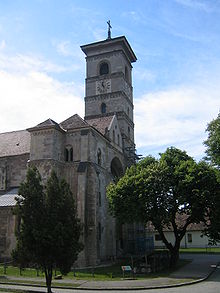
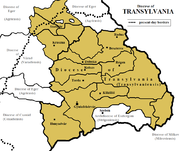
(Romanian) population and forceful conversions. The Diocese of Alba Iulia (Gyulafehérvár) was probably set up in the 11th century. Tradition holds that this was done under supervision from King Stephen I — according to the Catholic Encyclopedia
Catholic Encyclopedia
The Catholic Encyclopedia, also referred to as the Old Catholic Encyclopedia and the Original Catholic Encyclopedia, is an English-language encyclopedia published in the United States. The first volume appeared in March 1907 and the last three volumes appeared in 1912, followed by a master index...
of 1913, a more likely patron is Ladislaus I, who ruled almost a century after (the first bishop it lists is Simon, who held the see between 1103 and 1113).
Other dioceses were created in Cenad
Cenad
Cenad is a commune in Timiş County, Banat, Romania. It is composed of a single village, Cenad.-Demography:...
(Csanád) and Oradea
Oradea
Oradea is the capital city of Bihor County, in the Crișana region of north-western Romania. The city has a population of 204,477, according to the 2009 estimates. The wider Oradea metropolitan area has a total population of 245,832.-Geography:...
(Nagyvárad). They were subordinated to the Archbishop of Kalocsa
Kalocsa
Kalocsa is a town in Bács-Kiskun county, Hungary. It lies 88 miles south of Budapest. It is situated in a marshy but highly productive district, near the left bank of the Danube River. Historically it had greater political and economic importance than at present.Kalocsa is the Episcopal see...
, part of the Roman Catholic Church in Hungary
Roman Catholicism in Hungary
The Roman Catholic Church in Hungary is part of the worldwide Roman Catholic Church, under the spiritual leadership of the Pope and curia in Rome....
. The northern area comprised in the comitatus
Comitatus (Kingdom of Hungary)
A county is the name of a type of administrative units in the Kingdom of Hungary and in Hungary from the 10th century until the present day....
of Máramaros
Máramaros
Máramaros is the name of a historic administrative county of the Kingdom of Hungary. Its territory is presently in north-western Romania and western Ukraine...
was originally part of the Alba Iulia Diocese, while the southern one, Szeben
Szeben
Szeben was the name of a historic administrative county of the Kingdom of Hungary. Its territory is presently in central Romania . The capital of the county was Sibiu .-Geography:...
, was a provostship
Provost (religion)
A provost is a senior official in a number of Christian churches.-Historical Development:The word praepositus was originally applied to any ecclesiastical ruler or dignitary...
not comprised in any bishopric (and thus exempt
Exemption (church)
In the Roman Catholic Church, exemption is the whole or partial release of an ecclesiastical person, corporation, or institution from the authority of the ecclesiastical superior next higher in rank....
).
During the rule of Béla IV
Béla IV of Hungary
Béla IV , King of Hungary and of Croatia , duke of Styria 1254–58. One of the most famous kings of Hungary, he distinguished himself through his policy of strengthening of the royal power following the example of his grandfather Bela III, and by the rebuilding Hungary after the catastrophe of the...
, the Catholic hierarchy was disestablished by the Mongol
Mongol Empire
The Mongol Empire , initially named as Greater Mongol State was a great empire during the 13th and 14th centuries...
incursion (see Battle of Mohi
Battle of Mohi
The Battle of Mohi , or Battle of the Sajó River, was the main battle between the Mongol Empire and the Kingdom of Hungary during the Mongol invasion of Europe. It took place at Muhi, Southwest of the Sajó River. After the invasion, Hungary lay in ruins. Nearly half of the inhabited places had...
), and only recovered after 1300. In 1304, Pope Boniface VIII
Pope Boniface VIII
Pope Boniface VIII , born Benedetto Gaetani, was Pope of the Catholic Church from 1294 to 1303. Today, Boniface VIII is probably best remembered for his feuds with Dante, who placed him in the Eighth circle of Hell in his Divina Commedia, among the Simonists.- Biography :Gaetani was born in 1235 in...
sent the first Catholic missionaries from Transylvania into the lands over the Carpathian Mountains
Carpathian Mountains
The Carpathian Mountains or Carpathians are a range of mountains forming an arc roughly long across Central and Eastern Europe, making them the second-longest mountain range in Europe...
(the area known as "Cumania
Cumania
Cumania is a name formerly used to designate several distinct lands in Eastern Europe inhabited by and under the military dominance of the Cumans, a nomadic tribe who, with the Kipchaks, created a confederation. The Cumans were also known as the Polovtsians, or Folban...
"), where Eastern Orthodox
Eastern Orthodox Church
The Orthodox Church, officially called the Orthodox Catholic Church and commonly referred to as the Eastern Orthodox Church, is the second largest Christian denomination in the world, with an estimated 300 million adherents mainly in the countries of Belarus, Bulgaria, Cyprus, Georgia, Greece,...
bishops were already present. A Diocese of Cumania
Diocese of Cumania
The Diocese of Cumania was a Roman Catholic diocese in Hungary.The diocese was founded in 1227 with its seat in Milcov, serving the Cumans and the Teutonic Knights in the Burzenland. The diocese was destroyed during the course of the Mongol invasion of Europe in 1241.It was a suffragan of the...
was created in Milcov
Milcov
Milcovul or Milcov is a commune in Vrancea County, Romania. It is located in the historical region of Moldavia. It is composed of two villages, Lămoteşti and Milcovul, and also included Gologanu and Răstoaca before these became separate communes in 2004.In 1227 Milcov became the seat of the...
, in areas later ruled by Moldavia
Moldavia
Moldavia is a geographic and historical region and former principality in Eastern Europe, corresponding to the territory between the Eastern Carpathians and the Dniester river...
and Wallachia
Wallachia
Wallachia or Walachia is a historical and geographical region of Romania. It is situated north of the Danube and south of the Southern Carpathians...
. Its assets were granted by the Hungarian rulers, whose claimed suzerainty
Suzerainty
Suzerainty occurs where a region or people is a tributary to a more powerful entity which controls its foreign affairs while allowing the tributary vassal state some limited domestic autonomy. The dominant entity in the suzerainty relationship, or the more powerful entity itself, is called a...
over the region, and it extended over parts of Székely Land
Székely Land
The Székely Land or Szekler Land refers to the territories inhabited mainly by the Székely, a Hungarian-speaking ethnic group from eastern Transylvania...
.
The Diocese of Cumania disappeared for a while, as locals took over its property, but was revived in 1332-1334, when Pope John XXII
Pope John XXII
Pope John XXII , born Jacques Duèze , was pope from 1316 to 1334. He was the second Pope of the Avignon Papacy , elected by a conclave in Lyon assembled by Philip V of France...
appointed the Franciscan
Franciscan
Most Franciscans are members of Roman Catholic religious orders founded by Saint Francis of Assisi. Besides Roman Catholic communities, there are also Old Catholic, Anglican, Lutheran, ecumenical and Non-denominational Franciscan communities....
Vitus de Monteferro, the chaplain
Chaplain
Traditionally, a chaplain is a minister in a specialized setting such as a priest, pastor, rabbi, or imam or lay representative of a religion attached to a secular institution such as a hospital, prison, military unit, police department, university, or private chapel...
of King Carobert
Charles I of Hungary
Charles I , also known as Charles Robert , was the first King of Hungary and Croatia of the House of Anjou. He was also descended from the old Hungarian Árpád dynasty. His claim to the throne of Hungary was contested by several pretenders...
, as the new bishop. Direct control over the congregation was made difficult by the intrusion of the Golden Horde
Golden Horde
The Golden Horde was a Mongol and later Turkicized khanate that formed the north-western sector of the Mongol Empire...
, who had set up its base in the region later known as Budjak
Budjak
Budjak or Budzhak is a historical region in the Odessa Oblast of Ukraine. Lying along the Black Sea between the Danube and Dniester rivers this multiethnic region was the southern part of Bessarabia...
(present-day southern Ukraine
Ukraine
Ukraine is a country in Eastern Europe. It has an area of 603,628 km², making it the second largest contiguous country on the European continent, after Russia...
). Around 1318, the Dobruja
Dobruja
Dobruja is a historical region shared by Bulgaria and Romania, located between the lower Danube river and the Black Sea, including the Danube Delta, Romanian coast and the northernmost part of the Bulgarian coast...
n town of Vicina
Isaccea
Isaccea is a small town in Tulcea County, in Dobruja, Romania, on the right bank of the Danube, 35 km north-west of Tulcea. According to the 2002 census, it has a population 5,374....
was part of the Catholic vicar
Vicar
In the broadest sense, a vicar is a representative, deputy or substitute; anyone acting "in the person of" or agent for a superior . In this sense, the title is comparable to lieutenant...
iate of "Northern Tartary
Tartary
Tartary or Great Tartary was a name used by Europeans from the Middle Ages until the twentieth century to designate the Great Steppe, that is the great tract of northern and central Asia stretching from the Caspian Sea and the Ural Mountains to the Pacific Ocean inhabited mostly by Turkic, Mongol...
".
Danubian Principalities
Danubian Principalities was a conventional name given to the Principalities of Moldavia and Wallachia, which emerged in the early 14th century. The term was coined in the Habsburg Monarchy after the Treaty of Küçük Kaynarca in order to designate an area on the lower Danube with a common...
), Roman Catholic clerics arriving mainly from Jagiellon Poland and Transylvania set up the first Roman Catholic congregations over the Carpathians.
In both countries, as a result of stately emancipation and lingering conflicts with the Hungarian Kingdom, the relatively strong Catholic presence receded with the establishment of more powerful Orthodox institutions (the Hungro-Wallachian diocese and the Moldavian diocese). Nevertheless, Roman Catholics remained an important presence in both areas. As a result of fighting between Wallachia's Prince Vladislav I Vlaicu
Vladislav I of Wallachia
Vladislav I of the Basarab dynasty, also known as Vlaicu-Vodă, was a ruler of the principality of Wallachia . He was a vassal of the Bulgarian Emperor Ivan Alexander. In 1369 Vladislav I subdued Vidin and recognised Louis I of Hungary as his overlord in return for Severin, Amlaş, and Făgăraş...
and Hungarian King Louis I, concessions were made by both sides, and Wallachia agreed to tolerate a Catholic bishopric (1368). The following year, Wallachia resumed its anti-Catholic policies. In Moldavia, Prince Laţcu
Latcu of Moldavia
Laţcu was the Voivode of Moldavia between circa 1365 and 1373. He was the son of Bogdan I. His name is a diminutive form of Vladislav , often used in that period in Hungary due the deep rooted cult to Saint Ladislaus I of Hungary....
began negotiations with Pope Urban V
Pope Urban V
Pope Urban V , born Guillaume Grimoard, was Pope from 1362 to 1370.-Biography:Grimoard was a native of Grizac in Languedoc . He became a Benedictine and a doctor in Canon Law, teaching at Montpellier and Avignon...
and agreed to convert to Catholicism (1369); following a period of trouble, this political choice was to be overturned by Petru I
Petru I of Moldavia
Petru I Muşat was Voivode of Moldavia from 1375 to 1391, the son of Costea Muşat, the first ruler from the dynastic House of Bogdan. During his reign, he maintained good relationships with his neighbours, especially Poland....
during the 1380s. New sees were created in that country: in 1371, the one in Siret
Siret
Siret is a town in Romania, Suceava County, one of the oldest towns in, and a former capital of, the former principality of Moldavia. It is located 2 km from the border with Ukraine, being one of the main border passing points in the North of the country, having both a road border post and a...
, and, under the rule of Alexandru cel Bun
Alexandru cel Bun
Alexander cel Bun was a Voivode of Moldavia, reigning between 1400 and 1432, son of Roman I Mușat. He succeeded Iuga to the throne, and, as a ruler, initiated a series of reforms while consolidating the status of the Moldavian Principality....
, the short-lived one of Baia
Baia
Baia is a commune in the Suceava County, Romania with a population of 6,793 . It is composed of two villages, Baia and Bogata. Located on the Moldova River, it was one of the earliest urban settlements in Moldavia, originally inhabited by Germans...
(1405–1413).
Over the following centuries, the citadel of Cotnari
Cotnari
Cotnari is a village and the center of the eponymous commune in Iaşi County, Romania, in the informal region of Moldova. It is located north-west of Iaşi and south of Hârlău, in a major wine-producing region of Romania, and is famous for the wine variety known as Grasă de Cotnari...
was home to a notable Catholic community, initially comprising local Hungarians and Germans. In Wallachia, a short-lived Catholic diocese was created during the reign of Radu I
Radu I of Wallachia
Radu I was a ruler of the principality of Wallachia, ....
, around the main town of Curtea de Argeş
Curtea de Arges
Curtea de Argeș is a city in Romania on the right bank of the Argeş River, where it flows through a valley of the lower Carpathians , on the railway from Pitești to the Turnu Roşu Pass. It is part of Argeș County. The city administers one village, Noapteș...
(1381). The Moldavian diocese of Siret survived through the early stage of war with the Ottoman Empire
Ottoman Empire
The Ottoman EmpireIt was usually referred to as the "Ottoman Empire", the "Turkish Empire", the "Ottoman Caliphate" or more commonly "Turkey" by its contemporaries...
, but was ultimately disestablished during the early 15th century, when it moved to Bacău
Bacau
Bacău is the main city in Bacău County, Romania. It covers a land surface of 43 km², and, as of January 1, 2009, has an estimated population of 177,087. The city is situated in the historical region of Moldavia, at the foothills of the Carpathian Mountains, and on the Bistriţa River...
. In 1497, that location was abandoned by the hierarchy, and was no longer active during the following century. Until the mid-19th century, like all other religious minorities, Roman Catholics did not enjoy full political and civil rights.
The impact of Reformation
Battle of Mohács
The Battle of Mohács was fought on August 29, 1526 near Mohács, Hungary. In the battle, forces of the Kingdom of Hungary led by King Louis II of Hungary and Bohemia were defeated by forces of the Ottoman Empire led by Sultan Suleiman the Magnificent....
, during which the Ottomans conquered much of Hungary, leaving Transylvania under the rule of local Princes (see Ottoman Hungary
Ottoman Hungary
History of Ottoman Hungary refers to the history of parts of the Ottoman Empire situated in what today is Hungary, in the period from 1541 to 1699.-History:...
), Roman Catholicism entered a period of regression, and was later confronted with the success of Reformation
Protestant Reformation
The Protestant Reformation was a 16th-century split within Western Christianity initiated by Martin Luther, John Calvin and other early Protestants. The efforts of the self-described "reformers", who objected to the doctrines, rituals and ecclesiastical structure of the Roman Catholic Church, led...
. The first community to embrace a Protestant
Protestantism
Protestantism is one of the three major groupings within Christianity. It is a movement that began in Germany in the early 16th century as a reaction against medieval Roman Catholic doctrines and practices, especially in regards to salvation, justification, and ecclesiology.The doctrines of the...
creed were the Transylvanian Saxons
Transylvanian Saxons
The Transylvanian Saxons are a people of German ethnicity who settled in Transylvania from the 12th century onwards.The colonization of Transylvania by Germans was begun by King Géza II of Hungary . For decades, the main task of the German settlers was to defend the southeastern border of the...
, most of whom adhered to the Lutheran
Lutheranism
Lutheranism is a major branch of Western Christianity that identifies with the theology of Martin Luther, a German reformer. Luther's efforts to reform the theology and practice of the church launched the Protestant Reformation...
Augsburg Confession
Augsburg Confession
The Augsburg Confession, also known as the "Augustana" from its Latin name, Confessio Augustana, is the primary confession of faith of the Lutheran Church and one of the most important documents of the Lutheran reformation...
as early as 1547, followed soon after by large groups of the Hungarian population, who converted to Calvinism
Calvinism
Calvinism is a Protestant theological system and an approach to the Christian life...
. The provostship of Szeben ceased to exist entirely. Catholicism attempted to reestablish itself as George Cardinal Martinuzzi, a Catholic cleric, took over rule of Transylvania, but again declined after Martinuzzi was assassinated in 1551.
Religious disputes and battles prolonged themselves over the following centuries, as a large number of Roman Catholic communities founded specifically Protestant local churches — the Reformed Church
Reformed Church in Romania
The Reformed Church in Romania is the organization of the Calvinist church in Romania. The majority of its followers are of Hungarian ethnicity and Hungarian is the main church language...
, the Evangelical Lutheran Church and the Evangelical Church of Augustan Confession —, while others adhered to the Unitarian Church of Transylvania
Unitarian Church of Transylvania
The Unitarian Church of Transylvania is a church of the Unitarian denomination, based in the city of Cluj in the Principality of Transylvania, present day in Romania...
. The Diocese of Alba Iulia was disestablished in 1556.
An unprecedented stalemate was reached in 1568, under John II Sigismund Zápolya
John II Sigismund Zápolya
John II Sigismund Zápolya was King of Hungary from 1540 to 1570 and Prince of Transylvania from 1570–1571.-Family:The son of King John I and Isabella Jagiełło, he succeeded his father as an infant...
, when the Edict of Torda sanctioned freedom of religion
Freedom of religion
Freedom of religion is a principle that supports the freedom of an individual or community, in public or private, to manifest religion or belief in teaching, practice, worship, and observance; the concept is generally recognized also to include the freedom to change religion or not to follow any...
and awarded legal status to the Roman Catholic, Reformed, Lutheran and Unitarian churches alike (while viewing the majority Orthodox as "tolerated"). The Alba Iulia see was revived soon after the Catholic Stefan Batory
Stefan Batory
Stephen Báthory was a Hungarian noble Prince of Transylvania , then King of Poland and Grand Duke of Lithuania . He was a member of the Somlyó branch of the noble Hungarian Báthory family...
took the Transylvanian throne in succession to Zápolya (who had since become King of Hungary).
During that age, Roman Catholics were recognized an autonomous structure, which allowed clerics and laity
Laity
In religious organizations, the laity comprises all people who are not in the clergy. A person who is a member of a religious order who is not ordained legitimate clergy is considered as a member of the laity, even though they are members of a religious order .In the past in Christian cultures, the...
to organize teaching and administrate community schools. A particular compromise was the Saxon citadel of Biertan
Biertan
Biertan is a commune in central Romania, in the north of the Sibiu County, 80 km north of Sibiu and 15 km east of Mediaş. Biertan is one of the most important Saxon villages with fortified churches in Transylvania, having been on the list of UNESCO World Heritage Sites since 1993...
(Birthälm), where the fortified church
Saxon villages with fortified churches in Transylvania
Saxon and Székely Transylvanian villages were often organised around a fortified church. With its more than 150 well preserved fortified churches of a great variety of architectural styles , south-eastern Transylvania region in Romania currently has one of the highest numbers of existing fortified...
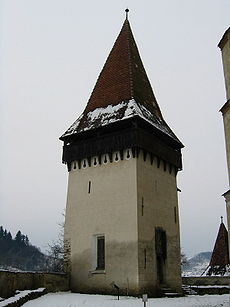
was taken over by the majority Lutheran community, and Catholic worship was still allowed to take place in the "Catholic Tower", located just south of the religious building.
The Counter-Reformation
Counter-Reformation
The Counter-Reformation was the period of Catholic revival beginning with the Council of Trent and ending at the close of the Thirty Years' War, 1648 as a response to the Protestant Reformation.The Counter-Reformation was a comprehensive effort, composed of four major elements:#Ecclesiastical or...
itself had an impact, with members of the Jesuit
Society of Jesus
The Society of Jesus is a Catholic male religious order that follows the teachings of the Catholic Church. The members are called Jesuits, and are also known colloquially as "God's Army" and as "The Company," these being references to founder Ignatius of Loyola's military background and a...
religious order
Religious order
A religious order is a lineage of communities and organizations of people who live in some way set apart from society in accordance with their specific religious devotion, usually characterized by the principles of its founder's religious practice. The order is composed of initiates and, in some...
being called into the region as early as 1579 (under the rule of Stefan Batory). In 1581, they founded an educational university in Cluj
Cluj-Napoca
Cluj-Napoca , commonly known as Cluj, is the fourth most populous city in Romania and the seat of Cluj County in the northwestern part of the country. Geographically, it is roughly equidistant from Bucharest , Budapest and Belgrade...
(Kolozsvár), nucleus of the present-day Babeş-Bolyai University
Babes-Bolyai University
The Babeș-Bolyai University in Cluj-Napoca is an university in Romania. With almost 50,000 students, the university offers 105 specialisations, of which there are 105 in Romanian, 67 in Hungarian, 17 in German, and 5 in English...
. Originally protected by the powerful Báthory
Báthory
The Báthory were a Hungarian noble family of the Gutkeled clan. The family rose to significant influence in Central Europe during the late Middle Ages, holding high military, administrative and ecclesiastical positions in the Kingdom of Hungary...
s, they continued to have a precarious status in Transylvania. Expelled in 1599-1595 (when Calvinism became official), and again in 1610-1615 (following the pressures of Gabriel Báthori
Gabriel Báthori
Gabriel Báthory was Prince of Transylvania from 1608 to his death in 1613.-Family:Gabriel was born at Nagyvárad, in Hungary as the son of Stephen Báthory , from Somlyo branch of the Hungarian Báthory family, and his first wife Susanna Bebek of Pelsocz...
), they continued their activities in the Moldavian region around Cotnari
Cotnari
Cotnari is a village and the center of the eponymous commune in Iaşi County, Romania, in the informal region of Moldova. It is located north-west of Iaşi and south of Hârlău, in a major wine-producing region of Romania, and is famous for the wine variety known as Grasă de Cotnari...
.
17th century setbacks and recovery
Habsburg Monarchy
The Habsburg Monarchy covered the territories ruled by the junior Austrian branch of the House of Habsburg , and then by the successor House of Habsburg-Lorraine , between 1526 and 1867/1918. The Imperial capital was Vienna, except from 1583 to 1611, when it was moved to Prague...
offensives, religious conflicts were resumed and, in 1601 Bishop Demeter Napragy was forced out of Alba Iulia, with the see being confiscated by Protestants (although bishops continued to be appointed, they resided abroad). By 1690, Roman Catholics were a minority in Transylvania.
In parallel, Hungary-proper was integrated into Habsburg domains (1622), which created a new base for Counter-Reformation, as well as a local seat for the Sacra Congregatio de Propaganda Fide
Congregation for the Evangelization of Peoples
The Congregation for the Evangelization of Peoples in Rome is the congregation of the Roman Curia responsible for missionary work and related activities...
. In Moldavia, Catholicism was reasserted among the Csángó
Csángó
The Csango people are a Hungarian ethnographic group of Roman Catholic faith living mostly in the Romanian region of Moldavia, especially in the Bacău County...
s before around 1590, when Franciscan
Franciscan
Most Franciscans are members of Roman Catholic religious orders founded by Saint Francis of Assisi. Besides Roman Catholic communities, there are also Old Catholic, Anglican, Lutheran, ecumenical and Non-denominational Franciscan communities....
monks took charge of the diocese reestablished in Bacău
Bacau
Bacău is the main city in Bacău County, Romania. It covers a land surface of 43 km², and, as of January 1, 2009, has an estimated population of 177,087. The city is situated in the historical region of Moldavia, at the foothills of the Carpathian Mountains, and on the Bistriţa River...
(1611) and first led by Bernardino Quirini. After 1644, more Jesuits from the Polish-Lithuanian Commonwealth
Polish-Lithuanian Commonwealth
The Polish–Lithuanian Commonwealth was a dualistic state of Poland and Lithuania ruled by a common monarch. It was the largest and one of the most populous countries of 16th- and 17th‑century Europe with some and a multi-ethnic population of 11 million at its peak in the early 17th century...
settled in that country, founding a college
College
A college is an educational institution or a constituent part of an educational institution. Usage varies in English-speaking nations...
in Cotnari and establishing a branch in Iaşi.
Around that time, the ethnic Romanian Transylvanian intellectual
Intellectual
An intellectual is a person who uses intelligence and critical or analytical reasoning in either a professional or a personal capacity.- Terminology and endeavours :"Intellectual" can denote four types of persons:...
Gheorghe Buitul joined the Jesuit order, the first member of his community to study in Rome
Rome
Rome is the capital of Italy and the country's largest and most populated city and comune, with over 2.7 million residents in . The city is located in the central-western portion of the Italian Peninsula, on the Tiber River within the Lazio region of Italy.Rome's history spans two and a half...
, while the Transylvanian-born István Pongrácz was one of the Jesuits executed by Calvinists in Royal Hungary
Royal Hungary
The Kingdom of Hungary between 1538 and 1867 was part of the lands of the Habsburg Monarchy, while outside the Holy Roman Empire.After Battle of Mohács, the country was ruled by two crowned kings . They divided the kingdom in 1538...
(1619). The order was expelled a third time from Transylvania (1652), on orders from George II Rákóczi
George II Rákóczi
György Rákóczi II , a Transylvanian Hungarian ruler, was the eldest son of George I and Susanna Lorantffy....
, and was twice driven out of Moldavia by the Great Turkish War
Great Turkish War
The Great Turkish War refers to a series of conflicts between the Ottoman Empire and contemporary European powers, then joined into a Holy League, during the second half of the 17th century.-1667–1683:...
(1672, 1683).
During the late 17th and early 18th centuries, the Roman Catholic Church sought to obtain the adherence of non-Catholic Christians to the Eastern Catholic Churches. They were assisted in this effort by the Habsburg offensive into Eastern Europe
Eastern Europe
Eastern Europe is the eastern part of Europe. The term has widely disparate geopolitical, geographical, cultural and socioeconomic readings, which makes it highly context-dependent and even volatile, and there are "almost as many definitions of Eastern Europe as there are scholars of the region"...
, which brought about Emperor
Holy Roman Emperor
The Holy Roman Emperor is a term used by historians to denote a medieval ruler who, as German King, had also received the title of "Emperor of the Romans" from the Pope...
Leopold I
Leopold I, Holy Roman Emperor
| style="float:right;" | Leopold I was a Holy Roman Emperor, King of Hungary and King of Bohemia. A member of the Habsburg family, he was the second son of Emperor Ferdinand III and his first wife, Maria Anna of Spain. His maternal grandparents were Philip III of Spain and Margaret of Austria...
's conquest of Transylvania in 1699. An additional factor for the new Catholic successes was, arguably, the continuous fighting between the various Protestant denominations of Transylvania.
In 1657, Armenians in Transylvania who belonged to the Armenian Apostolic Church
Armenian Apostolic Church
The Armenian Apostolic Church is the world's oldest National Church, is part of Oriental Orthodoxy, and is one of the most ancient Christian communities. Armenia was the first country to adopt Christianity as its official religion in 301 AD, in establishing this church...
and were led by Bishop Oxendius Vărzărescu, placed themselves under indirect Roman Catholic jurisdiction, as part of the Armenian Catholic Church
Armenian Catholic Church
|- |The Armenian Catholic Church is an Eastern Catholic Church sui juris in union with the other Eastern Rite, Oriental Rite and Latin Rite Catholics who accept the Bishop of Rome as spiritual leader of the Church. It is regulated by Eastern canon law...
. Many of them settled in and around Gherla
Gherla
Gherla is a city in Cluj County, Romania . It is located 45 km from Cluj-Napoca on the Someşul Mic River, and has a population of 24,083....
(Armenopolis or Szamosújvár).
18th century
Charles VI, Holy Roman Emperor
Charles VI was the penultimate Habsburg sovereign of the Habsburg Empire. He succeeded his elder brother, Joseph I, as Holy Roman Emperor, King of Bohemia , Hungary and Croatia , Archduke of Austria, etc., in 1711...
, the Bishops of Alba Iulia were able to return to their restored domains, as the see was removed from Protestant rule (1713). The diocese was completely restored in 1771, under Empress Maria Theresia
Maria Theresa of Austria
Maria Theresa Walburga Amalia Christina was the only female ruler of the Habsburg dominions and the last of the House of Habsburg. She was the sovereign of Austria, Hungary, Croatia, Bohemia, Mantua, Milan, Lodomeria and Galicia, the Austrian Netherlands and Parma...
. The defunct provostship of Szeben
Szeben
Szeben was the name of a historic administrative county of the Kingdom of Hungary. Its territory is presently in central Romania . The capital of the county was Sibiu .-Geography:...
was not revived, and its assets went instead to the main diocese. It was also under Maria Theresia that Catholic teaching and school administration came under the supervision of the Commissio catholica (this remained the rule under the Austrian Empire
Austrian Empire
The Austrian Empire was a modern era successor empire, which was centered on what is today's Austria and which officially lasted from 1804 to 1867. It was followed by the Empire of Austria-Hungary, whose proclamation was a diplomatic move that elevated Hungary's status within the Austrian Empire...
and the early years of Austria-Hungary
Austria-Hungary
Austria-Hungary , more formally known as the Kingdoms and Lands Represented in the Imperial Council and the Lands of the Holy Hungarian Crown of Saint Stephen, was a constitutional monarchic union between the crowns of the Austrian Empire and the Kingdom of Hungary in...
).
In 1700, with Jesuit assistance, the local Greek-Catholic Church
Romanian Church United with Rome, Greek-Catholic
The Romanian Church United with Rome, Greek-Catholic is an Eastern Catholic Church which is in full union with the Roman Catholic Church. It is ranked as a Major Archiepiscopal Church and uses the Byzantine liturgical rite in the Romanian language....
, grouping formerly Orthodox Romanians, was set up. Its leadership was supervised by Jesuit theologians, whose office ensured doctrinal conformity. The Jesuits were also allowed back into Moldavia by 1699, under the rule of Prince Antioh Cantemir
Antioh Cantemir
Antioh Cantemir , son of Constantin Cantemir and older brother of Dimitrie Cantemir , was a Moldavian Voivode between December 18, 1695 and September 12, 1700, and again from February 23, 1705 to July 31, 1707.-Reigns:He and Dimitrie successfully plotted against Prince Constantin...
. In 1773, the order was suppressed throughout Europe, before being again created by Pope Pius VII
Pope Pius VII
Pope Pius VII , born Barnaba Niccolò Maria Luigi Chiaramonti, was a monk, theologian and bishop, who reigned as Pope from 14 March 1800 to 20 August 1823.-Early life:...
in 1814 (see Suppression of the Society of Jesus). Pope Pius IX
Pope Pius IX
Blessed Pope Pius IX , born Giovanni Maria Mastai-Ferretti, was the longest-reigning elected Pope in the history of the Catholic Church, serving from 16 June 1846 until his death, a period of nearly 32 years. During his pontificate, he convened the First Vatican Council in 1869, which decreed papal...
reorganized the local Greek-Catholic Church in 1853, and placed it under Sacra Congregatio de Propaganda Fide jurisdiction (between 1912 and 1919, the Greek-Catholic parish
Parish
A parish is a territorial unit historically under the pastoral care and clerical jurisdiction of one parish priest, who might be assisted in his pastoral duties by a curate or curates - also priests but not the parish priest - from a more or less central parish church with its associated organization...
es were administered from Hajdúdorog
Hajdúdorog
Hajdúdorog is a town in Hajdú-Bihar county, in the Northern Great Plain region of eastern Hungary.-Geography:It covers an area of and has a population of 9070 people .-Twinnings: Lubartów, Poland Odorheiu Secuiesc, Romania Podenzano, Italy...
).
In the late 18th and early 19th centuries, Moldavia and Wallachia were awarded their own apostolic vicariate
Apostolic vicariate
An apostolic vicariate is a form of territorial jurisdiction of the Roman Catholic Church established in missionary regions and countries that do not have a diocese. It is essentially provisional, though it may last for a century or more...
s, based respectively in Iaşi
Iasi
Iași is the second most populous city and a municipality in Romania. Located in the historical Moldavia region, Iași has traditionally been one of the leading centres of Romanian social, cultural, academic and artistic life...
and Bucharest
Bucharest
Bucharest is the capital municipality, cultural, industrial, and financial centre of Romania. It is the largest city in Romania, located in the southeast of the country, at , and lies on the banks of the Dâmbovița River....
. The old Moldavian see of Bacău was itself abolished as a result. The Wallachian one was subordinated to the Bishop of Nikopol (later, of Rousse
Rousse
Ruse is the fifth-largest city in Bulgaria. Ruse is situated in the northeastern part of the country, on the right bank of the Danube, opposite the Romanian city of Giurgiu, from the capital Sofia and from the Bulgarian Black Sea Coast...
) for the following century. In 1792-1793, Bishop Paulus Davanlia left Rousse to live with the Franciscans in Bucharest (who had set up an important center at the Bărăţia
Bucharest Baratia
Bărăţia is one of the Roman Catholic churches in Bucharest, Romania. It is located in central Bucharest, on the I. C. Brătianu Blvd, next to Piaţa Unirii.-Name:...
).
In addition to the local presence, the Danubian Principalities
Danubian Principalities
Danubian Principalities was a conventional name given to the Principalities of Moldavia and Wallachia, which emerged in the early 14th century. The term was coined in the Habsburg Monarchy after the Treaty of Küçük Kaynarca in order to designate an area on the lower Danube with a common...
became home to communities of Catholic diaspora
Diaspora
A diaspora is "the movement, migration, or scattering of people away from an established or ancestral homeland" or "people dispersed by whatever cause to more than one location", or "people settled far from their ancestral homelands".The word has come to refer to historical mass-dispersions of...
s: in Bucharest, Ragusan
Republic of Ragusa
The Republic of Ragusa or Republic of Dubrovnik was a maritime republic centered on the city of Dubrovnik in Dalmatia , that existed from 1358 to 1808...
traders were first mentioned Bucharest during the 16th century, followed, around 1630, by Italian
Italians of Romania
The Italian Romanians are people of Italian descent who reside, or have moved to Romania.-Characteristics:They are an ethnic minority in Romania, numbering 3,288 people according to the 2002 census...
stonemasons; later, the Wallachian capital was settled by groups of Hungarians, Poles
Polish minority in Romania
According to the 2002 census, 3,671 Poles live in Romania, mainly in the villages of the Suceava region . There are even three exclusively Polish villages: Nowy Sołoniec , Plesza and Pojana Mikuli...
(a presence notable after the 1863 January Uprising
January Uprising
The January Uprising was an uprising in the former Polish-Lithuanian Commonwealth against the Russian Empire...
forced many to take refuge in Romania), and French people
France
The French Republic , The French Republic , The French Republic , (commonly known as France , is a unitary semi-presidential republic in Western Europe with several overseas territories and islands located on other continents and in the Indian, Pacific, and Atlantic oceans. Metropolitan France...
(see History of Bucharest
History of Bucharest
The history of Bucharest covers the time from the early settlements on the locality's territory until its modern existence as a city, capital of Wallachia, and present-day capital of Romania.-Ancient times:...
).
19th century and early 20th centuries
Roman Catholicism in Bulgaria
Roman Catholicism is the third largest religious congregation in Bulgaria, after Eastern Orthodoxy and Islam. It has roots in the country since the Middle Ages and is part of the worldwide Roman Catholic Church, under the spiritual leadership of the Pope and curia in Rome.As an entity, the Catholic...
Bishop of Chiprovtsi
Chiprovtsi
Chiprovtsi is a small town and municipality in northwestern Bulgaria, administratively part of Montana Province. It lies on the shores of the river Ogosta in the western Balkan Mountains, very close to the Bulgarian-Serbian border...
decided, as a result of an epidemic in the city, to move his seat to the village of Cioplea (presently part of Bucharest). The locality was a new center for the Bulgarian community in Wallachia
Bulgarians in Romania
Bulgarians are a recognized minority in Romania , numbering 8,025 according to the 2002 Romanian census, down from 9,851 in 1992. Despite their low census number today, Bulgarians from different confessional and regional backgrounds have had ethnic communities in various regions of Romania, and...
, but opposition from the local Orthodox hierarchy allowed the move to be completed only after 1847. Following the end of the Crimean War
Crimean War
The Crimean War was a conflict fought between the Russian Empire and an alliance of the French Empire, the British Empire, the Ottoman Empire, and the Kingdom of Sardinia. The war was part of a long-running contest between the major European powers for influence over territories of the declining...
, the Danubian Principalities
Danubian Principalities
Danubian Principalities was a conventional name given to the Principalities of Moldavia and Wallachia, which emerged in the early 14th century. The term was coined in the Habsburg Monarchy after the Treaty of Küçük Kaynarca in order to designate an area on the lower Danube with a common...
came under the supervision of several European powers, ending Russian
Russian Empire
The Russian Empire was a state that existed from 1721 until the Russian Revolution of 1917. It was the successor to the Tsardom of Russia and the predecessor of the Soviet Union...
tutelage and its Regulamentul Organic
Regulamentul Organic
Regulamentul Organic was a quasi-constitutional organic law enforced in 1834–1835 by the Imperial Russian authorities in Moldavia and Wallachia...
administration. The two countries were instead awarded ad-hoc Divans. On November 11, 1857, on Costache Negri
Costache Negri
Costache Negri was a Moldavian-born Romanian writer, politician and revolutionary....
's proposal, Moldavia's Divan regulated an end to religious discrimination
Religious discrimination
Religious discrimination is valuing or treating a person or group differently because of what they do or do not believe.A concept like that of 'religious discrimination' is necessary to take into account ambiguities of the term religious persecution. The infamous cases in which people have been...
against non-Orthodox Christians, a measure which mostly benefited the resident Roman Catholics and Gregorian
Armenian Apostolic Church
The Armenian Apostolic Church is the world's oldest National Church, is part of Oriental Orthodoxy, and is one of the most ancient Christian communities. Armenia was the first country to adopt Christianity as its official religion in 301 AD, in establishing this church...
Armenians
Armenians in Romania
Armenians have been present in what is now Romania and Moldova for over a millennium, and have been an important presence as traders since the 14th century...
.
Following the Moldo-Wallachian union of 1859, and the 1881 creation of the Kingdom of Romania
Kingdom of Romania
The Kingdom of Romania was the Romanian state based on a form of parliamentary monarchy between 13 March 1881 and 30 December 1947, specified by the first three Constitutions of Romania...
, the seat in Bucharest became an archdiocese (April 7, 1883) and the one in Iaşi a diocese, replacing the Franciscan-led diocese of Bacău (June 27, 1884). This came as a consequence of repeated protests from locals, who called for Romanian clerics not to be under the strict control of foreign bishops. Upgrading the local ecclesiastical hierarchy, the move also led to the disestablishment of the Cioplea bishopric. The first Archbishop of Bucharest was Ignazio Paoli.
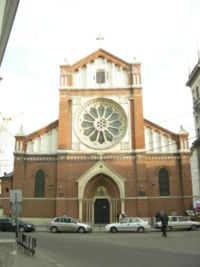
The Neogothic
Gothic Revival architecture
The Gothic Revival is an architectural movement that began in the 1740s in England...
Saint Joseph Cathedral in Bucharest was also completed in 1884, and two seminaries
Seminary
A seminary, theological college, or divinity school is an institution of secondary or post-secondary education for educating students in theology, generally to prepare them for ordination as clergy or for other ministry...
were set up (the main seminary was in Bucharest, and the Iaşi-based one was a Jesuit institution created in 1886, notably led by the Polish priest Feliks Wierciński). The Jesuit Mission in Romania was created in 1918, being subordinated to the Order's Province of Belgium
Belgium
Belgium , officially the Kingdom of Belgium, is a federal state in Western Europe. It is a founding member of the European Union and hosts the EU's headquarters, and those of several other major international organisations such as NATO.Belgium is also a member of, or affiliated to, many...
, and then to the Southern Province of Poland
Poland
Poland , officially the Republic of Poland , is a country in Central Europe bordered by Germany to the west; the Czech Republic and Slovakia to the south; Ukraine, Belarus and Lithuania to the east; and the Baltic Sea and Kaliningrad Oblast, a Russian exclave, to the north...
; it became a Vice-Province in 1927. Romania accommodated various Catholic organizations, including the Institute of the Brothers of the Christian Schools
Institute of the Brothers of the Christian Schools
The Institute of the Brothers of the Christian Schools is a Roman Catholic religious teaching congregation, founded in France by Saint Jean-Baptiste de la Salle and now based in Rome...
(who operated three Bucharest schools by 1913), the Sisters of Mercy
Sisters of Mercy
The Religious Order of the Sisters of Mercy is an order of Catholic women founded by Catherine McAuley in Dublin, Ireland, in 1831. , the order has about 10,000 members worldwide, organized into a number of independent congregations....
, the Passionist
Passionist
The Passionists are a Roman Catholic religious order founded by Saint Paul of the Cross . Professed members use the initials C.P. after their names.-History:St...
s, and the Congregation of Notre-Dame de Sion
Congregation of Notre-Dame de Sion
The Congregation of Notre-Dame de Sion is a Roman Catholic religious order of women founded in France in 1843 by Theodor Ratisbonne, encouraged by his brother Alphonse Ratisbonne, with the purpose of promoting the conversion of Jews to Christianity. The congregation established several educational...
. Despite this increase in importance, Romania and the Holy See did not formally establish diplomatic relations for several decades. The authorities also refused to allow the Church to create its own college
College
A college is an educational institution or a constituent part of an educational institution. Usage varies in English-speaking nations...
.
In parallel, autonomy for Roman Catholic school administration in Austro-Hungarian
Austria-Hungary
Austria-Hungary , more formally known as the Kingdoms and Lands Represented in the Imperial Council and the Lands of the Holy Hungarian Crown of Saint Stephen, was a constitutional monarchic union between the crowns of the Austrian Empire and the Kingdom of Hungary in...
Transylvania was recovered in 1873, through the creation of a "Roman-Catholic Status".
World War I and Greater Romania
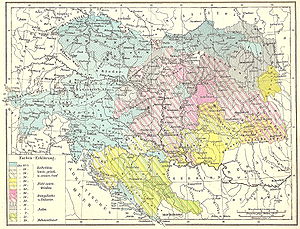
World War I
World War I , which was predominantly called the World War or the Great War from its occurrence until 1939, and the First World War or World War I thereafter, was a major war centred in Europe that began on 28 July 1914 and lasted until 11 November 1918...
and the stages leading up to Transylvania's union with Romania
Union of Transylvania with Romania
Union of Transylvania with Romania was declared on by the assembly of the delegates of ethnic Romanians held in Alba Iulia.The national holiday of Romania, the Great Union Day occurring on December 1, commemorates this event...
, Catholicism in Romania met with several diplomatic problems. Romania was defeated by the Central Powers
Central Powers
The Central Powers were one of the two warring factions in World War I , composed of the German Empire, the Austro-Hungarian Empire, the Ottoman Empire, and the Kingdom of Bulgaria...
and signed the Treaty of Bucharest, but its diplomats remained active in Allied
Allies of World War I
The Entente Powers were the countries at war with the Central Powers during World War I. The members of the Triple Entente were the United Kingdom, France, and the Russian Empire; Italy entered the war on their side in 1915...
countries, setting up the National Romanian Council in Paris
Paris
Paris is the capital and largest city in France, situated on the river Seine, in northern France, at the heart of the Île-de-France region...
. The latter, which also represented Romanian groups in the Austro-Hungarian-ruled Transylvania and Bukovina
Bukovina
Bukovina is a historical region on the northern slopes of the northeastern Carpathian Mountains and the adjoining plains.-Name:The name Bukovina came into official use in 1775 with the region's annexation from the Principality of Moldavia to the possessions of the Habsburg Monarchy, which became...
, appointed Monsignor
Monsignor
Monsignor, pl. monsignori, is the form of address for those members of the clergy of the Catholic Church holding certain ecclesiastical honorific titles. Monsignor is the apocopic form of the Italian monsignore, from the French mon seigneur, meaning "my lord"...
Vladimir Ghika
Vladimir Ghika
Vladimir Ghika was a prince, diplomat, writer, man of charity and the Romanian minister's nephew Grigore Alexandru Ghika, the last prince of Moldavia. Ghika Vladimir's father was John Gregory Ghika, minister of foriegn affairs of Romania. His brother was Dimitrie I. Ghika...
as its representative in Vatican City
Vatican City
Vatican City , or Vatican City State, in Italian officially Stato della Città del Vaticano , which translates literally as State of the City of the Vatican, is a landlocked sovereign city-state whose territory consists of a walled enclave within the city of Rome, Italy. It has an area of...
.
When the Paris Peace Conference
Paris Peace Conference, 1919
The Paris Peace Conference was the meeting of the Allied victors following the end of World War I to set the peace terms for the defeated Central Powers following the armistices of 1918. It took place in Paris in 1919 and involved diplomats from more than 32 countries and nationalities...
confirmed the creation of Greater Romania
Greater Romania
The Greater Romania generally refers to the territory of Romania in the years between the First World War and the Second World War, the largest geographical extent of Romania up to that time and its largest peacetime extent ever ; more precisely, it refers to the territory of the Kingdom of...
, Catholics of both churches represented 13 to 14% of its population. During the Conference, the Ion I. C. Brătianu
Ion I. C. Bratianu
Ion I. C. Brătianu was a Romanian politician, leader of the National Liberal Party , the Prime Minister of Romania for five terms, and Foreign Minister on several occasions; he was the eldest son of statesman and PNL leader Ion Brătianu, the brother of Vintilă and Dinu Brătianu, and the father of...
cabinet and representatives of Pope Benedict XV
Pope Benedict XV
Pope Benedict XV , born Giacomo Paolo Giovanni Battista della Chiesa, reigned as Pope from 3 September 1914 to 22 January 1922...
established preliminary contacts, a gesture coinciding with the encyclical
Encyclical
An encyclical was originally a circular letter sent to all the churches of a particular area in the ancient Catholic Church. At that time, the word could be used for a letter sent out by any bishop...
Pacem, Dei Munus Pulcherrimum (which, in turn, redefined relations between the Holy See and individual states). Negotiations were continued by the Alexandru Vaida-Voevod
Alexandru Vaida-Voevod
Alexandru Vaida-Voevod or Vaida-Voievod was a Romanian politician who was a supporter and promoter of the union of Transylvania with the Romanian Old Kingdom; he later served three terms as a Prime Minister of Greater Romania.-Transylvanian politics:He was born to a Greek-Catholic family in the...
cabinet, who appointed the Greek-Catholic priest Vasile Lucaciu
Vasile Lucaciu
Vasile Lucaciu was a Romanian Greek-Catholic priest and an advocate of equal rights with the Hungarians in Transylvania....
as its representative, and by that of Alexandru Averescu
Alexandru Averescu
Alexandru Averescu was a Romanian marshal and populist politician. A Romanian Armed Forces Commander during World War I, he served as Prime Minister of three separate cabinets . He first rose to prominence during the peasant's revolt of 1907, which he helped repress in violence...
. Through a decision taken by Foreign Minister Duiliu Zamfirescu
Duiliu Zamfirescu
Duiliu Zamfirescu was a Romanian novelist, poet, short story writer, lawyer, nationalist politician, journalist, diplomat and memoirist. In 1909, he was elected a member of the Romanian Academy, and, for a while in 1920, he was Foreign Minister of Romania...
, the outgoing Ghika was replaced with Dimitrie Pennescu, who was Romania's first Ambassador to the Vatican (see Holy See–Romania relations
Holy See–Romania relations
Holy See-Romania relations are foreign relations between the Holy See and Romania. Both countries established diplomatic relations in 1920. The Holy See has an embassy in Bucharest. Romania has an embassy to the Vatican.-History:...
). The Apostolic Nunciature
Nuncio
Nuncio is an ecclesiastical diplomatic title, derived from the ancient Latin word, Nuntius, meaning "envoy." This article addresses this title as well as derived similar titles, all within the structure of the Roman Catholic Church...
in Romania was set up as a result of this. The first person to hold this office was Archbishop Francesco Marmaggi
Francesco Marmaggi
Francesco Marmaggi was a Cardinal of the Roman Catholic Church who served as Prefect of the Congregation of the Council and, earlier, as Nuncio in Romania, Czechoslovakia and Poland, as well as being a special envoy to Turkey.-Biography:Francesco Marmaggi was born in Rome at a time when the...
, who took charge in October 1920.
Subsequently, the Roman Catholic presence registered significant successes: new religious orders, such as the Assumptionists
Assumptionists
The Augustinians of the Assumption constitute a congregation of Catholic religious , founded in Nîmes, southern France, by Fr. Emmanuel d'Alzon in 1845, initially approved by Rome in 1857 and definitively approved in 1864 . The current Rule of Life of the congregation draws its inspiration from...
and the Sisters of St. Mary
Sisters of St. Mary
The Sisters of St. Mary was a former Roman Catholic religious congregation for women based in St. Louis, Missouri that founded hospitals throughout the Midwest...
, began their activities on Romanian soil, and the lay
Laity
In religious organizations, the laity comprises all people who are not in the clergy. A person who is a member of a religious order who is not ordained legitimate clergy is considered as a member of the laity, even though they are members of a religious order .In the past in Christian cultures, the...
Acţiunea Catolică, a Romanian version of the Catholic Action
Catholic Action
Catholic Action was the name of many groups of lay Catholics who were attempting to encourage a Catholic influence on society.They were especially active in the nineteenth century in historically Catholic countries that fell under anti-clerical regimes such as Spain, Italy, Bavaria, France, and...
, was set up in 1927. By the end of World War II
World War II
World War II, or the Second World War , was a global conflict lasting from 1939 to 1945, involving most of the world's nations—including all of the great powers—eventually forming two opposing military alliances: the Allies and the Axis...
, there were 25 religious orders present in the country in 203 monasteries, maintaining 421 religious schools
Religious education in Romania
The Romanian Revolution of 1989, which ended the Communist regime of Nicolae Ceauşescu in December 1989, offered the 15 religious denominations then recognized in Romania the chance to regain the terrain lost after 1945, the year when Dr. Petru Groza of the Ploughmen's Front, a party closely...
and coordinating various charity ventures. Over the early 1920s, the Holy See and Romania engaged in several diplomatic disputes: in one case, the Catholic Church declared itself dissatisfied by the effects of a land reform
Land reform
[Image:Jakarta farmers protest23.jpg|300px|thumb|right|Farmers protesting for Land Reform in Indonesia]Land reform involves the changing of laws, regulations or customs regarding land ownership. Land reform may consist of a government-initiated or government-backed property redistribution,...
carried out in 1920-1921 (as a result of talks, it was occasionally allowed to keep larger estates than the law permitted); in parallel, Romanian authorities were dissatisfied with the activities of certain Roman Catholic prelate
Prelate
A prelate is a high-ranking member of the clergy who is an ordinary or who ranks in precedence with ordinaries. The word derives from the Latin prælatus, the past participle of præferre, which means "carry before", "be set above or over" or "prefer"; hence, a prelate is one set over others.-Related...
s in Transylvania and Hungary, whom they suspected of actively supporting Hungarian irredentism
Irredentism
Irredentism is any position advocating annexation of territories administered by another state on the grounds of common ethnicity or prior historical possession, actual or alleged. Some of these movements are also called pan-nationalist movements. It is a feature of identity politics and cultural...
(in one of his notes to the Vatican, Pennescu condemned the politically-motivated letters addressed by Gyula Glattfelder, the Bishop of Timişoara
Roman Catholic Diocese of Timisoara
The Roman Catholic Diocese of Timişoara is a diocese in Romania established on 5 June 1930 by Pope Pius XI. The Diocese of Cenad, corresponding to approximately the same region, had been created in 1030 by Stephen I of Hungary....
, to his Hungarian-majority congregation).
A Concordat
Concordat
A concordat is an agreement between the Holy See of the Catholic Church and a sovereign state on religious matters. Legally, they are international treaties. They often includes both recognition and privileges for the Catholic Church in a particular country...
was negotiated in 1927, being ratified by the Romanian side in 1929 and through the Papal bull Solemni conventione on June 5, 1930. On the basis of it, a 1932 agreement assigned to the Roman Catholic Church all the Transylvanian assets previously administered by the "Roman-Catholic Status". On August 15, 1930, the bishop of Bucharest was appointed metropolitan
Metropolitan bishop
In Christian churches with episcopal polity, the rank of metropolitan bishop, or simply metropolitan, pertains to the diocesan bishop or archbishop of a metropolis; that is, the chief city of a historical Roman province, ecclesiastical province, or regional capital.Before the establishment of...
(the others becoming suffragans
Suffragan bishop
A suffragan bishop is a bishop subordinate to a metropolitan bishop or diocesan bishop. He or she may be assigned to an area which does not have a cathedral of its own.-Anglican Communion:...
).
A redefinition of ecclesiastical administration took place in formerly Austro-Hungarian provinces, corresponding with the new borders of Greater Romania: Roman Catholics in Bukovina became part of the Iaşi Diocese
Roman Catholic Diocese of Iasi
The Roman Catholic Diocese of Iaşi, Romania was established on 27 June 1884. A diocese had been set up at Siret by Pope Urban V in 1370, due to work done by Franciscans and Dominicans; its seat was transferred to Bacău at the beginning of the 15th century...
, and those of Oradea
Oradea
Oradea is the capital city of Bihor County, in the Crișana region of north-western Romania. The city has a population of 204,477, according to the 2009 estimates. The wider Oradea metropolitan area has a total population of 245,832.-Geography:...
were joined with the Satu Mare Diocese
Roman Catholic Diocese of Satu Mare
The Roman Catholic Diocese of Satu Mare, Romania was established on 23 March 1804 by Francis I, King of Hungary, an act recognised by Pope Pius VII that 9 August. At the time, the diocese was part of the Kingdom of Hungary and covered a larger territory, including land in present-day Hungary and...
. The Armenians maintained their autonomous structure, with the Roman Catholic Church appointing their spiritual leader (see Armenian-Catholic Vicariate Gherla).
Communist period
Both Roman Catholicism and the Romanian Church United with Rome, Greek-CatholicRomanian Church United with Rome, Greek-Catholic
The Romanian Church United with Rome, Greek-Catholic is an Eastern Catholic Church which is in full union with the Roman Catholic Church. It is ranked as a Major Archiepiscopal Church and uses the Byzantine liturgical rite in the Romanian language....
entered a period of persecution and regression after 1948, when the Communist regime
Communist Romania
Communist Romania was the period in Romanian history when that country was a Soviet-aligned communist state in the Eastern Bloc, with the dominant role of Romanian Communist Party enshrined in its successive constitutions...
was established. Early signs of this were present after Soviet
Soviet Union
The Soviet Union , officially the Union of Soviet Socialist Republics , was a constitutionally socialist state that existed in Eurasia between 1922 and 1991....
authorities, when the Concordat came to be regularly disregarded by the Petru Groza
Petru Groza
Petru Groza was a Romanian politician, best known as the Prime Minister of the first Communist Party-dominated governments under Soviet occupation during the early stages of the Communist regime in Romania....
government, partly based on suspicions that the Holy See was attempting to convert the Orthodox population (see Soviet occupation of Romania
Soviet occupation of Romania
The Soviet occupation of Romania refers to the period from 1944 to August 1958, during which the Soviet Union maintained a significant military presence in Romania...
). In parallel, after 1945, Vladimir Ghika
Vladimir Ghika
Vladimir Ghika was a prince, diplomat, writer, man of charity and the Romanian minister's nephew Grigore Alexandru Ghika, the last prince of Moldavia. Ghika Vladimir's father was John Gregory Ghika, minister of foriegn affairs of Romania. His brother was Dimitrie I. Ghika...
and others led a movement calling for a union between the Roman Catholic and Romanian Orthodox Church
Romanian Orthodox Church
The Romanian Orthodox Church is an autocephalous Eastern Orthodox church. It is in full communion with other Eastern Orthodox churches, and is ranked seventh in order of precedence. The Primate of the church has the title of Patriarch...
es, which caused further suspicions from the new authorities. The Romanian Catholic Churches also explicitly refused to let their clergy join the Romanian Communist Party
Romanian Communist Party
The Romanian Communist Party was a communist political party in Romania. Successor to the Bolshevik wing of the Socialist Party of Romania, it gave ideological endorsement to communist revolution and the disestablishment of Greater Romania. The PCR was a minor and illegal grouping for much of the...
, which singled it out among religious organizations in the country.
In 1946, the Groza cabinet declared Apostolic Nuncio Andrea Cassulo
Andrea Cassulo
Andrea Cassulo was an archbishop of the Roman Catholic Church and a representative of the Holy See in Egypt, Canada, Romania and Turkey from 1921 to 1952.-Early life and ordination:...
a persona non grata
Persona non grata
Persona non grata , literally meaning "an unwelcome person", is a legal term used in diplomacy that indicates a proscription against a person entering the country...
, alleging that he had collaborated with Romania's wartime dictator, Ion Antonescu
Ion Antonescu
Ion Victor Antonescu was a Romanian soldier, authoritarian politician and convicted war criminal. The Prime Minister and Conducător during most of World War II, he presided over two successive wartime dictatorships...
; he was replaced with Gerald Patrick Aloysius O'Hara
Gerald Patrick Aloysius O'Hara
Gerald Patrick Aloysius O'Hara was an American prelate of the Catholic Church. He served as Bishop of Savannah , Apostolic Nuncio to Ireland , and Apostolic Delegate to Great Britain ....
, who continued to face accusations that he was spying in favor of the Western Allies
Western Allies
The Western Allies were a political and geographic grouping among the Allied Powers of the Second World War. It generally includes the United Kingdom and British Commonwealth, the United States, France and various other European and Latin American countries, but excludes China, the Soviet Union,...
. In secrecy, O'Hara continued to Consecrate bishops and administrators.
The 1927 Concordat was unilaterally denounced on July 17, 1948 (in December of the same year, the Greek-Catholic Church was disestablished, and its patrimony was passed to the Orthodox Church). New state regulations were designed to abolish papal
Pope
The Pope is the Bishop of Rome, a position that makes him the leader of the worldwide Catholic Church . In the Catholic Church, the Pope is regarded as the successor of Saint Peter, the Apostle...
authority over Catholics in Romania, and the Roman Catholic Church, although it was one of the sixteen recognized religions, lacked legal standing, as its organizational charter was never approved by the Department of Cults. Until 1978, the celebration of Catholic Mass
Mass (liturgy)
"Mass" is one of the names by which the sacrament of the Eucharist is called in the Roman Catholic Church: others are "Eucharist", the "Lord's Supper", the "Breaking of Bread", the "Eucharistic assembly ", the "memorial of the Lord's Passion and Resurrection", the "Holy Sacrifice", the "Holy and...
in Romanian language outside Bucharest and Moldavia was forbidden by the government.
Many foreign clerics, including the Jesuit superiors, were intimidated and ultimately expelled. The Apostolic Nunciature was also closed down on government orders in 1950, after O'Hara left the country. By that year, Romania, like all other Eastern Bloc
Eastern bloc
The term Eastern Bloc or Communist Bloc refers to the former communist states of Eastern and Central Europe, generally the Soviet Union and the countries of the Warsaw Pact...
countries, cut off diplomatic contacts with the Holy See. Only two dioceses were allowed (the Bucharest Diocese
Roman Catholic Archdiocese of Bucharest
The Roman Catholic Archdiocese of Bucharest, Romania was established on 27 April 1883. There had been a Catholic presence in the city since at least the 18th century, but it was only in 1847 that Bishop Josephus Molajoni was able to establish his residence there...
and the Alba Iulia Diocese
Roman Catholic Archdiocese of Alba Iulia
The Roman Catholic Archdiocese of Alba Iulia is an archdiocese in Transylvania, Romania. It was established as the Diocese of Transylvania in 1009 by Stephen I of Hungary and was renamed as the Diocese of Alba Iulia on 22 March 1932...
), while the banned ones continued to function in semi-clandestinity (their new bishops, appointed by the Holy See
Holy See
The Holy See is the episcopal jurisdiction of the Catholic Church in Rome, in which its Bishop is commonly known as the Pope. It is the preeminent episcopal see of the Catholic Church, forming the central government of the Church. As such, diplomatically, and in other spheres the Holy See acts and...
, were not formally recognized). The Communists unsuccessfully attempted to convince Catholics to organize themselves into a national church
National church
National church is a concept of a Christian church associated with a specific ethnic group or nation state. The idea was notably discussed during the 19th century, during the emergence of modern nationalism....
, and to cease their contacts with the Holy See.
Many Roman Catholic clerics, alongside their approx. 600 Greek-Catholics counterparts, were held in communist prisons from as early as 1947 and throughout the 1950s. Five of the six bishops, including both bishops of the recognized dioceses, Anton Durcovici
Anton Durcovici
Anton Durcovici was an Austro-Hungarian-born Romanian Roman Catholic clergyman, a victim of the Communist regime.-Biography:...
and Áron Márton
Áron Márton
Áron Márton was the bishop of the Roman Catholic Church in Transylvania during World War II and the communist dictatorship in Romania.-Early life:...
, were placed in custody. Among Roman Catholic clerics to die in confinement were the bishops Szilárd Bogdánffy
Szilárd Bogdánffy
Szilárd Ignác Bogdánffy was a Roman Catholic auxiliary bishop of Satu Mare and Oradea of the Latins. On October 30, 2010 he was proclaimed blessed in a ceremony held in St...
and Durcovici, Monsignor Ghika, and the Jesuit priest Cornel Chira. In 1949, 15 religious orders were banned in Romania, and the rest (including the Franciscan
Franciscan
Most Franciscans are members of Roman Catholic religious orders founded by Saint Francis of Assisi. Besides Roman Catholic communities, there are also Old Catholic, Anglican, Lutheran, ecumenical and Non-denominational Franciscan communities....
s) significantly reduced their activities. A number of local Jesuits were kept in imprisonment or under house arrest
House arrest
In justice and law, house arrest is a measure by which a person is confined by the authorities to his or her residence. Travel is usually restricted, if allowed at all...
at the Franciscan monastery in Gherla
Gherla
Gherla is a city in Cluj County, Romania . It is located 45 km from Cluj-Napoca on the Someşul Mic River, and has a population of 24,083....
(a situation which lasted for seven years).
During the relative liberalization
Liberalization
In general, liberalization refers to a relaxation of previous government restrictions, usually in areas of social or economic policy. In some contexts this process or concept is often, but not always, referred to as deregulation...
of the 1960s, sporadic talks between the Holy See and the Romanian state were carried out over the status of Greek-Catholic possessions, but without any significant result. Romania became a Jesuit Province by 1974 (numbering, at that time, eight priests and five brothers).
Post-1989
The situation normalized soon after the Romanian Revolution of 1989Romanian Revolution of 1989
The Romanian Revolution of 1989 was a series of riots and clashes in December 1989. These were part of the Revolutions of 1989 that occurred in several Warsaw Pact countries...
. Links with the Holy See were resumed in May 1990 (Romania was the fourth formerly Eastern Bloc country and first minority Catholic country to allow this, after the majority-Catholic Poland
Poland
Poland , officially the Republic of Poland , is a country in Central Europe bordered by Germany to the west; the Czech Republic and Slovakia to the south; Ukraine, Belarus and Lithuania to the east; and the Baltic Sea and Kaliningrad Oblast, a Russian exclave, to the north...
, Hungary
Hungary
Hungary , officially the Republic of Hungary , is a landlocked country in Central Europe. It is situated in the Carpathian Basin and is bordered by Slovakia to the north, Ukraine and Romania to the east, Serbia and Croatia to the south, Slovenia to the southwest and Austria to the west. The...
and Czechoslovakia). All six dioceses were recognized by the Romanian state during 1990, and the one in Alba Iulia became an archdiocese in 1991. Religious orders were once again permitted to function, and Jesuit activities were freely resumed following the 1990 visit of Provincial superior
Provincial superior
A Provincial Superior is a major superior of a religious order acting under the order's Superior General and exercising a general supervision over all the members of that order in a territorial division of the order called a province--similar to but not to be confused with an ecclesiastical...
Peter Hans Kolvenbach
Peter Hans Kolvenbach
Peter-Hans Kolvenbach, S.J., S.T.D. , was the 29th Superior General of the Society of Jesus, the largest male religious order of the Catholic Church.-Life:...
.
Beginning in the 1980s, the Romanian Roman Catholic Church has taken part in several international gatherings to promote ecumenism
Ecumenism
Ecumenism or oecumenism mainly refers to initiatives aimed at greater Christian unity or cooperation. It is used predominantly by and with reference to Christian denominations and Christian Churches separated by doctrine, history, and practice...
. These include the meetings in Patmos
Patmos
Patmos is a small Greek island in the Aegean Sea. One of the northernmost islands of the Dodecanese complex, it has a population of 2,984 and an area of . The highest point is Profitis Ilias, 269 meters above sea level. The Municipality of Patmos, which includes the offshore islands of Arkoi ,...
(1980), Munich
Munich
Munich The city's motto is "" . Before 2006, it was "Weltstadt mit Herz" . Its native name, , is derived from the Old High German Munichen, meaning "by the monks' place". The city's name derives from the monks of the Benedictine order who founded the city; hence the monk depicted on the city's coat...
(1982), Crete
Crete
Crete is the largest and most populous of the Greek islands, the fifth largest island in the Mediterranean Sea, and one of the thirteen administrative regions of Greece. It forms a significant part of the economy and cultural heritage of Greece while retaining its own local cultural traits...
and Bari
Bari
Bari is the capital city of the province of Bari and of the Apulia region, on the Adriatic Sea, in Italy. It is the second most important economic centre of mainland Southern Italy after Naples, and is well known as a port and university city, as well as the city of Saint Nicholas...
(1984), Vienna
Vienna
Vienna is the capital and largest city of the Republic of Austria and one of the nine states of Austria. Vienna is Austria's primary city, with a population of about 1.723 million , and is by far the largest city in Austria, as well as its cultural, economic, and political centre...
and Freising
Freising
Freising is a town in Bavaria, Germany, and capital of the district Freising. Total population 48,500.The city is located north of Munich at the Isar river, near the Munich International Airport...
(1990), and at the Balamand Monastery
Balamand Monastery
The Balamand Monastery , is an Antiochian Orthodox monastery founded in 1157 in Balamand near Tripoli, Lebanon.- References :...
(1993). In May 1999, Romania was the first majority-Orthodox country to be visited by Pope John Paul II
Pope John Paul II
Blessed Pope John Paul II , born Karol Józef Wojtyła , reigned as Pope of the Catholic Church and Sovereign of Vatican City from 16 October 1978 until his death on 2 April 2005, at of age. His was the second-longest documented pontificate, which lasted ; only Pope Pius IX ...
, who was personally welcomed by Teoctist Arăpaşu
Teoctist Arapasu
Teoctist was the Patriarch of the Romanian Orthodox Church from 1986 to 2007.Teoctist served his first years as patriarch under the Romanian Communist regime, and was accused by some of collaboration...
, the Patriarch of All Romania
Patriarch of All Romania
The Patriarch of All Romania is the title of the head of the Romanian Orthodox Church. As of September 12, 2007, the chair is occupied by Daniel Ciobotea.-Metropolitans of Ungro-Wallachia:* Maxim * Macarie II * Ilarion II...
. Problems continued to be faced in the relation with the Orthodox Church, in respect to the status of Greek-Catholic status and property.