


Roller chain

Encyclopedia
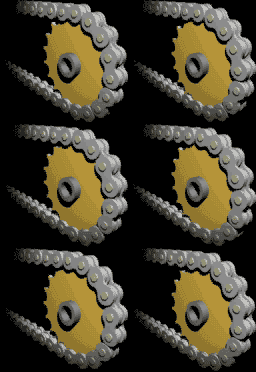
_of_roller_chain,_leonardo_da_vinci.jpg)
Chain drive
Chain drive is a way of transmitting mechanical power from one place to another. It is often used to convey power to the wheels of a vehicle, particularly bicycles and motorcycles...
most commonly used for transmission of mechanical power on many kinds of domestic, industrial and agricultural machinery, including conveyors, wire
Wire
A wire is a single, usually cylindrical, flexible strand or rod of metal. Wires are used to bear mechanical loads and to carry electricity and telecommunications signals. Wire is commonly formed by drawing the metal through a hole in a die or draw plate. Standard sizes are determined by various...
and tube drawing
Drawing
Drawing is a form of visual art that makes use of any number of drawing instruments to mark a two-dimensional medium. Common instruments include graphite pencils, pen and ink, inked brushes, wax color pencils, crayons, charcoal, chalk, pastels, markers, styluses, and various metals .An artist who...
machines, printing press
Printing press
A printing press is a device for applying pressure to an inked surface resting upon a print medium , thereby transferring the ink...
es, car
Čar
Čar is a village in the municipality of Bujanovac, Serbia. According to the 2002 census, the town has a population of 296 people.-References:...
s, motorcycle
Motorcycle
A motorcycle is a single-track, two-wheeled motor vehicle. Motorcycles vary considerably depending on the task for which they are designed, such as long distance travel, navigating congested urban traffic, cruising, sport and racing, or off-road conditions.Motorcycles are one of the most...
s, and simple machines like bicycle
Bicycle
A bicycle, also known as a bike, pushbike or cycle, is a human-powered, pedal-driven, single-track vehicle, having two wheels attached to a frame, one behind the other. A person who rides a bicycle is called a cyclist, or bicyclist....
s. It consists of a series of short cylindrical rollers held together by side links. It is driven by a toothed wheel called a sprocket
Sprocket
A sprocket or sprocket-wheel is a profiled wheel with teeth, cogs, or even sprockets that mesh with a chain, track or other perforated or indented material. The name 'sprocket' applies generally to any wheel upon which are radial projections that engage a chain passing over it...
. It is a simple, reliable, and efficient means of power transmission.
Though Hans Renold
Hans Renold
Hans Renold was a Swiss engineer. The son of a burgher family in Aarau, Switzerland, Hans came to Manchester, England at the age of 21 and found work with a firm of machinery exporters....
is credited with inventing the roller chain in 1880, sketches by Leonardo da Vinci
Leonardo da Vinci
Leonardo di ser Piero da Vinci was an Italian Renaissance polymath: painter, sculptor, architect, musician, scientist, mathematician, engineer, inventor, anatomist, geologist, cartographer, botanist and writer whose genius, perhaps more than that of any other figure, epitomized the Renaissance...
in the 16th century show a chain with a roller bearing.
Construction of the chain
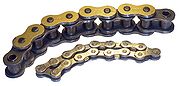
The roller chain design reduces friction compared to simpler designs, resulting in higher efficiency and less wear. The original power transmission chain varieties lacked rollers and bushings, with both the inner and outer plates held by pins which directly contacted the sprocket
Sprocket
A sprocket or sprocket-wheel is a profiled wheel with teeth, cogs, or even sprockets that mesh with a chain, track or other perforated or indented material. The name 'sprocket' applies generally to any wheel upon which are radial projections that engage a chain passing over it...
teeth; however this configuration exhibited extremely rapid wear of both the sprocket teeth, and the plates where they pivoted on the pins. This problem was partially solved by the development of bushed chains, with the pins holding the outer plates passing through bushings or sleeves connecting the inner plates. This distributed the wear over a greater area; however the teeth of the sprockets still wore more rapidly than is desirable, from the sliding friction against the bushings. The addition of rollers surrounding the bushing sleeves of the chain and provided rolling contact with the teeth of the sprockets resulting in excellent resistance to wear of both sprockets and chain as well. There is even very low friction, as long as the chain is sufficiently lubricated. Continuous, clean, lubrication of roller chains is of primary importance for efficient operation as well as correct tensioning.
Lubrication
Many driving chains (for example, in factory equipment) operate in clean environments, and thus the wearing surfaces (that is, the pins and bushings) are safe from precipitation and airborne grit, many even in a sealed environment such as an oil bath.But many other industrial-use chains run unprotected, and in those cases, internally sealed roller chain manufacturers such as Tsubaki
Tsubakimoto Chain Co.
is a Japanese power transmission chain manufacturer, founded in 1917, in Osaka.It takes its name from its founder 's family name.-Profile:*Corporate Name:...
, Renold, Diamond, Morse, and Rexnord produce low-maintenance versions wherein o-ring
O-ring
An O-ring, also known as a packing, or a toric joint, is a mechanical gasket in the shape of a torus; it is a loop of elastomer with a disc-shaped cross-section, designed to be seated in a groove and compressed during assembly between two or more parts, creating a seal at the interface.The O-ring...
s or x-rings seal in the lubricant for life.
There are also many chains that have to operate in dirty conditions, and for size or operational reasons cannot be sealed. Examples include chains on farm equipment, bicycles, and chain saws. These chains will necessarily have relatively high rates of wear, particularly when the operators are prepared to accept more friction, less efficiency, more noise and more frequent replacement as they neglect lubrication and adjustment.
Motorcycle chain lubrication
Chains operating at high speeds comparable to those on motorcycles should be used in conjunction with an oil bath. For modern motorcycles this is not applicable and most motorcycle chains run unprotected. They are subject to extreme forces and have to operate in tough conditions being exposed to rain, dirt, sand and road salt.Motorcycle chains are part of the drive train to transmit the motor power to the back wheel. While properly lubricated chains can reach an efficiency of more 98% in the transmission, unlubricated chains will significantly decrease performance and increase chain and sprockets wear.
Two distinct types of aftermarket lubricants are available for motorcycle chains, spray on lubricants and oil drip feed systems.
- Spray lubricants may contain wax or PTFE. While these lubricants use tack additives to stay on the chain they can also attract dirt and sand from the road and over time produce a grinding paste that accelerates component wear.
- Oil drip feed systems continuously lubricate the chain and use light oil that does not stick to the chain. Research has shown that oil drip feed systems provide the greatest wear protection and greatest power saving.
Scottoiler
Oil drip feed systems or automatic motorcycle chain oilers are often referred to as ‘Scottoilers’. Scottoiler Ltd. is a manufacturer of automatic oil drip feed systems for motorbikes. The original product is based on a vacuum system and works by gravity feed. The engine vacuum provides the power to open a valve. The oil then siphons from the reservoir by gravity and the flow rate can be adjusted by a dial opening/closing the valve aperture.Especially in the UK the brand is on the way to become a genericized trademark
Genericized trademark
A genericized trademark is a trademark or brand name that has become the colloquial or generic description for, or synonymous with, a general class of product or service, rather than as an indicator of source or affiliation as intended by the trademark's holder...
.
Variants in design
If the chain is not being used for a high wear application (for instance if it is just transmitting motion from a hand operated lever to a control shaft on a machine, or a sliding door on an oven), then one of the simpler types of chain may still be used. Conversely, where extra strength but the smooth drive of a smaller pitch is required, the chain may be "siamesed"; instead of just two rows of plates on the outer sides of the chain, there may be three ("duplex"), four ("triplex"), or more rows of plates running parallel, with bushings and rollers between each adjacent pair, and the same number of rows of teeth running in parallel on the sprockets to match. Timing chains on automotive engines, for example, typically have multiple rows of plates called strands.Roller chain is made in several sizes, the most common American National Standards Institute
American National Standards Institute
The American National Standards Institute is a private non-profit organization that oversees the development of voluntary consensus standards for products, services, processes, systems, and personnel in the United States. The organization also coordinates U.S. standards with international...
(ANSI) standards being 40, 50, 60, and 80. The first digit(s) indicate the pitch of the chain in eighths of an inch
Inch
An inch is the name of a unit of length in a number of different systems, including Imperial units, and United States customary units. There are 36 inches in a yard and 12 inches in a foot...
, with the last digit being 0 for standard chain, 1 for lightweight chain, and 5 for bushed chain with no rollers. Thus, a bicycle chain with half inch pitch would be a #40 while a #160 sprocket would have teeth spaced 2 inches apart, etc. Metric pitches are expressed in sixteenths of an inch; thus a metric #8 chain (08B-1) would be equivalent to an ANSI #40. Most roller chain is made from plain carbon or alloy steel, but stainless steel is used in food processing machinery or other places where lubrication is a problem, and nylon or brass are occasionally seen for the same reason.
Roller chain is ordinarily hooked up using a master link (also known as a connecting link), which typically has one pin held by a horseshoe clip
Horseshoe clip
A Horseshoe clip is the "U-shaped" spring steel fitting that holds the side-plate of the joining link formerly essential to complete the loop of a roller chain....
rather than friction fit, allowing it to be inserted or removed with simple tools. Half links (also known as offsets) are available and are used to increase the length of the chain by a single roller.
Use
- Roller chains are used in low- to mid-speed drives at around 600 to 800 feet per minute; however, at higher speeds, around 2,000 to 3,000 feet per minute, V-beltBelt (mechanical)A belt is a loop of flexible material used to link two or more rotating shafts mechanically. Belts may be used as a source of motion, to transmit power efficiently, or to track relative movement. Belts are looped over pulleys. In a two pulley system, the belt can either drive the pulleys in the...
s are normally used due to wear and noise issues.
- A bicycle chainBicycle chainA bicycle chain is a roller chain that transfers power from the pedals to the drive-wheel of a bicycle, thus propelling it. Most bicycle chains are made from plain carbon or alloy steel, but some are nickel-plated to prevent rust, or simply for aesthetics. Nickel also confers a measure of...
is a form of roller chain. Bicycle chains may have a master link, or may require a chain toolChain tool400px|thumb|right|A typical chain tool. With a chain placed on the central sprocket, the screw is turned until a pin is pushed from the linkageA chain tool is a small mechanical device used to "break" a bicycle chain in such a way that it can be mended with the same tool. A bicycle chain has...
for removal and installation. A similar but larger and thus stronger chain is used on most motorcycleMotorcycleA motorcycle is a single-track, two-wheeled motor vehicle. Motorcycles vary considerably depending on the task for which they are designed, such as long distance travel, navigating congested urban traffic, cruising, sport and racing, or off-road conditions.Motorcycles are one of the most...
s although it is sometimes replaced by either a toothed belt or a shaft drive, which offer lower noise level and fewer maintenance requirements.
- In older automobileAutomobileAn automobile, autocar, motor car or car is a wheeled motor vehicle used for transporting passengers, which also carries its own engine or motor...
engineEngineAn engine or motor is a machine designed to convert energy into useful mechanical motion. Heat engines, including internal combustion engines and external combustion engines burn a fuel to create heat which is then used to create motion...
s from the United StatesUnited StatesThe United States of America is a federal constitutional republic comprising fifty states and a federal district...
and other countries, roller chains would traditionally drive the camshaftCamshaftA camshaft is a shaft to which a cam is fastened or of which a cam forms an integral part.-History:An early cam was built into Hellenistic water-driven automata from the 3rd century BC. The camshaft was later described in Iraq by Al-Jazari in 1206. He employed it as part of his automata,...
(s) off the crankshaftCrankshaftThe crankshaft, sometimes casually abbreviated to crank, is the part of an engine which translates reciprocating linear piston motion into rotation...
, generating less noise than a gearGearA gear is a rotating machine part having cut teeth, or cogs, which mesh with another toothed part in order to transmit torque. Two or more gears working in tandem are called a transmission and can produce a mechanical advantage through a gear ratio and thus may be considered a simple machine....
drive as used in very high performance engines, and offering more durability than the timing beltTiming beltA timing belt, or cam belt , is a part of an internal combustion engine that controls the timing of the engine's valves. Some engines, such as the flat-4 Volkswagen air-cooled engine, and the straight-6 Toyota F engine use timing gears...
frequently used on more modern engines. Many modern automobile engines still use roller chains, which are more durable than timing belts.
- Chains are also used in forklifts using hydraulic rams as a pulley to raise and lower the carriage; however, these chains are not considered roller chains, but are classified as lift or leaf chains.
- ChainsawChainsawA chainsaw is a portable mechanical saw, powered by electricity, compressed air, hydraulic power, or most commonly a two-stroke engine...
cutting chainsSaw chainThe saw chain, or "cutting chain", is a key component of a chainsaw. It consists of steel links held together by rivets, and superficially resembles the bicycle-style roller chain, although it is closer in design to a leaf chain...
superficially resemble roller chains but are more closely related to leaf chains. They are driven by projecting drive links which also serve to locate the chain onto the bar.
- A perhaps unusual use of a pair of motorcycle chains is in the Harrier Jump JetHarrier Jump JetThe Harrier, informally referred to as the Jump Jet, is a family of British-designed military jet aircraft capable of vertical/short takeoff and landing operations...
, where a chain drive from an air motor is used to rotate the movable engine nozzles, allowing them to be pointed downwards for hovering flight, or to the rear for normal forward flight, a system known as Thrust vectoringThrust vectoringThrust vectoring, also thrust vector control or TVC, is the ability of an aircraft, rocket or other vehicle to manipulate the direction of the thrust from its engine or motor in order to control the attitude or angular velocity of the vehicle....
.
Wear
The effect of wear on a roller chain is to increase the pitch (spacing of the links), causing the chain to grow longer. Note that this is due to wear at the pivoting pins and bushes, not from actual stretching of the metal (as does happen to some flexible steel components such as the hand-brake cable of a motor vehicle).With modern chains it is unusual for a chain (other than that of a bicycle) to wear until it breaks, since a worn chain leads to the rapid onset of wear on the teeth of the sprockets, with ultimate failure being the loss of all the teeth on the sprocket. The sprockets (in particular the larger of the two) suffer a grinding motion that puts a characteristic hook shape into the driven face of the teeth. (This effect is made worse by a chain improperly tensioned, but is unavoidable no matter what care is taken). The worn teeth (and chain) no longer provides smooth transmission of power and this may become evident from the noise, the vibration or (in car engines using a timing chain) the variation in ignition timing seen with a timing light
Timing light
thumb|right|300px|Timing light, combination instrument with RPM, volt meter and dwell angle meter. The actual light is on the far end.The black clamp connects to the battery's -, the red clamp to +, the green one to the breaker side of the coil , the big black clamp in the foreground is an...
. Both sprockets and chain should be replaced in these cases, since a new chain on worn sprockets will not last long. However, in less severe cases it may be possible to save the smaller of the two sprockets, since it is always the larger one that suffers the most wear. Only in very light-weight applications such as a bicycle, or in extreme cases of improper tension, will the chain normally jump off the sprockets.
The lengthening due to wear of a chain is calculated by the following formula:

M = the length of a number of links measured
S = the number of links measured
P = Pitch
In industry, it is usual to monitor the movement of the chain tensioner (whether manual or automatic) or the exact length of a drive chain (one rule of thumb is to replace a roller chain which has elongated 3% on an adjustable drive or 1.5% on a fixed-center drive). A simpler method, particularly suitable for the cycle or motorcycle user, is to attempt to pull the chain away from the larger of the two sprockets. Any significant movement (eg making it possible to see through a gap) probably indicates a chain worn up to and beyond the limit. Sprocket damage will result if the problem is ignored.
Bicycle chain wear
The lightweight chain of a bicycle with derailleur gearsDerailleur gears
Derailleur gears are a variable-ratio transmission system commonly used on bicycles, consisting of a chain, multiple sprockets of different sizes, and a mechanism to move the chain from one sprocket to another...
can snap (or rather, come apart at the side-plates, since it is normal for the riveting to fail first) because the wearing pins inside are not parallel, they are barrel-shaped. Contact between the pin and the bush is not the regular line, but a point. This form of construction is necessary because the gear-changing action of this form of transmission requires the chain to both bend sideways and to twist.
Chain failure is much less of a problem on hub-geared systems (e.g. Sturmey-Archer AW) since the parallel pins have a much bigger wearing surface in contact with the bush. The hub-gear system also allows complete enclosure, a great aid to lubrication and protection from grit.
Chain strength
The most common measure of roller chain's strength is tensile strengthTensile strength
Ultimate tensile strength , often shortened to tensile strength or ultimate strength, is the maximum stress that a material can withstand while being stretched or pulled before necking, which is when the specimen's cross-section starts to significantly contract...
. Tensile strength represents how much load a chain can withstand under a one-time load before breaking. Just as important as tensile strength is a chain's fatigue strength. The critical factors in a chain's fatigue strength is the quality of steel used to manufacture the chain, the heat treatment of the chain components, the quality of the pitch hole fabrication of the linkplates, and the type of shot plus the intensity of shot peen coverage on the linkplates. Other factors can include the thickness of the linkplates and the design (contour) of the linkplates. The rule of thumb for roller chain operating on a continuous drive is for the chain load to not exceed a mere 1/6 or 1/9 of the chain's tensile strength, depending on the type of master links used (press-fit vs. slip-fit). Roller chains operating on a continuous drive beyond these thresholds can and typically do fail prematurely via linkplate fatigue failure.
The standard minimum ultimate strength of the ANSI 29.1 steel chain is 12,500 x (pitch, in inches)2 .
Chain standards
Standards organizationStandards organization
A standards organization, standards body, standards developing organization , or standards setting organization is any organization whose primary activities are developing, coordinating, promulgating, revising, amending, reissuing, interpreting, or otherwise producing technical standards that are...
s (such as ANSI
Ansi
Ansi is a village in Kaarma Parish, Saare County, on the island of Saaremaa, Estonia....
) maintain standards for design, dimensions, and interchangeability
Interchangeable parts
Interchangeable parts are parts that are, for practical purposes, identical. They are made to specifications that ensure that they are so nearly identical that they will fit into any device of the same type. One such part can freely replace another, without any custom fitting...
of transmission chains. For example, the following table shows the principal data of ANSI standard B29.1 (Precision Power Transmission Roller Chains, Attachments, and Sprockets). See the references for full information.
- NOTE: As of 1 January 2002, ANSI/AMSE B29.1 has been incorporated into ASME B29.100.
ANSI B29.1 roller chain standard sizes Size Pitch Roller diameter Tensile strength Working load 25
|0.25 in (6.35 mm)
|0.13 in (3.3 mm)
|781 pounds (354.3 kg)
|140 pounds (63.5 kg)35
|0.375 in (9.53 mm)
|0.2 in (5.08 mm)
|1758 pounds (797.4 kg)
|480 pounds (217.7 kg)41
|0.5 in (12.7 mm)
|0.306 in (7.77 mm)
|1500 pounds (680.4 kg)
|500 pounds (226.8 kg)40
|0.5 in (12.7 mm)
|0.312 in (7.92 mm)
|3125 pounds (1,417.5 kg)
|810 pounds (367.4 kg)50
|0.625 in (15.88 mm)
|0.4 in (10.16 mm)
|4880 pounds (2,213.5 kg)
|1430 pounds (648.6 kg)60
|0.75 in (19.05 mm)
|0.469 in (11.91 mm)
|7030 pounds (3,188.8 kg)
|1980 pounds (898.1 kg)80
|1 in (25.4 mm)
|0.625 in (15.88 mm)
|12500 pounds (5,669.9 kg)
|3300 pounds (1,496.9 kg)100
|1.25 in (31.75 mm)
|0.75 in (19.05 mm)
|19531 pounds (8,859.1 kg)
|5072 pounds (2,300.6 kg)120
|1.5 in (38.1 mm)
|0.875 in (22.23 mm)
|28100 pounds (12,745.9 kg)
|6800 pounds (3,084.4 kg)140
|1.75 in (44.45 mm)
|1 in (25.4 mm)
|38280 pounds (17,363.5 kg)
|9040 pounds (4,100.5 kg)160
|2 in (50.8 mm)
|1.125 in (28.58 mm)
|50000 pounds (22,679.6 kg)
|11900 pounds (5,397.7 kg)180
|2.25 in (57.15 mm)
|1.46 in (37.08 mm)
|63300 pounds (28,712.4 kg)
|13700 pounds (6,214.2 kg)200
|2.5 in (63.5 mm)
|1.562 in (39.67 mm)
|78000 pounds (35,380.2 kg)
|16000 pounds (7,257.5 kg)240
|3 in (76.2 mm)
|1.875 in (47.63 mm)
|112500 pounds (51,029.1 kg)
|22250 pounds (10,092.4 kg)
For mnemonic purposes, below is another presentation of key dimensions from the same standard, expressed in fractions of an inch (which was part of the thinking behind the choice of preferred numberPreferred numberIn industrial design, preferred numbers are standard guidelines for choosing exact product dimensions within a given set of constraints....
s in the ANSI standard):
Pitch (inches) Pitch expressed
in eighthsANSI standard
chain numberWidth (inches) 25 35 41 40 50 60 1 80 Notes:
1. The pitch is the distance between roller centers. The width is the distance between the link plates (ie slightly more than the roller width to allow for clearance).
2. The right-hand digit of the standard denotes 0 = normal chain, 1 = lightweight chain, 5 = rollerless bushing chain.
3. The left-hand digit denotes the number of eighths of an inch that make up the pitch.
4. An "H" following the standard number denotes heavyweight chain. A hyphenated number following the standard number denotes double-strand (2), triple-strand (3), and so on. Thus 60H-3 denotes number 60 heavyweight triple-strand chain.
A typical bicycle chain uses 40 series chain with a minimum tensile strength of 3125 pounds (1,417 kg) and a working load of 810 lb (367 kg). The width of the chain is variable, and does not affect the load capacity.
External links