


Roller

Encyclopedia
The rollers are an Old World
family, Coraciidae, of near passerine
bird
s. The group gets its name from the aerial acrobatics some of these birds perform during courtship or territorial flights. Rollers resemble crow
s in size and build, and share the colourful appearance of kingfishers and bee-eaters, blues and pinkish or cinnamon browns predominating. The two inner front toes are connected, but not the outer one.
They are mainly insect eaters, with Eurystomus
species taking their prey on the wing, and those of the genus Coracias
diving from a perch to catch food items from on the ground, like giant shrike
s.
Although living rollers are birds of warm climates in the Old World, fossil records show that rollers were present in North America during the Eocene. They are monogamous and nest in an unlined hole in a tree or in masonry, and lay 2–4 eggs in the tropics, 3–6 at higher latitudes. The eggs, which are white, hatch after 17–20 days, and the young remain in the nest for approximately another 30 days.
, which also includes the motmot
s, bee-eater
s, todies
, ground-roller
s, Cuckoo Roller and three families of kingfisher
s. Apart from the ground-rollers, these families do not appear to be particularly closely related to the rollers, and the Coraciiformes are therefore probably polyphyletic
. The division of the rollers into two genera is uncontroversial.
The eleven species are: Genus: Eurystomus
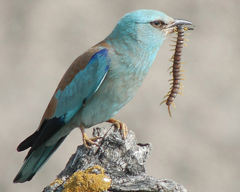 The Coraciiformes family gets its scientific name for Latin coracium, "like a raven", and the English name "roller" from the aerial acrobatics some of these birds perform during courtship or territorial flights.
s in size and build, ranging from 25 to 27 centimetres (10–11 in) in length. They share the colourful appearance of kingfishers and bee-eaters, blues and pinkish or cinnamon browns predominating. The rollers are similar in general morphology to their relatives in the order Coraciiformes
, having large heads on short necks, bright plumage
, weak feet and short legs. The two inner front toes are connected, but not the outer one. The weakness of the feet and legs is reflected in their behaviour, rollers do not hop or move along perches and seldom use their feet other than for occasional lurching leaps along the ground pursuing escaping prey. The bill is robust, and is shorter yet broader in the genus Eurystomus
, sometimes known as the broad-billed rollers. The broad-billed rollers have brightly coloured bills, whereas those of the Coracias
(or true) rollers are black. Other differences between the two genera are in wing length; the more aerial Eurystomus rollers have longer wings (and shorter feet still) than the Coracias rollers, this reflects differences in their foraging ecology. Their calls are "repeated short, gruff caws".
is completely migratory
, breeding in Europe and wintering in Africa, and the Dollarbird
also leaves much of its breeding range in winter. Other species are sedentary or short-range migrants.
These are birds of open habitats with trees or other elevated perches from which to hunt.
Eurystomus rollers hunt on the wings, swooping on flying beetles, crickets and other insects which are crushed by their broad deep beaks and eaten on the wing. The Azure Roller and Dollarbird
will hunt huge swarms of termites and flying ants which appear after thunderstorms. Tens or hundreds of these rollers may be attracted to large swarms.
Old World
The Old World consists of those parts of the world known to classical antiquity and the European Middle Ages. It is used in the context of, and contrast with, the "New World" ....
family, Coraciidae, of near passerine
Near passerine
Near passerine or higher land-bird assemblage are terms often given to arboreal birds or those most often believed to be related to the true passerines due to ecological similarities; the group corresponds to some extent with the Anomalogonatae of Garrod All near passerines are land birds...
bird
Bird
Birds are feathered, winged, bipedal, endothermic , egg-laying, vertebrate animals. Around 10,000 living species and 188 families makes them the most speciose class of tetrapod vertebrates. They inhabit ecosystems across the globe, from the Arctic to the Antarctic. Extant birds range in size from...
s. The group gets its name from the aerial acrobatics some of these birds perform during courtship or territorial flights. Rollers resemble crow
Crow
Crows form the genus Corvus in the family Corvidae. Ranging in size from the relatively small pigeon-size jackdaws to the Common Raven of the Holarctic region and Thick-billed Raven of the highlands of Ethiopia, the 40 or so members of this genus occur on all temperate continents and several...
s in size and build, and share the colourful appearance of kingfishers and bee-eaters, blues and pinkish or cinnamon browns predominating. The two inner front toes are connected, but not the outer one.
They are mainly insect eaters, with Eurystomus
Eurystomus
Eurystomus is a genus of the roller, one of the two genera in that family of birds. It contains four broad-billed species, which breed in Africa, Asia and Australasia. Two species are restricted to Africa, one of which, the Cinnamon Roller, is migratory. The Dollarbird has a large distribution...
species taking their prey on the wing, and those of the genus Coracias
Coracias
Coracias is a genus of the rollers, an Old World family of near passerine birds related to the kingfishers and bee-eaters. They share the colourful appearance of those groups, blues and browns predominating. The two inner front toes are connected, but not the outer one.These are insect eaters,...
diving from a perch to catch food items from on the ground, like giant shrike
Shrike
Shrikes are passerine birds of the family Laniidae. The family is composed of thirty-one species in three genera. The family name, and that of the largest genus, Lanius, is derived from the Latin word for "butcher", and some shrikes were also known as "butcher birds" because of their feeding habits...
s.
Although living rollers are birds of warm climates in the Old World, fossil records show that rollers were present in North America during the Eocene. They are monogamous and nest in an unlined hole in a tree or in masonry, and lay 2–4 eggs in the tropics, 3–6 at higher latitudes. The eggs, which are white, hatch after 17–20 days, and the young remain in the nest for approximately another 30 days.
Taxonomy
The roller family Coraciidae is one of nine in the order CoraciiformesCoraciiformes
The Coraciiformes are a group of usually colorful near passerine birds including the kingfishers, the Hoopoe, the bee-eaters, the rollers, and the hornbills...
, which also includes the motmot
Motmot
The motmots or Momotidae are a family of birds in the near passerine order Coraciiformes, which also includes the kingfishers, bee-eaters and rollers. All extant motmots are restricted to woodland or forest in the Neotropics, and the largest diversity is in Middle America. They have a colourful...
s, bee-eater
Bee-eater
The bee-eaters are a group of near-passerine birds in the family Meropidae. Most species are found in Africa and Asia but others occur in southern Europe, Australia, and New Guinea. They are characterised by richly coloured plumage, slender bodies, and usually elongated central tail feathers...
s, todies
Tody
The todies are a family, Todidae, of Caribbean birds in the order Coraciiformes, which also includes the kingfishers, bee-eaters and rollers. The family has one genus, Todus...
, ground-roller
Ground-roller
The ground rollers are a small family of non-migratory near-passerine birds restricted to Madagascar.They are related to the kingfishers, bee-eaters and rollers...
s, Cuckoo Roller and three families of kingfisher
Kingfisher
Kingfishers are a group of small to medium sized brightly coloured birds in the order Coraciiformes. They have a cosmopolitan distribution, with most species being found in the Old World and Australia...
s. Apart from the ground-rollers, these families do not appear to be particularly closely related to the rollers, and the Coraciiformes are therefore probably polyphyletic
Polyphyly
A polyphyletic group is one whose members' last common ancestor is not a member of the group.For example, the group consisting of warm-blooded animals is polyphyletic, because it contains both mammals and birds, but the most recent common ancestor of mammals and birds was cold-blooded...
. The division of the rollers into two genera is uncontroversial.
The eleven species are:
- Genus: CoraciasCoraciasCoracias is a genus of the rollers, an Old World family of near passerine birds related to the kingfishers and bee-eaters. They share the colourful appearance of those groups, blues and browns predominating. The two inner front toes are connected, but not the outer one.These are insect eaters,...
- European RollerEuropean RollerThe European Roller, Coracias garrulus, is the only member of the roller family of birds to breed in Europe. Its overall range extends into the Middle East and Central Asia and Morocco....
- European Roller
- Abyssinian RollerAbyssinian RollerThe Abyssinian Roller, Coracias abyssinicus, is a member of the roller family of birds which breeds across tropical Africa in a belt south of the Sahara, known as the Sahel...
Coracias abyssinicus - Lilac-breasted RollerLilac-breasted RollerThe Lilac-breasted Roller is a member of the roller family of birds. It is widely distributed in sub-Saharan Africa and the southern Arabian Peninsula, preferring open woodland and savanna; it is largely absent from treeless places...
Coracias caudatus - Racket-tailed RollerRacket-tailed RollerThe Racket-tailed Roller is a species of bird in the Coraciidae family.It is found in Angola, Botswana, Democratic Republic of the Congo, Malawi, Mozambique, Namibia, South Africa, Swaziland, Tanzania, Zambia, and Zimbabwe....
Coracias spatulatus - Rufous-crowned RollerRufous-crowned RollerThe Purple Roller , also called the Rufous-crowned Roller, is found over sub-Saharan Africa to as far south as Namibia and the Transvaal. Compared with other rollers its colours are rather dull and its voice rather harsh and grating...
Coracias naevius - Indian RollerIndian RollerThe Indian Roller , also called the Blue Jay in former times is a member of the roller family of birds. They are found in southern Asia from Iraq to Thailand and are best known for the aerobatic displays of the male during the breeding season...
Coracias benghalensis - Purple-winged RollerPurple-winged RollerThe Purple-winged Roller is a species of bird in the Coraciidae family.It is endemic to Celebes Island in Indonesia.Its natural habitat is subtropical or tropical moist lowland forests.-References:...
Coracias temminckii - Blue-bellied RollerBlue-bellied RollerThe Blue-bellied Roller, Coracias cyanogaster is a member of the roller family of birds which breeds across Africa in a narrow belt from Senegal to northeast Zaire. It is resident, apart from some local seasonal movements, in mature moist savannah dominated by Isoberlinia trees.The Blue-bellied...
Coracias cyanogaster
Eurystomus
Eurystomus is a genus of the roller, one of the two genera in that family of birds. It contains four broad-billed species, which breed in Africa, Asia and Australasia. Two species are restricted to Africa, one of which, the Cinnamon Roller, is migratory. The Dollarbird has a large distribution...
- Broad-billed RollerBroad-billed RollerThe Broad-billed Roller, Eurystomus glaucurus, is a member of the roller family of birds which breeds across tropical Africa and Madagascar in all but the driest regions. It is a wet season breeder, which migrates from the northern and southern areas of its range towards the moister equatorial...
Eurystomus glaucurus - Blue-throated RollerBlue-throated RollerThe Blue-throated Roller is a species of bird in the Coraciidae family.It is found in Angola, Benin, Cameroon, Central African Republic, Republic of the Congo, Democratic Republic of the Congo, Ivory Coast, Equatorial Guinea, Gabon, Ghana, Guinea, Guinea-Bissau, Liberia, Mali, Nigeria, Sierra...
Eurystomus gularis - Azure Dollarbird Eurystomus azureus
- Oriental Dollarbird Eurystomus orientalis
Morphology and appearance
Rollers resemble crowCrow
Crows form the genus Corvus in the family Corvidae. Ranging in size from the relatively small pigeon-size jackdaws to the Common Raven of the Holarctic region and Thick-billed Raven of the highlands of Ethiopia, the 40 or so members of this genus occur on all temperate continents and several...
s in size and build, ranging from 25 to 27 centimetres (10–11 in) in length. They share the colourful appearance of kingfishers and bee-eaters, blues and pinkish or cinnamon browns predominating. The rollers are similar in general morphology to their relatives in the order Coraciiformes
Coraciiformes
The Coraciiformes are a group of usually colorful near passerine birds including the kingfishers, the Hoopoe, the bee-eaters, the rollers, and the hornbills...
, having large heads on short necks, bright plumage
Plumage
Plumage refers both to the layer of feathers that cover a bird and the pattern, colour, and arrangement of those feathers. The pattern and colours of plumage vary between species and subspecies and can also vary between different age classes, sexes, and season. Within species there can also be a...
, weak feet and short legs. The two inner front toes are connected, but not the outer one. The weakness of the feet and legs is reflected in their behaviour, rollers do not hop or move along perches and seldom use their feet other than for occasional lurching leaps along the ground pursuing escaping prey. The bill is robust, and is shorter yet broader in the genus Eurystomus
Eurystomus
Eurystomus is a genus of the roller, one of the two genera in that family of birds. It contains four broad-billed species, which breed in Africa, Asia and Australasia. Two species are restricted to Africa, one of which, the Cinnamon Roller, is migratory. The Dollarbird has a large distribution...
, sometimes known as the broad-billed rollers. The broad-billed rollers have brightly coloured bills, whereas those of the Coracias
Coracias
Coracias is a genus of the rollers, an Old World family of near passerine birds related to the kingfishers and bee-eaters. They share the colourful appearance of those groups, blues and browns predominating. The two inner front toes are connected, but not the outer one.These are insect eaters,...
(or true) rollers are black. Other differences between the two genera are in wing length; the more aerial Eurystomus rollers have longer wings (and shorter feet still) than the Coracias rollers, this reflects differences in their foraging ecology. Their calls are "repeated short, gruff caws".
Distribution and habitat
The rollers are found in warmer parts of the Old World. Africa has most species, and is believed to be where the family originated. This is supported by the fact that the related ground-rollers are found on Madagascar. The European RollerEuropean Roller
The European Roller, Coracias garrulus, is the only member of the roller family of birds to breed in Europe. Its overall range extends into the Middle East and Central Asia and Morocco....
is completely migratory
Bird migration
Bird migration is the regular seasonal journey undertaken by many species of birds. Bird movements include those made in response to changes in food availability, habitat or weather. Sometimes, journeys are not termed "true migration" because they are irregular or in only one direction...
, breeding in Europe and wintering in Africa, and the Dollarbird
Dollarbird
The Oriental Dollarbird , also known as the Dollar Roller, is a bird of the roller family, so named because of the distinctive blue coin-shaped spots on its wings....
also leaves much of its breeding range in winter. Other species are sedentary or short-range migrants.
These are birds of open habitats with trees or other elevated perches from which to hunt.
Breeding
Rollers are noisy and aggressive when defending their nesting territories, which they patrol while displaying their striking plumage. Intruders are attacked with intimidating rolling dives. They are monogamous and nest in an unlined hole in a tree or in masonry, and lay 2–4 eggs in the tropics, 3–6 at higher latitudes. The eggs, which are white, hatch after 17–20 days, and the young remain in the nest for approximately another 30 days. Egg laying is staggered at one-day intervals so that if food is short only the older larger nestlings get fed. The chicks are naked, blind and helpless when they hatch.Feeding
Coracias rollers are watch-and wait hunters. they sit in a tree or on a post before descending on their prey and carrying it back to a perch in the beak before dismembering it. They take a wide range of terrestrial invertebrates, and small vertebrates such as frogs, lizards rodents and young birds. They will take items avoided by many other birds, such as hairy caterpillars, insects with warning colouration and snakes.Eurystomus rollers hunt on the wings, swooping on flying beetles, crickets and other insects which are crushed by their broad deep beaks and eaten on the wing. The Azure Roller and Dollarbird
Dollarbird
The Oriental Dollarbird , also known as the Dollar Roller, is a bird of the roller family, so named because of the distinctive blue coin-shaped spots on its wings....
will hunt huge swarms of termites and flying ants which appear after thunderstorms. Tens or hundreds of these rollers may be attracted to large swarms.
External links
- Roller videos on the Internet Bird Collection
- The distribution, status and places to see the Roller in northeast Spain
- Roller From Turkey