
All Topics  
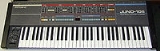
Roland Juno-106

 
Roland Juno 106

   Email Print
   Bookmark   Link


Roland Juno-106


The Roland Juno-106 was a hybrid digital/analogue polyphonic synth manufactured by Roland Corporation
Roland Corporation

is a Japanese manufacturer of electronic musical instruments, electronic equipment and software. It was founded by Ikutaro Kakehashi in Osaka on April 18, 1972, with ?33 million in capital....
 in 1984. It featured Digitally-controlled oscillator
Digitally-controlled oscillator

A digitally controlled oscillator or DCO is a hybrid digital/analog signal electronic oscillator. The name is an analogy with "voltage-controlled oscillator"....
s (DCOs) for tuning stability and digital envelope generation along with analog filters and signal path.

Roland Juno-106 was relatively simple in terms of its synthesis architecture.

The central tone-generating component of the instrument was a set of 3 digitally-controlled oscillators (one for each couple of voices) capable of producing sawtooth and square/pulse waveforms. The Juno is well known for its -24dB/octave analog lowpass filter with adjustable resonance
Resonance

In physics, resonance is the tendency of a system to oscillate at maximum amplitude at certain Frequency, known as the system's resonance frequencies ....
, which has been said to provide the Juno 106 with its rather distinctive sound, when combined with the tone of the MC5534 wave generation modules.

The 80017A VCF/VCA (voltage controlled filter, voltage controlled amplifier) module contains circuits common to other Roland machines (IR3109 and BA662).


Discussion
Ask a question about 'Roland Juno-106'
Start a new discussion about 'Roland Juno-106'
Answer questions from other users
Full Discussion Forum


Encyclopedia


The Roland Juno-106 was a hybrid digital/analogue polyphonic synth manufactured by Roland Corporation
Roland Corporation

is a Japanese manufacturer of electronic musical instruments, electronic equipment and software. It was founded by Ikutaro Kakehashi in Osaka on April 18, 1972, with ?33 million in capital....
 in 1984. It featured Digitally-controlled oscillator
Digitally-controlled oscillator

A digitally controlled oscillator or DCO is a hybrid digital/analog signal electronic oscillator. The name is an analogy with "voltage-controlled oscillator"....
s (DCOs) for tuning stability and digital envelope generation along with analog filters and signal path.

Features and Architecture


Sound Generation

The Roland Juno-106 was relatively simple in terms of its synthesis architecture.

The central tone-generating component of the instrument was a set of 3 digitally-controlled oscillators (one for each couple of voices) capable of producing sawtooth and square/pulse waveforms. The Juno is well known for its -24dB/octave analog lowpass filter with adjustable resonance
Resonance

In physics, resonance is the tendency of a system to oscillate at maximum amplitude at certain Frequency, known as the system's resonance frequencies ....
, which has been said to provide the Juno 106 with its rather distinctive sound, when combined with the tone of the MC5534 wave generation modules.

The 80017A VCF/VCA (voltage controlled filter, voltage controlled amplifier) module contains circuits common to other Roland machines (IR3109 and BA662). They are known to be prone to failure, leading to lost notes, and are no longer manufactured. Substitute parts have been designed and are available from a small number of sellers.

A single invertible ADSR envelope (attack, decay, sustain, release) can be assigned to the filter's cutoff frequency and can be selected to control the VCA rather than key gating by a switch. Filter cutoff can also be proportioned to note number so higher notes have higher harmonics.

Due to the simple features of the Juno-106, the synthesizer lacked the range of capabilities found in other instruments of its time that have multiple oscillators, complex envelopes, and more diverse modulation choices. Despite this fact the Juno-106 was quite popular and was able to produce rich basses, pads, and other tones.

Other Features

The Juno-106 featured an onboard analog stereo chorus effect which, while rather noisy, was also a fairly distinctive aspect of the instrument's sound. The Juno-106's chorus was based on a set of bucket brigade delay (BBD) lines similar to other Roland products of the time including guitar pedals. The Juno-106 also contained 128 internal memory slots for patch storage as well as surprisingly complete MIDI implementation - a rarity for any synthesizers of the time, let alone analogue ones. Almost all control surfaces on the synthesizer were capable of transmitting and receiving MIDI SysEx commands, allowing complete control of the instrument via a sequencer or computer.

Furthermore, this synthesizer featured polyphonic portamento
Portamento

Portamento is a musical term originated from Italian language primarily denoting a vocal slide between two pitch and its emulation by instruments such as the violin, and in 16th century polyphony writing refers to an ornamental figure....
, also rather rare for a 1984 analog instrument.

History

The Juno-106 was the third in the Juno series of digital/analog synthesizers. Its predecessors, the Roland Juno-6 and Roland Juno-60
Roland Juno-60

The Roland Juno-60 is a popular analogue 61-key polyphonic synthesizer produced by Roland Corporation in the early 1980s and a successor to the slightly earlier Roland Juno-6....
, were somewhat different in appearance than their later sibling, but shared most of the internal components and features in common with the exception of a tradeoff between a simple up/down arpeggiator on the earlier models and a portamento feature on the Juno-106. The Juno-106 also featured MIDI for inter-instrument communication rather than the proprietary Roland Digital Control Bus
Digital Control Bus

DCB was a proprietary data interchange interface by Roland Corporation, developed in 1981 and introduced in 1982 in their Roland Juno-60 and Roland Jupiter-8 products....
 (DCB) found on earlier models. In addition to the standard Juno-106, Roland produced a synthesizer called the HS-60. This synth was simply a Juno-106 with integrated speakers and a slightly redesigned enclosure, aimed specifically at consumers rather than professional users.

The Juno-106 is a unique synthesizer in a large part because it came at a time period when digital synthesizer components where just being introduced, midi being the most important, yet it featured the best of the analogue and digital worlds. The Juno-106 was one of the last synthesizers to feature all of its controls as buttons and sliders on the faceplate which made it easy to use, but unlike older analogue synthesizers the Juno-106 came standard with full midi control of many of its parameters. The Juno-106 also featured DCOs with an analog signal path including VCFs. This allowed for perfectly tuned pitch with the warmth of analogue waveshaping and filters, along with the drive provided by the VCA. It is because of this balance of analogue and digital that there really is no other synth quite like the Juno-106 and it is still a staple in most studios today.

The Juno-106 today

Despite being over 20 years old, the Juno-106 and its predecessors are traded among synthesizer aficionados with relative frequency and thus are more easily obtainable and less expensive than a number of other synthesizers. Furthermore, the instrument has proven generally reliable and long-lived if well cared for. Despite this, a common problem with surviving Juno 106s is a dead voice chip, which manifests itself as every sixth note played not sounding. One can get around this by playing the synth monophonically using its unison mode, but this is only a workaround rather than a permanent solution.

To test for dead voices perform the following procedure. Enter diagnostic mode by holding the transpose key down upon power-up. Then, to see which voice paks are bad, push poly 2 key and press keys one by one (any keys), making sure to hold down every key previously pressed. The display will read from 1-6. When you do not hear anything from a key, look at the number on the display. The number displayed is the number of the voice chip that has failed.

According to a former Roland technician, some of the voice chips may die naturally but the majority were traced to a couple of bad chip lots (with lot #41 being the worse). The lot number was stamped onto the side of the chips. According to the technician not every 106 is destined to fail.

For a live tutorial on how to replace the voice card, watch: http://www.youtube.com/watch?v=cU0N08WI0nc

Another helpful site: JUNO-106 CONNECTION offers workaround for dead voice chips replacing old chips for a new ones. http://www.hinzen.de/midi/juno-106/

Due to their enduring popularity and despite their overall simplicity and limited range of sonic possibilities, Juno-series synthesizers still make appearances with a number of bands, including Junobot (Band), Franz Ferdinand
Franz Ferdinand (band)

Franz Ferdinand are a Scotland Rock music band that formed in Glasgow, Scotland in 2002. Named after Archduke Franz Ferdinand of Austria, the band comprises Alex Kapranos , Bob Hardy , Nick McCarthy , and Paul Thomson ....
, Daft Punk
Daft Punk

Daft Punk is an electronic music duo consisting of French musicians Guy-Manuel de Homem-Christo and Thomas Bangalter . After Daft Punk reached significant popularity in the late 1990s house music movement in France, other artists such as Air , Cassius , and Dimitri from Paris began to receive a similar amount of attention....
, Dosh
Dosh

Martin Luther King Chavez Dosh , known in music as Dosh, is a musician and multi-instrumentalist based in Minneapolis, Minnesota. As an artist, Dosh is a percussionist who uses various electronics, often with a Rhodes piano....
, Moby
Moby

Richard Melville Hall , better known by his stage name Moby is an American DJ, singer-songwriter and musician.He plays keyboard, guitar, bass guitar and drums....
, The Chemical Brothers
The Chemical Brothers

The Chemical Brothers are the English electronic music duo Tom Rowlands and Ed Simons . Initially they called themselves "The Dust Brothers", after the noted United States Dust Brothers, but the threat of legal action from the originals led them to change their name in 1995....
, Justice
Justice

Justice is the concept of morality rightness based on ethics, rationality, law, natural law, fairness and equity."...
, Sigur Rós
Sigur Rós

Sigur R?s are an Icelandic post-rock band with melodic, Classical music and minimalist music elements. The band is known for its ethereal sound and lead singer J?n ??r Birgisson falsetto voice....
, Mundo Lego, Islands
Islands (band)

Islands is an indie rock band based in Montreal, Quebec, which currently records for Anti Records....
, the Unicorns
The Unicorns

The Unicorns were an indie pop band from Montreal, Canada, formed in December 2000 by Nicholas Thorburn and Alden Penner , who were later joined by Jamie Thompson in December 2003....
, Pet Shop Boys
Pet Shop Boys

Pet Shop Boys are an English people electronic dance music duo, consisting of Neil Tennant, who provides main Singing, Keyboard instruments and occasionally guitar, and Chris Lowe on keyboards and occasionally on vocals....
, Mansun
Mansun

Mansun were an England indie band formed in Chester in 1995. The band comprised vocalist/rhythm guitarist Paul Draper , bassist Stove King, lead guitarist/backing vocalist Dominic Chad, and drummer Andie Rathbone....
, a-ha
A-ha

a-ha is a band from Norway. They initially rose to fame during the 1980s and have had continued success in the 1990s and 2000s.a-ha achieved their biggest success with their debut album and single in 1985....
, Laserdance
Laserdance

Laserdance is a spacesynth studio project that was popular in the 80s with the hits like "Laserdance", "Power Run" and "Humanoid Invasion" and continues its production in the new millennium....
, Architecture in Helsinki
Architecture in Helsinki

Architecture in Helsinki is an Australian band based in the suburb of Northcote, Victoria in Melbourne. The group consists of Cameron Bird, Gus Franklin, Jamie Mildren, Sam Perry, and Kellie Sutherland....
, Late of the Pier
Late of the Pier

Late of the Pier are a four-piece indie electronic band from Castle Donington, England, currently signed to Parlophone Records. They have released five singles to date....
, the Automatic
The Automatic

The Automatic, , are a Wales based rock music band. The three remaining original members James Frost, Robin Hawkins, and Iwan Griffiths are from Wales; new addition Paul Mullen is from Sunderland....
, Pivot
Pivot (Australian band)

Pivot is an instrumental band from Sydney and Perth, Western Australia, Australia on Warp Records...
, the New Deal (band)
The New Deal (band)

The New Deal is high energy three-piece live electronic band from Canada. With a drummer , bass guitarist , and Keyboard synthesizer player , the music incorporates many elements of modern electronica, which they have branded live progressive breakbeat house music....
, Howlermonkey, and likely scores of other electronic and dance music projects.

Trivia

  • Juno-106's vintage style was used in the modern Roland Juno-G
    Roland Juno-G

    Roland Juno-G is a music workstation/synth introduced in 2006 by Roland Corporation. It is based on the Roland Fantom-X series, having a vintage design that resembles the first Juno synthesizer, such as the Roland Juno-106....
     workstation
    Workstation

    A workstation is a high-end microcomputer designed for technical or scientific applications. Intended primarily to be used by one person at a time, they are commonly connected to a local area network and run multi-user operating systems....
    . But there is nothing in common with Juno-106
except its colors.

External links