
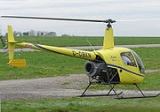
The
Robinson R22 is a two-bladed, single-engine light utility
helicopterA helicopter is a type of rotorcraft in which lift and thrust are supplied by one or more engine-driven rotors. This allows the helicopter to take off and land vertically, to hover, and to fly forwards, backwards, and laterally...
manufactured by
Robinson HelicopterThe Robinson Helicopter Company, based at Zamperini Field in Torrance, California, is the largest manufacturer of civil helicopters in North America.-History:...
. The two-seat R22 was designed in 1973 by
Frank RobinsonFranklin D. "Frank" Robinson is an engineer and the founder, president and Chief Executive Officer of Robinson Helicopter Company of Torrance, California...
and has been in production since 1979.
Development
Due to relatively low acquisition and operating costs, the R22 has been popular as a primary rotorcraft trainer around the world and as a livestock management tool on large
ranchA ranch is an area of landscape, including various structures, given primarily to the practice of ranching, the practice of raising grazing livestock such as cattle or sheep for meat or wool. The word most often applies to livestock-raising operations in the western United States and Canada, though...
es in
North AmericaNorth America is a continent wholly within the Northern Hemisphere and almost wholly within the Western Hemisphere. It is also considered a northern subcontinent of the Americas...
and
cattle stationCattle station is an Australian term for a large farm , whose main activity is the rearing of cattle. In Australia, the owner of a cattle station is called a grazier...
s in
AustraliaAustralia , officially the Commonwealth of Australia, is a country in the Southern Hemisphere comprising the mainland of the Australian continent, the island of Tasmania, and numerous smaller islands in the Indian and Pacific Oceans. It is the world's sixth-largest country by total area...
. The R22 has a very low inertia rotor system and the control inputs are operated directly by push rods with no hydraulic assistance. Thus, the flight controls are very sensitive and require a light touch to avoid over correcting. A student that masters an R22 generally does not have a problem transitioning to a heavier helicopter. Due to the issues relating to a low inertia rotor-system and a teetering main rotor, operation by any pilot of the Robinson R-22 or R-44 requires a special endorsement by a certified flight instructor (
SFAR No. 73 to Part 61 in the Federal Aviation Regulations). Tip weights were added to increase rotor inertia, but the small rotor limits weight.
Trailering
Because of its small size, relatively low empty weight and two bladed teetering rotor, the R22 is easy to trailer as a recreational helicopter. While other helicopters can be trailered, their larger size or multi-blade rotor system makes that more difficult. The R22 can be landed on a trailer and secured without having to remove the blades or perform other tasks that should require a licensed mechanic.
The R22 should be securely fastened to the trailer with the tail boom and the blades supported. The trailer should be torsionally rigid to prevent motion and stresses being applied to the helicopter during transportation.
An accomplished pilot can easily take off from and land directly onto the trailer.
Design
The R-22 is a single-engined helicopter with a semi-rigid two-bladed main rotor and a two-bladed tail rotor. The main rotor provides a teetering hinge and two coning hinges. The tail rotor provides only a teetering hinge.
The normal production variant has skid landing gear. The Mariner version provided floats. Wheeled gear is not available.
The basic structure is welded chrome moly tubing. The forward fuselage is made of fiberglass and aluminum with a Plexiglas canopy. The tailcone, vertical and horizontal stabilizers are aluminum. It has an enclosed cabin with side-by-side seating for a pilot and passenger. The doors may be removed for flight, and are often done so for photographic flights, interior cooling in high temperatures, or a 10.4 lb weight saving.
The first version was produced as the R22, followed by the R22 HP, R22 Alpha, R22 Beta and R22 Beta II. Superficially, the aircraft appear similar. The R22 HP was fitted with a 160 bhp Lycoming 0-320-B2C engine, an increase of 10 bhp over the original R22. The landing skid assembly on the R22 Alpha was modified by extending the rear struts, giving it a slightly nose-down attitude on the ground and better matching its attitude in a low altitude hover with two people onboard. The R22 Beta added an engine speed governor (optional), rotor brake and auxiliary fuel tank (optional). The battery was moved from below the instrument cluster to the engine compartment for better balance. It has been offered as an instrument trainer version, with optional fixed floats as the R22 Mariner, and other special configurations for police work, electronic news gathering, and so on. The R22 Beta II added a Lycoming 0-360 engine, remade of lightweight materials and derated for sealevel operation. It allows greater altitudes for hovering in and out of ground effect (HIGE/HOGE). The R22 Beta II also made the engine speed governor standard and included a "carb heat assist" which correlates adding carb heat with decrease in collective control. Only the basic skid style is currently being sold. The R44 is available as the Clipper with floats, and as police and electronics news configurations.
Controls
Instead of a floor-mounted cyclic stick between the pilot's knees, the R22 uses a unique teetering "T-Bar" control connected to a stick that emerges from the console between the seats. This makes it easier for occupants to enter and exit the cabin and reduces chances for injury in the event of a hard landing. The teeter bar has a hand grip on both sides that hangs down between the pilots' legs. Thus, if teetered to the right, the right side pilot would be flying and the left grip would be about 12 inches above the left pilot's lap. R22 flight instructors quickly learn how to fly with their hand in the air. The left part of the bar, left collective control, and left tail rotor pedals can be removed if the left seat occupant is not certificated to fly the R22 or needs the room for technical or observer duties. A floor-mounted foot activated push-to-talk switch facilitates intercom communications for the left seat occupant. The R22 has no artificial horizon indicator.
The
helicopter rotorA helicopter main rotor or rotor system is a type of fan that is used to generate both the aerodynamic lift force that supports the weight of the helicopter, and thrust which counteracts aerodynamic drag in forward flight...
system consists of a two-bladed main rotor and two-bladed anti-torque rotor on the tail, each equipped with a teetering hinge. The main rotor is equipped with two coning hinges. Collective and cyclic pitch inputs to the main rotor are transmitted through pushrods and a conventional
swashplateA swashplate is a device that translates input via the helicopter flight controls into motion of the main rotor blades. Because the main rotor blades are spinning, the swashplate is used to transmit three of the pilot's commands from the non-rotating fuselage to the rotating rotor hub and...
mechanism. Control inputs to the tail rotor are transmitted through a single pushrod inside the aluminum tail cone.
To ease the pilot's workload, a mechanical throttle correlator adjusts the throttle as the collective pitch control is raised or lowered. The pilot only needs to make small adjustments by twisting the throttle grip on the collective throughout the flight regime. Later models are also equipped with an electronic
governorA governor, or speed limiter, is a device used to measure and regulate the speed of a machine, such as an engine. A classic example is the centrifugal governor, also known as the Watt or fly-ball governor, which uses a rotating assembly of weights mounted on arms to determine how fast the engine...
which works to maintain RPM within normal operating limits (between 97 and 104% RPM); the governor is only active when the engine is running above 80% RPM, and is most effective in normal flight conditions.
Powerplant
The R22 uses a horizontally mounted
Lycoming O-320The Lycoming O-320 is a large family of 92 different normally aspirated, air-cooled, four-cylinder, direct-drive engines commonly used on light aircraft such as the Cessna 172 and Piper Cherokee. Different variants are rated for 150 or 160 horsepower...
(O-360-J2A on the Beta II), four-cylinder, air-cooled, normally aspirated, carburetor-equipped piston engine. It is fueled with 100LL grade aviation gasoline. Cooling is provided through a direct drive squirrel-cage blower. At sea level it is capable of producing more power than the transmission and rotor system can safely handle, and to ensure maximum engine and transmission life the O-360 must be derated, or operated at less than maximum power. As the air becomes thinner with increasing altitude, maximum available horse power decreases, reaching a point where the throttle can be completely open and rotor RPM is controlled by collective position. By derating the engine at sea level, the R22 achieves acceptable high-altitude performance without use of
superchargingA supercharger is an air compressor used for forced induction of an internal combustion engine.The greater mass flow-rate provides more oxygen to support combustion than would be available in a naturally aspirated engine, which allows more fuel to be burned and more work to be done per cycle,...
or
turbochargingA turbocharger, or turbo , from the Greek "τύρβη" is a centrifugal compressor powered by a turbine that is driven by an engine's exhaust gases. Its benefit lies with the compressor increasing the mass of air entering the engine , thereby resulting in greater performance...
, thus saving the weight, complexity, unreliability, and shortened engine life of a forced induction system.
A
carburetorA carburetor , carburettor, or carburetter is a device that blends air and fuel for an internal combustion engine. It is sometimes shortened to carb in North America and the United Kingdom....
is used to provide the air-fuel mixture. Carbureted engines are susceptible to carburetor icing, a condition most likely to occur in conditions of low (11°C) difference between the outside air temperature and
dew pointThe dew point is the temperature to which a given parcel of humid air must be cooled, at constant barometric pressure, for water vapor to condense into liquid water. The condensed water is called dew when it forms on a solid surface. The dew point is a saturation temperature.The dew point is...
(the "dew point spread"), as well as visible signs of moisture in the atmosphere. Icing can lead to loss of engine power, and if not corrected total shutdown of the engine. A carburetor heat control is available to supply heated air to the carburetor; this can prevent or cure icing, but also causes a reduction in engine power output because hot air is less dense. The R22 employs a carburetor air temperature gauge, marked to indicate temperatures conducive to icing. The Beta II version of the R22 also includes a "carburetor heat assist" which automatically applies carburetor heat when the collective is lowered below a certain point. When icing conditions are present carburetor heat is required to prevent icing around the butterfly valve from the pressure drop at that point. As the Carburetor Air Temperature (CAT) indicator does not read correctly below 18" of intake manifold pressure, icing conditions require applying full carburetor heat below 18" of manifold pressure. A placard indicating this requirement is located on the CAT indicator and in the Pilots Operating Handbook (POH).
Power is transmitted from the engine to the rotor system through
drive beltsA belt is a loop of flexible material used to link two or more rotating shafts mechanically. Belts may be used as a source of motion, to transmit power efficiently, or to track relative movement. Belts are looped over pulleys. In a two pulley system, the belt can either drive the pulleys in the...
. Originally, the R22 used four separate v-belts. This system proved problematic, as belt length variations due to manufacturing tolerances caused some belts to overstress and break. The problem was solved by replacing the four individual belts with two dual-v belts, running on matching multi-groove sheaves. The upper driven sheave is mounted on the tail rotor drive shaft next to a flexible coupling and is raised and lowered relative to the engine-mounted driving sheave by means of a small electric gear motor. During shutdown, the gear motor is used to lower the top sheave to loosen the drive belts. For startup, the engine is started with the belts loose, allowing the engine to run without spinning the rotor system. Immediately after engine start, the clutch switch located in the cockpit is closed by the pilot, powering the gear motor to slowly move the top sheave up to flight position which tightens the belts. The gear motor is thereafter controlled by a pressure-sensing switch, automatically maintaining proper belt tension during flight as the belts warm up and stretch. The tail rotor drive shaft also turns the main transmission, delivering power to the main rotor shaft through a pair of spiral bevel gears.
The top sheave has an over-running clutch built in to the middle to allow the rotor system to continue to rotate in the event the engine stops. This allows the R22 to enter auto rotation and land in a controlled manner after loss of engine power. Because the main rotor has very little mass and resulting inertia, auto rotations in an R22 are exciting at best and require careful and proper execution to assure a successful outcome. Much time is spent in training practising various types of
autorotationAutorotation is the state of flight where the main rotor system of a helicopter is being turned by the action of air moving up through the rotor rather than engine power driving the rotor...
. Target speed in an auto rotation is 65 kn (127.4 km/h) and the glide angle is approximately 4:1 in max glide configuration.
Service life
After 2200 hours of flight time, the R22 must undergo an extensive overhaul. There is also a 12-year inspection requirement if the aircraft has not reached 2200 hours of flight time. The overhaul and/or inspection can be performed by the Robinson factory in
Torrance, CaliforniaTorrance is a city incorporated in 1921 and located in the South Bay region of Los Angeles County, California, United States. Torrance has of shore-front beaches on the Pacific Ocean, quieter and less well-known by tourists than others on the Santa Monica Bay, such as those of neighboring...
(at the Torrance Municipal Airport), or a factory authorized service center in which many of the critical components of the helicopter are checked and replaced per the
R22 Factory Overhaul Price List 15 January 2011. After 4400 hours of flight the R22 undergoes an even more extensive overhaul, and is considered to be a "new" helicopter once the overhaul is completed.
Variants
R22
- Initial production version powered by a Lycoming O-320-A2B or A2C piston engine.
R22 HP
- Higher-powered version, powered by a 160-bhp Lycoming 0-320-B2C piston engine.
R22 Alpha
- Improved version certified in 1983 powered by a Lycoming 0-320-B2C piston engine.
- Fitted with a more powerful engine, powered by a Lycoming 0-320-B2C piston engine.
R22 Beta II
- Fitted with a more powerful engine, powered by a Lycoming O-360-J2A piston engine.
R22 Beta II Police
- Police patrol version, equipped with searchlight and loudspeaker.
R22 Mariner
- Designed for off-shore work, fitted with floats and wheels, powered by a Lycoming 0-320-B2C Beta piston engine. Limited to daylight operations when fitted with floats.
R22 Mariner II
- Designed for off-shore work, fitted with floats and wheels, powered by a Lycoming O-360-J2A Beta II piston engine. Limited to daylight operations when fitted with floats.
R22 Police
- Police version.
R22 IFR
- Designed for IFR training with a larger 10-hole panel to accommodate additional instruments. Not IFR certified so training must be done with a safety pilot in VFR conditions.
Maverick UAV
- Unmanned military version marketed by Boeing
Renegade UAV
- Unmanned R&D version built for DARPA
Operators
The R-22 is operated by many private individuals, companies and flying clubs. In Australia, where there are 489 R22s registered as of mid-2011, a survey found that 62% of the fleet's flying time was in mustering operations, while 13% of hours were spent in training pilots.
Accidents and incidents
The R22 has had 182 fatal accidents between December 1975 and June 2010 from a total of 1,230 incidents.
Specifications (R22)
See also
External links