

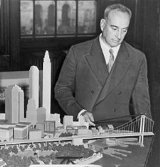
Robert Moses

Encyclopedia
Robert Moses was the "master builder" of mid-20th century New York City
, Long Island
, Rockland County, and Westchester County, New York. As the shaper of a modern city, he is sometimes compared to Baron Haussmann
of Second Empire
Paris, and is one of the most polarizing figures in the history of urban planning
in the United States. He changed shorelines, built bridges, tunnels and roadways, and transformed neighborhoods forever. His decisions favoring highways over public transit helped create the modern suburbs of Long Island
and influenced a generation of engineer
s, architect
s, and urban planner
s who spread his philosophies across the nation.
Never elected to public office, Moses was responsible for the creation and leadership of numerous public authorities which he could control without having to answer to the general public or to elected officials. It is due to Moses that there are a disproportionate number of public benefit corporations in New York state, which are the prime mode of infrastructure building and maintenance in New York, and are currently responsible for 90% of the state's debt. As head of various authorities, he controlled millions in income from his projects' revenue generation, such as tolls, and he had the power to issue bonds to borrow vast sums, allowing him to initiate new ventures with little or no approval from legislative bodies, bypassing the usual power of the purse
as it normally functioned in the United States, and the cumbersome process of citizen comment on major public works.
Moses's projects were considered by many to be necessary for the region's development after being hit hard by the Great Depression
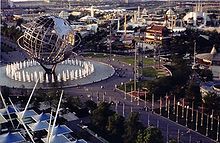
. During the height of his powers, New York City participated in the construction of two huge World's Fair
s: one in 1939
and the other in 1964
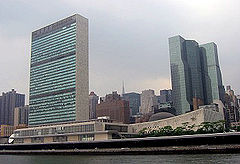
. Moses was also in large part responsible for the United Nations
' decision to headquarter in Manhattan
as opposed to Philadelphia.
His works remain extremely controversial. His supporters believe he made the city viable for the 21st century by building an infrastructure that most people wanted and that has endured. His critics claim that he preferred automobiles to people, that he displaced hundreds of thousands of residents in New York City, destroyed traditional neighborhoods by building expressways through them, contributed to the ruin of the South Bronx
and the amusement park
s of Coney Island
, caused the departure of the Brooklyn Dodgers
and the New York Giants
Major League baseball teams, and precipitated the decline of public transport through disinvestment
and neglect.
. He spent the first nine years of his life living at 83 Dwight Street in New Haven, two blocks from Yale University. In 1897, the Moses family moved to New York City, where they lived on East 46th Street off of Fifth Avenue. Moses's father was a successful department store owner and real estate
speculator in New Haven. In order for the family to move to New York City, he sold his real estate holdings and store, and then retired from business for the rest of his life. Bella, Moses's mother, was a forceful and brilliant woman, active in the settlement movement
, with her own love of building.
After graduating from Yale University
and Wadham College, Oxford, and earning a Ph.D. in political science from Columbia University
, Moses became attracted to New York City reform politics. At this time a committed idealist
, he developed several plans to rid New York of patronage hiring practices, including being the lead author of a 1919 proposal to reorganize the NY state government. None went very far, but Moses, due to his intelligence, caught the notice of Belle Moskowitz
, a friend and trusted advisor to Al Smith
.
Moses rose to power with Smith and set in motion a sweeping consolidation of the New York State government. This centralization allowed Smith to run a government later used as a model for Roosevelt's New Deal
federal government. Moses also received numerous commissions that he carried out extraordinarily well, such as the development of Jones Beach State Park
. Displaying a strong command of law
as well as matters of engineering
, Moses became known for his skill in drafting legislation, and was called "the best bill drafter in Albany
". At a time when the public was used to Tammany Hall
corruption and incompetence, Moses was seen as a savior of government. Shortly after President
Franklin D. Roosevelt's inauguration, the federal government found itself with millions of New Deal
tax dollars to spend, yet states and cities had few projects ready. Moses was one of the few local officials who had projects planned and prepared. For that reason, New York City could count on Moses to deliver to it Works Progress Administration
(WPA), Civilian Conservation Corps
(CCC), and other depression-era funding.
. Similarly, the main aesthetic achievements of Riverside Drive and associated amenities were located south of 125th street, and a pattern of barriers to access for non-white citizens, whether steep stairs or busy highways, appears repeatedly in his public projects. Close associates of Moses claimed that they could keep African American
s from using pools in white neighborhoods by making the water too cold. He actively precluded the use of public transit that would have allowed the non-car-owners to enjoy the elaborate recreation facilities he built. After much litigation by private landowners, his highway projects on Long Island
followed a circuitous path so as not to cross the properties of wealth
y landowners such as J. P. Morgan, Jr.
, while those same highways demolished numerous working class
neighborhoods throughout New York City.
During the Depression
, however, Moses, along with Mayor Fiorello H. La Guardia, was responsible for the construction of ten gigantic pools under the WPA
Program. Combined, they could accommodate 66,000 swimmers. This extensive social works program is sometimes attributed to the fact that Moses was an avid swimmer himself. One such pool is McCarren Park
Pool in Brooklyn
, formerly dry and used only for special cultural events but now undergoing reconstruction.
Moses persuaded Governor Smith and the government of New York City to allow him to hold state and the city governments jobs simultaneously; at one point, he had 12 separate titles, maintaining four palatial offices across the city and Long Island, and actually holding control of all federal appropriations to New York City. For the city, he was Parks Commissioner, and for the state, he was President of the Long Island State Park Commission
and Secretary of State of New York
(1927–1928), as well as Chairman of the New York State Power Commission
, responsible for building hydro-electric dams in the Niagara
/St. Lawrence region.
During the 1920s, Moses sparred with Franklin D. Roosevelt
, then head of the Taconic State Park Commission, who favored the prompt construction of a parkway
through the Hudson Valley
. Moses succeeded in diverting funds to his Long Island parkway projects (the Northern State Parkway
, the Southern State Parkway
and the Wantagh State Parkway
), although the Taconic State Parkway
was later completed as well. Moses is frequently given credit as the father of the New York State Parkway System
from these projects.
As the head of many public authorities, Moses's title as chairman gave his entities the flexibility associated with private enterprise, along with the tax-exempt debt capacity associated with government agencies. The inner workings of the authorities were free from public scrutiny, allowing money to be freely allocated to expenses public scrutiny could not have sustained. Contrary to his public image, Moses horse-traded and dealt out patronage extensively, building support from construction firms, investment banks, insurance companies, labor unions (and management), and real-estate developers. Calling on these vast reserves of power, Moses quickly developed a reputation for "getting things done" and used his influence to fast-track projects in legislators' home districts, a tactic for which these same lawmakers repaid him by granting money for ever more ambitious projects. He dealt out enough spoils to both political parties to ensure he avoided unwanted attention to his patronage politics.
In 1934, he ran on the Republican ticket for Governor of New York
, but was routed by the incumbent Democrat Herbert H. Lehman
. A measure of how badly he was defeated is seen in that the GOP held one or both houses of the New York state legislature in the period from 1912 to 1964, except in the wake of the Moses landslide defeat.
 Robert Moses had power over the construction of all public housing
projects, but the one position above all others giving him political power was his chairmanship of the Triborough Bridge Authority
.
The Triborough Bridge
(now officially the Robert F. Kennedy Memorial Bridge), a cluster of three separate spans, connects the Bronx
, Manhattan
, and Queens
. The legal structure of this particular public authority made it impervious to influence from mayors and governors, due to the language in the bond
contracts and multi-year appointments of the Commissioners. While New York City and New York State were perpetually strapped for money, the bridge's toll revenues amounted to tens of millions of dollars a year. The agency was therefore capable of financing the borrowing of hundreds of millions of dollars, making Moses the only person in New York capable of funding large public construction projects. Toll revenues rose quickly, as traffic on the bridges exceeded all projections. Rather than pay off the bonds, Moses sought other toll projects to build, a cycle that fed on itself.
should be a bridge or a tunnel. Bridges can be wider and cheaper but tall ones use more ramp space at landfall than tunnels. A "Brooklyn Battery Bridge" would have destroyed Battery Park and physically encroached on the financial district. The bridge was opposed by the Regional Plan Association, historical preservationists, Wall Street
financial interests and property owners, various high society people, construction
unions (since a tunnel would give them more work), the Manhattan borough president
, Mayor Fiorello LaGuardia, and governor Herbert H. Lehman
.
Moses, on the other hand, favored a bridge. It could carry more automobile traffic than a tunnel and would also serve as a visible monument. More traffic meant more tolls
, and more tolls meant more money and therefore more power for public improvements. LaGuardia and Lehman, as usual, had no money to spend and the federal government, by this point, felt it had given New York enough. Moses, because of his control of Triborough, had money to spend, and he decided his money could only be spent on a bridge. He also clashed with chief engineer of the project, Ole Singstad
, who preferred a tunnel instead of a bridge.
Only a lack of a key Federal approval thwarted the bridge scheme. President Roosevelt ordered the War Department to assert that a bridge in that location, if bombed, would block the East River
access to the Brooklyn Navy Yard
upstream. A dubious claim for a river already crossed by bridges, it nevertheless stopped Moses. In retaliation for being prevented from building his bridge, Moses dismantled the New York Aquarium
that had been in Castle Clinton
and moved it to Coney Island
in Brooklyn. He also attempted to raze Castle Clinton itself, on a variety of pretenses, and the historic fort's survival was assured only after ownership was transferred to the federal government.
Moses was forced to settle for a tunnel connecting Brooklyn to Lower Manhattan
, now called the Brooklyn Battery Tunnel. A 1941 publication from the Triborough Bridge and Tunnel Authority claimed that the government had forced them to build a tunnel at "twice the cost, twice the operating fees, twice the difficulty to engineer, and half the traffic," though engineering studies did not support this conclusion, and a tunnel may have held many of the advantages Moses publicly tried to attach to the bridge option.
Ultimately, this was not the first time that Moses tried to carry out the bridge option when a tunnel was already in progress. The same issue also occurred when the Queens-Midtown Tunnel was being planned, in which he also clashed with Ole Singstad
and tried to upstage the Tunnel Authority. For the same reasons, Moses also preferred a bridge crossing, but with no luck since the bridge was not supported by many officials.
 Moses's power increased after World War II
, when, after the retirement of LaGuardia, a series of mayors consented to almost all of Moses's proposals. Named city "construction coordinator", in 1946, by Mayor William O'Dwyer
, Moses also became the official representative of New York City in Washington, D.C.
Moses was also now given powers over public housing
that had eluded him under LaGuardia. Moses's power grew even more when O'Dwyer was forced to resign in disgrace and was succeeded by Vincent R. Impellitteri
, who was more than content to allow Moses to exercise control over infrastructure
projects from behind the scenes.
One of Moses's first steps after Impellitteri took office was killing the development of a city-wide Comprehensive Zoning Plan, underway since 1938, that would have restrained his nearly uninhibited power to build within the city, and removing the existing Zoning Commissioner from power. Impellitteri enabled Moses in other ways, too. Moses was now the sole person authorized to negotiate in Washington for New York City projects. He could now remake New York for the automobile
. By 1959, Moses had built 28,000 apartment units on hundreds of acres. In clearing the land for high-rises in accordance with the tower in a park scheme, which at that time was seen as innovative and beneficial, he sometimes destroyed almost as many housing units as he built.
From the 1930s to the 1960s, Robert Moses was responsible for the construction of the Throgs Neck
, the Bronx-Whitestone, the Henry Hudson
, and the Verrazano Narrows bridges. His other projects included the Brooklyn-Queens Expressway, the Staten Island Expressway, the Cross-Bronx Expressway
, the Belt Parkway
, the Laurelton Parkway, and many more. Federal interest had shifted from parkway
to freeway systems, and the new roads mostly conformed to the new vision, lacking the landscaping or the commercial traffic restrictions of the pre-war ones. He was the mover behind Shea Stadium
and Lincoln Center, and contributed to the United Nations headquarters
.
Moses had direct influence outside the New York area as well. City planners in many smaller American cities hired Moses to design freeway networks for them in the 1940s and early 1950s. Few of these were built; initially postponed for lack of funding, projects still unbuilt by the 1960s were often defeated by the awakening citizen-led opposition movement. The first successful examples of these freeway revolts were in New Orleans. Original plans for Interstate 10
followed U.S. Route 90
through Uptown, but instead the Interstate through the western part of the city was routed along the Pontchartrain Expressway
.
Following that adjustment was the blocking of New Orleans' Vieux Carré Riverfront Expressway
, an elevated highway that would have sliced through the French Quarter
, resulting in an even greater impact on the city's sense of history. Later, successful freeway revolts that saw highway projects either scaled back or cancelled outright also occurred in Portland
, Oregon
(see Mount Hood Freeway and Harbor Drive
), San Francisco, San Diego, Washington, D.C.
, Baltimore
, Phoenix
, Memphis, Toronto, and eventually Los Angeles. Moses was more successful with some design elements of the Penn-Lincoln Parkway
in Pittsburgh during the city's Renaissance Project, but wanted a beacon
at Point State Park
instead of the fountain that would eventually go there.
s, curving, landscaped "ribbon parks," intended to be pleasures to drive in and "lungs for the city".
owner Walter O'Malley
wanted to build a new stadium
to replace the outdated and dilapidated Ebbets Field
. O'Malley determined the best site for the stadium was on the corner of Atlantic Avenue and Flatbush Avenue in Brooklyn at the end of the Long Island Rail Road
. O'Malley pleaded with Moses to help him secure the property in a cost effective manner, but Moses wanted to use the land to build a parking garage. Moses envisioned New York's newest stadium in Flushing Meadows
on the former (and as it turned out, future) site of the World's Fair in Queens. O'Malley was vehement in his opposition, stating "we are the Brooklyn Dodgers, not the Queens Dodgers!" Moses won this clash of egos and would not be moved on this issue. After the Dodgers left for Los Angeles and the New York Giants left for San Francisco, Moses was able to build Shea Stadium
in Queens on the site he planned for stadium development. Construction began in October 1961 and the stadium opened in April 1964 to house the National League's
New York Mets
, who played there until the end of the 2008 season, when they moved to the adjacent Citi Field.
 Moses's reputation began to wane in the 1960s as public debate on urban planning began to focus on the virtues of intimate neighborhoods and smallness of scale. Around this time, Moses also started picking political battles he could not win. His campaign against the free Shakespeare in the Park
received much negative publicity, and his effort to destroy a shaded playground in Central Park
to make way for a parking lot for the expensive Tavern-on-the-Green
restaurant made him many enemies among the middle-class voters of the Upper West Side
.
The opposition reached a crescendo over the demolition of Penn Station
, which many attributed to the "development scheme" mentality cultivated by Moses although the impoverished Pennsylvania Railroad
was actually responsible for the demolition. The casual destruction of one of New York's greatest architectural landmarks helped prompt many city residents to turn against Moses's plans to build a Lower Manhattan Expressway
, which would have gone through Greenwich Village
and what is now SoHo
. This plan and the Mid-Manhattan Expressway
both failed politically; to this day no superhighway goes through the heart of Manhattan. One of his most vocal critics during this time was the urban activist Jane Jacobs
, whose book The Death and Life of Great American Cities
was instrumental in turning opinion against Moses's plans; the city government rejected the expressway in 1964.
Moses's power was further sapped by his association with the 1964 New York World's Fair
. His assumption of aggregate attendance of 70 million people for this event proved wildly optimistic, and generous contracts for Fair executives and contractors did not help the economics. His repeated and forceful public denials of the Fair's considerable financial difficulties in the face of the evidence eventually provoked press and governmental investigations, which eventually found accounting deceptions. In his organization of the fair, Moses's reputation was tarnished by his disdain for the opinions of others, his high-handed attempts to get his way in moments of conflict by turning to the press, and the fact that the fair was not sanctioned by the Bureau of International Expositions
(BIE), the worldwide body supervising such events. Moses refused to accept BIE requirements, including a restriction against charging ground rents to exhibitors, and the BIE in turn instructed its member nations not to participate. The United States had already staged the sanctioned Century 21 Exposition
in Seattle
in 1962. According to the rules of the organization, no one nation could host more than one fair in a decade.) The major European democracies, as well as Canada, Australia and the Soviet Union were all BIE members and they declined to participate, instead reserving their efforts for Expo 67
in Montreal
.
After the World's Fair, New York City mayor John Lindsay
, along with Governor Nelson Rockefeller
, sought to use toll revenues from the Triborough Bridge and Tunnel Authority's (TBTA) bridges and tunnels to cover deficits in the city's then financially ailing agencies, including the subway system
. Moses opposed this idea and fought to prevent it. Lindsay removed Moses from his post as the city's chief advocate for federal highway money in Washington.
But Moses could not so easily fend off Rockefeller, the only politician in the state who had a power base independent of him. The legislature's vote to fold the TBTA into the newly-created Metropolitan Transportation Authority
(MTA) could technically have led to a lawsuit by the TBTA bondholders, since the bond contracts were written into state law and under Article 1, Section 10
of the U.S. Constitution
states may not impair existing contractual obligations, and the bondholders had right of approval over such actions. However, the largest holder of TBTA bonds, and thus agent for all the others, was the Chase Manhattan Bank
, headed then by David Rockefeller
, the governor's brother. No suit was filed or even discussed. Moses could have directed TBTA to go to court against the action, but having been promised certain roles in the merged authority, Moses in turn declined to challenge the merger.
On March 1, 1968, the TBTA was folded into the MTA and Moses gave up his post as chairman of the TBTA. He eventually became a consultant to the MTA, but its new chairman and the governor froze him out - the promised roles did not materialize, and for all practical purposes Moses was out of power.
Moses had thought he had convinced Nelson Rockefeller of the need for one last great bridge project, a span crossing Long Island Sound from Rye to Oyster Bay. Rockefeller did not press for the project in the late 1960s through 1970, fearing public backlash among suburban Republicans would hinder his re-election prospects. While a 1972 study found the bridge was fiscally prudent and could be environmentally manageable, the anti-development sentiment was now insurmountable and in 1973 Rockefeller canceled plans for the bridge. In retrospect, NYCroads.com author Steve Anderson writes that leaving densely-populated Long Island completely dependent on access through New York City may not have been an optimal policy decision.
, a Pulitzer Prize
-winning biography by Robert A. Caro. Caro's 1,200-page opus (edited from over 3,000 pages long) largely destroyed the remainder of Moses's reputation; essayist Phillip Lopate
writes that "Moses's satanic reputation with the public can be traced, in the main, to...Caro's magnificent biography." For example, Caro described how insensitive Moses was in the construction of the Cross-Bronx Expressway
, and how he willfully neglected public transit. Moses's reputation today is in many ways attributable to Caro, whose book won both the Pulitzer Prize in Biography in 1975 and the Francis Parkman Prize, which is awarded by the Society of American Historians, and was named one of the 100 greatest non-fiction books of the twentieth century by the Modern Library
.
Caro's depiction of Moses's life gives him full credit for his early achievements, showing, for example, how he conceived and created Jones Beach and the New York State Park system, but he also shows how, as Moses's desire for power came to be more important to him than his earlier dreams, he destroyed more than a score of neighborhoods, by ramming 13 huge expressways across the heart of New York City and by building huge urban renewal
projects with little regard for the urban fabric or for human scale. Yet the author is more neutral in his central premise: the city would have been a very different place — maybe better, maybe worse — if Moses had never existed. Other U.S. cities were doing the same thing as New York in the 1940s, 1950s, and 1960s. Boston, San Francisco
and Seattle
, for instance, each built highways straight through their downtown areas. The New York City architectural intelligentsia
of the 1940s and 1950s largely believed in such prophets of the automobile as Le Corbusier
and Mies van der Rohe had supported Moses. Many other cities, like Newark
, Chicago and St. Louis
, also built massive, unattractive public housing projects.
Caro argues that Moses also demonstrated racist tendencies. He, along with other members of the New York city planning commission, were vocal opponents against black war veterans moving into Stuyvesant Town
, a Manhattan residential development complex created to house World War II veterans.
People had come to see Moses as a bully who disregarded public input, but until the publication of Caro's book, they had not known that he had allowed his brother Paul to spend much of his life in poverty. Paul Moses, who was interviewed by Caro shortly before his death, claimed Robert had exerted undue influence on their mother to change their will in his favour shortly before her death. Caro notes that Paul was on bad terms with their mother over a long period and she may have changed the will of her own accord. Caro suggested that Robert's subsequent treatment of Paul may have been legally justifiable but was morally questionable.
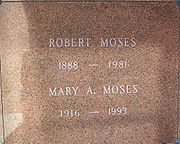
Moses died of heart disease
on July 29, 1981, at the age of 92 at Good Samaritan Hospital in West Islip, New York
. The headings in his New York Times obituary package form both a found poem and a thumbnail sketch of his life and influence: "Robert Moses, Master Builder, Is Dead at 92; Robert Moses, Builder of Road, Beach, Bridge and Housing Projects, Is Dead; Associate of High Officials; The Grand-Scale Approach; Not a Professional Planner; Part of 'Our Crowd'; Into the Orbit of Power; Fur Coat or Underwear?; An Overwhelming Success; Long Court Fights; Drafted Park Legislation; Moses' Tactics Were Both Extolled and Criticized; Badly Beaten in Election; Built to His Own Tastes; A Sampler of Quotations by Moses; The Face of a Region; and How One Man Changed It."
Moses was ethnically Jewish, but was raised in a secularist manner inspired by the Ethical Culture
movement of the late 19th century. He was a convert to Christianity and was interred in a crypt in an outdoor community mausoleum in Woodlawn Cemetery
in the Bronx
following services at Saint Peter's Episcopal Church in Bay Shore, New York
.
, because Langdon Winner
in his acclaimed essay Do Artifacts Have Politics? used Moses' bridges to make his point that artifacts do have politics. Winner uses Robert Caro's
biography of Moses pointing to a passage where Caro interviews Moses' co-worker. The co-worker all but implies that Moses purposefully built 204 bridges on Long Island too low for buses to clear. Due to poorer minorities being largely dependent on public transit, this becomes a testimony to Moses’s racism. This allegation, however, has since been disputed by Bernward Joerges
in his essay Do Politics Have Artefacts? On page 8 he writes that “at the time of the parkway building (beginning 1924), Long Island was already considerably well developed in terms of transport. The Manhattan-Long Island railway operated since 1877, and a rather dense system of ordinary roads was in place, parallel and across the parkways. The Long Island Expressway, a true Autobahn intended to relieve traffic congestion on the Island, was built by Moses alongside the Parkways.” Hence, as a segregationist measure, those bridges would be utterly ineffectual. Joerges goes on to give multiple reasons for the bridge’s nature, for example that “[i]n the USA, trucks, buses and other commercial vehicles were prohibited on all parkways. Moses did nothing different on Long Island from any parks commissioner in the country.”
While the overall impact of many of Moses's projects continues to be debated, their sheer scale across the urban landscape is indisputable. The peak of Moses’s construction occurred during the economic duress of the Great Depression
, and despite that era’s woes, Moses’s projects were completed in a timely fashion, and have been reliable public works since—which compares favorably to the contemporary delays New York City officials have had redeveloping the Ground Zero
site of the former World Trade Center
, or the technical snafus surrounding Boston’s Big Dig project.
Three major exhibits in 2007 prompted a reconsideration of his image among some intellectuals, as they acknowledged the magnitude of his achievements. According to Columbia University
architectural historian
Hilary Ballon and assorted colleagues, Moses deserves better. They argue that his legacy is more relevant than ever. All around New York State, she says, people take for granted the parks, playgrounds and housing Moses built, now generally binding forces in those areas, even if the old-style New York neighborhood was of no interest to Moses himself. And were it not for Moses’ public infrastructure and his resolve to carve out more space, she argues, New York might not have been able to recover from the blight and flight of the 1970s and ’80s and become the economic magnet it is today, she suggests.
“Every generation writes its own history,” said Kenneth T. Jackson
, a historian of New York City. “It could be that The Power Broker was a reflection of its time: New York was in trouble and had been in decline for 15 years. Now, for a whole host of reasons, New York is entering a new time, a time of optimism, growth and revival that hasn’t been seen in half a century. And that causes us to look at our infrastructure,” said Jackson. “A lot of big projects are on the table again, and it kind of suggests a Moses era without Moses,” he added.
Politicians, too, are reconsidering the Moses legacy. In a 2006 speech to the Regional Plan Association
on downstate transportation needs, Eliot Spitzer
, who would be overwhelmingly elected governor later that year, said a biography of Moses written today might be called At Least He Got It Built. “That’s what we need today. A real commitment to get things done.”
A testament to the enduring nature of his impact can be found in the various locations and roadways in New York State that bear Moses’s name. These include two state parks (one in Massena, New York
, the other on Long Island), the Robert Moses Causeway
on Long Island, the Robert Moses State Parkway
in Niagara Falls, New York
, and the Robert Moses Hydro-Electric Dam
in Lewiston, New York
. There is also a hydro-electric power dam in Massena, New York which bears Moses' name. These supply much of New York City's power. Moses also has a school named after him in North Babylon, New York
on Long Island; there is also a Robert Moses Playground
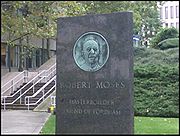
in New York City. There are other signs of the surviving appreciation held for him by some circles of the public. A statue of Moses was erected next to the Village Hall
in his long-time hometown, Babylon Village, New York
, in 2003, as well as a bust on the Lincoln Center campus of Fordham University
.
The impact of Robert Moses on the Rockaway Peninsula was almost universally considered positive with his development of Jacob Riis Park
and the Marine Parkway Bridge in the 1930s. However, Moses’s construction of the Shore Front Parkway
and his large-scale introduction of public housing
and large-scale demolition of the bungalow area along Rockaway’s beachfront provoked criticism.
New York City
New York is the most populous city in the United States and the center of the New York Metropolitan Area, one of the most populous metropolitan areas in the world. New York exerts a significant impact upon global commerce, finance, media, art, fashion, research, technology, education, and...
, Long Island
Long Island
Long Island is an island located in the southeast part of the U.S. state of New York, just east of Manhattan. Stretching northeast into the Atlantic Ocean, Long Island contains four counties, two of which are boroughs of New York City , and two of which are mainly suburban...
, Rockland County, and Westchester County, New York. As the shaper of a modern city, he is sometimes compared to Baron Haussmann
Baron Haussmann
Georges-Eugène Haussmann, commonly known as Baron Haussmann , was a French civic planner whose name is associated with the rebuilding of Paris...
of Second Empire
Second French Empire
The Second French Empire or French Empire was the Imperial Bonapartist regime of Napoleon III from 1852 to 1870, between the Second Republic and the Third Republic, in France.-Rule of Napoleon III:...
Paris, and is one of the most polarizing figures in the history of urban planning
Urban planning
Urban planning incorporates areas such as economics, design, ecology, sociology, geography, law, political science, and statistics to guide and ensure the orderly development of settlements and communities....
in the United States. He changed shorelines, built bridges, tunnels and roadways, and transformed neighborhoods forever. His decisions favoring highways over public transit helped create the modern suburbs of Long Island
Long Island
Long Island is an island located in the southeast part of the U.S. state of New York, just east of Manhattan. Stretching northeast into the Atlantic Ocean, Long Island contains four counties, two of which are boroughs of New York City , and two of which are mainly suburban...
and influenced a generation of engineer
Engineer
An engineer is a professional practitioner of engineering, concerned with applying scientific knowledge, mathematics and ingenuity to develop solutions for technical problems. Engineers design materials, structures, machines and systems while considering the limitations imposed by practicality,...
s, architect
Architect
An architect is a person trained in the planning, design and oversight of the construction of buildings. To practice architecture means to offer or render services in connection with the design and construction of a building, or group of buildings and the space within the site surrounding the...
s, and urban planner
Urban planner
An urban planner or city planner is a professional who works in the field of urban planning/land use planning for the purpose of optimizing the effectiveness of a community's land use and infrastructure. They formulate plans for the development and management of urban and suburban areas, typically...
s who spread his philosophies across the nation.
Never elected to public office, Moses was responsible for the creation and leadership of numerous public authorities which he could control without having to answer to the general public or to elected officials. It is due to Moses that there are a disproportionate number of public benefit corporations in New York state, which are the prime mode of infrastructure building and maintenance in New York, and are currently responsible for 90% of the state's debt. As head of various authorities, he controlled millions in income from his projects' revenue generation, such as tolls, and he had the power to issue bonds to borrow vast sums, allowing him to initiate new ventures with little or no approval from legislative bodies, bypassing the usual power of the purse
Power of the purse
The power of the purse is the ability of one group to manipulate and control the actions of another group by withholding funding, or putting stipulations on the use of funds. The power of the purse can be used to save their money and positively or negatively The power of the purse is the ability...
as it normally functioned in the United States, and the cumbersome process of citizen comment on major public works.
Moses's projects were considered by many to be necessary for the region's development after being hit hard by the Great Depression
Great Depression
The Great Depression was a severe worldwide economic depression in the decade preceding World War II. The timing of the Great Depression varied across nations, but in most countries it started in about 1929 and lasted until the late 1930s or early 1940s...
. During the height of his powers, New York City participated in the construction of two huge World's Fair
World's Fair
World's fair, World fair, Universal Exposition, and World Expo are various large public exhibitions held in different parts of the world. The first Expo was held in The Crystal Palace in Hyde Park, London, United Kingdom, in 1851, under the title "Great Exhibition of the Works of Industry of All...
s: one in 1939
1939 New York World's Fair
The 1939–40 New York World's Fair, which covered the of Flushing Meadows-Corona Park , was the second largest American world's fair of all time, exceeded only by St. Louis's Louisiana Purchase Exposition of 1904. Many countries around the world participated in it, and over 44 million people...
and the other in 1964
1964 New York World's Fair
The 1964/1965 New York World's Fair was the third major world's fair to be held in New York City. Hailing itself as a "universal and international" exposition, the fair's theme was "Peace Through Understanding," dedicated to "Man's Achievement on a Shrinking Globe in an Expanding Universe";...
. Moses was also in large part responsible for the United Nations
United Nations
The United Nations is an international organization whose stated aims are facilitating cooperation in international law, international security, economic development, social progress, human rights, and achievement of world peace...
' decision to headquarter in Manhattan
Manhattan
Manhattan is the oldest and the most densely populated of the five boroughs of New York City. Located primarily on the island of Manhattan at the mouth of the Hudson River, the boundaries of the borough are identical to those of New York County, an original county of the state of New York...
as opposed to Philadelphia.
His works remain extremely controversial. His supporters believe he made the city viable for the 21st century by building an infrastructure that most people wanted and that has endured. His critics claim that he preferred automobiles to people, that he displaced hundreds of thousands of residents in New York City, destroyed traditional neighborhoods by building expressways through them, contributed to the ruin of the South Bronx
South Bronx
The South Bronx is an area of the New York City borough of The Bronx. The neighborhoods of Tremont, University Heights, Highbridge, Morrisania, Soundview, Hunts Point, and Castle Hill are sometimes considered part of the South Bronx....
and the amusement park
Amusement park
thumb|Cinderella Castle in [[Magic Kingdom]], [[Disney World]]Amusement and theme parks are terms for a group of entertainment attractions and rides and other events in a location for the enjoyment of large numbers of people...
s of Coney Island
Coney Island
Coney Island is a peninsula and beach on the Atlantic Ocean in southern Brooklyn, New York, United States. The site was formerly an outer barrier island, but became partially connected to the mainland by landfill....
, caused the departure of the Brooklyn Dodgers
Los Angeles Dodgers
The Los Angeles Dodgers are a professional baseball team based in Los Angeles, California. The Dodgers are members of Major League Baseball's National League West Division. Established in 1883, the team originated in Brooklyn, New York, where it was known by a number of nicknames before becoming...
and the New York Giants
San Francisco Giants
The San Francisco Giants are a Major League Baseball team based in San Francisco, California, playing in the National League West Division....
Major League baseball teams, and precipitated the decline of public transport through disinvestment
Disinvestment
Disinvestment, sometimes referred to as divestment, refers to the use of a concerted economic boycott, with specific emphasis on liquidating stock, to pressure a government, industry, or company towards a change in policy, or in the case of governments, even regime change...
and neglect.
Early life and rise to power
Moses was born to assimilated German Jewish parents in New Haven, ConnecticutNew Haven, Connecticut
New Haven is the second-largest city in Connecticut and the sixth-largest in New England. According to the 2010 Census, New Haven's population increased by 5.0% between 2000 and 2010, a rate higher than that of the State of Connecticut, and higher than that of the state's five largest cities, and...
. He spent the first nine years of his life living at 83 Dwight Street in New Haven, two blocks from Yale University. In 1897, the Moses family moved to New York City, where they lived on East 46th Street off of Fifth Avenue. Moses's father was a successful department store owner and real estate
Real estate
In general use, esp. North American, 'real estate' is taken to mean "Property consisting of land and the buildings on it, along with its natural resources such as crops, minerals, or water; immovable property of this nature; an interest vested in this; an item of real property; buildings or...
speculator in New Haven. In order for the family to move to New York City, he sold his real estate holdings and store, and then retired from business for the rest of his life. Bella, Moses's mother, was a forceful and brilliant woman, active in the settlement movement
Settlement movement
The settlement movement was a reformist social movement, beginning in the 1880s and peaking around the 1920s in England and the US, with a goal of getting the rich and poor in society to live more closely together in an interdependent community...
, with her own love of building.
After graduating from Yale University
Yale University
Yale University is a private, Ivy League university located in New Haven, Connecticut, United States. Founded in 1701 in the Colony of Connecticut, the university is the third-oldest institution of higher education in the United States...
and Wadham College, Oxford, and earning a Ph.D. in political science from Columbia University
Columbia University
Columbia University in the City of New York is a private, Ivy League university in Manhattan, New York City. Columbia is the oldest institution of higher learning in the state of New York, the fifth oldest in the United States, and one of the country's nine Colonial Colleges founded before the...
, Moses became attracted to New York City reform politics. At this time a committed idealist
Idealism
In philosophy, idealism is the family of views which assert that reality, or reality as we can know it, is fundamentally mental, mentally constructed, or otherwise immaterial. Epistemologically, idealism manifests as a skepticism about the possibility of knowing any mind-independent thing...
, he developed several plans to rid New York of patronage hiring practices, including being the lead author of a 1919 proposal to reorganize the NY state government. None went very far, but Moses, due to his intelligence, caught the notice of Belle Moskowitz
Belle Moskowitz
Belle Moskowitz was the political advisor to New York Governor and 1928 presidential candidate Al Smith.-Biography:...
, a friend and trusted advisor to Al Smith
Al Smith
Alfred Emanuel Smith. , known in private and public life as Al Smith, was an American statesman who was elected the 42nd Governor of New York three times, and was the Democratic U.S. presidential candidate in 1928...
.
Moses rose to power with Smith and set in motion a sweeping consolidation of the New York State government. This centralization allowed Smith to run a government later used as a model for Roosevelt's New Deal
New Deal
The New Deal was a series of economic programs implemented in the United States between 1933 and 1936. They were passed by the U.S. Congress during the first term of President Franklin D. Roosevelt. The programs were Roosevelt's responses to the Great Depression, and focused on what historians call...
federal government. Moses also received numerous commissions that he carried out extraordinarily well, such as the development of Jones Beach State Park
Jones Beach State Park
Jones Beach State Park is a state park of the U.S. state of New York. It is located in southern Nassau County, in the hamlet of Wantagh, on Jones Beach Island, a barrier island linked to Long Island by the Meadowbrook State Parkway, Wantagh State Parkway and Ocean Parkway .The park is renowned for...
. Displaying a strong command of law
Law
Law is a system of rules and guidelines which are enforced through social institutions to govern behavior, wherever possible. It shapes politics, economics and society in numerous ways and serves as a social mediator of relations between people. Contract law regulates everything from buying a bus...
as well as matters of engineering
Engineering
Engineering is the discipline, art, skill and profession of acquiring and applying scientific, mathematical, economic, social, and practical knowledge, in order to design and build structures, machines, devices, systems, materials and processes that safely realize improvements to the lives of...
, Moses became known for his skill in drafting legislation, and was called "the best bill drafter in Albany
Albany, New York
Albany is the capital city of the U.S. state of New York, the seat of Albany County, and the central city of New York's Capital District. Roughly north of New York City, Albany sits on the west bank of the Hudson River, about south of its confluence with the Mohawk River...
". At a time when the public was used to Tammany Hall
Tammany Hall
Tammany Hall, also known as the Society of St. Tammany, the Sons of St. Tammany, or the Columbian Order, was a New York political organization founded in 1786 and incorporated on May 12, 1789 as the Tammany Society...
corruption and incompetence, Moses was seen as a savior of government. Shortly after President
President of the United States
The President of the United States of America is the head of state and head of government of the United States. The president leads the executive branch of the federal government and is the commander-in-chief of the United States Armed Forces....
Franklin D. Roosevelt's inauguration, the federal government found itself with millions of New Deal
New Deal
The New Deal was a series of economic programs implemented in the United States between 1933 and 1936. They were passed by the U.S. Congress during the first term of President Franklin D. Roosevelt. The programs were Roosevelt's responses to the Great Depression, and focused on what historians call...
tax dollars to spend, yet states and cities had few projects ready. Moses was one of the few local officials who had projects planned and prepared. For that reason, New York City could count on Moses to deliver to it Works Progress Administration
Works Progress Administration
The Works Progress Administration was the largest and most ambitious New Deal agency, employing millions of unskilled workers to carry out public works projects, including the construction of public buildings and roads, and operated large arts, drama, media, and literacy projects...
(WPA), Civilian Conservation Corps
Civilian Conservation Corps
The Civilian Conservation Corps was a public work relief program that operated from 1933 to 1942 in the United States for unemployed, unmarried men from relief families, ages 18–25. A part of the New Deal of President Franklin D...
(CCC), and other depression-era funding.
Influence
At one time, one quarter of Federal construction dollars were being spent in New York, and Moses had 80,000 people working under him. Although he built playgrounds in vast numbers, almost none of those were located in HarlemHarlem
Harlem is a neighborhood in the New York City borough of Manhattan, which since the 1920s has been a major African-American residential, cultural and business center. Originally a Dutch village, formally organized in 1658, it is named after the city of Haarlem in the Netherlands...
. Similarly, the main aesthetic achievements of Riverside Drive and associated amenities were located south of 125th street, and a pattern of barriers to access for non-white citizens, whether steep stairs or busy highways, appears repeatedly in his public projects. Close associates of Moses claimed that they could keep African American
African American
African Americans are citizens or residents of the United States who have at least partial ancestry from any of the native populations of Sub-Saharan Africa and are the direct descendants of enslaved Africans within the boundaries of the present United States...
s from using pools in white neighborhoods by making the water too cold. He actively precluded the use of public transit that would have allowed the non-car-owners to enjoy the elaborate recreation facilities he built. After much litigation by private landowners, his highway projects on Long Island
Long Island
Long Island is an island located in the southeast part of the U.S. state of New York, just east of Manhattan. Stretching northeast into the Atlantic Ocean, Long Island contains four counties, two of which are boroughs of New York City , and two of which are mainly suburban...
followed a circuitous path so as not to cross the properties of wealth
Wealth
Wealth is the abundance of valuable resources or material possessions. The word wealth is derived from the old English wela, which is from an Indo-European word stem...
y landowners such as J. P. Morgan, Jr.
J. P. Morgan, Jr.
John Pierpont "Jack" Morgan, Jr. was an American banker and philanthropist.-Biography:He was born on September 7, 1867 in Irvington, New York to John Pierpont Morgan, Sr. and Frances Louisa Tracy. He graduated from Harvard in 1886, where he was a member of the Delphic Club, formerly known as the...
, while those same highways demolished numerous working class
Working class
Working class is a term used in the social sciences and in ordinary conversation to describe those employed in lower tier jobs , often extending to those in unemployment or otherwise possessing below-average incomes...
neighborhoods throughout New York City.
During the Depression
Great Depression
The Great Depression was a severe worldwide economic depression in the decade preceding World War II. The timing of the Great Depression varied across nations, but in most countries it started in about 1929 and lasted until the late 1930s or early 1940s...
, however, Moses, along with Mayor Fiorello H. La Guardia, was responsible for the construction of ten gigantic pools under the WPA
Works Progress Administration
The Works Progress Administration was the largest and most ambitious New Deal agency, employing millions of unskilled workers to carry out public works projects, including the construction of public buildings and roads, and operated large arts, drama, media, and literacy projects...
Program. Combined, they could accommodate 66,000 swimmers. This extensive social works program is sometimes attributed to the fact that Moses was an avid swimmer himself. One such pool is McCarren Park
McCarren Park
McCarren Park is a public park in New York City, USA. It is located in the Greenpoint neighborhood of Brooklyn, and is bordered by Nassau Avenue, Bayard Street, Lorimer Street and North 12th Street...
Pool in Brooklyn
Brooklyn
Brooklyn is the most populous of New York City's five boroughs, with nearly 2.6 million residents, and the second-largest in area. Since 1896, Brooklyn has had the same boundaries as Kings County, which is now the most populous county in New York State and the second-most densely populated...
, formerly dry and used only for special cultural events but now undergoing reconstruction.
Moses persuaded Governor Smith and the government of New York City to allow him to hold state and the city governments jobs simultaneously; at one point, he had 12 separate titles, maintaining four palatial offices across the city and Long Island, and actually holding control of all federal appropriations to New York City. For the city, he was Parks Commissioner, and for the state, he was President of the Long Island State Park Commission
Long Island State Park Commission
The Long Island State Park Commission was created in 1924 by the New York State Legislature to build and operate parks and parkways on Long Island. Governor Al Smith appointed as its first President, Robert Moses, who had drafted the bill creating the Commission and who served until 1953...
and Secretary of State of New York
Secretary of State of New York
The Secretary of State of New York is a cabinet officer in the government of the U.S. state of New York.The current Secretary of State of New York is Cesar A...
(1927–1928), as well as Chairman of the New York State Power Commission
New York Power Authority
The New York Power Authority , officially the Power Authority of the State of New York , is a New York State public benefit corporation and the largest state-owned power organization in the United States. NYPA provides some of the lowest-cost electricity in New York State, operating 17 generating...
, responsible for building hydro-electric dams in the Niagara
Niagara Frontier
The Niagara Frontier refers to the stretch of land south of Lake Ontario and Lake Erie and extending westward to Cleveland, Ohio. The term dates to the War of 1812. This only includes the land east of the Niagara River and south of Lake Erie within the United States...
/St. Lawrence region.
During the 1920s, Moses sparred with Franklin D. Roosevelt
Franklin D. Roosevelt
Franklin Delano Roosevelt , also known by his initials, FDR, was the 32nd President of the United States and a central figure in world events during the mid-20th century, leading the United States during a time of worldwide economic crisis and world war...
, then head of the Taconic State Park Commission, who favored the prompt construction of a parkway
Parkway
The term parkway has several distinct principal meanings and numerous synonyms around the world, for either a type of landscaped area or a type of road.Type of landscaped area:...
through the Hudson Valley
Hudson Valley
The Hudson Valley comprises the valley of the Hudson River and its adjacent communities in New York State, United States, from northern Westchester County northward to the cities of Albany and Troy.-History:...
. Moses succeeded in diverting funds to his Long Island parkway projects (the Northern State Parkway
Northern State Parkway
The Northern State Parkway is a long limited-access state parkway on Long Island in the U.S. state of New York. The western terminus is at the Queens-Nassau County line, where the parkway continues westward into New York City as the Grand Central Parkway...
, the Southern State Parkway
Southern State Parkway
The Southern State Parkway is a long limited-access highway on Long Island, in the U.S. state of New York...
and the Wantagh State Parkway
Wantagh State Parkway
The Wantagh State Parkway is a state parkway on Long Island in New York, in the United States. It links the Ocean Parkway at Jones Beach State Park with the Northern State Parkway in Westbury. The parkway is located approximately east of Manhattan and east of the Nassau–Queens border...
), although the Taconic State Parkway
Taconic State Parkway
The Taconic State Parkway , is a divided highway between Kensico Dam and Chatham, the longest parkway in the U.S. state of New York. It follows a generally northward route midway between the Hudson River and the Connecticut and Massachusetts state lines...
was later completed as well. Moses is frequently given credit as the father of the New York State Parkway System
New York State Parkway System
The New York State Parkway System opened its first section in 1908 and was a series of then-high speed four-lane roads that were created to provide a scenic way into, out of, and around New York City. The parkway system is still in use today...
from these projects.
As the head of many public authorities, Moses's title as chairman gave his entities the flexibility associated with private enterprise, along with the tax-exempt debt capacity associated with government agencies. The inner workings of the authorities were free from public scrutiny, allowing money to be freely allocated to expenses public scrutiny could not have sustained. Contrary to his public image, Moses horse-traded and dealt out patronage extensively, building support from construction firms, investment banks, insurance companies, labor unions (and management), and real-estate developers. Calling on these vast reserves of power, Moses quickly developed a reputation for "getting things done" and used his influence to fast-track projects in legislators' home districts, a tactic for which these same lawmakers repaid him by granting money for ever more ambitious projects. He dealt out enough spoils to both political parties to ensure he avoided unwanted attention to his patronage politics.
In 1934, he ran on the Republican ticket for Governor of New York
Governor of New York
The Governor of the State of New York is the chief executive of the State of New York. The governor is the head of the executive branch of New York's state government and the commander-in-chief of the state's military and naval forces. The officeholder is afforded the courtesy title of His/Her...
, but was routed by the incumbent Democrat Herbert H. Lehman
Herbert H. Lehman
Herbert Henry Lehman was a Democratic Party politician from New York. He was the 45th Governor of New York from 1933 to 1942, and represented New York in the United States Senate from 1950 to 1957.-Lehman Brothers:...
. A measure of how badly he was defeated is seen in that the GOP held one or both houses of the New York state legislature in the period from 1912 to 1964, except in the wake of the Moses landslide defeat.
Triborough Bridge
Public housing
Public housing is a form of housing tenure in which the property is owned by a government authority, which may be central or local. Social housing is an umbrella term referring to rental housing which may be owned and managed by the state, by non-profit organizations, or by a combination of the...
projects, but the one position above all others giving him political power was his chairmanship of the Triborough Bridge Authority
Triborough Bridge and Tunnel Authority
MTA Bridges and Tunnels, legal name Triborough Bridge and Tunnel Authority, is a division of the Metropolitan Transportation Authority, that operates seven intrastate toll bridges and two tunnels in New York City...
.
The Triborough Bridge
Triborough Bridge
The Robert F. Kennedy ' Bridge, formerly known as the Triborough Bridge , is a complex of three separate bridges in New York City, United States...
(now officially the Robert F. Kennedy Memorial Bridge), a cluster of three separate spans, connects the Bronx
The Bronx
The Bronx is the northernmost of the five boroughs of New York City. It is also known as Bronx County, the last of the 62 counties of New York State to be incorporated...
, Manhattan
Manhattan
Manhattan is the oldest and the most densely populated of the five boroughs of New York City. Located primarily on the island of Manhattan at the mouth of the Hudson River, the boundaries of the borough are identical to those of New York County, an original county of the state of New York...
, and Queens
Queens
Queens is the easternmost of the five boroughs of New York City. The largest borough in area and the second-largest in population, it is coextensive with Queens County, an administrative division of New York state, in the United States....
. The legal structure of this particular public authority made it impervious to influence from mayors and governors, due to the language in the bond
Bond (finance)
In finance, a bond is a debt security, in which the authorized issuer owes the holders a debt and, depending on the terms of the bond, is obliged to pay interest to use and/or to repay the principal at a later date, termed maturity...
contracts and multi-year appointments of the Commissioners. While New York City and New York State were perpetually strapped for money, the bridge's toll revenues amounted to tens of millions of dollars a year. The agency was therefore capable of financing the borrowing of hundreds of millions of dollars, making Moses the only person in New York capable of funding large public construction projects. Toll revenues rose quickly, as traffic on the bridges exceeded all projections. Rather than pay off the bonds, Moses sought other toll projects to build, a cycle that fed on itself.
Brooklyn Battery Bridge
In the late 1930s a municipal controversy raged over whether an additional vehicular link between Brooklyn and lower ManhattanLower Manhattan
Lower Manhattan is the southernmost part of the island of Manhattan, the main island and center of business and government of the City of New York...
should be a bridge or a tunnel. Bridges can be wider and cheaper but tall ones use more ramp space at landfall than tunnels. A "Brooklyn Battery Bridge" would have destroyed Battery Park and physically encroached on the financial district. The bridge was opposed by the Regional Plan Association, historical preservationists, Wall Street
Wall Street
Wall Street refers to the financial district of New York City, named after and centered on the eight-block-long street running from Broadway to South Street on the East River in Lower Manhattan. Over time, the term has become a metonym for the financial markets of the United States as a whole, or...
financial interests and property owners, various high society people, construction
Construction
In the fields of architecture and civil engineering, construction is a process that consists of the building or assembling of infrastructure. Far from being a single activity, large scale construction is a feat of human multitasking...
unions (since a tunnel would give them more work), the Manhattan borough president
Borough president
Borough President is an elective office in each of the five boroughs of New York City.-Reasons for establishment:...
, Mayor Fiorello LaGuardia, and governor Herbert H. Lehman
Herbert H. Lehman
Herbert Henry Lehman was a Democratic Party politician from New York. He was the 45th Governor of New York from 1933 to 1942, and represented New York in the United States Senate from 1950 to 1957.-Lehman Brothers:...
.
Moses, on the other hand, favored a bridge. It could carry more automobile traffic than a tunnel and would also serve as a visible monument. More traffic meant more tolls
Toll bridge
A toll bridge is a bridge over which traffic may pass upon payment of a toll, or fee.- History :The practice of collecting tolls on bridges probably harks back to the days of ferry crossings where people paid a fee to be ferried across stretches of water. As boats became impractical to carry large...
, and more tolls meant more money and therefore more power for public improvements. LaGuardia and Lehman, as usual, had no money to spend and the federal government, by this point, felt it had given New York enough. Moses, because of his control of Triborough, had money to spend, and he decided his money could only be spent on a bridge. He also clashed with chief engineer of the project, Ole Singstad
Ole Singstad
Ole Knutsen Singstad was a Norwegian-American civil engineer who innovated the ventilation system for the Holland Tunnel and advanced the use of the "Sunk-tube" method of underwater vehicular tunnel building, a system of constructing the tunnels with prefabricated sections.By 1950...
, who preferred a tunnel instead of a bridge.
Only a lack of a key Federal approval thwarted the bridge scheme. President Roosevelt ordered the War Department to assert that a bridge in that location, if bombed, would block the East River
East River
The East River is a tidal strait in New York City. It connects Upper New York Bay on its south end to Long Island Sound on its north end. It separates Long Island from the island of Manhattan and the Bronx on the North American mainland...
access to the Brooklyn Navy Yard
Brooklyn Navy Yard
The United States Navy Yard, New York–better known as the Brooklyn Navy Yard or the New York Naval Shipyard –was an American shipyard located in Brooklyn, northeast of the Battery on the East River in Wallabout Basin, a semicircular bend of the river across from Corlear's Hook in Manhattan...
upstream. A dubious claim for a river already crossed by bridges, it nevertheless stopped Moses. In retaliation for being prevented from building his bridge, Moses dismantled the New York Aquarium
New York Aquarium
The New York Aquarium is the oldest continually operating aquarium in the United States, having opened in Castle Garden in Battery Park, Manhattan in 1896. Since 1957, it has been located on the boardwalk in Coney Island, Brooklyn. The aquarium is managed by the Wildlife Conservation Society as...
that had been in Castle Clinton
Castle Clinton
Castle Clinton or Fort Clinton, once known as Castle Garden, is a circular sandstone fort now located in Battery Park at the southern tip of Manhattan Island, New York City, in the United States. It is perhaps best remembered as America's first immigration station , where more than 8 million...
and moved it to Coney Island
Coney Island
Coney Island is a peninsula and beach on the Atlantic Ocean in southern Brooklyn, New York, United States. The site was formerly an outer barrier island, but became partially connected to the mainland by landfill....
in Brooklyn. He also attempted to raze Castle Clinton itself, on a variety of pretenses, and the historic fort's survival was assured only after ownership was transferred to the federal government.
Moses was forced to settle for a tunnel connecting Brooklyn to Lower Manhattan
Lower Manhattan
Lower Manhattan is the southernmost part of the island of Manhattan, the main island and center of business and government of the City of New York...
, now called the Brooklyn Battery Tunnel. A 1941 publication from the Triborough Bridge and Tunnel Authority claimed that the government had forced them to build a tunnel at "twice the cost, twice the operating fees, twice the difficulty to engineer, and half the traffic," though engineering studies did not support this conclusion, and a tunnel may have held many of the advantages Moses publicly tried to attach to the bridge option.
Ultimately, this was not the first time that Moses tried to carry out the bridge option when a tunnel was already in progress. The same issue also occurred when the Queens-Midtown Tunnel was being planned, in which he also clashed with Ole Singstad
Ole Singstad
Ole Knutsen Singstad was a Norwegian-American civil engineer who innovated the ventilation system for the Holland Tunnel and advanced the use of the "Sunk-tube" method of underwater vehicular tunnel building, a system of constructing the tunnels with prefabricated sections.By 1950...
and tried to upstage the Tunnel Authority. For the same reasons, Moses also preferred a bridge crossing, but with no luck since the bridge was not supported by many officials.
Post-war city planning
World War II
World War II, or the Second World War , was a global conflict lasting from 1939 to 1945, involving most of the world's nations—including all of the great powers—eventually forming two opposing military alliances: the Allies and the Axis...
, when, after the retirement of LaGuardia, a series of mayors consented to almost all of Moses's proposals. Named city "construction coordinator", in 1946, by Mayor William O'Dwyer
William O'Dwyer
William O'Dwyer was the 100th Mayor of New York City, holding that office from 1946 to 1950.-Biography:O'Dwyer was born in County Mayo, Ireland and migrated to the United States in 1910, after abandoning studies for the priesthood...
, Moses also became the official representative of New York City in Washington, D.C.
Washington, D.C.
Washington, D.C., formally the District of Columbia and commonly referred to as Washington, "the District", or simply D.C., is the capital of the United States. On July 16, 1790, the United States Congress approved the creation of a permanent national capital as permitted by the U.S. Constitution....
Moses was also now given powers over public housing
Public housing
Public housing is a form of housing tenure in which the property is owned by a government authority, which may be central or local. Social housing is an umbrella term referring to rental housing which may be owned and managed by the state, by non-profit organizations, or by a combination of the...
that had eluded him under LaGuardia. Moses's power grew even more when O'Dwyer was forced to resign in disgrace and was succeeded by Vincent R. Impellitteri
Vincent R. Impellitteri
Vincent Richard Impellitteri was an American politician, who served as the 101st Mayor of New York City.-Biography:He was born in Isnello, Sicily, and moved with his family to the United States as an infant in 1901...
, who was more than content to allow Moses to exercise control over infrastructure
Infrastructure
Infrastructure is basic physical and organizational structures needed for the operation of a society or enterprise, or the services and facilities necessary for an economy to function...
projects from behind the scenes.
One of Moses's first steps after Impellitteri took office was killing the development of a city-wide Comprehensive Zoning Plan, underway since 1938, that would have restrained his nearly uninhibited power to build within the city, and removing the existing Zoning Commissioner from power. Impellitteri enabled Moses in other ways, too. Moses was now the sole person authorized to negotiate in Washington for New York City projects. He could now remake New York for the automobile
Automobile
An automobile, autocar, motor car or car is a wheeled motor vehicle used for transporting passengers, which also carries its own engine or motor...
. By 1959, Moses had built 28,000 apartment units on hundreds of acres. In clearing the land for high-rises in accordance with the tower in a park scheme, which at that time was seen as innovative and beneficial, he sometimes destroyed almost as many housing units as he built.
From the 1930s to the 1960s, Robert Moses was responsible for the construction of the Throgs Neck
Throgs Neck Bridge
The Throgs Neck Bridge is a suspension bridge opened on January 11, 1961, which carries Interstate 295 over the East River where it meets the Long Island Sound. The bridge connects the Throggs Neck section of the Bronx with the Bay Terrace section of Queens...
, the Bronx-Whitestone, the Henry Hudson
Henry Hudson Bridge
The Henry Hudson Bridge is a steel arch toll bridge in New York City across the Spuyten Duyvil Creek. It connects the Spuyten Duyvil section of The Bronx with the northern end of Manhattan to the south. On the Manhattan side, it touches Inwood Hill Park. The bridge was designed by David B. Steinman...
, and the Verrazano Narrows bridges. His other projects included the Brooklyn-Queens Expressway, the Staten Island Expressway, the Cross-Bronx Expressway
Cross-Bronx Expressway
The Cross Bronx Expressway is a major expressway in the New York City borough of the Bronx, conceived by Robert Moses and built between 1948 and 1972. It carries traffic on Interstate 95 through the city, and serves as a portion of Interstate 295 toward Long Island; a portion is also designated U.S...
, the Belt Parkway
Belt Parkway
The Belt System is a series of connected limited-access highways that form a belt-like circle around the New York City boroughs of Brooklyn and Queens. The system comprises four officially separate parkways; however, three of the four are signed as the Belt Parkway...
, the Laurelton Parkway, and many more. Federal interest had shifted from parkway
Parkway
The term parkway has several distinct principal meanings and numerous synonyms around the world, for either a type of landscaped area or a type of road.Type of landscaped area:...
to freeway systems, and the new roads mostly conformed to the new vision, lacking the landscaping or the commercial traffic restrictions of the pre-war ones. He was the mover behind Shea Stadium
Shea Stadium
William A. Shea Municipal Stadium, usually shortened to Shea Stadium or just Shea , was a stadium in the New York City borough of Queens, in Flushing Meadows–Corona Park. It was the home baseball park of Major League Baseball's New York Mets from 1964 to 2008...
and Lincoln Center, and contributed to the United Nations headquarters
United Nations headquarters
The headquarters of the United Nations is a complex in New York City. The complex has served as the official headquarters of the United Nations since its completion in 1952. It is located in the Turtle Bay neighborhood of Manhattan, on spacious grounds overlooking the East River...
.
Moses had direct influence outside the New York area as well. City planners in many smaller American cities hired Moses to design freeway networks for them in the 1940s and early 1950s. Few of these were built; initially postponed for lack of funding, projects still unbuilt by the 1960s were often defeated by the awakening citizen-led opposition movement. The first successful examples of these freeway revolts were in New Orleans. Original plans for Interstate 10
Interstate 10
Interstate 10 is the fourth-longest Interstate Highway in the United States, after I-90, I-80, and I-40. It is the southernmost east–west, coast-to-coast Interstate Highway, although I-4 and I-8 are further south. It stretches from the Pacific Ocean at State Route 1 in Santa Monica,...
followed U.S. Route 90
U.S. Route 90
U.S. Route 90 is an east–west United States highway. Despite the "0" in its route number, U.S. 90 never was a full coast-to-coast route; it has always ended at Van Horn, Texas. A short-lived northward extension to U.S...
through Uptown, but instead the Interstate through the western part of the city was routed along the Pontchartrain Expressway
Pontchartrain Expressway
The Pontchartrain Expressway is a parallel 6-lane section of Interstate 10 and U.S. Route 90 in New Orleans, Louisiana. The designation begins on I-10 near the Orleans Parish/Jefferson Parish line at the I-610 Split. The expressway follows I-10 into the Central Business District of New Orleans ...
.
Following that adjustment was the blocking of New Orleans' Vieux Carré Riverfront Expressway
Vieux Carré Riverfront Expressway
The Vieux Carré Riverfront Expressway was a controversial mostly-elevated never-built freeway that would have cut through the French Quarter of New Orleans, Louisiana, United States...
, an elevated highway that would have sliced through the French Quarter
French Quarter
The French Quarter, also known as Vieux Carré, is the oldest neighborhood in the city of New Orleans. When New Orleans was founded in 1718 by Jean-Baptiste Le Moyne de Bienville, the city was originally centered on the French Quarter, or the Vieux Carré as it was known then...
, resulting in an even greater impact on the city's sense of history. Later, successful freeway revolts that saw highway projects either scaled back or cancelled outright also occurred in Portland
Portland, Oregon
Portland is a city located in the Pacific Northwest, near the confluence of the Willamette and Columbia rivers in the U.S. state of Oregon. As of the 2010 Census, it had a population of 583,776, making it the 29th most populous city in the United States...
, Oregon
Oregon
Oregon is a state in the Pacific Northwest region of the United States. It is located on the Pacific coast, with Washington to the north, California to the south, Nevada on the southeast and Idaho to the east. The Columbia and Snake rivers delineate much of Oregon's northern and eastern...
(see Mount Hood Freeway and Harbor Drive
Harbor Drive
Harbor Drive is the name of a street in Portland, Oregon, which was formerly a freeway that carried U.S. Route 99W along the western shore of the Willamette River in the downtown area...
), San Francisco, San Diego, Washington, D.C.
Washington, D.C.
Washington, D.C., formally the District of Columbia and commonly referred to as Washington, "the District", or simply D.C., is the capital of the United States. On July 16, 1790, the United States Congress approved the creation of a permanent national capital as permitted by the U.S. Constitution....
, Baltimore
Baltimore
Baltimore is the largest independent city in the United States and the largest city and cultural center of the US state of Maryland. The city is located in central Maryland along the tidal portion of the Patapsco River, an arm of the Chesapeake Bay. Baltimore is sometimes referred to as Baltimore...
, Phoenix
Phoenix, Arizona
Phoenix is the capital, and largest city, of the U.S. state of Arizona, as well as the sixth most populated city in the United States. Phoenix is home to 1,445,632 people according to the official 2010 U.S. Census Bureau data...
, Memphis, Toronto, and eventually Los Angeles. Moses was more successful with some design elements of the Penn-Lincoln Parkway
Interstate 376
Interstate 376 is a major auxiliary route of the Interstate Highway System in the U.S. state of Pennsylvania, located entirely within the Allegheny Plateau. It runs from I-80 near Sharon south and east to a junction with the Pennsylvania Turnpike in Monroeville, after having crossed the Turnpike...
in Pittsburgh during the city's Renaissance Project, but wanted a beacon
Beacon
A beacon is an intentionally conspicuous device designed to attract attention to a specific location.Beacons can also be combined with semaphoric or other indicators to provide important information, such as the status of an airport, by the colour and rotational pattern of its airport beacon, or of...
at Point State Park
Point State Park
Point State Park is a Pennsylvania state park on in Downtown Pittsburgh, Allegheny County, Pennsylvania, USA, at the confluence of the Allegheny and Monongahela rivers, forming the Ohio River....
instead of the fountain that would eventually go there.
Car culture
Moses knew how to drive, but because he didn't have a license, many sources say that he did not know how to drive. His view of the automobile was shaped by the 1920s, when the car was thought of as entertainment and not a utilitarian lifestyle. Moses's highways in the first half of the 20th century were parkwayParkway
The term parkway has several distinct principal meanings and numerous synonyms around the world, for either a type of landscaped area or a type of road.Type of landscaped area:...
s, curving, landscaped "ribbon parks," intended to be pleasures to drive in and "lungs for the city".
Brooklyn Dodgers
Brooklyn DodgersHistory of the Brooklyn Dodgers
-Early Brooklyn baseball:Brooklyn was home to numerous baseball clubs in the mid-1850s. Eight of 16 participants in the first convention were from Brooklyn, including the Atlantic, Eckford, and Excelsior clubs that combined to dominate play for most of the 1860s...
owner Walter O'Malley
Walter O'Malley
Walter Francis O'Malley was an American sports executive who owned the Brooklyn/Los Angeles Dodgers team in Major League Baseball from to . He served as Brooklyn Dodgers chief legal counsel when Jackie Robinson broke the racial color barrier in...
wanted to build a new stadium
Brooklyn Dodgers proposed domed stadium
The Brooklyn Dodgers proposed domed stadium was to replace Ebbets Field for the Brooklyn Dodgers to allow them to stay in New York City. The Dodgers instead moved to Chavez Ravine in Los Angeles, California...
to replace the outdated and dilapidated Ebbets Field
Ebbets Field
Ebbets Field was a Major League Baseball park located in the Flatbush section of Brooklyn, New York, USA, on a city block which is now considered to be part of the Crown Heights neighborhood. It was the home of the Brooklyn Dodgers of the National League. It was also a venue for professional football...
. O'Malley determined the best site for the stadium was on the corner of Atlantic Avenue and Flatbush Avenue in Brooklyn at the end of the Long Island Rail Road
Long Island Rail Road
The Long Island Rail Road or LIRR is a commuter rail system serving the length of Long Island, New York. It is the busiest commuter railroad in North America, serving about 81.5 million passengers each year. Established in 1834 and having operated continuously since then, it is the oldest US...
. O'Malley pleaded with Moses to help him secure the property in a cost effective manner, but Moses wanted to use the land to build a parking garage. Moses envisioned New York's newest stadium in Flushing Meadows
Flushing Meadows
Flushing Meadows is an American short film by Larry Jordan, with director Joseph Cornell. The film is 8 minutes long, in color, 16mm, and silent....
on the former (and as it turned out, future) site of the World's Fair in Queens. O'Malley was vehement in his opposition, stating "we are the Brooklyn Dodgers, not the Queens Dodgers!" Moses won this clash of egos and would not be moved on this issue. After the Dodgers left for Los Angeles and the New York Giants left for San Francisco, Moses was able to build Shea Stadium
Shea Stadium
William A. Shea Municipal Stadium, usually shortened to Shea Stadium or just Shea , was a stadium in the New York City borough of Queens, in Flushing Meadows–Corona Park. It was the home baseball park of Major League Baseball's New York Mets from 1964 to 2008...
in Queens on the site he planned for stadium development. Construction began in October 1961 and the stadium opened in April 1964 to house the National League's
National League
The National League of Professional Baseball Clubs, known simply as the National League , is the older of two leagues constituting Major League Baseball, and the world's oldest extant professional team sports league. Founded on February 2, 1876, to replace the National Association of Professional...
New York Mets
New York Mets
The New York Mets are a professional baseball team based in the borough of Queens in New York City, New York. They belong to Major League Baseball's National League East Division. One of baseball's first expansion teams, the Mets were founded in 1962 to replace New York's departed National League...
, who played there until the end of the 2008 season, when they moved to the adjacent Citi Field.
End of the Moses era
Shakespeare in the Park
Shakespeare in the Park is a concept used across the world, as a form of free public presentation of William Shakespeare's works. Such performances exist in Australia, Canada, New Zealand, Singapore, the United Kingdom, and the United States of America....
received much negative publicity, and his effort to destroy a shaded playground in Central Park
Central Park
Central Park is a public park in the center of Manhattan in New York City, United States. The park initially opened in 1857, on of city-owned land. In 1858, Frederick Law Olmsted and Calvert Vaux won a design competition to improve and expand the park with a plan they entitled the Greensward Plan...
to make way for a parking lot for the expensive Tavern-on-the-Green
Tavern on the Green
Tavern on the Green was a privately owned American cuisine restaurant located in Central Park on the Upper West Side of Manhattan, in New York City. It remained in operation from 1934 to 2009 under various owners...
restaurant made him many enemies among the middle-class voters of the Upper West Side
Upper West Side
The Upper West Side is a neighborhood in the borough of Manhattan, New York City, that lies between Central Park and the Hudson River and between West 59th Street and West 125th Street...
.
The opposition reached a crescendo over the demolition of Penn Station
Pennsylvania Station (New York City)
Pennsylvania Station—commonly known as Penn Station—is the major intercity train station and a major commuter rail hub in New York City. It is one of the busiest rail stations in the world, and a hub for inbound and outbound railroad traffic in New York City. The New York City Subway system also...
, which many attributed to the "development scheme" mentality cultivated by Moses although the impoverished Pennsylvania Railroad
Pennsylvania Railroad
The Pennsylvania Railroad was an American Class I railroad, founded in 1846. Commonly referred to as the "Pennsy", the PRR was headquartered in Philadelphia, Pennsylvania....
was actually responsible for the demolition. The casual destruction of one of New York's greatest architectural landmarks helped prompt many city residents to turn against Moses's plans to build a Lower Manhattan Expressway
Lower Manhattan Expressway
The Lower Manhattan Expressway was a controversial plan for an expressway through lower Manhattan originally conceived by Robert Moses in 1941, but delayed until the early 1960s...
, which would have gone through Greenwich Village
Greenwich Village
Greenwich Village, , , , .in New York often simply called "the Village", is a largely residential neighborhood on the west side of Lower Manhattan in New York City. A large majority of the district is home to upper middle class families...
and what is now SoHo
SoHo
SoHo is a neighborhood in Lower Manhattan, New York City, notable for being the location of many artists' lofts and art galleries, and also, more recently, for the wide variety of stores and shops ranging from trendy boutiques to outlets of upscale national and international chain stores...
. This plan and the Mid-Manhattan Expressway
Mid-Manhattan Expressway
The Mid-Manhattan Expressway was a planned but never built expressway that would have crossed Midtown Manhattan in the vicinity of 30th Street, connecting the Lincoln Tunnel between Manhattan and New Jersey to the Queens Midtown Tunnel between Manhattan and Long Island.- Initial proposals :Plans...
both failed politically; to this day no superhighway goes through the heart of Manhattan. One of his most vocal critics during this time was the urban activist Jane Jacobs
Jane Jacobs
Jane Jacobs, was an American-Canadian writer and activist with primary interest in communities and urban planning and decay. She is best known for The Death and Life of Great American Cities , a powerful critique of the urban renewal policies of the 1950s in the United States...
, whose book The Death and Life of Great American Cities
The Death and Life of Great American Cities
The Death and Life of Great American Cities, by Jane Jacobs, is a greatly influential book on the subject of urban planning in the 20th century...
was instrumental in turning opinion against Moses's plans; the city government rejected the expressway in 1964.
Moses's power was further sapped by his association with the 1964 New York World's Fair
1964 New York World's Fair
The 1964/1965 New York World's Fair was the third major world's fair to be held in New York City. Hailing itself as a "universal and international" exposition, the fair's theme was "Peace Through Understanding," dedicated to "Man's Achievement on a Shrinking Globe in an Expanding Universe";...
. His assumption of aggregate attendance of 70 million people for this event proved wildly optimistic, and generous contracts for Fair executives and contractors did not help the economics. His repeated and forceful public denials of the Fair's considerable financial difficulties in the face of the evidence eventually provoked press and governmental investigations, which eventually found accounting deceptions. In his organization of the fair, Moses's reputation was tarnished by his disdain for the opinions of others, his high-handed attempts to get his way in moments of conflict by turning to the press, and the fact that the fair was not sanctioned by the Bureau of International Expositions
Bureau of International Expositions
The International Exhibitions Bureau is an intergovernmental organization created to supervise international exhibitions falling under the jurisdiction of the Convention Relating to International Exhibitions....
(BIE), the worldwide body supervising such events. Moses refused to accept BIE requirements, including a restriction against charging ground rents to exhibitors, and the BIE in turn instructed its member nations not to participate. The United States had already staged the sanctioned Century 21 Exposition
Century 21 Exposition
The Century 21 Exposition was a World's Fair held April 21, 1962, to October 21, 1962 in Seattle, Washington.Nearly 10 million people attended the fair...
in Seattle
Seattle, Washington
Seattle is the county seat of King County, Washington. With 608,660 residents as of the 2010 Census, Seattle is the largest city in the Northwestern United States. The Seattle metropolitan area of about 3.4 million inhabitants is the 15th largest metropolitan area in the country...
in 1962. According to the rules of the organization, no one nation could host more than one fair in a decade.) The major European democracies, as well as Canada, Australia and the Soviet Union were all BIE members and they declined to participate, instead reserving their efforts for Expo 67
Expo 67
The 1967 International and Universal Exposition or Expo 67, as it was commonly known, was the general exhibition, Category One World's Fair held in Montreal, Quebec, Canada, from April 27 to October 29, 1967. It is considered to be the most successful World's Fair of the 20th century, with the...
in Montreal
Montreal
Montreal is a city in Canada. It is the largest city in the province of Quebec, the second-largest city in Canada and the seventh largest in North America...
.
After the World's Fair, New York City mayor John Lindsay
John Lindsay
John Vliet Lindsay was an American politician, lawyer and broadcaster who was a U.S. Congressman, Mayor of New York City, candidate for U.S...
, along with Governor Nelson Rockefeller
Nelson Rockefeller
Nelson Aldrich Rockefeller was the 41st Vice President of the United States , serving under President Gerald Ford, and the 49th Governor of New York , as well as serving the Roosevelt, Truman and Eisenhower administrations in a variety of positions...
, sought to use toll revenues from the Triborough Bridge and Tunnel Authority's (TBTA) bridges and tunnels to cover deficits in the city's then financially ailing agencies, including the subway system
New York City Subway
The New York City Subway is a rapid transit system owned by the City of New York and leased to the New York City Transit Authority, a subsidiary agency of the Metropolitan Transportation Authority and also known as MTA New York City Transit...
. Moses opposed this idea and fought to prevent it. Lindsay removed Moses from his post as the city's chief advocate for federal highway money in Washington.
But Moses could not so easily fend off Rockefeller, the only politician in the state who had a power base independent of him. The legislature's vote to fold the TBTA into the newly-created Metropolitan Transportation Authority
Metropolitan Transportation Authority (New York)
The Metropolitan Transportation Authority of the State of New York is a public benefit corporation responsible for public transportation in the U.S...
(MTA) could technically have led to a lawsuit by the TBTA bondholders, since the bond contracts were written into state law and under Article 1, Section 10
Article One of the United States Constitution
Article One of the United States Constitution describes the powers of Congress, the legislative branch of the federal government. The Article establishes the powers of and limitations on the Congress, consisting of a House of Representatives composed of Representatives, with each state gaining or...
of the U.S. Constitution
United States Constitution
The Constitution of the United States is the supreme law of the United States of America. It is the framework for the organization of the United States government and for the relationship of the federal government with the states, citizens, and all people within the United States.The first three...
states may not impair existing contractual obligations, and the bondholders had right of approval over such actions. However, the largest holder of TBTA bonds, and thus agent for all the others, was the Chase Manhattan Bank
Chase Manhattan Bank
JPMorgan Chase Bank, N.A., doing business as Chase, is a national bank that constitutes the consumer and commercial banking subsidiary of financial services firm JPMorgan Chase. The bank was known as Chase Manhattan Bank until it merged with J.P. Morgan & Co. in 2000...
, headed then by David Rockefeller
David Rockefeller
David Rockefeller, Sr. is the current patriarch of the Rockefeller family. He is the youngest and only surviving child of John D. Rockefeller, Jr. and Abby Aldrich Rockefeller, and the only surviving grandchild of oil tycoon John D. Rockefeller, founder of Standard Oil. His five siblings were...
, the governor's brother. No suit was filed or even discussed. Moses could have directed TBTA to go to court against the action, but having been promised certain roles in the merged authority, Moses in turn declined to challenge the merger.
On March 1, 1968, the TBTA was folded into the MTA and Moses gave up his post as chairman of the TBTA. He eventually became a consultant to the MTA, but its new chairman and the governor froze him out - the promised roles did not materialize, and for all practical purposes Moses was out of power.
Moses had thought he had convinced Nelson Rockefeller of the need for one last great bridge project, a span crossing Long Island Sound from Rye to Oyster Bay. Rockefeller did not press for the project in the late 1960s through 1970, fearing public backlash among suburban Republicans would hinder his re-election prospects. While a 1972 study found the bridge was fiscally prudent and could be environmentally manageable, the anti-development sentiment was now insurmountable and in 1973 Rockefeller canceled plans for the bridge. In retrospect, NYCroads.com author Steve Anderson writes that leaving densely-populated Long Island completely dependent on access through New York City may not have been an optimal policy decision.
The Power Broker
Moses's image suffered a further blow in 1974 with the publication of The Power BrokerThe Power Broker
The Power Broker: Robert Moses and the Fall of New York is a Pulitzer Prize-winning 1974 biography of Robert Moses, "New York City's Master Builder", by Robert Caro...
, a Pulitzer Prize
Pulitzer Prize
The Pulitzer Prize is a U.S. award for achievements in newspaper and online journalism, literature and musical composition. It was established by American publisher Joseph Pulitzer and is administered by Columbia University in New York City...
-winning biography by Robert A. Caro. Caro's 1,200-page opus (edited from over 3,000 pages long) largely destroyed the remainder of Moses's reputation; essayist Phillip Lopate
Phillip Lopate
Doctor Phillip Lopate is an American film critic, essayist, fiction writer, poet, and teacher. He is the younger brother of radio host Leonard Lopate.-Early life and education:...
writes that "Moses's satanic reputation with the public can be traced, in the main, to...Caro's magnificent biography." For example, Caro described how insensitive Moses was in the construction of the Cross-Bronx Expressway
Cross-Bronx Expressway
The Cross Bronx Expressway is a major expressway in the New York City borough of the Bronx, conceived by Robert Moses and built between 1948 and 1972. It carries traffic on Interstate 95 through the city, and serves as a portion of Interstate 295 toward Long Island; a portion is also designated U.S...
, and how he willfully neglected public transit. Moses's reputation today is in many ways attributable to Caro, whose book won both the Pulitzer Prize in Biography in 1975 and the Francis Parkman Prize, which is awarded by the Society of American Historians, and was named one of the 100 greatest non-fiction books of the twentieth century by the Modern Library
Modern Library
The Modern Library is a publishing company. Founded in 1917 by Albert Boni and Horace Liveright as an imprint of their publishing company Boni & Liveright, it was purchased in 1925 by Bennett Cerf and Donald Klopfer...
.
Caro's depiction of Moses's life gives him full credit for his early achievements, showing, for example, how he conceived and created Jones Beach and the New York State Park system, but he also shows how, as Moses's desire for power came to be more important to him than his earlier dreams, he destroyed more than a score of neighborhoods, by ramming 13 huge expressways across the heart of New York City and by building huge urban renewal
Urban renewal
Urban renewal is a program of land redevelopment in areas of moderate to high density urban land use. Renewal has had both successes and failures. Its modern incarnation began in the late 19th century in developed nations and experienced an intense phase in the late 1940s – under the rubric of...
projects with little regard for the urban fabric or for human scale. Yet the author is more neutral in his central premise: the city would have been a very different place — maybe better, maybe worse — if Moses had never existed. Other U.S. cities were doing the same thing as New York in the 1940s, 1950s, and 1960s. Boston, San Francisco
San Francisco, California
San Francisco , officially the City and County of San Francisco, is the financial, cultural, and transportation center of the San Francisco Bay Area, a region of 7.15 million people which includes San Jose and Oakland...
and Seattle
Seattle, Washington
Seattle is the county seat of King County, Washington. With 608,660 residents as of the 2010 Census, Seattle is the largest city in the Northwestern United States. The Seattle metropolitan area of about 3.4 million inhabitants is the 15th largest metropolitan area in the country...
, for instance, each built highways straight through their downtown areas. The New York City architectural intelligentsia
Intelligentsia
The intelligentsia is a social class of people engaged in complex, mental and creative labor directed to the development and dissemination of culture, encompassing intellectuals and social groups close to them...
of the 1940s and 1950s largely believed in such prophets of the automobile as Le Corbusier
Le Corbusier
Charles-Édouard Jeanneret, better known as Le Corbusier , was a Swiss-born French architect, designer, urbanist, writer and painter, famous for being one of the pioneers of what now is called modern architecture. He was born in Switzerland and became a French citizen in 1930...
and Mies van der Rohe had supported Moses. Many other cities, like Newark
Newark, New Jersey
Newark is the largest city in the American state of New Jersey, and the seat of Essex County. As of the 2010 United States Census, Newark had a population of 277,140, maintaining its status as the largest municipality in New Jersey. It is the 68th largest city in the U.S...
, Chicago and St. Louis
St. Louis, Missouri
St. Louis is an independent city on the eastern border of Missouri, United States. With a population of 319,294, it was the 58th-largest U.S. city at the 2010 U.S. Census. The Greater St...
, also built massive, unattractive public housing projects.
Caro argues that Moses also demonstrated racist tendencies. He, along with other members of the New York city planning commission, were vocal opponents against black war veterans moving into Stuyvesant Town
Stuyvesant Town
Stuyvesant Town—Peter Cooper Village is a large private residential development on the East Side of the borough of Manhattan in New York City, and one of the most iconic and successful post-World War II private housing communities...
, a Manhattan residential development complex created to house World War II veterans.
People had come to see Moses as a bully who disregarded public input, but until the publication of Caro's book, they had not known that he had allowed his brother Paul to spend much of his life in poverty. Paul Moses, who was interviewed by Caro shortly before his death, claimed Robert had exerted undue influence on their mother to change their will in his favour shortly before her death. Caro notes that Paul was on bad terms with their mother over a long period and she may have changed the will of her own accord. Caro suggested that Robert's subsequent treatment of Paul may have been legally justifiable but was morally questionable.
Death
During the last years of his life, Moses concentrated on his lifelong love of swimming and was an active member of the Colony Hill Country Club.Moses died of heart disease
Heart disease
Heart disease, cardiac disease or cardiopathy is an umbrella term for a variety of diseases affecting the heart. , it is the leading cause of death in the United States, England, Canada and Wales, accounting for 25.4% of the total deaths in the United States.-Types:-Coronary heart disease:Coronary...
on July 29, 1981, at the age of 92 at Good Samaritan Hospital in West Islip, New York
West Islip, New York
West Islip is a hamlet and CDP, located in Suffolk County, New York, USA. Situated on the south shore of Long Island, the population of the CDP was 29,907 at the time of the 2000 census.-Geography:West Islip is located at ....
. The headings in his New York Times obituary package form both a found poem and a thumbnail sketch of his life and influence: "Robert Moses, Master Builder, Is Dead at 92; Robert Moses, Builder of Road, Beach, Bridge and Housing Projects, Is Dead; Associate of High Officials; The Grand-Scale Approach; Not a Professional Planner; Part of 'Our Crowd'; Into the Orbit of Power; Fur Coat or Underwear?; An Overwhelming Success; Long Court Fights; Drafted Park Legislation; Moses' Tactics Were Both Extolled and Criticized; Badly Beaten in Election; Built to His Own Tastes; A Sampler of Quotations by Moses; The Face of a Region; and How One Man Changed It."
Moses was ethnically Jewish, but was raised in a secularist manner inspired by the Ethical Culture
Ethical Culture
The Ethical movement, also referred to as the Ethical Culture movement or simply Ethical Culture, is an ethical, educational, and religious movement that is usually traced back to Felix Adler...
movement of the late 19th century. He was a convert to Christianity and was interred in a crypt in an outdoor community mausoleum in Woodlawn Cemetery
Woodlawn Cemetery, Bronx
Woodlawn Cemetery is one of the largest cemeteries in New York City and is a designated National Historic Landmark.A rural cemetery located in the Bronx, it opened in 1863, in what was then southern Westchester County, in an area that was annexed to New York City in 1874.The cemetery covers more...
in the Bronx
The Bronx
The Bronx is the northernmost of the five boroughs of New York City. It is also known as Bronx County, the last of the 62 counties of New York State to be incorporated...
following services at Saint Peter's Episcopal Church in Bay Shore, New York
Bay Shore, New York
Bay Shore is a hamlet and a census-designated place located in the Town of Islip, Suffolk County, New York, USA. It is situated on the south shore of Long Island, adjoining the Great South Bay. Bay Shore celebrated its 300th anniversary in 2008. The population of the CDP was 23,852 at the time of...
.
Legacy and lasting impact
The bridges of Robert Moses are a hotly disputed topic in the Social construction of technologySocial construction of technology
Social construction of technology is a theory within the field of Science and Technology Studies. Advocates of SCOT -- that is, social constructivists -- argue that technology does not determine human action, but that rather, human action shapes technology...
, because Langdon Winner
Langdon Winner
Langdon Winner is Professor of Political Science in the Department of Science and Technology Studies atRensselaer Polytechnic Institute, Troy, New York since 1990....
in his acclaimed essay Do Artifacts Have Politics? used Moses' bridges to make his point that artifacts do have politics. Winner uses Robert Caro's
Robert Caro
Robert Allan Caro is an American journalist and author known for his celebrated biographies of United States political figures Robert Moses and Lyndon B. Johnson...
biography of Moses pointing to a passage where Caro interviews Moses' co-worker. The co-worker all but implies that Moses purposefully built 204 bridges on Long Island too low for buses to clear. Due to poorer minorities being largely dependent on public transit, this becomes a testimony to Moses’s racism. This allegation, however, has since been disputed by Bernward Joerges
Bernward Joerges
Bernward Joerges is a professor of sociology at Technical University of Berlin and director of the Metropolitan Research Group, Berlin....
in his essay Do Politics Have Artefacts? On page 8 he writes that “at the time of the parkway building (beginning 1924), Long Island was already considerably well developed in terms of transport. The Manhattan-Long Island railway operated since 1877, and a rather dense system of ordinary roads was in place, parallel and across the parkways. The Long Island Expressway, a true Autobahn intended to relieve traffic congestion on the Island, was built by Moses alongside the Parkways.” Hence, as a segregationist measure, those bridges would be utterly ineffectual. Joerges goes on to give multiple reasons for the bridge’s nature, for example that “[i]n the USA, trucks, buses and other commercial vehicles were prohibited on all parkways. Moses did nothing different on Long Island from any parks commissioner in the country.”
While the overall impact of many of Moses's projects continues to be debated, their sheer scale across the urban landscape is indisputable. The peak of Moses’s construction occurred during the economic duress of the Great Depression
Great Depression
The Great Depression was a severe worldwide economic depression in the decade preceding World War II. The timing of the Great Depression varied across nations, but in most countries it started in about 1929 and lasted until the late 1930s or early 1940s...
, and despite that era’s woes, Moses’s projects were completed in a timely fashion, and have been reliable public works since—which compares favorably to the contemporary delays New York City officials have had redeveloping the Ground Zero
Ground zero
The term ground zero describes the point on the Earth's surface closest to a detonation...
site of the former World Trade Center
World Trade Center
The original World Trade Center was a complex with seven buildings featuring landmark twin towers in Lower Manhattan, New York City, United States. The complex opened on April 4, 1973, and was destroyed in 2001 during the September 11 attacks. The site is currently being rebuilt with five new...
, or the technical snafus surrounding Boston’s Big Dig project.
Three major exhibits in 2007 prompted a reconsideration of his image among some intellectuals, as they acknowledged the magnitude of his achievements. According to Columbia University
Columbia University
Columbia University in the City of New York is a private, Ivy League university in Manhattan, New York City. Columbia is the oldest institution of higher learning in the state of New York, the fifth oldest in the United States, and one of the country's nine Colonial Colleges founded before the...
architectural historian
History of architecture
The history of architecture traces the changes in architecture through various traditions, regions, overarching stylistic trends, and dates.-Neolithic architecture:Neolithic architecture is the architecture of the Neolithic period...
Hilary Ballon and assorted colleagues, Moses deserves better. They argue that his legacy is more relevant than ever. All around New York State, she says, people take for granted the parks, playgrounds and housing Moses built, now generally binding forces in those areas, even if the old-style New York neighborhood was of no interest to Moses himself. And were it not for Moses’ public infrastructure and his resolve to carve out more space, she argues, New York might not have been able to recover from the blight and flight of the 1970s and ’80s and become the economic magnet it is today, she suggests.
“Every generation writes its own history,” said Kenneth T. Jackson
Kenneth T. Jackson
Kenneth Terry Jackson is a professor of history and social sciences at Columbia University. A frequent television guest, he is best known as an urban historian and a preeminent authority on New York City, where he lives on the Upper West Side....
, a historian of New York City. “It could be that The Power Broker was a reflection of its time: New York was in trouble and had been in decline for 15 years. Now, for a whole host of reasons, New York is entering a new time, a time of optimism, growth and revival that hasn’t been seen in half a century. And that causes us to look at our infrastructure,” said Jackson. “A lot of big projects are on the table again, and it kind of suggests a Moses era without Moses,” he added.
Politicians, too, are reconsidering the Moses legacy. In a 2006 speech to the Regional Plan Association
Regional Plan Association
The Regional Plan Association is an independent, not-for-profit regional planning organization, founded in 1922, that focuses on recommendations to improve the quality of life and economic competitiveness of the 31-county New York-New Jersey-Connecticut region...
on downstate transportation needs, Eliot Spitzer
Eliot Spitzer
Eliot Laurence Spitzer is an American lawyer, former Democratic Party politician, and political commentator. He was the co-host of In the Arena, a talk-show and punditry forum broadcast on CNN until CNN cancelled his show in July of 2011...
, who would be overwhelmingly elected governor later that year, said a biography of Moses written today might be called At Least He Got It Built. “That’s what we need today. A real commitment to get things done.”
A testament to the enduring nature of his impact can be found in the various locations and roadways in New York State that bear Moses’s name. These include two state parks (one in Massena, New York
Massena (village), New York
Massena is a village in St. Lawrence County, New York, United States. The population was 13,589 at the 2000 census. The village is named after Andre Massena, one of Napoleon's generals....
, the other on Long Island), the Robert Moses Causeway
Robert Moses Causeway
The Robert Moses Causeway is an long parkway in Suffolk County, New York. The parkway, originally known as the Captree Causeway, connects West Islip on Long Island to the barrier beach islands, such as Captree Island, Jones Beach Island, and the western tip of Fire Island, to the south. It is...
on Long Island, the Robert Moses State Parkway
Robert Moses State Parkway
The Robert Moses State Parkway is an long north–south highway in western Niagara County, New York, United States. Its southern terminus is at the LaSalle Expressway on the east bank of the Niagara River in Niagara Falls. The northern terminus is at NY 18 at Four Mile Creek State Park in...
in Niagara Falls, New York
Niagara Falls, New York
Niagara Falls is a city in Niagara County, New York, United States. As of the 2010 census, the city had a total population of 50,193, down from the 55,593 recorded in the 2000 census. It is across the Niagara River from Niagara Falls, Ontario , both named after the famed Niagara Falls which they...
, and the Robert Moses Hydro-Electric Dam
Robert Moses Hydro-Electric Dam
The Robert Moses Niagara Hydroelectric Power Station is a hydroelectric power station in Lewiston, New York near Niagara Falls, New York, United States. The plant diverts water from Niagara River above Niagara Falls and returns the water into the lower portion of the river near Lake Ontario...
in Lewiston, New York
Lewiston, New York
Lewiston is a village in Niagara County, New York, United States. The population was 2,781 at the 2000 census. The village is named after Morgan Lewis, an early 19th-century governor of New York. It is part of the Buffalo–Niagara Falls Metropolitan Statistical Area.The Village of Lewiston,...
. There is also a hydro-electric power dam in Massena, New York which bears Moses' name. These supply much of New York City's power. Moses also has a school named after him in North Babylon, New York
North Babylon, New York
North Babylon is a hamlet in Suffolk County, New York, United States. The population was 17,877 at the 2000 census.North Babylon is a community in the Town of Babylon.-Geography:...
on Long Island; there is also a Robert Moses Playground
Robert Moses Playground
Robert Moses Playground is a playground and park in the New York City borough of Manhattan. It is located in the Murray Hill neighborhood on First Avenue between 41st and 42nd streets, immediately south of the United Nations Headquarters...
in New York City. There are other signs of the surviving appreciation held for him by some circles of the public. A statue of Moses was erected next to the Village Hall
Village hall
In the United States, a village hall is the seat of government for villages. It functions much as a city hall does within cities.In the United Kingdom, a village hall is usually a building within a village which contains at least one large room, usually owned by and run for the benefit of the local...
in his long-time hometown, Babylon Village, New York
Babylon (village), New York
Babylon is a village in Suffolk County, New York, United States. The population was 12,615 at the 2000 census.Its official name is The Incorporated Village of Babylon...
, in 2003, as well as a bust on the Lincoln Center campus of Fordham University
Fordham University
Fordham University is a private, nonprofit, coeducational research university in the United States, with three campuses in and around New York City. It was founded by the Roman Catholic Diocese of New York in 1841 as St...
.
The impact of Robert Moses on the Rockaway Peninsula was almost universally considered positive with his development of Jacob Riis Park
Jacob Riis Park
Jacob Riis Park in the New York City borough of Queens, is part of the Jamaica Bay Unit of the Gateway National Recreation Area, and is managed by the National Park Service . It lies at the foot of the Marine Parkway-Gil Hodges Memorial Bridge, toward the southwestern end the Rockaway Peninsula,...
and the Marine Parkway Bridge in the 1930s. However, Moses’s construction of the Shore Front Parkway
Shore Front Parkway
Shore Front Parkway is a two-lane beachfront road paralleling the boardwalk in Rockaway Beach in the New York City borough of Queens, running between Beach 73rd Street and Beach 108th Street....
and his large-scale introduction of public housing
Public housing
Public housing is a form of housing tenure in which the property is owned by a government authority, which may be central or local. Social housing is an umbrella term referring to rental housing which may be owned and managed by the state, by non-profit organizations, or by a combination of the...
and large-scale demolition of the bungalow area along Rockaway’s beachfront provoked criticism.
See also
- Car culture
- Modernist architecture
- Jane JacobsJane JacobsJane Jacobs, was an American-Canadian writer and activist with primary interest in communities and urban planning and decay. She is best known for The Death and Life of Great American Cities , a powerful critique of the urban renewal policies of the 1950s in the United States...
- The Death and Life of Great American CitiesThe Death and Life of Great American CitiesThe Death and Life of Great American Cities, by Jane Jacobs, is a greatly influential book on the subject of urban planning in the 20th century...
- Transportation in New York CityTransportation in New York CityThe transportation system of New York City is a cooperation of complex systems of infrastructure. New York City, being the largest city in the United States, has a transportation system which includes the largest subway system in the world, measured by track mileage; the world's first mechanically...
- Urban sprawlUrban sprawlUrban sprawl, also known as suburban sprawl, is a multifaceted concept, which includes the spreading outwards of a city and its suburbs to its outskirts to low-density and auto-dependent development on rural land, high segregation of uses Urban sprawl, also known as suburban sprawl, is a...
- Federal Power Commission v. Tuscarora Indian NationFederal Power Commission v. Tuscarora Indian NationFederal Power Commission v. Tuscarora Indian Nation, , was a case decided by the United States Supreme Court which determined that the Federal Power Commission was authorized to take lands owned by the Tuscarora Indian tribe by eminent domain under the Federal Power Act for a hydroelectric power...
- 1964 New York World's Fair1964 New York World's FairThe 1964/1965 New York World's Fair was the third major world's fair to be held in New York City. Hailing itself as a "universal and international" exposition, the fair's theme was "Peace Through Understanding," dedicated to "Man's Achievement on a Shrinking Globe in an Expanding Universe";...
Sources
- http://www.qgazette.com/News/1999/0630/Feature_Story/ : "Moses is racist because of his designs where the highway passed through Harlem."
- http://www.nytimes.com/2007/05/06/nyregion/thecity/06hist.html?_r=1&ref=thecity&pagewanted=all : "That Moses was highhanded, racist and contemptuous of the poor draws no argument even from the most ardent revisionists. But his grand vision and iron will, they say, seeded New York with highways, parks, swimming pools and cultural halls, from the Belt Parkway to Lincoln Center, and thus allowed the modern city to flower."
Further reading
- Ballon, Hilary, Robert Moses and the Modern City:The Transformation of New York(NY: Norton, 2007).
- Caro, Robert A.Robert CaroRobert Allan Caro is an American journalist and author known for his celebrated biographies of United States political figures Robert Moses and Lyndon B. Johnson...
, The Power Broker: Robert Moses and the fall of New YorkThe Power BrokerThe Power Broker: Robert Moses and the Fall of New York is a Pulitzer Prize-winning 1974 biography of Robert Moses, "New York City's Master Builder", by Robert Caro...
, New York: Knopf, 1974. hardcover: ISBN 0-394-48076-7, Vintage paperback: ISBN 0-394-72024-5 - Berman, MarshallMarshall BermanMarshall Berman is an American philosopher and Marxist Humanist writer. He is currently Distinguished Professor of Political Science at The City College of New York and at the Graduate Center of the City University of New York, teaching Political Philosophy and Urbanism.-Biography:An alumnus of...
, All That is Solid Melts into Air: The Experience of ModernityAll That Is Solid Melts Into AirAll That Is Solid Melts into Air is an academic text written by Marshall Berman between 1971 and 1981, and published in New York in 1982. The book examines social and economic modernization and its conflicting relationship with modernism...
, New York: Viking Penguin, 1988. - Jameson W. Doig, "Regional Conflict in the New York Metropolis: The Legend of Robert Moses and the Power of the Port Authority," Urban Studies Volume 27, Number 2 / April 1990 pp 201–232
- Kenneth T. Jackson and Hillary Ballon, eds. Robert Moses and the Modern City: The Transformation of New York (W. W. Norton, 2007)
- Lewis, Eugene, Public Entrepreneurship : toward a theory of bureaucratic political power—the organizational lives of Hyman Rickover, J. Edgar Hoover, and Robert Moses, Bloomington, Indiana: Indiana University Press, 1980.
- Rodgers, Cleveland, "Robert Moses: An Atlantic Portrait", The Atlantic, February 1939
- Rodgers, Cleveland, Robert Moses, Builder for Democracy, New York: Holt, 1952.
- Krieg, Joann P. Robert Moses: Single-Minded Genius, Interlaken, New York: Heart of the Lakes Publishing, 1989.
- Moses Robert. Public works: A dangerous trade. McGraw Hill. 1970. Autobiography
- Vidal, Gore. "What Robert Moses Did to New York City" New York Review of Books, October 17, 1974. Also found in "United States: Essays 1952-1992" Gore Vidal, Random House, 1993.
External links
- Robert A. Caro's Jan. 5, 1998 New Yorker article on Robert Moses and the writing of The Power Broker
- New Yorker review by Paul Goldberger Feb, 5, 2007
- Robert Moses's reply to The Power Broker
- New York Times Obituary
- Online letters of Moses
- Expansive Public Parks, Beaches and Travel Routes Created by Robert Moses for Long Island, New York. iLongIsland.com
- 1973 audio interview of Robert Moses by Don Swaim of CBS Radio, RealAudio at Wired for Books.org
- Robert A. Caro talks to Richard D. Heffner about Robert Moses on the Open Mind, 1998
- "The Triborough Bridge: Robert Moses and the Automobile Age" exhibit at the New York Transit Museum (through April 2008)
- "Robert Moses and the Modern City" exhibit February 2007 thru May 2007 at 3 New York City museums
- "Looking Back at Moses" a trio of New York museums explores the voluminous works of controversial urban planner Robert Moses
- Photographs from the Museum of the City of New York exhibit
- nywf64.com - The 1964/1965 New York World's Fair website