
All Topics  
Robert K. Merton

 
Robert K. Merton

   Email Print
   Bookmark   Link


Robert K. Merton


Robert King Merton (July 4, 1910 – February 23, 2003, born Meyer R. Schkolnick to immigrant parents) was a distinguished American sociologist perhaps best known for having coined the phrase "self-fulfilling prophecy
Self-fulfilling prophecy

A self-fulfilling prophecy is a prediction that directly or indirectly causes itself to become true, by the very terms of the prophecy itself. Although examples of such prophecy can be found in literature as far back as ancient Greece and ancient India, it is 20th-century sociologist Robert K....
." He also coined many other phrases that have gone into everyday use, such as "role model
Role model

The term role model first appeared in Robert K. Merton's socialization research of medical students. Merton hypothesized that individuals compare themselves with reference groups of people who occupy the social role to which the individual aspires....
" and "unintended consequence
Unintended consequence

Unintended consequences are outcomes that are not the results originally intended in a particular situation. The unintended results may be foreseen or unforeseen, but they should be the logical or likely results of the action....
s". He spent most of his career teaching at Columbia University
Columbia University

Columbia University in the City of New York , is a private university in the United States and a member of the Ivy League. Columbia's main campus lies in the Morningside Heights, Manhattan neighborhood in the borough of Manhattan, in New York City....
, where he attained the rank of University Professor.
Biography
Robert K.


Discussion
Ask a question about 'Robert K. Merton'
Start a new discussion about 'Robert K. Merton'
Answer questions from other users
Full Discussion Forum


Encyclopedia


Robert King Merton (July 4, 1910 – February 23, 2003, born Meyer R. Schkolnick to immigrant parents) was a distinguished American sociologist perhaps best known for having coined the phrase "self-fulfilling prophecy
Self-fulfilling prophecy

A self-fulfilling prophecy is a prediction that directly or indirectly causes itself to become true, by the very terms of the prophecy itself. Although examples of such prophecy can be found in literature as far back as ancient Greece and ancient India, it is 20th-century sociologist Robert K....
." He also coined many other phrases that have gone into everyday use, such as "role model
Role model

The term role model first appeared in Robert K. Merton's socialization research of medical students. Merton hypothesized that individuals compare themselves with reference groups of people who occupy the social role to which the individual aspires....
" and "unintended consequence
Unintended consequence

Unintended consequences are outcomes that are not the results originally intended in a particular situation. The unintended results may be foreseen or unforeseen, but they should be the logical or likely results of the action....
s". He spent most of his career teaching at Columbia University
Columbia University

Columbia University in the City of New York , is a private university in the United States and a member of the Ivy League. Columbia's main campus lies in the Morningside Heights, Manhattan neighborhood in the borough of Manhattan, in New York City....
, where he attained the rank of University Professor.

Biography


Robert K. Merton was born to working class
Working class

Working class is a term used in academic sociology and in ordinary conversation to describe, depending on context and speaker, those employed in specific fields or types of work....
 Jew
Jew

A Jew is a member of the Jewish people, an ethnoreligious group that traces its ancestry to the Israelites or Hebrews of the Ancient Near East....
ish Eastern European immigrants on July 4, 1910, in Philadelphia. Educated in the South Philadelphia High School
South Philadelphia High School

South Philadelphia High School is a public secondary high school located in the south section of Philadelphia, Pennsylvania, at the intersection of Broad Street and Snyder Avenue, just north of the South Philadelphia Sports Complex residential neighborhood, Marconi Plaza, Philadelphia, Pennsylvania, FDR Park, Philadelphia Naval Shipyard and...
, he became a frequent visitor of the nearby Andrew Carnegie Library
Carnegie library

Carnegie libraries are libraries which were built with money donated by Scottish-American businessman and philanthropist Andrew Carnegie. More than 2,500 Carnegie libraries were built, including those belonging to Public library and university library systems....
, The Academy of Music, Central Library, Museum of Arts and other cultural and educational centres. He started his sociological career under the guidance of George E. Simpson at Temple University in Philadelphia (1927-1931), and Pitrim A. Sorokin in Harvard University
Harvard University

Harvard University is a private university in Cambridge, Massachusetts, Massachusetts, United States, and a member of the Ivy League. Founded in 1636 by the colonial Massachusetts legislature, Harvard is the Colonial Colleges institution of higher learning in the United States....
 (1931-1936).

Merton never explained how and why he changed his name from the (Jewish) Schkolnik to the (Anglo-Saxon) Merton.

It is a popular misconception that Robert K. Merton was one of Talcott Parsons
Talcott Parsons

Talcott Parsons was an American sociology, who served on the faculty of Harvard University from 1927–1973. He produced a general theoretical system for the analysis of society, which was called action theory based on the concept on methodological and epistemological principle of "analytical realism" and on the ontological assumption of...
’ students. Parsons was only a junior member of his dissertation committee, the others being Pitirim Sorokin
Pitirim Sorokin

Pitirim Alexandrovich Sorokin was a Russian-American sociologist. Academic and political activist in Russia, he immigrated from Russia to the United States in 1923....
, Carle C. Zimmermanm and the historian of science, George Sarton
George Sarton

George Sarton is considered by some to be the "father" of the History of science#Academic study, having established the history of science as a discipline in its own right....
. The dissertation, a quantitative social history of the development of science in seventeenth-century England, reflected this interdisciplinary committee (Merton, 1985).

He taught at Harvard until 1939, when he became professor and chairman of the Department of Sociology at Tulane University
Tulane University

Tulane University is a private university, nonsectarian research university located in New Orleans, Louisiana, United States. Founded as a public medical college in 1834, the school grew into a comprehensive university and was eventually privatized under the endowments of Paul Tulane and Josephine Louise Newcomb in the late 19th century....
. In 1941 he joined the Columbia University
Columbia University

Columbia University in the City of New York , is a private university in the United States and a member of the Ivy League. Columbia's main campus lies in the Morningside Heights, Manhattan neighborhood in the borough of Manhattan, in New York City....
 faculty, becoming Giddings Professor of Sociology in 1963. He was named to the University's highest academic rank, University Professor, in 1974 and became Special Service Professor upon his retirement in 1979, a title reserved by the Trustees for emeritus faculty who "render special services to the University." In recognition of his lasting contributions to scholarship and the University, Columbia established the Robert K. Merton Professorship in the Social Sciences in 1990. He was associate director of the University's Bureau of Applied Social Research
Bureau of Applied Social Research

The Bureau of Applied Social Research was a social research institute at Columbia University which specialised in mass communications research. It grew out of the Radio Project at Princeton University, beginning in 1937....
 from 1942 to 1971. He was an adjunct faculty member at Rockefeller University
Rockefeller University

The Rockefeller University is a private university which focuses primarily on basic research in the biomedical fields and offers graduate and postgraduate education....
 and was also the first Foundation Scholar at the Russell Sage Foundation
Russell Sage Foundation

The Russell Sage Foundation, located in New York City, is the principal American foundation devoted exclusively to research in the social sciences....
. He withdrew from teaching in 1984.

Merton received many national and international honors for his research. He was one of the first sociologists elected to the National Academy of Sciences
United States National Academy of Sciences

The National Academy of Sciences is a corporation in the United States whose members serve pro bono as "advisers to the nation on science, engineering, and medicine."...
 and the first American sociologist to be elected a foreign member of the Royal Swedish Academy of Sciences
Royal Swedish Academy of Sciences

The Royal Swedish Academy of Sciences or Kungliga Vetenskapsakademien is one of the Swedish Royal Academies of Sweden. The Academy is an independent, non-governmental scientific organization which acts to promote the sciences, primarily the natural sciences and mathematics....
 and a Corresponding Fellow of the British Academy
British Academy

The British Academy is the United Kingdom's national academy for the humanities and the social sciences. It was established by Royal Charter in 1902, and is a fellowship of more than 800 scholars....
. He was also a member of the American Philosophical Society
American Philosophical Society

The American Philosophical Society is a discussion group founded in 1743 by Benjamin Franklin as an offshoot of his earlier club, the Junto....
, the American Academy of Arts and Sciences
American Academy of Arts and Sciences

The American Academy of Arts and Sciences is an organization dedicated to scholarship and the advancement of learning. It serves as a nationwide honor society for the United States....
, which awarded him its Parsons Prize, the National Academy of Education and Academica Europaea.

He received a Guggenheim Fellowship
Guggenheim Fellowship

Guggenheim Fellowships are United States Grant s that have been awarded annually since 1925 by the John Simon Guggenheim Memorial Foundation to those "who have demonstrated exceptional capacity for productive scholarship or exceptional creative ability in the arts." Each year, the foundation makes multiple awards in each of two separate compe...
 in 1962 and was the first sociologist to be named a MacArthur Fellow (1983-88). More than 20 universities awarded him honorary degree
Honorary degree

An honorary degree or a degree honoris causa is an academic degree for which a university has waived the usual requirements . The degree itself is typically a doctorate or, less commonly, a master's degree, and may be awarded to someone who has no prior connection with the institution in question....
s, including Harvard, Yale, Columbia and Chicago, and, abroad, the Universities of Leyden, Wales, Oslo and Kraków, the Hebrew University of Jerusalem and Oxford.

In 1994, Merton was awarded the US National Medal of Science
National Medal of Science

The National Medal of Science is an honor bestowed by the President of the United States to individuals in science and engineering who have made important contributions to the advancement of knowledge in the fields of behavioral science and social sciences, biology, chemistry, engineering, mathematics and physics....
 and was the first sociologist to receive the prize.

Merton was married twice, including to fellow sociologist Harriet Zuckerman
Harriet Zuckerman

Harriet Zuckerman is an United States sociologist who specializes in the sociology of science. She is Senior Vice President of the Andrew W. Mellon Foundation and professor emerita of Columbia University....
. He had one son and two daughters from the first marriage, including Robert C. Merton
Robert C. Merton

Robert Cox Merton is an American economist and Nobel laureate in economics....
, winner of the 1997 Nobel Prize in economics
Nobel Prize in Economics

The Nobel Memorial Prize in Economic Sciences, officially named The Sveriges Riksbank Prize in Economic Sciences in Memory of Alfred Nobel , is an award for outstanding contributions in the field of economics and is generally considered one of the most prestigious awards in that field....
.

His daughter, Vanessa Merton, is a Professor of Law at Pace University School of Law
Pace University School of Law

Pace University School of Law, known colloquially as "Pace Law School", is the law school of Pace University, a comprehensive, independent, and diversified university with campuses in New York City and Westchester County....
.

Works


Theories of the middle range


Middle-range theories
Middle range theory (sociology)

Middle range theory, developed by Robert K. Merton, is an approach to sociology aimed at integrating theory and empirical research. Merton criticized both radical or narrow empiricism which stresses solely on the collection of data without any attention to a theory, and the abstract theorizing of scholars who are engaged in the attempt to con...
, applicable to limited ranges of data, transcend sheer description of social phenomena and fill in the blanks between raw empiricism
Empiricism

In philosophy, empiricism is a theory of knowledge which asserts that knowledge arises from experience. Empiricism is one of several competing views about how we know "things," part of the branch of philosophy called epistemology, or "theory of knowledge"....
 and grand or all-inclusive theory. In his advocacy of these kinds of theories Merton stands on the shoulders of Emile Durkheim
Émile Durkheim

?mile Durkheim was a France sociologist whose contributions were instrumental in the formation of sociology and anthropology. His work and editorship of the first journal of sociology, L'Ann?e Sociologique, helped establish sociology within academia as an accepted Social sciences....
 and Max Weber
Max Weber

Maximilian Carl Emil Weber was one of the most profoundly influential thinkers of the twentieth century. Born in Germany, Weber became a lawyer, politician, scholar, political economy, and sociology....
.

Clarifying functional analysis


Merton argues that the central orientation of functionalism
Functionalism

Functionalism may refer to:* Functionalism * Functionalism * Functionalism versus intentionalism * Functionalism In social sciences:...
 is in interpreting data by their consequences for larger structures in which they are implicated. Like Durkheim and Parsons he analyzes society
Society

A society is a group of humans characterized by patterns of relationships between individuals that share a distinctive culture and/or institutions....
 with reference to whether cultural and social structure
Social structure

Social structure is a term frequently used in sociology and social theory ? yet rarely defined or clearly conceptualised . In a general sense, the term can refer to:...
s are well or badly integrated. Merton is also interested in the persistence of societies and defines functions that make for the adaptation of a given social system. Finally, Merton thinks that shared values are central in explaining how societies and institutions work. However he disagrees with Parsons on some issues which will be brought to attention in the following part.

Dysfunctions


Parsons’ work tends to imply that all institutions are inherently good for society. Merton emphasizes the existence of dysfunction
Dysfunction

Dysfunction can refer to:* in psychology, an abnormality* in social psychology, a dysfunctional family or group* in sociology, a dysfunction ...
s. He thinks that some things may have consequences that are generally dysfunctional or which are dysfunctional for some and functional for others. On this point he approaches conflict theory
Conflict theory

A conflict theory is a theory which emphasizes the role that a person or group's ability has to exercise influence and control over others in producing social order....
, although he does believe that institutions and values can be functional for society as a whole. Merton states that only by recognizing the dysfunctional aspects of institutions, can we explain the development and persistence of alternatives. Merton’s concept of dysfunctions is also central to his argument that functionalism is not essentially conservative.

Manifest and latent functions


Manifest functions are the consequences that people observe or expect, latent functions are those that are neither recognized nor intended. While Parsons tends to emphasize the manifest functions of social behavior
Social behavior

In biology, psychology and sociology social behavior is behavior directed towards society, or taking place between, members of the same species....
, Merton sees attention to latent functions as increasing the understanding of society: the distinction between manifest and latent forces the sociologist to go beyond the reasons individuals give for their actions or for the existence of customs and institutions; it makes them look for other social consequences that allow these practices’ survival and illuminate the way society works.

Dysfunctions can also be manifest or latent. Manifest dysfunctions of a festival include traffic jams, closed streets, piles of garbage, and a shortage of clean public toilets. Latent dysfunctions might include people missing work after the event to recover.

Functional alternatives


Functionalists believe societies must have certain characteristics in order to survive. Merton shares this view but stresses that at the same time particular institutions are not the only ones able to fulfill these functions; a wide range of functional alternatives may be able to perform the same task. This notion of functional alternative is important because it alerts sociologists to the similar functions different institutions may perform and it further reduces the tendency of functionalism to imply approval of the status quo
Status Quo

Status Quo, also known as The Quo or just Quo, are an England rock music band whose music is characterized by the twelve-bar blues....
.

Merton’s theory of deviance


The term anomie
Anomie

Anomie, in contemporary English language is a sociology term that signifies in individuals an erosion, diminution or absence of personal norms, standards or values, and increased states of psychological normlessness....
, derived from Emile Durkheim
Émile Durkheim

?mile Durkheim was a France sociologist whose contributions were instrumental in the formation of sociology and anthropology. His work and editorship of the first journal of sociology, L'Ann?e Sociologique, helped establish sociology within academia as an accepted Social sciences....
, for Merton means: a discontinuity between cultural goals and the legitimate means available for reaching them. Applied to the United States
United States

The United States of America is a Federal government constitutional republic comprising U.S. state and a federal district. The country is situated mostly in central North America, where its Contiguous United States and Washington, D.C., the Capital districts and territories, lie between the Pacific Ocean and Atlantic Oceans, Borders of the U...
 he sees the American dream
American Dream

The American Dream is the freedom that allows all Citizenship and most residents of the United States to pursue their goals in life through hard work and free choice ....
 as an emphasis on the goal of monetary success but without the corresponding emphasis on the legitimate avenues to march toward this goal. This leads to a considerable amount of (the Parsonian term of) deviance
Deviance

Deviance can refer to a number of topics, including:*Deviance *statistical deviance—see deviance *a warez group...
. This theory is commonly used in the study of criminology
Criminology

Criminology is the social science approach to the study of crime as an individual and social phenomenon. Criminological research areas include the incidence and forms of crime as well as its causes and consequences....
 (specifically the strain theory
Strain theory (sociology)

In criminology, the strain theory states that social structures within society may encourage citizens to commit crime. Following on the work of ?mile Durkheim, Strain Theories have been advanced by Robert King Merton , Albert K....
).

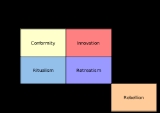
Cultural goals Institutionalized means Modes of adaptation
+ + Conformity
+ - Innovation
- + Ritualism
- - Retreatism
± ± Rebellion


Conformity
Conformity

Conformity may refer to:Psychology* Conformity, a process by which people's beliefs or behaviors are influenced by others within a group* The Asch conformity experiments, a series of studies that demonstrated the power of conformity in groups...
 is the attaining of societal goals by socially accepted means, while innovation
Innovation

The term innovation means a new way of doing something. It may refer to incremental, radical, and revolutionary changes in thinking, products, processes, or organizations....
 is the attaining of those goals in unaccepted ways. Ritualism is the acceptance of the means but the forfeit of the goals. Retreatism is the rejection of both the means and the goals and rebellion
Rebellion

Rebellion is a refusal of obedience. It may, therefore, be seen as encompassing a range of behaviors from civil disobedience and mass nonviolent resistance, to violent and organized attempts to destroy an established authority such as the government....
 is a combination of rejection of societal goals and means and a substitution of other goals and means. Innovation and ritualism are the pure cases of anomie as Merton defined it because in both cases there is a discontinuity between goals and means.

Sociology of science


Merton carried out extensive research into the sociology of science
Sociology of science

Sociology of science is the subfield of sociology that deals with the practice of science.Generally speaking, the sociology of science involves the study of science as a social activity, especially dealing "with the social conditions and effects of science, and with the social structures and processes of scientific activity." It has histori...
, developing the Merton Thesis
Merton Thesis

The Merton Thesis is an argument about the nature of early experimental science proposed by Robert K. Merton. Similar to Max Weber's The Protestant Ethic and the Spirit of Capitalism on the link between Protestant ethic and the capitalist economy, Merton argued for a similar positive correlation between the rise of Protestant pietism and earl...
 explaining some of the causes of the scientific revolution
Scientific revolution

The period which many History of science call the Scientific Revolution is commonly viewed as the foundation and origin of modern science.It was a time roughly coinciding with the later part of the Middle Ages and through the Renaissance in which scientific ideas in physics, astronomy, and biology evolved rapidly....
, and the Mertonian norms of science, often referred to by the acronym "Cudos
Cudos

Cudos is an Acronym and initialism used to denote principles that should guide good scientific research.According to the CUDOS principles, the scientific ethos should be governed by Communalism, Universalism, Disinterestedness, Organised Scepticism....
". This is a set of ideals that are dictated by what Merton takes to be the goals and methods of science and are binding on scientists. They include:

  • Communalism - the common ownership of scientific discoveries, according to which scientists give up intellectual property rights in exchange for recognition and esteem (Merton actually used the term Communism, but had this notion of communalism in mind, not Marxism);
  • Universalism - according to which claims to truth are evaluated in terms of universal or impersonal criteria, and not on the basis of race, class, gender, religion, or nationality;
  • Disinterestedness - according to which scientists are rewarded for acting in ways that outwardly appear to be selfless;
  • Organized Skepticism - all ideas must be tested and are subject to rigorous, structured community scrutiny.


The CUDOS set of Mertonian scientific norms is sometimes identified as Communism, Universalism, Disinterestedness, *Originality* (novelty in research contributions), and Skepticism (instead of Organized Skepticism). This is a subsequent modification of Merton's norm set, as he did not refer to Originality in the essay that introduced the norms (The Normative Structure of Science [1942]).

He introduced many relevant concepts to the field, among them 'obliteration by incorporation
Obliteration by incorporation

In sociology of science, obliteration by incorporation occurs when at some stage in the history of science, certain ideas become so accepted that their contributors are no longer citations....
' (when a concept becomes so popularized that its inventor is forgotten) and 'multiples' (theory about independent similar discoveries). Another much-discussed contribution was his identification of the Matthew effect
Matthew effect

The Matthew effect is the phenomenon that "the rich get richer and the poor get poorer", and can be observed in various different contexts where "rich" and "poor" can take different meanings....
. See also Stigler's law of eponymy
Stigler's law of eponymy

Stigler's law of eponymy is a process proposed by University of Chicago statistics professor Stephen Stigler in his 1980 publication "Stigler?s law of eponymy" ....
.

Influences

Merton was heavily influenced by Pitirim Sorokin
Pitirim Sorokin

Pitirim Alexandrovich Sorokin was a Russian-American sociologist. Academic and political activist in Russia, he immigrated from Russia to the United States in 1923....
, who tried to balance large-scale theorizing with a strong interest in empirical research and statistical studies. Sorokin and Paul Lazarsfeld
Paul Lazarsfeld

Paul Felix Lazarsfeld was one of the major figures in 20th-century American Sociology. The founder of Columbia University's Bureau for Applied Social Research, he exerted a tremendous influence over the techniques and the organization of research....
 influenced Merton to occupy himself with middle-range theories
Middle range theory (sociology)

Middle range theory, developed by Robert K. Merton, is an approach to sociology aimed at integrating theory and empirical research. Merton criticized both radical or narrow empiricism which stresses solely on the collection of data without any attention to a theory, and the abstract theorizing of scholars who are engaged in the attempt to con...
.

See also

  • Narcotizing Dysfunction
    Narcotizing Dysfunction

    The term narcotizing dysfunction was first identified in the book Mass Communication, Popular Taste and Organized Social Action, by Paul F. Lazarsfeld, and Robert K....


Publications

  • "Science, Technology and Society in Seventeenth Century England," Osiris, Vol. IV, pt. 2, pp. 360-632. Bruges: St. Catherine Press, 1938, reissued: Howard Fertig, 2002, ISBN 0865274347 - The 1938 publication made Merton well known among historians of science
    History of science

    Science is a body of empirical knowledge, theory, and Procedural knowledge knowledge about the Nature, produced by a global community of researchers making use of scientific methods, which emphasize the observation, experimentation and scientific explanation of real world phenomenon....
     . It was an attempt to refute Boris Hessen
    Boris Hessen

    Boris Mikhailovich Hessen , also Gessen was a USSR physicist, philosophy and History of science. He is most famous for his paper on Isaac Newton's Philosophiae Naturalis Principia Mathematica which became foundational in historiography of science....
    's famous Marxist account of 1931 The Socio-economic Roots of Newton's Principia.
  • Social Theory and Social Structure
    Social Theory and Social Structure

    Social Theory and Social Structure was a landmark publication in sociology by Robert K. Merton. It has been translated into close to 20 languages and is one of the most frequently cited texts in social sciences....
     (1949; revised and expanded, 1957 and 1968)
  • The Sociology of Science (1973)
  • Sociological Ambivalence (1976)
  • On the Shoulders of Giants: A Shandean Postscript (1985)


External links

  • Robert K. Merton, "." American Sociological Review, 3 (Oct. 1938): 672-82.