
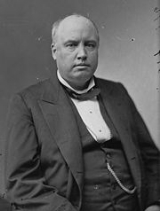
Robert Green "Bob" Ingersoll (August 11, 1833 – July 21, 1899) was a
Civil WarThe American Civil War was a civil war fought in the United States of America. In response to the election of Abraham Lincoln as President of the United States, 11 southern slave states declared their secession from the United States and formed the Confederate States of America ; the other 25...
veteran,
AmericanThe United States of America is a federal constitutional republic comprising fifty states and a federal district...
political leader, and orator during the
Golden Age of FreethoughtThe golden age of freethought describes the socio-political movement promoting freethought that developed in the mid 19th-century United States. Freethought was a philosophical position that held that ideas and opinions should be based on science and reason, and not restricted by authority,...
, noted for his broad range of culture and his defense of
agnosticismAgnosticism is the view that the truth value of certain claims—especially claims about the existence or non-existence of any deity, but also other religious and metaphysical claims—is unknown or unknowable....
. He was nicknamed "The Great Agnostic."
Life and career
Robert Ingersoll was born in
Dresden, New York----Dresden is a village in Yates County, New York, USA. The population was 307 at the 2000 census. The village was named after Dresden in Germany.The Village of Dresden is in the Town of Torrey and is twelve miles south of Geneva, New York...
. His father, John Ingersoll, was an abolitionist-leaning Presbyterian preacher, whose radical views forced his family to move frequently. For a period of time, Rev. John Ingersoll filled the pulpit for American revivalist
Charles G. FinneyCharles Grandison Finney was a leader in the Second Great Awakening. He has been called The Father of Modern Revivalism. Finney was best known as an innovative revivalist, an opponent of Old School Presbyterian theology, an advocate of Christian perfectionism, a pioneer in social reforms in favor...
while Finney was on a tour of Europe. Upon Finney's return, Rev. Ingersoll remained for a few months as co-pastor/associate pastor under Finney. The elder Ingersoll's later pastoral experiences influenced young Robert negatively, however, as The Elmira Telegram described in 1890
http://www.crookedlakereview.com/articles/34_66/41aug1991/41wilson.html:
Though for many years the most noted of American infidels, Colonel Ingersoll was born and reared in a devoutly Christian household. His father, John Ingersoll, was a Congregationalist minister and a man of mark in his time, a deep thinker, a logical and eloquent speaker, broad minded and generously tolerant of the views of others. The popular impression which credits Ingersoll's infidelity in the main to his father's severe orthodoxy and the austere and gloomy surroundings in which his boyhood was spent is wholly wrong. On the contrary the elder Ingersoll's liberal views were a source of constant trouble between him and his narrow-minded parishioners. They caused him to frequently change his charges, and several times made him the defendant in church trials. His ministerial career was, in fact, substantially brought to a close by a church trial which occurred while he was pastor of the Congregational Church at Madison, Ohio, and at which his third wife appeared as prosecutor. Upon this occasion he was charged with prevarication and unministerial conduct. The evidence adduced—the trial is one of the abiding traditions of the dull little town of Madison—was of the most trivial and ridiculous character, but the committee which heard it decided that though he had done "nothing inconsistent with his Christian character," he was "inconsistent with his ministerial character," and forbade him to preach in the future. Elder John went before the higher church authorities and was permitted to continue his clerical labors. However, he soon removed to Wisconsin, going from there to Illinois, where he died. The Madison trial occurred when young Robert was nine years old, and it was the unjust and bigoted treatment his father received which made him the enemy, first of Calvinism, and later of Christianity in its other forms.
In 1853, "Bob" Ingersoll taught a term of school in
Metropolis, IllinoisMetropolis is a city located along the Ohio River in Massac County, Illinois, in the United States. As of the 2000 census, the city population was 6,482...
, where he let one of his students, the future Judge Angus M. L. McBane, do the "greater part of the teaching, while Latin and history occupied his own attention". At some point prior to his Metropolis position, Ingersoll had also taught school in
Mount Vernon, IllinoisMount Vernon is a city located near the center of Jefferson County, Illinois, in the United States. In the 2010 census, the city's reported population was 15,277 people....
Later that year, the family settled in
Marion, IllinoisThe city of Marion is the county seat of Williamson County, Illinois. The 2010 census counted 17,193 residents, making Marion the 25th most populated city outside of the Chicago Metropolitan Area, in Illinois, and the second most populous city in Southern Illinois, outside of the Metro-East, behind...
, where Robert and his brother Ebon Clarke Ingersoll were admitted to the bar in 1854. A county historian writing 22 years later noted that local residents considered the Ingersolls as a "very intellectual family; but, being Abolitionists, and the boys being deists, rendered obnoxious to our people in that respect."
While in Marion, he studied law under Judge Willis Allen and served as deputy clerk for John M. Cunningham, Williamson County's County Clerk and Circuit Clerk. In 1855, after Cunningham was named registrar for the federal land office in southeastern Illinois at
Shawneetown, IllinoisOld Shawneetown is a village in Gallatin County, Illinois, United States. As of the 2000 census, the village had a total population of 193. Located along the Ohio River, Shawneetown served as an important United States government administrative center for the Northwest Territory. The village was...
, Ingersoll followed him to the riverfront city along the Ohio River. After a short time there he took the deputy clerk position with John E. Hall, the county clerk and circuit clerk of Gallatin County, and also a son-in-law of
John Hart CrenshawJohn Hart Crenshaw was an American landowner, salt maker, and slave trader, based out of Gallatin County, Illinois. Although Illinois was a free state, Crenshaw leased the salt works in nearby Equality from the government, which permitted the use of slaves for the arduous labor of hauling and...
. On November 11, 1856, Ingersoll caught Hall in his arms when the son of a political opponent assassinated his employer in their office.
When he moved to Shawneetown, he continued to read law under Judge William G. Bowman who had a large library of both law and the classics. In addition to his job as a clerk, he and his brother opened their law practice under the name "E.C. and R.G. Ingersoll". During this time they also had an office in
Raleigh, IllinoisRaleigh is a village in Saline County, Illinois, United States. The population was 330 at the 2000 census.-Geography:Raleigh is located at .According to the United States Census Bureau, the village has a total area of , all of it land.-History:...
, then the county seat of neighboring
Saline CountySaline County is a county located in the U.S. state of Illinois. According to the 2010 census, it has a population of 24,913, which is a decrease of 6.8% from 26,733 in 2000. Its county seat is Harrisburg. Saline County is home to the smallest post office and the largest KFC in the United States....
. As attorneys following the court circuit he often practiced along side Cunningham's soon-to-be son-in-law,
John A. LoganJohn Alexander Logan was an American soldier and political leader. He served in the Mexican-American War and was a general in the Union Army in the American Civil War. He served the state of Illinois as a state senator, congressman and senator and was an unsuccessful candidate for Vice President...
, the state's attorney and political ally to Hall.
As the trial of Hall's assassin dominated the scene and with his earlier mentor Cunningham having moved back to Marion following the land office's closing in 1856, and Logan's move to
Benton, IllinoisBenton is a city in Franklin County, Illinois, United States. The population was 7,087 at the 2010 census. It is the county seat of Franklin County. The city is part of the Metro Lakeland area.- History :...
, after his marriage that fall, Ingersoll and his brother moved to
Peoria, IllinoisPeoria is the largest city on the Illinois River and the county seat of Peoria County, Illinois, in the United States. It is named after the Peoria tribe. As of the 2010 census, the city was the seventh-most populated in Illinois, with a population of 115,007, and is the third-most populated...
, where they finally settled in 1857.
With the outbreak of the
American Civil WarThe American Civil War was a civil war fought in the United States of America. In response to the election of Abraham Lincoln as President of the United States, 11 southern slave states declared their secession from the United States and formed the Confederate States of America ; the other 25...
, he raised the
11th Regiment Illinois Volunteer CavalryThe 11th Regiment Illinois Volunteer Cavalry was a cavalry regiment that served in the Union Army during the American Civil War. The regiment was raised by orator Robert Green Ingersoll who became its first colonel and Basile D...
and took command. The regiment fought in the
Battle of ShilohThe Battle of Shiloh, also known as the Battle of Pittsburg Landing, was a major battle in the Western Theater of the American Civil War, fought April 6–7, 1862, in southwestern Tennessee. A Union army under Maj. Gen. Ulysses S. Grant had moved via the Tennessee River deep into Tennessee and...
. Ingersoll was later captured, then released on his promise that he would not fight again, which was common practice early in the war.
After the war, he served as
Illinois Attorney GeneralThe Illinois Attorney General is the highest legal officer of the state of Illinois in the United States. Originally an appointed office, it is now an office filled by election through universal suffrage...
. He was a prominent member of the
Republican PartyThe Republican Party is one of the two major contemporary political parties in the United States, along with the Democratic Party. Founded by anti-slavery expansion activists in 1854, it is often called the GOP . The party's platform generally reflects American conservatism in the U.S...
and, though he never held an elected position, he was nonetheless an active participant in politics. His speech nominating James G. Blaine for the 1876 presidential election was unsuccessful, as
Rutherford B. HayesRutherford Birchard Hayes was the 19th President of the United States . As president, he oversaw the end of Reconstruction and the United States' entry into the Second Industrial Revolution...
received the Republican nomination, but the speech itself, known as the "Plumed Knight" speech, was considered a model of political oratory. (Franklin Roosevelt probably used it as a model for his "Happy Warrior" speech when nominating Alfred E. Smith for president in 1928). His radical views on
religionReligion is a collection of cultural systems, belief systems, and worldviews that establishes symbols that relate humanity to spirituality and, sometimes, to moral values. Many religions have narratives, symbols, traditions and sacred histories that are intended to give meaning to life or to...
,
slaverySlavery is a system under which people are treated as property to be bought and sold, and are forced to work. Slaves can be held against their will from the time of their capture, purchase or birth, and deprived of the right to leave, to refuse to work, or to demand compensation...
, woman's
suffrageSuffrage, political franchise, or simply the franchise, distinct from mere voting rights, is the civil right to vote gained through the democratic process...
, and other issues of the day effectively prevented him from ever pursuing or holding political offices higher than that of state attorney general.
IllinoisIllinois is the fifth-most populous state of the United States of America, and is often noted for being a microcosm of the entire country. With Chicago in the northeast, small industrial cities and great agricultural productivity in central and northern Illinois, and natural resources like coal,...
Republicans tried to pressure him into running for governor on the condition that Ingersoll conceal his
agnosticismAgnosticism is the view that the truth value of certain claims—especially claims about the existence or non-existence of any deity, but also other religious and metaphysical claims—is unknown or unknowable....
during the campaign, which he refused to do on the basis that concealing information from the public was immoral.
Ingersoll was involved in several prominent trials as an attorney, notably the
Star RouteStar routes is a term used in connection with the United States postal service and the contracting of mail delivery services. The term is defunct as of 1970, but still is occasionally used to refer to Highway Contract Routes or which replaced the Star routes.-Background:Prior to 1845,...
trials, a major political scandal in which his clients were acquitted. He also defended a
New JerseyNew Jersey is a state in the Northeastern and Middle Atlantic regions of the United States. , its population was 8,791,894. It is bordered on the north and east by the state of New York, on the southeast and south by the Atlantic Ocean, on the west by Pennsylvania and on the southwest by Delaware...
man charged with
blasphemyBlasphemy is irreverence towards religious or holy persons or things. Some countries have laws to punish blasphemy, while others have laws to give recourse to those who are offended by blasphemy...
. Although he did not win acquittal, his vigorous defense is considered to have discredited blasphemy laws and few other prosecutions followed.
Ingersoll represented the noted con-artist, James Reavis, the 'Baron of Arizona' for a time, pronouncing his Peralta Land Grant claim airtight.
Robert Ingersoll made many observations on religion during his life. Robert Ingersoll stated, the myth of hell represents "all the meanness, all the revenge, all the selfishness, all the cruelty, all the hatred, all the infamy of which the heart of man is capable."
Ingersoll was most noted as an orator, the most popular of the age, when oratory was public entertainment. He spoke on every subject, from
ShakespeareWilliam Shakespeare was an English poet and playwright, widely regarded as the greatest writer in the English language and the world's pre-eminent dramatist. He is often called England's national poet and the "Bard of Avon"...
to Reconstruction, but his most popular subjects were
agnosticismAgnosticism is the view that the truth value of certain claims—especially claims about the existence or non-existence of any deity, but also other religious and metaphysical claims—is unknown or unknowable....
and the sanctity and refuge of the family. He committed his speeches to memory although they were sometimes more than three hours long. His audiences were said never to be restless.
Many of Ingersoll's speeches advocated
freethoughtFreethought is a philosophical viewpoint that holds that opinions should be formed on the basis of science, logic, and reason, and should not be influenced by authority, tradition, or other dogmas...
and
humanismHumanism is an approach in study, philosophy, world view or practice that focuses on human values and concerns. In philosophy and social science, humanism is a perspective which affirms some notion of human nature, and is contrasted with anti-humanism....
, and often poked fun at religious belief. For this the press often attacked him, but neither his views nor the negative press could stop his rising popularity. At the height of Ingersoll's fame, audiences would pay $1 or more to hear him speak, a giant sum for his day.
Ingersoll died from
congestive heart failureHeart failure often called congestive heart failure is generally defined as the inability of the heart to supply sufficient blood flow to meet the needs of the body. Heart failure can cause a number of symptoms including shortness of breath, leg swelling, and exercise intolerance. The condition...
at the age of 65. Soon after his death, his brother-in-law, Clinton P. Farrell, collected copies of Ingersoll’s speeches for publication. The 12-volume
Dresden Editions kept interest in Ingersoll's ideas alive and preserved his speeches for future generations. Ingersoll's ashes are interred in
Arlington National CemeteryArlington National Cemetery in Arlington County, Virginia, is a military cemetery in the United States of America, established during the American Civil War on the grounds of Arlington House, formerly the estate of the family of Confederate general Robert E. Lee's wife Mary Anna Lee, a great...
(Section 3, Lot 1620, Grid S-16.5).
In 2005, a popular edition of Ingersoll's work was published by Steerforth Press. Edited by the
Pulitzer PrizeThe Pulitzer Prize is a U.S. award for achievements in newspaper and online journalism, literature and musical composition. It was established by American publisher Joseph Pulitzer and is administered by Columbia University in New York City...
-winning music critic
Tim PageTim Page is a writer, editor, music critic, producer and professor. He is a Pulitzer Prize-winning music critic for the Washington Post and also played an essential role in the revival of American author Dawn Powell.-Career:Page grew up in Storrs, Connecticut, where his father, Ellis B...
, "What's God Got to Do With It: Robert Ingersoll on Free Speech, Honest Talk and the Separation of Church and State" brought Ingersoll's thinking to a new audience.
Friendship with Walt Whitman
Ingersoll enjoyed a friendship with the poet
Walt WhitmanWalter "Walt" Whitman was an American poet, essayist and journalist. A humanist, he was a part of the transition between transcendentalism and realism, incorporating both views in his works. Whitman is among the most influential poets in the American canon, often called the father of free verse...
, who considered Ingersoll the greatest orator of his time. "It should not be surprising that I am drawn to Ingersoll, for he is Leaves of Grass... He lives, embodies, the individuality, I preach. I see in Bob [Ingersoll] the noblest specimen—American-flavored—pure out of the soil, spreading, giving, demanding light."
The feeling was mutual. Upon Whitman's death in 1892, Ingersoll delivered the eulogy at the poet's funeral. The eulogy was published to great acclaim and is considered a classic
panegyricA panegyric is a formal public speech, or written verse, delivered in high praise of a person or thing, a generally highly studied and discriminating eulogy, not expected to be critical. It is derived from the Greek πανηγυρικός meaning "a speech fit for a general assembly"...
.
In popular culture
- In his Devil's Dictionary American journalist and writer Ambrose Bierce
Ambrose Gwinnett Bierce was an American editorialist, journalist, short story writer, fabulist and satirist...
included his own version of the DecalogueThe Ten Commandments, also known as the Decalogue , are a set of biblical principles relating to ethics and worship, which play a fundamental role in Judaism and most forms of Christianity. They include instructions to worship only God and to keep the Sabbath, and prohibitions against idolatry,...
in which the second commandment is, "No images nor idols make/for Robert Ingersoll to break."
- In A.B. Simpson's 1890 book, Wholly Sanctified, the prominent New York City
New York is the most populous city in the United States and the center of the New York Metropolitan Area, one of the most populous metropolitan areas in the world. New York exerts a significant impact upon global commerce, finance, media, art, fashion, research, technology, education, and...
pastor and founder of the Christian and Missionary AllianceThe Christian and Missionary Alliance is an evangelical Protestant denomination within Christianity.Founded by Rev. Albert Benjamin Simpson in 1887, the Christian & Missionary Alliance did not start off as a denomination, but rather began as two distinct parachurch organizations: The Christian...
writes of wanting to read Ingersoll's lectures with a view to answering them, but was so repulsed after reading one page that he "dared not go farther." Simpson referred to Ingersoll as "this daring blasphemer."
- In William Faulkner
William Cuthbert Faulkner was an American writer from Oxford, Mississippi. Faulkner worked in a variety of media; he wrote novels, short stories, a play, poetry, essays and screenplays during his career...
's short story Beyond an old man leaves his body at the moment of death and visits a sort of ante-purgatory where he encounters the shade of a man who may be Robert Ingersoll. The old man accosts Ingersoll, "So you too are reconciled . . . to this place." Ingersoll replies, "Ah . . . reconciled."
- In Sherwood Anderson
Sherwood Anderson was an American novelist and short story writer. His most enduring work is the short story sequence Winesburg, Ohio. Writers he has influenced include Ernest Hemingway, William Faulkner, John Steinbeck, J. D. Salinger, and Amos Oz.-Early life:Anderson was born in Clyde, Ohio,...
's 1920 novel Poor White, "Robert Ingersoll came to [a small Midwest town] to speak . . . , and after he had gone the question of the divinity of Christ for months occupied the minds of the citizens."
- In Sinclair Lewis
Harry Sinclair Lewis was an American novelist, short-story writer, and playwright. In 1930, he became the first writer from the United States to be awarded the Nobel Prize in Literature, "for his vigorous and graphic art of description and his ability to create, with wit and humor, new types of...
's 1927 novel Elmer Gantry, a burly college student named Elmer Gantry who is heavily under the influence of his agnostic friend Jim Lefferts undergoes a seeming miraculous conversion to Baptist Christianity and is immediately invited to speak before an audience. At Lefferts' suggestion, Gantry uses as inspiration for his first sermon a speech by Robert Ingersoll which commences, "Love is the only bow on life's dark cloud". Gantry decides not to credit Ingersoll, who would be infamous to his audience, and reflects, "Rats! Chances are nobody there tonight has ever read Ingersoll. Agin him. Besides I'll kind of change it around."
- The town of Redwater, Texas
Redwater is a city in Bowie County, Texas, United States. The population was 872 at the 2000 census. It is part of the Texarkana, Texas–Texarkana, Arkansas Metropolitan Statistical Area.-Geography:Redwater is located at ....
, was originally named Ingersoll in honor of Robert Ingersoll when it was founded in the mid-1870s; the current name was adopted after a revival meetingA revival meeting is a series of Christian religious services held in order to inspire active members of a church body, to raise funds and to gain new converts...
held in the town in 1886.
- Ingersoll's "After Visiting the Tomb of Napoleon" is quoted in Born Yesterday
Born Yesterday is a 1950 film based on the play of the same name by Garson Kanin and directed by George Cukor. The screenplay was written by Albert Mannheimer with uncredited contributions from Kanin....
.
- In P G Wodehouse's book "The Mating Season", PC Dobbs, who happens to be a fervent Agnostic/Atheist, left the County Talent Show at the local hall early because he didn't like the entertainment and went home to "smoke a pipe and read Robert G. Ingersoll".
- Colonel Bob Mountain
Colonel Bob is a summit in the Colonel Bob Wilderness, on the Olympic Peninsula in Washington state. It is one of the highest points in Grays Harbor County, the highest being an unnamed nearby peak....
in Washington state was named for Robert Ingersoll.
- His birthplace, known as the Robert Ingersoll Birthplace
Robert Ingersoll Birthplace, also known as Robert Green Ingersoll Birthplace Museum, is a historic home located at Dresden in Yates County, New York. It is a Federal-style structure that consists of a 2-story, three-bay, gable-roofed central block with a -story saltbox ell on the west side...
, or Robert Green Ingersoll Birthplace Museum, was listed on the National Register of Historic PlacesThe National Register of Historic Places is the United States government's official list of districts, sites, buildings, structures, and objects deemed worthy of preservation...
in 1988.
- The following Ingersoll statement is quoted on the inside cover of the Godley and Creme album "Consequences":
- "There are in nature neither rewards nor punishments, there are consequences."
Works
- The gods and other lectures (New York : D. M. Bennett
DeRobigne Mortimer Bennett was the founder and publisher of The Truth Seeker, a radical freethought and reform American periodical. Bennett was a devout member of the Shakers for 13 years before evolving into a "freethinker", founding The Truth Seeker newspaper in 1873...
, 1876)
- Some mistakes of Moses (Washington, D.C. : C. P. Farrell, 1879)
- Walt Whitman (New York, The Truth Seeker Co, 1890)
- Col. Ingersoll's reply to his critics in the N.Y. "Evening Telegram." (Toronto : J. Spencer Ellis, 1892)
- Shakespeare, a lecture (New York, Farrell, 1895)
- Abraham Lincoln, a lecture (New York, Farrell, 1895)
- Voltaire, a lecture (New York, Farrell, 1895)
- Great speeches of Col. R. G. Ingersoll; complete (Chicago : Rhodes & McClure, 1895)
- "Why I am an agnostic" (1896)
- The works of Robert G. Ingersoll vols. 1, 2, 3, 4, 5, 6, 7, 8, 9, 10, 11, and 12 (New York : The Dresden pub. co., C. P. Farrell, 1902)
External links