
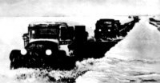
The
Road of Life was the
ice roadIce roads or ice crossings are frozen, human-made structures formed on the surface of bays, inlets, rivers, lakes, or seas. They are linked from frozen waterway to frozen waterway by overland portages or winter roads that are usually consistently used from year to year...
transportTransport or transportation is the movement of people and goods from one location to another. Transport is performed by modes, such as air, rail, road, water, cable, pipeline and space...
route across the frozen
Lake LadogaLake Ladoga is a freshwater lake located in Republic of Karelia and Leningrad Oblast in northwestern Russia, not far from Saint Petersburg. It is the largest lake in Europe, and the 14th largest lake by area in the world.-Geography:The lake's area is 17,891 km²...
, which provided the only access to the besieged city of
LeningradSaint Petersburg is a city and a federal subject of Russia located on the Neva River at the head of the Gulf of Finland on the Baltic Sea. The city's other names were Petrograd and Leningrad...
in the winter months during 1941–1944 while the
perimeterA perimeter is a path that surrounds an area. The word comes from the Greek peri and meter . The term may be used either for the path or its length - it can be thought of as the length of the outline of a shape. The perimeter of a circular area is called circumference.- Practical uses :Calculating...
in the
Siege of LeningradThe Siege of Leningrad, also known as The Leningrad Blockade was an unsuccessful military operation by the Axis powers to capture Leningrad during World War II. The siege started at 8 September 1941, when the last land connection to the city was severed...
was maintained by the
Army Group NorthArmy Group North was a strategic echelon formation commanding a grouping of Field Armies subordinated to the OKH during World War II. The army group coordinated the operations of attached separate army corps, reserve formations, rear services and logistics....
and the Finnish forces. The road today forms part of the
World Heritage SiteA UNESCO World Heritage Site is a site that is on the list that is maintained by the international World Heritage Programme administered by the UNESCO World Heritage Committee, composed of 21 state parties which are elected by their General Assembly for a four-year term.A World Heritage Site is a...
Saint Petersburg and Related Groups of Monuments.
The
Siege of LeningradThe Siege of Leningrad, also known as The Leningrad Blockade was an unsuccessful military operation by the Axis powers to capture Leningrad during World War II. The siege started at 8 September 1941, when the last land connection to the city was severed...
lasted for 29 months from September 8, 1941, to January 27, 1944.
The
Road of Life was the
ice roadIce roads or ice crossings are frozen, human-made structures formed on the surface of bays, inlets, rivers, lakes, or seas. They are linked from frozen waterway to frozen waterway by overland portages or winter roads that are usually consistently used from year to year...
transportTransport or transportation is the movement of people and goods from one location to another. Transport is performed by modes, such as air, rail, road, water, cable, pipeline and space...
route across the frozen
Lake LadogaLake Ladoga is a freshwater lake located in Republic of Karelia and Leningrad Oblast in northwestern Russia, not far from Saint Petersburg. It is the largest lake in Europe, and the 14th largest lake by area in the world.-Geography:The lake's area is 17,891 km²...
, which provided the only access to the besieged city of
LeningradSaint Petersburg is a city and a federal subject of Russia located on the Neva River at the head of the Gulf of Finland on the Baltic Sea. The city's other names were Petrograd and Leningrad...
in the winter months during 1941–1944 while the
perimeterA perimeter is a path that surrounds an area. The word comes from the Greek peri and meter . The term may be used either for the path or its length - it can be thought of as the length of the outline of a shape. The perimeter of a circular area is called circumference.- Practical uses :Calculating...
in the
Siege of LeningradThe Siege of Leningrad, also known as The Leningrad Blockade was an unsuccessful military operation by the Axis powers to capture Leningrad during World War II. The siege started at 8 September 1941, when the last land connection to the city was severed...
was maintained by the
Army Group NorthArmy Group North was a strategic echelon formation commanding a grouping of Field Armies subordinated to the OKH during World War II. The army group coordinated the operations of attached separate army corps, reserve formations, rear services and logistics....
and the Finnish forces. The road today forms part of the
World Heritage SiteA UNESCO World Heritage Site is a site that is on the list that is maintained by the international World Heritage Programme administered by the UNESCO World Heritage Committee, composed of 21 state parties which are elected by their General Assembly for a four-year term.A World Heritage Site is a...
Saint Petersburg and Related Groups of Monuments.
The
Siege of LeningradThe Siege of Leningrad, also known as The Leningrad Blockade was an unsuccessful military operation by the Axis powers to capture Leningrad during World War II. The siege started at 8 September 1941, when the last land connection to the city was severed...
lasted for 29 months from September 8, 1941, to January 27, 1944. The Nazi forces encircled the city together with the Finnish forces. Over one million citizens of Leningrad died from starvation, stress, exposure and bombardments.
The Road of Life began to operate on November 20, 1941 when the first convoy of horse-pulled sleighs brought supplies to the city. Shortly thereafter, the
ice roadIce roads or ice crossings are frozen, human-made structures formed on the surface of bays, inlets, rivers, lakes, or seas. They are linked from frozen waterway to frozen waterway by overland portages or winter roads that are usually consistently used from year to year...
began receiving truck traffic. Via the Road of Life, supplies could be brought into the city, and civilians evacuated to the still Soviet-controlled opposite coast. During the winter 1941–42 the ice line of "Road of Life" operated for 152 days, until April 24.
About 514,000 city inhabitants, 35,000 wounded soldiers, industrial equipment of 86 plants and factories, and also some art and museum collections were evacuated from Leningrad during the first winter of the blockade. While the road was protected by anti-aircraft
artilleryArtillery is a military combat Arm that employs weapons capable of discharging large projectiles in combat. They are generally capable of adding considerable fire power to the military capability of an armed force...
on the ice and fighter planes in the air, truck convoys were constantly attacked by German artillery and airplanes, making travel dangerous. Some survivors therefore bitterly recall the route as a "Road of Death".
The total number of people evacuated from the siege of Leningrad through the
Road of Life was about 1.3 million, mostly women and children who walked by foot.
During 1942 an oil pipeline ("
ArteryArteries are blood vessels that carry blood away from the heart. All arteries, with the exception of the pulmonary and umbilical arteries, carry oxygenated blood.The circulatory system is extremely important for sustaining life...
of Life") via Ladoga lake was built: its length was 29 km, of which 21 km ran under water at depth of 12.5 m.
During the following winter of 1942–1943, the Road of Life began to operate once again, starting with the horse traffic on December 20, 1942. Motor vehicles began to operate on December 24, 1942. Construction of the pile and ice railway of 30 km long also began in December 1942.
Operation SparkOperation Iskra was a Soviet military operation conducted by the Red Army's Leningrad and Volkhov Fronts, and the Baltic Fleet during January 12 —January 30, 1943 with the aim of creating a land connection to Leningrad, in order to raise the German Wehrmacht siege of the city.The full-scale...
— a full-scale offensive of troops of the
LeningradThe Leningrad Front was first formed on August 27, 1941, by dividing the Northern Front into the Leningrad Front and Karelian Front, during the German approach on Leningrad .-History:...
and
Volkhov FrontThe Volkhov Front was a Front of the Soviet Army during the First Period of the Second World War....
s — started in the morning of January 12, 1943. After heavy and fierce battles, the
Red ArmyThe Red Army The Red Army The Red Army was the Soviet government’s revolutionary militia beginning in the Russian Civil War of 1918-1922. It grew into the national army of the USSR. Since 1946, after the Second World War, it was called the Soviet Army.The 'Red...
units overcame the powerful German fortified zones to the South of Lake Ladoga, and on January 18, 1943 the two fronts met, opening a land corridor to the besieged city. Almost immediately, both truck and rail traffic began to bring supplies to Leningrad.
The city of Leningrad was still subject to at least a partial siege, as well as air and artillery bombardment, until a Soviet offensive broke through the German lines, lifting the siege on January 27, 1944.
For the heroic resistance of the citizens, Leningrad was the first city awarded the honorary title
Hero CityHero City is a Soviet honorary title awarded for outstanding heroism during the Great Patriotic War of 1941 to 1945. It was awarded to twelve cities of the Soviet Union. In addition the Brest Fortress was awarded an equivalent title of Hero-Fortress...
in 1945.
Volume of transported goods
The Road of Life was used to transport:
- January 1942: approximately 53-54,000 tonnes of various goods,
- February 1942: over 86,000 tonnes,
- March 1942: over 118,000 tonnes.
In total the
ice roadIce roads or ice crossings are frozen, human-made structures formed on the surface of bays, inlets, rivers, lakes, or seas. They are linked from frozen waterway to frozen waterway by overland portages or winter roads that are usually consistently used from year to year...
was used to ship more than 360,000 tonnes of goods, mostly rations and fodder, into
LeningradLeningrad is the former name of Saint Petersburg, Russia.Leningrad may also refer to:Places:* Leningrad Oblast, a federal subject of Russia, around Saint Petersburg* Leningrad, Tajikistan, capital of Muminobod district in Khatlon Province...
.
In the first winter of the siege the
ice roadIce roads or ice crossings are frozen, human-made structures formed on the surface of bays, inlets, rivers, lakes, or seas. They are linked from frozen waterway to frozen waterway by overland portages or winter roads that are usually consistently used from year to year...
operated until 24 April 1942. The last shipment was made via ice floes, and in places it was necessary to unload and reload by hand. In that time, around 32,000 tonnes of ammunition and almost 35,000 tonnes of fuels and lubricants destined for the front and naval fleet were shipped out of Leningrad.
On the
19Year 19 was a common year starting on Sunday of the Julian calendar.-Roman Empire:* Maroboduus, king of the Marcomanni, is deposed by Catualda. This ends the threat to the Romans from German tribes until the reign of Marcus Aurelius...
NovemberNovember is the 11th month of the year in the Gregorian Calendar and one of four Gregorian months with the length of 30 days. November retained its name when January and February were added to the Roman calendar....
a transport route opened across Ladoga, named 'the Road of Life'. However, in three weeks it was closed, and remained so until the middle of January.
After the siege
In the summer, with the start of the navigable period, deliveries to the city continued thanks to the Ladoga Military Flotilla. In 1943 the Road of Life was replaced by the Road of Victory - a railway, laid on the narrow path beaten out by German troops from Leningrad to
VolkhovVolkhov is an industrial town in Leningrad Oblast, Russia, situated 122 km east of St. Petersburg, on the Volkhov River. Population: 46,100 , 46,596 .-History:...
. Now the Road of Life, within the limits of
Saint PetersburgSaint Petersburg is a city and a federal subject of Russia located on the Neva River at the head of the Gulf of Finland on the Baltic Sea. The city's other names were Petrograd and Leningrad...
, is often referred to as Ryabovskoe Chausée (Highway), but within
VsevolozhskVsevolozhsk is a town in Leningrad Oblast, Russia, located on Karelian Isthmus 24 km east of St. Petersburg, and the administrative center of Vsevolozhsky District of Leningrad Oblast. Population: 45,310 ....
, the Road of Life is the official name.
Monuments and memorials
In total there are seven monuments along the Road of Life, 46 memorial poles along the road, and 56 memorial poles along the railway. All of these are part of the Green Zone of Glory («Зелёный пояс славы»).
- The memorial complex "The Flower of Life" («Цветок жизни»), at the 3rd km of the Road of Life, consists of a monument, erected in 1968, by the architects A. D. Levyenkov and P. I. Melnikov, and eight tablets (representing pages from the diary of the Leningrad
Leningrad is the former name of Saint Petersburg, Russia.Leningrad may also refer to:Places:* Leningrad Oblast, a federal subject of Russia, around Saint Petersburg* Leningrad, Tajikistan, capital of Muminobod district in Khatlon Province...
schoolgirl Tanya SavichevaTatyana Nikolayevna Savicheva , commonly referred to as Tanya Savicheva was a Russian child diarist who endured the Siege of Leningrad during World War II.- Early life :...
), erected in 1975 by the architects A. D. Levyenkov and G. G. Fetisov, and the engineer M. V. Koman.
- The "Rumbolovsk Hill" («Румболовская гора») memorial complex , at the 10th km, in Vsevolozhsk
Vsevolozhsk is a town in Leningrad Oblast, Russia, located on Karelian Isthmus 24 km east of St. Petersburg, and the administrative center of Vsevolozhsky District of Leningrad Oblast. Population: 45,310 ....
, erected by the architects P. F. Kozlov and V. N. Polukhin. It consists of metallic oakAn oak is a tree or shrub in the genus Quercus , of which about 400 species exist. "Oak" may also appear in the names of species in related genera, notably Lithocarpus...
and laurel-Botany:* Laurel family , a group of flowering plants** Azores laurel ** Bay Laurel , also called True Laurel** California Laurel ** Camphor Laurel...
leaves, symbolising life and glory, and a tablet with a verse by the poet Olga BerggoltsOlga Fyodorovna Berggolts was a Soviet poet. She is most famous for her work on the Leningrad radio during the city's blockade, when she became the symbol of city's strength and determination....
.
- The "Katyusha" («Катюша») monument, at the 17th km, near the village of Kornevo, erected in 1966 by the architects A. D. Levyenkov, P. I. Melnikov, L. V. Chulkevich and the designers G. I. Ivanov and L. V. Izyurov.
- Fifty-six memorial kilometre posts along the Finland Station - Lake Ladoga
Lake Ladoga is a freshwater lake located in Republic of Karelia and Leningrad Oblast in northwestern Russia, not far from Saint Petersburg. It is the largest lake in Europe, and the 14th largest lake by area in the world.-Geography:The lake's area is 17,891 km²...
railway line. Erected 1970 by the architects M. N. Meisel' and I. G. Yavein.
- Forty-six memorial kilometre posts on the highway from Rzhevka railway station, on the edge of Saint Petersburg, to Lake Ladoga
Lake Ladoga is a freshwater lake located in Republic of Karelia and Leningrad Oblast in northwestern Russia, not far from Saint Petersburg. It is the largest lake in Europe, and the 14th largest lake by area in the world.-Geography:The lake's area is 17,891 km²...
. Erected in 1967 by the architect M. N. Meisel'.
- A memorial consisting of a steam locomotive
A steam locomotive is a locomotive powered by steam. The term usually refers to its use on railways, but can also refer to a "road locomotive" such as a traction engine or steamroller....
, which had operated on the Road of Life, erected at the station Lake LadogaLake Ladoga is a freshwater lake located in Republic of Karelia and Leningrad Oblast in northwestern Russia, not far from Saint Petersburg. It is the largest lake in Europe, and the 14th largest lake by area in the world.-Geography:The lake's area is 17,891 km²...
in 1974 by the architect V. I. Kuznetsov.
- The memorial complex "The Broken Ring" («Прорванное кольцо»), at the 40th km of the Road of Life, on the shore of Lake Ladoga
Lake Ladoga is a freshwater lake located in Republic of Karelia and Leningrad Oblast in northwestern Russia, not far from Saint Petersburg. It is the largest lake in Europe, and the 14th largest lake by area in the world.-Geography:The lake's area is 17,891 km²...
near the village of Kokkorevo. Consists of a statue of an anti-aircraft cannon (1966, architect V. G. Fillipov, sculptor K. M. Simun, engineer I. A. Rybin).
- "The Crossing" («Переправа») monument, near the hamlet of Morozova, dedicated to the memory of the soldier-pontoon
Pontoon may refer to:* Pontoon , the Australian/Malaysian casino game* Pontoon , a chiefly British version of the card game blackjack...
eers (1970, architect L. M. Drexler, engineer E. N. Lutsko).
- The "Steel Way" («Стальной путь») plaque in the Petrokrepost railway station, dedicated to the memory of the heroic railway workers on the Road of Life (1972, architects N. M. Meisel' and I. G. Yavein, sculptor G. D. Glinman). On the same site stands a memorial steam locomotive
A steam locomotive is a locomotive powered by steam. The term usually refers to its use on railways, but can also refer to a "road locomotive" such as a traction engine or steamroller....
(1975).
- The "Kobona" («Кобона») plaque in the hamlet of Kobona, dedicated to the Road of Life (1964, architects M. N. Meisel'. A. A. Yakovlev).
- The memorial autmobile "The Legendary One-and-a-Half-Tonne" («Легендарная полуторка») at the 103rd km of the Petrozavodsk
Petrozavodsk is the capital of the Republic of Karelia, Russia, with a population of 266,160 . It stretches along the western shore of the Lake Onega for some 27 kilometers. The city is served by Besovets Airport...
highway, at the turn-off for Voibokalo (1974, architect A. D. Levyenkov, artist V. V. Fomyenko).
- The "Voibokalo" («Войбокало») plaque at the Voibokalo railway station, commemorating the Road of Life (1975, architect S. S. Natonin).
External links