

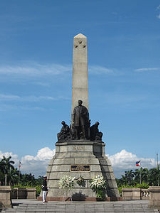
Rizal Park

Encyclopedia
Rizal Park, also known as Luneta Park or colloquially Luneta, is a historical urban
park located in the heart of the city of Manila
, Philippines
, adjacent to the old walled city of Manila, now Intramuros
. Since the Spanish Colonial Era, the park has been a favorite spot for unwinding, socializing, an urban oasis
for family picnic
s on Sundays and holidays
. It is one of the major tourist
attractions of Manila.
Located along Manila Bay
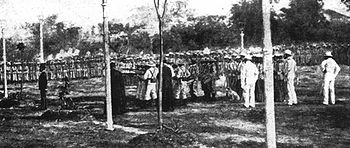
, Luneta has been the site of some of the most significant moments in Philippine history. The execution of pacifist Dr. José Rizal on December 30, 1896, sparked the fire of the Philippine Revolution
against the Spanish colonizers, elevating the martyr
as the national hero of the country. The park was officially renamed Rizal Park in his honor and his monument serves as the symbolic focal point of the park. The Declaration of Philippine Independence from American rule was held here on July 4, 1946 as well as the political rallies of Ferdinand Marcos
and Corazon Aquino
in 1986 that led to the EDSA Revolution deposing the dictator
.
. To the east of the boulevard
, the park is bounded by Taft Avenue, Padre Burgos Drive and T.M. Kalaw Avenue. To the west is the reclaimed area of the park bounded by Katigbak Dr., South Dr., and the shore of Manila Bay
.
) that dates back to 1601; it was cleared during the short British rule in 1762 to prevent sneak attacks from the patriotic natives. The area later became known as Bagumbayan Field where the Cuartel la Luneta (Luneta Barracks), a Spanish Military Hospital (which was destroyed by one of the earthquakes of Manila), and a moat-surrounded outwork
of the walled city of Manila, known as the Luneta (lunette
) because of its crescent
shape.
West of Bagumbayan Field is the Paseo de la Luneta (Plaza of the Lunette) named after the fortification, not because of the shape of the plaza which is a long 100 metre rectangle ended by two semicircle
s. It was also named Paseo de Alfonso XII (Plaza of Alfonso XII), after Alfonso XII
, King of Spain during his reign from 1874 to 1885. Paseo de la Luneta was the center of social activity for the people of Manila in the early evening hours. This plaza is arranged with paths and lawns and surrounded by a wide driveway called "La Calzada" (The Road) where carriages circulate.
, José Burgos
, and Jacinto Zamora
, collectively known as Gomburza
, were executed by garrote
, accused of subversion
arising from the 1872 Cavite mutiny
.
 The bronze-and-granite Rizal monument is among the most famous sculptural landmarks in the country. It is almost protocol for visiting dignitaries to lay a wreath at the monument. Located on the monument is not merely the statue of the national hero, but also his remains.
On September 28, 1901, the United States Philippine Commission
approved Act No. 243, which would erect a monument in Luneta to commemorate the memory of José Rizal, Philippine patriot, writer and poet. The committee formed by the act held an international design competition between 1905–1907 and invited sculptors from Europe and the United States to submit entries with an estimated cost of ₱100,000 using local materials.
The first-prize winner was Carlos Nicoli of Carrara, Italy for his scaled plaster model titled “Al Martir de Bagumbayan” (To the Martyr of Bagumbayan) besting 40 other accepted entries. The contract though, was awarded to second-placer Swiss sculptor named Richard Kissling
for his “Motto Stella” (Guiding Star).
After more than twelve years of its approval, the shrine was finally unveiled on December 30, 1913 during Rizal’s 17th death anniversary. His poem "Mi Ultimo Adios
" ("My Last Farewell") is inscribed on the memorial plaque. The site is continuously guarded by ceremonial soldiers, known as Kabalyeros de Rizal (Knights of Rizal).
. Next to the flagpole, a grand Independence Grandstand, designed by architect Juan Arellano, was built just for the occasion.
Quirino Grandstand. In 1949, a permanent grandstand, a replica of the Independence Grandstand was completed along Manila Bay where President Elpidio Quirino
was sworn in after winning the presidential election. Since then, newly-elected Presidents of the Philippines traditionally take their oath of office and deliver their inaugural address to the nation in the grandstand, which was later renamed after President Quirino. Many important political, cultural and religious events in the post war era have been held here.
from Spain, culminating to the establishment of the First Philippine Republic
. Celebrations were led by then president of the country Fidel V. Ramos
.
and the National Museum of the Filipino People (formerly the Department of Agriculture and the Department of Finance respectively) are located; followed by the 22 hectares (54.4 acre) park proper that extends down to Roxas Boulevard; and terminating at a 10 hectares (24.7 acre) open field across Roxas Boulevard fronting Quirino Grandstand along the Manila Bay.
/Eskrima
/Filipino Martial Arts
(FMA) groups. Every morning, especially on Sundays, Eskrimadors, or Eskrima practitioners can be seen at Luneta. Even up to the present, stickfighting duels are still very common, albeit in a friendly atmosphere.
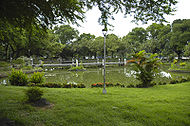
Garden and Luzviminda
Boardwalk, for the 150th birthday celebration of Jose Rizal.
Urban park
An urban park, is also known as a municipal park or a public park, public open space or municipal gardens , is a park in cities and other incorporated places to offer recreation and green space to residents of, and visitors to, the municipality...
park located in the heart of the city of Manila
Manila
Manila is the capital of the Philippines. It is one of the sixteen cities forming Metro Manila.Manila is located on the eastern shores of Manila Bay and is bordered by Navotas and Caloocan to the north, Quezon City to the northeast, San Juan and Mandaluyong to the east, Makati on the southeast,...
, Philippines
Philippines
The Philippines , officially known as the Republic of the Philippines , is a country in Southeast Asia in the western Pacific Ocean. To its north across the Luzon Strait lies Taiwan. West across the South China Sea sits Vietnam...
, adjacent to the old walled city of Manila, now Intramuros
Intramuros
Intramuros is the oldest district in the present day city of Manila, the capital of the Republic of the Philippines. Nicknamed the "Walled City", Intramuros is the historic fortified city of Manila, the seat ot the government during the Spanish Colonial Period. Its name in Latin, intramuros,...
. Since the Spanish Colonial Era, the park has been a favorite spot for unwinding, socializing, an urban oasis
Oasis
In geography, an oasis or cienega is an isolated area of vegetation in a desert, typically surrounding a spring or similar water source...
for family picnic
Picnic
In contemporary usage, a picnic can be defined simply as a pleasure excursion at which a meal is eaten outdoors , ideally taking place in a beautiful landscape such as a park, beside a lake or with an interesting view and possibly at a public event such as before an open air theatre performance,...
s on Sundays and holidays
Public holidays in the Philippines
-Regular and Special Holidays:-Other Holidays:* Constitution Day - A non-working holiday on February 2, 2002, in commemoration of the 15th anniversary of the approval of the 1987 Philippine constitution....
. It is one of the major tourist
Tourism
Tourism is travel for recreational, leisure or business purposes. The World Tourism Organization defines tourists as people "traveling to and staying in places outside their usual environment for not more than one consecutive year for leisure, business and other purposes".Tourism has become a...
attractions of Manila.
Located along Manila Bay
Manila Bay
Manila Bay is a natural harbor which serves the Port of Manila , in the Philippines.The bay is considered to be one of the best natural harbors in Southeast Asia and one of the finest in the world...
, Luneta has been the site of some of the most significant moments in Philippine history. The execution of pacifist Dr. José Rizal on December 30, 1896, sparked the fire of the Philippine Revolution
Philippine Revolution
The Philippine Revolution , called the "Tagalog War" by the Spanish, was an armed military conflict between the people of the Philippines and the Spanish colonial authorities which resulted in the secession of the Philippine Islands from the Spanish Empire.The Philippine Revolution began in August...
against the Spanish colonizers, elevating the martyr
Martyr
A martyr is somebody who suffers persecution and death for refusing to renounce, or accept, a belief or cause, usually religious.-Meaning:...
as the national hero of the country. The park was officially renamed Rizal Park in his honor and his monument serves as the symbolic focal point of the park. The Declaration of Philippine Independence from American rule was held here on July 4, 1946 as well as the political rallies of Ferdinand Marcos
Ferdinand Marcos
Ferdinand Emmanuel Edralin Marcos, Sr. was a Filipino leader and an authoritarian President of the Philippines from 1965 to 1986. He was a lawyer, member of the Philippine House of Representatives and a member of the Philippine Senate...
and Corazon Aquino
Corazon Aquino
Maria Corazon Sumulong Cojuangco-Aquino was the 11th President of the Philippines and the first woman to hold that office in Philippine history. She is best remembered for leading the 1986 People Power Revolution, which toppled Ferdinand Marcos and restored democracy in the Philippines...
in 1986 that led to the EDSA Revolution deposing the dictator
Dictator
A dictator is a ruler who assumes sole and absolute power but without hereditary ascension such as an absolute monarch. When other states call the head of state of a particular state a dictator, that state is called a dictatorship...
.
Location
Luneta is situated at the northern terminus of Roxas BoulevardRoxas Boulevard
Roxas Boulevard is a boulevard in Metro Manila, and an eight-lane arterial road that connects the center of Manila with Pasay City, Parañaque City. It is one of the major arteries in the city's metropolitan network, designated as Radial Road 1...
. To the east of the boulevard
Boulevard
A Boulevard is type of road, usually a wide, multi-lane arterial thoroughfare, divided with a median down the centre, and roadways along each side designed as slow travel and parking lanes and for bicycle and pedestrian usage, often with an above-average quality of landscaping and scenery...
, the park is bounded by Taft Avenue, Padre Burgos Drive and T.M. Kalaw Avenue. To the west is the reclaimed area of the park bounded by Katigbak Dr., South Dr., and the shore of Manila Bay
Manila Bay
Manila Bay is a natural harbor which serves the Port of Manila , in the Philippines.The bay is considered to be one of the best natural harbors in Southeast Asia and one of the finest in the world...
.
Spanish Colonial Period
Rizal Park's history began in 1820 when the Paseo de Luneta was completed just south of the walls of Manila on a marshy patch of land next to the beach during the Spanish rule. Prior to the park, the marshy land was the location of a small town called Nuevo Barrio (New Town or Bagumbayan in Tagalog languageTagalog language
Tagalog is an Austronesian language spoken as a first language by a third of the population of the Philippines and as a second language by most of the rest. It is the first language of the Philippine region IV and of Metro Manila...
) that dates back to 1601; it was cleared during the short British rule in 1762 to prevent sneak attacks from the patriotic natives. The area later became known as Bagumbayan Field where the Cuartel la Luneta (Luneta Barracks), a Spanish Military Hospital (which was destroyed by one of the earthquakes of Manila), and a moat-surrounded outwork
Outwork
An outwork is a minor defense, fortification, built or established outside the principal fortification limits, detached or semidetached. Outworks were developed in the 16th century, such as ravelins, lunettes , caponiers to shield bastions and fortification curtains from direct battery...
of the walled city of Manila, known as the Luneta (lunette
Lunette (fortification)
In fortification a lunette was originally an outwork of half-moon shape; later it became a redan with short flanks, in trace somewhat resembling a bastion standing by itself without curtains on either side...
) because of its crescent
Crescent
In art and symbolism, a crescent is generally the shape produced when a circular disk has a segment of another circle removed from its edge, so that what remains is a shape enclosed by two circular arcs of different diameters which intersect at two points .In astronomy, a crescent...
shape.
West of Bagumbayan Field is the Paseo de la Luneta (Plaza of the Lunette) named after the fortification, not because of the shape of the plaza which is a long 100 metre rectangle ended by two semicircle
Semicircle
In mathematics , a semicircle is a two-dimensional geometric shape that forms half of a circle. Being half of a circle's 360°, the arc of a semicircle always measures 180° or a half turn...
s. It was also named Paseo de Alfonso XII (Plaza of Alfonso XII), after Alfonso XII
Alfonso XII of Spain
Alfonso XII was king of Spain, reigning from 1874 to 1885, after a coup d'état restored the monarchy and ended the ephemeral First Spanish Republic.-Early life and paternity:Alfonso was the son of Queen Isabella II of Spain, and...
, King of Spain during his reign from 1874 to 1885. Paseo de la Luneta was the center of social activity for the people of Manila in the early evening hours. This plaza is arranged with paths and lawns and surrounded by a wide driveway called "La Calzada" (The Road) where carriages circulate.
Execution of Gomez, Burgos and Zamora
During the Spanish period, most especially in the latter part of the 19th century, the place became notorious for public executions of criminals and political enemies of Spain. On February 17, 1872, three Filipino priests, Mariano GómezMariano Gómez
Mariano Gómez y Guard was a Filipino secular priest, part of the Gomburza trio who were falsely accused of mutiny by the Spanish colonial authorities in the Philippines in the 19th century. He was placed in a mock trial and summarily executed in Manila along with two other clergymen.-Early...
, José Burgos
José Burgos
José Apolonio Burgos y García was a Filipino mestizo secular priest, accused of mutiny by the Spanish colonial authorities in the Philippines in the 19th century...
, and Jacinto Zamora
Jacinto Zamora
Jacinto Zamora y del Rosario was a Filipino friar, part of the Gomburza trio who were falsely accused of mutiny by the Spanish colonial authorities in the Philippines in the 19th century...
, collectively known as Gomburza
Gomburza
Gomburza or GOMBURZA is an acronym denoting the surnames of the priests Mariano Gómez, José Apolonio Burgos, and Jacinto Zamora, three Filipino priests who were executed on 17 February 1872 at Bagumbayan in Manila, Philippines by Spanish colonial authorities on charges of subversion arising from...
, were executed by garrote
Garrote
A garrote or garrote vil is a handheld weapon, most often referring to a ligature of chain, rope, scarf, wire or fishing line used to strangle someone....
, accused of subversion
Subversion
Apache Subversion is a software versioning and a revision control system distributed under a free license. Developers use Subversion to maintain current and historical versions of files such as source code, web pages, and documentation...
arising from the 1872 Cavite mutiny
Cavite Mutiny
The Cavite Mutiny of 1872 was an uprising of military personnel of Fort San Felipe, the Spanish arsenal in Cavite, Philippines on January 20, 1872. Around 200 soldiers and laborers rose up in the belief that it would elevate to a national uprising...
.
Rizal Monument
On September 28, 1901, the United States Philippine Commission
Philippine Commission
The Philippine Commission was a body appointed by the President of the United States to exercise legislative and limited executive powers in the Philippines. It was first appointed by President William McKinley in 1901. Beginning in 1907, it acted as the upper house of a bicameral Philippine...
approved Act No. 243, which would erect a monument in Luneta to commemorate the memory of José Rizal, Philippine patriot, writer and poet. The committee formed by the act held an international design competition between 1905–1907 and invited sculptors from Europe and the United States to submit entries with an estimated cost of ₱100,000 using local materials.
The first-prize winner was Carlos Nicoli of Carrara, Italy for his scaled plaster model titled “Al Martir de Bagumbayan” (To the Martyr of Bagumbayan) besting 40 other accepted entries. The contract though, was awarded to second-placer Swiss sculptor named Richard Kissling
Richard Kissling
Richard Kissling was a Swiss sculptor.Born in Wolfwil, Switzerland, Kissling went through apprenticeship as a plasterer before moving to Rome for 13 years, studying under the sculptor Ferdinand Schlöth. At the 1883 National Exhibition in Zurich, Kissling showed a portrait bust of the Swiss...
for his “Motto Stella” (Guiding Star).
After more than twelve years of its approval, the shrine was finally unveiled on December 30, 1913 during Rizal’s 17th death anniversary. His poem "Mi Ultimo Adios
Mi último adiós
"Mi último adiós" is a poem written by Philippine national hero José Rizal on the eve of his execution on December 30, 1896. Although the poem was untitled, this title served as an artifice useful as a quick reference. This poem was one of the last notes he wrote before his execution...
" ("My Last Farewell") is inscribed on the memorial plaque. The site is continuously guarded by ceremonial soldiers, known as Kabalyeros de Rizal (Knights of Rizal).
Philippine Independence Day celebrations
The Independence Flagpole, standing at 107 metres (351 ft), is the highest flagpole in the Philippines. On this spot in front of Rizal Monument, at 9:15am July 4, 1946, the full independence of the Republic of the Philippines was proclaimed as authorized by the United States President Harry S. TrumanHarry S. Truman
Harry S. Truman was the 33rd President of the United States . As President Franklin D. Roosevelt's third vice president and the 34th Vice President of the United States , he succeeded to the presidency on April 12, 1945, when President Roosevelt died less than three months after beginning his...
. Next to the flagpole, a grand Independence Grandstand, designed by architect Juan Arellano, was built just for the occasion.
Quirino Grandstand. In 1949, a permanent grandstand, a replica of the Independence Grandstand was completed along Manila Bay where President Elpidio Quirino
Elpidio Quirino
Elpidio Rivera Quirino was a Filipino politician, and the sixth President of the Philippines.A lawyer by profession, Quirino entered politics when he became a representative of Ilocos Sur from 1919 to 1925. He was then elected as senator from 1925–1931...
was sworn in after winning the presidential election. Since then, newly-elected Presidents of the Philippines traditionally take their oath of office and deliver their inaugural address to the nation in the grandstand, which was later renamed after President Quirino. Many important political, cultural and religious events in the post war era have been held here.
Philippine Centennial
On June 12, 1998, mammoth festivities capped the 1998 Philippine Centennial Celebrations, marking a hundred years of the Philippine Declaration of IndependencePhilippine Declaration of Independence
The Philippine Declaration of Independence occurred on June 12, 1898 in Cavite II el Viejo , Cavite, Philippines. With the public reading of the Act of the Declaration of Independence, Filipino revolutionary forces under General Emilio Aguinaldo proclaimed the sovereignty and independence of the...
from Spain, culminating to the establishment of the First Philippine Republic
First Philippine Republic
The Philippine Republic , more commonly known as the First Philippine Republic or the Malolos Republic was a short-lived insurgent revolutionary government in the Philippines...
. Celebrations were led by then president of the country Fidel V. Ramos
Fidel V. Ramos
Fidel "Eddie" Valdez Ramos , popularly known as FVR, was the 12th President of the Philippines from 1992 to 1998. During his six years in office, Ramos was widely credited and admired by many for revitalizing and renewing international confidence in the Philippine economy.Prior to his election as...
.
Recent events in the park
- January 15, 1995. The closing Mass of the X World Youth Day 1995World Youth Day 1995World Youth Day 1995 was a Catholic youth festival that took place from January 10–15, 1995 in Manila, Philippines. It was the first time for an Asian country to host the event...
was held here attended by more than 5 million people. This is the record gathering of the Roman Catholic ChurchRoman Catholic ChurchThe Catholic Church, also known as the Roman Catholic Church, is the world's largest Christian church, with over a billion members. Led by the Pope, it defines its mission as spreading the gospel of Jesus Christ, administering the sacraments and exercising charity...
.
- November 27, 2005. Rizal Park was the venue of the opening ceremony2005 Southeast Asian Games Opening CeremonyThe 2005 Southeast Asian Games Opening Ceremony was held at the Quirino Grandstand in Manila, Philippines on November 27, 2005. For the first time in the history of the Southeast Asian Games, the opening ceremony was held in an open-air location...
for the 2005 Southeast Asian Games2005 Southeast Asian GamesThe 23rd Southeast Asian Games were held in the Philippines from November 27 to December 5 in 2005. The games were participated by the eleven nations of Southeast Asia. This was the first time that the opening and closing ceremonies were held in a large open field, despite the fact that Manila...
at the Quirino Grandstand. It was held at an open-air park instead of a stadiumStadiumA modern stadium is a place or venue for outdoor sports, concerts, or other events and consists of a field or stage either partly or completely surrounded by a structure designed to allow spectators to stand or sit and view the event.)Pausanias noted that for about half a century the only event...
, a historic first for a Southeast Asian games' opening ceremony. It was again used on December 5, 2005 for the games' closing ceremony.
- January 17, 2010. Pentecostal Missionary Church of Christ (4th Watch) held its International Missionary Day at Quirino Grandstand.
- August 23, 2010. The park was the site of the 11-hour hostage crisis where a Hong Thai Travel ServicesHong Thai Travel ServicesHong Thai Travel Services is one of the largest travel agencies in Hong Kong. It was founded in 1966 and today has employees in more than 30 sales offices, located in Hong Kong, Macao, China , United States, Canada, Thailand and Taiwan....
tour group on a coach was hijacked by Rolando Mendoza, causing casualties and injuries.
Park layout
The park is divided into three sections beginning with the 16 hectares (39.5 acre) Teodora F. Valencia Circle adjoining Taft Avenue, where the Department of TourismDepartment of Tourism (Philippines)
The Department of Tourism is the executive department of the Philippine government responsible for the regulation of the Philippine tourism industry and the promotion of the Philippines as a tourist destination....
and the National Museum of the Filipino People (formerly the Department of Agriculture and the Department of Finance respectively) are located; followed by the 22 hectares (54.4 acre) park proper that extends down to Roxas Boulevard; and terminating at a 10 hectares (24.7 acre) open field across Roxas Boulevard fronting Quirino Grandstand along the Manila Bay.
Activities
The park is home to various KaliKali
' , also known as ' , is the Hindu goddess associated with power, shakti. The name Kali comes from kāla, which means black, time, death, lord of death, Shiva. Kali means "the black one". Since Shiva is called Kāla - the eternal time, Kālī, his consort, also means "Time" or "Death" . Hence, Kāli is...
/Eskrima
Eskrima
Eskrima is the umbrella term for the traditional martial arts of the Philippines, which emphasize weapon-based fighting with sticks, knives and other bladed weapons, and various improvised weapons...
/Filipino Martial Arts
Filipino martial arts
Filipino Martial Arts refers to ancient and newer fighting methods devised in the Philippines, the most popular of which are known as Arnis/Eskrima/Kali. The intrinsic need for self-preservation was the genesis of these systems. Throughout the ages, invaders and evolving local conflict imposed new...
(FMA) groups. Every morning, especially on Sundays, Eskrimadors, or Eskrima practitioners can be seen at Luneta. Even up to the present, stickfighting duels are still very common, albeit in a friendly atmosphere.
Points of interest
- Chinese Garden. An ornate Chinese-style gate, carved with swirling dragons, leads you into this whimsical garden which looks like it has been transported from old Peking. Along the lagoon constructed to simulate a small lake, are pagodas and gazebos that are set off by red pillars and green-tiled roofs and decorated with a profusion of mythical figures.
- Concert at the Park at the Rizal Park Open-Air Auditorium are performances provided for free to the general public by the National Parks Development Committee, Department of Tourism and the National Broadcasting Network. Featured shows are a mix of performances from dance, theatreTheatreTheatre is a collaborative form of fine art that uses live performers to present the experience of a real or imagined event before a live audience in a specific place. The performers may communicate this experience to the audience through combinations of gesture, speech, song, music or dance...
, to musical performances by local and foreign artists.
- Diorama of Rizal's Martrydom. On an area north of Rizal monument stands a set of statues depicting Rizal's execution, situated on the spot where he was actually martyred, contrary to popular belief that the monument is the spot where he was executed. In the evenings, a Light & Sound presentation titled "The Martyrdom of Dr. Jose Rizal", features a multimedia dramatization of the last poignant minutes of the life of the national hero.
- Japanese Garden. The gardens were built to promote friendship between Japan and the Philippines. Inside is nice place for pleasant walks around the Japanese style gardens, lagoon and bridge.
- Kilometer Zero. The Kilometre ZeroKilometre ZeroIn many countries, Kilometre Zero or similar terms in other languages, is a particular location , from which distances are traditionally measured...
marker of the Philippines, located on Roxas Boulevard, in front of Rizal monument, serves as the point from which road distances from Manila are measured.
- Lapu-Lapu Monument (or the Statue of the Sentinel of Freedom). The monument was a gift from the people of KoreaSouth KoreaThe Republic of Korea , , is a sovereign state in East Asia, located on the southern portion of the Korean Peninsula. It is neighbored by the People's Republic of China to the west, Japan to the east, North Korea to the north, and the East China Sea and Republic of China to the south...
as appreciation and to honor the memory of freedom-loving Filipinos who helped during the Korean WarKorean WarThe Korean War was a conventional war between South Korea, supported by the United Nations, and North Korea, supported by the People's Republic of China , with military material aid from the Soviet Union...
in the early 1950s (as inscribed in the plaque). Lapu-LapuLapu-LapuLapu-Lapu was the ruler of Mactan, an island in the Visayas, Philippines, who is known as the first native of the archipelago to have resisted the Spanish colonization...
was a native MuslimMuslimA Muslim, also spelled Moslem, is an adherent of Islam, a monotheistic, Abrahamic religion based on the Quran, which Muslims consider the verbatim word of God as revealed to prophet Muhammad. "Muslim" is the Arabic term for "submitter" .Muslims believe that God is one and incomparable...
chieftain in Mactan, CebuCebuCebu is a province in the Philippines, consisting of Cebu Island and 167 surrounding islands. It is located to the east of Negros, to the west of Leyte and Bohol islands...
and representative of the Sultan of Sulu, and is now known as the first native of the archipelago to resist Spanish colonization. He is retroactively regarded as the first national hero of the Philippines. On the morning of April 27, 1521, Lapu-Lapu and the men of Mactan, armed with spears and kampilan, faced Spanish soldiers led by Portuguese captain Ferdinand MagellanFerdinand MagellanFerdinand Magellan was a Portuguese explorer. He was born in Sabrosa, in northern Portugal, and served King Charles I of Spain in search of a westward route to the "Spice Islands" ....
in what would later be known as the Battle of Mactan. Magellan and several of his men were killed.
- Manila Ocean ParkManila Ocean ParkThe Manila Ocean Park is an oceanarium in Manila, Philippines. It is owned by China Oceanis Philippines Inc., a subsidiary of China Oceanis Inc., a Singaporean-registered firm that has operated four oceanariums in China. It is located behind the Quirino Grandstand at Rizal Park. It opened on March...
is an oceanariumOceanariumAn oceanarium can be either a marine mammal park, such as Marineland of Florida, or a large-scale aquarium, such as the Lisbon Oceanarium, presenting an ocean habitat with marine animals, especially large ocean dwellers such as sharks.- Marine mammal parks :...
located in the westernmost part of Luneta behind the Quirino Grandstand and along Manila BayManila BayManila Bay is a natural harbor which serves the Port of Manila , in the Philippines.The bay is considered to be one of the best natural harbors in Southeast Asia and one of the finest in the world...
. The complex opened on March 1, 2008.
- Manila PlanetariumPlanetariumA planetarium is a theatre built primarily for presenting educational and entertaining shows about astronomy and the night sky, or for training in celestial navigation...
- Museum of the Filipino People, on the building north of Agrifina Circle, are the AnthropologyAnthropologyAnthropology is the study of humanity. It has origins in the humanities, the natural sciences, and the social sciences. The term "anthropology" is from the Greek anthrōpos , "man", understood to mean mankind or humanity, and -logia , "discourse" or "study", and was first used in 1501 by German...
and Archeology collections of the National Museum of the Philippines.
- National Library of the PhilippinesNational Library of the PhilippinesThe National Library of the Philippines is the official national library of the Philippines. The complex is located in Ermita on a portion of Rizal Park facing T.M. Kalaw Avenue, neighboring culturally significant buildings such as the Museum of Philippine Political History and the National...
is the country's premier public library. The library has a history of its own and its rich Filipiniana collections are maintained by the librarians to preserve the institution as the nations fountain of local knowledge and source of information for thousands of students and everyday users in their research and studies.
- National Museum of the PhilippinesNational Museum of the PhilippinesThe Museum of the Filipino People is a department of the National Museum of the Philippines that houses the Anthropology and Archaeology Divisions of the National Museum. It is located in the Agrifina Circle, Rizal Park, Manila adjacent to the main National Museum building...
, located on the northeastern tip of Rizal Park, is the natural historyNatural historyNatural history is the scientific research of plants or animals, leaning more towards observational rather than experimental methods of study, and encompasses more research published in magazines than in academic journals. Grouped among the natural sciences, natural history is the systematic study...
and ethnographyEthnographyEthnography is a qualitative method aimed to learn and understand cultural phenomena which reflect the knowledge and system of meanings guiding the life of a cultural group...
museumMuseumA museum is an institution that cares for a collection of artifacts and other objects of scientific, artistic, cultural, or historical importance and makes them available for public viewing through exhibits that may be permanent or temporary. Most large museums are located in major cities...
of the Philippines.
- Orchidarium and Butterfly Pavilion, established in 1994, was a former parking lot developed into a one-hectare rainforest-like park. The Orchidarium showcases Philippines' rich collection of orchid species and butterflies. The pavilion is also a favorite venue for weddings.
- Relief map of the Philippines is a giant raised-relief mapRaised-relief mapA raised-relief map or terrain model is a three-dimensional representation, usually of terrain. When representing terrain, the elevation dimension is usually exaggerated by a factor between five and ten; this facilitates the visual recognition of terrain features.-History:In his 1665 paper for the...
of the country in the middle of a small man-made lake.
2011 renovations
Rizal Park is undergoing renovations by the National Parks Development Committee (NPDC) aimed at restoring elements of the park. The plans include the rehabilitation of the old musical dancing fountain located on the 40 by 100 m (131.2 by 328.1 ft) pool, which is the geographical center of the park. The fountain, which is set for inauguration on December 16, 2011, is handled by German-Filipino William Schaare, the same person who built the original fountain in the 1960s. Restoration also includes the Flower Clock which is set for inauguration on the 113th Philippine Independence day; the Noli Me TangereNoli Me Tangere (novel)
Noli Me Tangere is a novel by Filipino polymath José Rizal and first published in 1887 in Berlin, Germany. Early English translations used titles like An Eagle Flight and The Social Cancer, but more recent translations have been published using the original Latin title.Though originally written in...
Garden and Luzviminda
Luzviminda
Luzviminda, sometimes LuzViMinda, is an acronym for Luzon, Visayas, and Mindanao, which is used as a feminine given name. It may refer to:* Luzviminda Ilagan, Filipino activist and politician from GABRIELA Women's Party...
Boardwalk, for the 150th birthday celebration of Jose Rizal.
In popular culture
- The Amazing Race 5The Amazing Race 5The Amazing Race 5 is the fifth installment of the American reality television show The Amazing Race. The Amazing Race 5 featured 11 teams of two, with a pre-existing relationship, in a race around the world....
, the fifth installment of the AmericanUnited StatesThe United States of America is a federal constitutional republic comprising fifty states and a federal district...
Reality TV show, featured the Rizal MonumentRizal MonumentThe Rizal Monument is a memorial monument in Rizal Park in Manila, Philippines built to commemorate the Filipino nationalist, José Rizal. The mausoleum consists of a standing bronze sculpture of the martyr, with an obelisk as his backdrop, set on a pedestal upon which his remains are interred...
on Leg 12 as Route Marker. - The Port Malaya patch in Ragnarok OnlineRagnarok OnlineRagnarok Online , often referred to as RO, is a massively multiplayer online role-playing game or MMORPG created by GRAVITY Co., Ltd. based on the manhwa Ragnarok by Lee Myung-jin. It was first released in South Korea on 31 August 2002 for Microsoft Windows and has since been released in many other...
, a massively multiplayer online role-playing gameMassively multiplayer online role-playing gameMassively multiplayer online role-playing game is a genre of role-playing video games in which a very large number of players interact with one another within a virtual game world....
(MMOPPG), features a replica of the Rizal MonumentRizal MonumentThe Rizal Monument is a memorial monument in Rizal Park in Manila, Philippines built to commemorate the Filipino nationalist, José Rizal. The mausoleum consists of a standing bronze sculpture of the martyr, with an obelisk as his backdrop, set on a pedestal upon which his remains are interred...
as one of the town's attractions.