

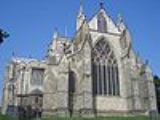
Ripon Cathedral

Encyclopedia
Ripon Cathedral is the seat of the Bishop of Ripon and Leeds
and the mother church
of the Diocese of Ripon and Leeds
, situated in the small North Yorkshire
city of Ripon
, England
.
building erected in the Anglo-Saxon
Kingdom of Northumbria . The crypt
dates from this period.
People have been coming to worship and pray at Ripon
for more than 1,350 years. The Cathedral building itself is part of this continuing act of worship, begun in the 7th century when Saint Wilfrid built one of England’s first stone churches on this site, and still renewed every day. Within the nave and choir, you can see the evidence of 800 years in which master craftsmen have expressed their faith in wood and stone.
in AD 672. A contemporary account by Eddius Stephanus tells us:
"In Ripon, Saint Wilfrid built and completed from the foundations to the roof a church of dressed stone, supported by various columns and side-aisles to a great height and many windows, arched vaults and a winding cloister."
Saint Wilfrid was buried in this church near the high altar.
Devastated by the English king in AD 948 as a warning to the Archbishop of York
, only the crypt of Wilfrid’s church survived but today this tiny 7th century chapel rests complete beneath the later grandeur of Archbishop Roger de Pont l’Evêque’s 12th century minster.
A second minster
soon arose at Ripon, but it too perished – this time in 1069 at the hands of William the Conqueror. Thomas of Bayeux, first Norman
Archbishop of York, then instigated the construction of a third church, traces of which were incorporated into the later chapter house of Roger’s minster.
The Early English west front was added in 1220, its twin towers originally crowned with wooden spires and lead. Major rebuilding had to be postponed due to the outbreak of the Wars of the Roses
but resumed after the accession of Henry VII
and the restoration of peace in 1485. The nave was widened and the central tower partially rebuilt. The church's thirty five misericord
s were carved between 1489 and 1494. It is worth noting that the same (Ripon) school of carvers also carved the misericords at Beverley Minster
and Manchester Cathedral
.
But in 1547, before this work was finished, Edward VI
dissolved Ripon’s college of canons. All revenues were appropriated by the Crown and the tower never received its last Perpendicular arches. It was not until 1604 that James I
issued his Charter of Restoration.
or throne) in 1836, the focal point of the newly created Anglican Diocese of Ripon
— the first to be established since the Reformation
.
, Wakefield Cathedral
and a possible Leeds Pro-Cathedral
), although the area Bishop of Ripon would presumably continue to have a "seat of honour" there. The Canons from the Colleges of the three cathedrals would merge into a new diocesan College, the Deans of each would retain day-to-day authority in their own cathedral, while one would become presiding dean of the College (initially the senior one by tenure – i.e. David Ison, Dean of Bradford – but later the one appointed by the diocesan bishop).
. A specification of the organ can be found on the National Pipe Organ Register.
The post of assistant organist was informal until 1928 when it made official.
See also the List of Organ Scholars at Ripon Cathedral.
of 12 bells with an additional 'flat sixth' bell is hung in the south west tower. A diatonic ring of ten bells was cast in 1932, and three additional bells were installed in 2008 with two new trebles being added to give a diatonic ring of twelve, and an additional 'flat sixth' bell to give a light ring of eight.
Bishop of Ripon and Leeds
The Bishop of Ripon and Leeds is the Ordinary of the Church of England Diocese of Ripon and Leeds in the Province of York.Though one ancient Bishop of Ripon is known, the modern diocese dates from 1836...
and the mother church
Mother Church
In Christianity, the term mother church or Mother Church may have one of the following meanings:# The first mission church in an area, or a pioneer cathedral# A basilica or cathedral# The main chapel of a province of a religious order...
of the Diocese of Ripon and Leeds
Diocese of Ripon and Leeds
The Diocese of Ripon and Leeds is an administrative division of the Church of England, part of the Province of York. It covers an area in western and northern Yorkshire as well as the south Teesdale area administered by County Durham which is traditionally part of Yorkshire...
, situated in the small North Yorkshire
North Yorkshire
North Yorkshire is a non-metropolitan or shire county located in the Yorkshire and the Humber region of England, and a ceremonial county primarily in that region but partly in North East England. Created in 1974 by the Local Government Act 1972 it covers an area of , making it the largest...
city of Ripon
Ripon
Ripon is a cathedral city, market town and successor parish in the Borough of Harrogate, North Yorkshire, England, located at the confluence of two streams of the River Ure in the form of the Laver and Skell. The city is noted for its main feature the Ripon Cathedral which is architecturally...
, England
England
England is a country that is part of the United Kingdom. It shares land borders with Scotland to the north and Wales to the west; the Irish Sea is to the north west, the Celtic Sea to the south west, with the North Sea to the east and the English Channel to the south separating it from continental...
.
Background
A church on the site is thought to date from 672, when it is believed to have been the second stoneRock (geology)
In geology, rock or stone is a naturally occurring solid aggregate of minerals and/or mineraloids.The Earth's outer solid layer, the lithosphere, is made of rock. In general rocks are of three types, namely, igneous, sedimentary, and metamorphic...
building erected in the Anglo-Saxon
Anglo-Saxons
Anglo-Saxon is a term used by historians to designate the Germanic tribes who invaded and settled the south and east of Great Britain beginning in the early 5th century AD, and the period from their creation of the English nation to the Norman conquest. The Anglo-Saxon Era denotes the period of...
Kingdom of Northumbria . The crypt
Crypt
In architecture, a crypt is a stone chamber or vault beneath the floor of a burial vault possibly containing sarcophagi, coffins or relics....
dates from this period.
People have been coming to worship and pray at Ripon
Ripon
Ripon is a cathedral city, market town and successor parish in the Borough of Harrogate, North Yorkshire, England, located at the confluence of two streams of the River Ure in the form of the Laver and Skell. The city is noted for its main feature the Ripon Cathedral which is architecturally...
for more than 1,350 years. The Cathedral building itself is part of this continuing act of worship, begun in the 7th century when Saint Wilfrid built one of England’s first stone churches on this site, and still renewed every day. Within the nave and choir, you can see the evidence of 800 years in which master craftsmen have expressed their faith in wood and stone.
History
Today’s church is the fourth to have stood on this site. Saint Wilfrid brought stonemasons, plasterers and glaziers from France and Italy to build his great basilicaBasilica
The Latin word basilica , was originally used to describe a Roman public building, usually located in the forum of a Roman town. Public basilicas began to appear in Hellenistic cities in the 2nd century BC.The term was also applied to buildings used for religious purposes...
in AD 672. A contemporary account by Eddius Stephanus tells us:
"In Ripon, Saint Wilfrid built and completed from the foundations to the roof a church of dressed stone, supported by various columns and side-aisles to a great height and many windows, arched vaults and a winding cloister."
Saint Wilfrid was buried in this church near the high altar.
Devastated by the English king in AD 948 as a warning to the Archbishop of York
Archbishop of York
The Archbishop of York is a high-ranking cleric in the Church of England, second only to the Archbishop of Canterbury. He is the diocesan bishop of the Diocese of York and metropolitan of the Province of York, which covers the northern portion of England as well as the Isle of Man...
, only the crypt of Wilfrid’s church survived but today this tiny 7th century chapel rests complete beneath the later grandeur of Archbishop Roger de Pont l’Evêque’s 12th century minster.
A second minster
Minster (cathedral)
Minster is an honorific title given to particular churches in England, most famously York Minster. The term minster is first found in royal foundation charters of the 7th century; and, although it corresponds to the Latin monasterium or monastery, it then designated any settlement of clergy living...
soon arose at Ripon, but it too perished – this time in 1069 at the hands of William the Conqueror. Thomas of Bayeux, first Norman
Norman dynasty
Norman dynasty is the usual designation for the family that were the Dukes of Normandy and the English monarchs which immediately followed the Norman conquest and lasted until the Plantagenet dynasty came to power in 1154. It included Rollo and his descendants, and from William the Conqueror and...
Archbishop of York, then instigated the construction of a third church, traces of which were incorporated into the later chapter house of Roger’s minster.
The Early English west front was added in 1220, its twin towers originally crowned with wooden spires and lead. Major rebuilding had to be postponed due to the outbreak of the Wars of the Roses
Wars of the Roses
The Wars of the Roses were a series of dynastic civil wars for the throne of England fought between supporters of two rival branches of the royal House of Plantagenet: the houses of Lancaster and York...
but resumed after the accession of Henry VII
Henry VII of England
Henry VII was King of England and Lord of Ireland from his seizing the crown on 22 August 1485 until his death on 21 April 1509, as the first monarch of the House of Tudor....
and the restoration of peace in 1485. The nave was widened and the central tower partially rebuilt. The church's thirty five misericord
Misericord
A misericord is a small wooden shelf on the underside of a folding seat in a church, installed to provide a degree of comfort for a person who has to stand during long periods of prayer.-Origins:...
s were carved between 1489 and 1494. It is worth noting that the same (Ripon) school of carvers also carved the misericords at Beverley Minster
Beverley Minster
Beverley Minster, in Beverley, East Riding of Yorkshire is a parish church in the Church of England. It is said to be the largest parish church in the UK....
and Manchester Cathedral
Manchester Cathedral
Manchester Cathedral is a medieval church on Victoria Street in central Manchester and is the seat of the Bishop of Manchester. The cathedral's official name is The Cathedral and Collegiate Church of St Mary, St Denys and St George in Manchester...
.
But in 1547, before this work was finished, Edward VI
Edward VI of England
Edward VI was the King of England and Ireland from 28 January 1547 until his death. He was crowned on 20 February at the age of nine. The son of Henry VIII and Jane Seymour, Edward was the third monarch of the Tudor dynasty and England's first monarch who was raised as a Protestant...
dissolved Ripon’s college of canons. All revenues were appropriated by the Crown and the tower never received its last Perpendicular arches. It was not until 1604 that James I
James I of England
James VI and I was King of Scots as James VI from 24 July 1567 and King of England and Ireland as James I from the union of the English and Scottish crowns on 24 March 1603...
issued his Charter of Restoration.
Cathedral status
The minster finally became a cathedral (the church where the Bishop has his cathedraCathedra
A cathedra or bishop's throne is the chair or throne of a bishop. It is a symbol of the bishop's teaching authority in the Catholic Church and the Orthodox Church, and has in some sense remained such in the Anglican Communion and in Lutheran churches...
or throne) in 1836, the focal point of the newly created Anglican Diocese of Ripon
Diocese of Ripon and Leeds
The Diocese of Ripon and Leeds is an administrative division of the Church of England, part of the Province of York. It covers an area in western and northern Yorkshire as well as the south Teesdale area administered by County Durham which is traditionally part of Yorkshire...
— the first to be established since the Reformation
Protestant Reformation
The Protestant Reformation was a 16th-century split within Western Christianity initiated by Martin Luther, John Calvin and other early Protestants. The efforts of the self-described "reformers", who objected to the doctrines, rituals and ecclesiastical structure of the Roman Catholic Church, led...
.
Future
Under the Dioceses Commission's Draft Reorganisation Scheme, the Diocese and See of Ripon and Leeds would be entirely dissolved to facilitate the creation of a new Anglican Diocese of Leeds. Ripon Cathedral would become one seat for the new diocesan bishop of Leeds (his or her other equal seats being Bradford CathedralBradford Cathedral
Bradford Cathedral , full name Cathedral Church of St Peter, is situated in the heart of Bradford in West Yorkshire, England, on a site used for Christian worship since the 8th century when missionaries based in Dewsbury evangelised the region...
, Wakefield Cathedral
Wakefield Cathedral
Wakefield Cathedral, formally the Cathedral Church of All Saints Wakefield is the cathedral for the Church of England's Diocese of Wakefield and is the seat of the Bishop of Wakefield. The cathedral has Anglo Saxon origins and the tallest cathedral spire in Yorkshire...
and a possible Leeds Pro-Cathedral
Leeds Parish Church
Leeds Parish Church, or the Parish Church of Saint Peter-at-Leeds, in Leeds, West Yorkshire is a large Church of England parish church of major architectural and liturgical significance. It has been designated a grade I listed building by English Heritage...
), although the area Bishop of Ripon would presumably continue to have a "seat of honour" there. The Canons from the Colleges of the three cathedrals would merge into a new diocesan College, the Deans of each would retain day-to-day authority in their own cathedral, while one would become presiding dean of the College (initially the senior one by tenure – i.e. David Ison, Dean of Bradford – but later the one appointed by the diocesan bishop).
Music
The musical tradition in the cathedral is very strong. The current director and assistant director of music are Andrew Bryden and Edmund Aldhouse respectively.Organ
The cathedral has a fine organ by Harrison and Harrison dating from 1926. The organ is on the screen and has casework by Gilbert ScottGilbert Scott
Gilbert Scott may refer to several of a family of British architects:* Sir George Gilbert Scott , who was principally known for his architectural designs for the Foreign and Commonwealth Office and St Pancras Station...
. A specification of the organ can be found on the National Pipe Organ Register.
List of organists
- 1447 Thomas Litster (priest)
- 1478 Lawrence Lancaster
- 1511 John Watson
- 1513 William Swaine
- 1520 Adam Bakehouse
- 1540 William Solber
- 1548 Interregnum
- 1613 John Wanlass
- ca. 1643 Interregnum
- 1662 Henry Wanlass
- 1670 Wilson
- 1674 Alexander Shaw
- 1677 William Sorrell
- 1682 John Hawkins
- 1690 Thomas Preston (sen)
- 1731 Thomas Preston (jun)
- 1748 William Ayrton
- 1799 William F. M. Ayrton
- 1802 Nicholas T. D. Ayrton
- 1823 John Henry Bond
- 1829 George Bates
- 1874 Edwin John Crow
- 1902 Charles Henry Moody, CBE (formerly organist of Holy Trinity Church, CoventryHoly Trinity Church, CoventryHoly Trinity Church, Coventry is a parish church in the Church of England located in Coventry City Centre, West Midlands, England.Above the chancel arch is probably the most impressive Doom wall-painting now remaining in an English church.-History:...
) - 1954 Lionel Frederick DakersLionel Frederick DakersLionel Frederick Dakers was an English cathedral organist, who served in Ripon Cathedral and Exeter Cathedral.-Background:Lionel Frederick Dakers was born on 24 February 1924 in Rochester, Kent...
- 1957 Philip MarshallPhilip MarshallPhilip Marshall was an English cathedral organist, who served in Lincoln Cathedral and Ripon Cathedral-Career:Organist of:*St Botolph's Church, Boston *Ripon Cathedral *Lincoln Cathedral -References:...
- 1966 Ronald Edward PerrinRonald Edward PerrinRonald Edward Perrin was a British cathedral organist. Born in London, Perrin's initial education was at Edmonton County Grammar School. He won an organ scholarship to Christ Church, Oxford, from where he graduated with an honours degree in music. Following National Service, he secured his first...
- 1994 Kerry BeaumontKerry BeaumontKerry Beaumont is the Director of Music at Coventry Cathedral and a British concert organist.Beaumont was previously director of music at Ripon Cathedral in North Yorkshire, England and at St David's Cathedral in Pembrokeshire, Wales.British by birth, his family emigrated to Canada in 1970...
- 2002 Andrew Bryden (Acting)
- 2003 Simon Morley
- 2003 Andrew Bryden
Assistant organists
- Edward Brown
- Henry Taylor 1876 - 1881
- William Rains
- William Edward Cave
- Edgar Alfred Lane
- Charles Morton Bailey 1887 - 1890
- David Lamb
The post of assistant organist was informal until 1928 when it made official.
- Dennis Cocks 1928 - 1935
- Alfred H. Allsop 1935 - 1939
- Interregnum 1939 - 1947
- Alex Forrest 1947 - 1952
- Paul Mace 1952 - 1955
- Keith Bond 1955 - 1956
- Peter Anthony Stanley Stevenson 1956 - 1958
- Laurence Gibbon 1958 - 1963
- Alan Dance 1963 - 1974
- Marcus HuxleyMarcus HuxleyMarcus Huxley is an English cathedral organist, who serves in St. Philip's Cathedral, Birmingham.-Background:Marcus Richard Huxley was born on 11 December 1949 in Chelmsford...
1974 - 1986 (later organist of St. Philip's Cathedral, Birmingham)
- Robert Marsh 1986 - 1998
- Andrew Bryden 1998 - 2003 (then organist)
- Thomas Leech 2004 - 2008
- Edmund Aldhouse 2009 -
See also the List of Organ Scholars at Ripon Cathedral.
Bells
A ringRing of bells
"Ring of bells" is a term most often applied to a set of bells hung in the English style, typically for change ringing...
of 12 bells with an additional 'flat sixth' bell is hung in the south west tower. A diatonic ring of ten bells was cast in 1932, and three additional bells were installed in 2008 with two new trebles being added to give a diatonic ring of twelve, and an additional 'flat sixth' bell to give a light ring of eight.
See also
- Ripon
- Architecture of the medieval cathedrals of EnglandArchitecture of the medieval cathedrals of EnglandThe medieval cathedrals of England, dating from between approximately 1040 and 1540, are a group of twenty-six buildings which together constitute a major aspect of the country’s artistic heritage and are among the most significant material symbols of Christianity. Though diversified in style, they...
- English Gothic architectureEnglish Gothic architectureEnglish Gothic is the name of the architectural style that flourished in England from about 1180 until about 1520.-Introduction:As with the Gothic architecture of other parts of Europe, English Gothic is defined by its pointed arches, vaulted roofs, buttresses, large windows, and spires...
- Romanesque architectureRomanesque architectureRomanesque architecture is an architectural style of Medieval Europe characterised by semi-circular arches. There is no consensus for the beginning date of the Romanesque architecture, with proposals ranging from the 6th to the 10th century. It developed in the 12th century into the Gothic style,...
- Church of EnglandChurch of EnglandThe Church of England is the officially established Christian church in England and the Mother Church of the worldwide Anglican Communion. The church considers itself within the tradition of Western Christianity and dates its formal establishment principally to the mission to England by St...