


Right-hand rule

Encyclopedia
Mathematics
Mathematics is the study of quantity, space, structure, and change. Mathematicians seek out patterns and formulate new conjectures. Mathematicians resolve the truth or falsity of conjectures by mathematical proofs, which are arguments sufficient to convince other mathematicians of their validity...
and physics
Physics
Physics is a natural science that involves the study of matter and its motion through spacetime, along with related concepts such as energy and force. More broadly, it is the general analysis of nature, conducted in order to understand how the universe behaves.Physics is one of the oldest academic...
, the right-hand rule is a common mnemonic
Mnemonic
A mnemonic , or mnemonic device, is any learning technique that aids memory. To improve long term memory, mnemonic systems are used to make memorization easier. Commonly encountered mnemonics are often verbal, such as a very short poem or a special word used to help a person remember something,...
for understanding notation conventions for vectors in 3 dimensions. It was invented for use in electromagnetism by British physicist John Ambrose Fleming
John Ambrose Fleming
Sir John Ambrose Fleming was an English electrical engineer and physicist. He is known for inventing the first thermionic valve or vacuum tube, the diode, then called the kenotron in 1904. He is also famous for the left hand rule...
in the late 19th century.
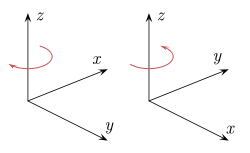
When choosing three vectors that must be at right angles to each other, there are two distinct solutions, so when expressing this idea in mathematics, one must remove the ambiguity of which solution is meant.
There are variations on the mnemonic depending on context, but all variations are related to the one idea of choosing a convention.
Direction associated with an ordered pair of directions
One form of the right-hand rule is used in situations in which an ordered operation must be performed on two vectors a and b that has a result which is a vector c perpendicular to both a and b. The most common example is the vector cross productCross product
In mathematics, the cross product, vector product, or Gibbs vector product is a binary operation on two vectors in three-dimensional space. It results in a vector which is perpendicular to both of the vectors being multiplied and normal to the plane containing them...
. The right-hand rule imposes the following procedure for choosing one of the two directions.

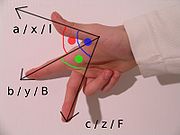
- With the thumb, index, and middle fingers at right angles to each other (with the index finger pointed straight), the middle finger points in the direction of c when the thumb represents a and the index finger represents b.
Other (equivalent) finger assignments are possible. For example, the first (index) finger can represent a, the first vector in the product; the second (middle) finger, b, the second vector; and the thumb, c, the product.
Direction associated with a rotation
Rotation
A rotation is a circular movement of an object around a center of rotation. A three-dimensional object rotates always around an imaginary line called a rotation axis. If the axis is within the body, and passes through its center of mass the body is said to rotate upon itself, or spin. A rotation...
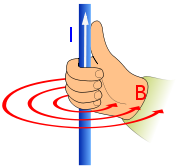
of a body, a magnetic field or a fluid. Alternatively, when a rotation is specified by a vector, and it is necessary to understand the way in which the rotation occurs, the right-hand grip rule is applicable.
This version of the rule is used in two complementary applications of Ampère's circuital law:
- An electric currentElectric currentElectric current is a flow of electric charge through a medium.This charge is typically carried by moving electrons in a conductor such as wire...
passes through a solenoidSolenoidA solenoid is a coil wound into a tightly packed helix. In physics, the term solenoid refers to a long, thin loop of wire, often wrapped around a metallic core, which produces a magnetic field when an electric current is passed through it. Solenoids are important because they can create...
, resulting in a magnetic fieldMagnetic fieldA magnetic field is a mathematical description of the magnetic influence of electric currents and magnetic materials. The magnetic field at any given point is specified by both a direction and a magnitude ; as such it is a vector field.Technically, a magnetic field is a pseudo vector;...
. When you wrap your right hand around the solenoid with your fingers in the direction of the conventional current, your thumb points in the direction of the magnetic north pole. - An electric current passes through a straight wire. Here, the thumb points in the direction of the conventional current (from positive to negative), and the fingers point in the direction of the magnetic lines of fluxFluxIn the various subfields of physics, there exist two common usages of the term flux, both with rigorous mathematical frameworks.* In the study of transport phenomena , flux is defined as flow per unit area, where flow is the movement of some quantity per time...
.
The principle is also used to determine the direction of the torque
Torque
Torque, moment or moment of force , is the tendency of a force to rotate an object about an axis, fulcrum, or pivot. Just as a force is a push or a pull, a torque can be thought of as a twist....
vector. If you grip the imaginary axis of rotation of the rotational force so that your fingers point in the direction of the force, then the extended thumb points in the direction of the torque vector.
The right-hand grip rule is a convention derived from the right-hand rule convention for vectors. When applying the rule to current in a straight wire for example, the direction of the magnetic field (counterclockwise instead of clockwise when viewed from the tip of the thumb) is a result of this convention and not an underlying physical phenomenon.
Applications
The first form of the rule is used to determine the direction of the cross productCross product
In mathematics, the cross product, vector product, or Gibbs vector product is a binary operation on two vectors in three-dimensional space. It results in a vector which is perpendicular to both of the vectors being multiplied and normal to the plane containing them...
of two vectors. This leads to widespread use in physics
Physics
Physics is a natural science that involves the study of matter and its motion through spacetime, along with related concepts such as energy and force. More broadly, it is the general analysis of nature, conducted in order to understand how the universe behaves.Physics is one of the oldest academic...
, wherever the cross product occurs. A list of physical quantities whose directions are related by the right-hand rule is given below. (Some of these are related only indirectly to cross product
Cross product
In mathematics, the cross product, vector product, or Gibbs vector product is a binary operation on two vectors in three-dimensional space. It results in a vector which is perpendicular to both of the vectors being multiplied and normal to the plane containing them...
s, and use the second form.)
- The angular velocityAngular velocityIn physics, the angular velocity is a vector quantity which specifies the angular speed of an object and the axis about which the object is rotating. The SI unit of angular velocity is radians per second, although it may be measured in other units such as degrees per second, revolutions per...
of a rotating object and the rotational velocity of any point on the object - A torqueTorqueTorque, moment or moment of force , is the tendency of a force to rotate an object about an axis, fulcrum, or pivot. Just as a force is a push or a pull, a torque can be thought of as a twist....
, the force that causes it, and the position of the point of application of the force - A magnetic fieldMagnetic fieldA magnetic field is a mathematical description of the magnetic influence of electric currents and magnetic materials. The magnetic field at any given point is specified by both a direction and a magnitude ; as such it is a vector field.Technically, a magnetic field is a pseudo vector;...
, the position of the point where it is determined, and the electric currentElectric currentElectric current is a flow of electric charge through a medium.This charge is typically carried by moving electrons in a conductor such as wire...
(or change in electric flux) that causes it - A magnetic fieldMagnetic fieldA magnetic field is a mathematical description of the magnetic influence of electric currents and magnetic materials. The magnetic field at any given point is specified by both a direction and a magnitude ; as such it is a vector field.Technically, a magnetic field is a pseudo vector;...
in a coil of wire and the electric currentElectric currentElectric current is a flow of electric charge through a medium.This charge is typically carried by moving electrons in a conductor such as wire...
in the wire - The force of a magnetic fieldMagnetic fieldA magnetic field is a mathematical description of the magnetic influence of electric currents and magnetic materials. The magnetic field at any given point is specified by both a direction and a magnitude ; as such it is a vector field.Technically, a magnetic field is a pseudo vector;...
on a charged particle, the magnetic field itself, and the velocityVelocityIn physics, velocity is speed in a given direction. Speed describes only how fast an object is moving, whereas velocity gives both the speed and direction of the object's motion. To have a constant velocity, an object must have a constant speed and motion in a constant direction. Constant ...
of the object - The vorticity at any point in the field of flow of a fluid
- The induced current from motion in a magnetic field (known as Fleming's right-hand rule)
- The x, y and z unit vectors in the Cartesian coordinate systemCartesian coordinate systemA Cartesian coordinate system specifies each point uniquely in a plane by a pair of numerical coordinates, which are the signed distances from the point to two fixed perpendicular directed lines, measured in the same unit of length...
follow the right-hand rule, as z = x × y. As a consequence, the right-hand rule is often used in Rigid bodyRigid bodyIn physics, a rigid body is an idealization of a solid body of finite size in which deformation is neglected. In other words, the distance between any two given points of a rigid body remains constant in time regardless of external forces exerted on it...
physics and KinematicsKinematicsKinematics is the branch of classical mechanics that describes the motion of bodies and systems without consideration of the forces that cause the motion....
.
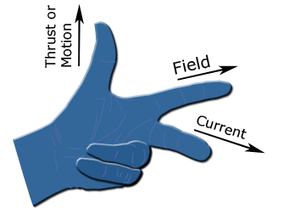
Fleming's left-hand rule is a rule for finding the direction of the thrust
Thrust
Thrust is a reaction force described quantitatively by Newton's second and third laws. When a system expels or accelerates mass in one direction the accelerated mass will cause a force of equal magnitude but opposite direction on that system....
on a conductor carrying a current in a magnetic field.
Left-handedness
In certain situations, it may be useful to use the opposite convention, where one of the vectors is reversed and so creates a left-handed triad instead of a right-handed triad.An example of this situation is for left-handed materials. Normally, for an electromagnetic wave, the electric and magnetic fields, and the direction of propagation
Wave propagation
Wave propagation is any of the ways in which waves travel.With respect to the direction of the oscillation relative to the propagation direction, we can distinguish between longitudinal wave and transverse waves....
of the wave obey the right-hand rule. However, left-handed materials have special properties, notably the negative refractive index. It makes the direction of propagation point in the opposite direction.
De Graaf's translation of Fleming's left-hand rule - which uses thrust, field and current - and the right-hand rule, is the FBI rule. The FBI rule changes thrust into F (Lorentz force
Lorentz force
In physics, the Lorentz force is the force on a point charge due to electromagnetic fields. It is given by the following equation in terms of the electric and magnetic fields:...
), B (direction of the magnetic field) and I (current). The FBI rule is easily remembered by US citizens because of the commonly known abbreviation for the Federal Bureau of Investigation
Federal Bureau of Investigation
The Federal Bureau of Investigation is an agency of the United States Department of Justice that serves as both a federal criminal investigative body and an internal intelligence agency . The FBI has investigative jurisdiction over violations of more than 200 categories of federal crime...
.
Symmetry
| Vector | Right-hand | Right-hand | Right-hand | Left-hand | Left-hand | Left-Hand |
|---|---|---|---|---|---|---|
| a, x or I | Thumb | Fingers or palm | First or Index | Thumb | Fingers or palm | First or index |
| b, y or B | First or index | Thumb | Fingers or palm | Fingers or palm | First or index | Thumb |
| c, z or F | Fingers or palm | First or index | Thumb | First or index | Thumb | Fingers or palm |
See also
- Chirality (mathematics)Chirality (mathematics)In geometry, a figure is chiral if it is not identical to its mirror image, or, more precisely, if it cannot be mapped to its mirror image by rotations and translations alone. For example, a right shoe is different from a left shoe, and clockwise is different from counterclockwise.A chiral object...
- Curl (mathematics)
- PseudovectorPseudovectorIn physics and mathematics, a pseudovector is a quantity that transforms like a vector under a proper rotation, but gains an additional sign flip under an improper rotation such as a reflection. Geometrically it is the opposite, of equal magnitude but in the opposite direction, of its mirror image...
- Improper rotationImproper rotationIn 3D geometry, an improper rotation, also called rotoreflection or rotary reflection is, depending on context, a linear transformation or affine transformation which is the combination of a rotation about an axis and a reflection in a plane perpendicular to the axis.Equivalently it is the...
- Reflection (mathematics)Reflection (mathematics)In mathematics, a reflection is a mapping from a Euclidean space to itself that is an isometry with a hyperplane as set of fixed points; this set is called the axis or plane of reflection. The image of a figure by a reflection is its mirror image in the axis or plane of reflection...
- Fleming's left-hand rule for motors
- Vorticity
- ISO 2ISO 2ISO 2 is an international standard for direction of twist designation for yarns, complex yarns, slivers, slubbings, rovings, cordage, and related products. The standard uses capital letters S and Z to indicate the direction of twist...
External links
- Right and Left Hand Rules - Interactive Java Tutorial National High Magnetic Field Laboratory
- A demonstration of the right-hand rule at physics.syr.edu
- Definition at mathworld.wolfram.com