


Rickshaw

Encyclopedia
- This article is about human-pulled rickshaws. For human-pedalled rickshaws see Cycle rickshawCycle rickshawThe cycle rickshaw is a small-scale local means of transport; it is also known by a variety of other names such as velotaxi, pedicab, bikecab, cyclo, becak, trisikad, or trishaw or, simply, rickshaw which also refers to auto rickshaws, and the, now uncommon, rickshaws pulled by a person on foot...
and for motorised rickshaws see Auto rickshawAuto rickshawAn auto rickshaw or three-wheeler is a usually three-wheeled cabin cycle for private use and as a vehicle for hire. It is a motorized version of the traditional pulled rickshaw or cycle rickshaw...
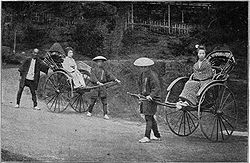
Human-powered transport
Human-powered transport is the transport of person and/or goods using human muscle power. Like animal-powered transport, human-powered transport has existed since time immemorial in the form of walking, running and swimming...
by which a runner draws a two-wheeled cart
Cart
A cart is a vehicle designed for transport, using two wheels and normally pulled by one or a pair of draught animals. A handcart is pulled or pushed by one or more people...
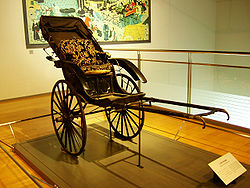
which seats one or two persons. Rickshaws are commonly made with bamboo. In recent times the use of rickshaws has been discouraged or outlawed in many countries due to concern for the welfare of rickshaw workers. Runner-pulled rickshaws have been replaced mainly by cycle rickshaw
Cycle rickshaw
The cycle rickshaw is a small-scale local means of transport; it is also known by a variety of other names such as velotaxi, pedicab, bikecab, cyclo, becak, trisikad, or trishaw or, simply, rickshaw which also refers to auto rickshaws, and the, now uncommon, rickshaws pulled by a person on foot...
s and auto rickshaw
Auto rickshaw
An auto rickshaw or three-wheeler is a usually three-wheeled cabin cycle for private use and as a vehicle for hire. It is a motorized version of the traditional pulled rickshaw or cycle rickshaw...
s. The term rickshaw is today commonly used for those vehicles as well.
Etymology
The word rickshaw originates from the JapaneseJapanese language
is a language spoken by over 130 million people in Japan and in Japanese emigrant communities. It is a member of the Japonic language family, which has a number of proposed relationships with other languages, none of which has gained wide acceptance among historical linguists .Japanese is an...
word jinrikisha , which literally means "human-powered vehicle". In 1874, The word jinricksha/jinrikisha" was published in the Oxford English Dictionary
Oxford English Dictionary
The Oxford English Dictionary , published by the Oxford University Press, is the self-styled premier dictionary of the English language. Two fully bound print editions of the OED have been published under its current name, in 1928 and 1989. The first edition was published in twelve volumes , and...
in 1887. The word rickshaw/ricksha was included in the Oxford English Dictionary as a relation of jinricksha/jinrikisha. The word ricksha was used as a manual laborer's slang word in Japan. However, the Japanese rickshaw declined due to the development of the auto industry in the 1930's.
History
Rickshaws were first seen in JapanJapan
Japan is an island nation in East Asia. Located in the Pacific Ocean, it lies to the east of the Sea of Japan, China, North Korea, South Korea and Russia, stretching from the Sea of Okhotsk in the north to the East China Sea and Taiwan in the south...
around 1868, at the beginning of the Meiji Restoration
Meiji Restoration
The , also known as the Meiji Ishin, Revolution, Reform or Renewal, was a chain of events that restored imperial rule to Japan in 1868...
. They soon became a popular mode of transportation since they were faster than the previously used palanquins (and human labor was considerably cheaper than the use of horses).
The identity of the inventor remains uncertain. Some American sources give the American blacksmith
Blacksmith
A blacksmith is a person who creates objects from wrought iron or steel by forging the metal; that is, by using tools to hammer, bend, and cut...
Albert Tolman, who is said to have invented the rickshaw around 1848 in Worcester
Worcester, Massachusetts
Worcester is a city and the county seat of Worcester County, Massachusetts, United States. Named after Worcester, England, as of the 2010 Census the city's population is 181,045, making it the second largest city in New England after Boston....
, Massachusetts, for a missionary
Missionary
A missionary is a member of a religious group sent into an area to do evangelism or ministries of service, such as education, literacy, social justice, health care and economic development. The word "mission" originates from 1598 when the Jesuits sent members abroad, derived from the Latin...
. Others claim that Jonathan Scobie
Jonathan Scobie
The Reverend Jonathan Scobie was an American Baptist minister and missionary in Yokohama, Japan. It is said that around 1869, he built the first rickshaw to transport his invalid wife around the city. However, there are numerous other theories about the origin of the rickshaw, as explained in...
(or Jonathan Goble), an American missionary to Japan, invented the rickshaw around 1869 to transport his invalid wife through the streets of Yokohama
Yokohama
is the capital city of Kanagawa Prefecture and the second largest city in Japan by population after Tokyo and most populous municipality of Japan. It lies on Tokyo Bay, south of Tokyo, in the Kantō region of the main island of Honshu...
. Other scholars think it was Izumi Yosuke, a restaurateur in Tokyo in 1869. In New Jersey
New Jersey
New Jersey is a state in the Northeastern and Middle Atlantic regions of the United States. , its population was 8,791,894. It is bordered on the north and east by the state of New York, on the southeast and south by the Atlantic Ocean, on the west by Pennsylvania and on the southwest by Delaware...
, the Burlington County Historical Society claims an 1867 invention by carriage maker James Birch, and exhibits a Birch rickshaw in its museum. None of these dates, however, are as early as the French sources.
Still others say the rickshaw was designed by an American Baptist minister in 1888. This is undoubtedly incorrect, for an 1877 article by a New York Times correspondent in Tokyo stated that the "jin-riki-sha, or man-power carriage" was in current popular use, and was probably invented by an American in 1869 or 1870.
Japanese sources often credit Izumi Yosuke, Suzuki Tokujiro, and Takayama Kosuke, who are said to have invented rickshaws in 1868, inspired by the horse carriages that had been introduced to the streets of Tokyo
Tokyo
, ; officially , is one of the 47 prefectures of Japan. Tokyo is the capital of Japan, the center of the Greater Tokyo Area, and the largest metropolitan area of Japan. It is the seat of the Japanese government and the Imperial Palace, and the home of the Japanese Imperial Family...
shortly before. Starting in 1870, the Tokyo government issued a permission to build and sell rickshaws to these three men. The seal of one of these inventors was also required on every license to operate a rickshaw.
By 1872, some 40,000 rickshaws were operating in Tokyo. They soon became the chief form of public transportation in Japan. (Powerhouse Museum, 2005; The Jinrikisha story, 1996)
Around 1880, rickshaws appeared in India
India
India , officially the Republic of India , is a country in South Asia. It is the seventh-largest country by geographical area, the second-most populous country with over 1.2 billion people, and the most populous democracy in the world...
, first in Simla
Shimla
Shimla , formerly known as Simla, is the capital city of Himachal Pradesh. In 1864, Shimla was declared the summer capital of the British Raj in India. A popular tourist destination, Shimla is often referred to as the "Queen of Hills," a term coined by the British...
and then, 20 years later, in Calcutta (now Kolkata
Kolkata
Kolkata , formerly known as Calcutta, is the capital of the Indian state of West Bengal. Located on the east bank of the Hooghly River, it was the commercial capital of East India...
). Here they were initially used by Chinese traders to transport goods. In 1914, the Chinese applied for permission to use rickshaws to transport passengers. Soon after, rickshaws appeared in many big cities in Southeast Asia
Southeast Asia
Southeast Asia, South-East Asia, South East Asia or Southeastern Asia is a subregion of Asia, consisting of the countries that are geographically south of China, east of India, west of New Guinea and north of Australia. The region lies on the intersection of geological plates, with heavy seismic...
. Pulling a rickshaw was often the first job for peasants migrating to these cities.
Pakistan
Runner-pulled rickshaws (and cycle rickshaws or qinqi) have officially been outlawed in PakistanPakistan
Pakistan , officially the Islamic Republic of Pakistan is a sovereign state in South Asia. It has a coastline along the Arabian Sea and the Gulf of Oman in the south and is bordered by Afghanistan and Iran in the west, India in the east and China in the far northeast. In the north, Tajikistan...
since the late 50s/early 60s. Formerly in Pakistan
Pakistan
Pakistan , officially the Islamic Republic of Pakistan is a sovereign state in South Asia. It has a coastline along the Arabian Sea and the Gulf of Oman in the south and is bordered by Afghanistan and Iran in the west, India in the east and China in the far northeast. In the north, Tajikistan...
most transportation was done by horse-drawn carriages called tongas, but more cost-effective auto rickshaw
Auto rickshaw
An auto rickshaw or three-wheeler is a usually three-wheeled cabin cycle for private use and as a vehicle for hire. It is a motorized version of the traditional pulled rickshaw or cycle rickshaw...
s have now taken their place in small cities.
China
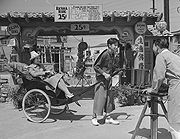
Manual rickshaws were first used in China during the late 19th century,Rickshaw transport was an important element in urban development in 20th century China, both in terms of its provision of transport to the consumers of the service and for the employment it provided (and migration it facilitated) for workers. Rickshaw Beijing: City People and Politics in the 1920 by David Strand quantifies the effect: "Sixty thousand men took as many as a half million fares a day in a city of slightly more than one million. Sociologist Li Jinghan estimated that one out of six males in the city between the ages of sixteen and fifty was a puller. Rickshaw men and their dependents made up almost 20 percent of Beijing's population." (p. 21)
Most manual rickshaws were eliminated in China after the founding of the People's Republic of China in 1949, because they were considered a symbol of oppression of the working class.
Bangladesh
BangladeshBangladesh
Bangladesh , officially the People's Republic of Bangladesh is a sovereign state located in South Asia. It is bordered by India on all sides except for a small border with Burma to the far southeast and by the Bay of Bengal to the south...
i rickshaw pullers are mostly from the villages. Because of the lack of job opportunities, people from the villages migrate to Dhaka
Dhaka
Dhaka is the capital of Bangladesh and the principal city of Dhaka Division. Dhaka is a megacity and one of the major cities of South Asia. Located on the banks of the Buriganga River, Dhaka, along with its metropolitan area, had a population of over 15 million in 2010, making it the largest city...
, Sylhet
Sylhet
Sylhet , is a major city in north-eastern Bangladesh. It is the main city of Sylhet Division and Sylhet District, and was granted metropolitan city status in March 2009. Sylhet is located on the banks of the Surma Valley and is surrounded by the Jaintia, Khasi and Tripura hills...
and Chittagong
Chittagong
Chittagong ) is a city in southeastern Bangladesh and the capital of an eponymous district and division. Built on the banks of the Karnaphuli River, the city is home to Bangladesh's busiest seaport and has a population of over 4.5 million, making it the second largest city in the country.A trading...
to pull rickshaws.
Rickshaw man Omar Ali is Bangla's music star winner in the television "Pop Idol"-style talent show.
Hong Kong
Rickshaws were first imported to Hong KongHong Kong
Hong Kong is one of two Special Administrative Regions of the People's Republic of China , the other being Macau. A city-state situated on China's south coast and enclosed by the Pearl River Delta and South China Sea, it is renowned for its expansive skyline and deep natural harbour...
from Japan in 1874. They were a popular form of transport for many years, peaking at more than 3,000 in the 1920s. However, their popularity waned after World War II
World War II
World War II, or the Second World War , was a global conflict lasting from 1939 to 1945, involving most of the world's nations—including all of the great powers—eventually forming two opposing military alliances: the Allies and the Axis...
. No new licenses for rickshaws have been issued since 1975, and only a few old men—four as of 2009—still bear a license. It is reported that only one of them still offer rickshaw rides on The Peak
Victoria Peak
Victoria Peak is a mountain in Hong Kong. It is also known as Mount Austin, and locally as The Peak. The mountain is located in the western half of Hong Kong Island...
, mainly for tourists.
India
Auto rickshaw
An auto rickshaw or three-wheeler is a usually three-wheeled cabin cycle for private use and as a vehicle for hire. It is a motorized version of the traditional pulled rickshaw or cycle rickshaw...
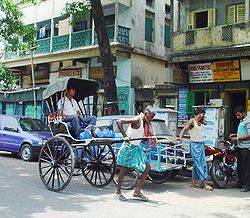
s, hand-pulled rickshaws do exist in a few pockets and towns. As of 2005, the last sizeable fleet of rickshaws can be found in Kolkata
Kolkata
Kolkata , formerly known as Calcutta, is the capital of the Indian state of West Bengal. Located on the east bank of the Hooghly River, it was the commercial capital of East India...
(Calcutta), where the rickshaw-puller union resisted prohibition.
Several major streets have been closed to rickshaw traffic since 1972, and in 1982 the city seized over 12,000 rickshaws and destroyed them. In 1992, it was estimated that over 30,000 rickshaws were operating in the city, all but 6,000 of them illegally, lacking a license (no new licenses have been issued since 1945). The large majority of rickshaw pullers rent their rickshaws for a few dollars per shift. They live cheaply in hostels, trying to save money to send home. (Eide, 1993) Each dera, a mixture of a garage, repair shop, and dormitory, has a sardar that manages it. Pullers often pay around 100 rupee
Indian rupee
The Indian rupee is the official currency of the Republic of India. The issuance of the currency is controlled by the Reserve Bank of India....
s (around $2.50 United States dollar
United States dollar
The United States dollar , also referred to as the American dollar, is the official currency of the United States of America. It is divided into 100 smaller units called cents or pennies....
s) per month to live in a dera. Hindu
Hinduism
Hinduism is the predominant and indigenous religious tradition of the Indian Subcontinent. Hinduism is known to its followers as , amongst many other expressions...
and Muslim
Muslim
A Muslim, also spelled Moslem, is an adherent of Islam, a monotheistic, Abrahamic religion based on the Quran, which Muslims consider the verbatim word of God as revealed to prophet Muhammad. "Muslim" is the Arabic term for "submitter" .Muslims believe that God is one and incomparable...
pullers often share housing. Some pullers sleep in the streets in their rickshaws.

Bihar
Bihar is a state in eastern India. It is the 12th largest state in terms of geographical size at and 3rd largest by population. Almost 58% of Biharis are below the age of 25, which is the highest proportion in India....
, considered to be one of the poorest states in India.
In August 2005, the Communist government of West Bengal
West Bengal
West Bengal is a state in the eastern region of India and is the nation's fourth-most populous. It is also the seventh-most populous sub-national entity in the world, with over 91 million inhabitants. A major agricultural producer, West Bengal is the sixth-largest contributor to India's GDP...
announced plans to completely ban pulled rickshaws, resulting in protests and strikes of the pullers.
In 2006, the chief minister of West Bengal, Buddhadeb Bhattacharya
Buddhadeb Bhattacharya
Buddhadeb Bhattacharjee is an Indian politician and a member of the politburo of the Communist Party of India . He was the Chief Minister of West Bengal from 2000 to 2011...
, announced that pulled rickshaws would be banned and that rickshaw pullers would be rehabilitated.
Calvin Trillin of National Geographic stated in a 2008 article that the city government has not decided how rickshaw drivers would be rehabilitated, nor has it settled on a date regarding when the government would decide. Trillin added that many high West Bengal officials made statements saying that rickshaws would be banned from 1976 to 2008.
According to Trillin, most Kolkata rickshaws serve people "just a notch above poor" who tend to travel short distances. He added that some people use rickshaws as "24 hour ambulance
Ambulance
An ambulance is a vehicle for transportation of sick or injured people to, from or between places of treatment for an illness or injury, and in some instances will also provide out of hospital medical care to the patient...
services," as escorts for shoppers, and as a way for businesses to transport goods. Trillin added that pullers told him that children enrolled in schools were the "steadiest" customers. Many middle-class families contract with rickshaw pullers to transport their children; a rickshaw puller who transports children becomes a "family retainer." Trillin adds that some Kolkatans do not like to ride in rickshaws because they feel offended by the idea of a human pulling them, and that some of them question the government's motives on banning rickshaws. Trillin cited Rudrangshu Mukerjee, an academic who said that he does not want to be carried in a rickshaw but does not like the idea of "taking away their livelihood." Trillin adds that when Kolkata floods rickshaw business increases and prices rise. A Kolkata writer told Trillin, "When it rains, even the governor takes rickshaws."
An Open Variation In England Created by the Mathieson-Harvey-Harrison Rikshaw Consortium.
Indonesia
Rickshaws are a type of bicycle.Ireland
Dublin first saw the rickshaw on its streets in 1994 when a rickshaw company originally based in Canada set up a fleet of 20 of the vehicles. The company builds them from tubular steel. However, the company was actually called the original rickshaw company. The people of Dublin, both locals and tourists alike, were surprised at first to see the Far Eastern concept in Ireland. People began to use the rickshaws for getting about from pubs to pubs to clubs or for a quick ride around Temple BarTemple Bar, Dublin
Temple Bar is an area on the south bank of the River Liffey in central Dublin, Ireland. Unlike the areas surrounding it, Temple Bar has preserved its medieval street pattern, with many narrow cobbled streets. It is promoted as "Dublin's cultural quarter" and has a lively nightlife that is popular...
. Later that year 12 pedicab
Cycle rickshaw
The cycle rickshaw is a small-scale local means of transport; it is also known by a variety of other names such as velotaxi, pedicab, bikecab, cyclo, becak, trisikad, or trishaw or, simply, rickshaw which also refers to auto rickshaws, and the, now uncommon, rickshaws pulled by a person on foot...
rickshaws were imported by a wine club owner named B. McDonald who started Pedicabs Ireland. A year later J. Ralf & J. Utah, former Pedicab Ireland riders, set up a small fleet of hand-pulled rickshaws called the Silver Rickshaw company. The last hand-pulled rickshaw Company was to be formed by ex-Pedicab Ireland Manager B. Wheeler. This was, in the summer of 2001, called simply The Rickshaw Co. The company quickly grew with six pedicabs added to its fleet of 12 newly built hand-pulled rickshaws. The attacks in America on 9/11 damaged the new industry and many of the companies mentioned above are no longer operating with the exception of the Silver Rickshaws.
Finland
Helsinki saw its first rickshaws in 2009 when a company decided to bring them from another town in Finland, Lappeenranta. The rental service is located at Kaivopuisto.Malaysia
Rickshaws were a common mode of transport in urban areas of Malaysia in the 19th and early 20th centuries until gradually replaced by cycle rickshawCycle rickshaw
The cycle rickshaw is a small-scale local means of transport; it is also known by a variety of other names such as velotaxi, pedicab, bikecab, cyclo, becak, trisikad, or trishaw or, simply, rickshaw which also refers to auto rickshaws, and the, now uncommon, rickshaws pulled by a person on foot...
s.
Madagascar
South Africa
DurbanDurban
Durban is the largest city in the South African province of KwaZulu-Natal and the third largest city in South Africa. It forms part of the eThekwini metropolitan municipality. Durban is famous for being the busiest port in South Africa. It is also seen as one of the major centres of tourism...
is famous for its iconic Zulu rickshaw pullers navigating throughout the city. These colourful characters are famous for their giant, vibrant hats and costumes. Although they had been a mode of transportation since the early 1900s, they were displaced by motorised transport, and the approximately 25 rickshaws left mostly cater to tourists
Tourism
Tourism is travel for recreational, leisure or business purposes. The World Tourism Organization defines tourists as people "traveling to and staying in places outside their usual environment for not more than one consecutive year for leisure, business and other purposes".Tourism has become a...
today.
United States of America
In Los AngelesLos Angeles, California
Los Angeles , with a population at the 2010 United States Census of 3,792,621, is the most populous city in California, USA and the second most populous in the United States, after New York City. It has an area of , and is located in Southern California...
, California, a rickshaw rental company operated and rented original vintage and antique hand pulled rickshaws. The company was the only one in the United States providing original antique hand pulled rickshaws.
Rickshaws are still present on the boardwalks of Atlantic City and Ocean City, New Jersey, and in some parts of New York City.
Rickshaws are also available in downtown Madison, Wisconsin
Madison, Wisconsin
Madison is the capital of the U.S. state of Wisconsin and the county seat of Dane County. It is also home to the University of Wisconsin–Madison....
, on State Street where normal automobile traffic is not allowed.
Rickshaws are present in Cincinnati, Ohio
Cincinnati, Ohio
Cincinnati is a city in the U.S. state of Ohio. Cincinnati is the county seat of Hamilton County. Settled in 1788, the city is located to north of the Ohio River at the Ohio-Kentucky border, near Indiana. The population within city limits is 296,943 according to the 2010 census, making it Ohio's...
, and northern Kentucky (Newport, Covington and Bellevue).
Pedicabs are available in downtown Minneapolis, Minnesota
Minneapolis, Minnesota
Minneapolis , nicknamed "City of Lakes" and the "Mill City," is the county seat of Hennepin County, the largest city in the U.S. state of Minnesota, and the 48th largest in the United States...
.
Tourist attractions
Rickshaws are a tourist attraction in the AsakusaAsakusa
is a district in Taitō, Tokyo, Japan, most famous for the Sensō-ji, a Buddhist temple dedicated to the bodhisattva Kannon. There are several other temples in Asakusa, as well as various festivals.- History :...
region of Tokyo
Tokyo
, ; officially , is one of the 47 prefectures of Japan. Tokyo is the capital of Japan, the center of the Greater Tokyo Area, and the largest metropolitan area of Japan. It is the seat of the Japanese government and the Imperial Palace, and the home of the Japanese Imperial Family...
; in the main temple area of Kyoto
Kyoto
is a city in the central part of the island of Honshū, Japan. It has a population close to 1.5 million. Formerly the imperial capital of Japan, it is now the capital of Kyoto Prefecture, as well as a major part of the Osaka-Kobe-Kyoto metropolitan area.-History:...
; in tourist heavy areas of Kamakura
Kamakura, Kanagawa
is a city located in Kanagawa Prefecture, Japan, about south-south-west of Tokyo. It used to be also called .Although Kamakura proper is today rather small, it is often described in history books as a former de facto capital of Japan as the seat of the Shogunate and of the Regency during the...
; on The Peak
The Peak
The Peak is the independent student newspaper of Simon Fraser University in Burnaby, British Columbia, Canada. It is split into six major sections: News, Opinions, Features, Arts, Sports and Humour.-History:...
, Hong Kong
Hong Kong
Hong Kong is one of two Special Administrative Regions of the People's Republic of China , the other being Macau. A city-state situated on China's south coast and enclosed by the Pearl River Delta and South China Sea, it is renowned for its expansive skyline and deep natural harbour...
; in Vietnam
Vietnam
Vietnam – sometimes spelled Viet Nam , officially the Socialist Republic of Vietnam – is the easternmost country on the Indochina Peninsula in Southeast Asia. It is bordered by China to the north, Laos to the northwest, Cambodia to the southwest, and the South China Sea –...
on Cijin Island in Kaohsiung
Kaohsiung
Kaohsiung is a city located in southwestern Taiwan, facing the Taiwan Strait on the west. Kaohsiung, officially named Kaohsiung City, is divided into thirty-eight districts. The city is one of five special municipalities of the Republic of China...
; in areas of London
London
London is the capital city of :England and the :United Kingdom, the largest metropolitan area in the United Kingdom, and the largest urban zone in the European Union by most measures. Located on the River Thames, London has been a major settlement for two millennia, its history going back to its...
's Chinatown, in Ottawa
Ottawa
Ottawa is the capital of Canada, the second largest city in the Province of Ontario, and the fourth largest city in the country. The city is located on the south bank of the Ottawa River in the eastern portion of Southern Ontario...
's Byward Market
Byward Market
ByWard Market is a district in Lower Town located east of the government & business district, surrounding the market buildings and open-air market on George, York, ByWard and William Streets.The district is bordered on the west by Sussex Drive, on the...
; in downtown Toronto
Toronto
Toronto is the provincial capital of Ontario and the largest city in Canada. It is located in Southern Ontario on the northwestern shore of Lake Ontario. A relatively modern city, Toronto's history dates back to the late-18th century, when its land was first purchased by the British monarchy from...
; in Kathmandu, Nepal
Nepal
Nepal , officially the Federal Democratic Republic of Nepal, is a landlocked sovereign state located in South Asia. It is located in the Himalayas and bordered to the north by the People's Republic of China, and to the south, east, and west by the Republic of India...
, and in Hanoi
Hanoi
Hanoi , is the capital of Vietnam and the country's second largest city. Its population in 2009 was estimated at 2.6 million for urban districts, 6.5 million for the metropolitan jurisdiction. From 1010 until 1802, it was the most important political centre of Vietnam...
and Ho Chi Minh City
Ho Chi Minh City
Ho Chi Minh City , formerly named Saigon is the largest city in Vietnam...
, (Vietnam). Also in the centre of Durban, South Africa, they are a common sight.
Books, films, television, music and modern art
- An early Rudyard KiplingRudyard KiplingJoseph Rudyard Kipling was an English poet, short-story writer, and novelist chiefly remembered for his celebration of British imperialism, tales and poems of British soldiers in India, and his tales for children. Kipling received the 1907 Nobel Prize for Literature...
story has the title The Phantom RickshawThe Phantom 'Rickshaw and other Eerie TalesThe Phantom 'Rickshaw and other Eerie Tales is a collection of short stories by Rudyard Kipling.-The Phantom 'Rickshaw:After an affair with a Mrs. Agnes Keith-Wessington in Simla, the narrator, Jack, repudiates her and eventually becomes engaged to Miss Kitty Mannering. Yet Mrs...
(1885). In it a young Englishman has a romance aboard a ship bound for India. He ends the affair and becomes engaged to another woman, causing his original love to die of a broken heart. After that, on excursions around the city of SimlaShimlaShimla , formerly known as Simla, is the capital city of Himachal Pradesh. In 1864, Shimla was declared the summer capital of the British Raj in India. A popular tourist destination, Shimla is often referred to as the "Queen of Hills," a term coined by the British...
, he frequently sees the ghost of the deceased driving around in her yellow-panelled rickshaw, though nobody else seems to notice the phenomenon.
- The 1936 novel Rickshaw BoyRickshaw BoyRickshaw Boy or Camel Xiangzi is a novel by the Chinese author Lao She about the life of a fictional Beijing rickshaw man. It is considered a classic of 20th-century Chinese literature.-History:...
is a novel by the Chinese author Lao SheLao SheShu Qingchun , better known by his pen name Lao She was a notable Chinese writer. A novelist and dramatist, he was one of the most significant figures of 20th century Chinese literature, and is perhaps best known for his novel Rickshaw Boy and the play Teahouse . He was of Manchu ethnicity...
about the life of a fictional BeijingBeijingBeijing , also known as Peking , is the capital of the People's Republic of China and one of the most populous cities in the world, with a population of 19,612,368 as of 2010. The city is the country's political, cultural, and educational center, and home to the headquarters for most of China's...
rickshaw man. The English version Rickshaw Boy became a U.S. bestseller in 1945. It was an unauthorized translation that added a happy endingHappy endingA happy ending is an ending of the plot of a work of fiction in which almost everything turns out for the best for the protagonists, their sidekicks, and almost everyone except the villains....
to the story. In 1982, the original version was made into a film of the same title.
- In the 1940s, Eddy HowardEddy HowardEddy Howard was an American vocalist and bandleader who was popular during the 1940s and 1950s.-Biography:...
recorded a song called The Rickety Rickshaw Man.
- The 1958 Japanese movie Muhomatsu no issho (Rickshaw ManRickshaw ManRickshaw Man is a 1958 color Japanese film directed by Hiroshi Inagaki. Its original Japanese title is . It tells the story of a Matsugoro, a rickshaw man who becomes a surrogate father to the child of a recently widowed woman....
) by Hiroshi InagakiHiroshi Inagakiwas a Japanese filmmaker most known for the Academy Award-winning Samurai I: Musashi Miyamoto, which he directed in 1954.-Career:Born in Tokyo as the son of a shinpa actor, Inagaki appeared on stage in his childhood before joining the Nikkatsu studio as an actor in 1922...
tells the story of a Matsugoro, a rickshaw man who becomes a surrogate father to the child of a recently widowed woman.
- The 1953 BollywoodBollywoodBollywood is the informal term popularly used for the Hindi-language film industry based in Mumbai , Maharashtra, India. The term is often incorrectly used to refer to the whole of Indian cinema; it is only a part of the total Indian film industry, which includes other production centers producing...
film Do Bigha ZameenDo Bigha ZameenDo Bigha Zamin is 1953 Hindi film, directed by Bengali film director Bimal Roy and star Balraj Sahni and Nirupa Roy in lead roles. The film is known for its socialist theme, and is an important film in the early parallel cinema of India and is rightly considered a trend setter...
, directed by Bimal RoyBimal RoyBimal Roy was one of the most acclaimed Indian film directors of all time. He is particularly noted for his realistic and socialistic films like Do Bigha Zamin, Parineeta, Biraj Bahu, Madhumati, Sujata, and Bandini, making him an important director of Hindi cinema...
, describes the fate of an impoverished farmer who becomes a rickshaw puller in KolkataKolkataKolkata , formerly known as Calcutta, is the capital of the Indian state of West Bengal. Located on the east bank of the Hooghly River, it was the commercial capital of East India...
.
- In the 1992 film City of JoyCity of Joy (film)City of Joy is a 1992 film directed by Roland Joffé, with a screenplay by Mark Medoff. It is based upon the novel of the same name by Dominique Lapierre.-Plot:...
(whose title refers to Kolkata), Om PuriOm PuriOm Puri is an Indian actor who has appeared in both mainstream Indian films and art films. His credits also include appearances in British and American films. He has received an honorary OBE.-Early life:...
plays a rickshaw puller, revealing the economic and emotional hardship that these underpaid workers face on a day-to-day basis.
- In the episode The BookstoreThe Bookstore"The Bookstore" is the 173rd episode of the NBC sitcom Seinfeld. This was the 17th episode for the 9th and final season. It aired on April 16, 1998.-Plot:...
of the American sitcom SeinfeldSeinfeldSeinfeld is an American television sitcom that originally aired on NBC from July 5, 1989, to May 14, 1998, lasting nine seasons, and is now in syndication. It was created by Larry David and Jerry Seinfeld, the latter starring as a fictionalized version of himself...
, KramerCosmo KramerCosmo Kramer, usually referred to as simply "Kramer", is a fictional character on the American television sitcom Seinfeld , played by Michael Richards...
and NewmanNewman (Seinfeld)Newman is a recurring character on the television show Seinfeld, played by Wayne Knight from 1991 until the show's finale in 1998.-Background:...
import rickshaws to New York CityNew York CityNew York is the most populous city in the United States and the center of the New York Metropolitan Area, one of the most populous metropolitan areas in the world. New York exerts a significant impact upon global commerce, finance, media, art, fashion, research, technology, education, and...
, for the purpose of running a business. They intend to employ members of the city's homeless population; however, one steals their rickshaw. The two recover the rickshaw, and Newman forces Kramer to transport him uphill, a voyage Kramer is unable to make.
- In Pearl S. BuckPearl S. BuckPearl Sydenstricker Buck also known by her Chinese name Sai Zhenzhu , was an American writer who spent most of her time until 1934 in China. Her novel The Good Earth was the best-selling fiction book in the U.S. in 1931 and 1932, and won the Pulitzer Prize in 1932...
's 1931 novel The Good EarthThe Good EarthThe Good Earth is a novel by Pearl S. Buck published in 1931 and awarded the Pulitzer Prize for the Novel in 1932. The best selling novel in the United States in both 1931 and 1932, it was an influential factor in Buck winning the Nobel Prize for Literature in 1938...
, hero Wang Lung leaves his land to travel southward during a drought. He ends up in the city of Kiangsu, where he becomes a rickshaw puller in order to support his family.
- The 2006 documentary filmDocumentary filmDocumentary films constitute a broad category of nonfictional motion pictures intended to document some aspect of reality, primarily for the purposes of instruction or maintaining a historical record...
Men of burden Pedaling towards a Horizon, set in the city of Pondicherry, a Union Territory in southeast IndiaIndiaIndia , officially the Republic of India , is a country in South Asia. It is the seventh-largest country by geographical area, the second-most populous country with over 1.2 billion people, and the most populous democracy in the world...
, uncovers the story of disappearing cycle rickshawCycle rickshawThe cycle rickshaw is a small-scale local means of transport; it is also known by a variety of other names such as velotaxi, pedicab, bikecab, cyclo, becak, trisikad, or trishaw or, simply, rickshaw which also refers to auto rickshaws, and the, now uncommon, rickshaws pulled by a person on foot...
drivers living in abject poverty.
- English graffiti artist and activist BanksyBanksyBanksy is a pseudonymous England-based graffiti artist, political activist, film director, and painter.His satirical street art and subversive epigrams combine irreverent dark humour with graffiti done in a distinctive stencilling technique...
portrays a modernised representation of a rickshaw in a piece where an overweight rich couple with a mobile phoneMobile phoneA mobile phone is a device which can make and receive telephone calls over a radio link whilst moving around a wide geographic area. It does so by connecting to a cellular network provided by a mobile network operator...
(in colour) are being ferried by a young black boy and his rickshaw (in black and white).
See also
- Boda-bodaBoda-bodaBoda-boda also known as a Poda-Poda in some parts of Africa is a bicycle taxi, originally in East Africa . The bicycle rider can also be called boda-boda...
- LitterLitter (vehicle)The litter is a class of wheelless vehicles, a type of human-powered transport, for the transport of persons. Examples of litter vehicles include lectica , jiao [较] , sedan chairs , palanquin , Woh , gama...
- The Indian Autorickshaw ChallengeIndian Autorickshaw ChallengeThe Indian Autorickshaw Challenge is an international autorickshaw rally self-styled as ‘an amazing race for the clinically insane’. The entrants use the ubiquitous Autorickshaw or Tuk-Tuk, workhorse of the urban east, to cross large portions of the Indian sub-continent in a matter of days...
and the Rickshaw RunRickshaw RunThe Rickshaw Run is an event where teams drive Auto Rickshaws across various routes across India. The first route in December 2006 was from Cochin in the southern state of Kerala to Darjeeling. In its inaugural run, thirty-four teams started the event, and thirty-one of those finished...
, both rallies travel across India by auto rickshawAuto rickshawAn auto rickshaw or three-wheeler is a usually three-wheeled cabin cycle for private use and as a vehicle for hire. It is a motorized version of the traditional pulled rickshaw or cycle rickshaw...
. - Taiwanese push car railwaysTaiwanese push car railwaysTaiwanese push car railways were a historic transportation system on Taiwan, based on Japan's daisha push car railways. After Taiwan was ceded to Japan, the push car system was brought to Taiwan. The push car railways were in general service from 1895 to the late 1940s...
- Utility cyclingUtility cyclingUtility cycling encompasses any cycling not done primarily for fitness, recreation such as cycle touring, or sport such as cycle racing, but simply as a means of transport...
- Rickshaw art
- Cycle rickshawCycle rickshawThe cycle rickshaw is a small-scale local means of transport; it is also known by a variety of other names such as velotaxi, pedicab, bikecab, cyclo, becak, trisikad, or trishaw or, simply, rickshaw which also refers to auto rickshaws, and the, now uncommon, rickshaws pulled by a person on foot...