

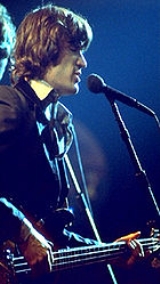
Rick Danko

Encyclopedia
Richard Clare "Rick" Danko (December 29, 1942 – December 10, 1999) was a Canadian musician and singer, best known as a member of The Band
.
, Ontario
, a farming community outside of the town of Simcoe
, to a musical family of Ukrainian
descent.
Growing up in front of the family radio (as his future bandmates also did), he was exposed to country
and R&B music at an early age. His musical heroes included Hank Williams and, later, Sam Cooke
. He also drew inspiration from the music of his oldest brother, Maurice "Junior" Danko. Danko's younger brother, Terry
, also became a musician. After entering the first grade in school, he performed on a 4 string tenor banjo
.
Danko formed the Rick Danko Band at the age of 12 or 13, and at 14, he left school to pursue music. At 17, already a five-year music veteran, he booked himself as the opening act for Ronnie Hawkins
, an American rockabilly
singer whose group, The Hawks, were considered to be one of the best in Canada
.
ist. Around this time, Hawks bassist Rebel Paine was fired by Hawkins, who, wasting no time, had Danko learn bass
, given help by other members of the band. By September 1960, he was Hawkins's bassist, using the Fender VI six-string bass, then switching to a Fender Jazz Bass
.
Soon joined by pianist Richard Manuel
and organist/reedsman Garth Hudson
, The Hawks played with Hawkins through mid-1963. An altercation that year between Danko and Hawkins led Danko, Helm, Robertson, Manuel, and Hudson to give two-weeks' notice in early 1964 and parted ways with Hawkins on reasonably amicable terms. The group had been planning to leave Hawkins and strike out together as a band without a frontman, as a team of equal members.
to Arkansas
, they became known as "the best damn bar band in the land."
By 1965, with two singles under their belt, recorded as the Canadian Squires, they met the legendary blues harmonicist and vocalist Sonny Boy Williamson
and planned a collaboration with him as soon as he returned to Chicago
. Unfortunately for the group (who went on to play a four-month stand of gigs in New Jersey
immediately afterward), Williamson died within days of their meeting, and the collaboration never happened.
Around that same time, Bob Dylan
contacted them, and they became his backing group. The nature of Dylan's tour, however, became too much for Helm, who departed in November. Through May 1966, Dylan and the remaining foursome (together with pick-up drummers, including actor/musician Mickey Jones
) traveled across America, Australia, and Europe, playing new versions of Dylan classics. After the final shows in England, Dylan retreated to his new home in Woodstock, New York, and the Hawks joined him shortly thereafter.
album. In October, The Hawks began their demo recordings for their first album, with Helm re-joining the group in that month. Their manager, Albert Grossman
, secured them a recording deal with Capitol Records
in late 1967.
From January to March 1968, The Band recorded their debut album, Music From Big Pink
, in recording studios in New York and Los Angeles. On this album, Danko sang lead vocal on three songs: "Caledonia Mission", "Long Black Veil" and "This Wheel's on Fire
," which Danko had co-written with Dylan. Before The Band could promote the album by touring, Danko was severely injured in a car accident, breaking his neck and back in six places, which put him in traction for months. The Band finally made their concert debut at Bill Graham
's Winterland in San Francisco April 1969.
By this time, they were already hard at work on their eponymous second album
. On that record, sometimes known as "The Brown Album," Danko sang what would become two of his signature songs—and two of the group's best-loved classics: the reflective yet whimsical story-song "When You Awake" and the achingly poignant "The Unfaithful Servant." Both songs exemplified Danko's talents as a lead singer and demonstrated his naturally plaintive voice.
The Band's albums were defined by each member—Robertson's lyrics and guitar work, Helm's "bayou folk" drumming and Southern voice, Manuel's Ray Charles
-like vocals and complex keyboard rhythms, and Hudson's arrangements on an assortment of instruments. But Danko's iconic tenor, his on-top-of-the-melody harmonies, and his percussive, melodic bass-playing style were an integral part of the group's sound. In an interview with Guitar Player
, Danko cited bassists James Jamerson
, Ron Carter
, Edgar Willis, and Chuck Rainey
as his musical influences. He eventually moved from the Fender Jazz Bass
to an Ampeg
fretless model and later a Gibson Ripper
for The Last Waltz
.
") at Winterland in November 1976, Danko had no intention of calling it quits. Clive Davis
offered him a contract with Arista Records
, making him the first Band member to record a solo album. Issued in 1977, his self titled début
featured each of his bandmates in addition to Ronnie Wood, Eric Clapton
, Doug Sahm
and Danko's brother, Terry
. The album was primarily recorded at The Band's California Studio, Shangri-La. The poor showing of the album, however (it barely cracked the Billboard 200), destined it for rarity status, and although he recorded a follow-up album, Danko was dropped from Arista. (The follow-up album, presumed lost for many years, was finally released as a part of 2005's Cryin' Heart Blues
.)
In early 1979 Danko briefly opened shows for Boz Scaggs
in selected venues. Also in 1979, Danko and Paul Butterfield
toured together as the Danko/Butterfield Band. Among the songs they covered was Sail On, Sailor
, originally recorded by The Beach Boys
.
From 1983 to 1999, Danko alternated between a reformed version of The Band
featuring Helm, Hudson, and guitarist Jim Weider
(and, from 1983 to 1986, Manuel); a busy solo career; and a number of collaborations, including award-winning work with singer/songwriter Eric Andersen
and Norway's Jonas Fjeld. The trio was known as Danko/Fjeld/Andersen.
In 1984, Rick Danko joined members of the Byrds, the Flying Burrito Brothers and others in the huge touring company that made up "The Byrds Twenty-Year Celebration." Several members of the band performed solo songs to start the show including Danko, who performed a rousing version of "Mystery Train".
In 1989, Danko toured with Levon Helm
and Garth Hudson
as part of Ringo Starr
's first All-Starr Band.
He sang on the Pink Floyd
songs "Comfortably Numb
" and "Mother
", the former with Van Morrison
, Roger Waters
, and Levon Helm
, and the latter with Helm and Sinéad O'Connor
on July 21, 1990, in Roger Waters
' stage production of The Wall Concert in Berlin
.
Danko recorded demos and made a number of appearances on albums by other artists throughout the 1980s and 1990s, and in 1997, he released Rick Danko in Concert
. Two years later, a third solo album (Live on Breeze Hill
) was released, and Danko was busy at work on a fourth (Times Like These) at the time of his death.
In the meantime, The Band
, without Robertson, recorded three more albums of their own, and Danko teamed with Fjeld and Andersen for two trio albums, Danko/Fjeld/Andersen
in 1991 and Ridin' on the Blinds
in 1994.
By the late 1990s, his lifestyle was taking its toll however, particularly his drinking and indulging in a mix of harder drugs and painkillers, the result of the serious car accident
in 1968. He continued to be on prescribed
opiate
s, including morphine
, throughout the remainder of his life, Danko's health problems were later compounded by rapid weight gain in the mid 1990s. By 1997, he was chronically obese. Danko was found guilty of attempting to smuggle heroin into Japan
. He told the presiding judge that he had begun using the drug (together with prescription morphine
) to fight life-long pain resulting from his 1968 auto accident.
in Ann Arbor, Michigan
, Danko died in his sleep at his home in Marbletown, New York
, near Woodstock
. Following an autopsy
, Danko's cause of death was determined to be drug-related heart failure.
He was survived by his wife, Elizabeth; son Justin (previously stepson, whom he had legally adopted); and daughter, Lisa, by his first marriage. His son Eli, also from his first marriage, died in 1989 at the age of 18 from asphyxiation.
The Band
The Band was an acclaimed and influential roots rock group. The original group consisted of Rick Danko , Garth Hudson , Richard Manuel , and Robbie Robertson , and Levon Helm...
.
Early years (1942–1960)
The third of four sons, Danko was born in Green's CornersNorfolk County, Ontario
Norfolk County is a rural city-status single-tier municipality on the north shore of Lake Erie in Southwestern Ontario, Canada. Bloomsburg is a small town located in Norfolk County and is the hometown of David Slater. The county seat and largest community is Simcoe...
, Ontario
Ontario
Ontario is a province of Canada, located in east-central Canada. It is Canada's most populous province and second largest in total area. It is home to the nation's most populous city, Toronto, and the nation's capital, Ottawa....
, a farming community outside of the town of Simcoe
Simcoe, Ontario
Simcoe is an unincorporated community and former town in Southwestern Ontario, Canada located near Lake Erie. It is the county seat and largest community of Norfolk County....
, to a musical family of Ukrainian
Ukrainians
Ukrainians are an East Slavic ethnic group native to Ukraine, which is the sixth-largest nation in Europe. The Constitution of Ukraine applies the term 'Ukrainians' to all its citizens...
descent.
Growing up in front of the family radio (as his future bandmates also did), he was exposed to country
Country music
Country music is a popular American musical style that began in the rural Southern United States in the 1920s. It takes its roots from Western cowboy and folk music...
and R&B music at an early age. His musical heroes included Hank Williams and, later, Sam Cooke
Sam Cooke
Samuel Cook, , better known under the stage name Sam Cooke, was an American gospel, R&B, soul, and pop singer, songwriter, and entrepreneur. He is considered to be one of the pioneers and founders of soul music. He is commonly known as the King of Soul for his distinctive vocal abilities and...
. He also drew inspiration from the music of his oldest brother, Maurice "Junior" Danko. Danko's younger brother, Terry
Terry Danko
Terry Danko is a Canadian musician and songwriter who has been active since childhood. He has written, performed and recorded his own material as a solo artist and as a member of a number of groups, such as Tin Pan Alley, Bearfoot and Terry Danko, Marty Grebb and Friends.Danko has also worked as...
, also became a musician. After entering the first grade in school, he performed on a 4 string tenor banjo
Banjo
In the 1830s Sweeney became the first white man to play the banjo on stage. His version of the instrument replaced the gourd with a drum-like sound box and included four full-length strings alongside a short fifth-string. There is no proof, however, that Sweeney invented either innovation. This new...
.
Danko formed the Rick Danko Band at the age of 12 or 13, and at 14, he left school to pursue music. At 17, already a five-year music veteran, he booked himself as the opening act for Ronnie Hawkins
Ronnie Hawkins
Ronald "Ronnie" Hawkins is a Juno Award-winning rockabilly musician whose career has spanned more than half a century. Though his career began in Arkansas, USA, where he'd been born and raised, it was in Ontario, Canada where he found success and settled for most of his life...
, an American rockabilly
Rockabilly
Rockabilly is one of the earliest styles of rock and roll music, dating to the early 1950s.The term rockabilly is a portmanteau of rock and hillbilly, the latter a reference to the country music that contributed strongly to the style's development...
singer whose group, The Hawks, were considered to be one of the best in Canada
Canada
Canada is a North American country consisting of ten provinces and three territories. Located in the northern part of the continent, it extends from the Atlantic Ocean in the east to the Pacific Ocean in the west, and northward into the Arctic Ocean...
.
The Hawks (1960-1964)
Hawkins invited Danko to join The Hawks as rhythm guitarRhythm guitar
Rhythm guitar is a technique and rôle that performs a combination of two functions: to provide all or part of the rhythmic pulse in conjunction with singers or other instruments; and to provide all or part of the harmony, ie. the chords, where a chord is a group of notes played together...
ist. Around this time, Hawks bassist Rebel Paine was fired by Hawkins, who, wasting no time, had Danko learn bass
Bass guitar
The bass guitar is a stringed instrument played primarily with the fingers or thumb , or by using a pick....
, given help by other members of the band. By September 1960, he was Hawkins's bassist, using the Fender VI six-string bass, then switching to a Fender Jazz Bass
Fender Jazz Bass
The Jazz Bass was the second model of electric bass created by Leo Fender. The bass is distinct from the Precision Bass in that its tone is brighter and richer in the midrange and treble with less emphasis on the fundamental harmonic...
.
Soon joined by pianist Richard Manuel
Richard Manuel
Richard George Manuel was a Canadian composer, singer, and multi-instrumentalist, best known for his contributions to and membership in The Band....
and organist/reedsman Garth Hudson
Garth Hudson
Eric Garth Hudson is a Canadian multi-instrumentalist. As the organist, keyboardist and saxophonist for Canadian-American rock group The Band, he was a principal architect of the group's unique sound...
, The Hawks played with Hawkins through mid-1963. An altercation that year between Danko and Hawkins led Danko, Helm, Robertson, Manuel, and Hudson to give two-weeks' notice in early 1964 and parted ways with Hawkins on reasonably amicable terms. The group had been planning to leave Hawkins and strike out together as a band without a frontman, as a team of equal members.
Pre-The Band (1964-1968)
Danko and the former Hawks initially performed as the Levon Helm Sextet, with saxophonist Jerry Penfound, later became The Canadian Squires, after Penfound left, and finally being called Levon and the Hawks. Playing a circuit that stretched in an arc from OntarioOntario
Ontario is a province of Canada, located in east-central Canada. It is Canada's most populous province and second largest in total area. It is home to the nation's most populous city, Toronto, and the nation's capital, Ottawa....
to Arkansas
Arkansas
Arkansas is a state located in the southern region of the United States. Its name is an Algonquian name of the Quapaw Indians. Arkansas shares borders with six states , and its eastern border is largely defined by the Mississippi River...
, they became known as "the best damn bar band in the land."
By 1965, with two singles under their belt, recorded as the Canadian Squires, they met the legendary blues harmonicist and vocalist Sonny Boy Williamson
Sonny Boy Williamson II
Willie "Sonny Boy" Williamson was an American blues harmonica player, singer and songwriter, from Mississippi. He is acknowledged as one of the most charismatic and influential blues musicians, with considerable prowess on the harmonica and highly creative songwriting skills...
and planned a collaboration with him as soon as he returned to Chicago
Chicago
Chicago is the largest city in the US state of Illinois. With nearly 2.7 million residents, it is the most populous city in the Midwestern United States and the third most populous in the US, after New York City and Los Angeles...
. Unfortunately for the group (who went on to play a four-month stand of gigs in New Jersey
New Jersey
New Jersey is a state in the Northeastern and Middle Atlantic regions of the United States. , its population was 8,791,894. It is bordered on the north and east by the state of New York, on the southeast and south by the Atlantic Ocean, on the west by Pennsylvania and on the southwest by Delaware...
immediately afterward), Williamson died within days of their meeting, and the collaboration never happened.
Around that same time, Bob Dylan
Bob Dylan
Bob Dylan is an American singer-songwriter, musician, poet, film director and painter. He has been a major and profoundly influential figure in popular music and culture for five decades. Much of his most celebrated work dates from the 1960s when he was an informal chronicler and a seemingly...
contacted them, and they became his backing group. The nature of Dylan's tour, however, became too much for Helm, who departed in November. Through May 1966, Dylan and the remaining foursome (together with pick-up drummers, including actor/musician Mickey Jones
Mickey Jones
Mickey Jones is an American musician and actor.-Early life:Jones was born in Houston, Texas, the son of Frances Marie and Fred Edward Jones...
) traveled across America, Australia, and Europe, playing new versions of Dylan classics. After the final shows in England, Dylan retreated to his new home in Woodstock, New York, and the Hawks joined him shortly thereafter.
The Band (1968–1977)
It was Danko who had found the pink house on Parnassus Lane, just off Stoll Road, in Saugerties, New York, which became known as "Big Pink". Danko, Hudson, and Manuel moved in, with Robertson ensconcing himself nearby. The Band's musical sessions with Dylan took place in the basement of Big Pink, between June and October 1967, generating recordings that were officially released in 1975 as The Basement TapesThe Basement Tapes
The Basement Tapes is a 1975 studio album by Bob Dylan and The Band. The songs featuring Dylan's vocals were recorded in 1967, eight years before the album's release, at houses in and around Woodstock, New York, where Dylan and the Band lived...
album. In October, The Hawks began their demo recordings for their first album, with Helm re-joining the group in that month. Their manager, Albert Grossman
Albert Grossman
Albert Bernard Grossman was an American entrepreneur and manager in the American folk music scene and rock and roll. He was most famous as the manager of Bob Dylan between 1962 and 1970.-Biography:...
, secured them a recording deal with Capitol Records
Capitol Records
Capitol Records is a major United States based record label, formerly located in Los Angeles, but operating in New York City as part of Capitol Music Group. Its former headquarters building, the Capitol Tower, is a major landmark near the corner of Hollywood and Vine...
in late 1967.
From January to March 1968, The Band recorded their debut album, Music From Big Pink
Music from Big Pink
Music from Big Pink is the 1968 debut album by rock band The Band. It features the well-known song, "The Weight". The music was composed partly in 'Big Pink', a house shared by Rick Danko, Richard Manuel, and Garth Hudson in West Saugerties, in upstate New York...
, in recording studios in New York and Los Angeles. On this album, Danko sang lead vocal on three songs: "Caledonia Mission", "Long Black Veil" and "This Wheel's on Fire
This Wheel's on Fire
This Wheel's on Fire - Levon Helm and the Story of The Band is the 1993 autobiography of actor and musician Levon Helm, focusing on his career as a member of the rock group The Band...
," which Danko had co-written with Dylan. Before The Band could promote the album by touring, Danko was severely injured in a car accident, breaking his neck and back in six places, which put him in traction for months. The Band finally made their concert debut at Bill Graham
Bill Graham (promoter)
Bill Graham was an American impresario and rock concert promoter from the 1960s until his death.-Early life:...
's Winterland in San Francisco April 1969.
By this time, they were already hard at work on their eponymous second album
The Band (album)
- Bonus Track listing from 2000 re-release :All songs by Robbie Robertson unless otherwise noted. The 2000 re-release has also been packaged as a double CD with The Band's debut album Music from Big Pink.- Personnel :...
. On that record, sometimes known as "The Brown Album," Danko sang what would become two of his signature songs—and two of the group's best-loved classics: the reflective yet whimsical story-song "When You Awake" and the achingly poignant "The Unfaithful Servant." Both songs exemplified Danko's talents as a lead singer and demonstrated his naturally plaintive voice.
The Band's albums were defined by each member—Robertson's lyrics and guitar work, Helm's "bayou folk" drumming and Southern voice, Manuel's Ray Charles
Ray Charles
Ray Charles Robinson , known by his shortened stage name Ray Charles, was an American musician. He was a pioneer in the genre of soul music during the 1950s by fusing rhythm and blues, gospel, and blues styles into his early recordings with Atlantic Records...
-like vocals and complex keyboard rhythms, and Hudson's arrangements on an assortment of instruments. But Danko's iconic tenor, his on-top-of-the-melody harmonies, and his percussive, melodic bass-playing style were an integral part of the group's sound. In an interview with Guitar Player
Guitar Player
Guitar Player is a popular magazine for guitarists founded in 1967. It contains articles, interviews, reviews and lessons of an eclectic collection of artists, genres and products. It has been in print since the late 1960s and during the 1980s, under editor Tom Wheeler, the publication was...
, Danko cited bassists James Jamerson
James Jamerson
James Lee Jamerson was an American bass player. He was the uncredited bassist on most of Motown Records' hits in the 1960s and early 1970s , and he is now regarded as one of the most influential bass players in modern music history...
, Ron Carter
Ron Carter
Ron Carter is an American jazz double-bassist. His appearances on over 2,500 albums make him one of the most-recorded bassists in jazz history, along with Milt Hinton, Ray Brown and Leroy Vinnegar. Carter is also an acclaimed cellist who has recorded numerous times on that...
, Edgar Willis, and Chuck Rainey
Chuck Rainey
Chuck Rainey, is an American bass guitar session musician, known for playing with many well-known American musicians and acts, including Donald Byrd, Steely Dan, Quincy Jones, and Aretha Franklin.-Biography:Rainey's youthful pursuits included violin, piano and trumpet...
as his musical influences. He eventually moved from the Fender Jazz Bass
Fender Jazz Bass
The Jazz Bass was the second model of electric bass created by Leo Fender. The bass is distinct from the Precision Bass in that its tone is brighter and richer in the midrange and treble with less emphasis on the fundamental harmonic...
to an Ampeg
Ampeg
Ampeg is primarily a musical instrument amplifier manufacturer headquartered in Woodinville, Washington, though they also manufacture guitars to a small extent...
fretless model and later a Gibson Ripper
Gibson Ripper
The Gibson L9-S Ripper is a model of electric bass guitar made by Gibson Guitar Corporation.The Ripper was manufactured from 1973 until 1983; the peak year being 1976. Most had a maple body with laminated maple neck, however a significant number manufactured in 1975 had lighter alder bodies while...
for The Last Waltz
The Last Waltz
The Last Waltz was a concert by the rock group The Band, held on American Thanksgiving Day, November 25, 1976, at Winterland Ballroom in San Francisco...
.
Later years (1977–1999)
Although The Band had performed its farewell concert ("The Last WaltzThe Last Waltz
The Last Waltz was a concert by the rock group The Band, held on American Thanksgiving Day, November 25, 1976, at Winterland Ballroom in San Francisco...
") at Winterland in November 1976, Danko had no intention of calling it quits. Clive Davis
Clive Davis
Clive Davis is an American record producer and music industry executive. He has won five Grammy Awards and is a member of the Rock and Roll Hall of Fame as a non-performer. From 1967 to 1973 he was the President of Columbia Records. He was the founder and president of Arista Records from 1975...
offered him a contract with Arista Records
Arista Records
Arista was an American record label. It was a wholly owned subsidiary of Sony Music Entertainment and operated under the RCA Music Group. The label was founded in 1974 by Clive Davis, who formerly worked for CBS Records...
, making him the first Band member to record a solo album. Issued in 1977, his self titled début
Rick Danko (album)
Rick Danko was the 1977 eponymous debut by the bassist and singer for The Band. Featuring ten tracks written by Danko usually in conjunction with lyricists Bobby Charles and Emmett Grogan, it was the first solo album by any member of the group, and is perhaps the most accessible to date.Rick Danko...
featured each of his bandmates in addition to Ronnie Wood, Eric Clapton
Eric Clapton
Eric Patrick Clapton, CBE, is an English guitarist and singer-songwriter. Clapton is the only three-time inductee to the Rock and Roll Hall of Fame: once as a solo artist, and separately as a member of The Yardbirds and Cream. Clapton has been referred to as one of the most important and...
, Doug Sahm
Doug Sahm
Douglas Wayne Sahm , was an American musician from Texas. Born in San Antonio, Texas, he was a child prodigy in country music, but became a significant figure in blues rock and other genres. Today Sahm is considered one of the most important figures in what is identified as Tejano music...
and Danko's brother, Terry
Terry Danko
Terry Danko is a Canadian musician and songwriter who has been active since childhood. He has written, performed and recorded his own material as a solo artist and as a member of a number of groups, such as Tin Pan Alley, Bearfoot and Terry Danko, Marty Grebb and Friends.Danko has also worked as...
. The album was primarily recorded at The Band's California Studio, Shangri-La. The poor showing of the album, however (it barely cracked the Billboard 200), destined it for rarity status, and although he recorded a follow-up album, Danko was dropped from Arista. (The follow-up album, presumed lost for many years, was finally released as a part of 2005's Cryin' Heart Blues
Cryin' Heart Blues
Cryin' Heart Blues is the name of a 17-track 2005 compilation of studio sessions and live recordings by the late bassist of The Band, Rick Danko Cryin' Heart Blues (Other Peoples Music, 2005) is the name of a 17-track 2005 compilation of studio sessions and live recordings by the late bassist of...
.)
In early 1979 Danko briefly opened shows for Boz Scaggs
Boz Scaggs
William Royce "Boz" Scaggs is an American singer, songwriter and guitarist. He gained fame in the 1970s with several Top 20 hit singles in the United States, along with the #2 album, Silk Degrees. Scaggs continues to write, record music and tour.-Early life and career:Scaggs was born in Canton,...
in selected venues. Also in 1979, Danko and Paul Butterfield
Paul Butterfield
Paul Butterfield was an American blues vocalist and harmonica player, who founded the Paul Butterfield Blues Band in the early 1960s and performed at the original Woodstock Festival...
toured together as the Danko/Butterfield Band. Among the songs they covered was Sail On, Sailor
Sail on, Sailor
"Sail On, Sailor" was the final song recorded for the 1973 Beach Boys album Holland. The song was written by Brian Wilson, Ray Kennedy, Tandyn Almer, Jack Rieley, and Van Dyke Parks.-Background:...
, originally recorded by The Beach Boys
The Beach Boys
The Beach Boys are an American rock band, formed in 1961 in Hawthorne, California. The group was initially composed of brothers Brian, Dennis and Carl Wilson, their cousin Mike Love, and friend Al Jardine. Managed by the Wilsons' father Murry, The Beach Boys signed to Capitol Records in 1962...
.
From 1983 to 1999, Danko alternated between a reformed version of The Band
The Band
The Band was an acclaimed and influential roots rock group. The original group consisted of Rick Danko , Garth Hudson , Richard Manuel , and Robbie Robertson , and Levon Helm...
featuring Helm, Hudson, and guitarist Jim Weider
Jim Weider
Jim Weider is a guitarist best known for his work with The Band. He joined the reformed version of The Band in 1985 to replace original guitarist Robbie Robertson....
(and, from 1983 to 1986, Manuel); a busy solo career; and a number of collaborations, including award-winning work with singer/songwriter Eric Andersen
Eric Andersen
Eric Andersen is an American singer-songwriter.-Biography:In the early 1960s, Eric Andersen was part of the Greenwich Village folk scene in New York...
and Norway's Jonas Fjeld. The trio was known as Danko/Fjeld/Andersen.
In 1984, Rick Danko joined members of the Byrds, the Flying Burrito Brothers and others in the huge touring company that made up "The Byrds Twenty-Year Celebration." Several members of the band performed solo songs to start the show including Danko, who performed a rousing version of "Mystery Train".
In 1989, Danko toured with Levon Helm
Levon Helm
Mark Lavon "Levon" Helm , is an American rock multi-instrumentalist and actor who achieved fame as the drummer and frequent lead and backing vocalist for The Band....
and Garth Hudson
Garth Hudson
Eric Garth Hudson is a Canadian multi-instrumentalist. As the organist, keyboardist and saxophonist for Canadian-American rock group The Band, he was a principal architect of the group's unique sound...
as part of Ringo Starr
Ringo Starr
Richard Starkey, MBE better known by his stage name Ringo Starr, is an English musician and actor who gained worldwide fame as the drummer for The Beatles. When the band formed in 1960, Starr was a member of another Liverpool band, Rory Storm and the Hurricanes. He became The Beatles' drummer in...
's first All-Starr Band.
He sang on the Pink Floyd
Pink Floyd
Pink Floyd were an English rock band that achieved worldwide success with their progressive and psychedelic rock music. Their work is marked by the use of philosophical lyrics, sonic experimentation, innovative album art, and elaborate live shows. Pink Floyd are one of the most commercially...
songs "Comfortably Numb
Comfortably Numb
"Comfortably Numb" is a song by the English rock band Pink Floyd, which first appears on the 1979 double album, The Wall. It was also released as a single in the same year with "Hey You" as the B-side. It is one of only three songs on the album for which writing credits are shared between Roger...
" and "Mother
Mother (Pink Floyd song)
"Mother" is a song by Pink Floyd. It appeared on The Wall album in 1979. The song is notable for its varied use of time signatures.-Composition:...
", the former with Van Morrison
Van Morrison
Van Morrison, OBE is a Northern Irish singer-songwriter and musician. His live performances at their best are regarded as transcendental and inspired; while some of his recordings, such as the studio albums Astral Weeks and Moondance, and the live album It's Too Late to Stop Now, are widely...
, Roger Waters
Roger Waters
George Roger Waters is an English musician, singer-songwriter and composer. He was a founding member of the progressive rock band Pink Floyd, serving as bassist and co-lead vocalist. Following the departure of bandmate Syd Barrett in 1968, Waters became the band's lyricist, principal songwriter...
, and Levon Helm
Levon Helm
Mark Lavon "Levon" Helm , is an American rock multi-instrumentalist and actor who achieved fame as the drummer and frequent lead and backing vocalist for The Band....
, and the latter with Helm and Sinéad O'Connor
Sinéad O'Connor
Sinéad Marie Bernadette O'Connor is an Irish singer-songwriter. She rose to fame in the late 1980s with her debut album The Lion and the Cobra and achieved worldwide success in 1990 with a cover of the song "Nothing Compares 2 U"....
on July 21, 1990, in Roger Waters
Roger Waters
George Roger Waters is an English musician, singer-songwriter and composer. He was a founding member of the progressive rock band Pink Floyd, serving as bassist and co-lead vocalist. Following the departure of bandmate Syd Barrett in 1968, Waters became the band's lyricist, principal songwriter...
' stage production of The Wall Concert in Berlin
The Wall Concert in Berlin
The Wall – Live in Berlin was a live concert performance by Roger Waters and numerous guest artists, of the Pink Floyd studio album, The Wall, itself largely written by Waters during his time with the band. The show was held in Berlin, Germany, on 21 July 1990, to commemorate the fall of the Berlin...
.
Danko recorded demos and made a number of appearances on albums by other artists throughout the 1980s and 1990s, and in 1997, he released Rick Danko in Concert
Rick Danko in Concert
Rick Danko in Concert was Band bassist and singer Rick Danko's second solo release, issued in 1997 as the first release on the small Woodstock Records label, in which Danko and The Band had interests...
. Two years later, a third solo album (Live on Breeze Hill
Live on Breeze Hill
Live on Breeze Hill was The Band bassist Rick Danko's third solo album, and the last released before his death in December 1999. It was credited to the "Rick Danko Band": Rick Danko, Garth Hudson & Aaron Hurwitz....
) was released, and Danko was busy at work on a fourth (Times Like These) at the time of his death.
In the meantime, The Band
The Band
The Band was an acclaimed and influential roots rock group. The original group consisted of Rick Danko , Garth Hudson , Richard Manuel , and Robbie Robertson , and Levon Helm...
, without Robertson, recorded three more albums of their own, and Danko teamed with Fjeld and Andersen for two trio albums, Danko/Fjeld/Andersen
Danko/Fjeld/Andersen (album)
Danko/Fjeld/Andersen was the first of two albums featuring the multi-national folk trio of Rick Danko , Jonas Fjeld and Eric Andersen...
in 1991 and Ridin' on the Blinds
Ridin' on the Blinds
Ridin' on the Blinds was the second and final album by the folk-rock trio of Rick Danko, Jonas Fjeld and Eric Andersen. Released in 1994, it was different from its predecessor in that its focus was rootsier, influenced more by the folk leanings of the group than their rock leanings.Among the tracks...
in 1994.
By the late 1990s, his lifestyle was taking its toll however, particularly his drinking and indulging in a mix of harder drugs and painkillers, the result of the serious car accident
Car accident
A traffic collision, also known as a traffic accident, motor vehicle collision, motor vehicle accident, car accident, automobile accident, Road Traffic Collision or car crash, occurs when a vehicle collides with another vehicle, pedestrian, animal, road debris, or other stationary obstruction,...
in 1968. He continued to be on prescribed
Prescription drug
A prescription medication is a licensed medicine that is regulated by legislation to require a medical prescription before it can be obtained. The term is used to distinguish it from over-the-counter drugs which can be obtained without a prescription...
opiate
Opiate
In medicine, the term opiate describes any of the narcotic opioid alkaloids found as natural products in the opium poppy plant.-Overview:Opiates are so named because they are constituents or derivatives of constituents found in opium, which is processed from the latex sap of the opium poppy,...
s, including morphine
Morphine
Morphine is a potent opiate analgesic medication and is considered to be the prototypical opioid. It was first isolated in 1804 by Friedrich Sertürner, first distributed by same in 1817, and first commercially sold by Merck in 1827, which at the time was a single small chemists' shop. It was more...
, throughout the remainder of his life, Danko's health problems were later compounded by rapid weight gain in the mid 1990s. By 1997, he was chronically obese. Danko was found guilty of attempting to smuggle heroin into Japan
Japan
Japan is an island nation in East Asia. Located in the Pacific Ocean, it lies to the east of the Sea of Japan, China, North Korea, South Korea and Russia, stretching from the Sea of Okhotsk in the north to the East China Sea and Taiwan in the south...
. He told the presiding judge that he had begun using the drug (together with prescription morphine
Morphine
Morphine is a potent opiate analgesic medication and is considered to be the prototypical opioid. It was first isolated in 1804 by Friedrich Sertürner, first distributed by same in 1817, and first commercially sold by Merck in 1827, which at the time was a single small chemists' shop. It was more...
) to fight life-long pain resulting from his 1968 auto accident.
Death
On December 10, 1999, just days after the end of a brief tour of the Midwest that included two shows in the Chicago area and a final gig at The ArkArk (folk venue)
The Ark, in Ann Arbor, Michigan, is a nationally known acoustic and folk music venue. It has been in existence in various locations for forty-five years, seats about 400 currently, and features more than 300 live performances each year....
in Ann Arbor, Michigan
Ann Arbor, Michigan
Ann Arbor is a city in the U.S. state of Michigan and the county seat of Washtenaw County. The 2010 census places the population at 113,934, making it the sixth largest city in Michigan. The Ann Arbor Metropolitan Statistical Area had a population of 344,791 as of 2010...
, Danko died in his sleep at his home in Marbletown, New York
New York
New York is a state in the Northeastern region of the United States. It is the nation's third most populous state. New York is bordered by New Jersey and Pennsylvania to the south, and by Connecticut, Massachusetts and Vermont to the east...
, near Woodstock
Woodstock, New York
Woodstock is a town in Ulster County, New York, United States. The population was 5,884 at the 2010 census, down from 6,241 at the 2000 census.The Town of Woodstock is in the northern part of the county...
. Following an autopsy
Autopsy
An autopsy—also known as a post-mortem examination, necropsy , autopsia cadaverum, or obduction—is a highly specialized surgical procedure that consists of a thorough examination of a corpse to determine the cause and manner of death and to evaluate any disease or injury that may be present...
, Danko's cause of death was determined to be drug-related heart failure.
He was survived by his wife, Elizabeth; son Justin (previously stepson, whom he had legally adopted); and daughter, Lisa, by his first marriage. His son Eli, also from his first marriage, died in 1989 at the age of 18 from asphyxiation.
Discography
- 1977: Rick DankoRick Danko (album)Rick Danko was the 1977 eponymous debut by the bassist and singer for The Band. Featuring ten tracks written by Danko usually in conjunction with lyricists Bobby Charles and Emmett Grogan, it was the first solo album by any member of the group, and is perhaps the most accessible to date.Rick Danko...
- 1991: Danko/Fjeld/AndersenDanko/Fjeld/Andersen (album)Danko/Fjeld/Andersen was the first of two albums featuring the multi-national folk trio of Rick Danko , Jonas Fjeld and Eric Andersen...
(with Jonas Fjeld and Eric Andersen) - 1994: Ridin' on the BlindsRidin' on the BlindsRidin' on the Blinds was the second and final album by the folk-rock trio of Rick Danko, Jonas Fjeld and Eric Andersen. Released in 1994, it was different from its predecessor in that its focus was rootsier, influenced more by the folk leanings of the group than their rock leanings.Among the tracks...
(with Jonas Fjeld and Eric Andersen) - 1997: Rick Danko in ConcertRick Danko in ConcertRick Danko in Concert was Band bassist and singer Rick Danko's second solo release, issued in 1997 as the first release on the small Woodstock Records label, in which Danko and The Band had interests...
- 1999: Live on Breeze HillLive on Breeze HillLive on Breeze Hill was The Band bassist Rick Danko's third solo album, and the last released before his death in December 1999. It was credited to the "Rick Danko Band": Rick Danko, Garth Hudson & Aaron Hurwitz....
- 2000: Times Like These
- 2002: One More Shot (with Jonas Fjeld and Eric Andersen)
- 2005: Cryin' Heart BluesCryin' Heart BluesCryin' Heart Blues is the name of a 17-track 2005 compilation of studio sessions and live recordings by the late bassist of The Band, Rick Danko Cryin' Heart Blues (Other Peoples Music, 2005) is the name of a 17-track 2005 compilation of studio sessions and live recordings by the late bassist of...
- 2009: At Dylan's Cafe (A live solo concert recorded in Washington, DC on December 8, 1987)
- 2009: Live at O'Tooles Tavern (with Richard ManuelRichard ManuelRichard George Manuel was a Canadian composer, singer, and multi-instrumentalist, best known for his contributions to and membership in The Band....
, recorded live in Scranton, PA December 12, 1985) - 2011: Live at the Tin Angel, 1999
- 2011: Live at the Lone Star Cafe, 1984 (with Richard Manuel and Paul ButterfieldPaul ButterfieldPaul Butterfield was an American blues vocalist and harmonica player, who founded the Paul Butterfield Blues Band in the early 1960s and performed at the original Woodstock Festival...
) - 2011: Live at Uncle Willy's, 1989
- 2011: Live at the Iron Horse, Northampton 1995 (with Blondie ChaplinBlondie ChaplinTerence William 'Blondie' Chaplin is a musician from Durban, South Africa who first became known to international audiences through his brief stint in the early 1970s as a singer and guitarist for The Beach Boys...
and Ed Kaercher)
See also
- List of bass guitarists
- Fretless guitarFretless guitarA fretless guitar is a guitar without frets. It operates in the same manner as most other stringed instruments and traditional guitars, but does not have any frets to act as the lower end point of the vibrating string...
, which includes a section on fretless bass